Class 8 . Science . Curiosity . The Amazing World of Solutes Solvents and Solutions
Chapter 9: The Amazing World of Solutes, Solvents, and Solutions
Ch 9
Science
Class 8
Introduction
Mixtures and Solutions
Non-uniform Mixtures
Why does every sip of ORS taste the same?
Quick recap
- A uniform mixture has components evenly distributed throughout.
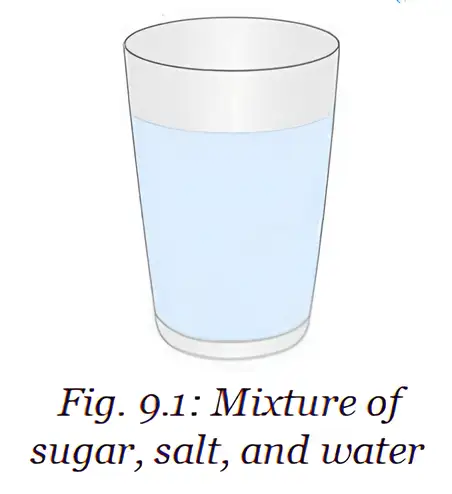
- Sugar and salt mixed with water form a uniform mixture.
- ORS tastes consistent from sip to sip because its components are evenly distributed.
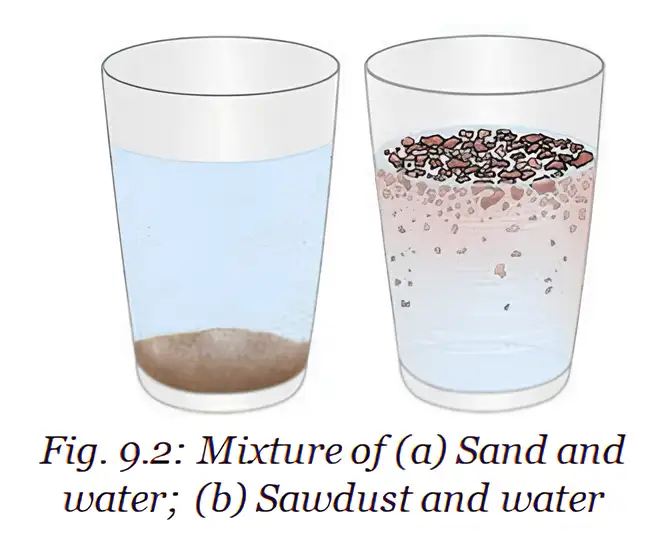
- Chalk powder, sand, and sawdust mixed with water form non-uniform mixtures.
- Sand settles in water; sawdust floats.
What Are Solute, Solvent, and Solution Part-1
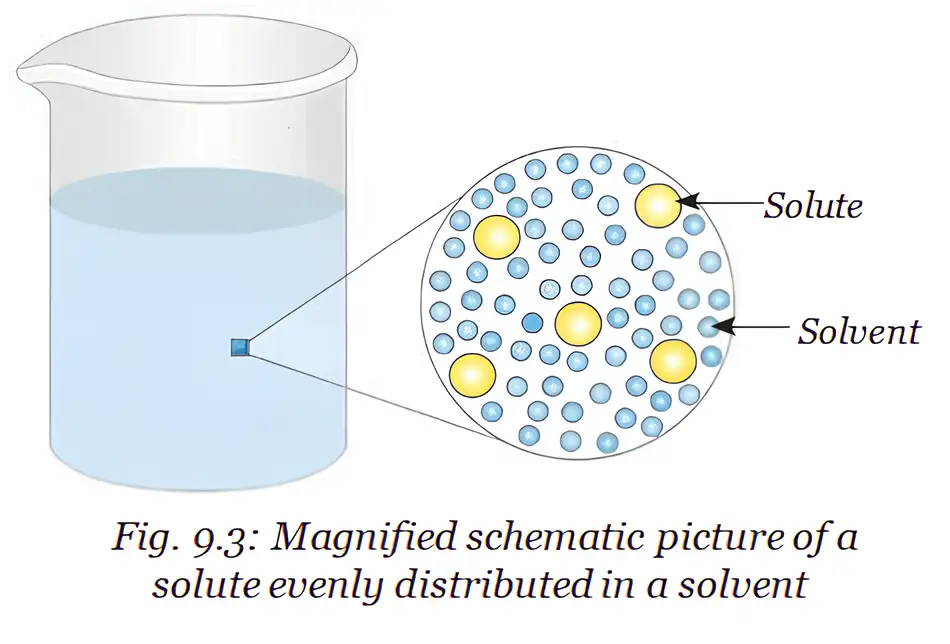
Solution, Solute, and Solvent
Solutions Made from Two Liquids
- Solute: In a mixture of two liquids, the substance present in the smaller amount is called the solute.
- Solvent: The liquid present in the larger amount is called the solvent.
Gaseous Solutions
- Air: It is a uniform solution of gases.
- Components: Nitrogen, present in the largest amount, is the solvent; oxygen, argon, carbon dioxide, and other gases are solutes.
Sugar Syrup: An Important Example
Do not always identify the solvent as the component in the larger amount: in a solid–liquid solution, the liquid is the solvent, as in sugar syrup.
Quick recap
- A solution is a uniform mixture.
- In a solid–liquid solution, the solid is the solute and the liquid is the solvent.
- For two liquids, the smaller-amount component is the solute and the larger-amount component is the solvent.
- Air is a gaseous solution; nitrogen is its solvent.
- In sugar syrup, sugar is the solute and water is the solvent, despite the greater amount of sugar.
What Are Solute, Solvent, and Solution Part-2
How Much Solute Can a Fixed Amount of Solvent Dissolve?
Saturation and Solubility
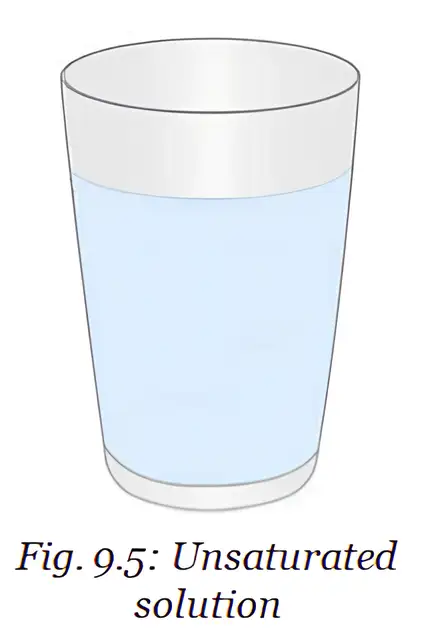
- Unsaturated solution: A solution that can dissolve more solute at a given temperature.
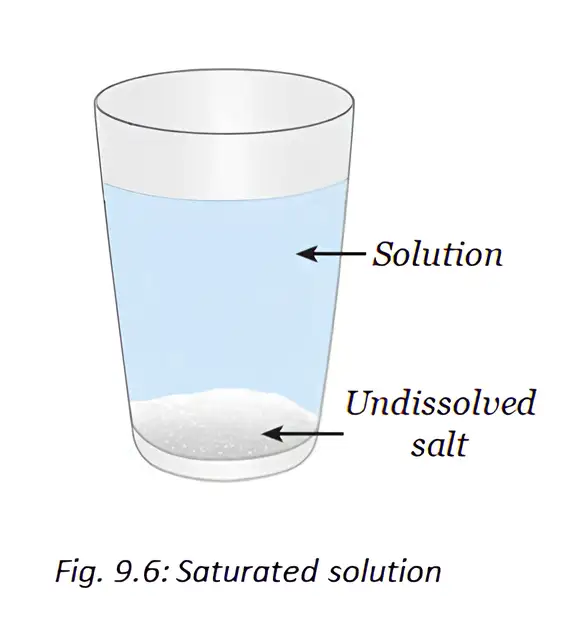
- Saturated solution: A solution that cannot dissolve more solute at a particular temperature; extra solute remains undissolved and may settle.
- Solubility: The maximum amount of solute that dissolves in a fixed quantity of solvent at a particular temperature.
- Example: Salt initially dissolves in water, but added salt eventually remains at the bottom when the solution becomes saturated.
Concentration of a Solution
Concentration — The amount of solute present in a fixed quantity of solution or solvent.
| Point | Dilute | Concentrated |
|---|---|---|
| Amount of solute | Less solute in a fixed quantity | More solute in a fixed quantity |
| Example | One spoon of salt in water is more dilute than two spoons in the same amount of water. | Four spoons of salt in 50 mL of water is more concentrated than two spoons in 100 mL. |
| Meaning | Relative term | Relative term |
Dilute/concentrated describe the relative amount of solute; unsaturated/saturated describe whether more solute can dissolve at a particular temperature.
Effect of Temperature on Solubility
Temperature and Dissolving
- General trend: For most substances, solubility increases as temperature increases.
- Baking soda example: Water at 50 °C dissolves more sodium hydrogen carbonate (baking soda) than at 20 °C; water at 70 °C dissolves more than at 50 °C.
- Effect on saturation: Heating a saturated solution can allow more solute to dissolve, so it behaves as an unsaturated solution at the higher temperature.
Solvents in Traditional Medicines
- Traditional systems: Ayurveda, Siddha, and other Indian systems have used water and hydro-alcoholic extracts to prepare medicinal formulations.
- Other solvents: Oils, ghee, and milk have also been used in drug formulations.
- Application: Solvents help prepare formulations and extract useful compounds from medicinal plants.
Asima Chatterjee and Medicinal Plants
- Research: Asima Chatterjee used solvents and solutions to extract and isolate compounds from medicinal plants while developing anti-epileptic and anti-malarial drugs.
- Recognition: She became the second Indian woman to earn a Doctorate of Science after Janaki Ammal, the first woman to receive the Shanti Swarup Bhatnagar Award in chemical science, and a Padma Bhushan recipient.
How does increasing temperature usually affect solubility?
What is the difference between a saturated and an unsaturated solution?
Quick recap
- Solubility is the maximum amount of solute that dissolves in a fixed quantity of solvent at a given temperature.
- Unsaturated solutions can dissolve more solute; saturated solutions cannot at that temperature.
- Concentration describes the amount of solute in a fixed quantity; dilute and concentrated are relative terms.
- For most substances, solubility increases with temperature; heating can let a saturated solution dissolve more.
- Water, hydro-alcoholic extracts, oils, ghee, and milk can act as solvents in traditional medicinal preparations.
- Asima Chatterjee used solvents and solutions to isolate medicinal plant compounds and develop anti-epileptic and anti-malarial drugs.
Solubility of Gases
Gases Dissolved in Water
Solubility of a gas — The solubility of a gas is the amount of that gas that can dissolve in a liquid.
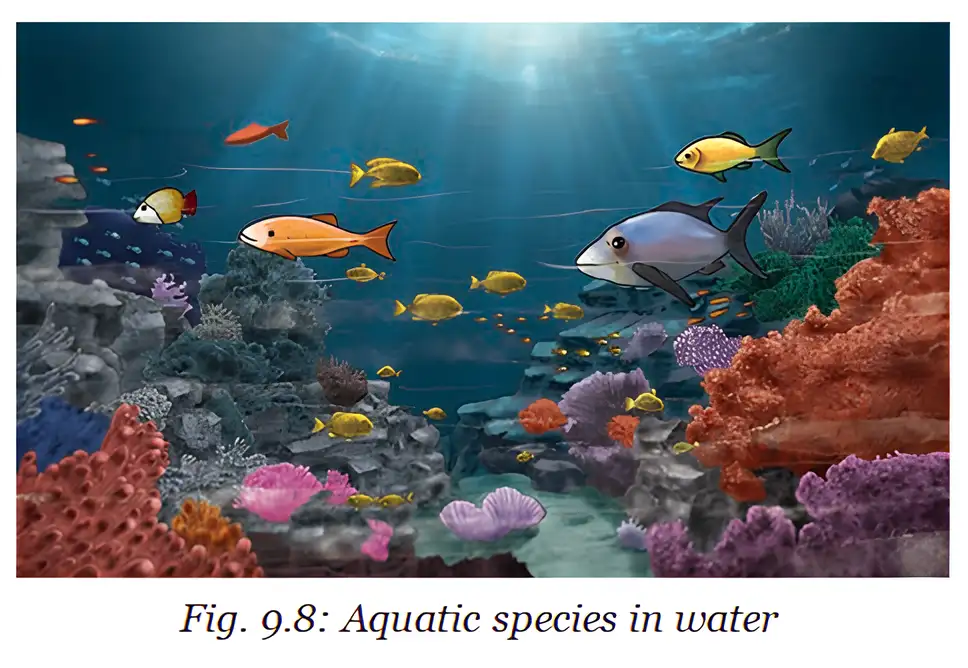
- Dissolving gases: Many gases, including oxygen, dissolve in water, though oxygen dissolves only in small amounts.
- Aquatic life: Dissolved oxygen sustains aquatic plants, fish and other organisms.
- Uniform mixture: Gases dissolved evenly in water form a solution; its components are not visible separately.
Effect of Temperature
- General trend: As the temperature of a liquid increases, the solubility of gases in it generally decreases.
- Cold water: More oxygen dissolves in cold water, helping provide aquatic life with sufficient oxygen.
- Warm water: Warming water lowers its oxygen solubility.
Uniform and Non-uniform Mixtures
| Point | Uniform mixture | Non-uniform mixture |
|---|---|---|
| Appearance | Components are evenly mixed and cannot be seen separately. | Components can be seen with the naked eye or a magnifying device. |
| Example | Gases dissolved evenly in water. | Sawdust in water or sand in water. |
- Different behaviour: Sawdust floats in water, while sand sinks to the bottom.
Why Objects Float or Sink
Density — Density is a property that describes the heaviness of an object.
- Density comparison: A wooden stick and an iron rod of the same size can have different heaviness; the iron rod feels much heavier because of its density.
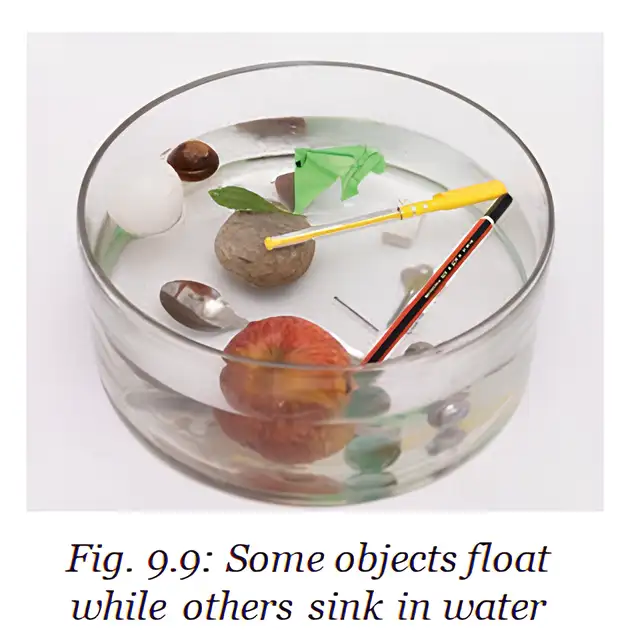
- Everyday examples: Rice sinks while husk floats in water; oil also floats on water.
- General idea: Objects considered lighter than a liquid tend to float, while those heavier tend to sink.
- Important qualification: Density is not the only factor that determines whether an object floats or sinks in a particular liquid.
How does temperature affect the solubility of gases in water?
What is density, and is it the only factor determining whether an object floats or sinks?
Quick recap
- Many gases dissolve in water; oxygen dissolves only in small amounts.
- Dissolved oxygen supports aquatic plants, fish and other organisms.
- Gas solubility in liquids generally decreases as temperature increases.
- Uniform-mixture components are not visible separately; non-uniform-mixture components can be seen with the naked eye or a magnifying device.
- Sawdust floats in water, while sand sinks; husk and oil also float, while rice sinks.
- Density describes an object's heaviness, but it is not the only factor affecting floating or sinking.
What Is Density Part-1
Understanding Density
Use mass and volume to calculate a substance’s density.
Density Units
- SI unit: Mass in kilograms and volume in cubic metres give density in kilograms per cubic metre, written as .
- Other units: Liquids are often measured in grams per millilitre () or grams per cubic centimetre ().
- Conversion: .
Using Water as a Density Reference
- Approximation: At room temperature, of water has a mass close to .
- Examples: Therefore, of water has a mass of about , and has a mass of about .
Relative density compares a substance’s density with the density of water at the same temperature; it has no units.
Comparing Oil with Water
- Example: If of oil has a mass of , its density is .
- Conclusion: Since this is less than water’s approximate density of , the oil is less dense than water.
Determining Density
Mass — Mass is the quantity of matter present in an object or substance.
Measuring Mass
- Instrument: A balance measures mass; a digital weighing balance displays the reading in grams or kilograms.
- Tare: Set the balance to zero before measuring. If using a container, place it on the balance and tare it before adding the object or liquid.
- Liquid samples: Measure liquid mass using a beaker, with the empty beaker’s mass removed by taring.
- Finding density: Measure an object's mass and volume, then use .
| Point | Mass | Weight |
|---|---|---|
| Meaning | Quantity of matter in an object | Force with which Earth attracts an object |
| Units | Gram (g) or kilogram (kg) | Newton (N) |
| Balance reading | Two-pan balances compare masses | Most other balances measure weight and display it in mass units |
Do not treat mass and weight as the same scientific quantity: mass is measured in grams or kilograms, while weight is a force measured in newtons.
Define density and state its SI unit.
How do mass and weight differ?
Quick recap
- Density is mass per unit volume: .
- Density is independent of shape and size, but depends on temperature and pressure; pressure mainly affects gases.
- The SI unit of density is ; common liquid units include and .
- Relative density compares a substance with water at the same temperature and has no unit.
- At room temperature, of water has a mass close to .
- Density is found by measuring mass and volume; mass and weight are different quantities.
What Is Density Part-2
Volume and Its Units
Volume — The volume of an object is the space it occupies.
- SI unit: The cubic metre, written as , is the volume of a cube with sides of .
- Smaller volumes: Volumes are often expressed in cubic decimetres () or cubic centimetres (); is also called .
- Liquid volumes: A tetra pack labelled contains of liquid. The litre () and millilitre () are common units.
| Conversion | Equivalent volume |
|---|---|
| Litre | |
| Millilitre |
Measuring Liquid Volume
Measuring cylinder — A measuring cylinder is a narrow, transparent cylindrical container, open at one end and closed at the other, with markings for measuring liquid volume.
- Capacity: The maximum volume a cylinder can measure is indicated by its markings; for example, a cylinder measures up to .
- Available sizes: Measuring cylinders come in capacities such as , , , , and larger.
- Smallest division: Divide the volume gap between two larger marks by the number of small divisions between them.
- Example: A gap divided into small divisions gives per division.
| Cylinder capacity | Smallest reading |
|---|---|
| or | |
Choosing a measuring cylinder
- Trade-off: A larger-capacity cylinder measures more in one go, but usually has larger divisions and lower precision.
- Example: To measure with a cylinder, measure and then .
- Best choice: A or cylinder can measure in one go but is less precise; a cylinder is a suitable balance.
Reading a Liquid Level
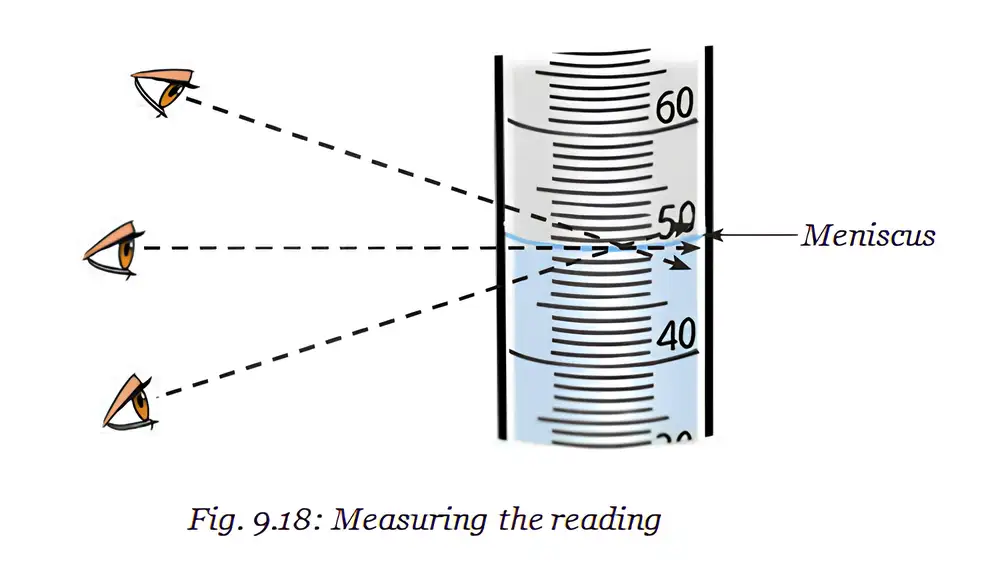
Meniscus — The curved surface formed by a liquid in a measuring cylinder is called the meniscus.
- Colourless liquids: Read the mark level with the bottom of the meniscus.
- Coloured liquids: Read the mark level with the top of the meniscus.
- Eye position: Keep your eyes level with the part of the meniscus being read to avoid an incorrect reading.
Volume of Regular-Shaped Solids
Cuboid volume — The volume of a cuboid is found by multiplying its length, width and height.
Use for regular-shaped solid objects with cuboid dimensions; the result is in cubic units.
Example
- Notebook: For length , width and height , volume is .
Volume of Irregular-Shaped Solids
- Challenge: An irregular solid, such as a stone, has no simple length–width–height formula, so its volume must be found to calculate its density.
Quick recap
- Volume is the space occupied by an object; its SI unit is .
- and .
- A measuring cylinder is a narrow, transparent, graduated container; its smallest division determines reading precision.
- Read the bottom of the meniscus for colourless liquids and the top for coloured liquids, with eyes level.
- Cuboid volume is ; irregular solids need another way to determine their volume.
What Is Density Part-3
Finding the Volume of an Irregular Solid
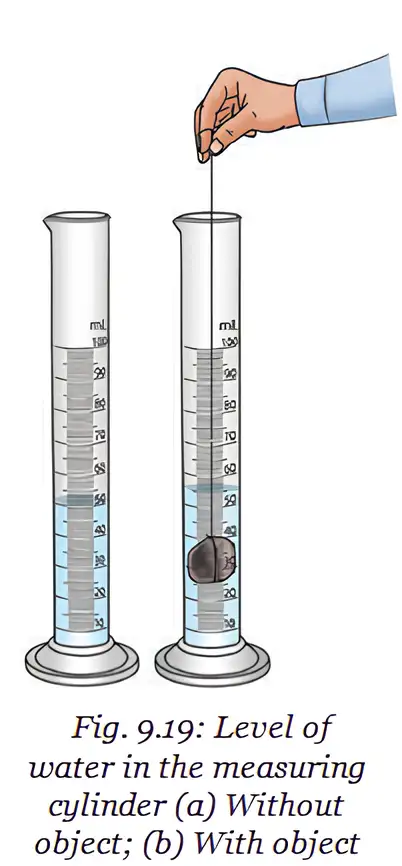
Water displacement method — The volume of an irregular solid is measured by how much the water level rises when the object is submerged.
- Measure: Record the water volume before and after submerging the object.
- Calculate: The difference between the final and initial readings is the object's volume.
- Units: .
Use this for an irregularly shaped object.
| Initial water volume | Final water volume | Volume of stone |
|---|---|---|
Calculating Density
Density — Density is the mass of a substance per unit volume.
Divide an object's mass by its volume.
Example
- Calculation: For a mass of and volume of , density is .
Density Inside the Earth
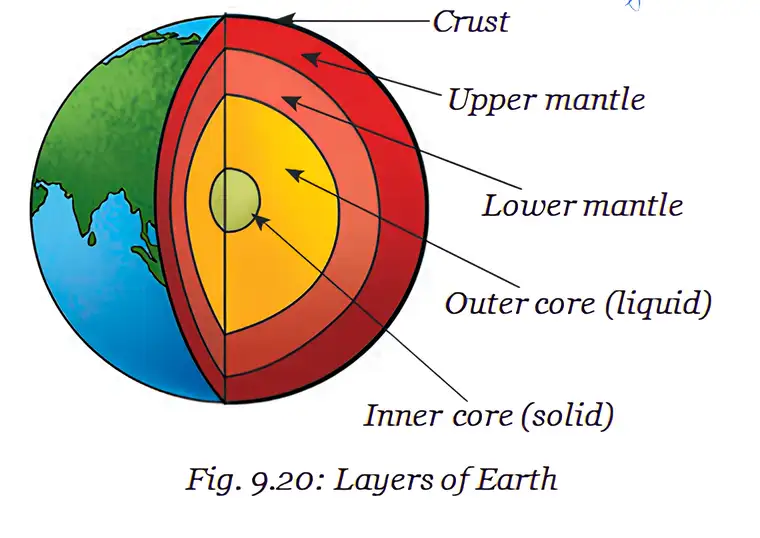
- Layers: Earth has the crust, upper mantle, lower mantle, outer core, and inner core.
- Density trend: The crust is the lightest layer; density increases towards Earth's centre.
- Reason: Pressure and temperature rise deeper inside Earth, making materials heavier and more compact.
- Core: The outer core is liquid, while the inner core is solid.
Materials That Float
- Bamboo: It is light and hollow, so it floats easily and can be tied into rafts.
- Wood: Logs can be used as rafts or hollowed out to make boats.

Effect of Temperature on Density
- Heating: Particles generally spread farther apart, increasing volume while mass stays the same; density decreases.
- Cooling: Density generally increases as a substance cools.
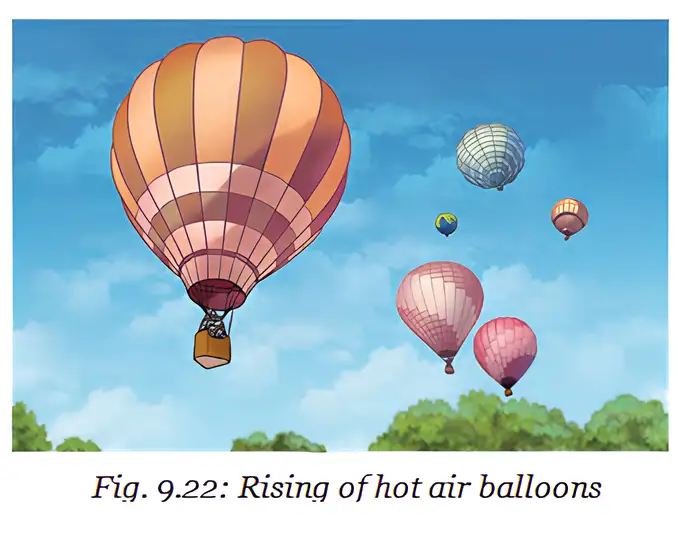
- Hot air: It is less dense than surrounding cool air, so it rises; hot-air balloons use this principle.
Effect of Pressure on Density
| State | Effect of increased pressure | Effect on density |
|---|---|---|
| Gas | Particles move closer; volume decreases. | Density increases. |
| Liquid | Nearly incompressible; pressure has little effect. | Only a small change. |
| Solid | Particles are already very close; solids are affected even less than liquids. | Change is usually negligible. |
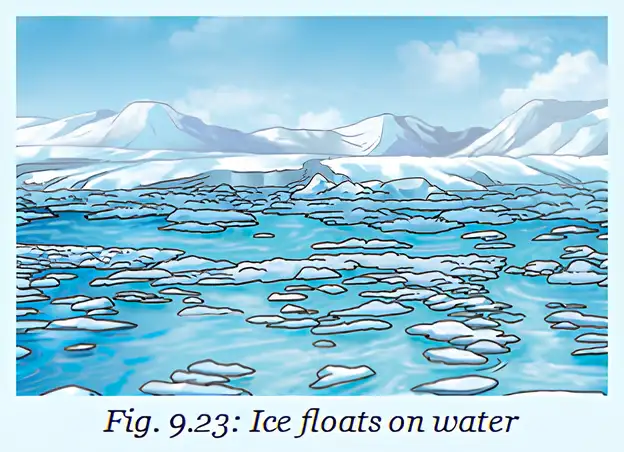
Why Ice Floats on Water
Freezing and density
- At : Water has its highest density.
- At : As water freezes, its particles arrange into a structure that occupies more space.
- Result: The same mass in a larger volume has lower density, so ice is less dense than liquid water and floats.
- Benefit: Floating ice forms a surface layer that helps keep water below warm enough for aquatic animals to survive.
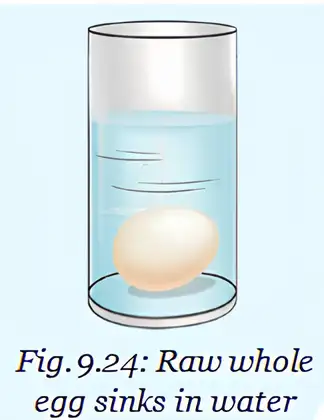
Density and Floating: The Egg Example
- Observation: A raw whole egg sinks to the bottom in tap water.
- Making it float: Dissolving salt in the water increases its density; the egg can float when the salt solution is denser than the egg.
- Concept: Density helps explain why some objects sink while others float.
How can the volume of an irregular solid be measured?
Why does ice float, and how does this help aquatic life?
What can be added to water to help a raw egg float?
Quick recap
- An irregular solid's volume equals the rise in water volume when submerged.
- Density is mass divided by volume: .
- Heating generally increases volume and lowers density; cooling generally increases density.
- Increasing pressure raises gas density but has little effect on liquids and usually a negligible effect on solids.
- Earth's density increases towards its centre; the crust is the lightest layer.
- Water is densest at ; ice is less dense than liquid water and floats.
Snapshots
Solutions, Solutes, and Solvents
- Solution: A uniform mixture formed when two or more substances mix.
- Solute and solvent: In a solid–liquid solution, the solid is the solute and the liquid is the solvent.
- Two liquids: The component in the smaller amount is the solute; the one in the larger amount is the solvent.
Saturated and Unsaturated Solutions
- Unsaturated solution: More solute can dissolve in it at a given temperature.
- Saturated solution: It contains as much solute as can dissolve at that temperature; any extra solute remains undissolved.
Solubility and Temperature
- Solubility: The maximum amount of solute that dissolves in a fixed quantity of solvent at a particular temperature.
- Temperature: For most solids, solubility in liquids increases as temperature rises; gas solubility generally decreases.
Mass, Volume, and Density
Calculate density by dividing mass by volume.
Factors Affecting Density
- Temperature: Density generally decreases as temperature increases.
- Pressure: Its effect on density differs according to the state of matter.
Quick recap
- A solution is a uniform mixture; its components are called solute and solvent.
- For a solid dissolved in a liquid, the solid is the solute; for two liquids, the lesser component is the solute.
- Saturated solutions cannot dissolve more solute at that temperature; unsaturated solutions can.
- Solubility is the maximum amount of solute that dissolves in a fixed quantity at a particular temperature.
- With increasing temperature, solids generally become more soluble in liquids, while gases become less soluble.
- Mass is measured with a weighing balance; volume is measured with a measuring cylinder.
- Density is mass per unit volume and generally decreases as temperature rises.
Science — ALL CHAPTERS
1
Exploring the Investigative World of Science
2
The Invisible Living World: Beyond Our Naked Eye
3
Health: The Ultimate Treasure
4
Electricity: Magnetic and Heating Effects
5
Exploring Forces
6
Pressure, Winds, Storms, and Cyclones
7
Particulate Nature of Matter
8
Nature of Matter: Elements, Compounds, and Mixtures
9
The Amazing World of Solutes, Solvents, and Solutions
10
Light: Mirrors and Lenses
11
Keeping Time with the Skies
12
How Nature Works in Harmony
13
Our Home: Earth, a Unique Life Sustaining Planet