Class 8 . Science . Curiosity . Particulate Nature of Matter
Chapter 7: Particulate Nature of Matter
Ch 7
Science
Class 8
Introduction
How Rocks Break Down
From Mountain Rocks to Fine Grains
- Mountain rocks break down through erosion.
- Rivers carry the pieces and break them down further.
- Pebbles and stones become sand and clay grains.
- Rivers transport these materials to the plains.
Quick recap
- Erosion gradually breaks down rocks.
- Rivers carry eroded rock pieces and cause further breakdown.
- Rock pieces can become pebbles, stones, sand and clay grains.
- Rivers transport these materials from mountains to plains.
What Is Matter Composed of
Breaking Matter into Smaller Units
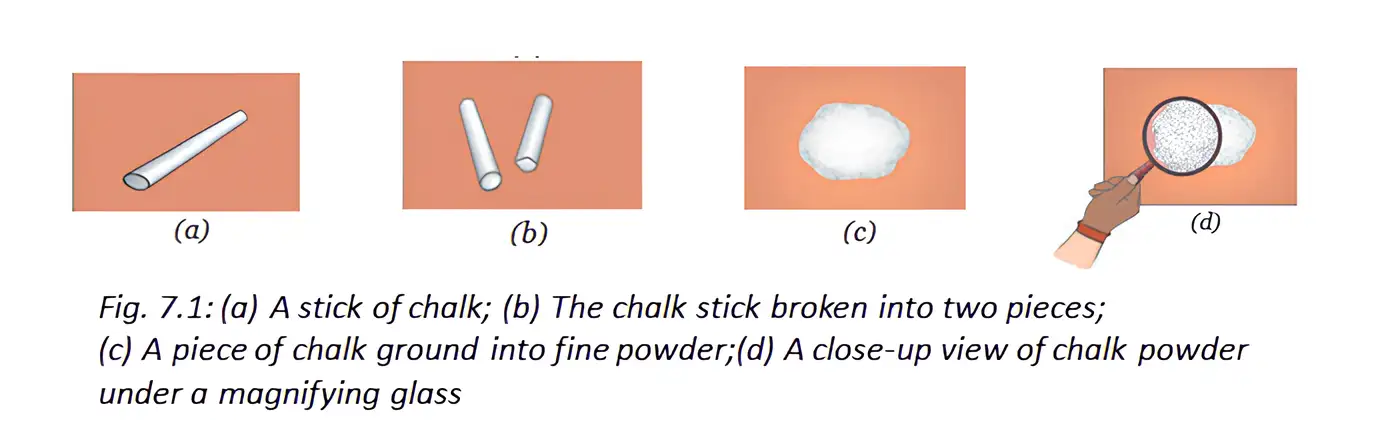
Matter Is Made of Tiny Particles
- Constituent particles: Matter is made up of extremely small particles that form the basic units of substances.
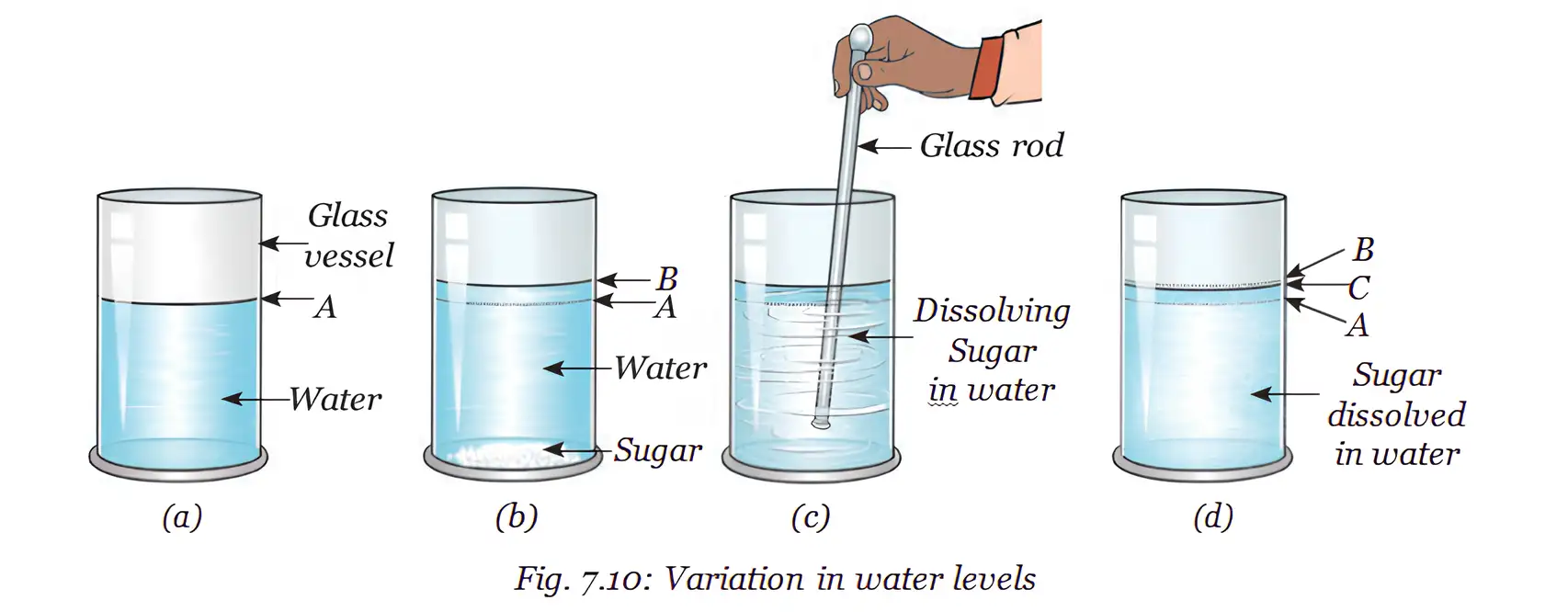
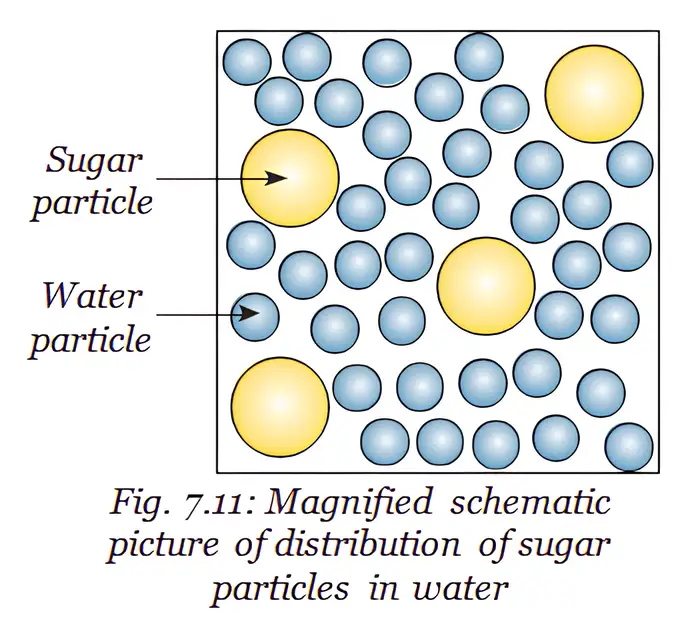
- Evidence: Dissolved sugar remains in water even when its particles can no longer be seen, as its sweetness can still be tasted.
Interparticle Spaces
What does dissolving sugar in water show about matter?
Why is grinding chalk a physical change?
Quick recap
- Matter is made of many extremely small particles.
- A constituent particle is a basic unit that makes up a larger piece of a substance.
- Grinding chalk makes smaller specks but does not produce a new substance.
- Dissolved sugar remains present even when its particles cannot be seen.
- Sugar particles occupy spaces between water particles; these spaces are interparticle spaces.
What Decides Different States of Matter Part-1
Interparticle Attractions
Interparticle attractions — The attractive forces that hold the constituent particles of matter together.
What affects their strength?
- Depends on: The nature of the substance and the distance between its particles.
- Distance effect: Even a small increase in interparticle distance can greatly weaken the attraction.
- State of matter: The strength of these attractions helps determine whether a substance is solid, liquid or gas.
Solid State
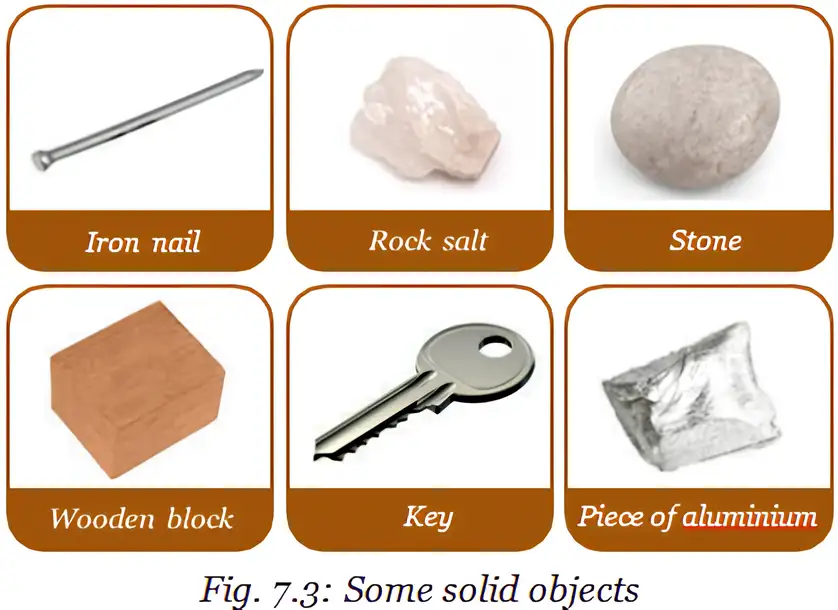
Particle arrangement and properties
- Packing: Solid particles are tightly packed, with very strong attractions between them.
- Shape and volume: Solids have a definite shape and a definite volume.
- Motion: Particles remain in fixed positions and vibrate or oscillate about those positions; they cannot move past one another.
Melting and Melting Point
How a solid melts
- Heating: Solid particles vibrate more vigorously as the solid is heated.
- Melting: When vibrations become strong enough, particles leave their fixed positions; the solid changes into a liquid.
- Attraction: During melting, the attractions holding particles in fixed positions are overcome enough for particles to move past one another.
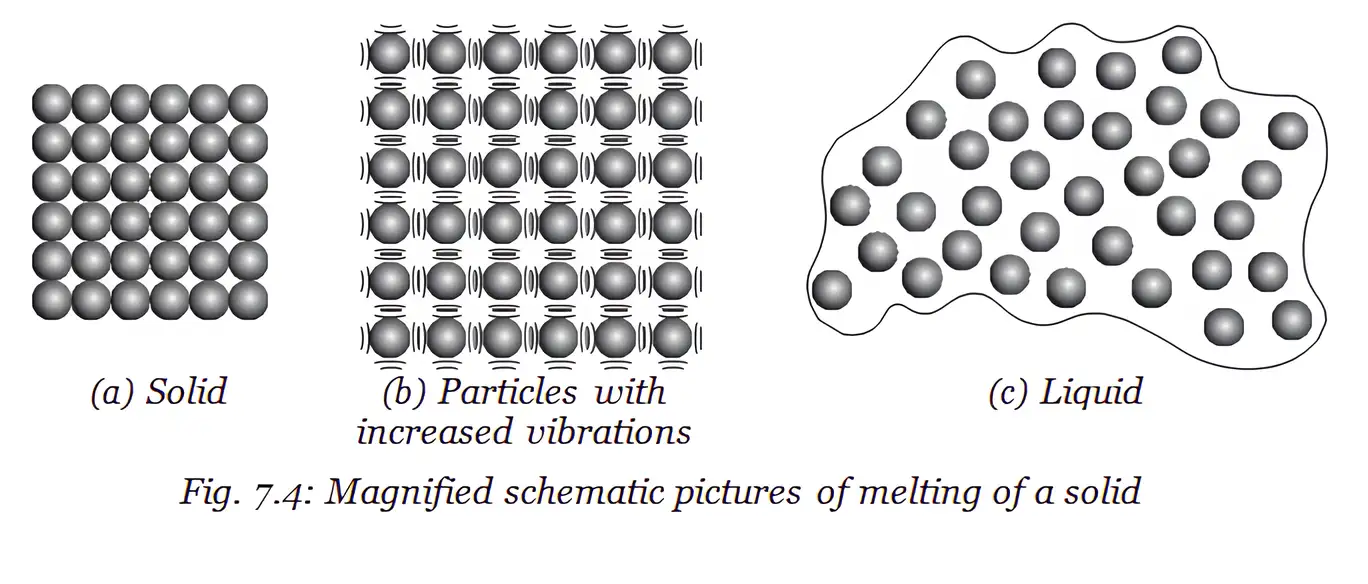
Melting point — The minimum temperature at which a solid melts into a liquid at atmospheric pressure.
Melting-point patterns
- Particle spacing: In most substances, liquid particles are somewhat farther apart than solid particles.
- Exception: Ice has particles farther apart than liquid water.
- Attraction and melting point: Weaker interparticle attractions generally mean a lower melting point; stronger attractions generally mean a higher melting point.
| Material | Melting point |
|---|---|
| Ice | |
| Urea | |
| Iron |
Why do solids have a definite shape and volume?
Define the melting point of a solid.
Quick recap
- Interparticle attractions depend on the substance and the distance between its particles.
- Solid particles are tightly packed and held in fixed positions by strong attractions.
- Particles in a solid vibrate about their fixed positions but do not move past one another.
- Heating increases particle vibrations until the solid melts into a liquid.
- Melting point is the minimum temperature at which a solid melts at atmospheric pressure.
- Stronger attractions generally correspond to higher melting points; ice is an exception to the usual solid–liquid spacing pattern.
What Decides Different States of Matter Part-2
Liquid State
- Shape and volume: Liquids take the shape of their container but have a definite volume.
- Particle attraction: Liquid particles move within a limited space and are held together by attractions weaker than those in solids.
Boiling and Evaporation
- Boiling point: The temperature at which a liquid boils and changes into vapour at atmospheric pressure.
- Boiling: Vapour forms rapidly throughout the liquid, producing bubbles.
- Evaporation: Vapour forms slowly at the liquid’s surface and can occur below the boiling point.
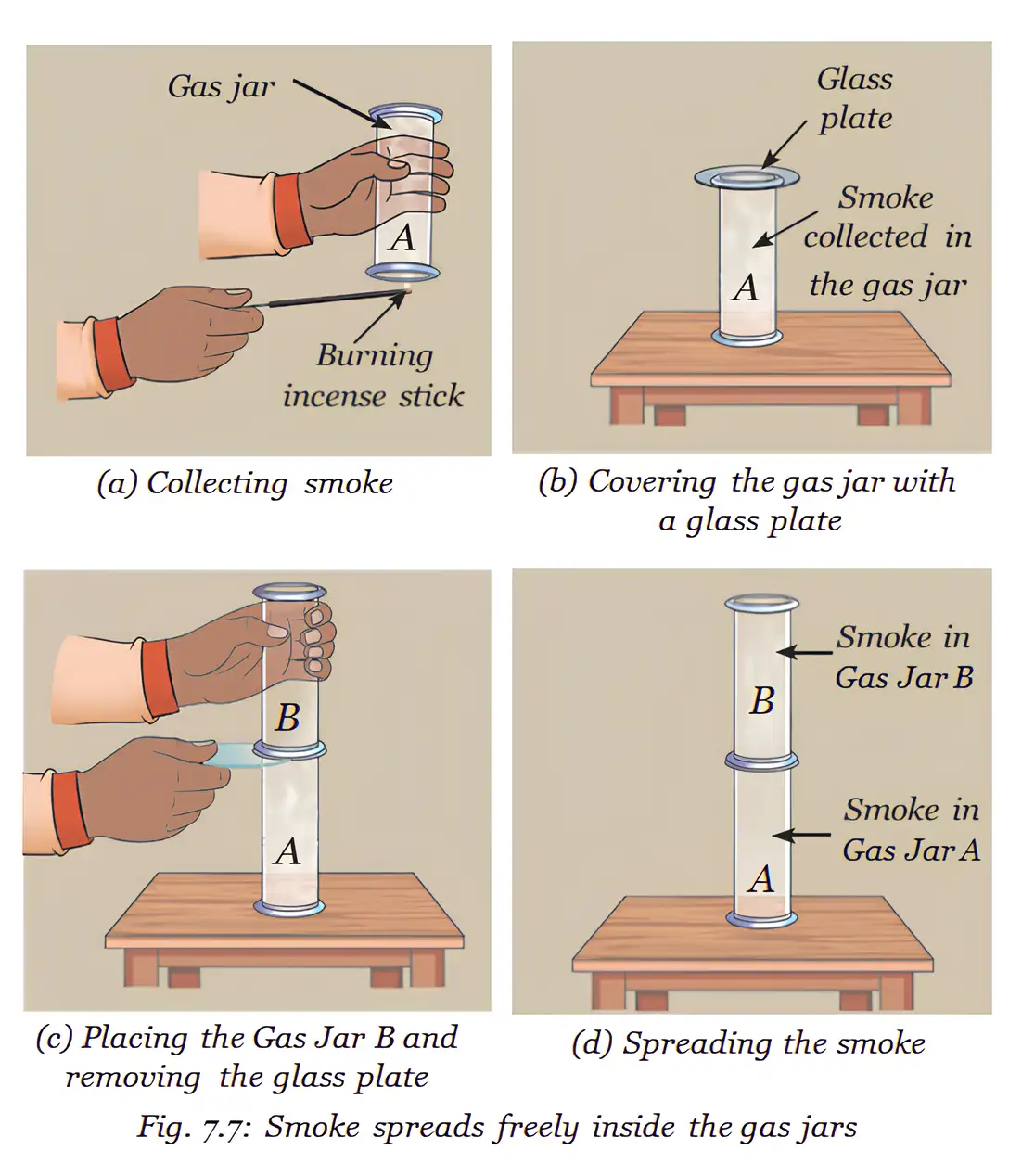
Gaseous State
How do boiling and evaporation differ?
Why do gases have no fixed shape or volume?
Quick recap
- Liquids have a definite volume but take the shape of their container.
- Liquid particles move within limited space and are held close by attractions weaker than those in solids.
- Boiling forms vapour rapidly throughout a liquid at its boiling point; evaporation occurs slowly at the surface at any temperature.
- Gases have no fixed shape or volume and fill the available space.
- Gas particles move freely in all directions, with negligible attractions.
- Liquids and gases flow and are classified as fluids.
How Does the Interparticle Spacing Differ in the Three States of Matter
Interparticle Spacing and Compressibility
Gases
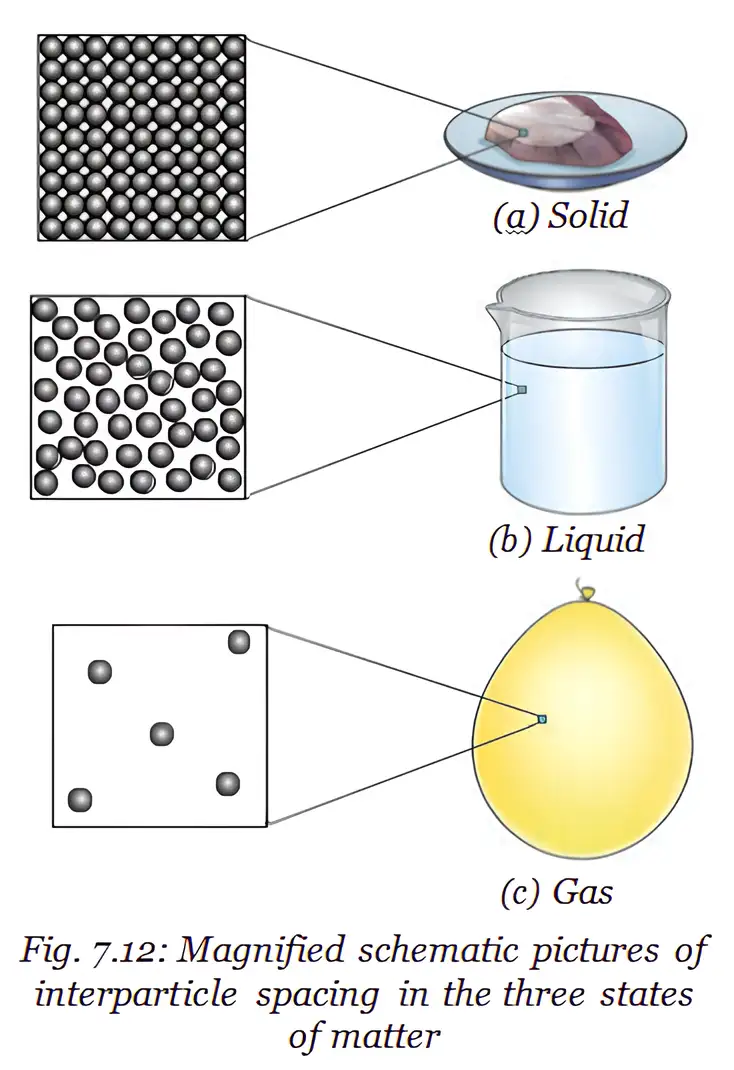
- Large spaces: Gas particles have considerable space between them in their natural state.
- Compression: External pressure pushes gas particles closer, reducing the gas volume.
- Expansion: When pressure is released, particles spread out again; the gas can push a plunger back.
- Example: Air in a closed syringe becomes smaller in volume when its plunger is pushed.
Liquids
- Some spacing: Liquid particles have spaces between them, though these are much smaller than in gases.
- Practically incompressible: Water shows almost no decrease in volume when pressure is applied.
- Dissolving: Dissolved sugar particles can occupy spaces between water particles, so the solution volume can be less than the sum of the separate volumes.
- Insoluble solids: Sand does not dissolve; its particles settle and occupy space, increasing the total volume.
Interparticle Spacing in Solids
- Close packing: Strong forces of attraction hold solid particles closely together.
- Fixed positions: Solid particles do not move from place to place.
- Small spaces: Some space remains between solid particles, but it is empty—not filled with air.
Comparison of Particle Spacing
| State | Interparticle spacing | Compressibility |
|---|---|---|
| Solid | Very small; particles are closely packed | Very low |
| Liquid | Some space; particles are less closely packed than in solids | Very low; practically incompressible |
| Gas | Large spaces between particles | High; volume decreases under pressure |
- Particle meaning: In this topic, a particle means a tiny constituent of matter, such as an atom or molecule.
- SPM: Suspended Particulate Matter refers to tiny dust particles suspended in air; each dust particle itself contains many constituent particles.
Quick recap
- Gas particles have large spaces between them and can be compressed.
- Releasing pressure lets compressed gas particles spread out again.
- Liquids have some interparticle spaces but are practically incompressible.
- Dissolved sugar can occupy spaces between water particles, reducing the combined volume.
- Solid particles are closely packed by strong attraction, with small empty spaces between them.
- Sand does not dissolve in water and increases the total volume when added.
How Particles Move in Different States of Matter
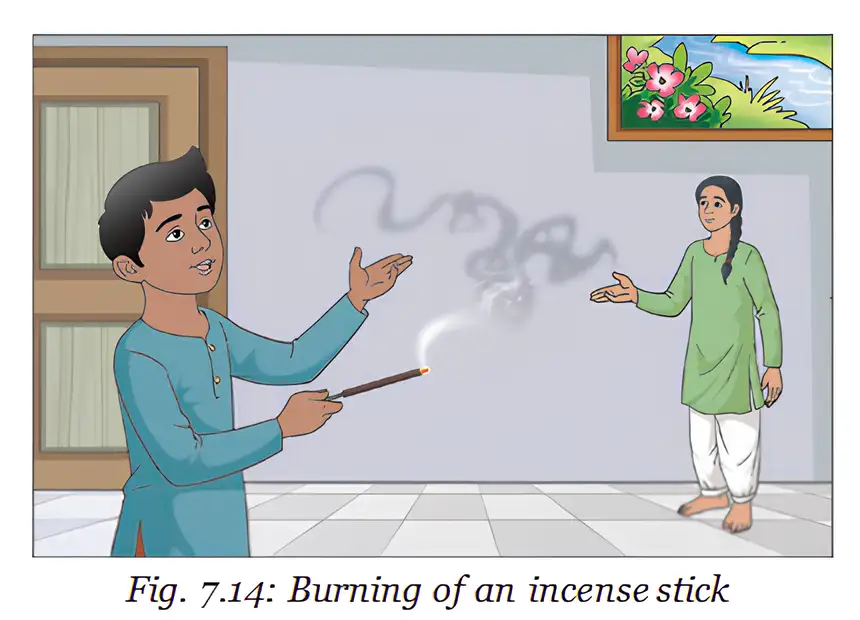
Particles Are in Constant Motion
Effect of Heat on Particle Movement
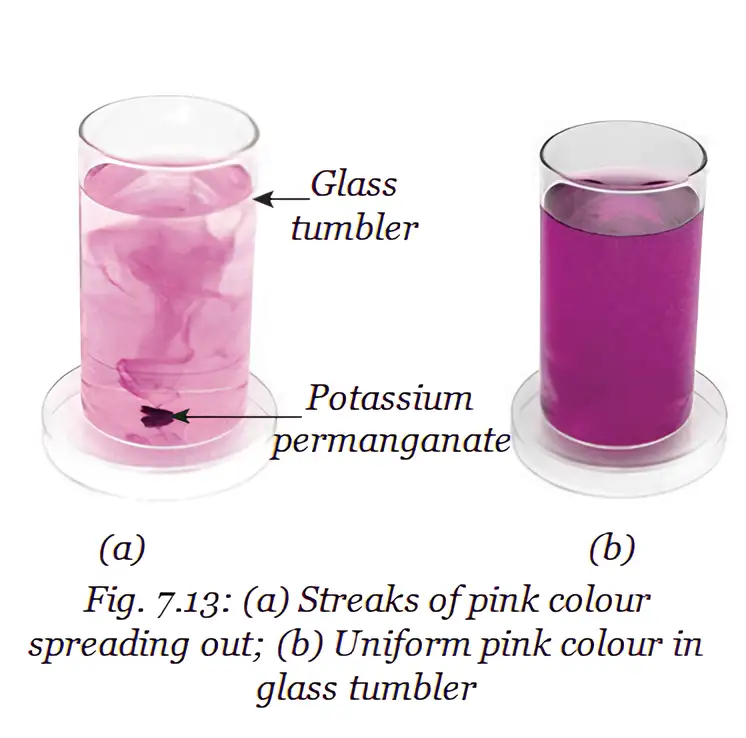
- Heating: Adding heat increases the motion of particles; for example, potassium permanganate spreads faster through hot water than through cold water.
- Thermal energy: It affects particle motion and the balance between particles’ energy and their attractive forces, helping determine the state of matter.
Movement of Gas Particles
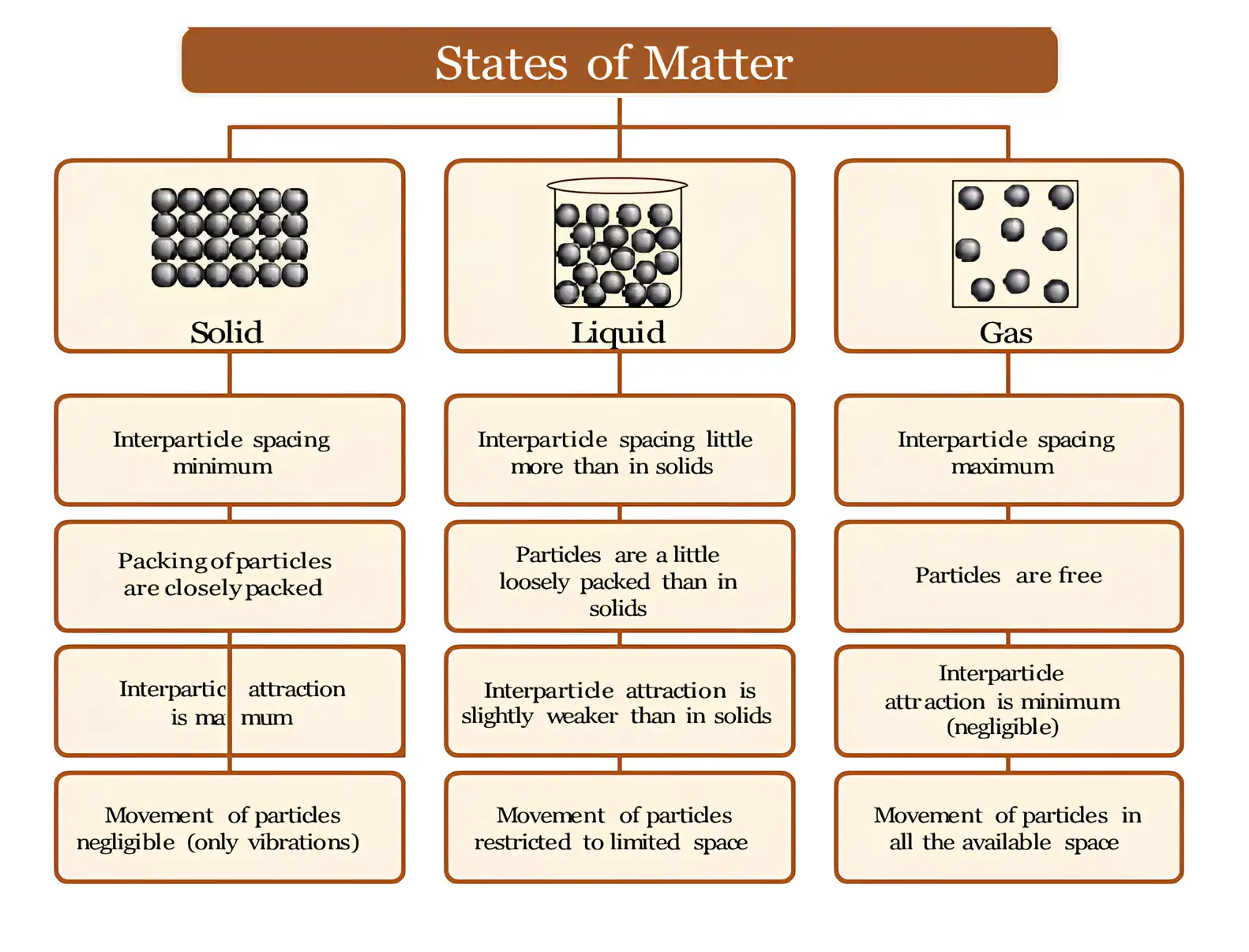
Thermal Energy, Attraction, and States of Matter
| State | Particle spacing and attraction | Particle movement |
|---|---|---|
| Solid | Close together; strong attraction | Small vibrations around fixed positions |
| Liquid | Slightly farther apart; weaker attraction | Move around within a limited space |
| Gas | Far apart; attraction is overcome | Move freely in all directions |
Quick recap
- Particles in matter are in constant motion.
- Diffusion is the spreading of particles through another substance.
- Higher temperature makes particles move faster and diffusion happen faster.
- Solid particles mainly vibrate; liquid particles move around within limited space.
- At melting, added thermal energy helps particles leave fixed positions.
- Gas particles have enough energy to overcome attraction and move freely in all directions.
Snapshots
Particles and interparticle attraction
Key ideas
- Matter is made of extremely small particles.
- Interparticle attraction holds the particles together; its strength differs between states of matter.
- Strength order: solids > liquids > gases.
How particle arrangement affects the states
| State | Attraction and spacing | Particle movement | Shape and volume |
|---|---|---|---|
| Solid | Strongest attraction; minimum particle spacing | Particles do not move freely | Fixed shape and size |
| Liquid | Attraction weaker than in solids; more spacing | Particles move within a particular space | Definite volume, but no fixed shape |
| Gas | Attraction is negligible; maximum spacing | Particles move freely from place to place | No fixed shape or volume |
From particle properties to observable form
- Strong attraction + little spacing + restricted movement → solids keep a fixed shape and size.
- Weaker attraction + some movement → liquids keep a definite volume but take the shape of their container.
- Negligible attraction + free movement + maximum spacing → gases have neither fixed shape nor fixed volume.
Do not confuse shape with volume: a liquid has no fixed shape, but it does have a definite volume.
Quick recap
- Matter consists of extremely small particles held together by interparticle attraction.
- Attraction is strongest in solids, weaker in liquids and negligible in gases.
- Solids have minimum particle spacing and a fixed shape and size.
- Liquids flow within a particular space, so they have a definite volume but no fixed shape.
- Gas particles move freely and have maximum spacing; gases have no fixed shape or volume.
Science — ALL CHAPTERS
1
Exploring the Investigative World of Science
2
The Invisible Living World: Beyond Our Naked Eye
3
Health: The Ultimate Treasure
4
Electricity: Magnetic and Heating Effects
5
Exploring Forces
6
Pressure, Winds, Storms, and Cyclones
7
Particulate Nature of Matter
8
Nature of Matter: Elements, Compounds, and Mixtures
9
The Amazing World of Solutes, Solvents, and Solutions
10
Light: Mirrors and Lenses
11
Keeping Time with the Skies
12
How Nature Works in Harmony
13
Our Home: Earth, a Unique Life Sustaining Planet