Class 11 Humanities . Economics . Statistics For Economics . Collection of Data
Chapter 2: Collection of Data
Ch 2
Economics
Class 11 Humanities
Introduction

Meaning and purpose of data
Data — Values gathered to provide information and help understand a problem or reach a sound solution.
- Variable: A characteristic whose values vary; variables are often represented by , or .
- Observation: Each value recorded for a variable is an observation.
- Example: Food-grain production in India varies across years, from 108 million tonnes in 1970–71 to 272 million tonnes in 2016–17.
| Year () | Production (), million tonnes |
|---|---|
| 1970–71 | 108 |
| 1978–79 | 132 |
| 1990–91 | 176 |
| 1997–98 | 194 |
| 2001–02 | 212 |
| 2015–16 | 252 |
| 2016–17 | 272 |
Sources of data
| Point | Primary Data | Secondary Data |
|---|---|---|
| Meaning | First-hand information collected directly by the researcher through an enquiry. | Data already collected and processed—scrutinised and tabulated—by another agency. |
| Sources | Direct enquiries, such as asking students about a film star's popularity. | Published sources such as government reports, documents, newspapers and books, or sources such as websites. |
| Use | Primary for the person or agency that first collects and processes it. | Secondary for later users; reusing another researcher's published data makes it secondary. |
| Practical point | Requires the researcher to collect the information. | Using it can save time and cost. |
Survey as a method of data collection
Survey — A method of gathering information from individuals, usually by asking questions.
- Purpose: Surveys collect information about characteristics of a product, candidate or other subject.
- Product examples: Price, quality and usefulness.
- Candidate examples: Popularity, honesty and loyalty.
- Typical use: Manufacturers may survey consumers about a product; political parties may ask people about a candidate.
- Data
- Collected values that provide information about a subject or problem.
- Variable
- A characteristic that can take different values.
- Observation
- One recorded value of a variable.
- Survey
- A way to gather information from individuals, commonly by asking questions.
What is the difference between primary and secondary data?
What is a survey, and what is its purpose?
Quick recap
- Data provide information to understand problems and support sound solutions.
- A variable can take different values; each recorded value is an observation.
- Primary data are collected first-hand; secondary data are previously collected and processed by another agency.
- Secondary data can come from reports, documents, newspapers, books and websites, and may save time and cost.
- A survey gathers information from individuals, often by asking questions about relevant characteristics.
Preparation of Instrument
Questionnaire and Interview Schedule
- Survey instrument: A questionnaire or interview schedule is used to collect information from respondents.
- Administration: Respondents may complete it themselves, or a researcher or trained investigator may ask the questions.
Guidelines for Preparing Questions
| Poor question | Better question | Principle |
|---|---|---|
| Is an increase in electricity charges justified? | First ask whether electricity supply is regular in the locality; then ask whether an increase in charges is justified. | Move from general to specific. |
| What percentage of your income do you spend on clothing in order to look presentable? | What percentage of your income do you spend on clothing? | Be precise and neutral. |
| Do you spend a lot of money on books in a month? | How much do you spend on books in a month? Offer clear spending ranges. | Avoid vague terms and make answers easy to select. |
| How do you like the flavour of this high-quality tea? | How do you like the flavour of this tea? | Do not lead the respondent. |
Types of Questions
| Point | Open-ended (unstructured) | Closed-ended (structured) |
|---|---|---|
| Structure | Respondents answer in their own words; no fixed answer choices are given. | Respondents choose from options provided in advance. |
| Example | What is your view about globalization? | Why did you sell your land? Options may include paying debts, funding children’s education, investing in another property, or “Any other.” |
| Advantage | Allows individualised responses. | Easy to use, score and code for analysis. |
| Limitation | Responses vary widely, making interpretation and scoring difficult. | Options may omit the true answer or restrict responses; alternatives must clearly cover both sides of the issue. |
| Type | Answer choices | Example |
|---|---|---|
| Two-way question | Only two possible answers, usually Yes or No. | Do you think smoking should be prohibited? Yes / No. |
| Multiple-choice question | More than two possible answers. | Why did you sell your land? Choose a listed reason or select “Any other” and specify. |
Using Answer Options
- “Any other” option: Include it when respondents may have answers the researcher did not anticipate.
- Limitation of fixed choices: Given alternatives can restrict answers; respondents may have responded differently without them.
Distinguish between open-ended and closed-ended questions.
Quick recap
- Questionnaires and interview schedules are common survey instruments; questionnaires may be self-administered or interviewer-administered.
- Keep questions short, simple, precise and clear, and arrange them from general to specific.
- Avoid double negatives, ambiguous or leading wording, and questions that suggest limited alternatives.
- Open-ended questions are unstructured and allow individualised responses, but are harder to interpret and score.
- Closed-ended questions are structured; they may be two-way or multiple-choice and are easier to score and code.
- Offer “Any other” when needed, while remembering that fixed choices can restrict responses.
Mode of Data Collection
Modes of data collection — The three basic modes are personal interviews, mailed questionnaire surveys and telephone interviews.
Personal Interviews
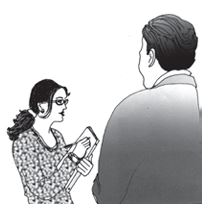
Personal interview — A face-to-face method used when the researcher has access to all members; the investigator meets respondents and asks questions.
Advantages and limitations
- Advantages: Personal contact lets the interviewer explain the study, clarify questions and ask respondents to expand important answers.
- Advantages: Misunderstandings can be reduced; the interviewer can observe reactions and gain supplementary information.
- Advantages: Usually has the highest response rate; allows all question types, especially open-ended questions.
- Disadvantages: It is the most expensive mode, requiring trained interviewers, and takes more time.
- Disadvantages: The interviewer's presence may influence or inhibit respondents, affecting what they say.
Mailed Questionnaire Surveys
Mailed questionnaire survey — A questionnaire is sent to each person by mail, with a request to complete and return it by a specified date.
Advantages and limitations
- Advantages: It is the least expensive method and can reach people in remote areas who are difficult to contact in person or by telephone.
- Advantages: There is no interviewer to influence respondents; respondents can take time to give thoughtful answers.
- Advantages: It can maintain anonymity and is useful for sensitive questions.
- Disadvantages: Questions or instructions cannot easily be explained, so respondents may misunderstand them.
- Disadvantages: Responses may be delayed or absent; questionnaires can be returned incomplete or lost in the mail.
- Disadvantages: It cannot be used effectively with illiterate respondents, and the interviewer cannot observe reactions.
Online and SMS surveys
- Current forms: Online surveys and surveys conducted through short messaging services (SMS) are also popular.

Telephone Interviews
Telephone interview — A method in which the investigator asks respondents questions over the telephone.
Advantages and limitations
- Advantages: It costs less than personal interviews and can be completed more quickly.
- Advantages: The investigator can clarify questions; it may suit respondents reluctant to answer sensitive questions face-to-face.
- Advantages: It generally has a relatively high response rate and may involve less influence than a personal interview.
- Disadvantages: Access is limited because some people do not own or have access to a telephone.
- Disadvantages: The investigator cannot observe respondents' reactions; the method has limited use and can still influence answers.

Pilot Survey
Pilot survey (pre-testing) — A small-scale try-out of a prepared questionnaire before conducting the actual survey.
Purpose
- Questionnaire: Identifies shortcomings in questions and checks whether they are suitable and clear.
- Instructions: Checks whether respondents can understand the directions.
- Fieldwork: Assesses enumerators' performance and estimates the time and cost of the full survey.
- Planning: Provides a preliminary idea of how the main survey is likely to work.
| Point | Personal interview | Mailed questionnaire | Telephone interview |
|---|---|---|---|
| Cost and time | Most expensive; most time-taking | Least expensive; long response time | Relatively low cost; quicker |
| Clarification | Questions can be explained | Ambiguous questions cannot be explained | Questions can be clarified |
| Respondent influence | Interviewer may influence respondents | No interviewer influence | Relatively less influence, but possible |
| Reach and access | Requires face-to-face access | Can reach remote areas | Limited to people with telephone access |
| Other features | Highest response rate; all question types; reactions can be observed | Anonymity; useful for sensitive questions; unsuitable for illiterate respondents; reactions cannot be observed | Relatively high response rate; reactions cannot be observed |
- Respondent
- A person who provides answers in a survey.
- Questionnaire
- A prepared set of questions used to collect survey information.
- Enumerator
- A person who collects survey information from respondents.
- Pilot survey
- A small preliminary survey used to test the questionnaire and survey arrangements.
Which mode is suitable for reaching a respondent in a remote village, and why?
What problem may arise if a school principal is present while parents are interviewed about teaching quality?
Quick recap
- The three modes are personal interviews, mailed questionnaires and telephone interviews.
- Personal interviews allow clarification and observation but are costly and time-consuming; they are used when the researcher can access all members.
- Mailed surveys are inexpensive and reach remote areas, but may have low response rates and unclear answers.
- Telephone interviews are relatively quick and low-cost, but require telephone access and do not reveal reactions.
- A pilot survey pre-tests questions, instructions, enumerators, cost and time before the main survey.
Census And Sample Surveys
Census or Complete Enumeration
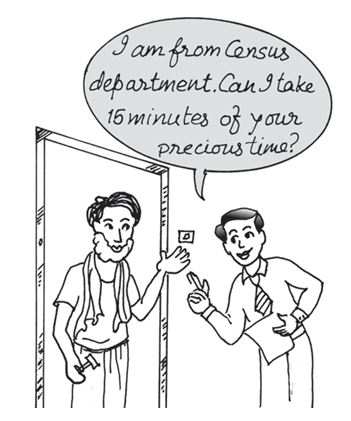
Census (complete enumeration) — A survey that collects information from every element of the population under study.
- India’s census: Conducted every ten years through a house-to-house enquiry covering all households.
- Published data: The Registrar General of India collects and publishes demographic information such as birth and death rates, literacy, employment, life expectancy, and population size and composition.
- Coverage: A census obtains information from the entire population; it requires substantial expenditure and a large number of enumerators.
India’s Population and Census Facts
- 1901India’s population was 23.83 crore.
- 1971–81The average annual population growth rate was 2.2 per cent.
- 1991–2001The average annual growth rate was 1.97 per cent.
- 2001India’s population was 102.87 crore.
- 2001–2011The average annual growth rate was 1.64 per cent.
- 2011The last census reported a population of 121.09 crore. From 1901 to 2011, the population increased by more than 97 crore.
Population and Sample
Population (universe) — The complete group of individuals or items with the characteristics relevant to a study, to which the results are intended to apply.
Sample — A group or section of the population from which information is collected.
Choosing and Using a Sample
- First step: Identify the population relevant to the research problem.
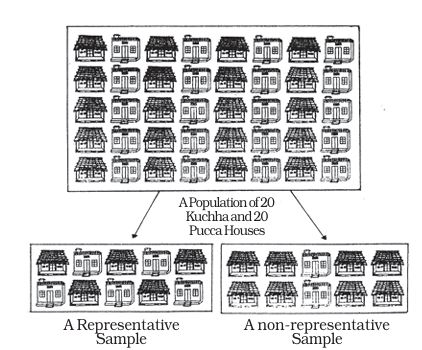
- Representative sample: A smaller group capable of providing reasonably accurate information about the population.
- Advantages: Sample surveys usually provide reasonably reliable information at lower cost and in less time than a census.
- Detailed enquiries: A smaller sample allows more detailed information to be collected through intensive enquiries.
- Fieldwork: A smaller team of enumerators is easier to train and supervise.
- Estimate: The average income of a selected group can be used to estimate the average income of the whole region.
- Use: Most surveys are sample surveys.
| Research problem | Population | Sample |
|---|---|---|
| Study the economic condition of agricultural labourers in Churachandpur district, Manipur | All agricultural labourers in Churachandpur district | Ten per cent of the agricultural labourers in the district |
| Estimate average income in a region | All individuals in the region | A representative group of individuals from the region |
Types of Sampling
| Point | Random sampling | Non-random sampling |
|---|---|---|
| Chance of selection | Every population unit has an equal chance of selection. | Units do not all have an equal chance of selection. |
| How units are chosen | Selection is made at random, such as by the lottery method or computer programmes. | Selection depends on the investigator’s judgement, purpose, convenience, or quota. |
Random Sampling: Example and Uses
- Definition: Random sampling selects individual units from a population at random, giving each unit an equal chance of selection.
- Example: To study the effect of rising petrol prices on household budgets, select 30 households at random from the 300 households in the locality.
- Sampling frame: The list of all 300 households from which the sample is selected.
- Lottery method: Write each household’s name on a slip, mix the slips, and draw 30 names.
- Modern selection: Computer programmes can also select random samples.
Exit Polls
- Method: A random sample of voters leaving polling booths is asked whom they voted for; the sample data are used to predict election results.
- Limitation: Exit polls do not always predict election results correctly.
Non-Random Sampling: Example
- Example: Choosing 10 households out of 100 because they are nearby or known to the investigator is non-random sampling.
- Reason: The investigator’s convenience or judgement influences selection, so all population units do not have an equal chance.
- Complete enumeration
- Collecting data from every unit in the population; another name for a census.
- Population or universe
- The entire group to which a study’s results are intended to apply.
- Representative sample
- A sample capable of providing reasonably accurate information about its population.
- Sampling frame
- The list of population units from which a sample is selected.
- Lottery method
- A random selection method using slips or names drawn from a mixed set.
What is the difference between a census and a sample survey?
State two advantages of sample surveys over a census.
Quick recap
- A census, or complete enumeration, surveys every unit in the population; India’s census is conducted every ten years.
- The population is the entire group under study, while a sample is a selected section of that group.
- A representative sample can provide reasonably accurate information at lower cost and in less time than a census.
- In random sampling, every population unit has an equal chance of selection; the lottery method is one example.
- In non-random sampling, selection depends on judgement, purpose, convenience, or quota.
- Exit polls use a random sample of voters to predict election results, but do not always predict correctly.
Sampling and Non- Sampling Errors
Sampling Errors
- Sampling error: The difference between a sample estimate and the corresponding actual population value.
- Reduction: Taking a larger sample can reduce the magnitude of sampling error.
Non-Sampling Errors
Examples of Data-Acquisition Errors
- Measurement differences: Results may vary with the equipment used and the care taken by the person measuring.
- Price data: Orange prices vary by shop, market and quality; average prices may therefore be considered.
- Recording mistakes: Respondents or enumerators may enter or transcribe data incorrectly, such as writing 13 instead of 31.
| Point | Sampling error | Non-sampling error |
|---|---|---|
| Meaning/source | Difference between a sample estimate and the population parameter. | May arise from bias, non-response, data acquisition or recording. |
| Reducing the error | Can be reduced by taking a larger sample. | Difficult to minimise by increasing sample size. |
| Relative seriousness | Generally less serious because larger samples can reduce it. | More serious because it is difficult to minimise, even with a large sample. |
| Census | A census covers the whole population, so sample-estimation error does not arise. | Can occur in a census; for example, from non-response, inaccurate measurement or recording mistakes. |
Census of India and National Sample Survey
Uses and Coverage of Census and NSS Data
- Census data: Analysed to understand economic and social issues using detailed population information.
- NSS estimates: Cover literacy, school enrolment, use of educational services, employment and unemployment, enterprises, morbidity, maternity, childcare and use of the public distribution system.
- Other NSS data: Includes industrial activities and retail prices; the Government of India uses these statistics for planning.
Using and Interpreting Data
- Census
- A method of data collection that covers every individual or unit in the population.
- Sample
- A smaller group selected from the population to provide relevant information.
- Random sampling
- A sampling method in which every individual has an equal chance of selection.
- Population parameter
- The actual value of a characteristic for the whole population.
- Sample estimate
- A value calculated from a sample to estimate a population parameter.
- Sampling bias
- A sampling-plan error that makes it impossible for some target-population members to be selected.
Quick recap
- Sampling error is the difference between a sample estimate and the population parameter; a larger sample can reduce it.
- Non-sampling errors are more serious and include bias, non-response, inaccurate data acquisition and recording mistakes; they can occur even in a census.
- A census covers every individual or unit in the population; a sample is a smaller selected group, and random sampling gives each individual an equal chance of selection.
- The Census of India has been conducted every ten years since 1881; the first post-Independence Census was in 1951.
- The NSS conducts nationwide socio-economic surveys in successive rounds and publishes reports and Sarvekshana.
- Primary data are first-hand; secondary data were previously collected. The study objective guides the choice of source and collection method.
Economics — ALL CHAPTERS
1
Introduction
2
Theory of Consumer Behaviour
3
Production And Costs
4
The Theory Of The Firm Under Perfect Competition
5
Market Equilibrium
1
Introduction
2
Collection of Data
3
Organizing of Data
4
Presentation of Data
5
Measures of Central Tendency
6
Correlation
7
Index Numbers
8
Use of Statistical Tools