Class 12 Humanities . History . Themes In Indian History Part I . Bricks Beads and Bones the Harappan Civilisation
Chapter 1: BRICKS, BEADS AND BONES THE HARAPPAN CIVILISATION
Ch 1
History
Class 12 Humanities
Introduction & Beginnings
The Harappan Civilisation and Its Evidence
Terminology, Places and Time
Harappan Phases
- 6000–2600 BCEEarly Harappan: the formative phase.
- 2600–1900 BCEMature Harappan: the urban and most prosperous phase.
- Around 1900 BCEThe civilisation’s decline begins.
- 1900–1300 BCELate Harappan: the phase of decline.
- 6000–1300 BCEOverall time span given for the civilisation.
Geographic Spread
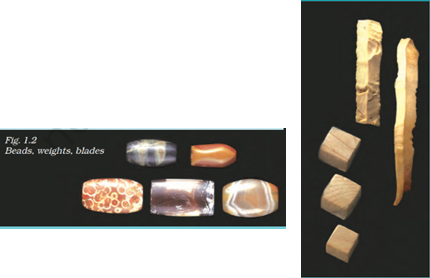
- Finds: Distinctive pottery, baked and unbaked bricks, seals, weights, beads, and copper and bronze objects have been found across a wide region.
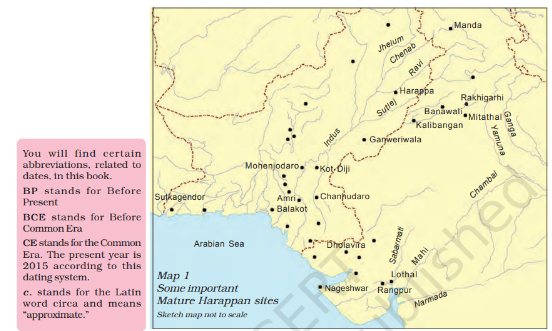
- Areas: Finds extend through Afghanistan, Baluchistan, Sind and Punjab in Pakistan, and Jammu and Kashmir, Punjab, Haryana, Rajasthan, Uttar Pradesh, Gujarat and Maharashtra in India.
Harappan Settlements
- Number and location: More than 2,000 sites are known in the Indian subcontinent; most lie between the Indus and Saraswati river basins.
- Saraswati basin: Nearly two-thirds of the settlements are here, showing the basin’s importance.
- Five major cities: Rakhigarhi, Mohenjodaro, Harappa, Dholavira and Ganweriwala.
- Other settlements: Regional centres, agricultural villages, ports and manufacturing centres.
Beginnings
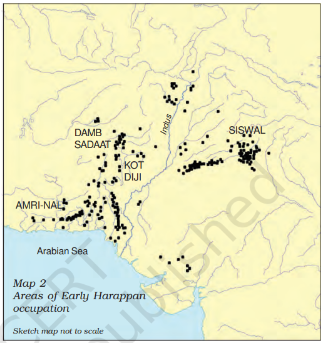
- Earlier cultures: Before the Mature Harappan phase, regional cultures had distinctive pottery, farming, pastoralism and some crafts.
- Settlements: These communities generally lived in small settlements, with virtually no large buildings.
- Early origins: Evidence indicates the emergence of Harappan culture from farming communities dating to around 7000 BCE.
- Urbanisation: The Mature Harappan phase developed through gradual transformation and internal development during the Early Harappan phase.
Subsistence Strategies
Food Sources
- Diet: Harappans ate a variety of plant and animal foods, including fish.
- Crops: Finds include wheat, barley, lentil, chickpea and sesame; millets occur at Gujarat sites, while rice finds are relatively rare.
- Plant evidence: Archaeo-botanists study charred grains and seeds to reconstruct diet and plant use.
- Domesticated animals: Bones of cattle, sheep, goat, buffalo and pig indicate these animals were domesticated.
- Other animal remains: Wild boar, deer, gharial, fish and fowl bones have been found; it is uncertain whether Harappans hunted wild animals or obtained meat from hunting communities.
Agricultural Technologies
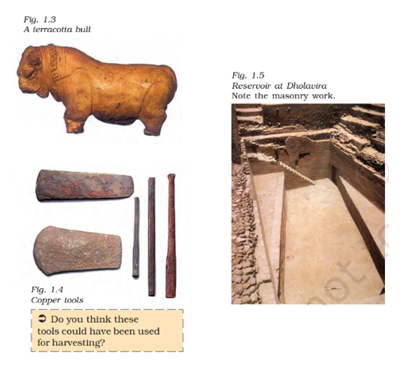
- Ploughing: Bull images suggest bulls were known; archaeologists infer that oxen may have been used to pull ploughs.
- Plough models: Terracotta models have been found at Cholistan and Banawali in Haryana.
- Kalibangan field: An Early Harappan field had two sets of furrows at right angles, suggesting two crops were grown together.
- Harvesting tools: Stone blades set in wooden handles may have been used; whether metal tools were also used is uncertain.
- Irrigation need: Many Harappan sites were in semi-arid areas, where irrigation was probably required.
- Water sources: Canal traces occur at Shortughai in Afghanistan, but have not been found in Punjab or Sind; ancient canals may have silted up. Wells may also have supplied irrigation water.
- Dholavira: Water reservoirs may have stored water for agriculture.
| Evidence | Interpretation | |
|---|---|---|
| Ploughing | Bull representations and terracotta plough models | Oxen may have been used to pull ploughs. |
| Cropping | Two sets of furrows at right angles at Kalibangan | Two different crops may have been grown together. |
| Irrigation | Canal traces at Shortughai and reservoirs at Dholavira | Canals and stored water may have supported agriculture. |
| Animal use | Bones of cattle, sheep, goat, buffalo and pig | These animals were domesticated. |
| Wild meat | Bones of boar, deer and gharial | Whether Harappans hunted them or obtained meat from hunting communities is unknown. |
- Archaeological evidence
- Material remains used to reconstruct past lives and practices.
- Archaeo-botanist
- A specialist who studies ancient plant remains.
- Archaeo-zoologist
- A specialist who studies animal remains from archaeological sites.
- Early Harappan
- The formative phase, dated 6000–2600 BCE.
- Mature Harappan
- The urban and most prosperous phase, dated 2600–1900 BCE.
- Late Harappan
- The phase of decline, dated 1900–1300 BCE.
What evidence suggests a gradual origin for the Mature Harappan civilisation?
What does the evidence reveal about Harappan food and farming?
Name the five major Harappan cities and state where most settlements were located.
Quick recap
- The Harappan Civilisation, also called the Indus Valley Civilisation, is reconstructed from archaeological remains.
- Its phases are Early Harappan (6000–2600 BCE), Mature Harappan (2600–1900 BCE) and Late Harappan (1900–1300 BCE).
- Harappan finds, including baked and unbaked bricks, pottery, seals and metal objects, extend across a broad region.
- More than 2,000 sites are known; nearly two-thirds lie in the Saraswati basin.
- The five major cities are Rakhigarhi, Mohenjodaro, Harappa, Dholavira and Ganweriwala.
- The Mature Harappan urban phase emerged gradually from earlier farming communities.
- Plant and animal remains, plough evidence and water-management features reveal Harappan subsistence and agriculture.
Mohanjodaro a Planned Urban Centre
The Layout of Mohenjo-daro
Two sections of the city
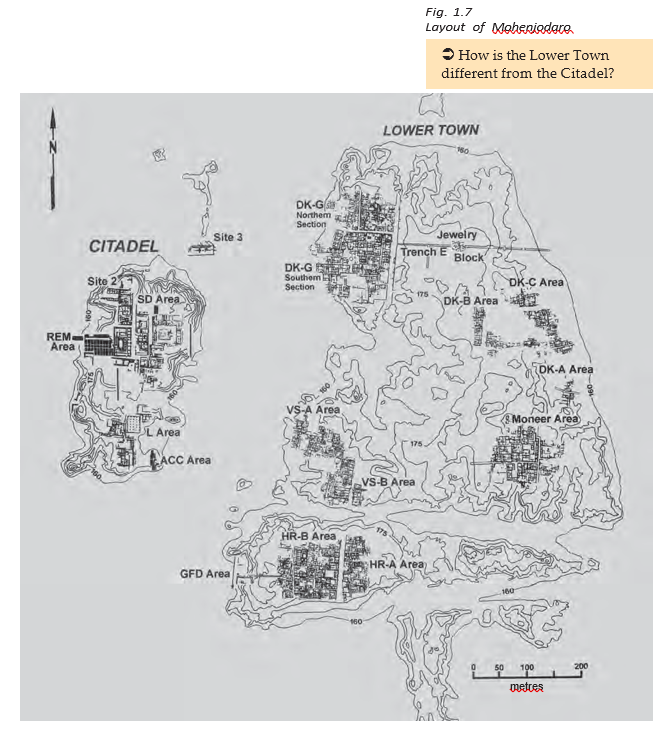
- Mohenjo-daro was a major Harappan urban centre; Harappa was the first Harappan site discovered.
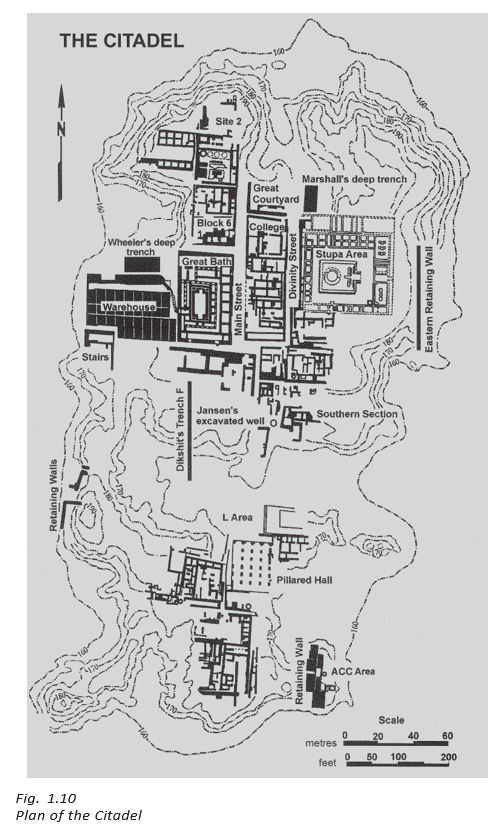
- Citadel: The smaller, higher section, raised on mud-brick platforms and walled off from the Lower Town.
- Lower Town: The much larger, lower section; it too was walled.
- Building platforms: Many buildings stood on raised foundations. Preparing them required an estimated four million person-days of labour.
- Planning: Construction was restricted to the platform area, suggesting the settlement was planned before it was built.
The Destruction of Harappa
The plight of Harappa
- Brick robbing: Harappa was badly damaged when its bricks were taken for construction, destroying many ancient structures.
- Mohenjo-daro: It was much better preserved than Harappa.
- Alexander Cunningham: The first Director-General of the Archaeological Survey of India (ASI), often called the father of Indian archaeology, reported the scale of brick removal from Harappa.
Evidence of damage to Harappa
- 1875Cunningham noted that bricks removed from Harappa could have laid about 100 miles of railway line between Lahore and Multan.
Planning and Standardised Bricks
Evidence of planned construction
- Labour scale: Preparing building platforms is estimated to have required four million person-days if one labourer moved about one cubic metre of earth daily.
- Prior planning: Once platforms were built, construction was restricted to a fixed area, suggesting that the settlement was planned before implementation.
- Brick ratio: Sun-dried and baked bricks followed a standard length:breadth:height ratio of .
- Widespread standard: The same brick proportions were used at Harappan settlements.
Street Planning and Drainage
A planned street network
- Grid pattern: Roads and streets generally intersected at right angles.
- Order of construction: Streets and drains appear to have been laid out before houses were built along them.
- House connections: To direct household wastewater into street drains, each house needed at least one wall facing a street.
Variations in Citadels and Fortifications
- Common pattern: Many Harappan settlements had a smaller, higher western section and a larger, lower eastern section.
- Dholavira and Lothal: The whole settlement was fortified, and walls also separated sections within the town.
- Lothal’s Citadel: It was elevated but not enclosed by its own wall.
Domestic Architecture
Residential buildings
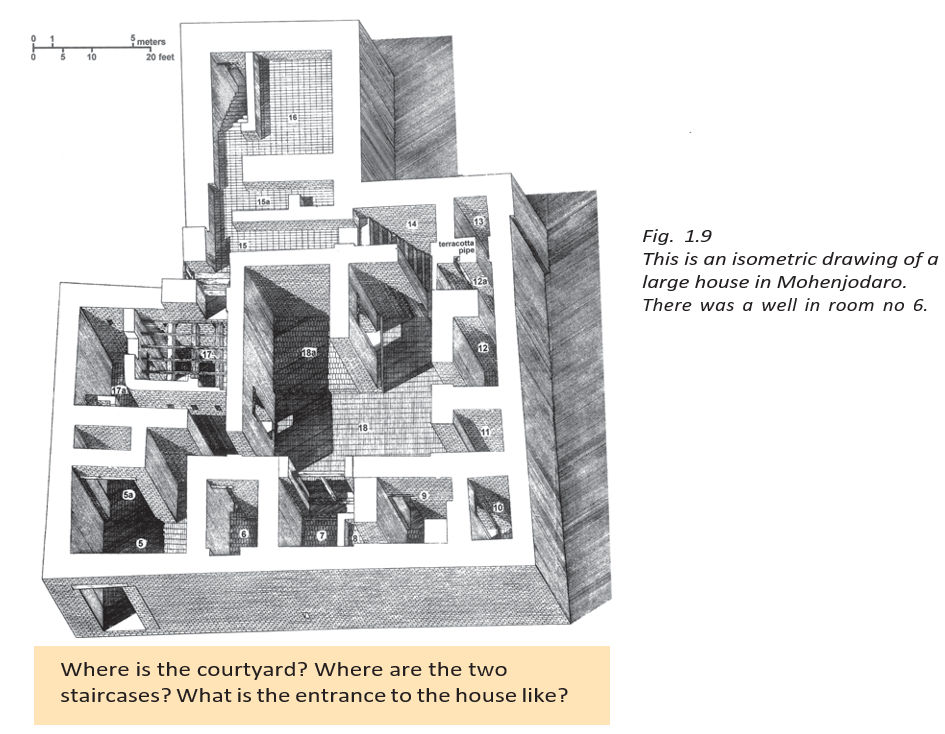
- Courtyard houses: Many houses had rooms arranged around a courtyard, likely used for cooking and weaving, especially in hot, dry weather.
- Privacy: Ground-level walls facing streets had no windows, and the main entrance did not provide a direct view into the house or courtyard.
- Bathrooms: Each house had a brick-paved bathroom connected through a wall to the street drains.
- Upper levels: Staircase remains in some houses indicate access to a second storey or the roof.
- Wells: Many houses had wells, sometimes in an externally accessible room that may also have served passers-by. Mohenjo-daro had an estimated 700 wells.
The Harappan Drainage System
Construction and maintenance
- Mackay’s assessment: He described it as “the most complete ancient system as yet discovered.”
- House-to-street connection: Every house was linked to the street drainage network.
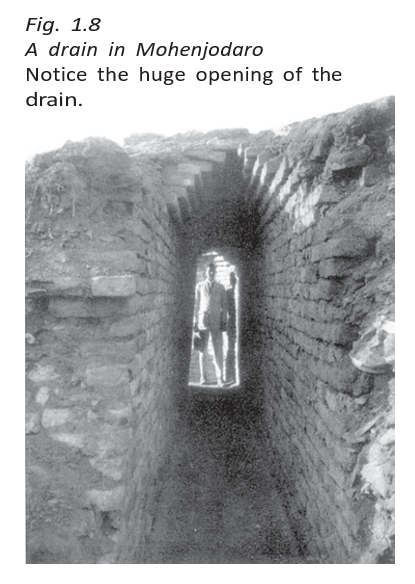
- Main drains: Built with bricks set in mortar and covered with loose bricks that could be lifted for cleaning; limestone covers were used in some cases.
- Sumps or cesspits: House drains first emptied into these chambers, where solid matter settled before wastewater flowed into street drains.
- Cleaning: Long drains had sumps at intervals to assist cleaning. Heaps of debris found beside drains suggest that waste was not always carted away after cleaning.
- Wide distribution: Drainage systems existed in smaller settlements as well as large cities. At Lothal, houses used mud bricks while drains used burnt bricks.
Household wastewater route
- House drain carried wastewater to a sump or cesspit.
- Solid matter settled in the sump.
- Wastewater flowed onwards into the street drain.
Public Structures on the Citadel
Warehouse and Great Bath
- Public-use evidence: The Citadel contained structures believed to have served special public purposes.
- Warehouse: A massive building whose surviving lower portions were made of brick; its upper parts were probably wooden and have decayed.
- Great Bath: A large rectangular tank in a courtyard, surrounded by a corridor on all four sides.
- Waterproofing: Bricks set on edge and gypsum mortar made the tank watertight.
- Access and water supply: Flights of steps on the north and south led into the tank; rooms lay on three sides, including one with a large well.
- Drainage and nearby building: Water flowed from the tank into a large drain. A smaller building across a lane had eight bathrooms, four on each side of a corridor, with drains joining a corridor drain.
- Likely purpose: Its distinctive design and Citadel location led scholars to suggest that the Great Bath was used for a special ritual bath.
- Citadel
- The smaller, higher section of a Harappan settlement, often walled.
- Lower Town
- The larger, lower section of a settlement.
- Sump or cesspit
- A chamber where solid matter settled before wastewater entered the street drain.
- Grid pattern
- A street layout in which roads intersect approximately at right angles.
- Great Bath
- A large, watertight tank on the Citadel at Mohenjo-daro, possibly used for ritual bathing.
What features show that Mohenjo-daro was a planned city?
Describe the main features of the Harappan drainage system.
Why do scholars think the Great Bath may have been used for ritual bathing?
Quick recap
- Mohenjo-daro had a smaller, raised Citadel and a larger Lower Town; both were walled.
- Raised platforms, standardised bricks and grid-like streets point to planned construction.
- Harappa was badly damaged by brick robbing; Cunningham noted the scale of removal in 1875.
- Houses commonly had courtyards, private entrances, bathrooms and access to wells.
- Household wastewater passed through sumps before entering covered street drains; Mackay called the system the most complete ancient system yet discovered.
- The Citadel contained a warehouse and the Great Bath, possibly used for ritual bathing.
Tracking Social Differences & Finding Out About Craft Production
Tracking Social Differences
Burials as Evidence
- Archaeological clue: Burials can help investigate social and economic differences within a culture.
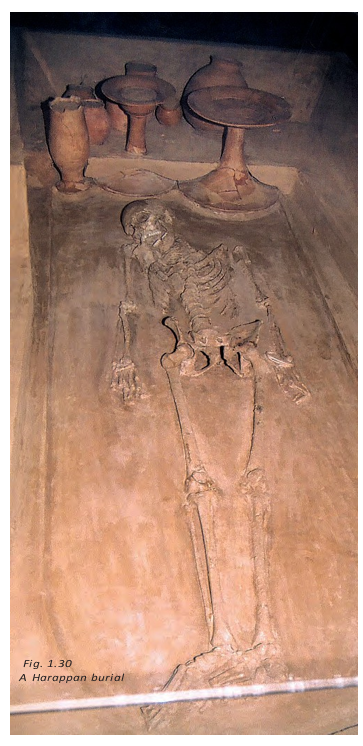
- Harappan graves: The dead were generally laid in pits; some pits had hollowed spaces lined with bricks.
- Cautious interpretation: Differences in grave construction might indicate social differences, but the evidence is inconclusive.
- Grave goods: Some graves contained pottery and ornaments, perhaps reflecting beliefs about an afterlife.
- Jewellery: It has been found with both men and women. One male burial at Harappa contained shell rings, a jasper bead and hundreds of microbeads near the skull.
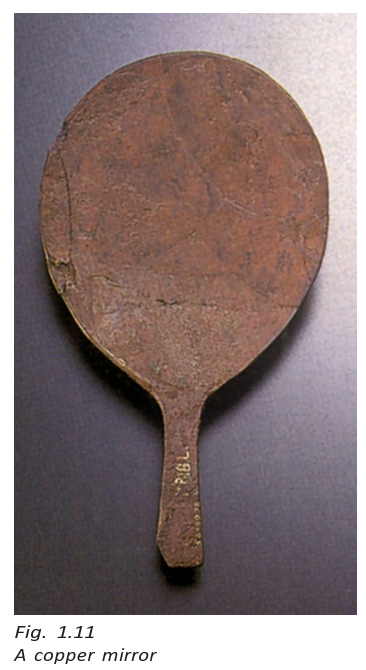
- Other finds: Copper mirrors were sometimes buried with the dead, but precious objects were generally not buried in large quantities.
Harappa Cemetery Find
- Mid-1980sExcavations at Harappa’s cemetery uncovered an ornament near the skull of a male.
Utilitarian Objects and Luxuries
Utilitarian objects — Everyday objects made relatively easily from common materials such as stone or clay.
Luxuries — Objects considered valuable because they are rare, made from costly non-local materials, or require complicated techniques.
| Category | Examples or clues | Distribution / note |
|---|---|---|
| Utilitarian | Querns, pottery, needles and flesh-rubbers | Usually widespread across settlements |
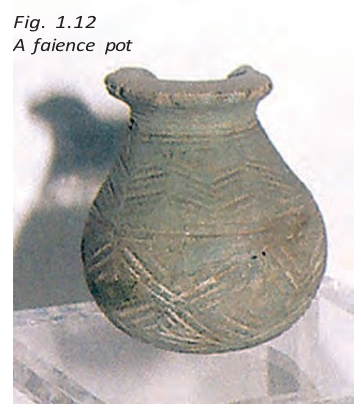
| Luxury | Rare objects, costly non-local materials or complicated manufacture; examples include faience pots | Rare valuable objects were concentrated in large settlements such as Mohenjodaro and Harappa |
| Ambiguous | Spindle whorls made of faience | An everyday-use object could still be made from a luxury material |
Luxury Goods and Hoards
- Faience: Made from ground sand or silica mixed with colour and gum, then fired; small faience pots were difficult to make.
- Settlement pattern: Miniature faience pots, perhaps perfume bottles, are common at Mohenjodaro and Harappa but absent from small Kalibangan.
- Gold: Rare and probably precious; all gold jewellery found at Harappan sites was recovered from hoards.
- Hoards: Carefully stored objects, often placed in pots; they could contain jewellery or metal saved for reuse by metalworkers.
- Archaeological evidence: If owners did not retrieve a hoard, its contents remained where they had been hidden.
Do not assume every rare-material object was a luxury: a faience spindle whorl may have been an everyday tool, so consider both its use and material.
Finding Out About Craft Production
Craft Centres and Products
- Chanhudaro: A small settlement of less than 7 hectares, compared with Mohenjodaro at 125 hectares; it was almost entirely devoted to craft production.
- Chanhudaro crafts: Bead-making, shell-cutting, metal-working, seal-making and weight-making.
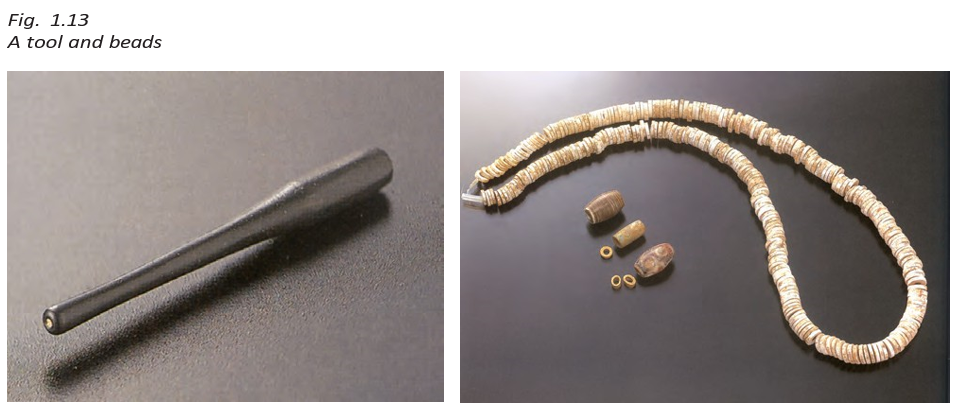
- Bead materials: Carnelian, jasper, crystal, quartz, steatite, copper, bronze, gold, shell, faience and terracotta.
- Bead forms and decoration: Shapes included disc-shaped, cylindrical, spherical, barrel-shaped and segmented; beads could be incised, painted or etched.
- Complex designs: Some beads combined two or more stones cemented together; some stone beads had gold caps.
| Material | Technique / result |
|---|---|
| Steatite | Soft and easy to work; beads could also be moulded from steatite-powder paste into varied shapes. |
| Hard stones | Often shaped into geometrical forms; specialised drilling was needed. |
| Carnelian | Its red colour was produced by firing the yellowish raw material and beads at different production stages. |
| Steatite microbeads | How they were made remains a puzzle for archaeologists studying ancient technology. |
Carnelian Bead Production
- Fire the yellowish raw material and beads at different stages to develop the red colour.
- Chip nodules into rough shapes, then finely flake them into the desired form.
- Grind and polish the bead.
- Drill it to complete the bead.
Specialised Production and Distribution
- Drilling tools: Specialised drills have been found at Chanhudaro, Lothal and Dholavira.
- Coastal shell centres: Nageshwar and Balakot, both near the coast, specialised in shell objects such as bangles, ladles and inlay.
- Distribution: Shell objects were taken to other settlements; beads from Chanhudaro and Lothal likely reached large cities such as Mohenjodaro and Harappa.
Identifying Centres of Production
Archaeological Indicators
- Look for: Raw materials such as stone nodules, whole shells and copper ore; tools; unfinished objects; rejects; and waste.
- Waste evidence: Cutting stone or shell leaves discarded fragments at the production site; waste is one of the strongest indicators of craft work.
- Reuse: Larger waste pieces could be used to make smaller objects, while tiny fragments were usually left in the work area.
- Where production occurred: Craft work took place both at small specialised centres and in large cities such as Mohenjodaro and Harappa.
Recognising a Craft Production Site
- Raw materials and tools are brought to a work area.
- Objects are shaped or manufactured there.
- Unfinished pieces, rejects and waste fragments remain behind.
- Archaeologists use these traces to identify the area as a production centre.
- Utilitarian object
- An everyday object made relatively easily from common materials.
- Luxury
- A rare or costly object, often made with non-local materials or complex techniques.
- Hoard
- A collection of objects deliberately stored, often in a container.
- Craft centre
- A settlement or area where particular crafts were produced.
- Waste material
- Discarded manufacturing fragments that help locate production areas.
How do archaeologists identify a craft production centre?
Why is it difficult to classify some Harappan artefacts as utilitarian or luxury items?
Quick recap
- Burials offer clues to social differences, but variations in Harappan graves do not prove a clear social hierarchy.
- Harappan graves sometimes held pottery, ornaments and mirrors, yet precious goods were generally not buried with the dead.
- Utilitarian objects were common everyday items; rare materials and complex manufacture could make an object a luxury.
- Chanhudaro was a small settlement focused on crafts, while coastal Nageshwar and Balakot specialised in shell objects.
- Carnelian beads were fired, shaped, flaked, ground, polished and drilled; how steatite microbeads were made remains unknown.
- Raw materials, tools, unfinished goods, rejects and especially waste help archaeologists locate craft production.
Strategies for Procuring Materials
Sourcing and Transporting Materials
Material procurement — The Harappans obtained craft materials both locally and from regions outside the alluvial plain.
Transport routes
- Local materials: Clay was available nearby, while stone, timber and metals often had to be brought from farther away.
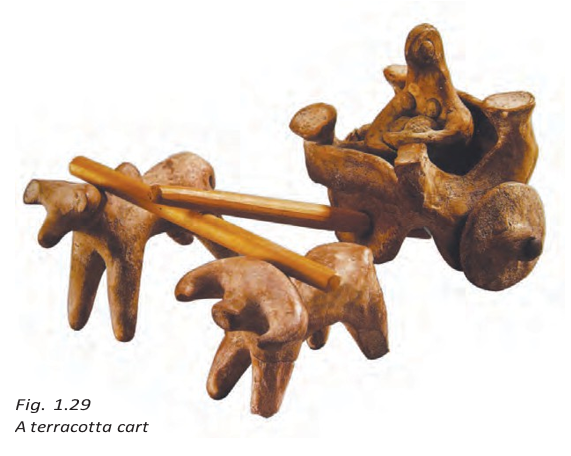
- Land routes: Terracotta models of bullock carts suggest carts carried goods and people overland.
- Water routes: The Indus and its tributaries, as well as coastal routes, were probably used.
Materials from the Subcontinent and Beyond
| Settlement or region | Resource and connection |
|---|---|
| Nageshwar and Balakot | Established near sources of shell. |
| Shortughai, Afghanistan | Near a major source of lapis lazuli, a highly valued blue stone. |
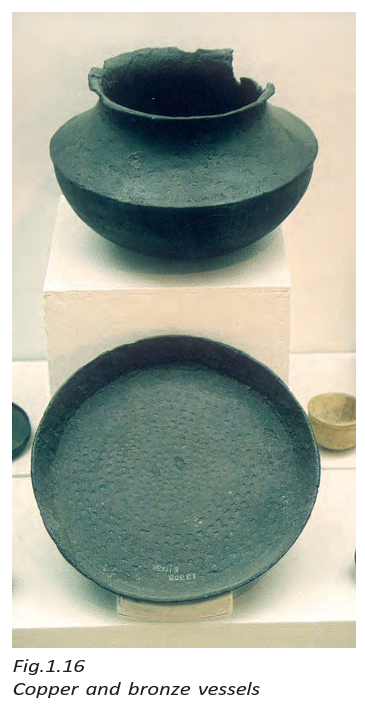
| Lothal | Near carnelian sources at Bharuch, steatite sources in south Rajasthan and north Gujarat, and metal sources in Rajasthan. |
Expeditions and Local Contacts
- Expeditions: Harappans may have travelled to the Khetri region of Rajasthan for copper and to south India for gold.
- Evidence of contact: Harappan steatite microbeads found in these areas indicate links with local communities.
- Khetri region: The Ganeshwar-Jodhpura culture had distinctive non-Harappan pottery and unusually many copper objects.
- Possible exchange: Local inhabitants of the Khetri region may have supplied copper to the Harappans.
Contact with Distant Lands
| Evidence | Interpretation | |
|---|---|---|
| Copper | Omani copper and Harappan artefacts contain traces of nickel. | The matching traces suggest a common copper source; copper was probably brought from Oman. |
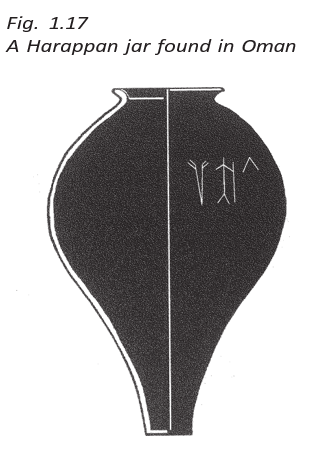
| Large jar | A Harappan jar coated with thick black clay was found at Omani sites; the coating prevents liquids from seeping through. | Its contents are unknown; the Harappans may have exchanged them for Omani copper. |
Mesopotamian References
- Third millennium BCEMesopotamian texts refer to copper from Magan, possibly Oman; copper at Mesopotamian sites also has nickel traces.
Evidence of Long-Distance Contact
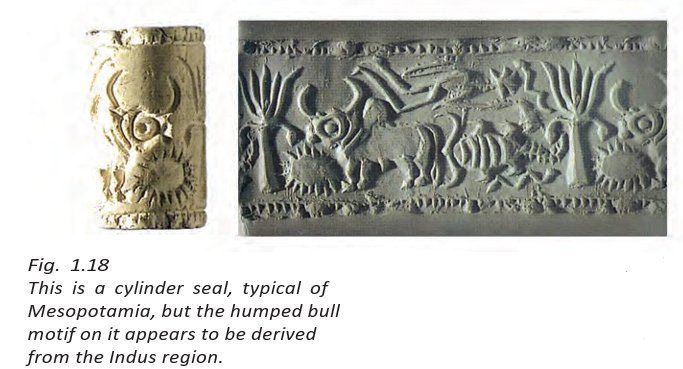
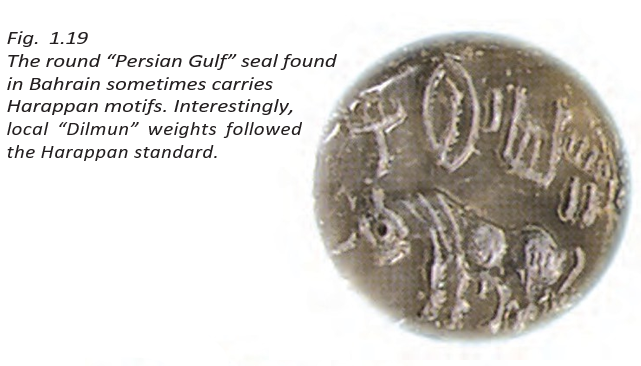
- Artefacts: Harappan seals, weights, dice and beads found beyond the Indus region indicate long-distance connections.
- Trading regions in Mesopotamian texts: Dilmun was probably Bahrain, Magan possibly Oman, and Meluhha possibly the Harappan region.
- Products linked with Meluhha: Carnelian, lapis lazuli, copper, gold and different kinds of wood.
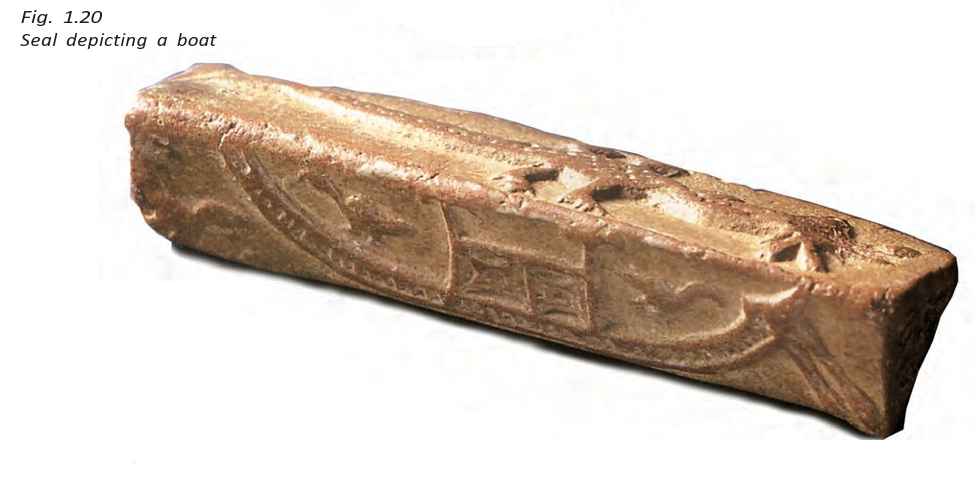
- Sea links: Mesopotamian texts describe Meluhha as a land of seafarers; seals also depict ships and boats.
- Possible cultural clue: A Mesopotamian myth mentions the haja-bird; some archaeologists identify it as the peacock.
- Lapis lazuli
- A valued blue stone sourced near Shortughai.
- Steatite
- A stone obtained from areas including south Rajasthan and north Gujarat.
- Magan
- A region named in Mesopotamian texts, possibly Oman.
- Meluhha
- A region named in Mesopotamian texts, possibly the Harappan region.
What evidence suggests contact between Harappans and Oman?
Which regions and products are associated with Meluhha in Mesopotamian texts?
Quick recap
- Harappans used local materials and obtained stone, timber and metals from beyond the alluvial plain.
- Bullock carts, rivers and coastal routes probably helped transport goods and people.
- Settlements near resources and expeditions to resource-rich regions supported procurement.
- Artefacts and matching nickel traces point to contact with Oman and other distant regions.
- Mesopotamian texts connect Meluhha with valuable goods and describe it as a land of seafarers.
Seals, Script, Weights & Ancient Authority
Seals and Sealings
- Purpose: Seals and sealings helped secure goods sent over long distances and identify the sender.
- Method: A bag’s mouth was tied with rope, and wet clay was pressed onto the knot with one or more seals.
- Meaning: An intact sealing showed that the bag had not been tampered with during transit.
The End of the Civilisation
Decline and Transformation
Changes after 1900 BCE
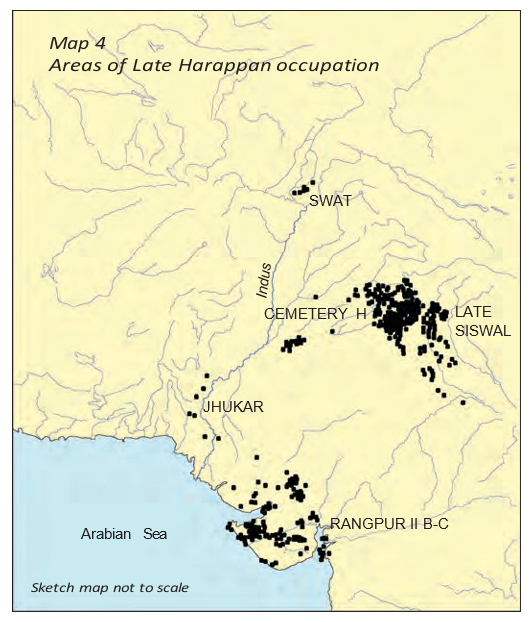
- Abandonment: By about 1800 BCE, most Mature Harappan sites in regions such as Cholistan had been deserted.
- New settlements: Population expanded into Gujarat, Haryana and western Uttar Pradesh.
- Material culture: In continuing settlements, weights, seals and distinctive beads disappeared; writing, long-distance trade and craft specialisation also declined.
- Urban life: Fewer materials were used to make fewer goods; house-building techniques weakened and large public structures were no longer produced.
- Successor cultures: The remaining settlements show a more rural way of life, often called Late Harappan or successor cultures.
Late Harappan or successor cultures — Post-urban cultures in which Harappan settlements and material life changed, generally becoming more rural.
Possible causes and the end of unity
- Suggested causes: Climatic change, deforestation, excessive floods, shifting or drying rivers, and overuse of the landscape have all been proposed.
- Limits of explanations: Some causes may explain change at particular settlements, but no single one explains the collapse of the whole civilisation.
- Unifying element: The end of a strong integrating force—possibly the Harappan state—best fits the widespread changes.
- Evidence of decline: Seals, script, distinctive beads and pottery disappeared; standardised weights gave way to local weights, while cities declined or were abandoned.
- Later urbanisation: New cities emerged only after more than a millennium, and in a different region.
The Invasion Theory and Its Reassessment
Evidence from Mohenjodaro
- Deadman Lane: Parts of an adult skull and bones from the thorax and upper arm, along with fragments of a tiny skull, were found in the lane at Mohenjodaro.
- Skeletons: Sixteen skeletons, still wearing ornaments, were found in the same part of the city in 1925.
- Wheeler’s argument: In 1947, R.E.M. Wheeler linked the remains to the Rigveda’s references to forts and Indra as a fort-destroyer; he suggested a violent invasion may have ended the city.
| Evidence | Interpretation | |
|---|---|---|
| R.E.M. Wheeler | Skeletons at Mohenjodaro; Harappan cities had substantial fortifications; the Rigveda mentions forts and Indra as a fort-destroyer. | Suggested that deliberate, large-scale destruction by Aryans may have completed the civilisation’s decline. |
| George Dales | Skeletons belonged to different periods; there was no destruction layer, extensive burning, group of armed warriors, or evidence of a final defence at the citadel. | Rejected the claim of a city-wide massacre; the bones did not prove an invasion. |
Why the massacre claim was questioned
- Dales’s conclusion: A few skeletons may indicate slaughter, but most were found in contexts consistent with careless or disrespectful burials.
- Historical method: Re-examining archaeological contexts can overturn earlier interpretations based on incomplete or circumstantial evidence.
Archaeogenetic Research at Rakhigarhi
Site and research
- Rakhigarhi: Located in Haryana’s Hisar district, it is the largest Harappan city described in the lecture, covering about 550 hectares.
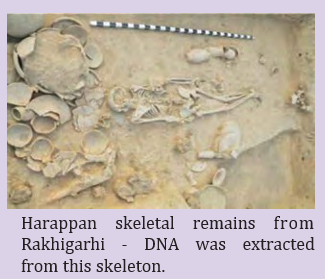
- Research team: DNA from excavated human remains was studied by Deccan College, Pune, with the Centre for Cellular and Molecular Biology, Hyderabad, and Harvard Medical College.
- Finding on ancestry: The analysis described Harappans as indigenous to the region, with genetic roots reaching back to 10,000 BCE.
- Continuity: The study reported genetic and cultural continuity in the region, with Harappan ancestry continuing among much of the South Asian population.
- Immigration conclusion: The researchers argued that this unbroken continuity ruled out large-scale immigration of the so-called Aryans.
- Population contact: Trade and cultural links brought a small amount of gene mixture; people arriving from nearby and distant regions were absorbed into society.
- Wider spread: As Harappans moved towards Iran and Central Asia, their genes gradually spread there too.
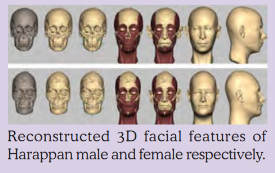
- Facial reconstruction: Reconstructed male and female faces were reported to resemble the modern population of Haryana, suggesting continuity over 5,000 years.
Key Dates and Periods
- 10,000 BCEThe Rakhigarhi study traced the Harappans’ genetic roots to this period.
- After 1900 BCEContinuing Harappan sites show major changes in material culture and urban life.
- c. 1800 BCEMost Mature Harappan sites in areas such as Cholistan had been abandoned.
- 1925Sixteen skeletons wearing ornaments were found in one part of Mohenjodaro.
- 1931John Marshall published an account of the bones found in Deadman Lane.
- 1947R.E.M. Wheeler proposed that invasion may have completed Harappan destruction.
- 1960s; 1964George Dales challenged the massacre theory; his article appeared in 1964.
- 2019The Rakhigarhi archaeogenetic research was published.
- Mature Harappan
- The urban phase of the Harappan civilisation, whose sites were widely abandoned or transformed after 1900 BCE.
- Late Harappan
- The later, generally more rural cultures that followed the Mature Harappan phase.
- Archaeogenetics
- The study of ancient DNA to investigate past populations and ancestry.
- Indigenous
- Originating in the region being discussed; the Rakhigarhi study described Harappans this way.
What changes marked the transformation of Harappan civilisation?
Why is the invasion theory based on the Mohenjodaro skeletons disputed?
What did the Rakhigarhi genetic research indicate?
Quick recap
- Most Mature Harappan sites were abandoned or transformed after 1900 BCE; settlement expanded into new regions.
- Late Harappan successor cultures were generally more rural and lacked many distinctive urban features.
- Environmental explanations may fit individual sites, but the end of a unifying force may explain civilisation-wide decline.
- Wheeler linked Mohenjodaro skeletons to an invasion theory; Dales challenged the massacre interpretation with archaeological evidence.
- Rakhigarhi DNA research reported indigenous roots and continuity; its researchers argued that this ruled out large-scale Aryan immigration while allowing for limited gene mixture.
Discovering the Harappan Civilisation
How the Civilisation Was Rediscovered
- After abandonment: Harappan cities became ruins, and later inhabitants no longer knew their origins.
- Accidental finds: Floods, erosion, ploughing and digging exposed ancient objects that people could not identify.
Cunningham’s Confusion
Why Harappa Was Overlooked
- Alexander Cunningham: The first Director-General of the Archaeological Survey of India (ASI), he began excavating in the mid-nineteenth century.
- Research approach: Archaeologists often used texts and inscriptions to guide investigations; Cunningham focused on Early Historic and later periods.
- Sources and work: He used Chinese Buddhist pilgrims’ accounts from the fourth to seventh centuries CE to locate settlements and collected, documented and translated inscriptions.
- Harappa did not fit: It was not on the pilgrims’ itinerary or known as an Early Historic city, so its finds did not match Cunningham’s framework.
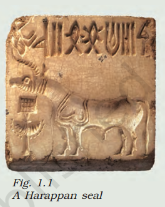
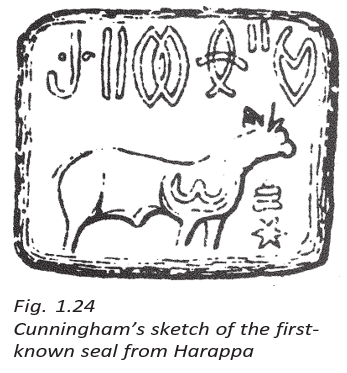
- The seal: Cunningham received a Harappan seal but could not place it within the time periods he knew; he shared the view that Indian history began with cities in the Ganga valley.
A New, Old Civilisation
Recognition of the Harappan Civilisation
- Daya Ram Sahni found seals at Harappa in layers much older than Early Historic levels.
- Rakhal Das Banerji found similar seals at Mohenjodaro.
- Shared material finds led archaeologists to suggest that Harappa and Mohenjodaro belonged to one archaeological culture.
- John Marshall, Director-General of the ASI, announced the discovery of a new Indus Valley civilisation in 1924.
- Mesopotamian connection: Similar, previously unidentified seals at Mesopotamian sites showed that the civilisation was contemporaneous with Mesopotamia.
Marshall’s Archaeological Approach
- New professional influence: Marshall was the first professional archaeologist to work in India and brought experience from Greece and Crete.
- Broader interests: Alongside spectacular finds, he sought patterns of everyday life.
- Excavation weakness: He dug in regular horizontal units and grouped finds from the same unit together, even when they came from different layers.
- Result: Ignoring stratigraphy destroyed valuable information about the context of artefacts.
Sites, Mounds and Layers
- Occupational debris
- Material and structural remains left through production, use and discard.
- Mound
- A build-up of occupational debris created as people use and reuse the same place.
- Sterile layer
- A layer formed during abandonment or desertion, with no traces of occupation.
- Stratigraphy
- The study of layers at an archaeological site and their sequence.
- Cultural sequence
- The order of cultural periods at a site, inferred from artefacts found in its layers.
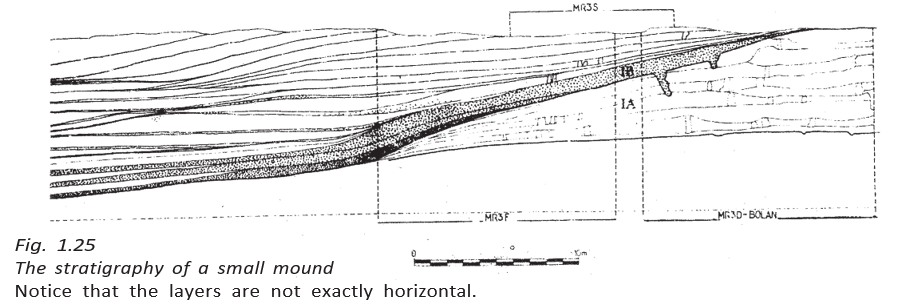
Reading a Site’s Layers
- Occupation: Building, using and discarding materials adds debris to the landscape.
- Mound formation: Continued occupation builds up layers of debris.
- Abandonment: Wind, water and erosion alter the site; sterile layers may form.
- Layer identification: Layers differ in colour, texture and the artefacts they contain.
- Sequence: In general, lower layers are older and higher layers are more recent; artefacts help identify cultural periods.
New Techniques and Questions
Wheeler and Stratigraphic Excavation
- R.E.M. Wheeler became Director-General of the ASI in 1944 and corrected the problem of digging in uniform horizontal units.
- Improved method: Excavation should follow the mound’s stratigraphy rather than cut mechanically across it.
- Contribution: Wheeler brought military precision to archaeological practice.
Expansion of Harappan Archaeology in India
- Civilisation’s extent: Harappan frontiers do not closely match present-day national boundaries.
- Partition: After the subcontinent was partitioned and Pakistan was created, major known sites lay in Pakistan.
- Research response: Indian archaeologists increased efforts to locate settlements within India.
- New discoveries: Surveys in Kutch and explorations in Punjab and Haryana added sites, including Kalibangan, Lothal, Rakhi Garhi and Dholavira.
- Continuing work: Exploration and excavation of Harappan sites continue.
Current Research Questions and Techniques
- Research questions: Archaeologists investigate cultural sequences, why particular sites were chosen and what functions artefacts served.
- International collaboration: Since the 1980s, specialists from the subcontinent and abroad have worked together at Harappa and Mohenjodaro.
- Scientific study: Surface exploration helps recover traces of clay, stone, metal, plants and animals.
- Detailed analysis: Researchers examine every available piece of evidence closely to develop new findings.
Key Dates and Periods
- c. sixth century BCE–fourth century CEEarly Historic period, a major focus of Cunningham’s archaeological work.
- Fourth–seventh centuries CEChinese Buddhist pilgrims visited the subcontinent; Cunningham used their accounts to locate early settlements.
- Mid-nineteenth centuryCunningham began archaeological excavations as the first Director-General of the ASI.
- Early decades of the twentieth centuryDaya Ram Sahni and Rakhal Das Banerji found Harappan seals at Harappa and Mohenjodaro.
- 1924John Marshall announced the discovery of a new civilisation in the Indus Valley.
- 1944R.E.M. Wheeler became Director-General of the ASI and emphasised stratigraphic excavation.
- Since the 1980sInternational collaboration and modern scientific techniques increasingly shaped Harappan research.
Why did Cunningham fail to recognise the significance of Harappan finds?
What was the problem with Marshall’s excavation method, and how did Wheeler address it?
How did archaeologists establish that Harappa and Mohenjodaro belonged to an old civilisation contemporaneous with Mesopotamia?
Quick recap
- Cunningham’s focus on Early Historic and later remains led him to miss the age and importance of Harappan artefacts.
- Sahni and Banerji’s seal finds helped establish links between Harappa and Mohenjodaro; Marshall announced the civilisation in 1924.
- Marshall’s horizontal excavation units could mix finds from different layers and destroy contextual information.
- Stratigraphy studies a site’s layers; lower layers are generally older and upper layers more recent.
- Wheeler stressed following stratigraphy during excavation.
- Post-partition surveys and modern collaboration expanded Harappan research across India and internationally.
Problems of Piecing Together the Past
Reconstructing Harappan Life from Material Evidence
- Evidence: Archaeologists reconstruct Harappan life from surviving material remains, since organic materials such as cloth, wood and leather usually decompose.
- Limits: Many objects were recycled; intact valuable finds are often accidental losses or unretrieved hoards, not typical of everyday life.
Classifying Archaeological Finds
- Approach: Archaeologists classify finds by material and by their possible function.
- Context: An artefact’s location—in a house, drain, grave or kiln—can help reveal how it was used.
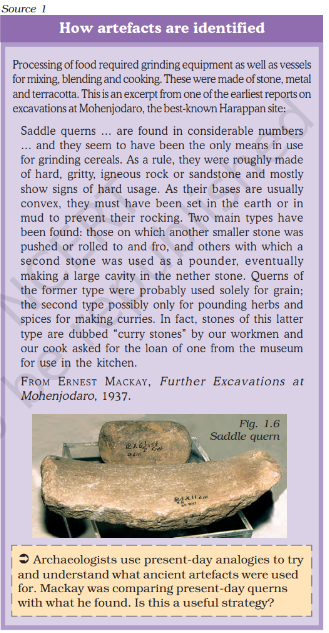
- Interpretation: When direct evidence is lacking, archaeologists use depictions, comparisons and other indirect evidence to develop explanations.
Interpreting Religious Finds
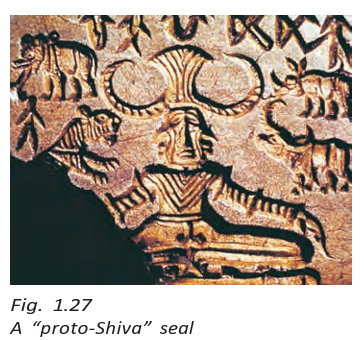
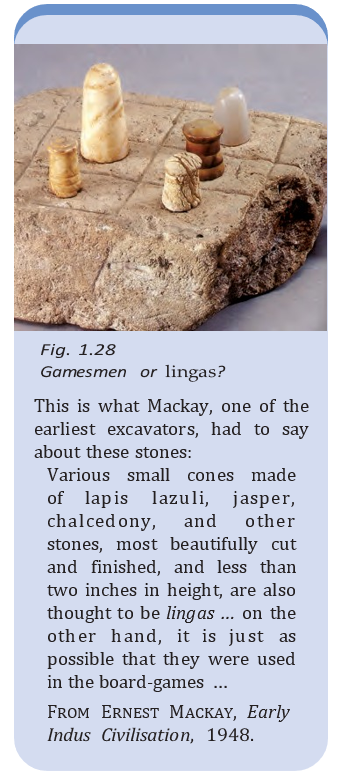
Why “Proto-Shiva” Remains Uncertain
- Linga
- A polished stone worshipped as a symbol of Shiva.
- Shaman
- A person who claims magical and healing powers and an ability to communicate with the other world.
- Pashupati
- “Lord of animals,” especially cattle; a title associated with Shiva in later traditions.
What Archaeology Has Established—and What Remains Unanswered
Major Periods in Early Indian Archaeology
- 2 million BP (Before Present)Lower Palaeolithic; dates are approximate.
- 80,000Middle Palaeolithic.
- 35,000Upper Palaeolithic.
- 12,000Mesolithic.
- 10,000Neolithic; early agriculturists and pastoralists.
- 6,000Chalcolithic; first use of copper.
- 2600 BCEHarappan civilisation.
- 1000 BCEEarly iron and megalithic burials.
- 600 BCE–400 CEEarly Historic period.
Reading the Archaeological Periods
- Dates: All dates are approximate and indicate the earliest evidence for each phase.
- Variation: Developments occurred at different times in different parts of the subcontinent.
Major Developments in Harappan Archaeology
- 1875Alexander Cunningham reported on a Harappan seal.
- 1921Daya Ram Sahni began excavations at Harappa.
- 1922Excavations began at Mohenjodaro.
- 1946R.E.M. Wheeler excavated at Harappa.
- 1955S.R. Rao began excavations at Lothal.
- 1960B.B. Lal and B.K. Thapar began excavations at Kalibangan.
- 1974M.R. Mughal began explorations in Bahawalpur.
- 1980A German and Italian archaeological team began surface explorations at Mohenjodaro.
- 1986An American team began excavations at Harappa.
- 1990R.S. Bisht began excavations at Dholavira.
- 1997Amrendra Nath began excavations at Rakhigarhi.
- 2013Vasant Shinde began archaeogenetic research at Rakhigarhi.
Why must archaeologists be cautious when interpreting Harappan religious objects?
Why is the identification of the seated seal figure as “proto-Shiva” uncertain?
Quick recap
- Harappan life is reconstructed mainly from surviving material evidence, not from a deciphered script.
- Finds are classified by material and possible function; context, comparison and indirect evidence help interpretation.
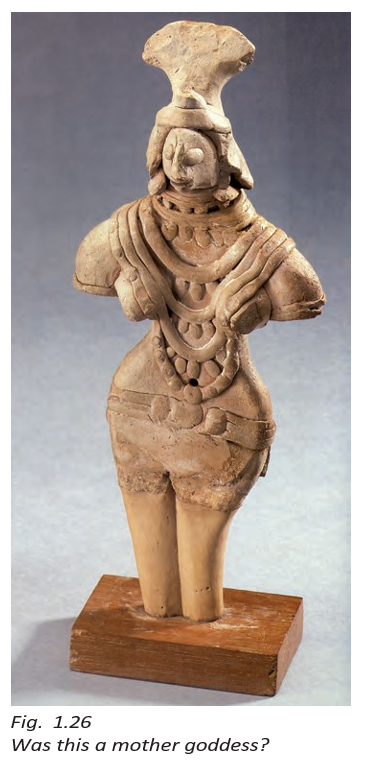
- Religious interpretations—including mother goddesses, ritual structures, lingas and “proto-Shiva”—are often uncertain.
- The Rigvedic description of Rudra does not closely match the seated seal figure called “proto-Shiva.”
- The economy and social differences are broadly understood, but questions about ritual, literacy, gender and Harappan–Vedic relations remain open.
- Archaeological timelines place the Harappan civilisation among early Indian periods and record key excavations from 1875 to 2013.
History — ALL CHAPTERS
1
BRICKS, BEADS AND BONES THE HARAPPAN CIVILISATION
2
KINGS, FARMERS AND TOWNS EARLY STATES AND ECONOMIES (C. 600 BCE-600 CE)
3
KINSHIP, CASTE AND CLASS EARLY SOCIETIES (C. 600 BCE-600 CE)
4
THINKERS, BELIEFS AND BUILDINGS CULTURAL DEVELOPMENTS (C. 600 BCE - 600 CE)
1
THROUGH THE EYES OF TRAVELLERS PERCEPTIONS OF SOCIETY (C. TENTH TO SEVENTEENTH CENTURY)
2
BHAKTI- SUFI TRADITIONS CHANGES IN RELIGIOUS BELIEFS AND DEVOTIONAL TEXTS (C. EIGHTH TO EIGHTEENTH CENTURY)
3
AN IMPERIAL CAPITAL VIJAYANAGARA (C. FOURTEENTH TO SIXTEENTH CENTURY)
4
PEASANTS, ZAMINDARS AND THE STATE AGRARIAN SOCIETY AND THE MUGHAL EMPIRE (C. SIXTEENTH- SEVENTEENTH CENTURY)
1
COLONIALISM AND THE COUNTRYSIDE EXPLORING OFFICIAL ARCHIVES
2
REBELS AND THE RAJ THE REVOLT OF 1857 AND ITS REPRESENTATIONS
3
MAHATMA GANDHI AND THE NATIONALIST MOVEMENT CIVIL DISOBEDIENCE AND BEYOND
4
FRAMING THE CONSTITUTION THE BEGINNING OF A NEW ERA