Class 12 Humanities . History . Themes In Indian History Part III . Rebels and the Raj the Revolt of 1857 and Its Representations
Chapter 2: REBELS AND THE RAJ THE REVOLT OF 1857 AND ITS REPRESENTATIONS
Ch 2
History
Class 12 Humanities
Introduction & Pattern of the Uprising
Outbreak at Meerut and Delhi
How the uprising began
- Meerut: On 10 May 1857, sepoys mutinied, first in the infantry lines and then among the cavalry; townspeople and villagers joined them.
- Targets: Rebels seized the bell of arms, attacked Europeans, and looted or burned bungalows and government buildings.
- Communication: The telegraph line to Delhi was cut; that evening, sepoys rode towards Delhi.
- Delhi: On 11 May, Meerut sepoys reached the Red Fort and sought Mughal emperor Bahadur Shah’s support.
- Cartridge grievance: The sepoys told the emperor they had been asked to bite cartridges greased with cow and pig fat, which they believed would corrupt Hindu and Muslim faiths.
- Legitimacy: The emperor blessed the rebellion under pressure, allowing it to be carried on in the Mughal emperor’s name.
- Spread: After Delhi fell, cantonments across the Gangetic valley and west of Delhi rose in mutiny.
Opening days of the revolt
- 10 May 1857Sepoys mutinied at Meerut; townspeople and villagers joined, and a group rode towards Delhi.
- 11 May 1857Sepoys entered Delhi and secured Bahadur Shah’s support for the rebellion.
- 12–13 May 1857North India was briefly quiet; news of Delhi’s fall then helped trigger further cantonment mutinies.
- May–June 1857British authorities struggled to contain the rebels; one British officer said rule had collapsed like a house of cards.
- 14 June 1857The Delhi Urdu Akhbar reported shortages of vegetables and water and disruption to everyday life.
Pattern of the Uprising
Bell of arms — A storehouse where weapons and ammunition were kept.
Typical sequence of a mutiny
- A signal—often an evening gun or bugle—began the action.
- Sepoys seized the bell of arms and plundered the treasury.
- They attacked government buildings, including jails, telegraph offices and record rooms, and burned records.
- Proclamations in Hindi, Urdu and Persian urged Hindus and Muslims to unite and rise against the firangis.
- As ordinary people joined, attacks widened to moneylenders and wealthy people seen as British allies.
From mutiny to popular rebellion
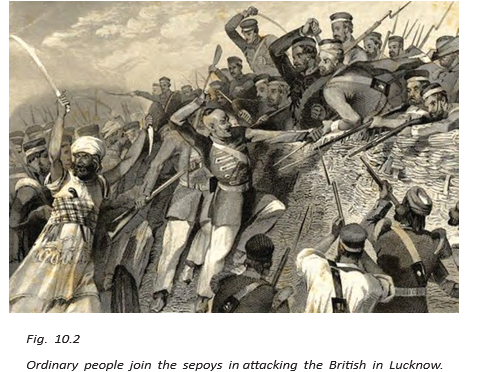
- Widening targets: In towns such as Lucknow, Kanpur and Bareilly, moneylenders’ and rich people’s houses were looted or destroyed.
- Reasons: Peasants viewed moneylenders as oppressors and as allies of the British.
- Wider challenge: The sepoy mutiny grew into a rebellion involving civilians and became a defiance of authority and hierarchy.
- Daily life: The Delhi Urdu Akhbar described scarce vegetables and water; poor and middle-class residents struggled to obtain food and carry water for household needs.
- Newspaper viewpoint: Its report criticised disrupted services and people’s conduct; such reports may reflect the reporter’s prejudices as well as the events.
Communication and Coordination
Evidence of communication
- Inter-cantonment contact: After refusing the new cartridges, the 7th Awadh Irregular Cavalry wrote to the 48th Native Infantry that it had acted for the faith and awaited its orders.
- Travelling messengers: Sepoys and their emissaries moved between stations, spreading discussion and messages about the rebellion.
- Sisten and the tahsildar: In Saharanpur, Muslim tahsildar from Bijnor asked François Sisten, a native Christian police inspector from Awadh, about events there and hinted that success was expected.
- Potential ally: The tahsildar may have regarded Sisten as a possible rebel because he was from Awadh; the tahsildar was later identified as Bijnor’s principal rebel leader.
Collective decision-making
- Awadh Military Police: Indian subordinates protected Captain Hearsey during the mutiny.
- Dispute: The 41st Native Infantry demanded that the Military Police kill Hearsey or hand him over; they refused.
- Panchayat: The dispute was referred to a council of native officers drawn from different regiments.
- Kanpur evidence: Charles Ball reported that sepoy panchayats met nightly in the Kanpur lines.
- Significance: These accounts suggest that some decisions were collective; sepoys helped plan and shape their own rebellion, though surviving records do not reveal all the planners or plans.
| Point | Mutiny | Revolt |
|---|---|---|
| Meaning | Collective disobedience of rules and regulations within the armed forces. | Rebellion of people against established authority and power. |
| In 1857 | Primarily the uprising of sepoys. | Primarily the uprising of civilians, including peasants, zamindars, rajas and jagirdars. |
| Usage | Describes the armed forces’ action. | Revolt and rebellion can be used synonymously. |
- Mutiny
- Collective disobedience within the armed forces.
- Revolt
- Rebellion against established authority; in 1857, mainly associated with civilian participation.
- Panchayat
- A council of native officers that could discuss and decide matters collectively.
- Firangi
- A term used in rebel proclamations for the British or foreigners.
How did the sepoy mutiny develop into a wider rebellion?
What evidence suggests communication and collective planning among the sepoys?
Quick recap
- The uprising began at Meerut on 10 May 1857 and reached Delhi the next day.
- Sepoys cited cartridges greased with cow and pig fat as a threat to Hindu and Muslim faiths.
- Bahadur Shah’s support gave the rebellion Mughal legitimacy.
- A recurring pattern included signals, seizure of arms and treasury, and attacks on government property.
- Popular participation widened targets and turned mutiny into a broader rebellion.
- Letters, messengers, conversations and panchayats point to communication and collective decisions.
- Mutiny refers mainly to sepoys’ disobedience; revolt refers mainly to civilian rebellion against authority.
Leaders and Followers
How Leaders Emerged
| Leader | Place / role | How support developed |
|---|---|---|
| Bahadur Shah | Delhi; Mughal emperor | Meerut sepoys sought his leadership; he became the revolt’s nominal leader. |
| Nana Sahib | Kanpur; successor to Peshwa Baji Rao II | Sepoys and townspeople pressed him to join as leader. |
| Rani of Jhansi | Jhansi | Popular pressure led her to take charge of the uprising. |
| Kunwar Singh | Arrah, Bihar; local zamindar | Became a local leader of the rebellion. |
| Birjis Qadr | Lucknow; son of Wajid Ali Shah | People hailed him as leader after British rule fell in Awadh. |
| Fakir and preachers | Meerut and Lucknow | Religious figures spread messages against British rule. |
| Shah Mal and Gonoo | Barout and Singhbhum | Local organisers mobilised villagers, peasants and tribal communities. |
Shah Mal
Shah Mal’s Revolt
- High, inflexible revenue demands -> cultivators lose land to outside traders and moneylenders.
- Land loss and wider grievances -> Shah Mal mobilises village headmen and cultivators.
- Mobilisation -> attacks on British institutions and symbols, and support for sepoys in Delhi.
- Local control -> Shah Mal administers justice and gathers intelligence; people experience a period when British rule seems absent.
Maulvi Ahmadullah Shah
| Point | Shah Mal | Maulvi Ahmadullah Shah |
|---|---|---|
| Basis of leadership | Local kinship ties and cultivators’ grievances | Religious preaching, courage and popular beliefs |
| Support base | Headmen and villagers of chaurasee des | Followers, Muslims who viewed him as a prophet, and mutinous soldiers |
| Actions | Organised a local revolt and established justice and intelligence systems | Preached rebellion and fought British forces at Chinhat |
Rumours and Prophecies
| Rumour or sign | Claim / practice | What it reflected |
|---|---|---|
| Enfield cartridges | Greased with cow and pig fat | Fear of caste and religious pollution |
| Market flour | Mixed with cow and pig bone dust | Suspicion that British rule threatened religious identities |
| Christian conversion | British intended to convert Indians | Fear of forced cultural and religious change |
| Plassey prophecy | British rule would end on 23 June 1857 | Expectation that colonial rule was about to collapse |
| Chapatti circulation | Chapattis passed between villages through watchmen | Interpreted as an omen of upheaval, though the purpose is unknown |
Why People Believed the Rumours
Why Rumours Gained Force
- British social reforms and Western institutions -> fears that familiar beliefs and customs would be weakened.
- Annexations and new land and revenue systems -> losses and disruption for rulers, landholders and communities.
- Missionary activity and uncertainty -> deeper suspicion of religious conversion.
- Existing fears and distrust -> rumours resonate and spread rapidly.
- Rumours and prophecies -> panic and expectations of change help stir people to action.
Key Dates
- Late 1820sUnder Lord William Bentinck, British policies increasingly promoted Western education, ideas and institutions.
- 1829A British law abolished sati.
- 1856Ahmadullah Shah preached rebellion and was stopped from preaching in Lucknow.
- Third week of January 1857Captain Wright’s report placed the alleged cartridge-rumour exchange at Dum Dum.
- 23 June 1857The date when prophecy said British rule would end, marking the centenary of the Battle of Plassey.
- July 1857Shah Mal was killed in battle.
- Nominal leader
- A leader recognised in name or formal status, even if they do not direct every action.
- Chaurasee des
- A network of eighty-four villages connected by kinship ties.
- Danka Shah
- Popular name for Maulvi Ahmadullah Shah, meaning “the maulvi with the drum.”
- Rumour
- An unverified claim that can spread rapidly when it matches existing fears.
- Prophecy
- A prediction about a future event; one in 1857 foretold the end of British rule.
How did leaders emerge during the Revolt of 1857?
Why did rumours and prophecies influence people in 1857?
Why were ordinary people drawn to Shah Mal and Maulvi Ahmadullah Shah?
Quick recap
- Rebels sought leadership from former rulers, religious figures and local organisers.
- Popular pressure and local grievances influenced who became a leader and whom they mobilised.
- Shah Mal organised cultivators, challenged British control and set up local systems of justice and intelligence.
- Ahmadullah Shah’s preaching, courage and reputation helped him gain followers and military leadership.
- Cartridge, flour, conversion and Plassey rumours reflected fears of religious and political change.
- British reforms, annexations and new revenue systems formed the wider context that made rumours persuasive.
Awadh in Revolt
The Annexation of Awadh
Why the British wanted Awadh
- British interest: Awadh’s soil was considered suitable for indigo and cotton, and its location made it a potential principal market for Upper India.
- Expansion: By the early 1850s, the British had conquered the Maratha lands, the Doab, the Carnatic, Punjab and Bengal.
- Annexation: In 1851, Lord Dalhousie described Awadh as a “cherry” that would one day fall into British hands. Awadh was formally annexed in 1856.
Resident — A representative of the Governor General who lived in a state not under direct British rule.
Subsidiary Alliance — A system devised by Lord Wellesley in 1798 that placed Indian rulers under British military and political control.
| Term | Effect on the ruler |
|---|---|
| British protection | The British undertook to protect the ally from internal and external threats. |
| British troops | A British armed contingent was stationed in the ally’s territory. |
| Payment | The ally had to provide resources to maintain the contingent. |
| Restricted diplomacy | The ally could make agreements with other rulers or wage war only with British permission. |
How the alliance weakened Awadh
- 1801: The Subsidiary Alliance was imposed on Awadh. The Nawab had to disband his army, host British troops and follow the British Resident’s advice.
- Loss of authority: Without his own armed forces, the Nawab depended on the British to maintain order and could not effectively control rebellious chiefs and taluqdars.
Key dates
- 1798Lord Wellesley devised the Subsidiary Alliance system.
- 1801The Subsidiary Alliance was imposed on Awadh.
- 1851Lord Dalhousie described Awadh as a territory the British would eventually acquire.
- 1856Awadh was formally annexed to the British Empire.
- 1857Awadh became a major centre of revolt against British rule.
The Exile of Wajid Ali Shah
A shared sense of loss
- Dethronement: The British removed Nawab Wajid Ali Shah and exiled him to Calcutta, claiming that Awadh was misgoverned.
- Popular support: The British wrongly assumed the Nawab was unpopular. Many people loved him; mourners followed him from Lucknow towards Kanpur, singing songs of grief.
- Public grief: Contemporary accounts described the town as lifeless, while a folk song blamed the English for taking the country.
- Lost livelihoods: The Nawab’s removal dissolved the court and its culture, leaving musicians, dancers, poets, artisans, cooks, retainers and officials without work.
- Wider meaning: His departure represented the loss of a ruler, a homeland and a familiar social and cultural world.
Taluqdars, Peasants and the Breakdown of Rural Society
Taluqdars — Landholding chiefs who controlled estates and exercised local power in the Awadh countryside.
Before and after annexation
- Before British rule: Taluqdars maintained armed retainers, built forts and enjoyed considerable autonomy if they accepted the Nawab’s authority and paid revenue.
- Military strength: Some large taluqdars commanded as many as 12,000 foot soldiers; even smaller ones could have about 200.
- British action: After annexation, the British disarmed taluqdars and destroyed their forts, aiming to eliminate their power.
- Summary Settlement (1856): British officials viewed taluqdars as interlopers with no permanent stakes in land, claiming they had established their hold through force and fraud. The settlement removed them wherever possible.
- Loss of land: Taluqdars had held 67 per cent of Awadh’s villages before British rule; after the settlement, they held 38 per cent. Southern Awadh’s taluqdars were hit hardest, and some lost more than half the villages they had previously held.
Effects of British land and revenue policies
- The British removed taluqdars to settle land directly with its supposed actual owners.
- State revenue income rose, but the burden on peasants did not fall.
- Some areas faced revenue-demand increases of 30 to 70 per cent; many were heavily over-assessed.
- Direct, inflexible collection exposed peasants to demands even during hardship or crop failure.
- Earlier ties of patronage broke down: peasants lost the support, loans and possible revenue relief they had received from taluqdars.
| Point | Earlier order | British rule after annexation |
|---|---|---|
| Taluqdars | Held land, forts and local authority under the Nawab. | Disarmed, deprived of estates and stripped of much of their power. |
| Peasants | Faced dues and oppression, but could sometimes receive help from taluqdars in hard times. | Faced heavy, inflexible revenue collection with no assured relief or loans. |
| Social ties | Loyalty and patronage linked peasants to taluqdars. | Those relationships were disrupted, weakening the old social order. |
Taluqdars in the revolt
- Resistance: Where the revolt was intense and prolonged, taluqdars and their peasants fought together.
- Loyalty to the Nawab: Many taluqdars joined Begum Hazrat Mahal, Wajid Ali Shah’s wife, in Lucknow; some continued fighting even after defeat.
- Hanwant Singh: The Raja of Kalakankar had sheltered a British officer, yet said he would fight to drive the British out after they took his family’s ancestral lands.
- “People of the land”: Hanwant Singh meant the local population rising against British rule. He linked their anger to the removal of the king and the dispossession of landholders.
Sepoys and the Rural World
Changing relations between sepoys and officers
- Long-standing grievances: Sepoys had complained for decades about low pay and difficulty obtaining leave.
- 1820s: Many British officers built friendly relations with sepoys, joined their leisure activities and learned their language and customs. They acted as disciplinarians and paternal figures.
- 1840s onward: Officers increasingly treated sepoys as racial inferiors. Abuse and physical violence grew, replacing trust with suspicion.
- Cartridges: The greased-cartridge episode became a classic example of sepoy fears and distrust of British authority.
Why Awadh’s village ties mattered
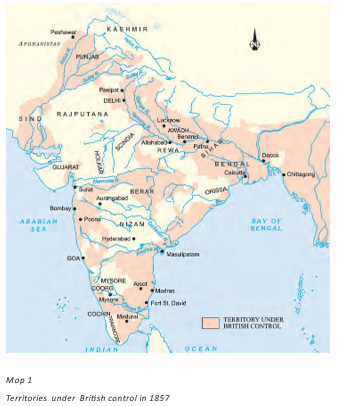
- Recruitment: A large majority of Bengal Army sepoys came from Awadh and eastern Uttar Pradesh; many were Brahmins or from upper castes. Awadh was called the “nursery of the Bengal Army”.
- Shared grievances: Sepoys’ village families experienced the effects of annexation, while concerns about cartridges, leave and officer abuse travelled back to rural communities.
- Collective rebellion: When sepoys took up arms, villagers joined them quickly. Peasants moved into towns and fought alongside soldiers and townspeople.
- Overall significance: In Awadh, revolt linked princes, taluqdars, peasants and sepoys in resistance to foreign rule and the disruption of a valued world.
- Annexation
- The taking of a territory and its incorporation into another state.
- Subsidiary Alliance
- An arrangement that placed an Indian ruler under British military and political control.
- Taluqdar
- A landholding chief with local authority over an estate and its villages.
- Summary Settlement
- The British revenue settlement introduced in Awadh after annexation in 1856, which removed many taluqdars from their lands.
- Firangi raj
- Foreign, or British, rule, associated in Awadh with the disruption of valued institutions and relationships.
Why did people mourn Wajid Ali Shah’s departure?
How did British land policies create grievances among both taluqdars and peasants?
Why did sepoy discontent spread quickly into Awadh’s villages?
Quick recap
- Awadh annexed: The 1856 takeover followed British political and military control established through the Subsidiary Alliance.
- Wajid Ali Shah’s exile: His removal caused grief and deprived court workers of their livelihoods.
- Taluqdars dispossessed: Disarmament and the Summary Settlement weakened landholders and disrupted rural patronage.
- Peasants burdened: Revenue demands remained high and rigid despite the removal of taluqdars.
- Sepoys connected to villages: Shared ties and grievances helped turn local resistance into collective rebellion.
- Awadh’s revolt: Princes, taluqdars, peasants, sepoys and townspeople resisted British rule together.
What the Rebels Wanted
Reconstructing the Rebels’ Views
What the sources reveal
- Limited rebel records: Repression, low literacy and the ordinary backgrounds of many rebels left few first-hand accounts.
- Main surviving sources: Rebel proclamations and ishtahars (notifications) were used to spread ideas and urge people to join.
- Source imbalance: British accounts dominate the record, revealing much about officials but little about rebel aims.
- Proclamation / ishtahar
- A public announcement used by rebel leaders to communicate aims and seek support.
- Arzi
- A petition or application; a surviving sepoy arzi describes the soldiers’ grievances.
- Badshahi
- The imperial government that the Azamgarh Proclamation promised would replace British rule.
A Vision of Unity
Hindu-Muslim solidarity
- Broad appeal: Proclamations called on people of all castes and religions to unite against British rule.
- Shared stakes: Rebels presented the conflict as one in which Hindus and Muslims had equally much to lose or gain.
- Shared past: Proclamations praised Hindu-Muslim coexistence under the Mughal Empire; Bahadur Shah’s appeal invoked both Muhammad and Mahavir.
- British attempts to divide: In Bareilly, the British spent Rs. 50,000 in December 1857 to turn Hindus against Muslims; the effort failed.
Dates in the sources
- 25 August 1857The Azamgarh Proclamation was issued, outlining grievances and appealing for support.
- December 1857The British attempt in Bareilly to stir Hindu-Muslim conflict failed.
The Azamgarh Proclamation
Overall message
- Common cause: The proclamation described British rule as oppressive to both Hindus and Muslims and called on Indians to join a shared struggle.
- Support and reward: It promised subsistence to those willing to fight but unable to support themselves, and urged people to support the Badshahi government.
- End of British rule: It claimed that religious writings and predictions showed British power would not last, and urged people not to miss the opportunity to act.
| Group | Grievances under British rule | Promised change under Badshahi rule |
|---|---|---|
| Zemindars | High revenue demands; estates auctioned for arrears; loss of dignity in courts; costly litigation and extra subscriptions. | Lighter revenue, protected honour and authority within their zemindaries. |
| Merchants | British monopolies over valuable trade; taxes, tolls and postages; risk of imprisonment and disgrace. | Trade in all goods by land and water open to Indian merchants; these practices ended. |
| Public servants | Natives in civil and military service received low pay and little respect or influence; senior posts went to Englishmen. | Immediate salaries of 200–300 rupees a month and access to high posts. |
| Artisans | Imported English goods displaced weavers, cotton dressers, carpenters, blacksmiths and shoemakers. | Employment in the service of kings, rajahs and the wealthy. |
| Pundits and fakirs | The proclamation portrayed Europeans as enemies of Hindu and Muslim religions. | Religious leaders were urged to join the struggle to defend their faiths. |
Treat the proclamation’s promises as the rebels’ appeals and political programme, not as proof that every promise was later carried out.
What the Sepoys Thought
Sepoy grievances in the arzi
- Past service: The petition says Indian soldiers had helped the British conquer territories and had served without rebelling.
- Religious threat: Sepoys said new cartridges were greased with cow and pig fats, and that wheat flour mixed with powdered bones was being distributed.
- Coercion: After troopers of the 3rd Light Cavalry refused to bite the cartridges, 84 were imprisoned in irons; the petition says troops and guns were used to intimidate the regiments.
- Reason for fighting: Sepoys said they united to protect their faiths from pollution and fought the British for this purpose.
| Point | Azamgarh Proclamation | Sepoy Arzi |
|---|---|---|
| Main focus | A broad political and economic appeal to several social groups. | The soldiers’ account of cartridge-related religious fears and coercion. |
| Shared idea | Hindus and Muslims should unite against British rule. | Hindus and Muslims should fight together to preserve their religions. |
| Desired outcome | Support the Badshahi government and end British power. | Resist British actions perceived as threatening faith. |
What kinds of grievances against British rule did the Azamgarh Proclamation describe?
How did rebel proclamations express Hindu-Muslim unity?
According to the sepoy arzi, why did the soldiers rebel?
Quick recap
- Sources: Few rebel accounts survive, so British records dominate but reveal little about rebel aims.
- Unity: Proclamations appealed to Hindus and Muslims as partners in a common struggle.
- Azamgarh: The proclamation combined opposition to British rule with group-specific economic and political grievances.
- Badshahi: It promised changes benefiting zemindars, merchants, public servants and artisans, and called for religious leaders’ support.
- Sepoys: Their arzi centred on cartridge fears, coercion and the defence of religious faith.
Against the Symbols of Oppression
Rejection of British Rule
Firangi raj — A term used for British rule, which the rebels’ proclamations rejected as untrustworthy and oppressive.
Grievances against British rule
- Political distrust: Proclamations condemned British annexations and broken treaties, claiming the British could not be trusted.
- Land revenue: Settlements dispossessed both large and small landholders.
- Foreign commerce: Artisans and weavers were driven to ruin.
- Loss of a way of life: Rebels accused British rule of destroying a familiar, cherished world they wanted to restore.
Religion, Livelihood and Unity
The call to resist
- Religious fear: Proclamations voiced the fear that the British intended to destroy Hindu and Muslim caste and religion and convert people to Christianity.
- Rumours: This fear encouraged people to believe rumours circulating at the time.
- Appeal to unity: People were urged to defend their livelihood, faith, honour and identity in a struggle for the “greater public good.”
- Shared opposition: The appeal sought to unite different social groups against firangi raj.
Attacks on Local Oppressors
A challenge to social hierarchies
- Targets: In many places, rebels attacked people seen as British allies or local oppressors.
- Urban elites: Rebels sometimes deliberately humiliated the elites of a city.
- Villages: They burnt account books and ransacked moneylenders’ houses.
- Possible vision: These actions challenged traditional hierarchies and suggest a more egalitarian society, though this vision was not stated in the proclamations.
- Proclamations’ aim: The proclamations instead stressed unity across social groups in the fight against British rule.
The Search for Alternative Power
Restoring authority and organising resistance
- Where: After British authority collapsed, rebels in places such as Delhi, Lucknow and Kanpur tried to establish authority and administration.
- Model: Their leadership harked back to the eighteenth-century Mughal court and the pre-British world, which had become a symbol of what was lost.
- Administration: They made appointments, arranged land-revenue collection and troop payments, and issued orders against looting and plunder.
- Military organisation: They planned battles and established chains of command in the army.
- Purpose and limits: These structures were mainly designed to meet the demands of war and generally could not survive the British onslaught.
Resistance in Awadh
- Duration: Resistance to the British lasted longest in Awadh.
- Organisation: The Lucknow court drew up counter-attack plans and maintained hierarchies of command into the last months of 1857 and early 1858.
Evidence and the Rebels’ Point of View
Challenges for historians
- Limited evidence: Proclamations reveal what rebel leaders publicly urged, but do not necessarily express every rebel’s views.
- Unity versus diversity: Proclamations aimed to unite social groups, so they do not clearly express the more egalitarian possibilities suggested by attacks on local elites and moneylenders.
- Source perspective: A British officer’s report describes villagers from the colonial side, not in their own words.
- Careful reconstruction: Historians must compare available accounts and distinguish leaders’ stated aims, rebels’ actions and outsiders’ interpretations.
Villagers as Rebels: Awadh
What the British officer reported
- Numbers and weapons: Civil authorities reported a very large number of villagers, with many guns.
- Mobility: Villagers were difficult for Europeans to pin down: they melted away and then regrouped.
- Pressure on communications: The officer reported villagers pressing down on the line of communication from the north.
What problems did British forces face in dealing with the Awadh villagers, according to the officer’s account?
Why is it difficult for historians to reconstruct the rebels’ point of view?
Quick recap
- Rebel proclamations rejected British rule for annexations, broken treaties, dispossession and economic damage.
- Fears of attacks on religion and conversion fuelled rumours and calls to defend livelihood, faith, honour and identity.
- Rebels attacked local oppressors and sometimes challenged traditional hierarchies, suggesting an alternative egalitarian vision.
- Rebel administrations looked to the eighteenth-century Mughal court and were organised mainly to sustain the war.
- Awadh’s resistance and the Lucknow court’s military planning continued into early 1858.
- Awadh villagers were reported as numerous, armed, mobile and difficult for the British to pin down.
Repression & Images of the Revolt
Repression
Emergency laws and punishment
- Special laws: Acts passed in May and June 1857 placed all of North India under martial law.
- Suspended legal process: Military officers and ordinary Britons could try and punish Indians suspected of rebellion; normal trials were set aside.
- Punishment: The British declared that rebellion would be punished by death.
- Reinforcements: Using these laws and troops sent from Britain, the British began a large-scale military reconquest.
British campaign to recapture Delhi
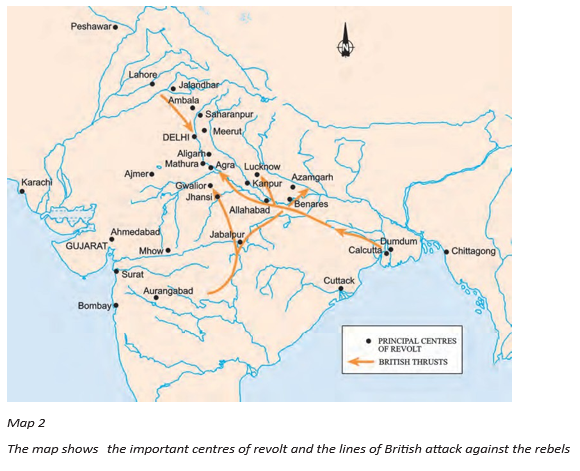
- Two-pronged advance: One force moved north from Calcutta; another advanced from the largely peaceful Punjab.
- Delhi targeted: Both forces aimed to recapture Delhi, whose symbolic importance was recognised by the British and rebels.
- Prolonged siege: The British began their serious attempt in early June 1857, but captured Delhi only in late September.
- Heavy losses: Fighting was fierce partly because rebels from across North India had gathered to defend the capital.
Reconquest of the countryside
- Gangetic plain: British progress was slow; troops had to retake the area village by village.
- Popular resistance: The hostile countryside showed the British they faced a broadly supported uprising, not merely a military mutiny.
- Awadh: British official Forsyth estimated that three-fourths of adult men there were in rebellion.
- Outcome: Awadh was brought under British control only in March 1858, after prolonged fighting.
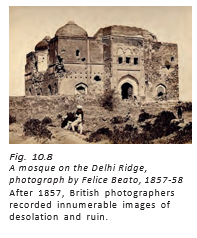
British strategy against landholders
- United resistance: In parts of present-day Uttar Pradesh, large landholders and peasants resisted together.
- Divide the opposition: The British offered to restore estates to large landholders to weaken this unity.
- Unequal treatment: Rebel landholders were dispossessed, while those loyal to the British were rewarded.
- Fates of rebels: Some landholders died fighting; others fled to Nepal, where illness or starvation killed many.
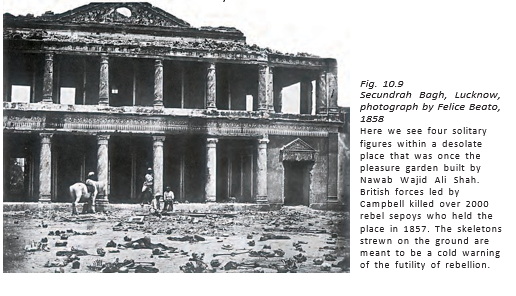
Images of the Revolt
| Evidence | Interpretation | |
|---|---|---|
| Rebel perspectives | Few proclamations, notifications and letters by rebel leaders survive. | The limited record makes it difficult to reconstruct rebel actions from their own point of view. |
| British written accounts | Officials and military personnel produced letters, diaries, autobiographies, official histories, memos, notes and reports. | These sources reveal official fears, anxieties and views of the rebels, but are shaped by the colonial perspective. |
| Newspapers and magazines | British publications described violence attributed to the mutineers in graphic detail. | Such accounts inflamed public feeling and encouraged demands for revenge and retribution. |
| Visual images | British and Indian artists produced paintings, pencil drawings, etchings, posters, cartoons and bazaar prints. | Images can communicate viewpoints and shape how audiences understand events. |
- Martial law
- Military rule under which ordinary legal procedures are suspended.
- Mutiny records
- Collected documentary records, including official reports, memos and notes about the revolt.
- Proclamation
- A formal public statement or announcement, including those issued by rebel leaders.
Celebrating the Saviours
The British relief of Lucknow
- The siege: When rebel forces besieged Lucknow, Commissioner Henry Lawrence gathered the Christian population in the fortified Residency.
- Defence: Lawrence was killed, but Colonel Inglis continued to defend the Residency.
- First relief: James Outram and Henry Havelock arrived on 25 September, fought through rebel forces and reinforced the British garrison.
- Rescue: Twenty days later, the newly appointed commander Colin Campbell arrived with troops and rescued the besieged garrison.
- British account: The siege was presented as a story of survival, heroic resistance and the eventual triumph of British power.
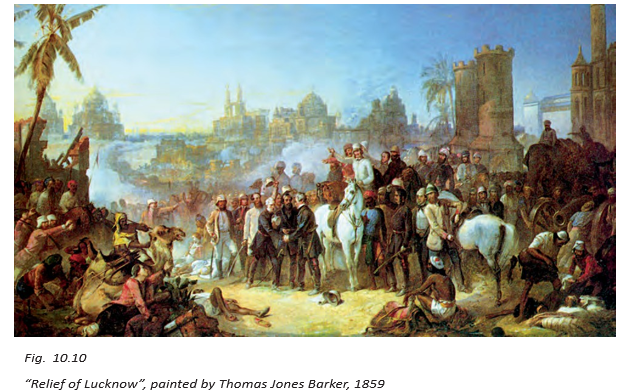
How the painting shapes its message
- Central heroes: Campbell, Outram and Havelock occupy the centre; surrounding gestures direct the viewer’s gaze towards them.
- Setting: The heroes stand in bright light, contrasted with foreground shadows and the damaged Residency behind them.
- Cost of conflict: The dead and injured in the foreground show the suffering caused by the siege.
- Restored control: Triumphant horses in the middle ground symbolise the re-establishment of British power.
- Public effect: The painting reassured British viewers that the crisis was over and Britain had emerged victorious.
How did the British try to weaken resistance by landholders and peasants?
What do British written records and images reveal about the revolt?
How does Barker’s “Relief of Lucknow” present the British role?
Quick recap
- Acts in May and June 1857 imposed martial law across North India and allowed suspected rebels to be punished without ordinary trials.
- The British advanced on Delhi from Calcutta and the Punjab, capturing it in late September 1857 after heavy fighting.
- Reclaiming the countryside was slow; Awadh remained in rebellion until March 1858.
- The British used promises of restored estates to divide landholders from peasants and rewarded loyal landholders.
- Rebel sources are scarce; many accounts come from British officials, newspapers and visual representations.
- Barker’s 1859 painting of Lucknow presented British commanders as saviours and the revolt as defeated.
English Women and the Honour of Britain
English Women and the Honour of Britain
Newspapers and public feeling
- Newspaper reports shaped public attitudes towards the revolt, especially through accounts of violence against women and children.
- Public response in Britain included demands for revenge and for the protection of women’s honour and children’s safety.
- Artists both expressed existing feelings and influenced how audiences understood the events.
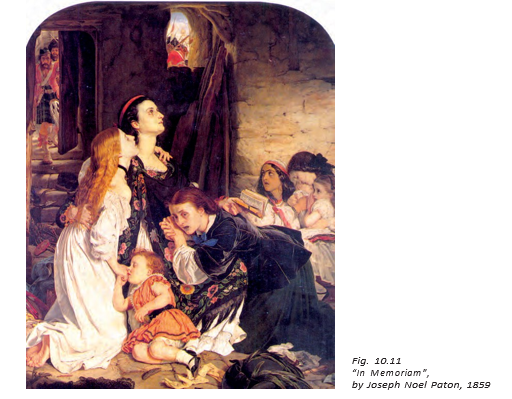
How British images represented women
- In Memoriam suggests the threat of dishonour, violence and death without showing graphic violence; this invites viewers to imagine it and feel anger.
- Its composition presents the women and children as helpless and innocent, while British rescue forces appear in the background as saviours.
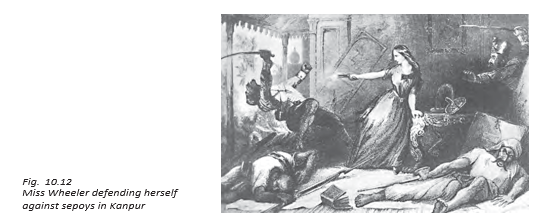
- Miss Wheeler illustrations instead show a woman as heroic, defending herself and killing attackers; the rebels are depicted as threatening and demonised.
- Religious meaning is added through a Bible on the floor: the woman’s struggle is framed as defending both her honour and Christianity.
Vengeance and Retribution
From shock to calls for repression
- Reports and images of the revolt stirred anger and shock in Britain.
- Calls for revenge grew louder, and violent repression was presented as necessary and just.
- British honour and power were portrayed as challenged by the rebellion.
- Repression was used to demonstrate British invincibility.
Visualising vengeance
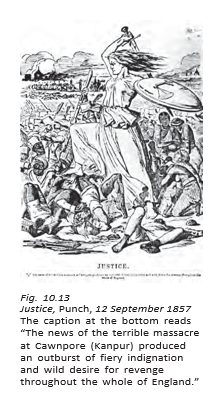
- Justice is shown as an aggressive female figure carrying a sword and shield, with a face expressing rage and revenge.
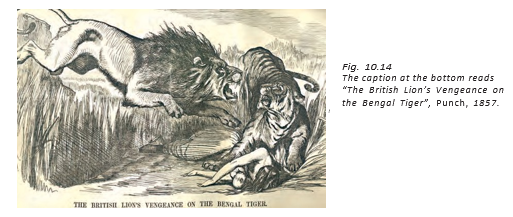
- The image’s message connects justice with punishment: sepoys are trampled, while Indian women and children appear frightened.
- British press cartoons, including “The British Lion’s Vengeance on the Bengal Tiger,” helped justify brutal repression and retaliation.
The Performance of Terror
Public executions as punishment
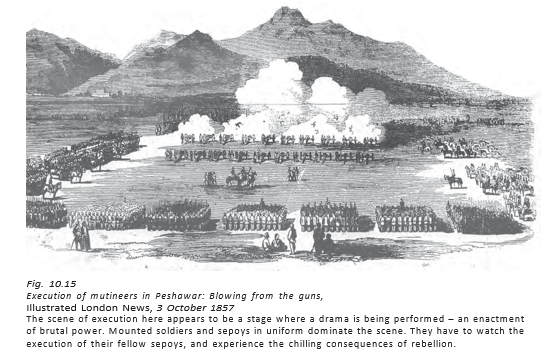
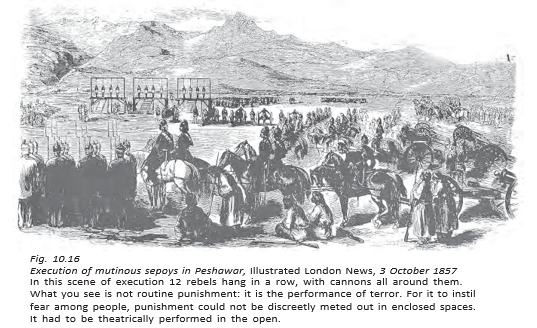
- Executions expressed the British demand for vengeance: rebels were blown from guns or hanged.
- Circulation of execution images in popular journals made punishment a public spectacle and displayed the force of British authority.
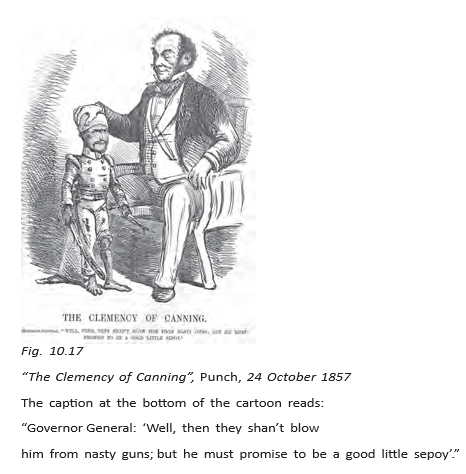
No Time for Clemency
| Point | Canning’s position | British press response |
|---|---|---|
| Policy | Governor General Canning argued that leniency and mercy could help regain sepoy loyalty. | At a time of public anger, pleas for moderation were mocked. |
| Punch cartoon | Canning appears as a protective father figure, shielding a small sepoy. | The sepoy holds a sword and dagger shown as bloodstained, portraying clemency as dangerous. |
| Wider message | Mercy is presented as a possible way to restore loyalty. | The imagery supports vengeance and treats mercy as misplaced. |
Nationalist Imageries
Recasting the revolt as a freedom struggle
- Twentieth-century nationalism drew inspiration from 1857 and celebrated it as the First War of Independence.
- Nationalist accounts presented people from different sections of India as united against imperial rule.
- Art, literature and history-writing kept the revolt’s memory alive and represented its leaders as heroic figures who inspired resistance to oppression.
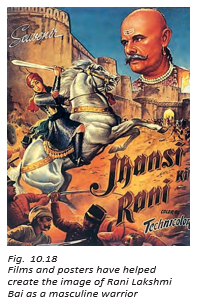
- Rani Lakshmi Bai was portrayed as a courageous warrior fighting for her motherland; popular images show her in armour, with a sword, riding a horse.
- Subhadra Kumari Chauhan’s poem made the Rani’s courage widely memorable: “Khoob lari mardani woh to Jhansi wali rani thi.”
| Point | What images reveal | What images do |
|---|---|---|
| Perspective | Visual choices reveal what artists felt and wanted to communicate. | Images guide viewers towards particular emotions and interpretations. |
| Audience | Public appreciation, criticism and purchase of copies show how images were received. | Circulation could strengthen support for repression in Britain or shape nationalist ideas in India. |
| Overall | Images reflect feelings of the time. | Images also shape public sensibilities; they do not merely record events. |
Dates and Periods in the Lecture
- 1857British cartoons and execution images represented the revolt and calls for retaliation.
- 1859Joseph Noel Paton painted *In Memoriam*, two years after the revolt.
- Twentieth centuryNationalist imagination celebrated 1857 as the First War of Independence.
- Retribution
- Punishment or revenge inflicted in response to an offence or challenge.
- Clemency
- Mercy or lenient treatment towards those being punished.
- Nationalist imagery
- Images and stories that present the revolt as a shared struggle against imperial rule.
- Sensibilities
- Public feelings, attitudes and ways of responding to events.
How did British images of women shape public attitudes towards the revolt?
What was the contrast between Canning’s position and the mood in the British press?
How did nationalist representations reinterpret the revolt of 1857?
Quick recap
- Newspapers and images shaped British feelings about the revolt, especially through depictions of threatened women and children.
- British representations often demonised rebels and helped make revenge and repression appear justified.
- Executions were shown publicly to communicate punishment and British authority.
- Canning’s call for clemency was mocked in a press climate favouring retribution.
- Twentieth-century nationalist imagery celebrated 1857 as the First War of Independence and made Rani Lakshmi Bai a heroic symbol.
- Images both reflect the attitudes of their time and influence the attitudes of their audiences.
History — ALL CHAPTERS
1
BRICKS, BEADS AND BONES THE HARAPPAN CIVILISATION
2
KINGS, FARMERS AND TOWNS EARLY STATES AND ECONOMIES (C. 600 BCE-600 CE)
3
KINSHIP, CASTE AND CLASS EARLY SOCIETIES (C. 600 BCE-600 CE)
4
THINKERS, BELIEFS AND BUILDINGS CULTURAL DEVELOPMENTS (C. 600 BCE - 600 CE)
1
THROUGH THE EYES OF TRAVELLERS PERCEPTIONS OF SOCIETY (C. TENTH TO SEVENTEENTH CENTURY)
2
BHAKTI- SUFI TRADITIONS CHANGES IN RELIGIOUS BELIEFS AND DEVOTIONAL TEXTS (C. EIGHTH TO EIGHTEENTH CENTURY)
3
AN IMPERIAL CAPITAL VIJAYANAGARA (C. FOURTEENTH TO SIXTEENTH CENTURY)
4
PEASANTS, ZAMINDARS AND THE STATE AGRARIAN SOCIETY AND THE MUGHAL EMPIRE (C. SIXTEENTH- SEVENTEENTH CENTURY)
1
COLONIALISM AND THE COUNTRYSIDE EXPLORING OFFICIAL ARCHIVES
2
REBELS AND THE RAJ THE REVOLT OF 1857 AND ITS REPRESENTATIONS
3
MAHATMA GANDHI AND THE NATIONALIST MOVEMENT CIVIL DISOBEDIENCE AND BEYOND
4
FRAMING THE CONSTITUTION THE BEGINNING OF A NEW ERA