Class 12 Humanities . History . Themes In Indian History Part III . Mahatma Gandhi and the Nationalist Movement Civil Disobedience and Beyond
Chapter 3: MAHATMA GANDHI AND THE NATIONALIST MOVEMENT CIVIL DISOBEDIENCE AND BEYOND
Ch 3
History
Class 12 Humanities
Introduction & a Leader Announces Himself
Gandhi, History and the National Movement
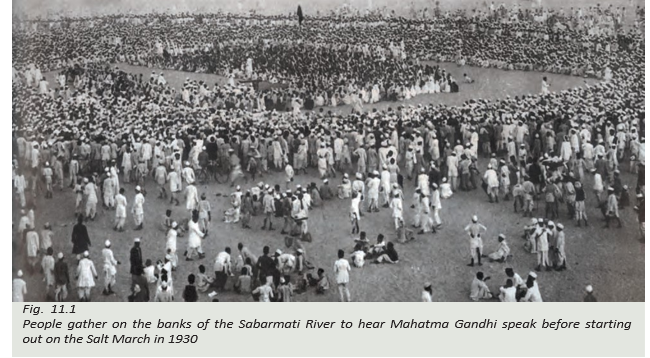
A Leader Announces Himself
Satyagraha — A distinctive method of non-violent protest that Gandhi first developed in South Africa.
The Political Landscape Gandhi Returned To
| Group or leader | Key figures | Approach or significance |
|---|---|---|
| Lal, Bal and Pal | Lala Lajpat Rai (Punjab), Bal Gangadhar Tilak (Maharashtra), Bipin Chandra Pal (Bengal) | Advocated militant opposition to colonial rule; their different provinces represented the all-India reach of the struggle. |
| Moderates | Gopal Krishna Gokhale and Mohammad Ali Jinnah | Favoured a more gradual and persuasive approach; Gokhale was Gandhi’s acknowledged political mentor. |
| Point | Militant nationalists | Moderates |
|---|---|---|
| Approach | Militant opposition to colonial rule | Gradual and persuasive methods |
| Examples | Tilak, Bipin Chandra Pal and Lala Lajpat Rai | Gopal Krishna Gokhale and Mohammad Ali Jinnah |
Gandhi’s First Years Back in India
- Gokhale’s advice: Gandhi spent a year travelling around British India to learn about the land and its people.
- First major public appearance: At the opening of Banaras Hindu University (BHU) in February 1916, Gandhi was still relatively unknown in India.
- Why he was invited: His invitation reflected his work in South Africa, not an established position within Indian politics.
- Audience: Princes, philanthropists and Congress leaders, including Annie Besant, attended the opening.
The BHU Speech: A Call for Representative Nationalism
- Critique of privilege: Gandhi challenged the elite’s indifference to the labouring poor and the millions absent from the gathering.
- Representative nationalism: He argued that India’s salvation and self-government depended on peasants and workers, not only lawyers, doctors and landlords.
From Principle to Action: Champaran
Gandhi’s Call for Broader Nationalism
- Nationalism was largely led by wealthy and educated elites
- Peasants and workers, despite forming a majority, remained unrepresented
- Gandhi challenged the elite to recognise their responsibilities to the poor
- He called for a nationalism that included ordinary Indians
- The Champaran peasant’s appeal offered a chance to act on this principle
Key Dates
- 1893Gandhi left India for South Africa.
- 1905–07The Swadeshi movement broadened Congress’s appeal among the middle classes.
- January 1915Gandhi returned to India after about two decades abroad.
- February 1916Gandhi made his first major public appearance in India at the opening of BHU in Banaras.
- December 1916At the Lucknow Congress, a Champaran peasant told Gandhi about the treatment of peasants by British indigo planters.
- 1915–1948The period of Gandhi’s activities in India examined by the chapter.
- 1930The Salt March referenced in the figure caption.
- Satyagraha
- Gandhi’s distinctive method of non-violent protest, first developed in South Africa.
- Swadeshi movement
- The 1905–07 movement that widened Congress’s middle-class appeal.
- Moderates
- Nationalists who preferred gradual and persuasive methods against colonial rule.
- Lal, Bal and Pal
- Lala Lajpat Rai, Bal Gangadhar Tilak and Bipin Chandra Pal, leaders associated with militant opposition to colonial rule.
- Trusteeship
- Gandhi’s appeal that the privileged hold wealth for the benefit of their countrymen.
How did Gandhi’s South African experience shape his later political work?
What was the significance of Gandhi’s speech at the opening of BHU?
What issue did the Champaran peasant bring to Gandhi at the Lucknow Congress?
Quick recap
- Gandhi’s political methods and concerns were shaped by his South African experience, especially satyagraha.
- India had a wider political landscape by 1915, with an expanding Congress and different nationalist approaches.
- Gokhale advised Gandhi to travel through British India to understand its people.
- At BHU in 1916, Gandhi challenged elite nationalism and stressed the importance of peasants and workers.
- The Champaran peasant’s appeal at Lucknow in 1916 linked Gandhi’s ideas to a practical issue.
The Making and Unmaking of Non-cooperation
From Local Campaigns to a National Leader
Gandhi’s early campaigns
- Champaran (1917): Gandhi supported peasants seeking secure tenancy and freedom to choose what crops to grow.
- Ahmedabad (1918): He intervened in a textile workers’ dispute, demanding better working conditions.
- Kheda (1918): He joined peasants asking for tax remission after crop failure.
- Significance: These local struggles established Gandhi as a nationalist sympathetic to the poor.
The Rowlatt Satyagraha and Jallianwala Bagh
Rowlatt Act — A law that continued wartime restrictions, including press censorship and detention without trial, on the recommendation of a committee chaired by Sir Sidney Rowlatt.
Nationwide protest and its climax
- Gandhi’s response: He called for a countrywide satyagraha; a bandh brought shops and schools to a standstill in towns across North and West India.
- Punjab: Many who served Britain in the First World War expected a reward but instead faced the Rowlatt Act. Gandhi was detained en route to Punjab, and prominent local Congressmen were arrested.
- Jallianwala Bagh: In Amritsar in April 1919, a British Brigadier ordered troops to fire on a nationalist meeting; more than 400 people were killed.
- Impact: The Rowlatt satyagraha made Gandhi a truly national leader.
Launching Non-Cooperation
Non-cooperation — A campaign to end colonial rule by withdrawing Indians’ voluntary cooperation from British institutions and authority.
Aims and strategy
- Actions urged: Stop attending government schools, colleges and law courts, and refuse to pay taxes.
- Promise: Gandhi said effective non-cooperation could win swaraj within a year.
- Khilafat alliance: Gandhi linked the campaigns, hoping Hindus and Muslims would unite to end colonial rule.
Khilafat Movement — A movement of Indian Muslims, led by Muhammad Ali and Shaukat Ali, seeking to preserve the Turkish Khalifa’s authority, territory and control of Muslim sacred places.
Khilafat context and demands
- Context: The Turkish ruler Kemal Attaturk had recently abolished the Caliphate, prompting demands to restore the Khalifa’s position.
- Sacred places: The Turkish Sultan or Khalifa should retain control over Muslim sacred places in the former Ottoman Empire.
- Muslim sovereignty: Arabia, Syria, Iraq and Palestine (the jazirat-ul-Arab) should remain under Muslim sovereignty.
- Khalifa’s position: He should retain enough territory to defend the Islamic faith.
- Congress support: The Congress supported the movement, and Gandhi sought to join it with Non-Cooperation.
Knitting a Popular Movement
| Participants | Action or example |
|---|---|
| Students | Stopped attending government-run schools and colleges. |
| Lawyers | Refused to attend court. |
| Workers | In 1921, official figures recorded 396 strikes involving 600,000 workers and seven million lost workdays. |
| Hill tribes in northern Andhra | Violated forest laws. |
| Farmers in Awadh | Did not pay taxes. |
| Peasants in Kumaun | Refused to carry loads for colonial officials. |
How the movement spread
- Unprecedented reach: Non-cooperation generated a surge of popular action and shook the British Raj for the first time since the Revolt of 1857.
- Local interpretations: Peasants, workers and others acted on the call in ways that served their interests; some protests defied local nationalist leaders.
- Gandhi’s approach: The campaign combined peaceful refusal with active self-discipline and was intended as training for self-rule.
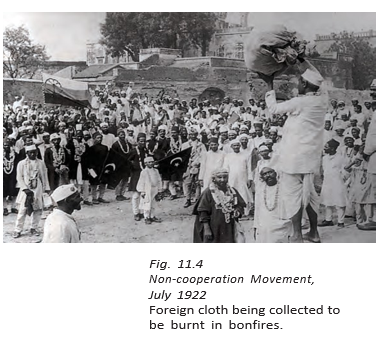
Withdrawal after Chauri Chaura
Why Gandhi Called Off the Movement
- In February 1922, a group of peasants at Chauri Chaura in the United Provinces attacked and burned a police station.
- Several constables perished in the fire.
- Gandhi judged the violence incompatible with non-violent struggle.
- He called off the movement, arguing that provocation could not justify killing defenceless men.
Arrest and Trial
Gandhi’s 1922 trial
- Arrest: Thousands of Indians were jailed during the movement; Gandhi was arrested in March 1922 and charged with sedition.
- Sentence: Justice C.N. Broomfield said the court had to impose six years’ imprisonment because Gandhi had broken the law.
- Judge’s assessment: Broomfield acknowledged Gandhi’s standing as a patriot and leader, and said he would welcome an opportunity for the government to release him early.
Key Dates
- 1914–1918During the Great War, the British introduced press censorship and detention without trial.
- 1917Gandhi campaigned in Champaran for peasants’ rights.
- 1918Gandhi intervened in the Ahmedabad mill workers’ dispute and the Kheda tax-remission campaign.
- 1919Gandhi launched the Rowlatt satyagraha; more than 400 people were killed at Jallianwala Bagh in April.
- 1919–1920The Khilafat Movement sought to preserve the Khalifa’s position and Muslim control of sacred places.
- 1921Official figures recorded 396 strikes involving 600,000 workers and seven million lost workdays.
- February 1922The Chauri Chaura violence led Gandhi to call off the Non-Cooperation Movement.
- March 1922Gandhi was arrested and tried for sedition.
Why did Gandhi link the Khilafat Movement with Non-Cooperation?
Why did Gandhi withdraw the Non-Cooperation Movement?
Quick recap
- Champaran, Ahmedabad and Kheda established Gandhi’s reputation through campaigns for peasants and workers.
- The Rowlatt satyagraha opposed wartime restrictions; Jallianwala Bagh was its bloody climax.
- Non-Cooperation asked Indians to withdraw support from British institutions, with swaraj promised within a year if carried out effectively.
- Gandhi linked the campaign to Khilafat, whose supporters opposed the abolition of the Caliphate and sought to protect the Khalifa’s position.
- People adapted non-cooperation to local concerns, sometimes acting beyond or against nationalist leaders’ direction.
- Gandhi called off the movement after the Chauri Chaura violence in February 1922.
A People’s Leader
Nationalism Becomes a Mass Movement
Gandhi’s connection with ordinary people
- By 1922: Nationalism had expanded beyond professionals and intellectuals to include hundreds of thousands of peasants, workers and artisans.
- Popular image: Many people called Gandhi “Mahatma” because he dressed, lived and spoke in ways they recognised.
- Identification: Gandhi showed empathy with ordinary people and their working lives instead of appearing distant from them.
- Distinctive dress: He wore a simple dhoti or loincloth rather than formal Western or Indian elite clothing.
- Charkha: Gandhi’s daily spinning connected mental and manual labour, challenging traditional caste divisions.
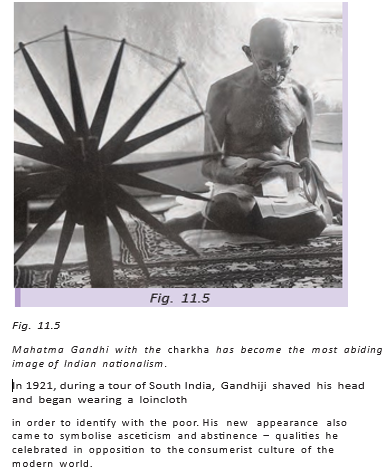
The Charkha, Machinery and Khadi
Gandhi’s view of machinery
- Criticism: Gandhi opposed the craze for machinery when it displaced workers and concentrated wealth; he believed machines could enslave people and displace labour.
- Charkha as a symbol: The spinning wheel represented a society that did not glorify machines and technology.
- Employment and fairness: Gandhi wanted labour and time saved for everyone, and wealth shared broadly rather than concentrated in a few hands.
- Self-reliance: Spinning could provide poor people with supplementary income and help them become self-reliant.
- Khadi and machinery: Gandhi did not reject all machinery; khadi regulated its use and directed it towards serving the poor in their homes. The charkha itself was a machine.
Gandhi’s Image Among Peasants
Popular beliefs and rumours
- Shahid Amin’s study: The historian traced Gandhi’s image among eastern Uttar Pradesh peasants through local press reports and rumours.
- Crowds: During Gandhi’s February 1921 journey, large crowds gathered at railway stations, donated money and sought his darshan.
- Names and hopes: Called “Gandhi baba”, “Gandhi Maharaj” or “Mahatma”, he was seen by many peasants as a saviour from high taxes and oppressive officials who could restore dignity and autonomy.
- Claims tested: Stories said a sugarcane-juice pan split after a man demanded proof of Gandhi’s power, and that wheat in a field became sesame after a cultivator said he would believe in Gandhi if this happened.
- Rumoured punishments: Stories said a critic’s house caught fire; a man who abused Gandhi had his goat bitten by his own dogs; and brickbats fell when a villager who had promised to give up liquor set off for the liquor shop.
- What rumours reveal: They are evidence of popular beliefs, hopes and fears, not proof that Gandhi caused miracles or misfortunes.
| Evidence | Interpretation | |
|---|---|---|
| Examples | Some stories described supposed miracles when people tested Gandhi’s power; others linked misfortune to people who opposed him. | These stories reflect the beliefs and expectations of the people who circulated them; they do not establish that Gandhi caused the events. |
| What they reveal | Local newspapers recorded rumours circulating in the United Provinces. | Rumours reveal popular hopes and fears, including the desire for protection from taxes and officials. |
Why Gandhi connected with the labouring poor
- Background and contrast: Gandhi was by caste a merchant and by profession a lawyer, but his simple lifestyle and hands-on work helped him empathise with labouring people.
- Symbols: His dhoti and charkha made his identification with ordinary people visible.
- Mutual understanding: Many felt he did not talk down to them; he seemed to understand and relate to their lives.
How Nationalism Reached More People
Organisation and communication
- Congress branches: New branches spread the nationalist movement across different parts of India.
- Praja Mandals: These organisations promoted nationalism in princely states.
- Mother tongues: Gandhi encouraged nationalist communication in people’s own languages rather than English.
- Linguistic regions: Congress provincial committees were organised by language, not by British India’s administrative boundaries.
- Wider participation: These measures carried nationalism to distant areas and social groups previously untouched by it.
| Point | Peasants | Businessmen and industrialists |
|---|---|---|
| Reasons for support | Many hoped for relief from high taxes and oppressive officials, and for greater dignity and autonomy. | Some expected independence to end the advantages enjoyed by British competitors. |
| Form of support | Gandhi’s lifestyle and symbols helped him connect with the labouring poor. | Some entrepreneurs supported the movement openly; others did so quietly. |
| Example | Peasants formed a major part of the expanding nationalist movement. | G.D. Birla openly supported the national movement. |
Gandhi’s Associates
The growth of Gandhian nationalism
- Between 1917 and 1922: A group of talented Indians joined Gandhi and helped inspire many others to join and work for the Congress.
- Associates: Mahadev Desai, Vallabh Bhai Patel, J.B. Kripalani, Subhas Chandra Bose, Abul Kalam Azad, Jawaharlal Nehru, Sarojini Naidu, Govind Ballabh Pant and C. Rajagopalachari.
- Range: Gandhi’s close associates came from different regions and religious traditions.
Social Reform and Self-Reliance
Gandhi as social reformer
- After his release: Gandhi was released from prison in February 1924 and focused on khadi and the abolition of untouchability.
- Social change: He opposed child marriage and untouchability and promoted Hindu-Muslim harmony.
- Economic self-reliance: Wearing khadi rather than imported, mill-made cloth was a way to build economic independence.
- Wider role: Gandhi was both a political leader and a social reformer; he believed Indians had to address social evils to be worthy of freedom.
Key Dates
- February 1916Gandhi’s BHU speech expressed a promise fulfilled by his later transformation of nationalism.
- 1917–1922A group of talented Indian associates gathered around Gandhi and helped expand the movement.
- February 1921Gandhi travelled through eastern Uttar Pradesh and was welcomed by large crowds.
- 1922Nationalism had grown into a mass movement involving peasants, workers and artisans.
- February 1924Gandhi was released from prison and focused on khadi and the abolition of untouchability.
- 13 November 1924Young India published Gandhi’s criticism of machinery that displaced workers and concentrated wealth.
- 17 March 1927Young India explained that khadi regulated machinery and used it to serve the poor.
- Charkha
- A spinning wheel used by Gandhi as a symbol of simple living, work and self-reliance.
- Khadi
- Home-spun cloth promoted as an alternative to imported, mill-made cloth.
- Praja Mandals
- Organisations that promoted nationalism in princely states.
- Untouchability
- A social practice Gandhi sought to abolish as part of reforming Indian society.
Why did Gandhi’s charkha and simple dress help him connect with ordinary people?
How did Gandhi and the Congress broaden the reach of nationalism?
What do the rumours about Gandhi reveal?
Quick recap
- By 1922, nationalism had become a mass movement involving peasants, workers and artisans.
- Gandhi’s dress, lifestyle and charkha helped him identify with ordinary people and challenge divisions between mental and manual labour.
- The charkha symbolised a society that did not glorify machinery; Gandhi criticised machinery that displaced workers but accepted tools serving the poor.
- Some rumours described supposed miracles when people tested Gandhi’s power, while others linked misfortune to people who opposed him; both kinds reveal popular beliefs.
- Congress branches, Praja Mandals and mother-tongue communication carried nationalism to more regions and groups.
- Gandhi’s associates helped expand the movement, while his social programme promoted khadi, self-reliance and reform.
The Salt Satyagraha a Case Study & Dandi
From Social Reform to Purna Swaraj
Political developments before the Salt March
- Political return: After the Non-cooperation Movement ended, Gandhi focused for several years on social reform; by 1928, he was considering a return to politics.
- Simon Commission: An all-White commission sent from England to investigate conditions in India faced an all-India protest in 1928. Gandhi did not join the campaign but supported it.
- Bardoli: Gandhi also supported the peasant satyagraha there in 1928.
- Lahore Congress: At the end of December 1929, Jawaharlal Nehru became Congress President, signalling a shift of leadership towards the younger generation.
- Purna Swaraj: The Congress declared its commitment to complete independence.
The road to the Salt March
- 1928Simon Commission protests took place; Gandhi supported the campaign and the Bardoli peasant satyagraha.
- Late December 1929The Lahore Congress elected Jawaharlal Nehru President and declared commitment to Purna Swaraj.
- 26 January 1930Independence Day was observed across the country.
Observing Independence Day
- Public observance: People hoisted the national flag and sang patriotic songs; Gandhi urged whole villages and cities to make the declaration together.
- Programme: Meetings were to begin at the same time, announced traditionally by beating drums. The day could include spinning, service to untouchables, Hindu-Muslim unity and prohibition work.
- Pledge: People affirmed their right to freedom and to enjoy the fruits of their labour, and their right to change or abolish a government that denied these rights and oppressed them.
Dandi and the Salt Law
Salt monopoly — The colonial government controlled the manufacture and sale of salt, preventing people from making even household salt.
Why Gandhi chose salt
- Everyday necessity: Salt was essential in every household, so the law affected people across regions and social groups.
- Economic burden: People were forced to buy taxed salt, often at a high price, and could not make it for domestic use.
- Political strategy: The deeply unpopular monopoly offered Gandhi a clear way to unite diverse grievances against British rule.
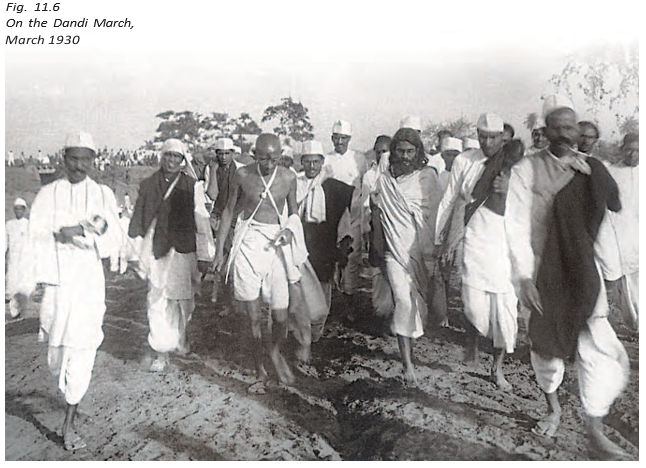
The Dandi March
- 12 March 1930Gandhi began the march from Sabarmati Ashram towards the sea, after giving Viceroy Lord Irwin advance notice.
- 5 April 1930At Dandi, Gandhi spoke of the planned breach of the salt law.
- 6 April 1930Gandhi made salt at the seashore, breaking the law; parallel salt marches took place elsewhere in India.
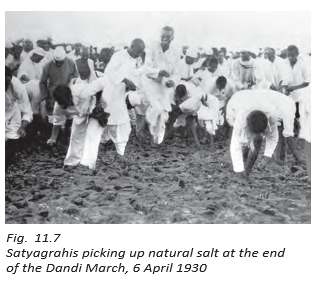
Gandhi’s criticism of the salt tax
- Salt was a vital necessity, but the government taxed it heavily and prevented people from making it.
- To stop untaxed salt being used, officials destroyed natural salt that they could not sell profitably.
- This destroyed a valuable local resource and obstructed a village industry.
- The government spent public money on destruction while imposing a tax Gandhi described as more than 1,000 per cent.
- Gandhi called the monopoly a fourfold curse: loss of a village industry, destruction of natural property, public expense for that destruction and a heavy tax on poor people.
The salt tax as a symbol of protest
- Scale of the tax: Gandhi stated that the tax could be as much as fourteen times the value of the salt.
- Government policy: Salt officers were posted to prevent local people from collecting natural salt; salt was reportedly destroyed in coastal areas.
- Popular action: Gandhi argued that the tax had endured partly because of public apathy, and that its abolition depended on the strength of popular opposition.
Civil Disobedience Spreads
Gandhi’s speech at Dandi
- Non-violence: Gandhi presented the marchers as an “army of peace” and credited peace and non-violence with helping them reach Dandi.
- Colonial response: He suggested that the government had refrained from arresting the marchers partly because of shame or fear of world opinion.
- Mass leadership: Gandhi said the movement rested on the faith that when a whole nation was roused, no single leader was necessary.
- Planned defiance: He announced that the salt tax law would be broken the next day.
Protests beyond the official campaign
- Peasants: In many areas, they broke forest laws that restricted access to woods and grazing for their cattle.
- Workers and professionals: Factory workers went on strike; lawyers boycotted British courts and students left government-run educational institutions.
- Popular participation: Gandhi’s call encouraged people of different classes to express their own opposition to colonial rule.
- Repression: The authorities detained dissenters; nearly 60,000 Indians were arrested after the Salt March, including Gandhi.
Swaraj as social reform and unity
- Village appeals: Gandhi asked local officials to resign from government service and join the freedom struggle.
- Ending untouchability: At Wasna, he argued that Swaraj required upper castes to serve untouchables and make amends for past injustices.
- Unity: He said Hindus, Muslims, Parsis and Sikhs had to unite for Swaraj; repeal of salt or other taxes alone would not be enough.
- Support: Police reports described well-attended village meetings, participation by women and men of different castes, and officials resigning to join the nationalist cause.
| Evidence | Interpretation | |
|---|---|---|
| Police reports | Recorded Gandhi’s speeches, large village crowds, volunteers and resignations by officials. | The reports show how officials monitored the march and recognised its growing strength. |
| Time magazine | Initially doubted Gandhi could complete the march; within a week it reported mass support and British anxiety. | Its changing coverage reflects a shift from ridicule and scepticism to recognition of the march’s political impact. |
Separate Electorates and the Depressed Classes
Gandhi’s argument against separate electorates
- Concern: At the Round Table Conference, Gandhi argued that separate electorates for the Depressed Classes would keep them politically separate and perpetuate the stigma of untouchability.
- Priority: He considered the destruction of untouchability essential; once the social barrier was removed, he argued, separate electorates would no longer be needed.
- Purna Swaraj
- Complete independence, adopted as the Congress goal at the Lahore session.
- Salt Satyagraha
- A non-violent campaign of civil disobedience against the colonial salt monopoly.
- Civil disobedience
- Deliberately breaking an unjust law as a form of political protest.
- Separate electorates
- An electoral arrangement in which a community votes separately for its representatives.
Why did Gandhi choose salt as the focus of civil disobedience?
What did Gandhi’s Dandi speech reveal about his view of the colonial state and the movement?
Why did Gandhi oppose separate electorates for the Depressed Classes?
Quick recap
- 1929: The Lahore Congress, led by President Jawaharlal Nehru, declared Purna Swaraj.
- 26 January 1930: Independence Day linked the freedom pledge with constructive social work.
- Salt: Gandhi targeted an essential commodity burdened by monopoly, restrictions and a heavy tax.
- Dandi: The march began on 12 March; Gandhi broke the salt law on 6 April 1930.
- Mass protest: Civil disobedience included peasants, workers, lawyers, students and many other Indians; repression led to nearly 60,000 arrests.
- Swaraj: Gandhi connected independence with non-violence, social reform and unity across communities.
Dialogues
The Significance of the Salt March
Why the Salt March mattered
- Global attention: Extensive European and American press coverage brought Gandhi to world attention.
- Women’s participation: It was the first nationalist activity involving women in large numbers. Kamaladevi Chattopadhyay urged Gandhi not to limit protests to men; women broke salt and liquor laws and courted arrest.
- British response: The march made the British recognise that their rule could not last indefinitely and that they would have to transfer some power to Indians.
Round Table Conferences and the Gandhi-Irwin Pact
Negotiations with the British
- November 1930The first Round Table Conference met in London without Gandhi, then the pre-eminent political leader in India.
- January 1931Gandhi was released from prison.
- February 1931After meetings between Gandhi and Viceroy Lord Irwin, the Gandhi-Irwin Pact was reached.
- Later in 1931Gandhi represented the Congress at the second Round Table Conference in London.
Gandhi-Irwin Pact and the second conference
- Pact terms: Civil disobedience would stop, prisoners would be released, and salt could be manufactured along the coast.
- Limitation: Irwin gave no commitment to political independence—only an assurance of talks towards that possibility. Radical nationalists criticised Gandhi for this outcome.
- Representation challenged: At the second conference, the Muslim League claimed to represent Muslims; the Princes rejected Congress claims over their territories; and B.R. Ambedkar argued that Congress did not represent the lowest castes.
- Outcome: The conference was inconclusive. Gandhi returned to India and resumed civil disobedience.
Lord Willingdon’s view of Gandhi
- Viceroy: Lord Willingdon was unsympathetic to Gandhi and viewed his actions as political manoeuvres, despite Gandhi describing them as divinely inspired.
- Perspective: Willingdon’s private letter also portrayed Gandhi’s supporters as treating him as a holy figure; this was a hostile colonial interpretation, not a neutral account.
Provincial Government and the Second World War
Political developments
- 1935The Government of India Act promised a limited form of representative government.
- 1937In elections held under a restricted franchise, Congress won a sweeping victory and formed ministries in eight of the eleven provinces.
- September 1939The Second World War began. Gandhi and Jawaharlal Nehru opposed Hitler and the Nazis and offered Congress support for the war effort if Britain promised independence after the war.
- October 1939After the British refused the offer, Congress ministries resigned.
Congress in office
- Government: The 1937 provincial ministries had Congress “Prime Ministers” working under British Governors.
- Franchise: The election victory came through a restricted franchise, not universal voting rights.
Ambedkar and Separate Electorates
| Point | Gandhi | Ambedkar |
|---|---|---|
| Position in this account | Opposed separate electorates for the Depressed Classes. | Argued that the Depressed Classes needed political power to protect themselves. |
| Main concern | The lecture gives no further explanation of Gandhi’s reasoning here. | Caste oppression, economic dependence on high-caste Hindus, social exclusion, and blocked opportunities left the community unable to defend its interests. |
| Proposed need | — | A share of political power was, in Ambedkar’s view, essential for the community’s struggle for survival and advancement. |
- Depressed Classes
- The historically oppressed communities referred to in Ambedkar’s argument.
- Separate electorates
- An electoral arrangement allowing a community to elect its own representatives.
- Individual satyagraha
- A series of individual acts of non-violent protest used by Congress to pressure the British.
- Restricted franchise
- Voting rights limited to a section of the population.
War, Satyagraha, and Political Negotiations
- March 1940The Muslim League passed a resolution demanding autonomy for Muslim-majority areas of the subcontinent.
- 1940–1941Congress organised individual satyagrahas to press Britain to promise freedom after the war.
- Spring 1942Winston Churchill sent Sir Stafford Cripps to India to seek a compromise with Gandhi and Congress.
The Changing Political Struggle
- The Muslim League demanded autonomy for Muslim-majority regions.
- Political disagreement widened beyond the question of Indian independence from Britain.
- The struggle became three-sided: Congress, the Muslim League, and the British.
The Cripps Mission
- British divisions: Labour members of the British all-party government were sympathetic to Indian aspirations, while Conservative Prime Minister Winston Churchill was a committed imperialist.
- Congress condition: Congress said it would help Britain defend India from the Axis powers only if an Indian was first appointed Defence Member of the Viceroy’s Executive Council.
- Result: The talks broke down because agreement was not reached.
What were the main terms and limitation of the Gandhi-Irwin Pact?
Why did Ambedkar argue that the Depressed Classes needed political power?
What condition did Congress set for supporting Britain in the war effort in 1942?
Quick recap
- The Salt March gained international attention, drew women into nationalist protest, and pressured Britain to consider transferring power.
- The Gandhi-Irwin Pact resumed negotiations but did not promise independence; Gandhi’s claim to represent all Indians was challenged at the second Round Table Conference.
- The Government of India Act of 1935 led to provincial elections in 1937, where Congress won in eight of eleven provinces.
- Ambedkar argued that the Depressed Classes required political power to resist caste and economic oppression.
- The war led to Congress ministry resignations and individual satyagrahas; the Muslim League’s autonomy demand made politics a three-sided struggle.
- The Cripps talks failed after Congress demanded an Indian appointment to the Defence portfolio before offering wartime support.
Quit India & Knowing Gandhi
Quit India and the Road to Partition
Quit India Movement
- Launch: After the Cripps Mission failed, Gandhi began the Quit India campaign in August 1942, his third major movement against British rule.
- Resistance: Gandhi was jailed immediately; young activists organised strikes and sabotage. Congress socialist Jayaprakash Narayan was active in the underground movement.
- Mass participation: Hundreds of thousands joined, especially young people; many students left college and went to jail.
- Repression: The British used force, but it took more than a year to suppress the rebellion.
- Political opening: While Congress leaders were imprisoned, Jinnah and the Muslim League expanded their influence, particularly in Punjab and Sind.
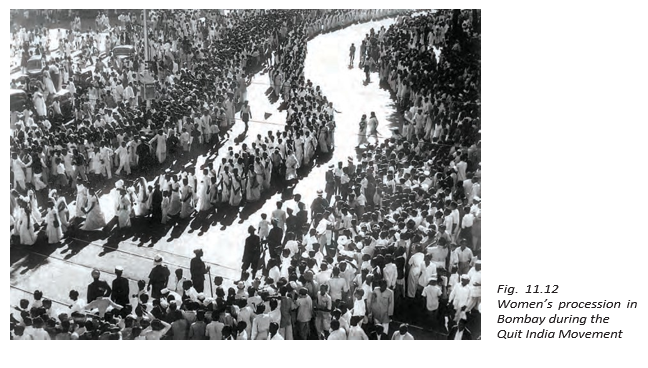
Satara’s Parallel Government
Prati Sarkar
- Background: Maharashtra’s non-Brahman movement opposed caste hierarchy and landlordism; by the 1930s it had links with the national movement.
- Formation: In 1943, younger leaders in Satara district established a parallel government called the prati sarkar.
- Organisation: Volunteer corps called seba dals and village units called tufan dals supported its work.
- Work and support: It ran people’s courts and organised constructive work; Kunbi peasants predominated, with Dalit support.
- Duration: It continued until the 1946 elections despite government repression and later disapproval from Congress.
Elections, Communal Violence and Independence
Political Polarisation
- 1946 elections: Congress won the General-category seats; the Muslim League won an overwhelming majority of seats reserved for Muslims.
- Cabinet Mission: Its plan for a federal India with provincial autonomy failed because Congress and the League could not agree.
- Direct Action Day: After talks collapsed, Jinnah called for action to press the demand for Pakistan. On 16 August 1946, riots began in Calcutta.
- Spread of violence: Riots spread to rural Bengal, Bihar, the United Provinces and Punjab; Muslims were the main victims in some places and Hindus in others.
From Political Deadlock to Partition
- Congress–League disagreement over a federal system → Cabinet Mission talks fail
- Jinnah calls for Direct Action Day → communal riots begin in Calcutta
- Violence spreads across regions → Mountbatten’s final talks also fail
- Mountbatten announces freedom with Partition → transfer of power set for 15 August 1947
Key Dates
- August 1942The Quit India campaign began after the Cripps Mission failed.
- 1943The Satara prati sarkar was established.
- June 1944Gandhi was released from prison and later met Jinnah in an effort to bridge the Congress–League divide.
- 1945A Labour government came to power in Britain and committed to granting India independence; Viceroy Wavell also brought Congress and the League into talks.
- Early 1946Provincial elections showed Congress strength in General seats and League dominance in Muslim-reserved seats.
- Summer 1946The Cabinet Mission failed to secure agreement on a federal system.
- 16 August 1946Direct Action Day was followed by deadly riots in Calcutta.
- February 1947Lord Mountbatten replaced Wavell as Viceroy.
- 15 August 1947British rule ended and power was transferred amid Partition.
- September–October 1947Gandhi visited hospitals and refugee camps, consoling displaced and distressed people.
- 20 January 1948An attempt was made on Gandhi’s life; he continued his work.
- 26 January 1948At a prayer meeting, Gandhi reflected on freedom and hoped for equality and friendship between India and Pakistan.
- 30 January 1948Nathuram Godse shot Gandhi at his daily prayer meeting.
Gandhi in the Aftermath of Partition
Peace and Minority Rights
- 15 August 1947: Gandhi was in Calcutta, not at the capital’s celebrations; he marked Independence Day with a 24-hour fast because freedom had come with Partition and communal violence.
- Peace work: He visited hospitals and refugee camps, urging Sikhs, Hindus and Muslims to set aside hatred and live peacefully.
- Minority rights: At Gandhi and Nehru’s initiative, Congress affirmed that India should be a democratic, secular state where citizens have equal rights and state protection regardless of religion.
- Partition and unity: Congress had rejected the two-nation theory. Although it accepted Partition under pressure, Gandhi urged India and Pakistan to respect and befriend one another.
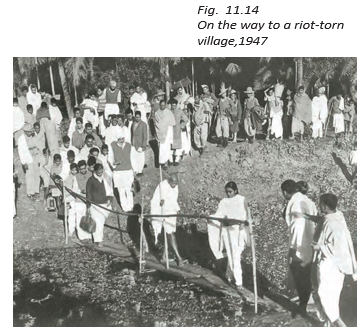
Gandhi’s Final Days and Legacy
- Hope: In January 1948, Gandhi hoped Indians would work for equality among all classes and faiths, without domination by the majority community.
- Assassination: Nathuram Godse shot Gandhi at his prayer meeting on 30 January 1948.
- Public response: His death brought widespread grief and tributes across India’s political spectrum and from international figures, including George Orwell and Albert Einstein.
- Comparison: Time magazine compared Gandhi’s killing with Abraham Lincoln’s, linking both assassinations to prejudice against equality and inter-community friendship.
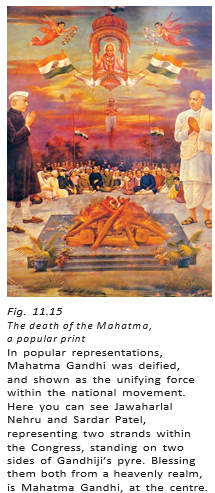
Knowing Gandhi: Sources and Their Limits
Public Voice and Private Writings
- Sources: Gandhi’s career and the nationalist movement can be studied through writings and speeches by him, his associates and his political opponents.
- Speeches: They reveal a person’s public voice and arguments.
- Private letters: They may reveal anger, pain, anxiety, hopes and frustrations that writers might not express publicly.
- Limits of the distinction: Personal letters can be written with future publication in mind; fear of publication can also restrict honest expression.
- Examples: Gandhi published letters sent to him in *Harijan*; Nehru edited letters written to him during the movement as *A Bunch of Old Letters*.
| Point | Public voice | Private letters |
|---|---|---|
| Typical source | Speeches and public statements | Letters written to individuals |
| What it may reveal | Public arguments and positions | Personal feelings and concerns |
| Important caution | May not express private thoughts | May be shaped by intended or feared publication |
- Prati sarkar
- A parallel government established in Satara during the Quit India movement.
- Seba dals
- Volunteer corps organised by the Satara parallel government.
- Tufan dals
- Village units connected with the Satara parallel government.
- Direct Action Day
- The day called by Jinnah to press the Muslim League’s demand for Pakistan; it was followed by deadly riots.
- Two-nation theory
- The idea that Hindus and Muslims formed separate nations; Congress had not accepted it.
Why was the Quit India Movement a mass movement?
What was the Satara prati sarkar?
How did Gandhi respond to Partition and communal violence?
Quick recap
- The Quit India campaign began in August 1942 and drew mass participation despite Gandhi’s imprisonment.
- The Satara prati sarkar ran local courts and constructive programmes from 1943 until the 1946 elections.
- The 1946 elections and failed Cabinet Mission talks deepened Congress–League polarisation; Direct Action Day was followed by communal riots.
- India became independent on 15 August 1947, but Partition and violence shaped Gandhi’s final months.
- Gandhi advocated peace, equal rights for minorities and friendship between India and Pakistan; Nathuram Godse assassinated him on 30 January 1948.
- Speeches and letters are valuable sources, but the distinction between public and private expression is not absolute.
Knowing Gandhi (continuation) & Framing a Picture
Congress Ideals and the 1936 Disagreement
Political context
- Nehru’s views: In the 1920s, Jawaharlal Nehru became increasingly influenced by socialism; his 1928 visit to the Soviet Union strengthened this influence.
- Socialist circle: Nehru worked with Jayaprakash Narayan, Narendra Dev, N.G. Ranga and other socialists.
- Congress division: A rift grew between socialists and conservatives. As Congress President in 1936, Nehru opposed fascism and supported workers’ and peasants’ demands.
- Conservative response: Rajendra Prasad and Sardar Patel threatened to resign from the Working Committee; some Bombay industrialists publicly criticised Nehru.
- Gandhi’s mediation: At Wardha, Gandhi restrained Nehru’s radicalism while urging Prasad and others to recognise the value of Nehru’s leadership.
Context and Correspondence
- 1920sNehru’s interest in socialism grew.
- 1928Nehru returned from Europe deeply impressed by the Soviet Union.
- 1936As Congress President, Nehru’s socialist views sharpened tensions with conservative colleagues.
- 1 July 1936Rajendra Prasad wrote that the conservatives withdrew their letter and resignation after reconsidering the situation.
- 5 July 1936Nehru told Gandhi he felt hurt and explained why he continued to express his socialist ideas.
- 15 July 1936Gandhi urged Nehru to understand his colleagues’ grievances and continue as Congress President with humour.
- 1958Nehru reprinted many of the exchanged letters in A Bunch of Old Letters.
What the Letters Reveal
| Writer and date | Main points |
|---|---|
| Rajendra Prasad, 1 July 1936 | He apologised for hurting Nehru, withdrew the letter and resignation, but said Nehru seemed to speak for the minority rather than the Congress majority. Conservatives felt attacked as outdated and obstructive. |
| Jawaharlal Nehru, 5 July 1936 | He described his socialist views as deeply held, not casual. He believed speaking about poverty and unemployment could inspire the masses and help the Congress. |
| Mahatma Gandhi, 15 July 1936 | He said Nehru’s colleagues had failed to speak frankly, but also noted that Nehru’s impatience and manner had hurt them. He encouraged Nehru to keep the presidency and use humour. |
| Evidence | Interpretation | |
|---|---|---|
| Congress ideals | Nehru promoted socialism, workers’ and peasants’ demands, and attention to poverty and unemployment. | Congress ideals were contested and developed through debate; socialist concerns coexisted with conservative priorities. |
| Congress working | The letters record disagreement, threatened resignations, personal hurt and discussion within the Working Committee. | Congress leadership involved negotiation and internal divisions, not simply a united, unchanging position. |
| Gandhi’s role | Both Prasad and Nehru turned to Gandhi; Gandhi intervened and advised each side. | Gandhi acted as a mediator, balancing unity with disagreement rather than merely imposing one view. |
| Limits of the source | These are personal letters written during a dispute and later selected for publication by Nehru. | They offer close insight into leaders’ feelings, but show the episode through particular writers’ perspectives. |
- Socialism
- A political and economic outlook that Nehru associated with addressing workers’ and peasants’ concerns and India’s poverty.
- Working Committee
- A key Congress body whose members were at the centre of the dispute over Nehru’s public views.
- Congress President
- The leader of the Congress, expected by Prasad to speak for the organisation’s majority.
- A Bunch of Old Letters
- Nehru’s 1958 publication of many letters exchanged during this period.
What do the letters reveal about the development of Congress ideals?
What do the letters show about Gandhi’s role in the national movement?
What special insight do personal letters provide, and what is their limitation?
Framing a Picture: Reading Autobiographies
Autobiography — A person’s account of their own life, often written retrospectively from memory.
How to read autobiographies
- Personal selection: An autobiography records what the author remembers, considers important or chooses to recount.
- Self-presentation: Writing about one’s life frames a picture of how the author wants to be viewed by others.
- Silences matter: Notice what is omitted and consider whether the forgetting was deliberate or unintentional.
- Careful interpretation: Autobiographies provide rich human detail, but memory and the author’s purposes shape the account.
How an Autobiographical Account Is Shaped
- Past experiences
- Memory and later perspective
- Selection of events and details
- Omissions or acts of forgetting
- A framed account of the self
Quick recap
- Nehru’s socialism created tensions with conservative Congress leaders in 1936.
- The letters show competing views about Congress policy and its leadership.
- Gandhi mediated between Nehru and his colleagues, encouraging continued cooperation.
- Personal letters reveal private disagreements but represent particular viewpoints.
- Autobiographies are retrospective accounts shaped by memory and self-presentation.
- To interpret an autobiography, consider both what it says and what it leaves out.
Through Police Eyes
Government Records as Historical Sources
Fortnightly Reports — Confidential Home Department reports prepared every two weeks from police information gathered in localities.
How to Read Official Reports
- Purpose: Colonial officials closely monitored people they considered critical of the government.
- Confidentiality: These reports were secret at the time but are now available in archives.
- Limit: Reports drew on local police information, yet could reflect senior officials’ assumptions or preferred interpretations.
- Bias: Officials noted fears of sedition and rebellion but often reassured themselves that these fears were unwarranted.
- Historical use: Reports reveal official perceptions and anxieties; they are not automatically reliable accounts of local public opinion.
| Evidence in the reports | Official interpretation | |
|---|---|---|
| Public response | A Nagpur meeting welcoming Gandhi’s march drew over 3,000 people; schools and colleges there were largely deserted on 12 March. | Some reports described meetings as uninteresting and Gandhi’s march as theatrical. |
| Civil disobedience | The Salt Act was openly defied in several United Provinces towns; illicit salt-making was attempted in parts of Bengal and elsewhere. | Reports stressed that little salt was made, much was confiscated, and resistance in some places was weak. |
| Possible actions | Reports noted preparations and possible actions across provinces, including liquor-shop boycotts and forest-law violations as anticipated lines of protest. | Officials often described popular enthusiasm as limited or suggested that serious unrest was unlikely. |
Reports During the Salt March
- Early twentieth centuryThe Home Department began preparing fortnightly reports based on local police information.
- First half of March 1930Reports followed the launch of Gandhi’s civil disobedience campaign and described varied regional reactions.
- 12 March 1930The campaign was inaugurated; Nagpur meetings were well attended, and Bombay celebrations included saluting the national flag.
- Second half of March 1930Reports described preparations and possible actions across Bengal, the Central Provinces, Punjab and the United Provinces.
- First half of April 1930Reports recorded salt-law defiance, attempts to make illicit salt and Jawaharlal Nehru’s arrest on 14 April.
| Region | Reported developments |
|---|---|
| Gujarat | Officials noted that peasants were harvesting the rabi crop and students were preparing for examinations. |
| Central Provinces and Berar | Patel’s arrest reportedly caused little excitement outside Congress circles, but over 3,000 attended a Nagpur meeting for Gandhi’s march. Later, schools and colleges in Nagpur were largely deserted on 12 March. |
| Bengal | Civil-disobedience councils were formed, but officials initially reported little direct action or general interest. They also noted that women were attending meetings in increasing numbers. |
| Bihar and Orissa | There was talk of withholding the chaukidari tax, but no area had yet been selected for action. |
| Madras | Many regarded the march as theatrical and its programme as impractical, yet Gandhi’s personal reverence and the possibility of his arrest caused concern. |
| Bombay | Kesari argued that either arresting Gandhi or allowing the movement to spread would benefit the national cause. Vividh Vritt called the movement futile but warned that repression could defeat its purpose. |
| Punjab | Reports anticipated possible salt-law breaking in Jhelum, renewed water-tax agitation in Multan and a national-flag campaign near Gujranwala. |
| United Provinces | Political activity intensified, with volunteer enrolment, village propaganda and preparations to break salt laws. |
| Region | Reported developments |
|---|---|
| United Provinces | The Salt Act was openly defied in Agra, Cawnpore, Benaras, Allahabad, Lucknow, Meerut, Rae Bareli, Farukhabad, Etawah, Ballia and Mainpuri. Jawaharlal Nehru was arrested at Cheoki on 14 April, tried and sentenced to six months’ simple imprisonment. |
| Bihar and Orissa | Small-scale attempts to manufacture illicit salt were underway or taking shape. |
| Central Provinces | Seth Govinddass attempted to make chemical salt in Jubbulpore at a cost many times higher than the market price. |
| Madras | At Vizagapatam, people strongly opposed police attempts to seize salt made by boiling seawater; resistance elsewhere was described as half-hearted. |
| Bengal | Illicit salt-making was attempted mainly in 24-Parganas and Midnapore. Little salt was produced; much was confiscated and the utensils destroyed. |
Why Gandhi’s Arrest Was a Major Concern
- Gandhi appeared to be deliberately courting arrest.
- His personal reverence among the public made officials uncertain about how people would respond to his arrest.
- Reports warned that action against him could set off wider unrest, especially in Bengal.
- Officials closely watched public opinion because both arresting Gandhi and allowing the movement to continue carried political risks.
Newspapers as Sources
Interpreting Newspaper Accounts
- Coverage: English-language and Indian-language newspapers tracked Gandhi’s movements and reported his activities.
- Public views: Newspapers can provide evidence of what ordinary Indians thought of Gandhi.
- Partiality: Editors’ political opinions and world views shaped what was published and how events were described.
- Different perspectives: A London newspaper and an Indian nationalist paper could report the same event differently.
- Caution: Newspaper accounts should not be accepted literally as complete or neutral descriptions of events on the ground.
- Colonial records
- Documents produced by colonial officials and departments.
- Fortnightly Reports
- Confidential Home Department reports compiled every two weeks from police information.
- Chaukidari tax
- A tax that people in Bihar and Orissa were discussing withholding.
- Illicit salt
- Salt made in defiance of the colonial Salt Act.
How does the nature of the Fortnightly Reports affect what they say?
Why did officials monitor the possibility of Gandhi’s arrest, and why might they have hesitated to arrest him?
Why might the Home Department have continued to claim that the march was not evoking a strong response?
Quick recap
- Official records are useful sources, but their authors’ aims and assumptions shape them.
- Fortnightly Reports combined local police information with senior officials’ interpretations.
- March–April 1930 reports recorded both claims of limited enthusiasm and evidence of meetings, preparations and civil disobedience.
- Possible protests such as liquor-shop boycotts and forest-law violations were reported as anticipated actions, not completed events.
- Arrest concerns reflected uncertainty about the political consequences of acting against Gandhi.
- Newspapers documented events and public views, but their political outlook shaped their reporting.
- Historical sources should be compared and interpreted rather than accepted as complete, literal accounts.
History — ALL CHAPTERS
1
BRICKS, BEADS AND BONES THE HARAPPAN CIVILISATION
2
KINGS, FARMERS AND TOWNS EARLY STATES AND ECONOMIES (C. 600 BCE-600 CE)
3
KINSHIP, CASTE AND CLASS EARLY SOCIETIES (C. 600 BCE-600 CE)
4
THINKERS, BELIEFS AND BUILDINGS CULTURAL DEVELOPMENTS (C. 600 BCE - 600 CE)
1
THROUGH THE EYES OF TRAVELLERS PERCEPTIONS OF SOCIETY (C. TENTH TO SEVENTEENTH CENTURY)
2
BHAKTI- SUFI TRADITIONS CHANGES IN RELIGIOUS BELIEFS AND DEVOTIONAL TEXTS (C. EIGHTH TO EIGHTEENTH CENTURY)
3
AN IMPERIAL CAPITAL VIJAYANAGARA (C. FOURTEENTH TO SIXTEENTH CENTURY)
4
PEASANTS, ZAMINDARS AND THE STATE AGRARIAN SOCIETY AND THE MUGHAL EMPIRE (C. SIXTEENTH- SEVENTEENTH CENTURY)
1
COLONIALISM AND THE COUNTRYSIDE EXPLORING OFFICIAL ARCHIVES
2
REBELS AND THE RAJ THE REVOLT OF 1857 AND ITS REPRESENTATIONS
3
MAHATMA GANDHI AND THE NATIONALIST MOVEMENT CIVIL DISOBEDIENCE AND BEYOND
4
FRAMING THE CONSTITUTION THE BEGINNING OF A NEW ERA