Class 12 Humanities . History . Themes In Indian History Part II . Through the Eyes of Travellers Perceptions of Society C Tenth to Seventeenth Century
Chapter 1: THROUGH THE EYES OF TRAVELLERS PERCEPTIONS OF SOCIETY (C. TENTH TO SEVENTEENTH CENTURY)
Ch 1
History
Class 12 Humanities
Introduction & Al-biruni and the Kitab-ul-hind
Why Travellers’ Accounts Matter
Travel and observations
- Reasons for travel: People moved for work, to escape disasters, or as traders, soldiers, priests, pilgrims and adventurers.
- Encountering difference: Travellers met unfamiliar landscapes, customs, languages, beliefs and practices; some adapted, while others recorded what seemed unusual.
- Surviving accounts: They cover varied subjects, including courts, religion, architecture, monuments and everyday life.
- Women travellers: Women travelled, but practically no travel accounts written by them have survived.
- Different perspectives: Travellers often noticed everyday practices that local writers considered routine and did not record.
| Account or traveller | What it describes |
|---|---|
| Abdur Razzaq Samarqandi | A diplomat from Herat who described Vijayanagara in the fifteenth century. |
| Mughal administrators | Some travelled within the empire and recorded popular customs, folklore and traditions. |
| Al-Biruni, Ibn Battuta and François Bernier | Travellers from different cultural backgrounds whose accounts help us study the subcontinent. |
Travellers studied in this chapter
- Al-Biruni: From Uzbekistan; visited in the eleventh century.
- Ibn Battuta: From Morocco, in northwestern Africa; visited in the fourteenth century.
- François Bernier: A French traveller of the seventeenth century.
- Audience: Travellers wrote for different readers; their intended audiences varied from one account to another.
Al-Biruni: From Khwarizm to the Punjab
Al-Biruni’s life and intellectual context
- Eighth century onwardsSanskrit works on astronomy, mathematics and medicine began to be translated into Arabic.
- 973Al-Biruni was born in Khwarizm, an important centre of learning in present-day Uzbekistan.
- 1017Sultan Mahmud invaded Khwarizm and took scholars, including Al-Biruni, to Ghazni.
- Before 1500Few people in India may have read Al-Biruni, although his work could be read by audiences outside India.
Education, languages and travel
- Education: Al-Biruni received a strong education in Khwarizm.
- Languages: He knew Syriac, Arabic, Persian, Hebrew and Sanskrit. Though he did not know Greek, he read Greek philosophers such as Plato in Arabic translation.
- Ghazni: He arrived there as a hostage in 1017, gradually grew fond of the city and stayed there for the rest of his life; he died at age 70.
- Learning about India: After the Punjab became part of the Ghaznavid Empire, contact with local people supported mutual trust and understanding.
- Study in India: He spent years with Brahmana priests and scholars, learning Sanskrit and studying religious and philosophical texts. He likely travelled widely in the Punjab and northern India.
Translation and intellectual exchange
- Arabic travel writing: Travel literature was already an established part of Arabic writing, describing regions from the Sahara in the west to the River Volga in the north.
- Al-Biruni’s translations: He translated several Sanskrit works into Arabic, including Patanjali’s work on grammar.
- Translation for scholars: For his Brahmana friends, he translated works by the Greek mathematician Euclid into Sanskrit.
- Cultural exchange: His linguistic knowledge helped him compare languages and share ideas across traditions.
The Kitab-ul-Hind
Kitab-ul-Hind — Al-Biruni’s extensive Arabic work on Indian knowledge, beliefs and social life, organised into 80 chapters.
Contents, structure and audience
- Subjects: The 80 chapters cover religion and philosophy, festivals, astronomy, alchemy, manners and customs, social life, weights and measures, iconography, laws and metrology.
- Chapter pattern: Many chapters begin with a question, explain the subject through Sanskritic traditions, and end by comparing it with other cultures.
- Style: The work is described as simple and lucid. Its precise, almost geometric structure may reflect Al-Biruni’s mathematical outlook.
- Intended readers: Written in Arabic, it was probably meant for people living along the subcontinent’s frontiers.
- Aim: Al-Biruni described it as a guide for those discussing religious questions with Hindus and as a source of information for those wishing to associate with them.
- Improving earlier accounts: He knew Arabic translations and adaptations of Sanskrit, Pali and Prakrit works, but criticised how they were written and wanted to improve on them.
Metrology — The science of measurement.
How the term “Hindu” developed
- c. sixth–fifth centuries BCEAn Old Persian term derived from Sindhu (Indus) referred to the region east of the river.
- Later Persian and Arab usageArabs used al-Hind for the region and Hindi for its people.
- Later Turkish usageTurks used Hindu for people east of the Indus, Hindustan for their land, and Hindavi for their language.
- Much laterThe term Hindu developed religious connotations; earlier uses did not identify people by religion.
- Al-Hind
- The Arabic name for the region east of the Indus, following Persian usage.
- Hindi
- A term Arabs used for the people of al-Hind.
- Hindustan
- A term Turks used for the land east of the Indus.
- Hindavi
- A term Turks used for the language of the people east of the Indus.
Why are travellers’ accounts useful for studying society?
Describe the structure and purpose of the Kitab-ul-Hind.
Do not assume that “Hindu” originally meant a follower of a religion; the term first referred to a region and its people.
Quick recap
- Travel accounts record encounters with unfamiliar societies, often highlighting what local writers considered ordinary.
- Surviving travel accounts are varied, but practically none written by women remain.
- Al-Biruni was born in Khwarizm in 973 and was taken to Ghazni in 1017.
- His language skills enabled him to study Sanskrit texts and translate works between Arabic and Sanskrit.
- The Arabic Kitab-ul-Hind contains 80 chapters and often combines description with cross-cultural comparison.
- The words Hindu, al-Hind, Hindustan and Hindavi originally referred to a region, its people, land or language—not religious identity.
Ibn Battuta’s Rihla
Ibn Battuta and the Rihla
- Rihla: Ibn Battuta’s Arabic travelogue records his observations of the societies and cultures he encountered.
- Purpose: His dictated account combined descriptions of places and people with curious events, offering readers both information and entertainment.
Journeys and Appointments
Ibn Battuta’s Travels
- Before 1332–33He made pilgrimages to Mecca and travelled through Syria, Iraq, Persia, Yemen, Oman and East African trading ports.
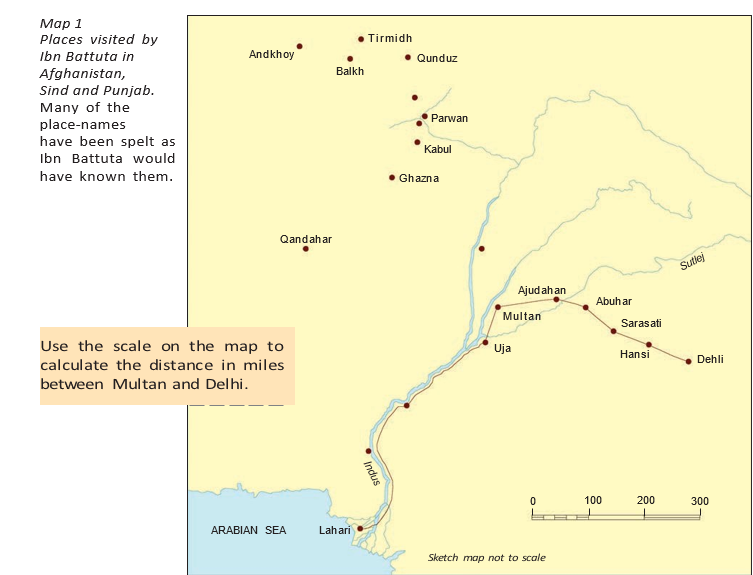
- 1332–33He set out for India; travelling overland through Central Asia, he reached Sind in 1333.
- After 1333He travelled via Multan and Uch to Delhi, where Sultan Muhammad bin Tughlaq appointed him qazi.
- 1342After a period in prison and restoration to imperial service, he was sent as the Sultan’s envoy to China.
- 1347After travelling in China as far as Beijing, he decided to return home.
- 1354He returned home, about 30 years after setting out.
Route on the China Mission
- Delhi → central India → Malabar coast → Maldives, where he served as qazi for 18 months.
- Maldives → Sri Lanka → Malabar coast and Maldives again → Bengal and Assam.
- He sailed to Sumatra, then to Zaytun (now Quanzhou), and travelled in China as far as Beijing.
Delhi and Imperial Service
- Appointment: Muhammad bin Tughlaq was impressed by Ibn Battuta’s scholarship and appointed him qazi of Delhi.
- Change in favour: After several years, Ibn Battuta fell out of favour and was imprisoned; after a misunderstanding was cleared, he returned to imperial service.
- China mission: The Sultan appointed him envoy to the Mongol ruler of China in 1342.
Travel: Risks, Hardships and Distance
Hazards of Travel
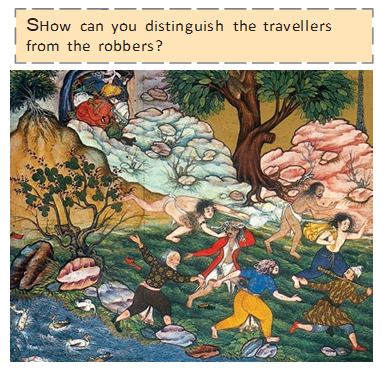
- Robbers: He was attacked several times. On the Multan–Delhi journey, robbers attacked his caravan; many travellers died and survivors, including Ibn Battuta, were severely wounded.
- Illness: During one journey, fever weakened him so much that he tied himself to his saddle to avoid falling.
- Loneliness: At Tunis, he felt deeply homesick when the townspeople greeted people he did not know; a fellow pilgrim noticed his distress and greeted him.
- Travel conditions: Journeys in the fourteenth century were far more arduous and dangerous than modern travel; caravans offered companionship but did not guarantee safety.
| Route | Approximate travel time |
|---|---|
| Multan to Delhi | 40 days |
| Sind to Delhi | About 50 days |
| Daulatabad to Delhi | 40 days |
| Gwalior to Delhi | 10 days |
What the Rihla Records
- Observations: Ibn Battuta carefully recorded new cultures, peoples, beliefs and values encountered on his travels.
- Comparison: His account is often compared with Marco Polo’s, who travelled from Venice to China and India in the late thirteenth century.
- Purpose: The Rihla offers rich details about the subcontinent’s fourteenth-century social and cultural life.
The ‘Enjoyment of Curiosities’
Recording the Rihla
- Dictation: After Ibn Battuta returned to Morocco, the local ruler instructed him to dictate his travel experiences.
- Writer: Ibn Juzayy was assigned to record the account.
- Contents and appeal: The narrative covered cities, memorable events, rulers, scholars and pious saints; its curious and marvellous details aimed to entertain and interest as well as edify readers.
Later Travel Writers
Travelogues from 1400 to 1800
- Tradition: Visitors to India wrote travelogues in Persian; Indian visitors to Central Asia, Iran and the Ottoman Empire also recorded their experiences.
- Influence: Later travellers followed Al-Biruni and Ibn Battuta and sometimes read their accounts.
- Abdur Razzaq Samarqandi: Visited south India in the 1440s.
- Mahmud Wali Balkhi: Travelled widely in the 1620s and became a sort of sanyasi for a time.
- Shaikh Ali Hazin: Came to north India in the 1740s; unlike some fascinated visitors, he was disappointed and disgusted, expecting a red-carpet reception.
- Views of India: Many visitors saw India as a land of wonders, while their personal responses varied.
Why is Ibn Battuta’s Rihla an important source for studying fourteenth-century India?
Quick recap
- Ibn Battuta was a Moroccan traveller who valued knowledge gained from experience and wrote the Arabic Rihla.
- He travelled to India in 1332–33, reached Sind in 1333 and became qazi of Delhi.
- Sent to China in 1342, he travelled through the Maldives, Sri Lanka, Bengal, Assam and Sumatra to Zaytun and Beijing.
- He experienced illness, loneliness and robber attacks; a caravan journey from Multan to Delhi proved especially dangerous.
- Ibn Juzayy recorded Ibn Battuta’s dictated account, which combined information with entertainment and curiosity.
- Later travel writers included Abdur Razzaq Samarqandi, Mahmud Wali Balkhi and Shaikh Ali Hazin, whose views of India differed.
Francois Bernier & Making Sense of an Alien World Al-biruni and the Sanskritic Tradition
European Travellers and François Bernier
European Travel Accounts
- Portuguese writers: After arriving in India around 1500, some described Indian social customs and religious practices; Jesuit Roberto Nobili translated Indian texts into European languages.
- Duarte Barbosa: A notable Portuguese writer who described trade and society in south India.
- Later arrivals: After 1600, increasing numbers of Dutch, English and French travellers came to India.
- Jean-Baptiste Tavernier: A French jeweller who travelled to India at least six times, focusing on trade and comparing India with Iran and the Ottoman Empire.
- Manucci: An Italian doctor who settled in India rather than returning to Europe.
Bernier’s Period in India
- 1656–1668Bernier spent twelve years in India and was closely associated with the Mughal court.
Bernier at the Mughal Court
- François Bernier: A French doctor, political philosopher and historian who came to the Mughal Empire seeking opportunities.
- Dara Shukoh: Bernier served as physician to Dara Shukoh, Shah Jahan’s eldest son.
- Danishmand Khan: Bernier later associated with this Armenian noble at court as an intellectual and scientist.
Comparing East and West
Bernier’s Comparisons
- Comparative lens: Bernier frequently judged what he saw in India against conditions in Europe, often portraying India as bleak by comparison.
- Patron and audience: He dedicated his major work to Louis XIV, king of France; many other writings were letters to influential officials and ministers.
- Caution: His assessments were not always accurate, but his published accounts became very popular.
Bernier’s Journey with the Army
- Animals and attendants: On the march to Kashmir, Bernier took two Turkoman horses, a Persian camel and driver, a groom, a cook and a servant carrying water before his horse.
- Equipment: His party carried a tent, carpet, portable bed, pillow, mattress, table coverings, napkins and cooking utensils.
- Luggage and supplies: A large leather sack held provisions, linen and clothing for the master and servants.
- Food and refreshments: He packed rice for five or six days, anise-flavoured biscuits, limes and sugar; lemonade and dahi were considered refreshing.
- Curds: A linen bag and small iron hook were used to suspend and drain dahi.
The Creation and Circulation of Ideas About India
Travel Writing and Public Perceptions
- European image of India: Printed travel books circulated travellers’ accounts and helped shape European ideas about Indian society.
- Indian responses: After 1750, Shaikh Itisamuddin and Mirza Abu Talib visited Europe and sought to influence European perceptions by presenting their own accounts.
- Different forms of circulation: Arabic and Persian accounts generally circulated as manuscripts and were not usually published before 1800.
Publication and Circulation of Bernier’s Works
- 1670–1671Bernier’s works were published in France.
- Within the next five yearsHis works were translated into English, Dutch, German and Italian.
- 1670–1725His account was reprinted eight times in French.
- By 1684His account had been reprinted three times in English.
- Before 1800Arabic and Persian accounts generally remained in manuscript circulation rather than being published.
Al-Biruni and Sanskrit
A Language with an Enormous Range
- Sanskrit’s complexity: Al-Biruni described Sanskrit as difficult to learn because it had an enormous vocabulary and many inflections.
- Many names and meanings: One thing could have several names, while one word could refer to different subjects; qualifying words were needed to distinguish meanings.
- Comparison: Al-Biruni compared Sanskrit’s range in words and inflections to Arabic.
Al-Biruni’s Critical Approach
- Questioning a claim: When told a wooden idol had lasted 216,432 years, Al-Biruni questioned how wood could survive so long, especially in a damp climate.
- Conclusion: He expressed uncertainty rather than accepting the story without scrutiny.
Overcoming Barriers to Understanding
| Barrier | How it obstructed understanding |
|---|---|
| Language | Sanskrit differed greatly from Arabic and Persian, making ideas and concepts difficult to translate. |
| Religion | Differences in religious beliefs and practices complicated understanding. |
| Social outlook | Al-Biruni saw local self-absorption and resulting insularity as obstacles. |
Texts Used by Al-Biruni
- Main sources: Despite recognising these barriers, Al-Biruni relied almost entirely on works by Brahmanas to understand Indian society.
- Texts cited: He used passages from the Vedas, Puranas, Bhagavad Gita, Patanjali’s works and Manusmriti.
- Travel account
- A traveller’s written description of places, people and practices encountered.
- Sanskritic tradition
- Indian religious and intellectual works composed in Sanskrit, used by Al-Biruni as sources.
- Insularity
- A limited outlook linked here to separation from outside ideas and people.
What three barriers to understanding did Al-Biruni identify?
How did Bernier’s writings help shape European perceptions of India?
Quick recap
- European travellers wrote about Indian customs, society and trade; Dutch, English and French travellers arrived in increasing numbers after 1600.
- Bernier spent 1656–1668 in India, serving Dara Shukoh and later associating with Danishmand Khan as an intellectual and scientist.
- Bernier often portrayed India as bleak compared with Europe, though his judgments were not always accurate.
- His works were widely translated and reprinted, while Arabic and Persian accounts generally circulated as manuscripts.
- Al-Biruni described Sanskrit as complex and identified language, religion and perceived insularity as barriers to understanding.
- Despite these barriers, Al-Biruni relied mainly on Brahmana texts, including the Vedas, Puranas, Bhagavad Gita, Patanjali’s works and Manusmriti.
Al-biruni’s Description of the Caste System
Comparing Social Divisions
Al-Biruni’s comparisons
- Social divisions: Al-Biruni used examples from other societies to argue that social ranking was not unique to India.
- Islam: He noted that all men were considered equal in Islam, differing only in their observance of piety.
| Category | Occupations or roles |
|---|---|
| First | Knights and princes |
| Second | Monks, fire-priests and lawyers |
| Third | Physicians, astronomers and other scientists |
| Fourth | Peasants and artisans |
Al-Biruni’s Criticism of Pollution
- Caste pollution: Al-Biruni rejected the idea that social pollution was a permanent condition or a natural law.
- Regaining purity: He argued that things made impure strive to return to their original pure state.
- Examples from nature: The sun cleanses the air, while salt prevents sea water from becoming polluted.
- Conclusion: Since nature restores purity, social pollution was, in his view, contrary to nature; without such cleansing, life on earth would be impossible.
Al-Biruni’s Account of the Varnas
| Varna | Origin from Brahman | Status described |
|---|---|---|
| Brahmana | Head | Highest caste; considered the choice part of humanity because Brahman meant the force called nature and the head was the body's highest part |
| Kshatriya | Shoulders and hands | Next in rank; not much below the Brahmana |
| Vaishya | Thigh | Third caste |
| Shudra | Feet | Fourth caste |
How the varnas lived
- Relative distance: Al-Biruni said there was no great distance between the Vaishya and Shudra.
- Shared spaces: Despite differences in rank, the groups lived in the same towns and villages, mixed together in the same houses and lodgings.
Normative Rules and Lived Reality
| Point | Normative account | Lived reality |
|---|---|---|
| Basis | Al-Biruni’s description drew strongly on Sanskrit texts setting out Brahmanical rules. | Social relations were not always as rigid as the rules suggested. |
| Antyaja | Described as born outside the varna system. | Often expected to provide inexpensive labour to peasants and zamindars. |
| Social and economic position | The system placed groups in ranked categories. | Antyaja groups faced social oppression but were included in economic networks. |
- Varna
- A ranked social category in the Brahmanical system described by Al-Biruni.
- Normative Sanskrit texts
- Texts that laid down rules for the social system from a Brahmanical viewpoint.
- Antyaja
- Groups described as born outside the varna system; often socially oppressed but economically connected.
- Social pollution
- The idea that contact with certain people or conditions causes social impurity, which Al-Biruni rejected as contrary to nature.
How did Al-Biruni challenge the idea of social pollution?
Why should Al-Biruni’s account not be treated as a complete description of everyday society?
Quick recap
- Al-Biruni compared Indian social divisions with four categories in ancient Persia.
- He noted that Islam regarded men as equal, with differences based on piety.
- He accepted the Brahmanical varna account but rejected social pollution as contrary to nature.
- His varna account linked Brahmana, Kshatriya, Vaishya and Shudra to parts of Brahman’s body and ranked them accordingly.
- He explained that Brahman was another name for nature and that the Brahmana were considered the choice part because the head was the body’s highest part.
- His description relied heavily on Sanskrit normative texts, while everyday society could be less rigid; antyaja groups faced oppression but remained part of economic networks.
Ibn Battuta and the Excitement of the Unfamiliar
Ibn Battuta and a Connected World
Global communication network — By the fourteenth century, the subcontinent was connected to routes and contacts stretching from China to north-west Africa and Europe.
Context
- Fourteenth centuryIbn Battuta arrived in Delhi, then part of an extensive communication network.
Travel, society and unfamiliar experiences
- Ibn Battuta’s travels: He visited sacred shrines, met learned people and rulers, and sometimes served as a qazi (judge).
- Cosmopolitan cities: People speaking Arabic, Persian, Turkish and other languages exchanged ideas, information and stories.
- Travel accounts: Stories ranged from pious people and rulers to the lives of ordinary people.
- Unfamiliar details: Descriptions of unfamiliar customs and products made distant places vivid and impressive to readers and listeners.
The Coconut and the Paan
Descriptions of unfamiliar produce
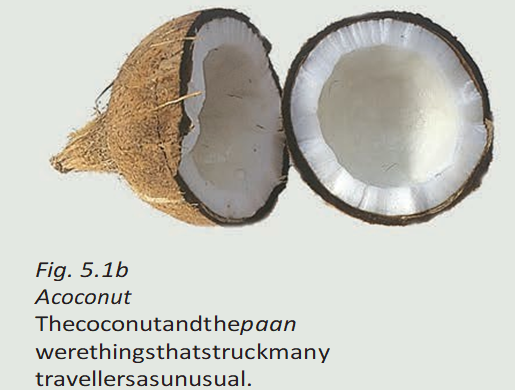
- Coconut tree: Ibn Battuta compared it to a date-palm, but noted that it produces nuts rather than dates.
- Coconut: The nut reminded him of a human head: its markings resembled eyes and a mouth, its green interior resembled a brain, and its fibre resembled hair.
- Coconut fibre: It was made into cords for sewing ships and cables for vessels, instead of using iron nails.
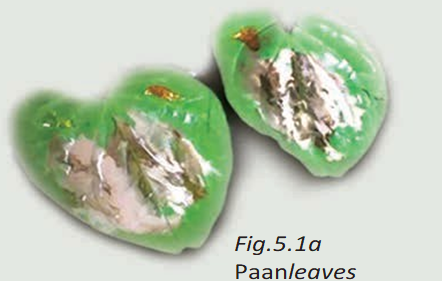
- Betel (paan): The plant was cultivated like a grape-vine and grown for its leaves rather than its fruit.
- Using paan: People chewed small pieces of areca nut, then chewed betel leaves with a little chalk.
His comparisons with familiar objects helped his audience understand and remember unfamiliar plants and practices.
Ibn Battuta and Indian Cities
Cities, bazaars and urban life
- Cities: Ibn Battuta described them as densely populated and prosperous, with crowded streets and colourful markets filled with goods; wars and invasions sometimes disrupted them.
- Delhi and Daulatabad: Delhi was vast and, in his account, India’s largest city; Daulatabad rivalled it in size.
- Bazaars: Markets were centres of trade and social and cultural life. Many had a mosque and a temple; some also had spaces for performances by dancers, musicians and singers.
- Sources of urban wealth: Historians have used Ibn Battuta’s account to suggest that towns drew significant wealth from the surplus produced by villages.
Delhi’s fortifications and built features
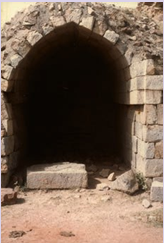
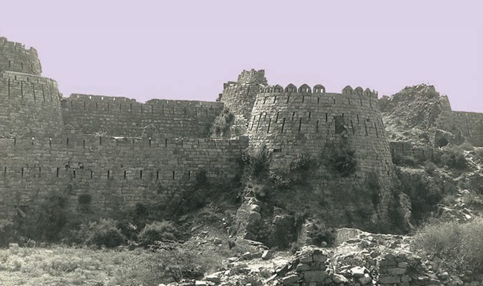
- Rampart: The city wall was eleven cubits wide, with closely spaced towers and twenty-eight gates; Budaun Gate was the largest.
- Construction: The lower part of the wall was stone and the upper part brick. Windows opened towards the city.
- Defence and supplies: Sentry and gatekeeper houses, food stores, ammunition and siege equipment were inside the rampart; stored grain could last a long time without rotting.
- Movement: Horsemen and infantry could move between parts of the city within the rampart.
- Gate surroundings: A grain market was inside Mandwi Gate, while an orchard stood beside Gul Gate.
- Cemetery: Graves had domes or arches and were planted with tuberose, jasmine and wild rose; flowers bloomed there in every season.
Agriculture, trade and urban prosperity
- Fertile soil supported productive agriculture.
- Farmers could grow two crops a year, generating agricultural surplus.
- The surplus from villages contributed to the wealth of towns.
- Inter-Asian trade connected Indian producers with markets in West Asia and Southeast Asia.
- Demand for Indian manufactures brought substantial profits to artisans and merchants.
Indian textiles and trade
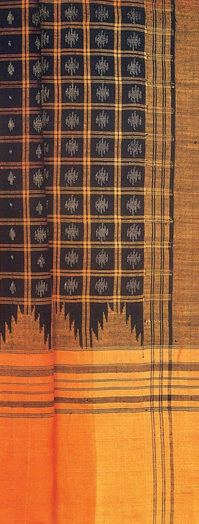
- Important goods: Cotton cloth, fine muslins, silks, brocade and satin were in high demand.
- Fine muslin: Some varieties were so expensive that only nobles and the very rich could afford them.
- Ikat: Ikat weaving patterns were adopted and modified at coastal production centres in the subcontinent and Southeast Asia.
Music in the Market
Tarababad in Daulatabad
- Market: Tarababad was a large, beautiful bazaar for male and female singers, with many shops connected to their owners’ houses.
- Performances: Shops were decorated with carpets; female singers performed seated on swings, accompanied by attendants.
- Musicians’ cupola: A decorated, carpeted cupola stood in the market. The chief musician went there every Thursday after dawn prayers.
- Entertainment: Female singers arrived in groups to sing and dance before the chief musician until dusk.
- Shared public culture: The bazaar had mosques, and Ibn Battuta reported that both Hindu and Muslim rulers stopped at the cupola to hear singers.
What architectural features of Delhi did Ibn Battuta describe?
What do Ibn Battuta’s accounts suggest about Indian cities and trade?
Why did Ibn Battuta highlight unfamiliar plants and activities at Tarababad?
Quick recap
- By the fourteenth century, the subcontinent was linked to a wide network of communication and travel.
- Ibn Battuta made unfamiliar plants and customs vivid through comparisons and detailed descriptions.
- Delhi was a large, fortified city; its ramparts held gates, stores and military facilities.
- Indian bazaars combined commerce with social, religious and cultural activities.
- Fertile agriculture and inter-Asian trade supported urban prosperity.
- Indian textiles were in demand, and some fine muslins were affordable only to the wealthy.
- Tarababad’s performances show the importance of entertainment in the life of a market.
A Unique System of Communication
Postal Communication and Trade
How the Foot-post Worked
- Stations: Three pavilions with ready couriers stood at each dawa station, about one-third of a mile apart.
- Relay: A runner carried the letter and a bell-topped rod; the next courier took the letter and ran to the following station.
- Reach: The relay continued until the letter reached its destination. Ibn Battuta said this system was faster than horse-post.
- Other cargo: Foot-post couriers sometimes transported prized fruits from Khurasan to India.
Abdur Razzaq’s Impressions
- Calicut: Abdur Razzaq described its people as a “strange nation,” showing his sense of unfamiliarity.
- Mangalore: He admired a temple’s bronze-covered structure, golden statue and skilled craftsmanship.
Bernier’s View of Mughal India
- Comparison: Bernier repeatedly contrasted Mughal India with Europe and generally presented Europe as superior.
- Purpose and audience: He dedicated his major work to Louis XIV and addressed influential officials, seeking to shape their views and policies.
Landownership and Its Alleged Effects
Poverty and Peasant Oppression
- Pelsaert: The Dutch traveller visited the subcontinent in the early seventeenth century and described poverty as widespread and severe.
- State responsibility: Pelsaert blamed heavy state extraction, saying peasants had so much taken from them that scarcely enough remained for basic food.
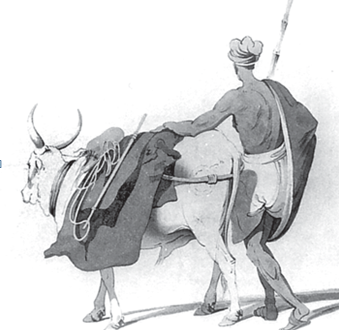
- Bernier’s account: He described uncultivated land, labour shortages and peasants mistreated by governors.
- Further harms: In Bernier’s description, peasants unable to meet demands could lose their means of subsistence; children might be taken as slaves, and some peasants abandoned the countryside.
Bernier’s Picture of Social Classes
- Claim: Bernier depicted society as impoverished masses beneath a small, wealthy and powerful ruling class.
- Middle group: He asserted, “There is no middle state in India,” denying the presence of a significant social group between rich rulers and the poor.
Bernier’s Warning to Europe
- Warning: Bernier urged European kings not to follow the Mughal model of landownership.
- Doom scenario: He predicted poorly cultivated and depopulated kingdoms, ruined cities, abandoned fields and marshes if European rulers adopted it.
- Argument: He used this imagined collapse to present private property as essential to prosperity and crown ownership as destructive.
Questioning Bernier’s Account
- Mughal records: Official accounts describe land revenue as a ruler’s claim for protecting his subjects, not as rent on land he owned.
- Revenue: The state’s demand was a tax on the crop; European travellers could mistake its high level for rent.
Later Theories and Rural Reality
| Group | Position or livelihood |
|---|---|
| Big zamindars | Held superior rights in land. |
| Big peasants | Used hired labour and produced commodities for the market. |
| Smaller peasants | Could barely produce enough for subsistence. |
| Landless labourers | Included “untouchable” labourers without land. |
Dates and Periods in the Lecture
- 1440sAbdur Razzaq wrote the travel account describing Calicut and the temple near Mangalore.
- Early seventeenth centuryPelsaert visited the subcontinent and recorded severe poverty.
- Sixteenth and seventeenth centuriesThe period in which rural society showed substantial social and economic differences.
- Eighteenth centuryMontesquieu developed the idea of Oriental despotism using accounts such as Bernier’s.
- Nineteenth centuryMarx developed the concept of the Asiatic mode of production.
What were the main features of the postal system described by Ibn Battuta?
How did Bernier explain the effects of crown ownership of land, and what evidence challenges his view?
What later theories drew on Bernier’s account, and what did they argue?
Quick recap
- State-supported inns and postal routes helped merchants send information, credit and goods.
- The foot-post (dawa) used relay runners and was faster than the horse-post (uluq).
- Abdur Razzaq’s 1440s account criticized the people of Calicut but admired a bronze-covered temple near Mangalore.
- Bernier blamed crown ownership of land for weak investment, agricultural decline and peasant oppression, and claimed India had no middle class.
- Mughal records describe revenue as a sovereignty claim and a tax on crops, not rent on land the ruler owned.
- Montesquieu’s Oriental despotism and Marx’s Asiatic mode of production drew on such accounts, but actual rural society was socially differentiated.
A More Complex Social Reality
Bernier’s Conflicting Picture of the Economy
Imperial Karkhanas
How does Bernier convey a sense of activity but little progress in the karkhanas?
Towns and Urban Society
Why is Bernier’s description of Mughal towns considered oversimplified?
Merchants and Professional Groups
- Karkhana
- An imperial workshop employing specialised artisans.
- Mahajan
- A merchant community or corporate body, especially in western India.
- Sheth
- The chief or leader of a mahajan.
- Nagarsheth
- The representative of the merchant community collectively in an urban centre such as Ahmedabad.
Why Bernier’s Account Needs Careful Reading
- Bernier emphasised state control and imperial patronage → he portrayed crafts and towns as dependent and stagnant.
- His descriptions also recorded fertile land, skilled production, exports and precious-metal inflows → they point to substantial economic activity.
- Evidence of diverse towns, merchants and professionals → shows that urban life had foundations beyond the imperial court.
Urban Population
- Seventeenth centuryAbout 15% of the population lived in towns, a higher average proportion than in Western Europe.
Why might scholars such as Bernier have compared India with Europe?
Quick recap
- Bernier criticised state control but also recorded Indian productivity, exports and prosperous merchants.
- He described Bengal as fertile and rich in agricultural and commercial goods.
- Imperial karkhanas employed artisans in specialised crafts, though Bernier portrayed little social progress.
- About 15% of the population lived in towns in the seventeenth century, a higher average share than in Western Europe.
- Mughal towns had diverse roles and were not all dependent on the imperial camp.
- Merchant networks and professional groups helped sustain urban society beyond imperial patronage.
Women Slaves, Sati and Labourers
Travellers’ Views of Women
- Perspective: The surviving travel accounts were written mainly by men, who often treated social inequalities as natural.
- Focus: Travellers sometimes viewed women’s conditions as a marker of difference between Eastern and Western societies.
Slavery and the Work of Female Slaves
| Role or condition | Details |
|---|---|
| Music and dance | Some female slaves in the Sultan’s service were skilled performers; Ibn Battuta saw them perform at the Sultan’s sister’s wedding. |
| Surveillance | The Sultan used slaves to spy on nobles. Female scavengers entered houses unannounced, and slave girls shared information with them. |
| Domestic labour | Slaves commonly did household work and carried men and women in palanquins, also called dola. |
| Price and ownership | Female slaves for domestic work were inexpensive; families who could afford them often kept one or two. |
Sati in Travellers’ Accounts
- Bernier’s account: He described sati and observed that some women appeared to accept death, while others were compelled.
- Example: At Lahore, Bernier witnessed a twelve-year-old widow being forced onto her husband’s funeral pyre.
Women’s Work and Public Life
- Labour: Women’s work was important in both agricultural and non-agricultural production.
- Commerce: Women from merchant families took part in business and sometimes brought commercial disputes before the courts.
Limits of Travellers’ Accounts
- Palanquin (dola)
- A conveyance carried by people; slaves were employed to carry passengers in it.
- Sati
- A widow’s death by burning on her husband’s funeral pyre, as described in the accounts.
- Tankas
- Coins; Ibn Battuta reported that Muhammad bin Tughlaq gave Nasiruddin 100,000 tankas.
Quick recap
- Slaves were sold and exchanged as gifts; female slaves worked in households, performed, and helped with surveillance.
- Many female slaves were captured in raids; domestic slaves were relatively inexpensive and commonly owned by families who could afford them.
- Bernier’s account of sati describes both apparent acceptance and coercion, including the forced death of a child widow at Lahore.
- Women contributed to agricultural and other production; some merchant women traded and took disputes to court.
- Travellers’ accounts are selective and shaped by their backgrounds, leaving many ordinary women’s experiences under-recorded.
History — ALL CHAPTERS
1
BRICKS, BEADS AND BONES THE HARAPPAN CIVILISATION
2
KINGS, FARMERS AND TOWNS EARLY STATES AND ECONOMIES (C. 600 BCE-600 CE)
3
KINSHIP, CASTE AND CLASS EARLY SOCIETIES (C. 600 BCE-600 CE)
4
THINKERS, BELIEFS AND BUILDINGS CULTURAL DEVELOPMENTS (C. 600 BCE - 600 CE)
1
THROUGH THE EYES OF TRAVELLERS PERCEPTIONS OF SOCIETY (C. TENTH TO SEVENTEENTH CENTURY)
2
BHAKTI- SUFI TRADITIONS CHANGES IN RELIGIOUS BELIEFS AND DEVOTIONAL TEXTS (C. EIGHTH TO EIGHTEENTH CENTURY)
3
AN IMPERIAL CAPITAL VIJAYANAGARA (C. FOURTEENTH TO SIXTEENTH CENTURY)
4
PEASANTS, ZAMINDARS AND THE STATE AGRARIAN SOCIETY AND THE MUGHAL EMPIRE (C. SIXTEENTH- SEVENTEENTH CENTURY)
1
COLONIALISM AND THE COUNTRYSIDE EXPLORING OFFICIAL ARCHIVES
2
REBELS AND THE RAJ THE REVOLT OF 1857 AND ITS REPRESENTATIONS
3
MAHATMA GANDHI AND THE NATIONALIST MOVEMENT CIVIL DISOBEDIENCE AND BEYOND
4
FRAMING THE CONSTITUTION THE BEGINNING OF A NEW ERA