Class 12 Humanities . History . Themes In Indian History Part I . Kinship Caste and Class Early Societies C 600 Bce 600 Ce
Chapter 3: KINSHIP, CASTE AND CLASS EARLY SOCIETIES (C. 600 BCE-600 CE)
Ch 3
History
Class 12 Humanities
Introduction & the Critical Edition of the Mahabharata
Using Texts to Study Society
Texts as historical sources
- Social change: Agricultural expansion into forests, the rise of craft specialists and unequal wealth changed social relations between c. 600 BCE and 600 CE.
- Different purposes: Some texts prescribe social behaviour; others describe social situations and sometimes comment on them. Inscriptions can also reveal social actors.
- Read critically: Ask who composed a text, for whom, in what language and how it circulated; texts reflect particular social perspectives.
- Evidence, not a direct record: Texts help reconstruct attitudes and practices, but prescribed norms do not prove that everyone followed them.
Mahabharata — A Sanskrit epic, in its present form over 100,000 verses, composed over about 1,000 years from c. 500 BCE; some stories may have circulated earlier.
What the epic contains
- Central story: A conflict between two groups of cousins, the Kauravas and Pandavas.
- Social material: The epic depicts varied social groups and situations, and includes sections prescribing behaviour for different groups.
- Historical question: Characters sometimes follow prescribed norms and sometimes depart from them; historians examine what these patterns reveal about attitudes and practice.
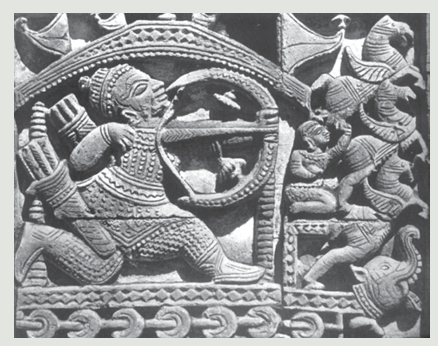
The Critical Edition of the Mahabharata
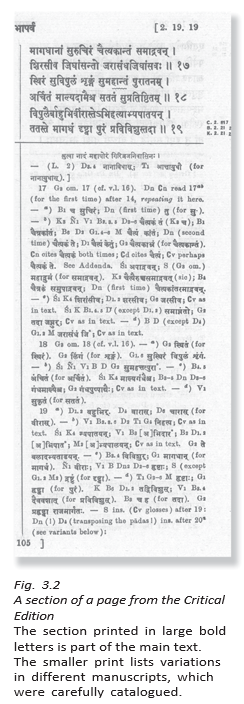
Critical edition — A scholarly edition made by comparing manuscripts to identify shared text while recording their variations.
Mahabharata and Its Critical Edition
- c. 500 BCE onwardsThe Mahabharata was composed over about 1,000 years; some stories may have circulated earlier.
- 1919V.S. Sukthankar led the project to prepare a critical edition.
- 47 years after the project beganThe multi-volume critical edition was completed.
How the edition was prepared
- Manuscripts gathered: Scholars collected Sanskrit manuscripts written in different scripts from across India.
- Comparison: Verses were compared across manuscripts; those common to most versions were selected for the main text.
- Scale: The edition appeared in several volumes exceeding 13,000 pages; more than half the pages record variations in footnotes and appendices.
| Finding | Historical significance |
|---|---|
| Common elements appeared in Sanskrit manuscripts across regions from Kashmir and Nepal to Kerala and Tamil Nadu. | The story shared elements across a wide geographical area. |
| Manuscripts also contained extensive regional variations, recorded in footnotes and appendices. | The variations show how the text changed through transmission over the centuries. |
| Differences reflect exchanges between dominant traditions and resilient local ideas and practices. | These exchanges involved both conflict and consensus and helped shape social histories. |
| Evidence | Interpretation | |
|---|---|---|
| Sanskrit texts | Many were written by and for Brahmanas and laid down norms of behaviour. | Earlier historians sometimes treated prescriptions as proof that people actually followed them. |
| Other traditions | Works in Pali, Prakrit and Tamil provide additional perspectives. | They show that Sanskrit ideals could be recognised as authoritative, questioned or rejected. |
Kinship and Marriage: Many Rules and Varied Practices
- Kinship: Families and kinfolk were defined through varied relationships and practices.
- Marriage: Brahmanical texts prescribed rules, but actual customs differed across communities and regions.
Finding Out About Families
Kinfolk — People connected through kinship and regarded as relatives.
Families and Historical Evidence
- Family life: Families differ in size, relationships and shared activities; members may share food and resources, and live, work and perform rituals together.
- Kinship varies: Family ties are often treated as natural or based on blood, but societies define them differently—for example, some count cousins as blood relations and others do not.
- Uneven evidence: Elite family relationships are easier to reconstruct than those of ordinary people.
- Attitudes and actions: Ideas about family can shape behaviour, while actions can also change attitudes.
The Ideal of Patriliny
Patriliny — A system in which sons inherit their fathers’ resources, including the throne when the father is a king.
Patriliny in the Mahabharata
- Kuru lineage: The Kauravas and Pandavas were cousins from the ruling family of the Kurus, who dominated a janapada.
- Conflict and succession: Their feud over land and power ended in the Pandavas’ victory; patrilineal succession was then proclaimed.
- An ideal reinforced: Patriliny existed before the epic’s composition, but the Mahabharata strengthened the idea that it was valuable.
- Wider concern: Patrilineal ideals also appear in Rigveda ritual mantras and may have been shared by wealthy men and high-status groups, including Brahmanas.
Patriliny and Succession
- From c. sixth century BCEMost ruling dynasties claimed to follow patrilineal succession.
| Patrilineal ideal | Variations in practice |
|---|---|
| Sons inherited their fathers’ resources and, for kings, the throne. | If there were no sons, brothers or other kinsmen might claim succession. |
| Most ruling dynasties claimed to follow patriliny. | In exceptional circumstances, women such as Prabhavati Gupta exercised power. |
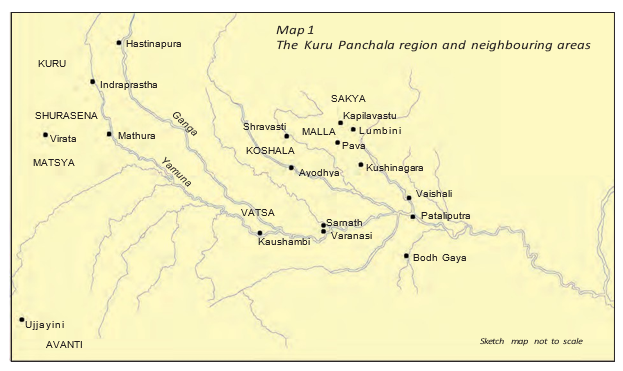
Places and Rivers on the Map
- Rivers: The Ganga and Yamuna were major rivers in the region.
- Kuru: Hastinapura was the capital of the Kuru kingdom.
- Other important places: Pataliputra and Ujjayini were important cities; Lumbini is known as the Buddha’s birthplace.
- Regional setting: Several kingdoms existed side by side across this area.
- Normative text
- A text that lays down rules or ideals for behaviour.
- Critical edition
- An edition based on comparing manuscripts and recording their differences.
- Kinfolk
- People regarded as relatives through culturally defined kinship ties.
- Patriliny
- Inheritance or succession traced through the male line, especially from father to son.
- Janapada
- A territorial unit or realm; the Kurus dominated one such region.
What was the purpose and method of preparing the Critical Edition of the Mahabharata?
Why should historians not treat normative texts as direct descriptions of social practice?
What is patriliny, and how does the Mahabharata relate to it?
Quick recap
- Texts and inscriptions reveal social ideas, but historians must consider authorship, audience, language and purpose.
- The Mahabharata is a vast Sanskrit epic composed over a long period, containing stories as well as social norms.
- The Critical Edition compared manuscripts, presented shared verses and documented regional variations.
- Normative Sanskrit ideals were influential but could be questioned or rejected; they do not automatically prove actual practice.
- Families and kinship ties varied, and evidence about elite families is easier to find than evidence about ordinary people.
- Patriliny made sons the expected heirs, but succession could vary and women such as Prabhavati Gupta could occasionally exercise power.
- The map highlights the Ganga and Yamuna, Hastinapura, Pataliputra, Ujjayini and Lumbini.
Rules of Marriage
Marriage, Sons and Patrilineal Succession: Epic Sources
Marriage and the expectation of sons
- Rigvedic marriage mantra: A priest’s chant wished the bride fine sons and good fortune in her husband’s love.
- “Here” and “there”: These referred to the bride’s father’s house and her husband’s house, respectively.
- Patrilineage: Sons were valued because they continued the family line and could inherit household resources.
Kinship and a royal succession dispute
- Initial succession: Dhritarashtra was blind, so his younger brother Pandu took the throne of Hastinapura.
- After Pandu’s death: Dhritarashtra became king while the princes were still young.
- Public preference: As the princes grew up, citizens favoured the Pandavas, considering them more capable and virtuous than the Kauravas.
- Duryodhana’s fear: He worried that the Pandavas would inherit the patrimony, leaving his own branch excluded from the royal succession.
- Conflict: The episode shows how competing claims to inheritance and succession could create conflict between kin.
Epic passages may not be literal records of events, but they reveal ideas held by their authors and may contain conflicting views.
Rules of Marriage
Marriage norms and social change
- Daughters: In the patrilineal framework, daughters had no claims to household resources; marrying them outside the kin was considered desirable.
- Exogamy: Marriage outside one’s kin group; the timing and choice of marriage for high-status girls and women were often closely regulated.
- Kanyadana: The father’s giving of his daughter in marriage was treated as an important religious duty.
- Urban change: Growing towns brought people and ideas together, potentially prompting questions about older beliefs and practices.
- Brahmanical response: Brahmanas set out detailed social codes for their own community and society more broadly, claiming wide validity.
| Point | Brahmanical prescriptions | Social practice |
|---|---|---|
| Authority | Dharmasutras and Dharmashastras presented rules as widely binding. | Regional diversity and difficulties of communication meant Brahmanical influence was not all-pervasive. |
| Marriage | Texts classified marriage forms and prescribed rules such as avoiding same-gotra marriage. | Communities could follow customs that differed from Brahmanical norms. |
| Evidence | Texts describe ideals and classifications. | Inscriptions, such as those of the Satavahanas, reveal practices that could differ from those ideals. |
| Form | Description in the excerpt | Judgement |
|---|---|---|
| First | A father gives his daughter, dressed in fine clothes and adorned with jewels, to a Veda-learned man whom he invites. | Among the first four forms considered good. |
| Fourth | A father gives his daughter after asking the couple to perform their duties together and honouring the bridegroom. | Among the first four forms considered good. |
| Fifth | The bridegroom gives as much wealth as he can afford to the bride and her kin, then receives the maiden. | Among the remaining forms condemned. |
| Sixth | A maiden and her lover unite voluntarily, driven by desire. | Among the remaining forms condemned. |
- Dharmasutras and Dharmashastras recognised eight forms of marriage: the first four were classed as good and the remaining four condemned.
- The Manusmriti, an important Dharmashastra, was compiled between c. 200 BCE and 200 CE.
Gotra and Marriage
Gotra — A lineage group named after a Vedic seer; its members were regarded as descendants of that seer.
Brahmanical gotra rules
- Classification: Gotra classification, especially among Brahmanas, is evident from c. 1000 BCE.
- Marriage rule: A woman was expected to leave her father’s gotra and adopt her husband’s gotra after marriage.
- Prohibition: Members of the same gotra were not supposed to marry.
| Point | Exogamy | Endogamy |
|---|---|---|
| Meaning | Marriage outside one’s kin group. | Marriage within one’s kin group. |
| Relation to Brahmanical ideal | Same-gotra marriage was prohibited; marriage outside the kin was favoured. | Marriage among kin, such as cousins, ran counter to the prescribed ideal. |
| Example | The preferred rule in Brahmanical texts. | Practised among some South Indian communities, helping maintain close-knit groups. |
Satavahana evidence
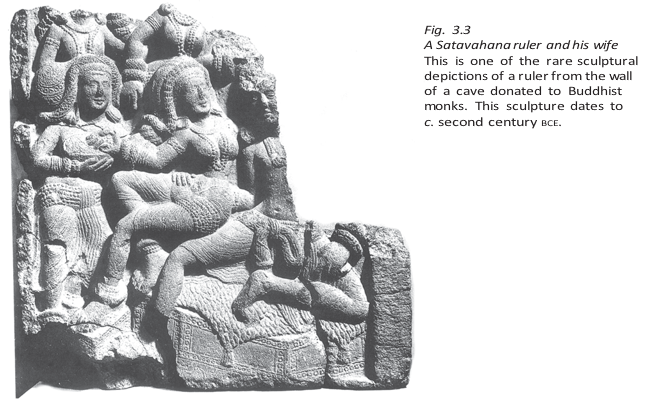
- Names in inscriptions: Satavahana rulers’ names include forms such as Gotami-puta and Vasithi-puta; *puta* means “son” in Prakrit.
- Women’s names: Gotami and Vasithi are feminine forms of the seer names Gotama and Vasistha; women’s names derived from such gotras could reflect their fathers’ gotras.
- Different practice: Many Satavahana women retained names derived from their fathers’ gotras instead of adopting names based on their husbands’ gotras.
- Same-gotra marriages: Some wives shared a gotra, showing that actual customs could differ from Brahmanical rules; such kin marriages were an alternative to exogamy.
- Polygyny: Some Satavahana rulers had more than one wife.
- Inscriptional titles: Rulers used the uniform title *raja*; names such as Gotami-puta mean “son of Gotami.”
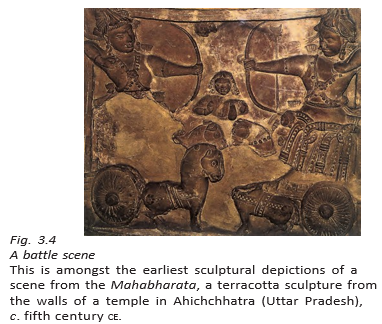
Gandhari’s advice to Duryodhana
- Appeal for peace: Gandhari urged Duryodhana to honour his parents and well-wishers by making peace and sharing the earth with the Pandavas.
- Her reasoning: Greed and anger harm a ruler; wisdom and self-control help him guard his kingdom. War brings no assured law, profit, happiness or victory.
- Outcome: Duryodhana ignored her advice, fought the war and lost.
Were Mothers Important?
Metronymics and succession
- Metronymic: A name derived from the mother’s name; Satavahana rulers used such names, for example Gotami-puta.
- Caution: Maternal names do not by themselves prove that mothers held greater political power or determined succession.
- Succession: The Satavahana throne generally passed through the male line, so succession was patrilineal.
Texts and practices mentioned
- c. 1000 BCEA Rigvedic marriage mantra was probably inserted into the text; gotra classification is also evident from around this period.
- From c. 500 BCEBrahmanical social norms were compiled in Sanskrit Dharmasutras and Dharmashastras.
- c. 200 BCE–200 CEThe Manusmriti was compiled.
- c. second century BCE–second century CESatavahana rulers governed parts of western India and the Deccan; their inscriptions record family names and ties.
- Patrilineage
- Descent traced through the male line.
- Kanyadana
- The giving of a daughter in marriage, regarded as a father’s religious duty.
- Exogamy
- Marriage outside one’s kin group.
- Endogamy
- Marriage within one’s kin group.
- Metronymic
- A name derived from the mother’s name.
What were the main Brahmanical rules about gotra and marriage?
How do Satavahana names show a difference between prescribed rules and practice?
Quick recap
- Sons were valued as continuers of the patrilineage; daughters were expected to marry outside their kin.
- Dhritarashtra’s blindness led Pandu to take the throne first; after Pandu’s death, rival claims to succession helped fuel conflict.
- Kanyadana was treated as an important religious duty of the father; Brahmanical texts recognised eight forms of marriage, four approved and four condemned.
- Gotra rules prescribed adopting the husband’s gotra and avoiding marriage within the same gotra.
- Satavahana inscriptions show marriage practices that did not always match Brahmanical prescriptions, including same-gotra marriages.
- Metronymics indicate maternal naming, but Satavahana succession was generally patrilineal.
Social Differences: Within and Beyond the Framework of Caste
Caste and the Ideal Social Order
Caste — A hierarchy of social categories, whose ideal order was set out in the Dharmasutras and Dharmashastras.
The Brahmanical ideal
- Ranking: The four varnas were ordered by status, with Brahmanas at the top; Shudras and “untouchables” were placed at the bottom.
- Birth: Social position was said to be determined by birth.
- Divine sanction: Brahmanas claimed that this hierarchy had divine authority.
The “Right” Occupation
| Varna | Prescribed occupations |
|---|---|
| Brahmana | Study and teach the Vedas; perform and officiate at sacrifices; give and receive gifts. |
| Kshatriya | Wage war, protect people and administer justice; study the Vedas; arrange sacrifices; give gifts. |
| Vaishya | Study the Vedas, arrange sacrifices and give gifts; practise agriculture, pastoralism and trade. |
| Shudra | Serve the three higher varnas. |
How Brahmanical norms were promoted
- Divine origin: Brahmanas presented the varna order as sanctioned by the gods.
- Royal enforcement: Kings were urged to ensure that people followed the prescribed rules.
- Birth-based status: People were persuaded that their social position was fixed by birth.
- Stories: Epics such as the Mahabharata helped reinforce these norms.
Purusha Sukta — A Rigvedic hymn describing the four varnas as emerging from different parts of the primeval man, Purusha.
| Body part | Varna said to originate from it |
|---|---|
| Mouth | Brahmana |
| Arms | Kshatriya |
| Thighs | Vaishya |
| Feet | Shudra |
Ekalavya and the enforcement of social roles
- Ekalavya: A Nishada youth from a forest-dwelling hunting community; Drona refused to teach him archery.
- Self-training: Ekalavya made a clay image of Drona and practised until he became a skilled archer.
- Guru fee: After Arjuna reminded Drona of his promise that no pupil would surpass him, Drona demanded Ekalavya’s right thumb.
- Outcome: Ekalavya gave the thumb; his archery slowed, protecting Arjuna’s claim to be unrivalled.
Use Ekalavya’s story to show how epic narratives could reinforce boundaries around learning and social position.
Non-Kshatriya Kings
Kingship did not always follow varna rules
- Shastric rule: The Shastras stated that kings should be Kshatriyas.
- Political reality: Rulers could gain power through resources and support; birth as a Kshatriya was not always decisive.
- Mauryas: Their social origins are disputed: later Buddhist texts called them Kshatriyas, while Brahmanical texts described them as low-born.
- Shungas and Kanvas: The dynasties that succeeded the Mauryas were Brahmanas.
Shakas and Satavahanas: complex social identities
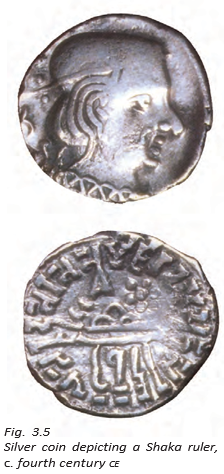
- Shakas: Migrants from Central Asia; Brahmanas described them as mlechchhas, or outsiders. Rudradaman, a prominent Shaka ruler, rebuilt Sudarshana Lake and is associated with one of the earliest Sanskrit inscriptions.
- Satavahana claim: Gotami-puta Siri-Satakani called himself a unique Brahmana and a destroyer of Kshatriya pride.
- Contradiction: He claimed to prevent intermarriage between the four varnas, yet his family formed a marriage alliance with Rudradaman’s kin.
- Takeaway: Political power and marriage ties could cross categories that Brahmanical ideals sought to keep distinct.
Endogamy and exogamy
- Endogamy: Marriage within a social group; the text notes this practice among the Satavahanas.
- Exogamy: Marriage outside the prescribed group; this was recommended in Brahmanical texts.
Jatis and Social Mobility
| Point | Varna | Jati |
|---|---|---|
| Number | Four categories in Brahmanical theory. | No fixed limit on the number of groups. |
| Basis in theory | Assigned by birth. | Also treated as birth-based. |
| Use | Broad ideal social order. | Category for new communities and occupations that did not fit neatly into the four-varna system. |
Shreni — A guild, sometimes formed by people belonging to jatis with a shared occupation or craft.
Jatis and guilds in practice
- New categories: Forest communities such as Nishadas and occupational groups such as goldsmiths (suvarnakaras) could be classified as jatis.
- Shared craft: Guild membership could unite people through a common specialisation, but members might also take up other occupations.
- Collective action: Guilds could act together and invest wealth earned from their craft.
The Mandasor silk-weavers’ guild
- Migration: A fifth-century CE inscription records silk weavers moving with their families and kin from Lata in Gujarat to Dashapura (Mandasor), attracted by the local king’s reputation.
- Guild life: Members shared a craft, but their interests and skills were not limited to weaving.
- Collective investment: They used wealth earned through their work to build a temple to the Sun god.
- Diverse skills: The inscription mentions members interested in music, biographies and stories, religious discussions and rites, Vedic astronomy, and battle.
Dates mentioned in this lecture
- c. second century CERudradaman was a prominent Shaka ruler.
- c. fourth century CEA silver coin depicts a Shaka ruler.
- c. fifth century CEThe Mandasor inscription records the history of a silk-weavers’ guild.
- Varna
- One of the four broad categories in the Brahmanical social ideal.
- Jati
- A social category, often used for groups that did not fit neatly into the four-varna scheme.
- Mlechchha
- A term Brahmanical texts used for people regarded as outsiders.
- Shreni
- A guild of people, often linked by a shared occupation or craft.
How did the Shastras define the ideal occupations of the four varnas?
What do the Satavahanas and Shakas show about caste and political power?
What does the Mandasor inscription reveal about the silk-weavers’ guild?
Quick recap
- Brahmanical texts presented a birth-based hierarchy of four varnas and prescribed occupations for each.
- The Purusha Sukta gave the varna order a divine origin; stories such as Ekalavya’s reinforced social roles.
- Actual political power could be held by rulers whose origins did not match the Kshatriya ideal.
- Shaka and Satavahana examples show that social identities, marriage alliances and political practice could conflict with ideal rules.
- Jatis were more numerous and flexible than varnas, and guilds could organise people around shared crafts.
- The Mandasor inscription shows that a guild could include diverse interests and undertake collective projects.
Beyond the Four Varnas: Integration
Communities Beyond Brahmanical Society
- Diversity: Forest-dwellers, nomadic pastoralists and speakers of non-Sanskritic languages often lived beyond Brahmanical social norms.
- Interaction: Despite differences, these communities shared ideas and beliefs with others.
The Mahabharata Story of Bhima and Hidimba
- Social interaction: The Mahabharata includes stories of relationships between people inside and outside Brahmanical society.
- Integration: Such accounts reflect contact and exchanges across differing social practices.
Subordination and Untouchability
Accounts of Chandalas and Social Reality
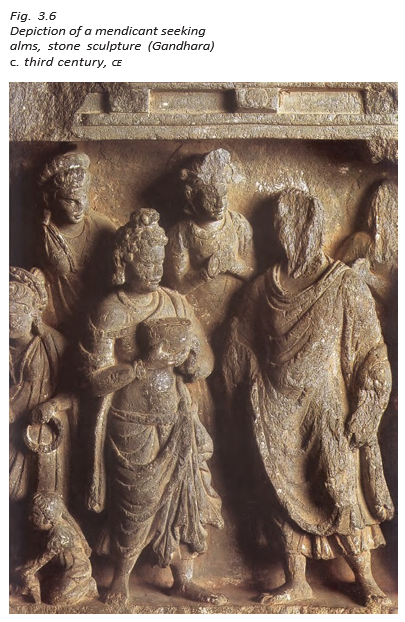
- Chandalas: Brahmanical texts placed them at the bottom of the social order because their work was considered polluting.
- Prescribed duties: The Manusmriti required them to live outside villages, use discarded utensils and dispose of unclaimed bodies.
- Historical evidence: Accounts by Fa Xian and Xuan Zang describe social exclusion, while other texts offer glimpses of different realities.
Matanga Jataka: Challenging Social Rank
Dates Mentioned
- c. third century CEGandhara stone sculpture depicting a mendicant seeking alms.
- c. fifth century CEFa Xian reported that untouchables sounded a clapper to warn others.
- c. seventh century CEXuan Zang observed that executioners and scavengers lived outside the city.
- Nishada
- A category associated with forest-dwellers; Ekalavya is said to have belonged to it.
- Mlechchha
- A label sometimes applied to people who spoke non-Sanskritic languages.
- Chandala
- A group placed at the bottom of the social hierarchy and associated with polluting tasks.
- Bodhisattva
- The Buddha in a previous birth.
- Shastras
- Brahmanical texts that prescribed social rules and duties.
How did Brahmanical ideas define the position of chandalas?
What does the Matanga Jataka suggest about social status?
Quick recap
- Groups such as forest-dwellers, nomadic pastoralists and mlechchhas stood outside Brahmanical social frameworks; Ekalavya is associated with the nishadas.
- The Bhima–Hidimba story reflects connections across communities and a possible difference in social practices.
- Ideas of purity and pollution placed chandalas at the bottom of the social hierarchy.
- The Manusmriti prescribed restrictions, residence rules and duties for chandalas.
- Accounts by Fa Xian and Xuan Zang describe exclusion, while non-Brahmanical texts may reveal other social realities.
- The Matanga Jataka questions birth-based status and emphasises virtue.
Beyond Birth Resources and Status
Resources and social position
- Social actors: Slaves, landless labourers, hunters, fisherfolk, pastoralists, peasants, village headmen, craftspersons, merchants and kings.
- Key idea: Differences in control over wealth and resources could reinforce social distinctions.
Gendered access to property
Property, inheritance and the Mahabharata
- Dice game: Yudhisthira successively wagered his wealth, kingdom, subjects’ property, brothers and himself; he then wagered Draupadi and lost her.
- Draupadi’s question: She asked whether Yudhisthira could stake her after he had already lost himself.
- Two views: One held that Draupadi remained under her husband’s control; the other argued that an unfree man could not stake another person.
- Outcome: The dispute remained unresolved. Dhritarashtra eventually restored the personal freedom of the Pandavas and Draupadi.
| Area | Rule or source |
|---|---|
| Paternal estate | After the parents’ death, it was to be divided equally among sons, with a special share for the eldest; women could not claim a share. |
| Stridhana | A woman’s wealth included marriage gifts; her children could inherit it, and her husband had no claim to it. |
| Control over wealth | Women were warned not to hoard family property or even their own valuables without their husband’s permission. |
| Broader pattern | Some upper-class women had access to resources, but land, cattle and money were generally controlled by men. |
Stridhana — A woman’s wealth, including gifts received at marriage, which could be inherited by her children.
| Men | Women |
|---|---|
| Inheritance; finding; purchase; conquest; investment; work; and gifts from good people. | The text identifies six means: marriage gifts (given before the fire or during the bridal procession); tokens of affection; gifts from a brother, mother or father; later gifts; and gifts from an affectionate husband. |
Impact of unequal access
- Evidence: Epigraphic and textual sources suggest that even when elite women could access wealth, men generally controlled major resources.
- Consequence: Unequal access to property sharpened social differences between men and women.
Varna and access to property
Brahmanical views and social realities
- Occupations: Shudras were prescribed servitude, while men of the first three varnas were assigned a wider range of occupations.
- Expected wealth: If these rules were followed, Brahmanas and Kshatriyas would likely be wealthiest.
- Textual depictions: Kings are almost always shown as wealthy; priests are generally rich, though some accounts depict poor Brahmanas.
Buddhist critique of birth-based status
- Challenge: Buddhists rejected claims to higher status based solely on birth.
- Wealthy Shudra: In a dialogue in the Majjhima Nikaya, Kachchana asked whether a wealthy Shudra could command servants from any varna.
- Argument: King Avantiputta agreed that a wealthy Shudra could employ Shudra, Kshatriya, Brahmana or Vaishya servants.
- Conclusion: On the basis of wealth and service, the four varnas were not different; the story challenges claims of inherent Brahmana superiority.
An alternative social scenario: sharing wealth
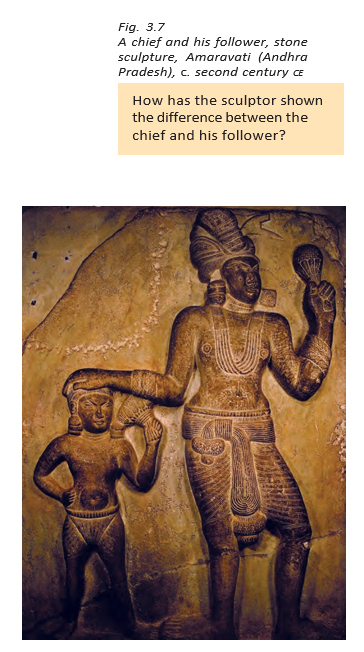
Generosity and social respect in Tamilakam
- Values: Generous men were respected, while misers and those who kept wealth only for themselves could be despised.
- Chiefs and poets: Chiefs patronised bards and poets, whose songs praised them.
- Sangam poems: The poems show differences between rich and poor, while suggesting that people who controlled resources were expected to share them.
Periods mentioned
- From c. sixth century BCE onwardsEarly Buddhism developed critiques of the varna order and birth-based status.
- Around 2,000 years agoTamilakam had several chiefdoms whose chiefs patronised bards and poets.
- Stridhana
- A woman’s wealth, including certain marriage gifts.
- Varna
- A social classification used in Brahmanical texts to prescribe status and occupations.
- Tamilakam
- The ancient Tamil region described in Sangam poems as having chiefdoms.
- Chiefdom
- A society or territory organised under a chief.
What does the Draupadi episode reveal about ownership and women’s status?
How did the Buddhist story of the wealthy Shudra challenge the varna hierarchy?
What social values around wealth are suggested by Sangam poems?
Quick recap
- Resources: Economic access helped shape social position across different groups.
- Gender: Women’s property rights were limited; stridhana was a recognised but restricted form of wealth.
- Varna: Brahmanical rules linked occupation and wealth to varna, but Buddhist accounts challenged birth-based status.
- Wealth: The wealthy Shudra story shows that wealth could influence social dealings across varnas.
- Sharing: Tamilakam’s poems praise generosity and suggest that resource holders were expected to share.
Explaining Social Differences: a Social Contract
A Sangam Poem on a Generous Chief
Source 14: The poor generous chief
- Source: A poem from the *Puranaruru*, an anthology of Tamil Sangam literature, from about the first century CE.
- Patron: Though not wealthy enough to give lavishly every day, the chief is not mean or unwilling to help.
- Bard’s appeal: The chief responds to hungry poets; if asked, he will even have a blacksmith make a war spear for them.
Buddhist Explanation of Social Differences
Social contract — An agreement in which people choose a ruler and give him a share of their produce in return for services that regulate social conflict.
The Buddhist myth of kingship in the Sutta Pitaka
- Early humans lived peacefully, taking from nature only what they needed.
- Greed, hostility and deceit gradually disrupted this condition.
- People chose a person to punish wrongdoing, censure offenders and banish those deserving banishment.
- The chosen ruler was called mahasammata (“the great elect”); people gave him a share of rice as payment.
What the account implies
- Kingship: It is based on human choice, not presented as an unquestionable natural arrangement.
- Taxation: The ruler’s share of rice is payment for the services he provides.
- Human agency: People created social and economic arrangements, so they could also change them later.
How Historians Handle Texts
| Aspect | What historians investigate |
|---|---|
| Language | Whether it was composed in Prakrit, Pali, Tamil or Sanskrit, and what that suggests about its users. |
| Form and content | Whether it is a mantra, a story, or a text combining narrative and social prescriptions. |
| Authors and audience | Whose views shaped it and for whom it was composed. |
| Date and place | When and where it may have been composed or compiled. |
| Historical significance | What its content can reveal after these other factors are assessed. |
Why the Mahabharata is difficult to interpret
- Complexity: The epic has many layers, authors and additions, making its historical significance difficult to establish.
- Method: Historians assess context and authorship before treating a text’s contents as evidence about the past.
The Mahabharata: Language and Content
Language and literary divisions
- Language: The version discussed is in Sanskrit, but its Sanskrit is simpler than that of the Vedas or prashastis and was probably widely understood.
- Narrative: Sections that tell stories and make the epic a dramatic, moving account.
- Didactic: Sections that prescribe social norms; these can also contain stories.
- Overlap: The division is not absolute: narratives may carry social messages, while didactic passages may include stories. Historians generally consider the didactic sections later additions.
Itihasa — A term in early Sanskrit tradition meaning “thus it was,” generally translated as “history.”
| Evidence | Interpretation | |
|---|---|---|
| War in the epic | The Mahabharata describes conflict among kinfolk. | Some historians think it preserves the memory of a real conflict; others note that no independent evidence confirms the battle. |
Authors and Dates of the Mahabharata
How the epic developed
- Suta charioteer-bards probably composed the original stories and poems celebrating Kshatriya warriors; these circulated orally.
- From the fifth century BCE, Brahmanas took over the story and began committing it to writing.
- Between c. 200 BCE and 200 CE, the text developed further as Vishnu worship grew and Krishna came to be identified with Vishnu.
- Between c. 200 and 400 CE, large didactic sections—some resembling the Manusmriti—were added.
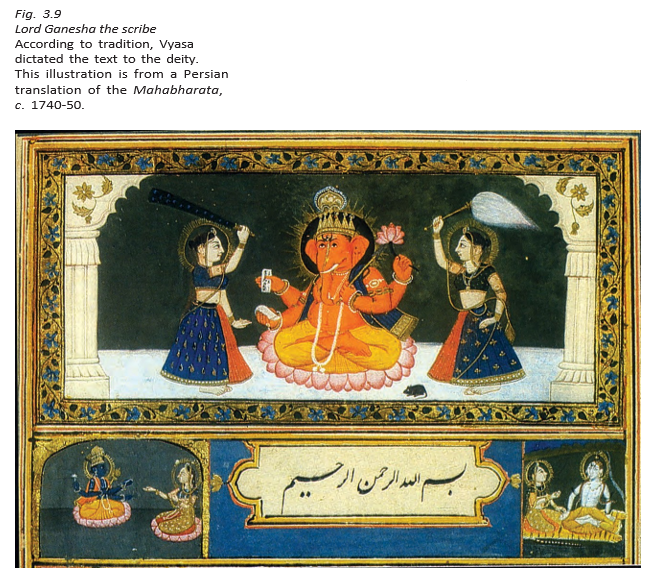
- The epic grew from perhaps fewer than 10,000 verses to about 100,000; tradition attributes it to the sage Vyasa.
Historical context
- Changing polities: The Kuru and Panchala chiefdoms around which the epic centres were becoming kingdoms.
- Social change: The upheavals of state formation and the replacement of older values by new norms may be reflected in parts of the story.
- Authorship: The epic’s growth over centuries means it should not be treated as the work of a single known author.
Composition and growth
- From the fifth century BCEBrahmanas took over the story and began committing it to writing.
- c. 200 BCE–200 CEA further phase of composition occurred as Vishnu worship grew and Krishna became associated with Vishnu.
- c. 200–400 CELarge didactic sections were added.
Searching for Convergence: Texts and Archaeology
Hastinapura excavations
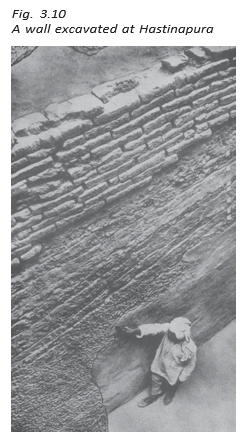
- Excavation: In 1951–52, archaeologist B.B. Lal excavated at Hastinapura, a village in Meerut, Uttar Pradesh.
- Possible identification: The site’s location in the Upper Ganga doab, associated with the Kuru kingdom, suggests it may be the epic’s Hastinapura; the matching name alone cannot prove this.
- Levels: Lal found five occupational levels; the second and third are especially relevant.
| Phase | Date | Finds |
|---|---|---|
| Second | c. twelfth–seventh centuries BCE | Mud and mud-brick walls; reed-marked mud plaster suggests some houses had reed walls plastered with mud. No definite house plans were found in the excavated area. |
| Third | c. sixth–third centuries BCE | Mud-brick and burnt-brick houses; soakage jars and brick drains for wastewater; terracotta ring-wells possibly used as wells or drainage pits. |
| Evidence | Interpretation | |
|---|---|---|
| Descriptions of the city | The epic describes cities; archaeology shows changes in settlement construction at Hastinapura. | Urban descriptions may have been added after the main narrative as urban centres flourished after the sixth century BCE, or they may be poetic invention. Archaeology cannot settle the question by itself. |
Draupadi’s Marriage and Polyandry
Polyandry — A marriage in which one woman has more than one husband.
How historians interpret the episode
- Possible social evidence: The inclusion of Draupadi’s polyandrous marriage may indicate that the practice existed among ruling elites at some time.
- Changing views: The many explanations offered for the marriage may show that polyandry gradually fell out of favour among Brahmanas who reshaped the epic.
- Regional practice: Polyandry was and is prevalent in the Himalayan region.
- Crisis explanation: Some historians suggest warfare may have caused a shortage of women, leading to polyandry.
- Caution: Polyandry was not necessarily the only or most common marriage form; literature has narrative needs and does not always record social life literally.
How does the Buddhist account explain the origin of kingship and taxation?
Name two kinds of evidence historians consider when studying the Mahabharata.
Why should Draupadi’s marriage not be treated as straightforward proof that polyandry was common?
- Mahasammata
- “The great elect”; the ruler chosen by the people in the Buddhist account.
- Itihasa
- A Sanskrit term meaning “thus it was,” usually translated as “history.”
- Narrative
- Story-telling sections of the Mahabharata.
- Didactic
- Sections that prescribe social norms or teach lessons.
- Polyandry
- Marriage in which one woman has more than one husband.
- Sutas
- Charioteer-bards who composed and orally circulated early epic poems.
Quick recap
- The Sutta Pitaka’s Buddhist account presents kingship as a human choice, with rice given as payment for the ruler’s services.
- Historians assess a text’s language, form, authors, audience, date and place before interpreting it.
- The Mahabharata combines narrative and didactic material and developed through several stages.
- Archaeological evidence from Hastinapura can be compared with the epic, but cannot confirm every description.
- Draupadi’s marriage offers evidence for historical discussion, not simple proof that polyandry was widespread; polyandry was and is prevalent in the Himalayan region.
A Dynamic Text
Hastinapura in the Mahabharata
Literary and archaeological references
- Epic description: The *Adi Parvan* portrays Hastinapura as a grand, crowded city with hundreds of mansions, gateways, arches and turrets like massing clouds; its splendour is compared to Great Indra’s city.
- Archaeological remains: Excavations at Hastinapura provide material evidence of an ancient settlement.
Draupadi’s Marriage
The epic’s explanation of Draupadi’s shared marriage
- Contest: Arjuna won Drupada’s challenge to string a bow and hit a target, and Draupadi garlanded him.
- Kunti’s command: Before seeing Draupadi, Kunti told her sons to share what they had brought home; she then realised what she had said.
- Decision: Yudhishthira decided that Draupadi would be the common wife of the five Pandavas. Drupada objected.
- Vyasa’s explanations: He said the Pandavas were incarnations of Indra, whose wife had been reborn as Draupadi. He also told of a woman who prayed to Shiva five times for a husband and was reborn as Draupadi.
- Outcome: These stories persuaded Drupada to consent to the marriage.
The Mahabharata as a Dynamic Text
Dynamic text — A text that continues to grow and change through retelling, translation and exchange among communities and writers.
How the epic developed and travelled
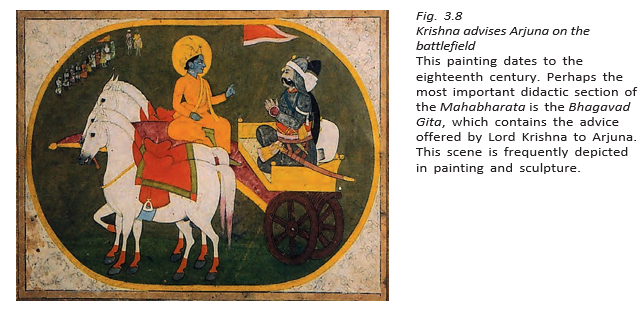
- Many languages: The epic’s growth continued beyond its Sanskrit version, through versions in different languages.
- Exchange: Its development involved ongoing dialogue among peoples, communities and writers.
- Regional stories: Stories originating in particular regions or circulating among specific groups became part of the epic.
- Retelling and performance: The central story was retold in different ways and episodes appeared in sculpture and painting; the epic also inspired plays, dance and other forms of narration.
Major Textual Traditions
Major works and compilations
- c. 500 BCEPanini’s *Ashtadhyayi*, a work on Sanskrit grammar.
- c. 500–200 BCEMajor Dharmasutras composed in Sanskrit.
- c. 500–100 BCEEarly Buddhist texts, including the *Tripitaka*, composed in Pali.
- c. 500 BCE–400 CEThe *Ramayana* and *Mahabharata* composed in Sanskrit.
- c. 200 BCE–200 CEThe *Manusmriti* composed in Sanskrit; Tamil Sangam literature composed and compiled.
- c. 100 CEThe *Charaka* and *Sushruta Samhitas*, works on medicine, composed in Sanskrit.
- c. 200 CE onwardsThe *Puranas* compiled in Sanskrit.
- c. 300 CEBharata’s *Natyashastra*, a work on dramaturgy, composed in Sanskrit.
- c. 300–600 CEOther Dharmashastras composed in Sanskrit.
- c. 400–500 CESanskrit plays, including works by Kalidasa; astronomy and mathematics works by Aryabhata and Varahamihira; and Jaina works compiled in Prakrit.
Studying the Mahabharata
Major landmarks
- 1919–1966Preparation and publication of the Critical Edition of the *Mahabharata*.
- 1973J. A. B. van Buitenen began an English translation of the Critical Edition.
- 1978Van Buitenen died; his English translation remained incomplete.
Quick recap
- The *Mahabharata* continued to develop through versions in many languages and ongoing cultural exchange.
- Regional stories entered the epic, while its central story was retold in different ways.
- Epic episodes influenced sculpture, painting, plays, dance and other forms of narration.
- The Draupadi story explains her marriage to the five Pandavas through Kunti’s command and Vyasa’s accounts.
- The *Adi Parvan* compares Hastinapura’s splendour to Great Indra’s city and its turrets to massing clouds.
- The Critical Edition was prepared and published between 1919 and 1966; van Buitenen began an English translation in 1973, which remained incomplete after his death in 1978.
History — ALL CHAPTERS
1
BRICKS, BEADS AND BONES THE HARAPPAN CIVILISATION
2
KINGS, FARMERS AND TOWNS EARLY STATES AND ECONOMIES (C. 600 BCE-600 CE)
3
KINSHIP, CASTE AND CLASS EARLY SOCIETIES (C. 600 BCE-600 CE)
4
THINKERS, BELIEFS AND BUILDINGS CULTURAL DEVELOPMENTS (C. 600 BCE - 600 CE)
1
THROUGH THE EYES OF TRAVELLERS PERCEPTIONS OF SOCIETY (C. TENTH TO SEVENTEENTH CENTURY)
2
BHAKTI- SUFI TRADITIONS CHANGES IN RELIGIOUS BELIEFS AND DEVOTIONAL TEXTS (C. EIGHTH TO EIGHTEENTH CENTURY)
3
AN IMPERIAL CAPITAL VIJAYANAGARA (C. FOURTEENTH TO SIXTEENTH CENTURY)
4
PEASANTS, ZAMINDARS AND THE STATE AGRARIAN SOCIETY AND THE MUGHAL EMPIRE (C. SIXTEENTH- SEVENTEENTH CENTURY)
1
COLONIALISM AND THE COUNTRYSIDE EXPLORING OFFICIAL ARCHIVES
2
REBELS AND THE RAJ THE REVOLT OF 1857 AND ITS REPRESENTATIONS
3
MAHATMA GANDHI AND THE NATIONALIST MOVEMENT CIVIL DISOBEDIENCE AND BEYOND
4
FRAMING THE CONSTITUTION THE BEGINNING OF A NEW ERA