Class 12 Humanities . History . Themes In Indian History Part III . Framing the Constitution the Beginning of a New Era
Chapter 4: FRAMING THE CONSTITUTION THE BEGINNING OF A NEW ERA
Ch 4
History
Class 12 Humanities
Introduction & a Tumultuous Time
Why India Needed an Elaborate Constitution
Constitution of India — The framework for governing India and bringing its diverse people together in a shared political system.
Purpose and Making
- Length: The Indian Constitution has the distinction of being the world's longest Constitution; its length reflects India's size, diversity and deep divisions.
- Aims: It sought to heal past and present divisions, unite people across class, caste and community, and nurture democratic institutions in a hierarchical society.
- Drafting period: The Constitution was framed from December 1946 to November 1949, with clauses discussed in the Constituent Assembly.
- Deliberations: The Assembly held 11 sessions over 165 sitting days; committees and sub-committees revised and refined drafts between sessions.
What This Chapter Examines
- Focus: The chapter explores the history behind the Constitution and the intense debates involved in its making.
- Assembly voices: Studying members' arguments reveals how the Constitution was framed and how a vision for the new nation took shape.
Key Events Around Constitution-Making
- 1942The Quit India movement became a major popular struggle against British rule.
- Winter 1945–46Provincial elections were held; provincial legislatures later selected representatives to the Constituent Assembly.
- Spring 1946Ratings of the Royal Indian Navy rose in Bombay and other cities.
- August 1946The Great Calcutta Killings began a period of almost continuous communal rioting.
- December 1946–November 1949The Constitution was framed and debated in the Constituent Assembly.
- 15 August 1947India became independent and was partitioned.
- 26 January 1950The Constitution of India came into effect.
A Tumultuous Time
Hope, Resistance and Unrest
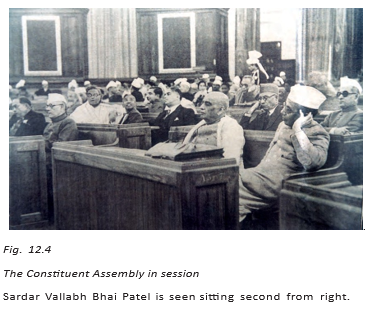
- Mixed moment: The years before Constitution-making brought great hope as well as deep disappointment; Independence came with Partition.
- Popular resistance: The Quit India struggle was perhaps the broadest popular movement against British rule; Subhas Chandra Bose sought freedom through armed struggle with foreign aid.
- Mass upsurges: The 1946 naval ratings' rising and scattered worker and peasant protests showed continuing unrest.
- Unity and division: Popular upsurges often showed Hindu-Muslim unity, while Congress and the Muslim League repeatedly failed to reach agreement on religious reconciliation and social harmony.
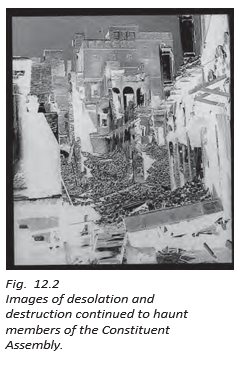
Partition and Its Human Consequences
- Failure to achieve political and religious reconciliation → communal violence spread across northern and eastern India.
- Partition and transfer of populations → millions faced displacement and the loss of long-standing homes and communities.
- Threats of sudden death or shrinking opportunities, alongside forced separation from ancestral roots → many people faced a cruel choice of migration or remaining in danger.
- Mass migration → Muslims moved to East and West Pakistan; Hindus and Sikhs moved to West Bengal and eastern Punjab, and many perished on the way.
The Princely States
- Under British rule: About one-third of the subcontinent was governed by nawabs and maharajas, who owed allegiance to the British Crown but largely ruled their territories themselves.
- After British withdrawal: Their constitutional status was uncertain; some rulers imagined independent power, creating another challenge for the new nation.
Making the Constituent Assembly
Constituent Assembly — The body that debated and framed India's Constitution.
Selection and Party Composition
- Selection: Members were not elected by universal franchise; provincial legislatures selected the Assembly's representatives after the 1945–46 provincial elections.
- Congress: Congress dominated the Assembly, and 82% of its members also belonged to Congress.
- Muslim League: It captured most reserved Muslim seats in the provincial elections but boycotted the Assembly while demanding Pakistan with a separate constitution.
- Socialists: They were initially unwilling to join, believing the Assembly was a British creation and could not be truly autonomous.
Differences Within Congress
- Not one voice: Congress members differed on critical issues.
- Range of views: Some were inspired by socialism and others defended landlordism; some were close to communal parties while others were assertively secular.
- Debate and compromise: Experience in the national movement had taught members to debate publicly and negotiate differences, and these debates continued in the Assembly.
Public Opinion and Constitution-Making
- Assembly deliberations reported in newspapers → proposals debated publicly.
- Public criticism and counter-criticism → helped shape the consensus on specific issues.
- People submitted views → questions of cultural rights and social justice entered Assembly debates.
| Group | Demand |
|---|---|
| Linguistic minorities | Protection of their mother tongues. |
| Religious minorities | Special safeguards. |
| Dalits | An end to caste oppression and reserved seats in government bodies. |
| Committee | President |
|---|---|
| Rules of Procedure Committee | Rajendra Prasad |
| Union Power Committee | Jawaharlal Nehru |
| Union Constitution Committee | Jawaharlal Nehru |
| Provincial Constitution Committee | Vallabhbhai Patel |
| Steering Committee | Rajendra Prasad |
| Drafting Committee | B. R. Ambedkar |
| Flag Committee | J. B. Kripalani |
| States Committee | Jawaharlal Nehru |
| Advisory Committee | Vallabhbhai Patel |
| Supreme Court Committee | S. Varadachariar |
| Fundamental Rights Sub-Committee | J. B. Kripalani |
| Minorities Sub-Committee | H. C. Mookerjee |
| Constitution Review Commission | M. N. Venkatachaliah |
- Universal franchise
- The right of all adult citizens to vote; Assembly members were not chosen this way.
- Princely states
- Territories ruled by nawabs or maharajas under allegiance to the British Crown.
- Partition
- The division of British India into India and Pakistan, accompanied by mass migration and violence.
How were members of the Constituent Assembly selected, and which groups initially stayed away?
How did public opinion influence the making of the Constitution?
Quick recap
- India's size, diversity and divisions made an elaborate Constitution necessary; it is the world's longest Constitution.
- The Constitution was framed from December 1946 to November 1949 in 11 sessions over 165 sitting days.
- Independence brought hope, but Partition brought communal violence, mass displacement and refugee deaths.
- Uncertain princely-state status posed another challenge to the new nation.
- Provincial legislatures selected the Assembly; Congress dominated it, but its members held diverse views.
- Newspapers, public debate and public submissions helped shape constitutional discussions and consensus.
The Dominant Voices & the Vision of the Constitution
The Dominant Voices
| Member | Role in constitution-making |
|---|---|
| Jawaharlal Nehru | Moved the Objectives Resolution and proposed a horizontal tricolour of saffron, white and dark green in equal proportions, with a navy-blue wheel at the centre. |
| Vallabh Bhai Patel | Worked on several reports and helped reconcile opposing views. |
| Rajendra Prasad | As Assembly President, guided constructive discussion and ensured members could speak. |
| B.R. Ambedkar | Chairman of the Drafting Committee; guided the Draft Constitution through the Assembly. |
| K.M. Munshi and Alladi Krishnaswamy Aiyar | Lawyers who contributed important inputs to the drafting. |
Other key contributors
- B.R. Ambedkar: A lawyer and economist, and previously a political opponent of the Congress; on Mahatma Gandhi’s advice, he joined the Union Cabinet as Law Minister at Independence.
- B.N. Rau: Constitutional Adviser to the Government of India; prepared background papers after studying political systems in other countries.
- S.N. Mukherjee: Chief Draughtsman; translated complex proposals into clear legal language.
The Assembly debates
- Duration and record: Ambedkar guided the Draft Constitution through a process lasting three years; the printed debates filled eleven volumes.
- Range of views: Members expressed differing ideas about language, political and economic systems, and citizens’ moral values.
The Vision of the Constitution
The Objectives Resolution
- 13 December 1946Jawaharlal Nehru introduced the Objectives Resolution, setting out the ideals and framework for constitution-making.
Core commitments of the Resolution
- Political status: Declared India an independent, sovereign republic.
- Rights and justice: Promised citizens justice, equality and freedom.
- Safeguards: Promised adequate protection for minorities, backward and tribal areas, and Depressed and Other Backward Classes.
Learning from Earlier Revolutions Without Copying
Nehru’s historical perspective
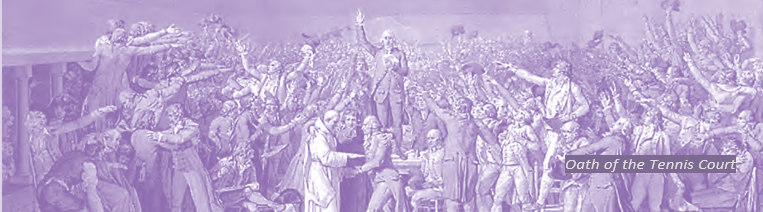
- Examples recalled: Nehru referred to the American and French Revolutions and the Russian Revolution as major experiments in political change.
- Lessons, not blueprints: India could learn from other countries’ successes and failures, but should not copy their systems mechanically.
- Indian context: Institutions had to fit the temper of the Indian people and be acceptable to them; their form should be decided through deliberation.
- Creative adaptation: The Constitution was to combine liberal democratic ideals with socialist ideas of economic justice, adapted to Indian conditions.
| Idea | Nehru’s explanation |
|---|---|
| Republic and democracy | Nehru acknowledged that a republic need not always be democratic, but said India stood for democratic institutions. |
| Why omit “democratic”? | Nehru said that “republic” made the democratic ideal obvious, so the word would be redundant; the Resolution stated democracy’s substance, including economic democracy. |
| Socialism | Nehru supported socialism and hoped India would move towards a Socialist State, but the Resolution did not use that label. |
- Objectives Resolution
- Nehru’s statement of the Constitution’s fundamental ideals and guiding framework.
- Sovereign republic
- A country that is independent and has no external ruler.
- Economic democracy
- Democracy that includes economic justice, not only political institutions.
- Drafting Committee
- The committee responsible for preparing the Draft Constitution, chaired by B.R. Ambedkar.
Why was the word “democratic” not included in the Objectives Resolution?
How did Nehru view the influence of foreign revolutions on India’s Constitution?
Quick recap
- The 300-member Assembly included six especially influential members, supported by constitutional and drafting experts.
- Nehru proposed a saffron, white and dark green horizontal tricolour in equal proportions, with a navy-blue wheel at its centre.
- Ambedkar chaired the Drafting Committee and guided the Draft Constitution through three years of debate.
- The Objectives Resolution, introduced on 13 December 1946, set out sovereignty, justice, equality, freedom and safeguards.
- Nehru drew lessons from revolutions abroad but rejected copying their systems as fixed models.
- The Constitution was to fit Indian conditions and combine democratic ideals with economic justice.
- Nehru considered “democratic” redundant because he said the term “republic” already contained that idea.
The Will of the People
British Influence and the Constituent Assembly
Somnath Lahiri’s criticism
- Somnath Lahiri, a Communist member, argued that British imperialism still constrained the Constituent Assembly’s work.
- Context: During the winter of 1946–47, British authorities remained in India; the interim administration led by Jawaharlal Nehru was still subject to the Viceroy and the British Government.
- Lahiri’s claim: The Assembly had been created under British conditions and, in his view, was working within British plans.
- His proposal: Declare independence immediately, unite Indians against British imperialism, and settle internal disputes after freedom.
Why Lahiri said the Assembly was under the “shadow of British guns”
- British forces and the British administration remained in India.
- The Assembly’s plans were subject to British conditions, including a proposed treaty satisfactory to Britain.
- Britain retained military, economic and financial power; disputes could also be referred to British institutions or leaders.
- British leaders could threaten division, so final authority and control over India’s future had not fully passed to Indians.
Nehru: The People as the Source of Authority
| Point | Lahiri’s view | Nehru’s view |
|---|---|---|
| Source of authority | The Assembly was created within British plans and conditions. | Its strength came from the people and their support. |
| Britain’s power | British military, political and economic control meant India was not yet fully free. | Although Britain had a hand in the Assembly’s creation, its popular mandate mattered. |
| Purpose | Declare independence first and resolve internal claims later. | Represent the people as a whole and fulfil their aspirations. |
Nehru’s principle
- Popular will: Governments do not gain legitimacy merely through official documents; they express the will of the people.
- Representation: The Assembly should heed the aspirations of the people as a whole, not only a party or group.
- Responsibility: Members should recognise the hopes and passions of ordinary people and work to fulfil them.
Social Struggles and Democratic Aspirations
Ideas expressed through social and national movements
- Democracy, equality and justice had become linked to India’s social struggles and independence movement.
- Social reformers: Opposition to child marriage and campaigns for widows’ remarriage demanded social justice.
- Swami Vivekananda: Sought reform of Hinduism and a more just religious life.
- Jyotiba Phule: Drew attention to the suffering of oppressed castes.
- Communists and Socialists: Organised workers and peasants in demands for economic and social justice.
- National movement: Resistance to oppressive, illegitimate colonial rule also advanced democracy, citizens’ rights and equality.
Earlier Reforms and the New Constitutional Vision
Constitutional Reforms and Political Participation
- 1909A constitutional reform enlarged opportunities for Indian participation.
- 1919The executive became partly responsible to the provincial legislature.
- 1935The Government of India Act made the executive almost entirely responsible to provincial legislatures.
- 1937Under the 1935 Act, Congress formed governments in eight of the eleven provinces.
- 13 December 1946Nehru outlined the Assembly’s popular mandate and vision for India’s future in his Objectives Resolution speech.
| Point | Earlier reforms | New constitutional vision |
|---|---|---|
| Who framed the rules | Acts were enacted by the colonial government, not directly debated and formulated by Indians. | The Assembly aimed to frame the Constitution of an independent India. |
| Electorate | Even in 1935, only about 10–15% of adults could vote; there was no universal adult franchise. | The Assembly claimed strength from the people and their aspirations. |
| Governmental control | Provincial legislatures operated under colonial rule and answered to a British-appointed Governor. | Nehru’s vision was a sovereign Republic of India. |
| Meaning | Reforms responded to demands for representation but remained within the colonial system. | The Assembly marked a break toward self-government and popular sovereignty. |
- Popular sovereignty
- The principle that a government’s authority comes from the people.
- Universal adult franchise
- The right of all adult citizens to vote; it did not exist under the 1935 Act.
- Sovereign Republic
- An independent state whose authority is not subordinate to a foreign power.
- Objectives Resolution
- The resolution associated with Nehru’s speech outlining the Assembly’s aims and vision.
Why did Somnath Lahiri say the Constituent Assembly was under the shadow of British guns?
What ideas did Nehru outline in his speech on the Objectives Resolution?
When comparing the 1935 Act with the Constituent Assembly, mention both the limited electorate and colonial control under the Act, then contrast these with the Assembly’s aim of a sovereign republic based on popular will.
Quick recap
- Lahiri saw British military and political power as a continuing constraint on the Assembly.
- He urged immediate independence and unity against British imperialism.
- Nehru argued that the people—not official documents or one party—were the Assembly’s source of strength.
- Democracy, equality and justice grew from social reform, workers’ and peasants’ movements, and the national struggle.
- The reforms of 1909, 1919 and 1935 expanded participation but remained colonial and excluded most adults from voting.
- The Assembly’s new vision was an independent, sovereign Republic shaped by popular aspirations.
Defining Rights & the Problem with Separate Electorates
Defining Rights
- Central questions: The Assembly debated how to define individual rights, protect oppressed groups and minorities, and balance community claims with equal citizenship.
- Consensus: Members expressed different demands, which had to be reconciled through debate before a shared framework of rights could emerge.
The Problem with Separate Electorates
Separate electorates — An arrangement in which a community elects its own representatives, so its representatives are chosen only by members of that community.
| Argument | For separate electorates | Against separate electorates |
|---|---|---|
| Representation | B. Pocker Bahadur argued that only separate electorates could ensure Muslims had a meaningful political voice. | Govind Ballabh Pant argued that minority representatives elected separately would have no effective influence in government. |
| Understanding minority needs | Bahadur said non-Muslims could not properly understand Muslim needs or choose true Muslim representatives. | Pant accepted the need for majority empathy, but argued that segregation would isolate minorities and make them vulnerable. |
| Effects on the nation | Bahadur argued that representation could help communities live in harmony and make their differences less divisive. | Sardar Patel and other nationalists saw separate electorates as divisive, linked to British policies, communal conflict and Partition. |
| Long-term outcome | Separate representation was presented as protection for a minority’s voice. | Pant called it suicidal: permanent isolation would frustrate minorities and prevent them from becoming an integral part of the nation. |
Nationalist objections
- R. V. Dhulekar: He said the British had used the language of safeguards to entice minorities and divide people; he urged them to abandon the arrangement after British rule.
- Sardar Patel: Partition and communal violence strengthened his opposition. He described separate electorates as a poison in the body politic that had turned communities against each other.
- Patel’s warning: Continuing separate electorates after Partition could endanger peace and perpetuate the divisive legacy of British rule.
- Govind Ballabh Pant: He acknowledged that democracy depends on confidence among communities and respect for minorities’ material needs and self-respect, yet opposed separate electorates.
Separate electorates and national unity
- Separate electorates organise political representation by community
- Communities may become politically isolated and develop competing loyalties
- Divided loyalties can weaken democratic cooperation and national unity
- Nationalists therefore favoured equal citizenship within one State
Citizenship, Community Rights and Loyalty
Building a unified nation
- Political principle: All communities could be recognised as cultural groups and assured cultural rights, but their members were to participate politically as equal citizens of one State.
- Nationalist concern: Treating politics mainly through communities could create divided loyalties and obstruct a strong nation and State.
- Pant’s emphasis: The citizen—not the community—must be the foundation of the political order.
- Begum Aizaz Rasul: She also considered separate electorates self-destructive because they isolated minorities from the majority.
- By 1949: Most Muslim members of the Constituent Assembly agreed that separate electorates harmed minorities; Muslims should participate actively in democracy to secure an effective political voice.
Pant’s loyal citizen — A loyal citizen practises self-discipline, cares about others and the wider public interest, and centres loyalty on the State rather than competing groups.
Pant on democracy and loyalty
- Self-discipline: Citizens should restrain self-interest and care more for others.
- Single loyalty: Pant argued that all loyalties must be centred on the State; rival loyalties place democracy in danger.
- Shared interests: Individuals and groups must consider larger interests rather than pursue their own interests without regard for others.
“We Will Need Much More Than This Resolution”
N. G. Ranga’s “real minorities” — Ranga defined the real minorities in economic and social terms: the poor and oppressed masses who could not effectively use ordinary civil rights.
Ranga: rights need practical support
- Limits of legal rights: Fundamental rights and civil liberties alone were not enough if poverty and social powerlessness prevented people from using them.
- Examples of exploitation: Tribal land could be taken despite legal protections; moneylenders, landlords, zamindars and malguzars could exploit poor villagers.
- Needed safeguards: The poor required protection and practical support—Ranga’s “props” and “ladder”—so they could enjoy their rights in reality.
- Representation: Ranga said Assembly members acted as trustees and champions for the masses, who could not themselves reach the Constituent Assembly.
Tribal Rights and Representation
Jaipal Singh’s case for tribal protection
- Historical injustice: Jaipal Singh said tribal people had faced long-term neglect, exploitation and dispossession; he described their history as extending over 6,000 years.
- Land and resources: Tribals had been dispossessed of settled lands, forests and pastures, forcing them to move in search of homes.
- Need for protection: Though not a numerical minority, tribes needed protection and conditions that would help them reach equality of opportunity.
- Integration: Singh urged non-tribal society to mix with tribal communities and overcome their emotional and physical separation.
- Political representation: Singh did not seek separate electorates; he supported reserved legislative seats so tribal people could represent themselves and make their voices heard.
| Member | Date of signing register | Constituency |
|---|---|---|
| Ammu Swaminathan | 9 December 1946 | Madras (General) |
| Annie Mascarene | 9 December 1946 | Travancore and Cochin (General) |
| Begum Aizaz Rasul | 14 December 1946 | United Provinces (Muslim) |
| Dakshayani Velayudhan | 9 December 1946 | Madras (General) |
| G. Durgabai | 9 December 1946 | Madras (General) |
| Hansa Mehta | 9 December 1946 | Bombay (General) |
| Kamla Chaudhri | 9 December 1946 | United Provinces (General) |
| Leela Roy | 9 December 1946 | West Bengal (General) |
| Malati Choudhury | 9 December 1946 | Orissa (General) |
| Purnima Banerji | 9 December 1946 | United Provinces (General) |
| Rajkumari Amrit Kaur | 21 December 1946 | Central Provinces and Berar (General) |
| Renuka Ray | 14 July 1947 | West Bengal (General) |
| Sarojini Naidu | 9 December 1946 | Bihar (General) |
| Sucheta Kripalani | 9 December 1946 | United Provinces (General) |
| Vijayalakshmi Pandit | 17 December 1946 | United Provinces (General) |
Key dates
- 27 August 1947B. Pocker Bahadur argued for continuing separate electorates; Pant argued against them.
- By 1949Most Muslim Assembly members agreed that separate electorates were against minority interests.
- Separate electorates
- A system in which a community elects its own representatives.
- Cultural rights
- Rights that recognise and protect communities’ cultural identities.
- Reserved seats
- Legislative seats set aside to help a group represent itself.
- Divided loyalty
- Competing allegiances that weaken shared commitment to the State.
What were the main arguments against separate electorates?
How did Pant describe a loyal citizen?
How did Ranga define the real minorities, and what did he say they needed?
Quick recap
- The Constituent Assembly debated how individual, minority and oppressed-group rights should be defined.
- Bahadur supported separate electorates for meaningful minority representation; Patel and Pant opposed them as divisive and isolating.
- Nationalists sought equal political citizenship and cultural rights within one unified State.
- Pant linked democracy to self-discipline, public-mindedness and loyalty centred on the State.
- Ranga called the poor and oppressed the real minorities and argued that legal rights needed practical protection.
- Jaipal Singh supported tribal protection and reserved seats, not separate electorates.
We Were Suppressed for Thousands of Years
Debate over safeguards for Depressed Castes
- Core issue: The Assembly considered how the Constitution should protect the Depressed Castes from long-standing oppression.
- Competing approaches: Members debated whether safeguards and political representation were sufficient, or whether wider social change was also essential.
Social disabilities and the demand for justice
- Social exclusion: Caste society denied the Depressed Castes access to education and administration and subjected them to untouchability and social segregation.
- Demand for justice: Members such as Dakshayani Velayudhan called for the immediate removal of social disabilities, not merely formal safeguards.
Constitutional measures and their limits
- Constitutional measures: The Assembly recommended abolishing untouchability, opening Hindu temples to all castes, and reserving legislative seats and government jobs for the lowest castes.
- Limits: Legal measures alone could not erase discrimination; lasting change also required a transformation in social attitudes.
Women’s demand for equality
- Depressed Castes
- The historically oppressed castes discussed in the debate over constitutional protection.
- Social disabilities
- Restrictions and exclusion imposed through caste practices, including barriers to social contact and temple entry.
- Moral safeguard
- Protection grounded in social attitudes and respect, alongside legal or political measures.
- Separate electorates
- Separate electoral arrangements through which a community chooses its own representatives.
Why did some Assembly members argue that safeguards alone were insufficient for the Depressed Castes?
What measures did the Constituent Assembly recommend for the lowest castes?
Quick recap
- Ambedkar initially demanded separate electorates; Gandhi feared they would permanently segregate the Depressed Castes.
- The Depressed Castes were numerically significant but systematically marginalised.
- Speakers demanded immediate removal of social disabilities and moral protection, not safeguards alone.
- The Assembly recommended abolishing untouchability, opening temples and reserving legislative seats and government jobs.
- Law could not end discrimination without a change in social attitudes.
- Hansa Mehta sought social, economic and political justice and equality for women, not reserved seats or separate electorates.
The Powers of the State
Dividing powers between the Centre and the states
- Three lists: The Draft Constitution divided subjects between the Union List, State List and Concurrent List, assigning some matters to the Centre, some to states, and some jointly.
- Distribution: The Centre received exclusive control over more subjects than was common in other federations, while the Union and Concurrent Lists also included many areas of shared national concern.
Fiscal federalism
- Tax allocation: The Constitution assigned some taxes entirely to the Centre, shared others between the Centre and states, and allocated some wholly to the states.
- State revenue: States could also levy and collect taxes such as those on land, property, sales and bottled liquor.
The case for stronger states
- K. Santhanam’s argument: Giving the Centre too many responsibilities could weaken its ability to function effectively; transferring some powers to states could strengthen both levels of government.
- Provincial concern: Santhanam warned that the proposed distribution of powers would cripple the states and leave them unable to carry out development work.
The case for a strong Centre
- National stability: Supporters argued that a strong Centre was needed to restore order amid Partition-era riots and communal violence.
- Common purposes: A powerful Union could coordinate national affairs, plan economic development, mobilise resources and defend the country.
Why the Constitution favoured the Union
Pressures behind centralisation
- Partition changed the political situation and reduced support for the earlier provincial-autonomy compromise.
- Communal violence and riots increased fears of disorder.
- National leaders saw a strong Centre as necessary to maintain peace, unity and security.
- Planning and mobilising resources for national development also encouraged central coordination.
- The Constitution consequently gave the Union greater powers than its constituent states.
Patriotism and the debate
- Union List
- Subjects reserved for the Central Government.
- State List
- Subjects assigned to state governments.
- Concurrent List
- Subjects for which the Centre and states share responsibility.
- Fiscal federalism
- The division of taxing powers and revenues between levels of government.
- Article 356
- Provision allowing the Centre to take over a state administration on the Governor’s recommendation.
What were K. Santhanam’s main objections to the proposed distribution of powers?
Why did many Constituent Assembly members support a strong Centre?
Why did the Constitution favour the Union after Partition?
Quick recap
- The Draft Constitution divided subjects between Union, State and Concurrent Lists.
- Tax revenues were divided among the Centre and states through several arrangements.
- Santhanam argued that states needed more powers and finances, and that the Centre could be weakened by excessive responsibilities.
- Supporters of a strong Centre cited unity, security, peace and national development.
- Partition and communal violence helped shift opinion towards centralisation.
- Mudaliar argued that questioning central power did not make someone less patriotic.
The Language of the Nation
Hindustani as a Language of Unity
Hindustani — A popular composite language combining Hindi and Urdu, shaped by interaction among different cultures and languages.
Why Gandhi supported Hindustani
- Accessible: Gandhi believed a national language should be understood by ordinary people.
- Composite: Hindustani had absorbed words from many sources, helping people across regions communicate.
- Unifying: Gandhi saw it as a bridge between Hindus and Muslims, and between northern and southern India.
- Flexible: He wanted it to draw freely on regional and foreign words when they fitted naturally, developing into a rich means of expressing human thought and feelings.
Changing Language Politics
- From the end of the nineteenth centuryHindi was increasingly Sanskritised, while Urdu was increasingly Persianised; the two languages grew apart.
- By the 1930sThe Congress had accepted Hindustani as the national language.
- 13 September 1949The language question again caused a major storm in the Constituent Assembly.
- The first fifteen years after the ConstitutionUnder the proposed compromise, English would continue for official purposes while the transition to Hindi was gradual.
Language and Religious Identity
- Communal conflict deepened → Hindi and Urdu began to diverge.
- Hindi was Sanskritised by removing Persian- and Arabic-origin words; Urdu was increasingly Persianised.
- Languages became associated with religious identities and political divisions.
- Gandhi’s position remained that Hindustani should retain its inclusive, composite character.
- Sanskritised Hindi
- Hindi shaped by removing words of Persian and Arabic origin in favour of Sanskrit-derived vocabulary.
- Persianised Urdu
- Urdu increasingly influenced by Persian vocabulary and forms.
- Composite language
- A language that incorporates influences and vocabulary from different cultural and linguistic sources.
The Constituent Assembly Debate
| Person or group | Position | Main concern or argument |
|---|---|---|
| Mahatma Gandhi | Supported inclusive Hindustani | It should combine Hindi and Urdu, welcome suitable regional and foreign words, and express the full range of human thought and feeling. |
| R. V. Dhulekar | Demanded Hindi as the national language and as the language of constitution-making | He argued that Assembly members unable to understand Hindustani were unfit to serve. |
| Language Committee | Proposed Hindi in Devanagari as the official language, with a gradual transition | English would continue for official purposes for the first fifteen years; provinces could choose a regional language for provincial official work. |
Dhulekar’s intervention
- Early Assembly session: Dhulekar pressed for Hindi to be used in constitution-making; his remarks caused a commotion, and Jawaharlal Nehru helped restore order.
- 13 September 1949: He opposed the compromise and insisted Hindi should be called the national language, not merely the official language.
- Assembly response: The President repeatedly warned that Dhulekar’s tone was not strengthening his argument.
- Wider effect: The language question disrupted proceedings and agitated members during the Assembly’s work.
| Point | Official language | National language |
|---|---|---|
| Meaning in the debate | Language designated for government and official work | Language presented as representing or uniting the nation |
| Language Committee’s approach | Hindi in Devanagari was proposed as the official language, with transition safeguards | The committee avoided calling Hindi the national language to reduce conflict |
| Dhulekar’s demand | He accepted Hindi becoming the official language | He wanted Hindi declared the national language as well |
Fear of Linguistic Domination
Concerns raised in the Assembly
- G. Durgabai of Madras: Warned that non-Hindi-speaking people feared Hindi advocacy would weaken other major Indian languages and the nation’s composite culture.
- Durgabai’s concern: She had supported Hindi in the south, but worried that removing Urdu and regional-language words was changing Hindustani’s inclusive character.
- Shankarrao Deo of Bombay: Supported Hindustani but cautioned that aggressive promotion of Hindi could deepen suspicions and fears.
- T. A. Ramalingam Chettiar of Madras: Urged caution, mutual adjustment and reassurance; imposing Hindi could leave lasting bitterness.
Why Accommodation Was Necessary
- Aggressive demands for Hindi → non-Hindi-speaking groups feared domination.
- Fear of weakening provincial languages → opposition to Hindi grew, especially in the south.
- Risk of bitterness and division → members called for caution and mutual adjustment.
- Give-and-take → the Constitution emerged through compromise between opposing positions.
Universal Adult Franchise and Secularism
Universal adult franchise — The right of every adult citizen to vote, granted in India without first restricting it by property, education, class or gender.
| Point | India’s Constitution | United States and United Kingdom (as described in the text) |
|---|---|---|
| Grant of the vote | Granted to every adult Indian as a major act of faith | Extended gradually, beginning with men of property |
| Expansion | Adults received the right without a staged expansion by property, education or gender | Men with education, then working-class and peasant men, gained the vote after struggles; women’s struggle took even longer |
Indian political secularism — A system of equal treatment and religious freedom that keeps a judicious distance between the State and religion, rather than an absolute separation.
How the Constitution expressed secularism
- Preamble: It did not contain a ringing or explicit pronouncement of secularism; its key features were instead set out through constitutional provisions.
- Equal treatment: All religions were guaranteed equal treatment by the State, and religious communities could maintain charitable institutions.
- Religious freedom and rights: Articles 25–28 protect freedom of religion; Articles 29–30 provide cultural and educational rights; Articles 14, 16 and 17 establish rights to equality.
- Limits and protections: Compulsory religious instruction in State-run schools and colleges was banned; religious discrimination in employment was illegal.
- Social reform: The Constitution left legal space for reform within communities, including banning untouchability and changing personal and family laws.
Do not describe Indian secularism as an absolute separation of State and religion: the Preamble did not explicitly pronounce secularism, but constitutional provisions secured religious freedom and equality while allowing a judicious State role in social reform.
What the Assembly Debates Reveal
- Negotiation: Constitutional provisions often emerged by finding a middle ground between opposing demands.
- Changing views: Members sometimes reconsidered their positions after hearing arguments or responding to events.
- Context matters: The ideals members invoked were interpreted and reshaped according to the circumstances of debate.
Why did Gandhi consider Hindustani suitable as a language of communication across India?
What compromise did the Language Committee propose on Hindi and English?
How did the Constitution express secularism in India?
Quick recap
- Gandhi supported an inclusive Hindustani drawing on Hindi, Urdu, regional languages and suitable foreign words.
- Hindi and Urdu grew apart as they became increasingly Sanskritised and Persianised amid communal conflict.
- The Language Committee proposed Hindi in Devanagari as the official language, with a gradual transition and continued use of English for fifteen years.
- Dhulekar demanded Hindi as the national language, while members from non-Hindi-speaking regions feared linguistic domination.
- Universal adult franchise gave every adult Indian the vote without the staged restrictions seen in other democracies.
- The Preamble did not explicitly proclaim secularism; constitutional rights and protections established Indian secularism as a judicious distance between State and religion.
History — ALL CHAPTERS
1
BRICKS, BEADS AND BONES THE HARAPPAN CIVILISATION
2
KINGS, FARMERS AND TOWNS EARLY STATES AND ECONOMIES (C. 600 BCE-600 CE)
3
KINSHIP, CASTE AND CLASS EARLY SOCIETIES (C. 600 BCE-600 CE)
4
THINKERS, BELIEFS AND BUILDINGS CULTURAL DEVELOPMENTS (C. 600 BCE - 600 CE)
1
THROUGH THE EYES OF TRAVELLERS PERCEPTIONS OF SOCIETY (C. TENTH TO SEVENTEENTH CENTURY)
2
BHAKTI- SUFI TRADITIONS CHANGES IN RELIGIOUS BELIEFS AND DEVOTIONAL TEXTS (C. EIGHTH TO EIGHTEENTH CENTURY)
3
AN IMPERIAL CAPITAL VIJAYANAGARA (C. FOURTEENTH TO SIXTEENTH CENTURY)
4
PEASANTS, ZAMINDARS AND THE STATE AGRARIAN SOCIETY AND THE MUGHAL EMPIRE (C. SIXTEENTH- SEVENTEENTH CENTURY)
1
COLONIALISM AND THE COUNTRYSIDE EXPLORING OFFICIAL ARCHIVES
2
REBELS AND THE RAJ THE REVOLT OF 1857 AND ITS REPRESENTATIONS
3
MAHATMA GANDHI AND THE NATIONALIST MOVEMENT CIVIL DISOBEDIENCE AND BEYOND
4
FRAMING THE CONSTITUTION THE BEGINNING OF A NEW ERA