Class 12 Humanities . Political Science . Politics In India Since Independence . Challenges of Nation Building
Chapter 1: Challenges of Nation Building
Ch 1
Political Science
Class 12 Humanities
Chapter Overview
Nation-Building Challenges after Independence
- Focus: The chapter examines how independent India addressed urgent challenges to national unity and territorial integrity.
- Period: It traces key nation-building efforts during the first decade after 1947.
Three Challenges of Nation-Building
Partition: Freedom and Displacement
- Independence came with Partition
- Partition led to large-scale violence and displacement
- The violence and displacement challenged the idea of a secular India
Kolkata: A Moment of Communal Peace
- 1947: Hindus and Muslims in Kolkata jointly flew the flags of India and Pakistan from trucks patrolling the city.
- Significance: This marked the end of communal violence in the city and reflected both the joy of freedom and the tragedy of Partition.
Early Nation-Building
- 1947India became independent amid Partition and its associated violence and displacement.
- First decade after 1947The major challenges of nation-building were negotiated.
- Partition
- The division associated with independence that brought large-scale violence and displacement.
- Princely states
- States whose integration into the Indian Union needed urgent resolution.
- Territorial integrity
- The unity and wholeness of a country’s territory.
- Secular India
- The idea of India as a secular country, challenged by the violence surrounding Partition.
What were the three major nation-building challenges highlighted in this overview?
How did Partition challenge the idea of a secular India?
Quick recap
- India’s early post-independence years brought challenges to national unity and territorial integrity.
- Partition caused large-scale violence and displacement and challenged the idea of a secular India.
- In Kolkata in 1947, Hindus and Muslims jointly flew the flags of India and Pakistan, marking the end of communal violence there.
- Integrating princely states into the Indian Union required urgent resolution.
- Internal boundaries needed redrawing to respond to the aspirations of language communities.
- These three challenges were negotiated in the first decade after 1947.
Challenges for the new nation-state
Independence and Its Context
- Independence: India became independent at midnight on 14–15 August 1947, amid the trauma of Partition.
- Promise: Leaders aimed to build a democratic government working for all, especially the poor and socially disadvantaged.
Three Challenges Facing Independent India
- Three challenges: India had to build a united nation, establish democracy and promote development and welfare for all.
- Constitutional goals: Fundamental rights, equality, protection for disadvantaged groups and Directive Principles set out important aims for the new nation.
Making Democracy Work
- Democratic framework: The Constitution established representative democracy through a parliamentary system and gave every citizen the right to vote.
- Democratic practice: The challenge was to make political competition and government function in accordance with constitutional principles.
Nation-Building: Unity Without Erasing Diversity
Why National Unity Became an Urgent Challenge
- India’s vast size and diversity → doubts about whether it could remain united
- Partition → violence, displacement and deep trauma
- Partition and diversity → urgent questions about territorial integration and national unity
- Need for unity → a nation-building approach that respected regional identities and protected minorities
- Partition
- The division of the country at independence, accompanied by violence and mass displacement.
- Universal adult franchise
- The right of every adult citizen to vote.
- Directive Principles of State Policy
- Constitutional principles setting welfare goals for democratic politics.
- Sub-national identity
- A regional or other identity within the larger nation.
What were the three major challenges facing independent India?
Why was a democratic Constitution alone not enough to establish democracy?
How did Nehru describe the responsibility towards India’s Muslim minority in 1947?
Quick recap
- India became independent on 14–15 August 1947, but Partition brought violence and displacement.
- The new nation faced three challenges: unity with diversity, democracy, and development with social welfare.
- India’s Constitution provided rights, voting rights for every citizen and a parliamentary framework.
- Democracy required both constitutional institutions and democratic practices.
- Nation-building meant integrating the country while respecting regional identities and protecting minorities.
- The Constitution’s equality provisions and Directive Principles set welfare goals for the state.
Partition: displacement and rehabilitation
Partition and Its Basis
- Partition: British India was divided into the independent nation-states of India and Pakistan in 1947.
- Two-nation theory: The Muslim League argued that Hindus and Muslims were two distinct peoples and demanded a separate Muslim state; the Congress opposed this theory.
The Process and Difficulties of Partition
- Religious-majority principle: Muslim-majority areas were to form Pakistan, while the remaining areas stayed with India.
- Geographical difficulty: Muslim-majority regions lay in both the east and west, separated by Indian territory, so Pakistan comprised two non-contiguous parts.
- Uneven preferences: The North-West Frontier Province’s leader, Khan Abdul Gaffar Khan, opposed Partition, but the province was included in Pakistan.
Consequences: Displacement and Violence
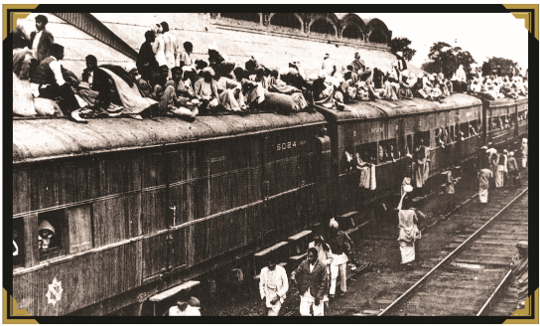
Partition Beyond Borders
- More than a border: Partition divided communities, government employees, administrative institutions and financial and material assets.
- Migration and loss: About 80 lakh people crossed the new border, and an estimated five to ten lakh were killed in Partition-related violence.
- National identity: Partition raised the question of whether India would treat citizens of every religion equally; the ideal of a secular nation was enshrined in the Constitution.
Garam Hawa: The Choice to Stay or Leave
- Film: M. S. Sathyu’s 1973 film Garam Hawa follows Salim Mirza, a Muslim shoe manufacturer in Agra, as Partition reshapes his life and business.
- Central conflict: Salim is torn between moving to Pakistan and remaining in India; witnessing a student procession demanding fair treatment shapes his choice.
Gandhi’s Efforts for Peace
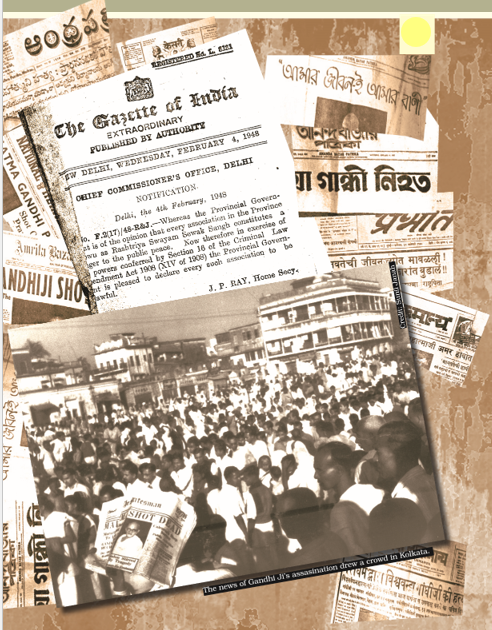
Compassion and Solidarity Across Communities
Key Dates
- 14–15 August 1947India and Pakistan came into existence; Partition triggered mass displacement and violence.
- 15 August 1947Gandhi remained in riot-hit Kolkata, working for communal peace.
- January 1948Gandhi’s last fast in Delhi helped reduce communal violence.
- 30 January 1948Nathuram Vinayak Godse assassinated Gandhi in Delhi.
- 1951Muslims accounted for about 10–12% of India’s population.
- 1973*Garam Hawa*, directed by M.S. Sathyu, depicted the post-Partition dilemma of whether to stay in India or move to Pakistan.
- Two-nation theory
- The Muslim League’s claim that Hindus and Muslims were distinct peoples, used to argue for a separate Muslim nation.
- Refugee
- A person forced to leave their home, often crossing a border to escape violence.
- Secular nation
- A nation where citizenship and equal treatment do not depend on religion.
- Ahimsa
- Non-violence; a principle Gandhi lived and worked for.
- Satyagraha
- Active but non-violent resistance.
What were the main difficulties in applying the religious-majority principle during Partition?
How did the secular ideal shape India’s response to the religious division of Partition?
Quick recap
- Partition created India and Pakistan on 14–15 August 1947, following a religious-majority principle.
- Separated Muslim-majority regions, Khan Abdul Gaffar Khan’s opposition in the NWFP and minority populations made the division difficult to implement.
- About 80 lakh people migrated and an estimated five to ten lakh died in Partition-related violence.
- Partition divided communities, resources and institutions, and raised the question of equal citizenship for religious minorities.
- Gandhi’s ahimsa and satyagraha shaped his efforts to reduce communal violence; he was assassinated on 30 January 1948.
- *Garam Hawa* (1973) portrays the pressures on Muslims deciding whether to stay in India or move to Pakistan.
- Despite violence, people across religious communities also sheltered and helped one another.
Integration of Princely State
British India and the Princely States
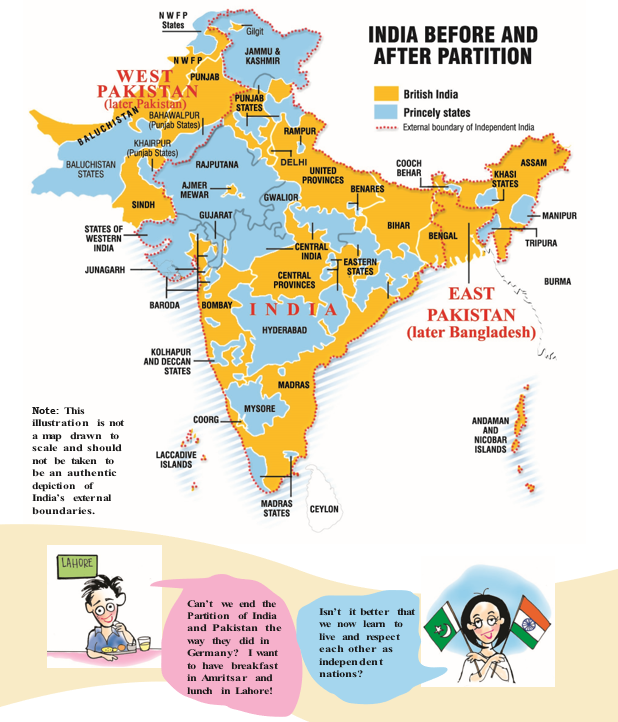
The Problem of Integration
Why Integration Was Urgent
- British rule ended → British paramountcy lapsed.
- Rulers could choose independence → India risked further territorial division.
- People lacked a say in many states → democratic rights were at risk.
- Integration was needed to protect unity, self-determination, and democracy.
Government’s Approach
Three Principles Guiding Integration
- Popular will: People in most princely states wanted to become part of India.
- Flexibility: The government was willing to grant some regions autonomy and accommodate plurality.
- Territorial consolidation: After Partition, integrating and consolidating national boundaries became a supreme priority.
Instrument of Accession — A document through which a princely ruler agreed that the state would become part of the Union of India.
States Requiring Special Attention
- Most states joined India by signing the Instrument of Accession.
- Junagadh: A plebiscite confirmed the people’s desire to join India.
- Difficult cases: Junagadh, Hyderabad, Kashmir, and Manipur proved more challenging than most states.
Key Events
- Before 15 August 1947Peaceful negotiations brought almost all states contiguous to India into the Union.
- A few days before IndependenceManipur’s Maharaja, Bodhachandra Singh, signed the Instrument of Accession after receiving assurance that its internal autonomy would be maintained.
- November 1947Hyderabad’s Nizam entered a one-year Standstill Agreement with India while negotiations continued.
- June 1948Under public pressure, elections were held in Manipur, which became a constitutional monarchy.
- September 1948The Indian Army entered Hyderabad; after several days of intermittent fighting, the Nizam surrendered and Hyderabad acceded to India.
- September 1949The Maharaja of Manipur signed the Merger Agreement with India.
Hyderabad
- Nizam’s ambition: Hyderabad’s ruler sought independence and signed a one-year Standstill Agreement with India in November 1947.
- People’s movement: Resistance to the Nizam’s oppressive rule grew, especially among Telangana’s peasantry; the Razakars responded with violence.
- Accession: In September 1948, the Indian Army moved into Hyderabad; after several days of fighting, the Nizam surrendered and the state joined India.
Manipur
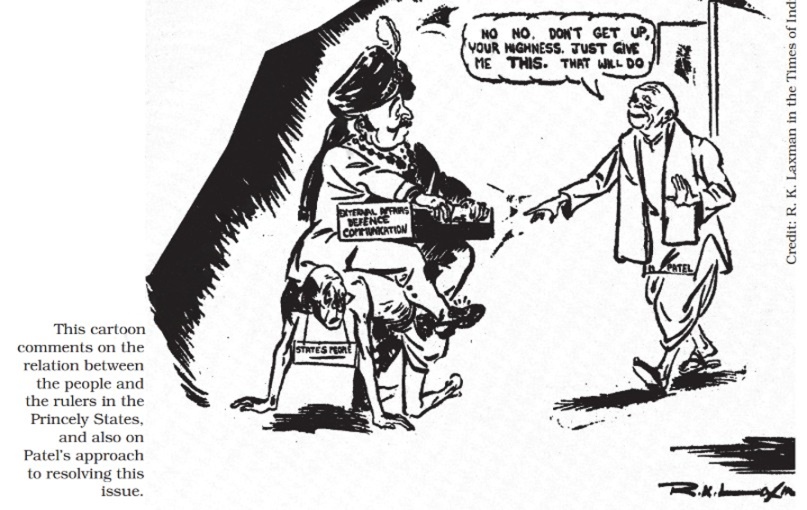
- Paramountcy
- British Crown supremacy over princely rulers.
- Instrument of Accession
- Document by which a princely state agreed to join the Union of India.
- Standstill Agreement
- A one-year agreement between Hyderabad and India while negotiations continued.
- Constitutional monarchy
- A system in which a monarch remains, but government operates through constitutional and representative arrangements.
What guided the Government of India’s approach to integrating the princely states?
How did Hyderabad become part of India?
Why was Manipur significant in the early democratic process?
Quick recap
- British paramountcy ended with British rule, leaving 565 princely states to decide whether to join India, Pakistan, or remain independent.
- The rulers’ freedom to remain independent threatened Indian unity, while people’s lack of a say endangered democracy.
- Sardar Patel helped bring most states into the Union through firm, diplomatic negotiations and Instruments of Accession.
- Government policy considered popular wishes, regional autonomy, and territorial consolidation after Partition.
- Junagadh joined India after a plebiscite confirmed popular support.
- Hyderabad acceded after the Nizam surrendered in 1948; Manipur held an election under universal adult franchise and signed a Merger Agreement in 1949.
Reorganisation of State
Why Reorganise the States?
Background and principles
- Nation-building continued: After Partition and the integration of princely states, India still had to decide its internal state boundaries.
- Colonial boundaries: These followed administrative convenience, territories annexed by the British, or princely-state territories—not a consistent national principle.
- National movement's promise: It rejected these artificial divisions and supported forming states on a linguistic basis.
- Congress organisation: After the Nagpur session of 1920, Provincial Congress Committees were organised by linguistic zones, often crossing British administrative boundaries.
- Gandhi's view: In January 1948, Gandhi supported regional languages for education, arguing against imposing Hindustani or English as a common medium across all regions.
The Demand for Andhra
Post-Independence hesitation
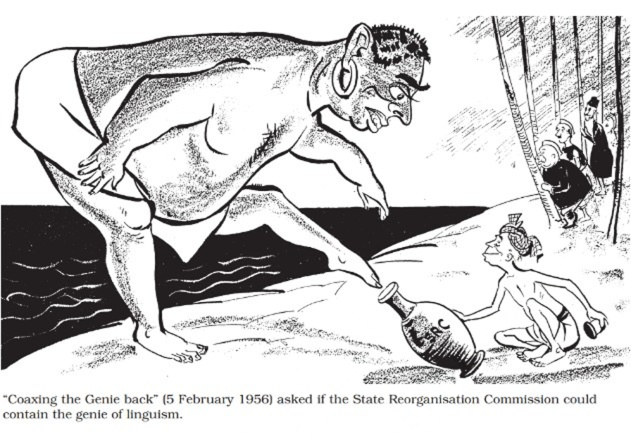
- Leadership's concerns: Leaders feared linguistic states could encourage separatism, weaken national unity, and distract from social and economic challenges.
- Reasons for delay: The future of princely states was unsettled, and the recent memory of Partition made leaders cautious.
- Vishalandhra movement: Telugu-speaking people in the old Madras province demanded a separate Andhra state; almost all political forces in the region supported linguistic reorganisation.
- Potti Sriramulu: The Congress leader and veteran Gandhian fasted indefinitely and died after 56 days.
- Public response: His death led to unrest, protests and violence in Andhra; protesters were injured or killed in police firing, and several Madras legislators resigned.
- Outcome: In December 1952, the Prime Minister announced the formation of a separate Andhra state.
Andhra Movement: Demand to Decision
- Demand for a separate Telugu-speaking Andhra
- Central government delays a decision
- Potti Sriramulu's 56-day fast ends in his death
- Mass protests and unrest spread
- Prime Minister announces a separate Andhra state in December 1952
Linguistic Reorganisation and National Unity
Commission and legislation
- Growing demands: Andhra's creation encouraged movements for linguistic states elsewhere.
- States Reorganisation Commission: Appointed by the Central Government in 1953 to examine state boundaries; it accepted that boundaries should reflect language areas.
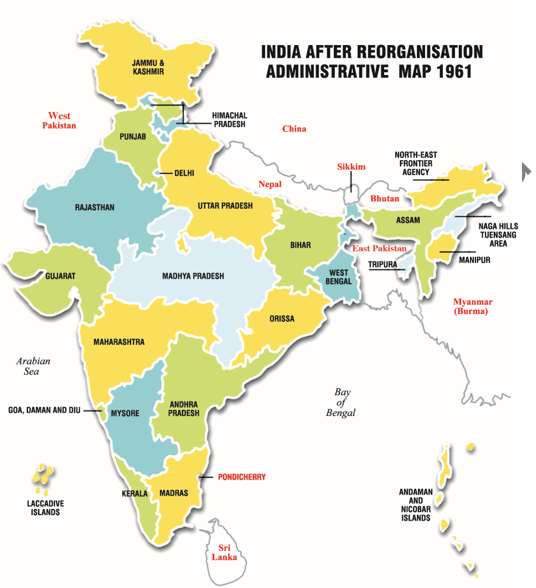
- States Reorganisation Act: Passed in 1956 on the basis of the Commission's report; it created 14 states and six union territories.
| Point | Initial fear | Outcome |
|---|---|---|
| National unity | Linguistic states might fuel separatism and disintegration. | They did not disintegrate India; accommodating regional claims strengthened national unity. |
| Democracy | Regional demands were seen as a possible threat to the new nation. | Recognising linguistic and regional claims was more democratic and accepted diversity. |
| Political participation | Politics was largely accessible to a small English-speaking elite. | Linguistic reorganisation opened political leadership to a wider range of people. |
| State boundaries | Earlier boundaries lacked a consistent basis. | Language provided a more uniform principle for drawing state boundaries. |
Democracy and diversity
- Democracy beyond elections: It meant recognising differences and accepting a plurality of ideas and ways of life, including differences that could sometimes be opposed.
- Political significance: Linguistic states brought regional claims into democratic politics rather than treating them as threats to the nation.
Further Reorganisation of States
| Year | Change | Basis or detail |
|---|---|---|
| 1960 | Maharashtra and Gujarat formed | The bilingual Bombay state, with Marathi- and Gujarati-speaking people, was divided after popular agitation. |
| 1963 | Nagaland became a state | A state created in the north-east. |
| 1966 | Punjab reorganised | Punjabi-speaking people gained a state; today's Haryana and Himachal Pradesh were separated from the larger Punjab. |
| 1972 | Meghalaya, Manipur and Tripura became states | Meghalaya was carved out of Assam; Manipur and Tripura also emerged as separate states. |
| 1987 | Mizoram and Arunachal Pradesh became states | Further state creation in the north-east. |
| 2000 | Chhattisgarh, Uttarakhand and Jharkhand formed | Demands reflected distinct regional cultures or complaints of regional imbalance in development. |
| 2 June 2014 | Telangana became a state | A further example of continuing state reorganisation. |
Reorganisation beyond language
- Not every state was immediately linguistic: The bilingual Bombay state remained until popular agitation led to its division.
- New grounds for demands: Later movements also sought separate states because of distinct regional cultures or perceived regional imbalances in development.
- Continuing demands: The lecture identifies Vidarbha in Maharashtra, Harit Pradesh in western Uttar Pradesh, and the northern region of West Bengal as areas with movements for smaller states.
- Ongoing process: State reorganisation has not ended; demands for new and smaller states continue.
Key Dates
- 1920After the Nagpur Congress session, the linguistic principle was used to organise Provincial Congress Committees.
- January 1948Gandhi supported the use of regional languages for instruction.
- December 1952The Prime Minister announced a separate Andhra state after the Vishalandhra agitation.
- 1953The States Reorganisation Commission was appointed.
- 1956The States Reorganisation Act created 14 states and six union territories.
- 1960Maharashtra and Gujarat were formed from bilingual Bombay.
- 1963Nagaland became a state.
- 1966Punjab was reorganised; Haryana and Himachal Pradesh were separated from the larger Punjab.
- 1972Meghalaya, Manipur and Tripura became states.
- 1987Mizoram and Arunachal Pradesh became states.
- 2000Chhattisgarh, Uttarakhand and Jharkhand were created.
- 2 June 2014Telangana emerged as a new state.
- Linguistic reorganisation
- Redrawing state boundaries to reflect the languages spoken in different regions.
- Vishalandhra movement
- The movement demanding a separate Andhra state for Telugu-speaking areas of the old Madras province.
- States Reorganisation Commission
- The 1953 commission that examined the redrawing of state boundaries and supported reflecting language areas.
- Plurality
- The recognition and acceptance of different ideas, languages and ways of life within a democracy.
Why did the national leadership initially postpone linguistic reorganisation?
What were the main decisions of the States Reorganisation Commission and the 1956 Act?
How did linguistic states affect Indian democracy and national unity?
Quick recap
- The national movement supported linguistic state formation, while colonial boundaries had mainly reflected administrative or political convenience.
- After Independence, fears about unity and Partition delayed reorganisation.
- The Vishalandhra movement and Potti Sriramulu's death led to the announcement of a separate Andhra state in December 1952.
- The 1956 States Reorganisation Act created 14 states and six union territories, broadly reflecting language areas.
- Linguistic states broadened democratic participation and strengthened unity by recognising diversity.
- Later states were formed for linguistic, cultural and regional-development reasons; demands for reorganisation continue.
Political Science — ALL CHAPTERS
1
THE END OF BIPOLARITY
2
CONTEMPORARY CENTRES OF POWER
3
CONTEMPORARY SOUTH ASIA
4
INTERNATIONAL ORGANISATIONS
5
SECURITY IN THE CONTEMPORARY WORLD
6
ENVIRONMENT AND NATURAL RESOURCES
7
GLOBALISATION
1
Challenges of Nation Building
2
Era of one-party dominance
3
Politics Of Planned Development
4
India’s external relations
5
Challenges to and Restoration of the Congress System
6
The Crisis of Democratic Order
7
Regional Aspirations
8
Recent Developments in Indian Politics