Class 12 Humanities . Political Science . Contemporary World Politics . International Organisations
Chapter 4: INTERNATIONAL ORGANISATIONS
Ch 4
Political Science
Class 12 Humanities
Why International Organisations
Why International Organisations Matter
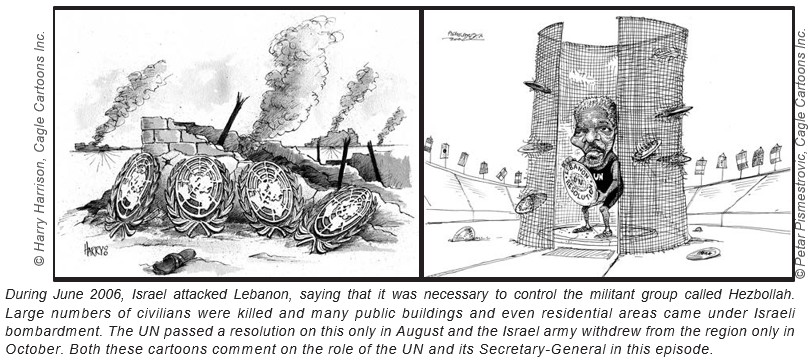
The UN and Conflict Resolution
How International Organisations Support Cooperation
- Countries have conflicting interests and differences.
- They discuss issues through an international organisation rather than automatically resorting to war.
- The organisation can provide information, ideas, rules and a bureaucracy to support cooperation.
- These mechanisms can build confidence that costs and benefits are shared fairly and members honour agreements.
Cooperation on Global Problems
- Shared challenges: Problems that cross national borders require countries to coordinate their responses.
- Collective action: International organisations provide forums and support for countries to address global problems together.
Cooperation and the International Monetary Fund
- IMF: The International Monetary Fund promotes international monetary cooperation and financial stability.
- Assistance: It provides financial support and advice to member countries facing economic difficulties.
Why Cooperation Is Difficult
- Different interests: Countries may disagree on how to cooperate and how to share its costs and benefits fairly.
- Trust and compliance: Members may worry that others will break agreements or fail to meet their commitments.
The UN after the Cold War
- Changed world order: The Cold War’s end brought new power realities, including US dominance and the rise of China and India.
- New challenges: Conflicts, terrorism, nuclear proliferation, climate change and epidemics increased calls to make the UN more effective and representative.
Founding of the United Nations
- International organisation
- A body created by states to help address shared problems; it does not rule over its members as a super-state.
- Cooperation
- Joint action by countries to address shared challenges or reach agreed goals.
- UN Charter
- The founding document signed by nations establishing the United Nations.
- IMF
- An international organisation that oversees international-level financial institutions and regulations.
Why are international organisations useful if they cannot force countries to cooperate?
Why do global problems such as disease and global warming need international cooperation?
What concern about the UN arose after the Cold War?
Quick recap
- International organisations are created by states; they are not super-states governing their members.
- The UN offers a forum for peaceful discussion, though its response to the 2006 Lebanon crisis was criticised as delayed.
- Disease control and preventing global warming require cooperation across national borders.
- Organisations can help members cooperate through information, rules and mechanisms, but disagreements over costs, benefits and compliance remain.
- IMF membership does not mean equal voting power; the G-7 held 41.29% of votes as of 19 February 2024.
- After the Cold War, a key question was whether the UN could provide dialogue and a check on US-led power.
- The UN was founded on 24 October 1945; India joined on 30 October 1945.
Evolution of the Un
From the League of Nations to the UN
Why the UN was established
- After the First World War, the League of Nations was created to help prevent conflict and war.
- League's failure: Despite early success, it could not prevent the Second World War (1939–45), which caused immense loss of life and injury.
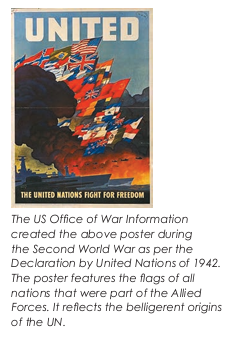
- UN established: Founded in 1945 as the League's successor, through the signing of the United Nations Charter by 51 states.
- Core purpose: Prevent international conflict, encourage cooperation among states, stop conflicts escalating into war, and limit hostilities if war occurs.
- Development aim: Bring countries together to improve social and economic development, since underdevelopment can contribute to conflict.
Key dates
- 1939–45The Second World War demonstrated the League of Nations' failure to prevent a major war.
- 1945The UN was founded after the Second World War; 51 states signed its Charter.
- By 2011The UN had 193 member states, including almost all independent states.
- 1 January 2017António Guterres took office as the UN Secretary-General.
Membership and representation
| Point | General Assembly | Security Council |
|---|---|---|
| Role in the lecture | A forum where war, peace, and differences between member states are discussed. | A forum where war, peace, and differences between member states are discussed. |
| Representation | All member states have one vote each. | Has five permanent members: the United States, Russia, the United Kingdom, France, and China. |
| Why permanent members? | — | They were the most powerful states immediately after the Second World War and were victors in it. |
Representation and a reform proposal
- Membership: By 2011, the UN had 193 members, including almost all independent states.
- Democratic representation proposal: One reform argument is that only democratic leaders should represent countries, rather than dictators speaking in the people's name; this is a proposal, not a stated UN membership rule.
The Secretary-General
- Role: The Secretary-General is the UN's representative head and most visible public figure.
- António Guterres: The ninth Secretary-General, who took office on 1 January 2017.
- Earlier positions: Prime Minister of Portugal (1995–2002) and UN High Commissioner for Refugees (2005–2015).
UN organs and agencies
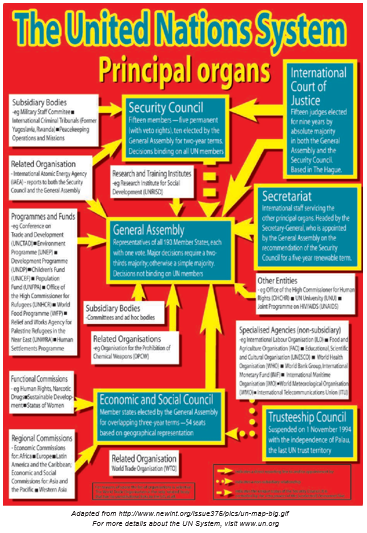
What the UN system deals with
- General Assembly and Security Council: Discuss war, peace, and differences between member states.
- UN agencies: Address social and economic issues; examples include WHO, UNDP, UNHRC, UNHCR, UNICEF, and UNESCO.
| Full name | Abbreviation |
|---|---|
| World Health Organisation | WHO |
| United Nations Development Programme | UNDP |
| United Nations Human Rights Commission | UNHRC |
| United Nations High Commission for Refugees | UNHCR |
| United Nations Children’s Fund | UNICEF |
| United Nations Educational, Scientific, and Cultural Organisation | UNESCO |
- United Nations Charter
- The founding document signed by 51 states to establish the UN in 1945.
- Secretary-General
- The UN's representative head and most visible public figure.
- UN agencies
- Bodies within the UN system that address social and economic issues.
Why was the UN established, and what were its main aims?
Name the five permanent members of the Security Council and explain why they were selected.
Quick recap
- The League of Nations could not prevent the Second World War; the UN succeeded it in 1945.
- The UN was founded by 51 Charter signatories to prevent conflict and foster international cooperation.
- The UN also promotes social and economic development as a way to improve prospects for peace.
- By 2011, the UN had 193 member states; every member has one vote in the General Assembly.
- The five Security Council permanent members were selected for their postwar power and victory in the war.
- The Secretary-General is the UN's representative head; António Guterres took office in 2017.
- The General Assembly and Security Council discuss peace and conflict; UN agencies address social and economic issues.
Refirms of the After the Cold War
Why the UN needs reform
UN reform — Changes to the UN’s structures, processes or areas of work so it can respond effectively to a changing world.
| Dimension | What it involves |
|---|---|
| Structures and processes | Reforming the organisation’s institutions and how they function. |
| Issues within UN jurisdiction | Reviewing which global issues the UN should address and how active its role should be. |
Debate over the UN’s role
- Broad agreement: Both dimensions of reform are necessary, but countries disagree on what, how and when to change.
- Peace and security: Some want a stronger, more effective UN role in peace and security missions.
- Development and humanitarian work: Others want the UN to focus on health, education, the environment, population control, human rights, gender and social justice.
Changed world after the Cold War
Why the post-1945 UN structure came under pressure
- Power shifts: The Soviet Union collapsed; the US became the strongest power, while relations between Russia and the US grew more cooperative.
- Emerging powers: China was rising rapidly, India was growing, and Asian economies were expanding at an unprecedented rate.
- New members: Many countries joined the UN after becoming independent from the Soviet Union or former communist states in eastern Europe.
- New challenges: Genocide, civil wars, ethnic conflict, terrorism, nuclear proliferation, climate change, environmental degradation and epidemics required attention.
- Core question: As the Cold War ended, was the UN equipped to meet new needs, and what reforms would make it more effective?
Reforming structures and processes
Structural reform proposals
- Security Council membership: Proposals call for increasing both permanent and non-permanent membership so the Council better reflects contemporary world politics.
- Regional representation: In particular, proposals seek greater representation from Asia, Africa and South America.
- Budget and administration: The US and other Western countries have also called for improvements to the UN’s budgetary procedures and administration.
Key steps in the reform debate
- 1945The UN was established after the Second World War, reflecting the political realities of that period.
- 1989As the Cold War was ending, questions about the UN’s capacity and role became pressing.
- 1992The UN General Assembly adopted a resolution reflecting major criticisms of the Security Council.
- 1 January 1997Secretary-General Kofi Annan initiated an inquiry into UN reform, including how new Security Council members should be selected.
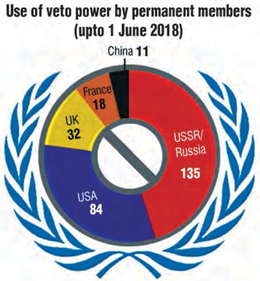
- 1 June 2018The veto chart records Security Council vetoes cast by each permanent member up to this date.
Main criticisms of the Security Council
- Outdated representation: The Council does not adequately represent contemporary political realities.
- Concentration of influence: Its decisions are seen as reflecting mainly Western values and interests and as being dominated by a few powers.
- Unequal representation: Many countries consider its membership insufficiently equitable.
| Criterion | Question or difficulty |
|---|---|
| Major economic power | What level of economic strength would qualify? |
| Major military power | How should military strength be measured, and should it determine membership? |
| Substantial contributor to the UN budget | What contribution would qualify, and could states effectively buy a seat? |
| Large population | Would population be an asset or a liability in judging a country’s global role? |
| Respect for democracy and human rights | Would a strong record also make a country an effective Council member? |
| Represent world diversity | How should geography, economic systems and culture be balanced? |
| Member state | Share |
|---|---|
| USA | 22.0% |
| China | 12.0% |
| Japan | 8.5% |
| Germany | 6.0% |
| UK | 4.5% |
| India | 0.8% |
The representation problem
- Geography: Should seats be distributed by continents, such as Asia, Africa and Latin America and the Caribbean, or by regions and subregions?
- Development: Should developing countries receive more seats? The developing world itself contains countries at very different levels of development.
- Culture: Balancing cultural or civilisational representation is difficult because many countries contain multiple cultural streams.
- No agreed formula: Each criterion has merit, but its application can favour some states and disadvantage others.
Membership and veto power
| Point | Permanent members | Non-permanent members |
|---|---|---|
| Number | 5 | 10 |
| Term | Permanent membership | Two years; members then give way to newly elected states |
| Immediate re-election | Not applicable | A country cannot be re-elected immediately after its two-year term |
| Representation | Privileged position established by the Charter after the Second World War | Elected so that all continents are represented |
| Veto | Have veto power | Do not have veto power |
Veto power — The power of a permanent Security Council member to block a decision by voting against it, even when all other members support it.
The debate over the veto
- Criticism: The veto is seen by many as conflicting with democracy and the UN principle of sovereign equality; some argue it is no longer justified.
- Abolition or modification: Some countries have called for the veto system to be abolished or changed.
- Practical obstacle: Permanent members are unlikely to agree to losing this privilege, and the world may not be ready for such a radical change.
- Argument for retaining it: Without the veto, major powers might lose interest in the UN, act outside it and leave the organisation ineffective without their support.
What two kinds of reform are being debated in the UN?
What are the main criticisms of the Security Council?
How can a permanent member use the veto?
Quick recap
- UN reform covers both institutional structures and the issues the organisation addresses.
- Post-Cold War power shifts and new global challenges increased pressure to reform the UN.
- The 1992 General Assembly resolution highlighted weak representation, concentrated influence and inequity in the Security Council.
- Proposals include expanding permanent and non-permanent Security Council membership, especially for Asia, Africa and South America, and improving UN budgeting and administration.
- Proposed membership criteria include power, budget contribution, population, rights records and representation of global diversity.
- Geographical, developmental and cultural representation are difficult to balance through a single membership formula.
- The Security Council has five permanent and ten non-permanent members; only permanent members have veto power. Removing the veto could weaken major-power support for the UN.
Jurisdiction of the Un
UN jurisdiction — The scope of issues on which the UN may act, including peacebuilding, human rights, development and responses to atrocities.
The 2005 Summit and Proposed Reforms
Key Dates
- September 2005Heads of UN member states met as the UN marked 60 years, reviewing how it could remain relevant in a changing world.
- 19 June 2006The Human Rights Council became operational.
| Proposed step | Purpose or focus |
|---|---|
| Create a Peacebuilding Commission | Support peacebuilding; its role and choice of conflicts to address were unresolved. |
| Accept international responsibility when governments fail to protect citizens from atrocities | Raises questions about when and how outside action should occur. |
| Establish a Human Rights Council | The Council became operational on 19 June 2006. |
| Agree to achieve the Millennium Development Goals (MDGs) | Set shared development goals. |
| Condemn terrorism in all its forms and manifestations | Agreement on a definition of terrorism remained difficult. |
| Create a Democracy Fund | Raised questions about how the UN should use funds to promote democracy. |
| Wind up the Trusteeship Council | Member states agreed to end the Council. |
Why UN Action Is Controversial
| Issue | Questions about UN jurisdiction |
|---|---|
| Peacebuilding | Which conflicts should the Commission address? Can, or should, it intervene in every conflict? |
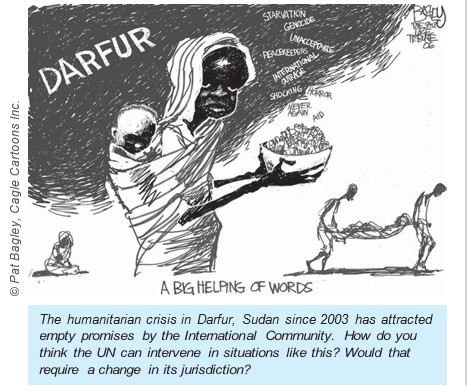
| Atrocities and protection | What responsibility does the international community have when a government fails to protect its citizens? |
| Human rights | What counts as a violation, who determines its severity, and what action should follow? |
| Development goals | How realistic are ambitious goals such as the Sustainable Development Goals (SDGs) when many countries are still developing? |
| Terrorism | Can member states agree on a common definition? |
| Democracy promotion | How should UN funds be used to support democracy? |
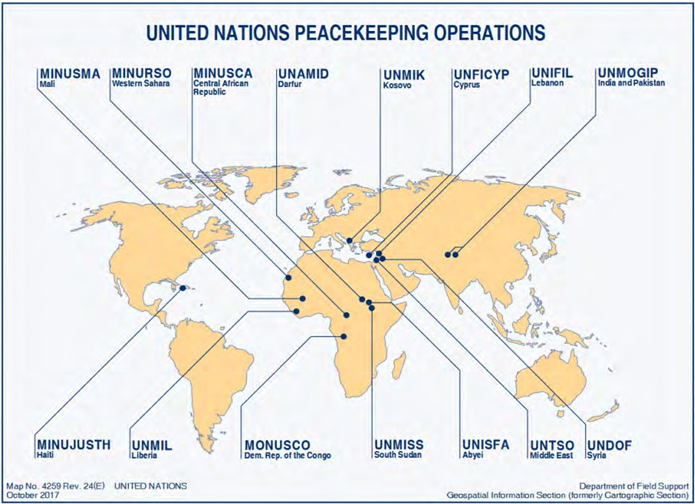
Examples of UN Peacekeeping Missions
- MINUSMA operated in Mali.
- UNMIK operated in Kosovo.
- MONUSCO operated in the Democratic Republic of the Congo.
- UNMISS operated in South Sudan.
- Peacebuilding Commission
- A proposed UN body to support peacebuilding, with its mandate and intervention choices open to debate.
- Human Rights Council
- A UN body established to address human-rights issues; operational since 19 June 2006.
- Millennium Development Goals (MDGs)
- Development goals that UN member states agreed to pursue at the 2005 summit.
- International responsibility
- The responsibility discussed for the international community when a government fails to protect its citizens from atrocities.
What major steps did UN leaders agree to in September 2005?
Why are questions of UN jurisdiction contentious?
Quick recap
- The UN’s jurisdiction concerns the issues on which it can act, including peace, human rights and development.
- At the September 2005 summit, leaders agreed on seven steps to make the UN more relevant.
- The Human Rights Council became operational on 19 June 2006.
- The summit endorsed pursuit of the MDGs; the lecture raises questions about the realism of ambitious goals such as the SDGs.
- UN peacekeeping operations included missions in places such as Mali, Kosovo, the Democratic Republic of the Congo and South Sudan.
- A central challenge is balancing international action with disagreement over its limits and authority.
India and the Un Reforms
Why India Supports UN Reform
India’s Development–Peace Argument
- Development is strengthened
- Cooperation among states is encouraged
- Conditions for international peace and security improve
Reforming the Security Council
Security Council Membership
- 1965Security Council membership increased from 11 to 15, but the number of permanent members did not change.
- World Trade Organisation (WTO)
- International organisation that sets rules for global trade; it succeeded GATT.
- Developing-country criticism
- Developing countries have complained of non-transparent procedures and pressure from major economic powers.
WTO
- 1995The WTO was established as the successor to the General Agreement on Trade and Tariffs (GATT), created after the Second World War.
- 29 July 2016The WTO had 164 members.
WTO Decision-Making
- Formal rule: WTO decisions are taken unanimously.
- Power imbalance: The US, EU and Japan have used their influence to shape trade rules in their interests.
India’s Claim to Permanent Membership
International Atomic Energy Agency (IAEA)
- 1957The IAEA was established following US President Dwight Eisenhower’s “Atoms for Peace” proposal.
IAEA: Purpose
- Main aims: Promote peaceful uses of nuclear energy and prevent its use for military purposes.
- Safeguards: IAEA teams inspect nuclear facilities to check that civilian reactors are not being used for military purposes.
Objections and Challenges
| Point | India’s case | Objections |
|---|---|---|
| Representation | A more representative Council should include developing countries. | Other emerging powers and underrepresented regions may also demand seats. |
| International role | India contributes to UN initiatives, peacekeeping and UN finances. | Some question whether India’s relations with Pakistan could limit its effectiveness. |
| Global standing | India’s population, democracy and economic emergence support its claim. | Some states are concerned about its nuclear weapons capability. |
Why does India seek reform of the Security Council?
Give reasons supporting India’s claim to a permanent Security Council seat.
What are the main objections to India becoming a permanent veto-wielding member?
Quick recap
- India supports a stronger UN with development and cooperation central to its work.
- India argues that Security Council membership has failed to reflect the growth of the General Assembly.
- In 1965, Council membership rose from 11 to 15, with no change in permanent membership.
- India supports expanding both permanent and non-permanent membership and seeks a permanent veto seat.
- India cites its population, democracy, UN role, peacekeeping, economy and financial contributions as grounds for its claim.
- Opposition reflects concerns about India and competing demands for representation from other powers and regions.
The Un in Aunipolar Word
The UN and US Dominance
Unipolar world — A world with one dominant superpower and no serious rival; after the Soviet Union disappeared, the US occupied this position.
Why US power is difficult to check
- Military and economic strength: The US can ignore the UN and other international organisations.
- Financial influence: As the UN’s largest contributor, the US has unmatched financial power within the organisation.
- Institutional influence: The UN is located in US territory, and many US nationals work in its bureaucracy.
- Veto power: The US can block actions it considers harmful to its interests or those of its friends and allies.
- Secretary-General selection: US power and its veto give Washington considerable influence over the choice of the UN Secretary-General.
- Political strategy: The US can use its influence to divide other countries and reduce opposition to its policies.
Why is the UN not a strong counterbalance to US dominance?
The UN as a Forum for Dialogue
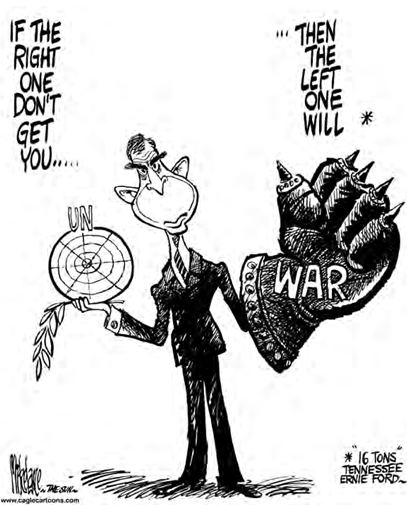
- Not a balance: The UN cannot equal or neutralise US power in a unipolar world.
- A forum for discussion: It brings the US and the rest of the world together to discuss conflict and social and economic development.
- A way to influence policy: Other countries can challenge specific US attitudes and policies and try to modify them.
- Scope for compromise: The UN provides a space where arguments can be heard and compromises or concessions shaped, even though the rest of the world is rarely united against Washington.
- US perspective: Despite frequent criticism of the UN, US leaders recognise its role in bringing together more than 190 nations.
Why the UN Remains Important
- Imperfect but necessary: The UN has limitations, but the world would be worse off without it.
- Interdependence: Growing connections between societies and issues make cooperation increasingly important.
- Future importance: Technology is expected to increase planetary interdependence, strengthening the need for the UN.
- Shared responsibility: Peoples and governments should support and use the UN and other international organisations in ways that serve both national interests and the wider international community.
Why is the UN likely to become more important?
International Human Rights NGOs
Non-governmental organisation (NGO) — An organisation independent of governments that may work internationally on issues such as human rights.
| Organisation | Main work and key features |
|---|---|
| Amnesty International | Campaigns worldwide to protect human rights and promote the rights in the Universal Declaration of Human Rights. It regards human rights as interdependent and indivisible; it researches and publishes reports, often on government misconduct. These reports support research and advocacy, though governments may object to them. |
| Human Rights Watch | Conducts international research and advocacy on human rights and is described as the largest international human rights organisation in the US. It draws global media attention to abuses and helped build coalitions to ban landmines, stop the use of child soldiers and establish the International Criminal Court. |
- Interdependence
- Growing connections between societies and issues that make cooperation increasingly necessary.
- Human-rights advocacy
- Research and action that draw attention to human-rights abuses and promote protection of rights.
Quick recap
- After the Soviet Union disappeared, the US became the only superpower, and its power was difficult to check.
- US financial, institutional and veto influence limits the UN’s ability to balance US dominance.
- The UN provides a forum for dialogue, criticism of policies and the shaping of compromises.
- Technology promises to increase interdependence, making international cooperation and the UN more important.
- Amnesty International and Human Rights Watch conduct human-rights research, advocacy and campaigns.
Political Science — ALL CHAPTERS
1
THE END OF BIPOLARITY
2
CONTEMPORARY CENTRES OF POWER
3
CONTEMPORARY SOUTH ASIA
4
INTERNATIONAL ORGANISATIONS
5
SECURITY IN THE CONTEMPORARY WORLD
6
ENVIRONMENT AND NATURAL RESOURCES
7
GLOBALISATION
1
Challenges of Nation Building
2
Era of one-party dominance
3
Politics Of Planned Development
4
India’s external relations
5
Challenges to and Restoration of the Congress System
6
The Crisis of Democratic Order
7
Regional Aspirations
8
Recent Developments in Indian Politics