Class 12 Humanities . Political Science . Contemporary World Politics . Security in the Contemporary World
Chapter 5: SECURITY IN THE CONTEMPORARY WORLD
Ch 5
Political Science
Class 12 Humanities
Security and Traditional Notions: External
Meaning and Scope of Security
Security — Freedom from threats that could cause serious, lasting damage to core values.
What Counts as a Security Threat?
- Core values: Security may concern the values of a country as a whole or the safety and well-being of ordinary people.
- Threshold: Not every risk is a security threat; it must be extremely dangerous and threaten irreparable damage to core values.
- Changing idea: Understandings of security can differ between societies and change over time.
- Democratic debate: Security should not automatically be treated as too secret or important for citizens to discuss.
| Conception | Focus |
|---|---|
| Traditional | National security, especially military threats to a country. |
| Non-traditional | Other security concerns beyond the traditional focus on military threats. |
Traditional Notions: External Security
Traditional national security — A view of security focused mainly on protecting a country from military threats posed by other countries.
External Military Threats
- Core values at risk: Military action can threaten sovereignty, independence and territorial integrity.
- Human cost: War can kill or injure ordinary people as well as soldiers; civilians may be targeted to weaken support for a war.
- External focus: In the traditional view, most threats to a country’s security come from outside its borders.
| Response | Meaning | Purpose |
|---|---|---|
| Surrender | Give in when confronted with war. | A possible crisis response, but not generally announced as national policy. |
| Deterrence | Promise to make the costs of attack unacceptably high. | Prevent the other side from attacking. |
| Defence | Resist an attack after war begins; deny the attacker its objectives or defeat its forces. | Limit or end the war. |
Balance of Power
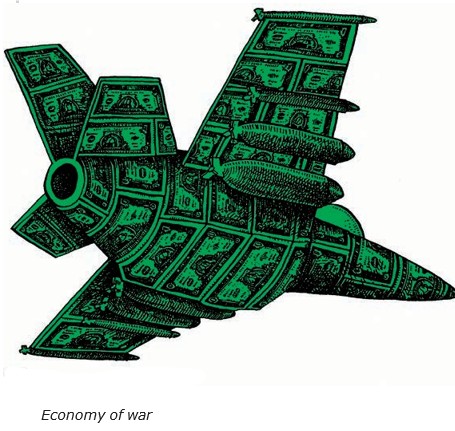
- Meaning: The relative strength of countries; governments try to maintain a favourable balance for their own security.
- Why it matters: A powerful neighbour may be viewed as a possible future threat even if it shows no immediate sign of attack.
- How it is maintained: States build military strength; economic and technological strength also matter because they support military power.
- Key relationships: Governments pay particular attention to nearby states, states with which they have differences, and former adversaries.
Alliance Building
Alliance — A coalition of states that coordinate their actions to deter or defend against military attack.
How Alliances Work
- Organisation: Most alliances are formalised through written treaties and identify the threat they address.
- Purpose: States combine their power to strengthen their position relative to another country or alliance.
- Basis and change: Alliances reflect national interests and can change when those interests change.
Example of Changing Alliances
- 1980sThe United States backed Islamic militants in Afghanistan against the Soviet Union.
- 11 September 2001After Al Qaeda launched terrorist attacks against the United States, the United States later attacked militants it had previously supported.
The International System and Self-Reliance
Why Countries Must Provide for Their Own Security
- No world government: Unlike within a country, world politics has no central authority accepted as capable of controlling every state’s behaviour.
- United Nations: The UN’s authority depends on its members; it has authority only to the extent that members allow it and obey it.
- Result: Each country must take responsibility for its own security.
- Sovereignty
- A country’s authority to govern itself.
- Territorial integrity
- The protection of a country’s territory and borders.
- Deterrence
- Preventing an attack by making its expected costs unacceptable.
- Defence
- Resisting an attack and denying the attacker its objectives.
- Balance of power
- The relative power of states, which shapes their security calculations.
- Alliance
- A coalition of states coordinating against military threats.
What makes a threat a security threat?
What are the three government responses to war, and which two form security policy?
Why must countries take responsibility for their own security?
Quick recap
- Security concerns extremely dangerous threats to core values, not every everyday risk.
- Security conceptions are broadly classified as traditional and non-traditional.
- Traditional national security focuses on military threats from other countries.
- Deterrence aims to prevent war; defence aims to resist an attack and limit or end war.
- States seek a favourable balance of power and build alliances according to national interests.
- Because no world authority can fully control states, each country must provide for its own security.
Traditional Notions Internal
Why Internal Security Matters
- Internal security: Traditional security also concerns peace and order within a country’s borders.
- Changing priorities: After the Second World War, powerful states often gave greater attention to external threats because internal peace seemed assured.
External Threats and Newly Independent Countries
Cold War and Colonial Conflicts
- Cold War threat: The US-led Western alliance and Soviet-led Communist alliance feared a military attack by the opposing side.
- Colonial conflicts: Some European powers also faced violence in their colonies from people seeking independence.
- Examples: France fought in Vietnam in the 1950s; Britain fought in Kenya in the 1950s and early 1960s.
Security Concerns After Independence
- Cold War alliances: Some newly independent countries joined one of the rival alliances and feared that the Cold War could become a direct war and draw them into hostilities.
- Possible opponents: They might fight neighbouring states aligned with the other side, a superpower, or another partner of either alliance.
- Scale of conflict: The Cold War was responsible for approximately one-third of all wars in the post-Second World War period; most were fought in the Third World.
- Fear of former rulers: Newly independent peoples also worried that former European colonial powers might attack them in an imperial war.
Key Periods and Examples
- After 1945The US and Soviet Union appeared internally secure, while Cold War rivalry shaped external security concerns.
- From the late 1940sColonies gained independence, and many new states faced Cold War, neighbourly and internal security risks.
- 1946–1991The number of civil wars rose twelve-fold, the greatest increase in 200 years.
- 1950s and early 1960sFrance fought in Vietnam in the 1950s; Britain fought in Kenya in the 1950s and early 1960s.
Internal and External Challenges in New States
| Point | European powers | Newly independent states |
|---|---|---|
| Main focus | Primarily threats from outside their borders | Threats from both outside and within their borders |
| External danger | Military attack from the rival Cold War alliance; violence in colonies | Conflict with neighbouring countries, often over borders, territory, people or populations |
| Internal danger | Generally few serious threats from groups within powerful Western European states | Separatist movements seeking to form independent countries; internal military conflict |
| Relative fears | Focused on Cold War rivals and violence in colonies | Many came to fear neighbouring countries even more than the US, the Soviet Union or former colonial powers |
How Internal and External Threats Could Merge
- A separatist movement seeks an independent state.
- A neighbouring country may assist or instigate the movement.
- Internal conflict creates tension between the neighbouring states.
- The new state faces both internal and external security threats.
Scale of Internal Conflict
- Internal wars: They make up more than 95% of all armed conflicts fought worldwide.
- Civil wars: Between 1946 and 1991, their number increased twelve-fold—the greatest jump in 200 years.
- Overall challenge: For newly independent states, wars with neighbours and internal wars both posed serious security threats.
- Separatist movement
- A movement seeking to separate a region or group from a state and form an independent country.
- Civil war
- An armed conflict fought within a country.
- Imperial war
- A war feared by a newly independent country in which its former colonial power might attack it.
- Cold War alliance
- A group of states aligned with either the US-led Western bloc or the Soviet-led Communist bloc.
Why did powerful Western countries give less attention to internal security after the Second World War?
Name two distinct security challenges faced by newly independent Asian and African states.
Quick recap
- Traditional security includes protection from threats inside as well as outside a country.
- After 1945, powerful Western states focused mainly on external threats because internal peace seemed assured.
- Cold War rivalry and colonial resistance shaped the external security concerns of European powers and new states.
- Newly independent Asian and African states faced neighbourly conflicts, separatism and civil wars—and many feared neighbouring countries most.
- External states could support internal separatist movements, turning domestic conflict into interstate tension.
- Internal wars account for more than 95% of armed conflicts worldwide; civil wars rose twelve-fold from 1946 to 1991.
Traditional Security and Cooperation
Limits on the Use of Force
- Just causes: War is generally justified only for self-defence or to protect people from genocide.
- Limits: Armies should spare civilians and unarmed or surrendering combatants, avoid excessive violence, and use force only after alternatives fail.
Forms of Cooperation
Arms control — Arms control regulates the acquisition or development of weapons rather than requiring states to give them up.
| Group | NPT rule |
|---|---|
| Countries that had tested and manufactured nuclear weapons before 1967 | Were allowed to keep their weapons. |
| Countries that had not done so | Were to give up the right to acquire nuclear weapons. |
| Point | Disarmament | Arms control |
|---|---|---|
| Main idea | States give up specified kinds of weapons. | States regulate the acquisition or development of weapons. |
| Examples | BWC and CWC. | ABM Treaty, SALT II, START and NPT. |
Confidence building — Confidence building is the sharing of information between rivals to reduce violence caused by misunderstanding or misperception.
- Disarmament
- Giving up specified categories of weapons.
- Arms control
- Regulating the acquisition or development of weapons.
- Confidence building
- Sharing information to reduce mistrust and prevent conflict caused by misunderstanding.
- Traditional security
- A view of security centred on military force, its use and its threat.
Treaties and Conventions
- 1968The Nuclear Non-Proliferation Treaty (NPT) regulated the acquisition of nuclear weapons.
- 1972The ABM Treaty limited defensive missile systems; the Biological Weapons Convention (BWC) banned the production and possession of biological weapons.
- 1997The Chemical Weapons Convention (CWC) banned the production and possession of chemical weapons.
- Traditional security sees military force as both the principal threat to security and the principal means of achieving security.
- Cooperation can limit violence through restraint in war, disarmament, arms control and confidence building.
How do disarmament and arms control differ?
What was the main effect of the NPT?
How can confidence building help prevent war?
Quick recap
- Traditional security accepts limits on the purposes and methods of war.
- Force should be a last resort and should not be excessive or directed at protected non-combatants.
- Disarmament requires states to give up specified weapons; BWC and CWC are examples.
- Arms control regulates weapons acquisition or development; examples include ABM, SALT II, START and NPT.
- The NPT restricted access to nuclear weapons without abolishing them.
- Confidence building shares military information to reduce suspicion and prevent conflict through misperception.
Non- Traditional Notions
Beyond Traditional Security
- Wider scope: Non-traditional security extends beyond military threats to dangers affecting human existence.
- Broader referent: Security may concern individuals, communities or all humankind, rather than only the state.
- Global challenges: Problems such as global warming, international terrorism and epidemics require cooperation among countries.
Human Security
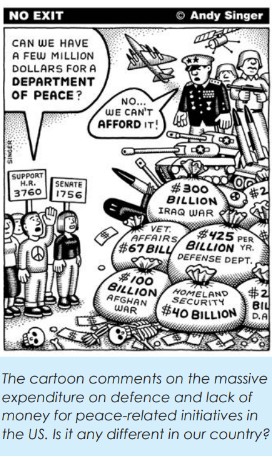
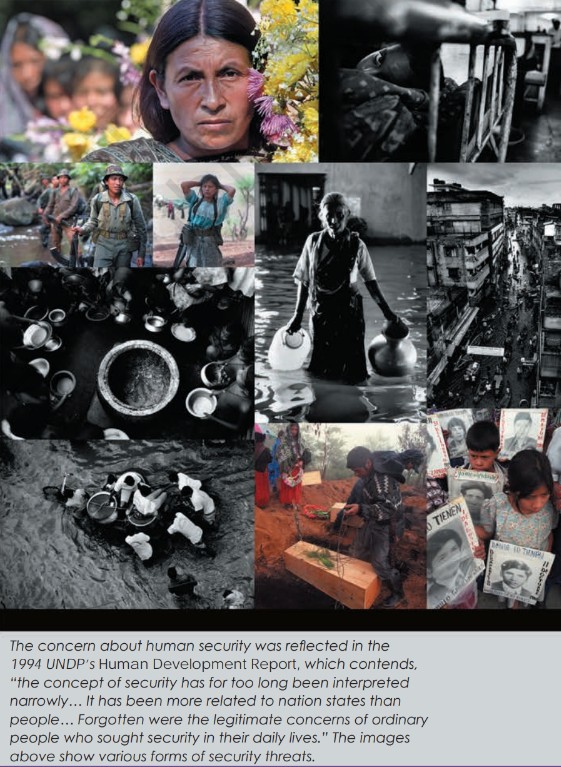
Two approaches to human security
- Shared goal: Both narrow and broad approaches aim primarily to protect individuals.
- Narrow approach: Focuses on protecting individuals and communities from violence, particularly internal violence.
- Broad approach: Includes hunger, disease and natural disasters because these can kill more people than war, genocide and terrorism combined.
- Broadest approach: Also includes economic security and threats to human dignity; it stresses freedom from want and freedom from fear.

Global Security
Global threats and cooperation
- Threats such as global warming and epidemics cross national borders.
- No country can resolve them on its own.
- Their effects may fall disproportionately on particular countries.
- International cooperation is therefore vital, even when difficult to achieve.
Example: Global warming
- Sea-level rise: A rise of 1.5–2.0 metres could flood 20% of Bangladesh, inundate most of the Maldives and threaten nearly half of Thailand’s population.
Development of global security
- 1990sThe idea of global security emerged in response to threats such as global warming, international terrorism and health epidemics.
- Referent
- The person, group or entity whose security is being considered.
- Human security
- Protection of people from threats to their safety and well-being.
- Global security
- Security concerns involving cross-border threats and international cooperation.
- Freedom from want
- Protection from deprivation, including hunger and economic insecurity.
- Freedom from fear
- Protection from violence and other threats to personal safety.
Why does state security not automatically ensure human security?
Distinguish between narrow and broad human security.
Why is international cooperation important for global security?
Quick recap
- Non-traditional security extends beyond military threats and expands the referent from the state to people and communities.
- Human security prioritises protecting individuals; secure states do not automatically mean secure people.
- Narrow human security focuses on violence, while the broad approach also covers hunger, disease and natural disasters.
- Broadest human security includes economic security and human dignity, linked to freedom from want and fear.
- Global security addresses cross-border threats that require international cooperation.
- Global warming could cause severe, uneven harm, including the projected flooding risks for Bangladesh, the Maldives and Thailand.
New Sources of Threats
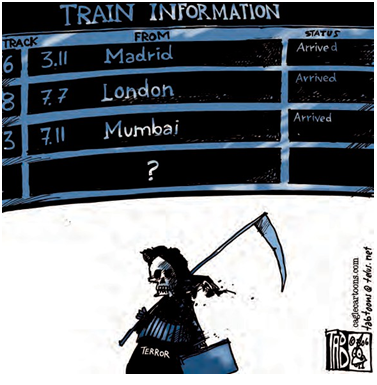
Terrorism
Human Rights and International Intervention
Debate over Universal Rights and UN Action
- Agreement and disagreement: There is broad agreement on these three categories, but no consensus on which rights are universal or what the international community should do when they are violated.
- Debate since the 1990s: Iraq’s invasion of Kuwait, the Rwanda genocide and killings by the Indonesian military in East Timor raised questions about UN intervention.
- Intervention argument: Some argue that the UN Charter allows the international community to use armed force to defend human rights.
- Caution: Others argue that powerful states’ national interests determine which violations the UN responds to.
Global Poverty and Inequality
Population and the Poverty Cycle
- Population projection: World population was about 760 crore and was expected to reach nearly 1,000 crore by the middle of the 21st century.
- Growth concentration: Six countries—India, China, Pakistan, Nigeria, Bangladesh and Indonesia—account for half of current world population growth.
- Uneven trends: The population of the poorest countries is expected to triple over 50 years, while many rich countries are expected to see population shrinkage.
- Reinforcing cycle: High per-capita income and low population growth help rich states or groups become richer; low incomes and high growth reinforce poverty.
Poverty and Regional Insecurity
- Low incomes and high population growth reinforce each other
- Poverty deepens in disadvantaged countries and groups
- The global North–South economic gap grows
- Disparities also sharpen within the South
- Insecurity and conflict are concentrated in some of the poorest regions
Poverty and Conflict
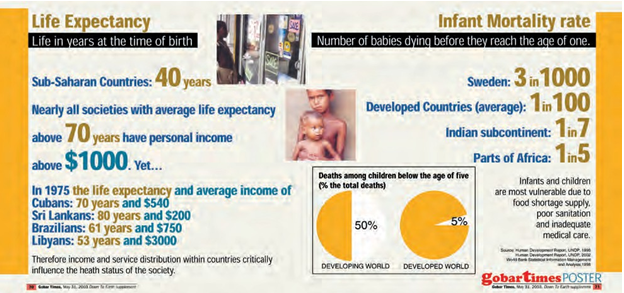
- Within the South: Some countries have reduced population growth and raised incomes, while others have not.
- Sub-Saharan Africa: Most of the world’s armed conflicts take place in this poorest region.
- Scale of violence: At the turn of the 21st century, more people were being killed in wars in sub-Saharan Africa than in the rest of the world combined.
Migration, Refugees and Displacement
Poverty and Migration
- Poverty in the South creates pressure to seek a better life
- People move, especially towards the North, for better economic opportunities
- Large-scale movement creates international political friction
| Point | Migrants | Refugees | Internally displaced people |
|---|---|---|---|
| Reason and movement | Voluntarily leave their home country | Flee war, natural disaster or political persecution and leave their country | Flee their homes but remain within their country |
| State obligation | States are generally not required to accept them | States are generally expected to accept them | Remain within national borders |
| Example | People moving for better economic opportunities | People seeking safety from conflict | Kashmiri Pandits who fled violence in the Kashmir Valley in the early 1990s |
Conflict and Refugee Flows
- Strong link: The refugee map closely matches the conflict map because wars in the South have forced millions to seek safety.
- 1990–1995: Seventy states were involved in 93 wars, killing about 55 lakh people.
- Why people flee: Generalised fear of violence, or the destruction of livelihoods, identities and living environments, can force individuals, families and whole communities to leave.
- 1990s pattern: All but three of 60 refugee flows coincided with an internal armed conflict.
Epidemics as Security Threats
Cross-Border Spread and Effects
- Spread: HIV-AIDS, bird flu and SARS have crossed borders through migration, business, tourism and military operations.
- Interdependence: One country’s success or failure in limiting disease affects infections in other countries.
- HIV-AIDS by 2003: About 4 crore people were infected worldwide; two-thirds were in Africa and half of the remainder in South Asia.
- Unequal treatment access: New drug therapies sharply reduced HIV-AIDS deaths in North America and other industrialised countries in the late 1990s, but were too expensive for poor regions such as Africa.
- Poverty impact: HIV-AIDS has been a major factor in pushing Africa further into poverty.
Emerging, Resistant and Animal Diseases
- New or poorly understood diseases: Corona, Ebola virus, hantavirus and hepatitis C.
- Drug resistance: Tuberculosis, malaria, dengue fever and cholera have developed forms that are difficult to treat.
- Economic consequences: Since the late 1990s, mad-cow disease cost Britain billions of dollars in income; bird flu halted poultry exports from several Asian countries.
- Security lesson: Epidemics show that state borders are less meaningful in an interdependent world and that international cooperation is needed.
When Does an Issue Become a Security Threat?
Security problem — An issue qualifies as a security problem when it threatens the very existence of a state or group of people.
Threats Depend on Local Context
- Not everything is a security issue: Expanding security to include every disease or hardship would make the concept lose coherence.
- Maldives: Rising sea levels and global warming threaten the existence of the country by potentially submerging much of its territory.
- Southern Africa: HIV-AIDS poses a severe threat; about one in six adults had the disease, and the figure for Botswana was one in three.
- Rwanda, 1994: Nearly five lakh Tutsi people were killed by the rival Hutu tribe within weeks, threatening the Tutsi community’s existence.
- Conclusion: Non-traditional security threats, like traditional ones, vary with local conditions.
Cooperative Security
| Point | Military confrontation | Cooperative security |
|---|---|---|
| Best suited to | May help combat terrorism or enforce human rights, but has limits | Addressing poverty, migration, refugee movements and epidemics |
| Risks and value | Often makes non-traditional problems worse | Shares responses across countries and organisations |
| Use of force | A country may act on its own | May be sanctioned collectively as a last resort |
Forms and Participants
- Levels of cooperation: It can be bilateral, regional, continental or global, depending on the threat and countries’ willingness and ability to respond.
- International organisations: The UN, World Health Organisation, World Bank and IMF can take part.
- Other participants: NGOs such as Amnesty International and the Red Cross, foundations, charities, religious organisations, trade unions, social and development organisations, businesses and corporations.
- Individuals: Prominent people such as Mother Teresa and Nelson Mandela may also contribute.
- Collective action: Force may sometimes be authorised against governments that kill their people or ignore severe suffering, and against international terrorists and those who harbour them.
- Principle: Non-traditional security is better served when force is collectively sanctioned by the international community rather than used unilaterally.
Key Dates and Periods
- Early 1990sKashmiri Pandits fled violence in the Kashmir Valley and became an internally displaced community.
- 1990–1995Seventy states were involved in 93 wars, causing about 55 lakh deaths.
- 1990sNearly all of the 60 refugee flows cited coincided with internal armed conflict; new HIV-AIDS therapies reduced deaths in industrialised countries in the late 1990s.
- 1994Nearly five lakh Tutsi people were killed in Rwanda within weeks.
- Since the late 1990sMad-cow disease caused major income losses in Britain; bird flu disrupted poultry exports from several Asian countries.
- 11 September 2001Terrorists attacked the World Trade Centre in the United States, drawing greater public and government attention to terrorism.
- 2003An estimated 4 crore people worldwide were infected with HIV-AIDS.
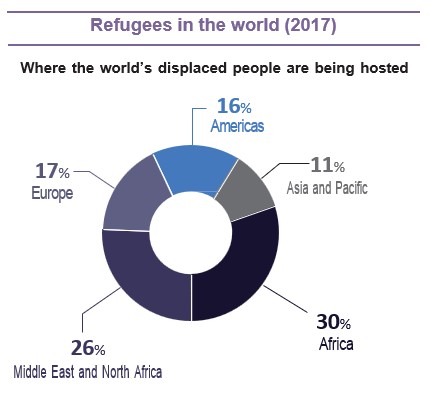
- 2017The cited chart compares the regions hosting displaced people.
How are migrants, refugees and internally displaced people distinguished?
What is the minimum criterion for an issue to qualify as a security problem?
Why is cooperative security generally more effective for non-traditional threats?
Quick recap
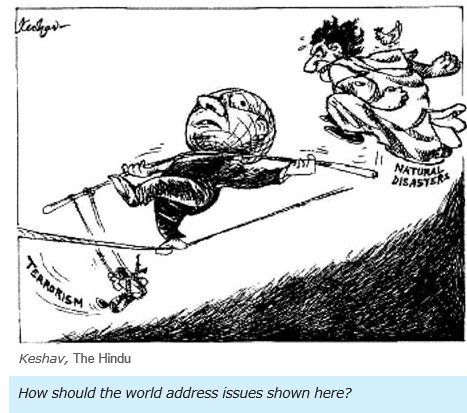
- Non-traditional security includes threats such as terrorism, human-rights abuses, poverty, displacement and epidemics.
- Human rights are grouped into political, economic and social, and colonised or minority peoples’ rights; UN intervention remains contested.
- Poverty, population pressures, inequality and conflict are linked, while wars generate refugee flows.
- Migrants move voluntarily; refugees cross borders to flee danger; internally displaced people remain within their country.
- An issue becomes a security problem when it threatens the existence of a state or group, with the threat varying by context.
- International cooperation is usually more effective than military confrontation; any force should be a collective last resort.
India’s Security Strategy
India’s security strategy — India’s security strategy combines measures to address traditional military and non-traditional threats arising both within and beyond its borders.
Four broad components
- Military capability: Strengthen defence to protect the country from external threats.
- International cooperation: Support international norms and institutions that protect security interests.
- National unity: Address internal security challenges through democratic politics.
- Human development: Reduce poverty and inequality so economic progress supports citizens’ security.
1. Strengthening Military Capabilities
- Reason: Conflicts with neighbouring Pakistan and China led India to strengthen its military capabilities.
- Nuclear security: India’s government justified the 1998 nuclear tests as necessary to safeguard national security, particularly because the region includes nuclear-armed countries.
- First nuclear test: India tested a nuclear device in 1974.
Conflicts and Nuclear Tests
- 1947–48India fought a conflict with Pakistan.
- 1962India fought a conflict with China.
- 1965India fought a conflict with Pakistan.
- 1971India fought a conflict with Pakistan.
- 1974India tested a nuclear device for the first time.
- 1998India conducted nuclear tests, which its government justified on national-security grounds.
- 1999India fought a conflict with Pakistan.
2. Strengthening International Norms and Institutions
- Nehru’s approach: Jawaharlal Nehru supported Asian solidarity, decolonisation, disarmament and the United Nations as a forum for settling international conflicts.
- Non-proliferation: India sought a universal, non-discriminatory system in which all countries had equal rights and obligations regarding weapons of mass destruction: nuclear, biological and chemical weapons.
- Economic order: India argued for an equitable New International Economic Order (NIEO).
- Non-alignment: India used non-alignment to help create a zone of peace outside the bloc politics of the two superpowers.
- Cooperative security: Indian troops have served abroad on United Nations peacekeeping missions.
- Climate cooperation: India joined countries signing and ratifying the Kyoto Protocol, which set out a roadmap for reducing greenhouse-gas emissions to check global warming.
International Climate Agreement
- 1997The Kyoto Protocol provided a roadmap for reducing greenhouse-gas emissions; India joined 160 countries that signed and ratified it.
- Non-alignment
- A policy used to remain outside the rival blocs led by the two superpowers and support a zone of peace.
- Non-proliferation
- Efforts to prevent the spread of weapons of mass destruction under fair, shared rules.
- NIEO
- New International Economic Order: an economic order India argued should be equitable.
- Cooperative security
- Security pursued through international cooperation, including UN peacekeeping.
3. Meeting Internal Security Challenges
- Separatist challenges: Militant groups in regions including Nagaland, Mizoram, Punjab and Kashmir have at times sought separation from India.
- Democratic response: India has sought to preserve national unity through a democratic system that lets different communities express grievances and share political power.
Democracy and National Unity
- Democratic institutions allow communities to voice grievances
- Communities can participate in political power
- Political inclusion helps address internal challenges and preserve national unity
4. Economic Development and Human Security
- Economic aim: Develop the economy so citizens can escape poverty and misery, while preventing huge economic inequalities.
- Progress: This effort has had partial success; India continues to work towards overcoming poverty and inequality.
- Democratic voice: Democratic politics gives poor and deprived citizens space to express their concerns.
- Government pressure: Elected governments face pressure to combine economic growth with human development.
- Security link: Democracy is both a political ideal and a way of providing greater security to people.
What are the four broad components of India’s security strategy?
How does democracy help address internal security challenges?
How can democracy contribute to greater security?
Quick recap
- India’s security strategy addresses military and non-military threats from within and beyond its borders.
- Military strengthening responded to conflicts with Pakistan and China; India tested a nuclear device in 1974 and conducted nuclear tests in 1998.
- India promoted the UN, disarmament, non-alignment, fair non-proliferation rules and an equitable NIEO.
- Indian troops have participated in UN peacekeeping, and India joined the 1997 Kyoto Protocol with 160 other countries.
- Democracy helps preserve national unity by enabling communities to voice grievances and share political power.
- Reducing poverty and inequality, and combining growth with human development, are also parts of India’s security strategy.
Political Science — ALL CHAPTERS
1
THE END OF BIPOLARITY
2
CONTEMPORARY CENTRES OF POWER
3
CONTEMPORARY SOUTH ASIA
4
INTERNATIONAL ORGANISATIONS
5
SECURITY IN THE CONTEMPORARY WORLD
6
ENVIRONMENT AND NATURAL RESOURCES
7
GLOBALISATION
1
Challenges of Nation Building
2
Era of one-party dominance
3
Politics Of Planned Development
4
India’s external relations
5
Challenges to and Restoration of the Congress System
6
The Crisis of Democratic Order
7
Regional Aspirations
8
Recent Developments in Indian Politics