Class 12 Humanities . Political Science . Politics In India Since Independence . Challenges to and Restoration of the Congress System
Chapter 5: Challenges to and Restoration of the Congress System
Ch 5
Political Science
Class 12 Humanities
Chapter Overview
The Congress System Faces Challenges
Starting point
- Background: The Congress system emerged earlier and was first seriously challenged during the 1960s.
- External challenge: Opposition parties became more powerful and less divided, increasing political competition.
- Internal challenge: Congress found it harder to accommodate differences within the party and retain its dominance.
Chapter setting
- After NehruThe chapter examines the political transition following Nehru’s leadership.
- 1960sOpposition unity and divisions within Congress challenged Congress dominance.
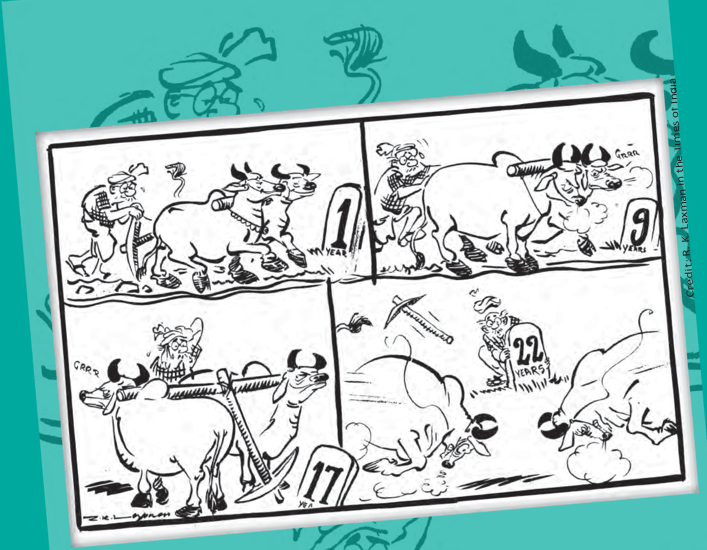
- 22nd year after IndependenceA cartoon depicts a head-on confrontation amid changes within Congress.
The Challenge and Restoration
Chapter storyline
- Political transition after Nehru
- Opposition unity and the Congress split challenge Congress dominance
- A new Congress led by Indira Gandhi overcomes these challenges
- New policies and ideologies help restore the Congress system
Quick recap
- The Congress system first faced major challenges during the 1960s.
- A stronger, more united opposition challenged Congress from outside.
- Congress also struggled to contain differences within the party.
- Opposition unity and the Congress split weakened Congress dominance.
- Indira Gandhi led a new Congress that overcame these challenges.
- New policies and ideologies helped restore the Congress system.
Challenge of Political Succession
Why succession was a challenge
The questions after Nehru
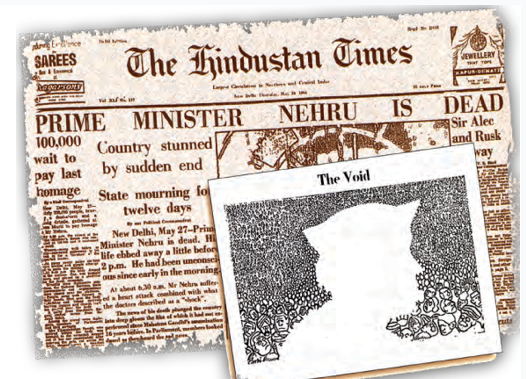
- Nehru’s death: Prime Minister Jawaharlal Nehru died in May 1964 after being unwell for more than a year, raising the question of who would succeed him.
- Wider concern: Observers also questioned whether India’s democratic experiment could survive after Nehru and whether the new leadership could manage the country’s crises.
- Fear of military intervention: It was feared that failure to manage a democratic succession could give the army a political role.
- Dangerous decade: The 1960s were labelled the “dangerous decade”; unresolved poverty, inequality, communal divisions and regional divisions could threaten democracy or lead to national disintegration.
- Unequal suspicion: Succession problems in France or Canada did not prompt similar fears of collapse, while India’s democracy faced intense scrutiny.
From Nehru to Shastri
A smooth first transition
- K. Kamraj’s role: As Congress president, he consulted party leaders and Congress MPs; they reached a consensus in favour of Lal Bahadur Shastri.
- Selection: Shastri was unanimously chosen leader of the Congress parliamentary party and became Prime Minister.
- Why Shastri: A non-controversial leader from Uttar Pradesh, he had served in Nehru’s cabinet for years and had become one of Nehru’s trusted colleagues.
- Reputation: He was known for simplicity and commitment to principle; he had resigned as Railway Minister, accepting moral responsibility after a major railway accident.
- Democratic significance: The orderly transition contradicted predictions of instability. A *Guardian* editorial on 3 June 1964 said the appointment was faster and more dignified than Britain’s succession after Harold Macmillan.
Shastri’s term and the crises
- Term: Shastri served as Prime Minister from 1964 to 1966.
- Economic and food crisis: India was still facing the economic effects of the war with China; failed monsoons and drought caused a serious food crisis.
- War: India also fought a war with Pakistan in 1965.
- Slogan: “Jai Jawan Jai Kisan” expressed the country’s resolve to face both the security challenge and the food crisis.
- Death: Shastri died suddenly in Tashkent on 10 January 1966, while there to discuss and sign an agreement to end the war with Pakistan with its President, Muhammad Ayub Khan. Tashkent was then in the USSR and is now the capital of Uzbekistan.
From Shastri to Indira Gandhi
The leadership contest in 1966
- Candidates: Morarji Desai, a former Chief Minister of Bombay state and Union minister, competed with Indira Gandhi, Nehru’s daughter and a former Congress president and Information Minister in Shastri’s cabinet.
- Choice: Senior Congress leaders backed Indira Gandhi, but the decision was not unanimous.
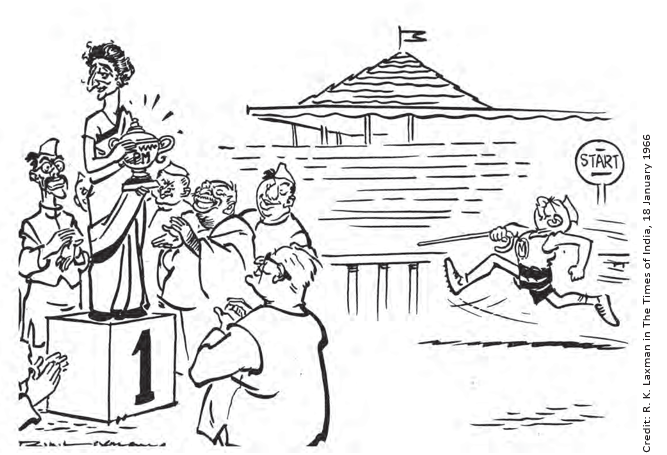
- Method and result: Congress MPs settled the contest by secret ballot; Indira Gandhi defeated Desai with the support of more than two-thirds of the party’s MPs.
- Significance: Despite intense competition, the peaceful transfer of power showed the growing maturity of Indian democracy.
Indira Gandhi establishes her authority
- Senior leaders supported Indira Gandhi, partly expecting her limited ministerial experience to make her dependent on their guidance.
- Within a year, she had to lead the Congress in a Lok Sabha election, while the country’s economic situation had worsened.
- Facing political and economic difficulties, she sought to gain control of the party and demonstrate her leadership.
Key political careers
- Lal Bahadur Shastri: Joined the freedom movement in 1930; served in the Uttar Pradesh cabinet, became Congress General Secretary, and served in the Union Cabinet in 1951–1956 and 1957–1964. He resigned as Railway Minister after an accident and coined “Jai Jawan Jai Kisan”.
- Indira Gandhi: Prime Minister in 1966–1977 and 1980–1984; Congress President in 1958; served as a minister under Shastri in 1964–1966.
- Indira Gandhi’s record: Led Congress to general-election victories in 1967, 1971 and 1980; associated with “Garibi Hatao”, the 1971 war victory, abolition of Privy Purse, bank nationalisation, a nuclear test and environmental protection.
- Representation: Indira Gandhi’s rise took place in a political world dominated by men, highlighting the limited presence of women in top leadership.
Succession and leadership
- 1930Shastri began participating in the freedom movement.
- 1951–1956Shastri served in the Union Cabinet.
- 1958Indira Gandhi became Congress President.
- May 1964Nehru died; Congress leaders and MPs chose Shastri unanimously as their parliamentary party leader.
- 1957–1964Shastri served in the Union Cabinet.
- 1964–1966Shastri was Prime Minister; Indira Gandhi served as a minister in his cabinet.
- 1965India fought a war with Pakistan amid drought and a serious food crisis.
- 10 January 1966Shastri died in Tashkent during talks with Pakistan’s President, Muhammad Ayub Khan.
- 1966Indira Gandhi defeated Morarji Desai by secret ballot and became Prime Minister.
- 1967, 1971 and 1980Indira Gandhi led Congress to victory in the general elections.
- 1966–1977 and 1980–1984Indira Gandhi served as Prime Minister.
- 31 October 1984Indira Gandhi was assassinated.
- Political succession
- The transfer of political leadership when a leader leaves office or dies.
- Congress parliamentary party
- Congress MPs acting as a party group in Parliament; its leader became Prime Minister.
- Secret ballot
- A vote in which each voter’s choice is private.
- Jai Jawan Jai Kisan
- Shastri’s slogan expressing resolve to support soldiers and farmers through national challenges.
How was Lal Bahadur Shastri chosen as Prime Minister after Nehru’s death?
How did the Congress resolve the contest between Morarji Desai and Indira Gandhi?
Why was the 1966 succession significant for Indian democracy?
Quick recap
- Nehru’s death in May 1964 raised concerns about democratic survival and political stability.
- It was feared a failed succession could give the army a political role; separately, unresolved national problems could threaten democracy or national unity.
- Congress chose Shastri unanimously through consultation led by K. Kamraj.
- Shastri faced economic hardship, drought, a food crisis and the 1965 war with Pakistan.
- After Shastri’s death in 1966, Indira Gandhi defeated Morarji Desai in a secret ballot.
- The peaceful succession reflected democratic maturity, although Indira faced party and economic challenges.
Fourth General Elections, 1967
Context of the Elections
Why 1967 became a turning point
- Political uncertainty: Two Prime Ministers had died in quick succession; Indira Gandhi was new to office and viewed by many as inexperienced.
- Economic crisis: Failed monsoons and drought reduced agricultural production, causing food shortages; foreign-exchange reserves, industrial production and exports also declined.
- Pressure on development: Increased military spending diverted resources from planning and economic development.
- Rupee devaluation: Under perceived US pressure, the government devalued the rupee; one US dollar rose in cost from less than Rs. 5 to more than Rs. 7.
- Public unrest: Rising prices, shortages and unemployment led to frequent protests, bandhs and hartals. Treating these as law-and-order issues deepened public bitterness.
Social and political unrest
- Left movements: Communist and socialist parties mobilised struggles for greater equality. CPI(M)-linked communists who broke away formed the CPI(ML), leading armed agrarian struggles and peasant agitations.
- Communal violence: The period saw some of the worst Hindu–Muslim riots since Independence.
A Rajasthan Village Election
Devisar village, Chomu constituency
- Local rivalry: The Assembly contest between Congress and Swatantra became entangled with a village power struggle between Sher Singh and his nephew Bhim Singh.
- Bhim Singh’s alliance: Though both were Rajputs, Bhim Singh gained support from non-Rajputs by responding to their needs as village panchayat Pradhan.
- Congress connection: Bhim Singh backed candidates in nearby villages and supported a Congress candidate, hoping a victory would give him access to a minister.
- Sher Singh’s support: He worked for the Swatantra candidate, a jagirdar, arguing that the candidate could help build a school and develop the area.
- Significance: National party competition combined with local factions, caste ties and personal alliances.
Non-Congressism
Non-Congressism — Ram Manohar Lohia’s strategy of bringing diverse anti-Congress parties together to challenge Congress rule.
How the strategy worked
- Shared electoral aim: Opposition parties realised that divided votes helped Congress remain in power, so they formed anti-Congress fronts or made seat-sharing arrangements.
- Ideological differences: Parties with very different programmes cooperated, hoping to use Indira Gandhi’s inexperience and factional conflict within Congress to defeat it.
- Lohia’s argument: He said Congress rule was undemocratic and harmed ordinary poor people; united opposition was necessary to restore democracy to the people.
Why opposition parties united
- Opposition votes divided among parties
- Congress benefited and stayed in power
- Parties formed fronts or shared seats
- A united challenge weakened Congress electorally
The Electoral Verdict
Electoral milestones
- 1952 onwardsCongress remained the dominant political force in India.
- February 1967The fourth general elections were held for the Lok Sabha and State Assemblies; Congress faced voters without Nehru for the first time.
National result
- Congress retained power at the Centre, but won its lowest number of seats and share of votes since 1952.
- Cabinet losses: Half of Indira Gandhi’s ministers were defeated.
- Prominent defeats: Kamaraj in Tamil Nadu, S.K. Patil in Maharashtra, Atulya Ghosh in West Bengal and K.B. Sahay in Bihar lost their seats.
- Overall impact: The results were widely described as a “political earthquake” because Congress dominance was sharply challenged.
State results
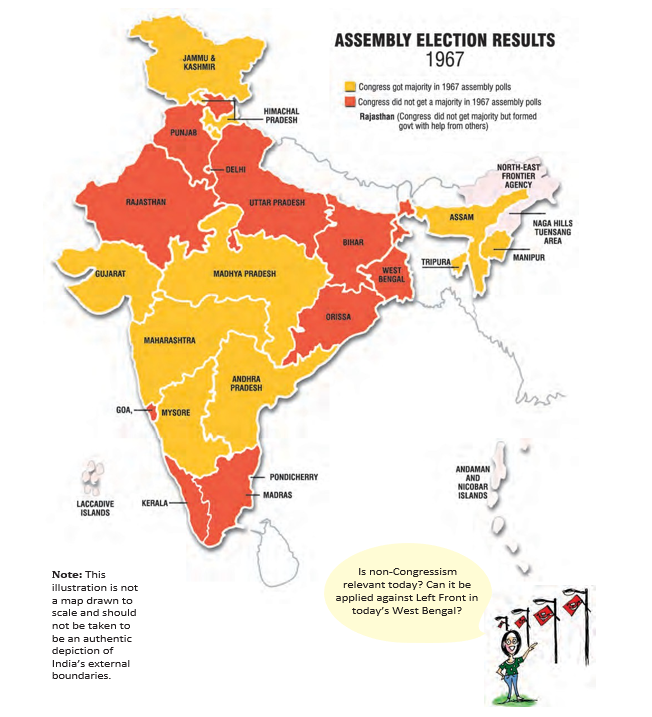
- Congress lost power in nine States: It lost its majority in seven; in two others, defections prevented it from forming a government.
- States affected: Punjab, Haryana, Uttar Pradesh, Madhya Pradesh, Bihar, West Bengal, Orissa, Madras and Kerala.
- Madras State: The regional party DMK won a clear majority—the first time a non-Congress party had secured a majority of its own in any State.
- DMK’s rise: Its victory followed a major student-led anti-Hindi agitation against the Centre’s move to impose Hindi as the official language.
- Other States: Coalition governments of non-Congress parties formed in the remaining eight States.
Coalition Governments
Samyukt Vidhayak Dal (SVD) — A joint legislative party formed by different non-Congress parties to support a government when no single party had a majority.
| State/front | Coalition partners |
|---|---|
| Bihar SVD | SSP and PSP (socialist parties), CPI (left) and Jana Sangh (right) |
| Punjab Popular United Front | Two rival Akali groups (Sant and Master), CPI, CPI(M), SSP, Republican Party and Bharatiya Jana Sangh |
Why these coalitions mattered
- Ideological variety: Coalition partners often had sharply different political positions.
- New political pattern: The 1967 results brought coalition governments into Indian politics as a significant alternative to single-party rule.
Defections
Defection — When an elected representative leaves the party whose symbol they were elected on and joins another party.
Defections after 1967
- Government formation: Breakaway Congress legislators helped install non-Congress governments in Haryana, Madhya Pradesh and Uttar Pradesh.
- Political effect: Frequent party-switching and shifting loyalties helped make and unmake State governments.
- Gaya Lal: The Haryana MLA changed parties three times in a fortnight—Congress to United Front, back to Congress, and again to United Front within nine hours.
- Famous phrase: After Gaya Lal said he would leave the United Front for Congress, leader Rao Birendra Singh announced, “Gaya Ram was now Aya Ram.”
- Later response: The phrase “Aya Ram, Gaya Ram” came to describe frequent floor-crossing; the Constitution was later amended to prevent defections.
- Non-Congressism
- Strategy of uniting opposition parties to defeat Congress.
- SVD
- Samyukt Vidhayak Dal; a joint legislative group supporting a non-Congress coalition government.
- Defection
- An elected representative’s move from the party that elected them to another party.
- Floor-crossing
- A legislator’s change of political allegiance, often affecting government stability.
Why was the 1967 election considered a political earthquake?
What was non-Congressism, and who advocated it?
What does “Aya Ram, Gaya Ram” refer to?
Quick recap
- Economic hardship, protests and political uncertainty weakened Congress before the 1967 elections.
- Non-Congressism united opposition parties that had previously divided the anti-Congress vote.
- Congress retained a national majority but lost power in nine States; the DMK won Madras with a clear majority.
- Coalitions of ideologically diverse parties formed SVD governments in several States.
- Defections helped install and destabilise State governments, giving rise to the phrase “Aya Ram, Gaya Ram.”
Split in the Congress
The Congress after the 1967 Elections
Political context
- Election result: Congress retained power at the Centre in 1967, but with a reduced majority, and lost power in many States.
- Significance: The results showed that Congress could be defeated, but no stable alternative had emerged.
- State governments: Many non-Congress coalitions lost their majorities; new combinations or President’s Rule followed.
Indira Gandhi and the Syndicate
Syndicate — An informal group of influential Congress leaders who controlled much of the party organisation and had a decisive role in leadership and policy.
Power struggle and policy shift
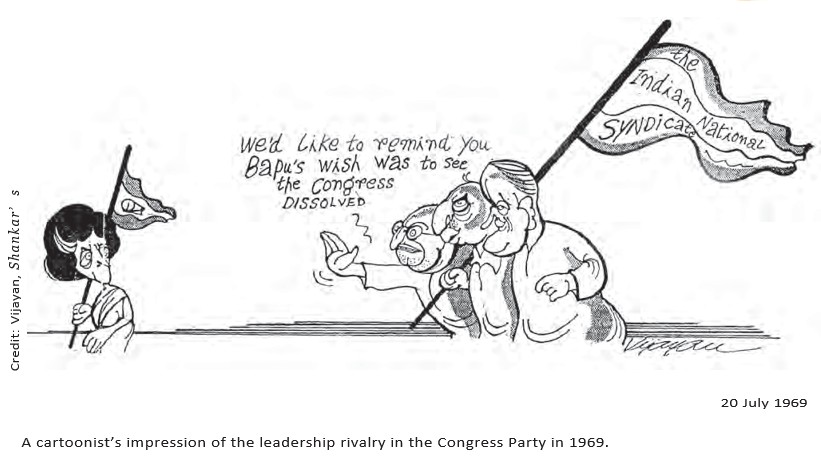
- Leadership: Led by K. Kamaraj, the Syndicate had helped Indira Gandhi become Prime Minister and expected her to follow its direction.
- Indira’s response: She built independence by relying on trusted advisers from outside the party and gradually sidelining Syndicate leaders.
- Two challenges: She needed to free herself from the Syndicate and recover the support Congress had lost in 1967.
- Strategy: She recast an internal power struggle as an ideological contest and moved government policy to the Left.
| Aspect | Key details |
|---|---|
| Syndicate leaders | K. Kamaraj; S. K. Patil; S. Nijalingappa; N. Sanjeeva Reddy; Atulya Ghosh. |
| Influence | Helped shape Indira Gandhi’s first Council of Ministers and influenced policy formulation and implementation. Lal Bahadur Shastri and Indira Gandhi both owed their positions to Syndicate support. |
| Ten-Point Programme | Adopted by the Congress Working Committee in May 1967; proposed social control of banks, nationalisation of General Insurance, ceilings on urban property and income, public distribution of food grains, land reforms and house sites for the rural poor. |
| Syndicate’s position | Its leaders formally approved the programme but had serious reservations about it. |
The Presidential Election of 1969 and the Split
The election contest
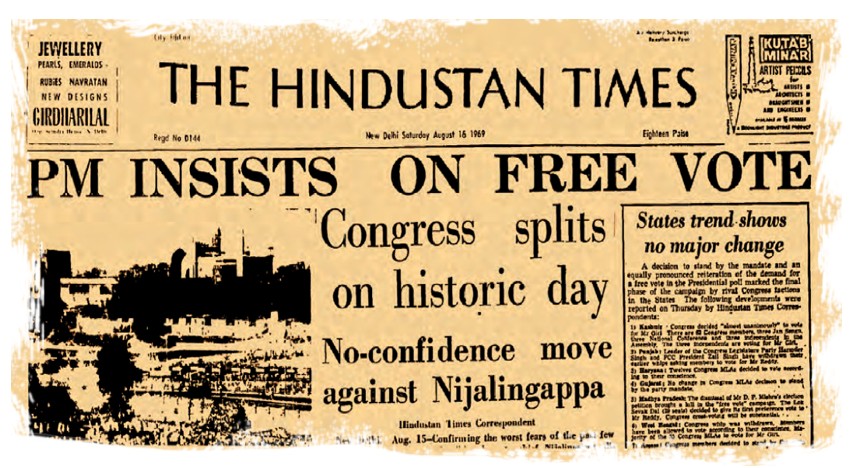
- Vacancy: President Zakir Hussain’s death in 1969 led to a presidential election.
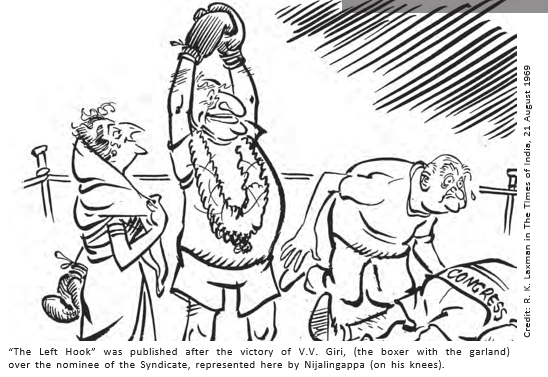
- Official candidate: Despite Indira Gandhi’s reservations, the Syndicate secured the nomination of N. Sanjeeva Reddy, then Speaker of the Lok Sabha.
- Indira’s candidate: She encouraged Vice-President V. V. Giri to stand as an independent candidate and backed him.
- Policy confrontation: Indira announced nationalisation of fourteen leading private banks and abolition of privy purses. Disagreements with Deputy Prime Minister and Finance Minister Morarji Desai led him to leave the government.
- Whip and conscience vote: Congress President S. Nijalingappa ordered MPs and MLAs to vote for Reddy. Indira called for a ‘conscience vote’, allowing them to vote as they chose.
- Requisitionists: Indira’s supporters requested a special AICC meeting; this faction came to be known as the Requisitionists.
From presidential contest to party split
- Indira-backed V. V. Giri defeats the official Congress candidate, Sanjeeva Reddy.
- The defeat exposes the factional conflict and formalises the split.
- Nijalingappa expels Indira Gandhi from the party; she claims her group is the real Congress.
- By November 1969, the Syndicate faction is Congress (Organisation), or Congress (O)/Old Congress; Indira’s faction is Congress (Requisitionists), also called Congress (R)/New Congress.
- Indira presents the divide as socialists versus conservatives, and pro-poor versus pro-rich.
| Point | Congress (O) | Congress (R) |
|---|---|---|
| Leadership | Syndicate leaders, including K. Kamaraj and S. Nijalingappa. | Indira Gandhi and her supporters. |
| Other name | Old Congress; Congress (Organisation). | New Congress; Congress (Requisitionists). |
| Outcome | Lost power and prestige after the 1971 election. | Won the test of popularity in 1971. |
Abolition of the Privy Purse
Privy purse — A hereditary government allowance granted to former princely rulers after their states joined India; its amount depended on the state’s size, revenue and potential.
Why abolition became an issue
- Original assurance: Privy purses were part of the terms accompanying integration of the princely states; they attracted little criticism while integration was the priority.
- Equality debate: Hereditary privileges conflicted with constitutional principles of equality and social and economic justice. Jawaharlal Nehru had repeatedly expressed dissatisfaction with them.
- Political disagreement: Indira Gandhi supported abolition after the 1967 elections; Morarji Desai opposed it as morally wrong and a breach of faith with the princes.
- Legislative failure: A constitutional amendment introduced in 1970 failed in the Rajya Sabha; a subsequent ordinance was struck down by the Supreme Court.
- Final abolition: Indira made the issue prominent in the 1971 election and gained public support. After Congress (R)’s victory, the Constitution was amended to remove the legal obstacles to abolition.
Key dates
- 1967Congress retained power at the Centre with a reduced majority, lost several States, and adopted the Ten-Point Programme in May.
- 1969The presidential election dispute ended in V. V. Giri’s victory and formalised the Congress split.
- 11 November 1969S. Nijalingappa’s letter expelled Indira Gandhi from the party.
- 1970A constitutional amendment to abolish privy purses failed in the Rajya Sabha; an ordinance was later struck down by the Supreme Court.
- 1971Congress (R) won the election; a constitutional amendment then removed the legal obstacles to abolition of privy purses.
- Syndicate
- Informal group of powerful Congress organisation leaders.
- Conscience vote
- A vote cast according to an individual member’s choice rather than a party whip.
- Congress (O)
- Organisation/Old Congress faction led by the Syndicate.
- Congress (R)
- Requisitionists/New Congress faction led by Indira Gandhi.
- Privy purse
- Hereditary allowance granted to former princely rulers after integration.
What was the Syndicate, and why did it clash with Indira Gandhi?
How did the 1969 presidential election lead to the Congress split?
How was the privy purse issue resolved?
Quick recap
- The 1967 elections weakened Congress and showed that it could be defeated.
- The Syndicate was a powerful group within the Congress organisation; Indira Gandhi worked to reduce its influence.
- The Ten-Point Programme of May 1967 reflected a leftward policy direction, though Syndicate leaders had reservations.
- V. V. Giri’s 1969 presidential victory over the Syndicate-backed candidate formalised the party split.
- The two factions became Congress (O), led by the Syndicate, and Congress (R), led by Indira Gandhi.
- After failed attempts in 1970, privy purses were abolished following the 1971 election and a constitutional amendment.
The 1971 Election and Restoration of Congress
Why Indira Gandhi Called an Early Election
- Political position: After the Congress split, Indira Gandhi’s government depended on issue-based support from other parties.
- Early election: In December 1970, her government recommended dissolving the Lok Sabha to seek a popular mandate and strengthen its position in Parliament.
- Election date: The fifth general election was held in February 1971.
The 1971 Electoral Contest
- Electoral alignments: Congress(R) allied with the CPI, while major non-communist opposition parties formed the Grand Alliance.
- Campaign themes: Indira Gandhi promoted a positive programme centred on “Garibi Hatao”; the opposition was portrayed as united mainly by “Indira Hatao”.
- Political strategy: Congress(R) focused on poverty reduction and support among disadvantaged groups to build an independent nationwide base.
Election Results and Political Effects
Further Consolidation of Indira Gandhi's Power
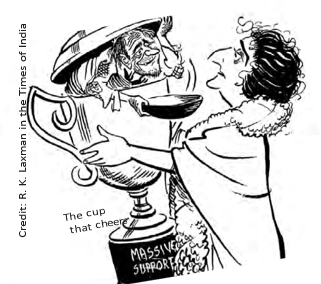
Was the Congress System Restored?
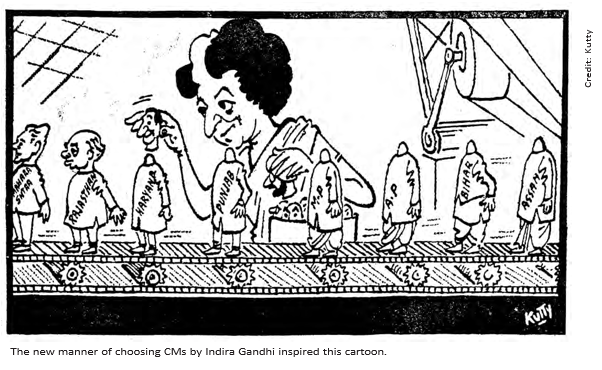
Limits of the Restored Dominance
- Garibi Hatao
- “Remove Poverty”; Indira Gandhi's campaign slogan and part of her strategy to build a nationwide support base.
- Indira Hatao
- “Remove Indira”; the opposition alliance's shared anti-Indira slogan, as described by Indira Gandhi.
- Congress(R)
- The Congress faction led by Indira Gandhi.
- Congress(O)
- The rival Congress faction, believed by many to hold the party's organisational strength.
What was the main contrast between Congress(R) and the Grand Alliance in the 1971 election?
How did the 1971 results restore Congress dominance?
Why was the restored Congress system different from the old one?
Quick recap
- Indira Gandhi called an early election to secure a popular mandate and strengthen her parliamentary position.
- Congress(R)'s “Garibi Hatao” campaign contrasted with the Grand Alliance's “Indira Hatao” slogan.
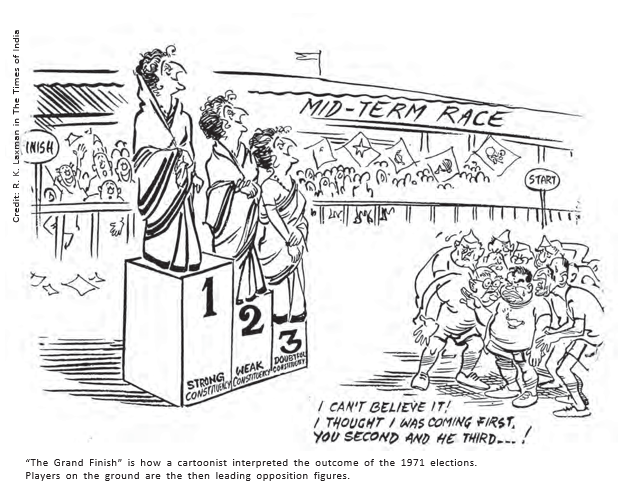
- Congress(R) won 352 seats; its alliance with the CPI won 375 seats and 48.4% of the vote—more seats and votes than Congress had won in the first four general elections.
- The East Pakistan crisis and war, followed by Congress's 1972 State election victories, further strengthened Indira Gandhi.
- Congress dominance returned, but the party became more leader-centred and less able to include diverse interests.
- Democratic space narrowed even as mobilisation over development and economic deprivation continued.
Political Science — ALL CHAPTERS
1
THE END OF BIPOLARITY
2
CONTEMPORARY CENTRES OF POWER
3
CONTEMPORARY SOUTH ASIA
4
INTERNATIONAL ORGANISATIONS
5
SECURITY IN THE CONTEMPORARY WORLD
6
ENVIRONMENT AND NATURAL RESOURCES
7
GLOBALISATION
1
Challenges of Nation Building
2
Era of one-party dominance
3
Politics Of Planned Development
4
India’s external relations
5
Challenges to and Restoration of the Congress System
6
The Crisis of Democratic Order
7
Regional Aspirations
8
Recent Developments in Indian Politics