Class 12 Humanities . Political Science . Contemporary World Politics . Contemporary South Asia
Chapter 3: CONTEMPORARY SOUTH ASIA
Ch 3
Political Science
Class 12 Humanities
What Is South Asia ?
South Asia: A Region of Conflict and Cooperation
Regional dynamics
- Conflict: Border and water-sharing disputes, insurgency, ethnic strife and competition over resources contribute to regional tension.
- Cooperation: Regional states can develop and prosper through cooperation, despite rivalry and mutual suspicion.
- Coexistence: South Asian affairs combine rivalry with goodwill, and suspicion with trust.
The Meaning and Boundaries of South Asia
South Asia — In this chapter, South Asia refers to Bangladesh, Bhutan, India, the Maldives, Nepal, Pakistan and Sri Lanka.
Regional features
- Natural boundaries: The Himalayas lie to the north; the Indian Ocean, Arabian Sea and Bay of Bengal border the south, west and east.
- Distinctiveness: Geography has helped shape the subcontinent’s linguistic, social and cultural distinctiveness.
- Unclear edges: The region’s eastern and western boundaries are less definite than its northern and southern boundaries.
- Wider discussions: Afghanistan and Myanmar are sometimes included in discussions of the region; China is an important player but is not considered part of South Asia here.
- Unity and diversity: South Asia is highly diverse, yet forms one geopolitical space.
Democracy and Political Systems
Democratic experience across the region
- India and Sri Lanka: Both have maintained democratic systems since independence, despite limitations in India’s democracy.
- Pakistan: It has experienced civilian and military rule. The post-Cold War period began with elected governments led successively by Benazir Bhutto and Nawaz Sharif; a military coup occurred in 1999, and civilian government returned in 2008.
- Bangladesh: It has experienced civilian and military rulers, but remained a democracy in the post-Cold War period.
- Nepal: It was a constitutional monarchy until 2006; the monarchy was abolished in 2008, establishing a democratic republic.
- Bhutan: It became a constitutional monarchy in 2008 and developed into a multiparty democracy under the king’s leadership.
- Maldives: It was a sultanate until becoming a republic with a presidential system in 1968. Parliament approved a multiparty system in June 2005; the Maldivian Democratic Party (MDP) won the 2018 elections.
| Country | Political experience highlighted |
|---|---|
| India | Democracy since independence |
| Sri Lanka | Democracy since independence |
| Pakistan | Alternation between civilian and military rule |
| Bangladesh | Civilian and military rule; democracy in the post-Cold War period |
| Nepal | Constitutional monarchy until 2006; democratic republic from 2008 |
| Bhutan | Constitutional monarchy and multiparty democracy from 2008 |
| Maldives | Republic with presidential system from 1968; multiparty system introduced in 2005 |
Public attitudes towards democracy
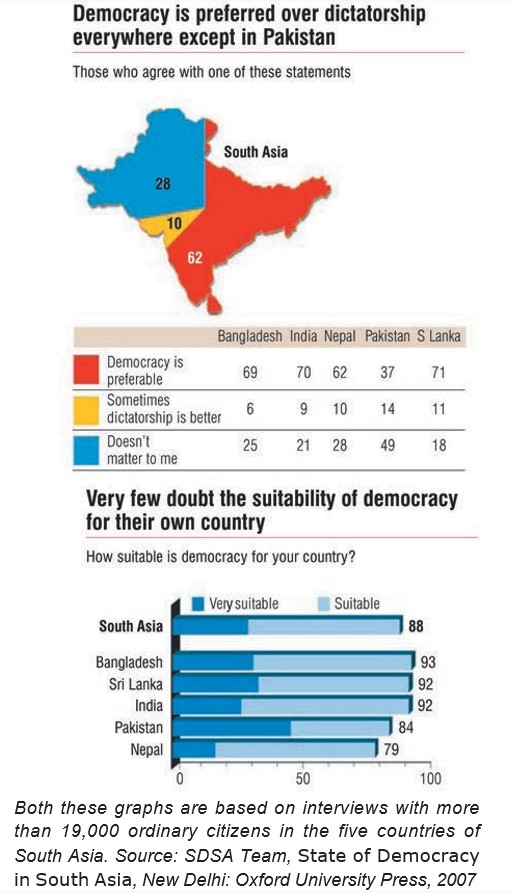
- Broad support: A survey in the five largest countries found support for democracy among citizens across income groups and religions.
- Preference: Many people favour democracy over other forms of government and consider it suitable for their country.
- Significance: South Asia’s experience challenges the belief that democracy can gain support only in prosperous countries and broadens the global understanding of democracy.
Human Development Indicators
| Country/region | Life expectancy (years), 2017 | Adult literacy (%), 2006–2016 | Secondary enrolment (%), 2012–2017 | GDP per capita (2011 PPP dollars), 2017 | Infant mortality (per 1,000), 2016 | TB cases (per 100,000), 2016 | Poverty below PPP 1.90 dollars/day (%), 2006–2016 | HDI rank |
|---|---|---|---|---|---|---|---|---|
| World | 72.2 | 82.1 | 79 | 15,439 | 29.9 | 140.0 | — | — |
| Developing countries | 70.7 | 81.1 | 75 | 10,199 | 32.7 | 164.5 | — | — |
| South Asia | 69.3 | 68.7 | 71 | 6,485 | 37.8 | 206.3 | — | — |
| Bangladesh | 72.8 | 72.8 | 69 | 3,524 | 28.2 | 221.0 | 14.8 | 136 |
| India | 68.8 | 69.3 | 75 | 6,427 | 34.6 | 211.0 | 21.2 | 130 |
| Nepal | 70.6 | 59.6 | 71 | 2,433 | 28.4 | 154.0 | 15.0 | 149 |
| Pakistan | 66.6 | 57.0 | 46 | 5,035 | 64.2 | 268.0 | 6.1 | 150 |
| Sri Lanka | 75.5 | 91.2 | 98 | 11,669 | 8.0 | 65.0 | — | 76 |
Timeline of South Asia Since 1947
- 1947India and Pakistan became independent after the end of British rule.
- 1948Sri Lanka, then Ceylon, became independent; conflict over Kashmir continued between India and Pakistan.
- 1954–1956Pakistan joined the Cold War military blocs SEATO and CENTO.
- 1960India and Pakistan signed the Indus Waters Treaty.
- 1962India and China fought a border conflict.
- 1965India and Pakistan fought a war; the UN India-Pakistan Observation Mission was established.
- 1966India and Pakistan signed the Tashkent Agreement; Sheikh Mujib-ur-Rahman presented a six-point proposal for greater autonomy for East Pakistan.
- March 1971Leaders of Bangladesh proclaimed independence.
- August 1971India and the Soviet Union signed a 20-year Treaty of Friendship.
- December 1971India and Pakistan fought a war, leading to the liberation of Bangladesh.
- July 1972India and Pakistan signed the Simla Agreement.
- May 1974India conducted a nuclear test.
- 1976Pakistan and Bangladesh established diplomatic relations.
- December 1985South Asian leaders signed the SAARC Charter at the organisation’s first summit in Dhaka.
- 1987India and Sri Lanka signed the Indo-Sri Lanka Accord; the Indian Peace Keeping Force operated in Sri Lanka from 1987 to 1990.
- 1988India sent troops to the Maldives to prevent a coup attempt by mercenaries.
- 1988–1991Democracy was restored in Pakistan, Bangladesh and Nepal.
- 1990India and Pakistan agreed not to attack each other’s nuclear installations and facilities.
- December 1996India and Bangladesh signed the Ganga Waters Treaty.
- May 1998India and Pakistan conducted nuclear tests.
- December 1998India and Sri Lanka signed a Free Trade Agreement.
- February 1999Indian Prime Minister Atal Bihari Vajpayee travelled by bus to Lahore and signed a Peace Declaration.
- June–July 1999The Kargil conflict took place between India and Pakistan.
- July 2001The Vajpayee–Musharraf Agra Summit did not succeed.
- January 2004SAFTA was signed at the 12th SAARC Summit in Islamabad.
- 2007Afghanistan joined SAARC.
- November 2014The 18th SAARC Summit was held in Kathmandu, Nepal.
Which countries are included in South Asia in this chapter, and what are its main natural boundaries?
How has democracy developed across South Asia?
Name key areas of both conflict and cooperation in South Asia.
Quick recap
- South Asia in this chapter comprises seven countries and forms one diverse geopolitical space.
- The region has natural boundaries to the north and south, but less-defined eastern and western edges.
- South Asian politics combines conflict and mistrust with goodwill and opportunities for cooperation.
- Political systems vary, but support for democracy is widespread across the region.
- Regional relations include wars and disputes as well as treaties, trade agreements and SAARC cooperation.
- The 2018 UNDP data show substantial differences in human development indicators among the listed countries.
The Military and Democracy in Pakistan, and Democracy in Bangladesh
The Military and Democracy in Pakistan
Why Democracy Has Struggled in Pakistan
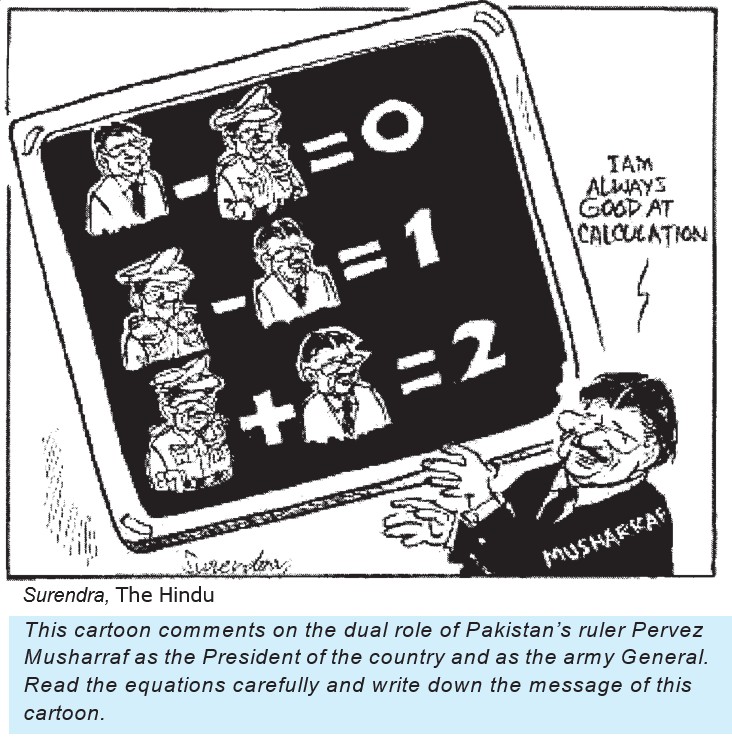
- Military dominance: Repeated coups and the influence of the military, clergy and landowning elite weakened elected governments.
- Other factors: Conflict with India strengthened pro-military arguments, while Western support for military rulers further encouraged army rule.
Democracy in Bangladesh
From East Pakistan to Independence
- West Pakistani domination and unfair treatment of Bengali culture and language
- Demands for autonomy, fair representation and political power
- The Awami League’s 1970 victory is denied its political result; Mujib is arrested and the army suppresses the movement
- Mass killings lead to refugee migration into India; India supports East Pakistan’s independence movement
- The December 1971 war ends with Pakistani forces surrendering in East Pakistan, which becomes independent Bangladesh
Military Rule and the Return of Democracy in Bangladesh
- East Pakistan
- The eastern region of Pakistan that became independent Bangladesh in 1971.
- Awami League
- The party led by Sheikh Mujib-ur Rahman that led the East Pakistan movement and won the 1970 election there.
- Pakistan People’s Party
- The party led by Benazir Bhutto that competed with the Muslim League in Pakistan’s elected politics.
- Bangladesh National Party
- The party formed by Ziaur Rahman, which won the 1979 elections.
Why has Pakistan struggled to build a stable democracy?
What led to Bangladesh’s independence?
Quick recap
- Pakistan has repeatedly alternated between elected governments and military rule.
- Social power structures, conflict with India and Western support for military rulers have weakened democracy in Pakistan.
- Pakistan has retained pro-democracy sentiment, a relatively free press and a strong human rights movement.
- East Pakistan’s demands for Bengali rights, autonomy and political representation led to repression and the 1971 independence war.
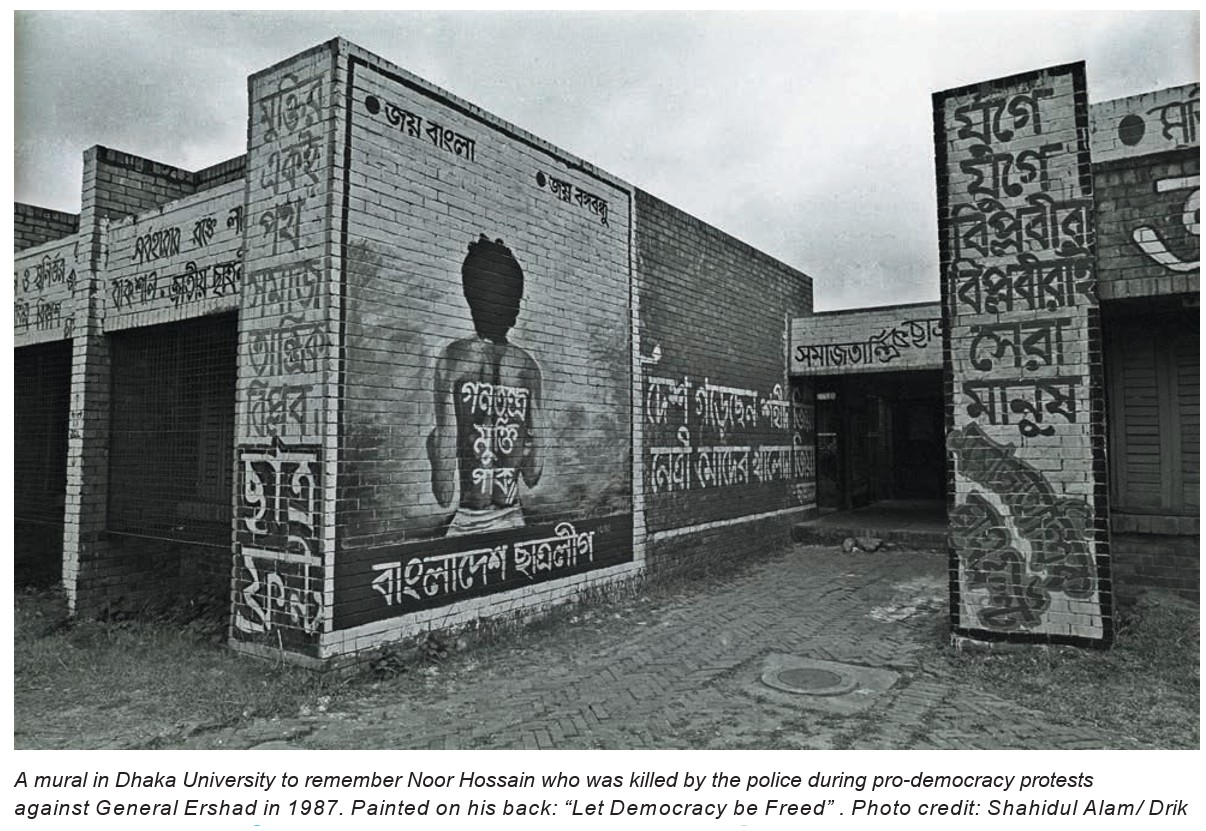
- Bangladesh’s early democracy was interrupted by constitutional centralisation and military takeovers.
- Mass protests and elections restored multi-party representative democracy in Bangladesh from 1991.
Monarchy and Democracy in Nepal
Nepal’s Political Background
Monarchy and the Demand for Democracy
- Political system: Nepal was a Hindu kingdom and later a constitutional monarchy.
- Royal control: The king, supported by the army, retained full control of government and restricted democracy.
- Popular demand: Political parties and ordinary people wanted a more open and responsive system of government.
Key Turning Points
- 1990After a strong pro-democracy movement, the king accepted the demand for a new democratic constitution.
- The 1990sMaoists spread their influence and pursued armed insurrection; Maoist guerrillas fought the king’s armed forces.
- 2002The king abolished parliament and dismissed the government, ending even the limited democracy that existed.
- April 2006Countrywide pro-democracy protests forced the king to restore the House of Representatives, dissolved in April 2002.
- 2008Nepal abolished the monarchy and became a democratic republic.
- 2015Nepal adopted a new constitution.
Conflict and the 2006 Pro-Democracy Movement
Political Conflict
- Maoist position: The Maoists supported armed insurrection against the monarch and ruling elite.
- Violent conflict: Maoist guerrillas fought the king’s armed forces; democratic governments meanwhile had a short and troubled career.
- Triangular conflict: For a period, monarchists, democrats and Maoists were the three main forces in the conflict.
- 2006 movement: The largely non-violent movement was led by the Seven Party Alliance (SPA), Maoists and social activists.
The 2002 Dissolution and 2006 Restoration
- 2002: The king abolished parliament and dismissed the government, ending Nepal’s limited democracy.
- April 2006: Mass, countrywide pro-democracy protests were led by the SPA, Maoists and social activists.
- Outcome: The king was forced to restore the House of Representatives, which had been dissolved in April 2002.
Transition to a Democratic Republic
Constitution-Making and Political Differences
- Transition: Nepal’s transition to democracy was described as almost complete.
- Constituent assembly: Nepal formed an assembly to draft a constitution, marking a unique moment in its history.
- Monarchy debate: Some groups believed a nominal monarchy was needed to preserve Nepal’s link with the past.
- Maoist agreement: Maoists agreed to suspend armed struggle and sought radical social and economic restructuring in the constitution.
- Disagreements: Not all SPA parties supported the Maoist programme; Maoists and some other groups were also deeply suspicious of the Indian government’s role in Nepal’s future.
- Constitutional monarchy
- A political system in which a monarch’s authority is defined or limited by a constitution.
- Maoists
- Political groups that opposed the monarch and ruling elite and sought radical social and economic change.
- Seven Party Alliance (SPA)
- An alliance of political parties that led the 2006 pro-democracy movement with the Maoists and social activists.
- Constituent assembly
- An assembly formed to draft a country’s constitution.
- Democratic republic
- A republic governed through democratic institutions rather than by a monarch.
What was the triangular conflict in Nepal?
What was the outcome of the April 2006 pro-democracy movement?
How did Nepal’s political system change in 2008 and 2015?
Quick recap
- Nepal moved from a Hindu kingdom to a constitutional monarchy, while political parties and people demanded more responsive government.
- A pro-democracy movement led the king to accept a new democratic constitution in 1990, but democratic governments had a short and troubled career.
- Maoist insurgency and conflict with royal forces formed part of a three-sided struggle among monarchists, democrats and Maoists.
- The king dissolved parliament and dismissed the government in 2002; mass protests in April 2006 led to restoration of the House of Representatives.
- Nepal’s transition to democracy was considered almost complete as it moved towards constitution-making.
- Nepal became a democratic republic in 2008 and adopted a new constitution in 2015.
Ethnic Conflict and Democracy in Sri Lanka
Democracy and the Ethnic Conflict
Background
- Democracy: Sri Lanka has maintained a democratic political system since independence in 1948.
- Challenge: Its major challenge was ethnic conflict and a regional demand for secession—not military rule or monarchy.
- Ceylon: Sri Lanka was known as Ceylon at independence.
Sinhala-Tamil Conflict and the LTTE
Ethnic tensions
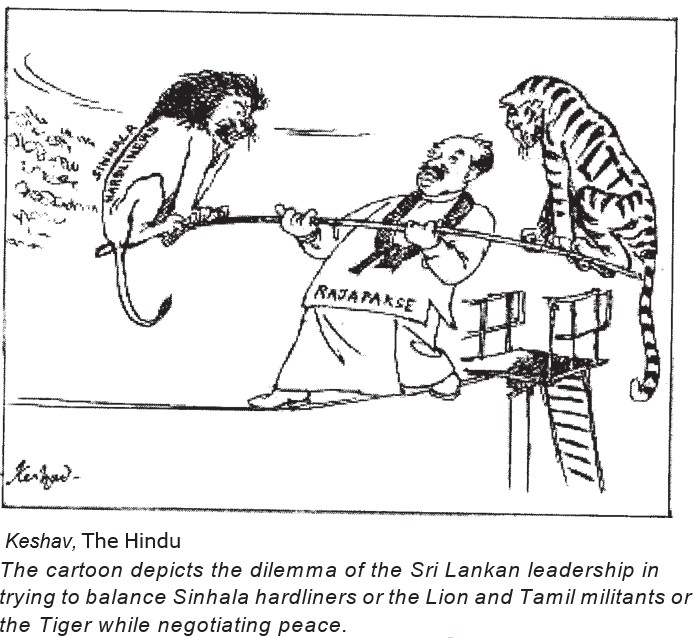
- Majority politics: After independence, politics was dominated by forces representing the Sinhala majority.
- Tamil community: Many Tamils had migrated from India and settled in Sri Lanka; migration continued after independence.
- Sinhala nationalism: Sinhala nationalists opposed concessions to Tamils, claiming Sri Lanka belonged only to the Sinhala people.
- Result: The neglect of Tamil concerns contributed to the growth of militant Tamil nationalism.
Liberation Tigers of Tamil Eelam (LTTE) — A militant Tamil organisation that fought the Sri Lankan army for a separate country, Tamil Eelam, for the Tamils of Sri Lanka.
Armed struggle
- From 1983: The LTTE waged an armed struggle against the Sri Lankan army, seeking a separate Tamil state.
- Territorial control: At one point, the LTTE controlled the north-eastern part of Sri Lanka.
India’s Involvement
India and the Tamil question
- Pressure on India: Tamil people in India pressed the Indian government to protect the interests of Tamils in Sri Lanka.
- Negotiations: India repeatedly tried to negotiate with the Sri Lankan government over the Tamil question.
- First direct involvement (1987): India became directly involved in the Sri Lankan Tamil question for the first time, signing an accord with Sri Lanka and sending troops to stabilise relations between the Sri Lankan government and the Tamils.
- Consequences: Indian troops fought the LTTE, while many Sri Lankans viewed their presence as interference in Sri Lanka’s internal affairs.
- 1989 withdrawal: The Indian Peace Keeping Force (IPKF) left Sri Lanka without achieving its objective.
India’s involvement: causes and consequences
- Pressure from Tamils in India to protect Sri Lankan Tamils
- India’s first direct involvement in the question: accord with Sri Lanka and troop deployment in 1987
- Indian troops become involved in fighting the LTTE
- Sri Lankan opposition to perceived Indian interference
- IPKF withdraws in 1989 without attaining its objective
End of the Armed Conflict
Negotiations and the war’s end
- International efforts: Scandinavian countries, particularly Norway and Iceland, tried to bring the warring groups back to negotiations.
- 2009: The armed conflict ended when the LTTE was vanquished.
Development Despite Conflict
Economic and human development
- Growth: Sri Lanka achieved considerable economic growth and high levels of human development despite prolonged internal conflict.
- Population: It was among the first developing countries to successfully control population growth.
- Economic liberalisation: It was the first country in the region to liberalise its economy.
- Per capita GDP: Sri Lanka had a high per capita GDP for many years, right through the civil war.
- Political system: Despite the ravages of conflict, Sri Lanka continued to maintain democracy.
Key events
- 1948Sri Lanka became independent; it has retained democracy since then.
- 1983The LTTE’s armed struggle for Tamil Eelam began.
- 1987India became directly involved for the first time, signed an accord with Sri Lanka and sent troops.
- 1989The IPKF withdrew without achieving its objective.
- 2009The armed conflict ended with the LTTE’s defeat.
Why did militant Tamil nationalism grow in Sri Lanka?
What was India’s role in the Sri Lankan Tamil question, and what was the outcome?
Quick recap
- Sri Lanka retained democracy after independence in 1948, but faced ethnic conflict and a demand for secession.
- Sinhala-majority politics and neglect of Tamil concerns contributed to militant Tamil nationalism.
- From 1983, the LTTE fought for a separate Tamil state, Tamil Eelam.
- India first became directly involved in 1987; the IPKF withdrew in 1989 without achieving its objective.
- Norway and Iceland helped encourage negotiations; the armed conflict ended with the LTTE’s defeat in 2009.
- Despite conflict, Sri Lanka maintained democracy and recorded strong economic and human-development outcomes.
India-pakistan Conflicts
India–Pakistan Conflict and Kashmir
Why the conflict matters
- Regional tensions: The end of the Cold War did not end conflicts in South Asia; international disputes continued alongside domestic and ethnic tensions.
- Central role: India’s position in the region means that many of these international conflicts involve India.
- Kashmir: The dispute began soon after Partition, with Pakistan claiming Kashmir; the issue remains unresolved.
- Kashmiris’ perspective: Kashmir should not be viewed only as a territorial dispute between the two governments; the views of Kashmiris also matter.
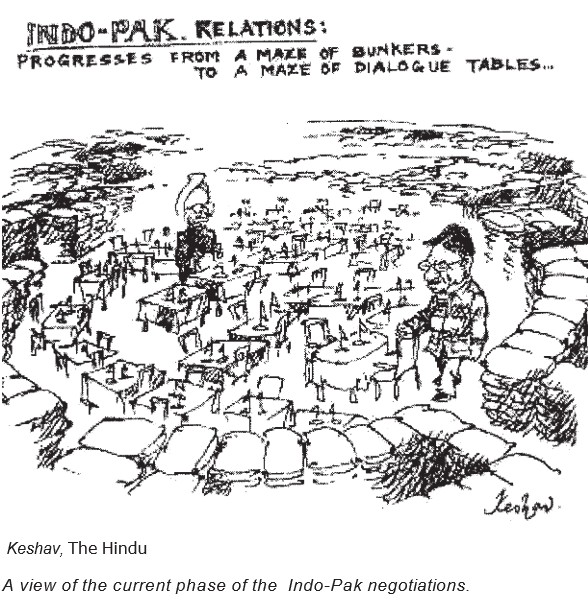
Kashmir and the wars
- 1947–48War over Kashmir divided the province into Pakistan-occupied Kashmir and the Indian province of Jammu and Kashmir, separated by the Line of Control.
- 1965Another India–Pakistan war failed to settle the Kashmir dispute.
- 1971India won a decisive war against Pakistan, but the Kashmir issue remained unresolved.
Strategic Rivalry and Nuclear Weapons
Other strategic concerns
- Territory and resources: The two countries have disputed control of the Siachen Glacier and competed in acquiring arms.
- Nuclear arms race: In the 1990s, both states acquired nuclear weapons and missiles capable of delivering them.
- Post-tests: The two states appear to have developed a military relationship in which the likelihood of a direct, full-scale war has declined; mutual suspicion continues.
Nuclear tests
- 1998India conducted a nuclear explosion at Pokhran; Pakistan responded within days with nuclear tests in the Chagai Hills.
Mutual Allegations and Militancy
| Accusing government | Allegation |
|---|---|
| India | Pakistan allegedly supported Kashmiri militants with arms, training, money and protection to carry out terrorist attacks. |
| India | Pakistan allegedly aided pro-Khalistani militants with arms and ammunition during 1985–1995. |
| India | Pakistan’s Inter Services Intelligence (ISI) was alleged to be involved in anti-India campaigns in northeast India, operating secretly through Bangladesh and Nepal. |
| Pakistan | India’s government and security agencies were accused of fomenting trouble in Sindh and Balochistan. |
Period cited in India’s allegation
- 1985–1995India alleged that Pakistan had aided pro-Khalistani militants with arms and ammunition.
River Waters and Other Disputes
Indus waters and Sir Creek
- Indus basin: India and Pakistan argued intensely over the use of the basin’s rivers before agreeing on a treaty.
- Indus Waters Treaty: Signed with World Bank assistance, it has remained in force despite military conflicts; disagreements over its interpretation and river-water use continue.
- Sir Creek: The countries disagree over the boundary line in the Rann of Kutch. Though seemingly a minor dispute, its settlement may affect control of nearby sea resources.
- Negotiations: India and Pakistan continue to hold talks on these and other issues.
Indus Waters Treaty
- 1960India and Pakistan signed the Indus Waters Treaty with the help of the World Bank.
- Line of Control
- The line dividing Pakistan-occupied Kashmir from the Indian province of Jammu and Kashmir.
- Indus Waters Treaty
- The 1960 agreement between India and Pakistan on sharing Indus basin river waters.
- ISI
- Pakistan’s Inter Services Intelligence agency, alleged by India to be involved in anti-India campaigns.
- Sir Creek
- A disputed boundary area in the Rann of Kutch, with possible implications for nearby sea resources.
Why did the 1971 war not resolve the Kashmir issue?
What has been the significance of the Indus Waters Treaty?
Quick recap
- Kashmir has remained unresolved despite the wars of 1947–48, 1965 and 1971.
- Siachen, arms acquisition and nuclear weapons are major strategic concerns.
- India and Pakistan continue to distrust each other and exchange allegations of support for militancy.
- The 1998 nuclear tests took place at Pokhran in India and the Chagai Hills in Pakistan.
- The 1960 Indus Waters Treaty has endured, but differences over water interpretation and use persist.
- The Sir Creek boundary dispute may affect access to adjoining sea resources.
India and Its Other Neighbours
India and Bangladesh
Disputes and cooperation
- Main disputes: Sharing Ganga and Brahmaputra waters, the boundary, trade, and Bangladesh’s alleged denial of illegal immigration and support for anti-Indian fundamentalist groups.
- India’s concerns: Bangladesh has not allowed Indian troops to cross its territory to reach northeastern India, or permitted gas exports to India and Myanmar gas transit through Bangladesh.
- Bangladesh’s concerns: It sees India as dominant in river-water negotiations, accused of encouraging rebellion in the Chittagong Hill Tracts, seeking Bangladeshi natural gas, and being unfair in trade.
- Cooperation: Economic ties have improved; the countries also work together on disaster management and environmental issues.
- Regional link: Bangladesh is part of India’s Look East policy, renamed Act East in 2014, which aims to connect India with Southeast Asia through Myanmar.
- Progress: The two countries exchanged certain enclaves in 2015 and have sought wider cooperation by identifying shared threats and considering each other’s needs.
India and Nepal
Special ties alongside disagreements
- Open movement: A treaty allows Indian and Nepalese citizens to travel to and work in the other country without visas or passports.
- Indian concerns: India has objected to Nepal’s close relationship with China and its perceived inaction against anti-Indian elements. Indian security agencies view Nepal’s Maoist movement as a threat, particularly alongside the growth of Naxalite groups in India.
- Nepalese concerns: Many in Nepal believe India interferes in its internal affairs, seeks control over river waters and hydroelectricity, and restricts Nepal’s access to the sea through Indian territory.
- Continuing links: Despite past trade disputes, relations are generally stable and peaceful. Trade, scientific cooperation, shared natural resources, electricity generation and interconnected water-management grids connect the countries.
- Outlook: Consolidation of democracy in Nepal was seen as a possible basis for better relations.
India and Sri Lanka
Ethnic conflict and closer ties
- Central difficulty: India’s relationship with Sri Lanka has been affected by the island’s ethnic conflict; Indian leaders and citizens find it difficult to remain neutral when Tamils face political hardship or violence.
- Policy shift: After India’s military intervention in 1987, India preferred disengagement from Sri Lanka’s internal troubles.
- Cooperation: A free trade agreement strengthened ties, while India’s assistance with post-tsunami reconstruction brought the countries closer.
India and Bhutan
Close cooperation
- Relations: India has no major conflict with Bhutan and enjoys a special relationship with it.
- Security: Bhutanese efforts to remove guerrillas and militants from northeastern India who operated in Bhutan helped India.
- Development: India participates in major hydroelectric projects and is Bhutan’s largest source of development aid.
India and the Maldives
Warm relations and support
- Relations: India–Maldives ties have been warm and cordial.
- Security assistance: In November 1988, India’s air force and navy responded to the Maldives’ request for help after Tamil mercenaries from Sri Lanka attacked.
- Development: India has contributed to the Maldives’ economic development, tourism and fisheries.
Regional tensions and cooperation
| Point | Smaller neighbours | India |
|---|---|---|
| Power and influence | May suspect India of seeking regional dominance because of its size and power. | May feel that neighbours exploit India’s position and interests. |
| Regional stability | May view Indian actions as interference or pressure. | Worries that political instability in neighbouring states could allow outside powers to gain influence in the region. |
Why India’s regional position can create tension
- India is much larger and more powerful than most of its neighbours.
- Its neighbours may become suspicious of its intentions and fear regional dominance.
- India may interpret neighbours’ actions as exploitative or worry about outside influence.
- These competing concerns can make disputes harder to resolve, even when countries also cooperate.
Disputes beyond India’s bilateral relations
- Nepal and Bhutan: They have disagreed over the migration of ethnic Nepalese into Bhutan.
- Bangladesh and Myanmar: They have had disagreements connected with Rohingya migration into India and Bangladesh.
- Bangladesh and Nepal: Differences have concerned the future of Himalayan river waters.
- Regional geography: India lies centrally and is the only country that borders all the others in the region; this contributes to the prominence of India-centred disputes.
Key dates
- 1987India intervened militarily in Sri Lanka; afterwards, it preferred disengagement from Sri Lanka’s internal troubles.
- November 1988India responded to the Maldives’ request for help during an attack by Tamil mercenaries.
- 2014India’s Look East policy became the Act East policy.
- 2015India and Bangladesh exchanged certain enclaves.
Why do India’s smaller neighbours sometimes fear its intentions?
State two examples of cooperation between India and its neighbours.
Quick recap
- India–Bangladesh relations combine river, border, trade and security disputes with economic and environmental cooperation.
- India and Nepal share open movement and close practical links, but differ over security, sovereignty, rivers and access to the sea.
- Ethnic conflict shaped India’s Sri Lanka policy; trade and reconstruction assistance strengthened ties.
- India’s relations with Bhutan and the Maldives are especially cooperative and cordial.
- India’s size, power and central geography contribute to neighbours’ suspicions and the prominence of India-centred disputes.
- Regional disputes also involve migration and river waters between countries other than India.
Peace and Cooperation
Regional Cooperation: SAARC and SAFTA
SAARC — The South Asian Association for Regional Cooperation is a regional initiative through which South Asian states seek cooperation by multilateral means.
SAARC and Regional Cooperation
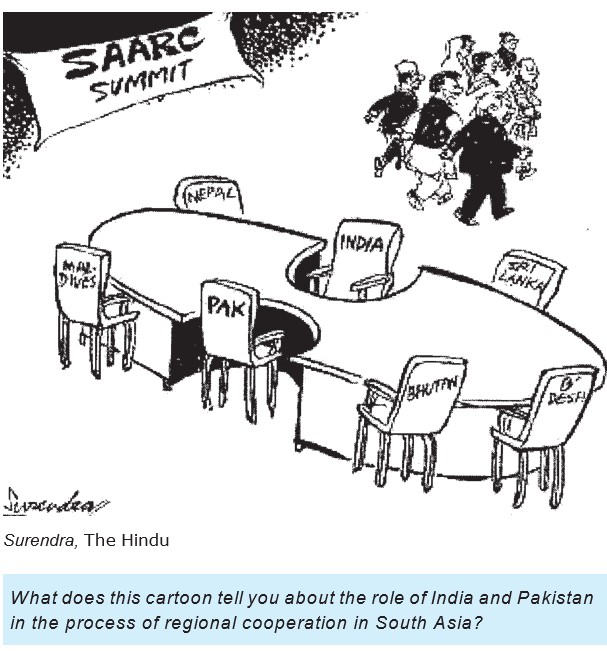
- Purpose: South Asian countries recognise the value of cooperation and friendly relations despite ongoing conflicts.
- Limit: Persistent political differences have prevented SAARC from achieving much success.
- Trade link: SAARC members signed the SAFTA agreement, which aims to create a free-trade zone across South Asia.
SAFTA — The South Asian Free Trade Agreement aims to lower trade tariffs and promote freer trade across South Asia.
Regional Cooperation and Trade
- 1985SAARC began as a regional cooperation initiative.
- 1991 onwardIndia–China economic ties multiplied rapidly.
- 2004SAFTA was signed.
- 1 January 2006SAFTA came into effect.
| Viewpoint | Main argument |
|---|---|
| Some neighbouring countries | Fear that Indian businesses could enter their markets and influence their societies and politics. |
| India’s position | Believes freer trade can benefit all countries and strengthen cooperation on political issues. |
| Some in India | Question whether SAFTA is worthwhile because India already has bilateral agreements with Bhutan, Nepal and Sri Lanka. |
India–Pakistan Relations: Managing Tensions
Peace-Building Efforts
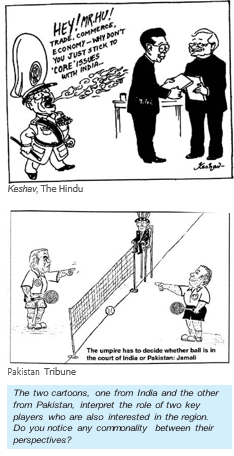
- Confidence-building measures: The two countries have agreed on steps to reduce the risk of war.
- People-to-people ties: Social activists and prominent personalities have worked to foster friendship.
- Leadership dialogue: Summits have allowed leaders to understand each other and seek solutions to major problems.
- Connections: Bus routes opened, trade increased and visas were granted more easily; the situation has changed in recent times.
Outside Powers in South Asian Politics
| Point | China | United States |
|---|---|---|
| Role and relations | A key regional player; improved relations with India, while its strategic partnership with Pakistan remains an irritant. | Involvement grew rapidly after the Cold War; it has had good relations with both India and Pakistan and increasingly acts as a moderator. |
| Economic interests | Development and globalisation have brought China and India closer, with economic ties multiplying rapidly since 1991. | Economic reforms and liberal policies in India and Pakistan deepened US participation in the region. |
| Other interests | Its partnership with Pakistan affects regional relations. | A large South Asian diaspora in the US and the region’s large population and markets give the US a stake in regional security and peace. |
The Region’s Future
- Regional choice: South Asia may remain conflict-prone or develop into a regional bloc with shared cultural features and trade interests.
- Main responsibility: The region’s people and governments will shape this outcome more than any outside power.
- Multilateral cooperation
- Cooperation involving several countries through a shared regional framework.
- Free-trade zone
- A region where trade barriers such as tariffs are reduced.
- Confidence-building measures
- Steps agreed by countries to reduce mistrust and the risk of conflict.
- Diaspora
- People living outside their ancestral or home region.
What are SAARC and SAFTA, and why has regional trade cooperation faced difficulties?
What efforts have India and Pakistan made to manage tensions?
Quick recap
- SAARC began in 1985, but political differences have constrained its achievements.
- SAFTA was signed in 2004 and came into force on 1 January 2006 to lower tariffs and promote free trade.
- India–Pakistan peace efforts have included confidence-building, dialogue and stronger social and economic links.
- China and the United States both influence South Asian politics through strategic and economic ties.
- The future of South Asian cooperation depends chiefly on the region’s people and governments.
Political Science — ALL CHAPTERS
1
THE END OF BIPOLARITY
2
CONTEMPORARY CENTRES OF POWER
3
CONTEMPORARY SOUTH ASIA
4
INTERNATIONAL ORGANISATIONS
5
SECURITY IN THE CONTEMPORARY WORLD
6
ENVIRONMENT AND NATURAL RESOURCES
7
GLOBALISATION
1
Challenges of Nation Building
2
Era of one-party dominance
3
Politics Of Planned Development
4
India’s external relations
5
Challenges to and Restoration of the Congress System
6
The Crisis of Democratic Order
7
Regional Aspirations
8
Recent Developments in Indian Politics