Class 12 Humanities . Political Science . Contemporary World Politics . The End of Bipolarity
Chapter 1: THE END OF BIPOLARITY
Ch 1
Political Science
Class 12 Humanities
What Was the Soviet System ?
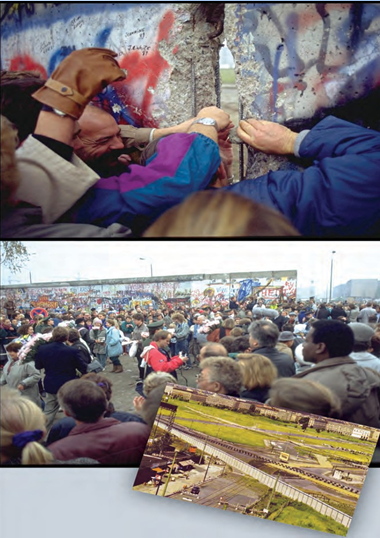
The Berlin Wall and the End of the Cold War
Why the Wall mattered
- Symbol: The Berlin Wall represented the division between the capitalist and communist worlds.
- Construction: Built in 1961, it separated East Berlin from West Berlin and extended for more than 150 kilometres.
- Fall: After standing for 28 years, the Wall was broken by people on 9 November 1989, allowing free movement.
- Consequences: Germany was unified, and eight East European countries replaced communist governments following mass demonstrations.
- End of the Cold War: The Soviet Union stood by as the Cold War began to end through mass actions by ordinary people, not military means; the USSR itself later disintegrated.
The Berlin Wall
- 1961The Berlin Wall was built to separate East and West Berlin.
- 9 November 1989People broke open the Wall; this helped begin the end of the communist bloc and led towards German reunification.
The Soviet Revolution and Its Ideals
Vladimir Lenin — Vladimir Lenin (1870–1924) founded the Bolshevik Communist Party, led the 1917 Russian Revolution, headed the USSR during 1917–1924, practised Marxism, and inspired communists worldwide.
Union of Soviet Socialist Republics (USSR) — A union established after the socialist revolution in Russia in 1917, built around state ownership and the goal of creating a more equal society.
Foundations of the Soviet system
- Ideology: The 1917 revolution drew on socialism, opposed to capitalism, and aimed to create an egalitarian society.
- Social change: Soviet leaders sought to abolish private property and consciously organise society around equality.
- State and party: The system gave primacy to the state and the Communist Party.
- Politics: The Communist Party controlled the political system; no other political party or opposition was allowed.
- Economy: The state owned and controlled productive assets, while the economy was planned.
The Soviet Bloc and Soviet Strength
The Second World
- Soviet bloc: After the Second World War, East European countries liberated by the Soviet army came under USSR control and adopted political and economic systems modelled on it.
- Second World: The USSR and these socialist countries were known as the Second World or the socialist bloc.
- Warsaw Pact: This military alliance held the bloc together, with the USSR as its leader.
Economic and social achievements
- Great-power status: After the Second World War, the Soviet Union became a great power; its economy was more developed than the rest of the world except the US.
- Industrial base: The USSR had extensive communications and transport networks, vast energy resources, and strong iron, steel and machinery production.
- Consumer industry: It produced goods ranging from pins to cars, though their quality often lagged behind that of Western capitalist countries.
- Welfare: The state ensured a minimum standard of living and subsidised health, education, childcare and other basic necessities.
- Ownership: Land and productive assets were predominantly owned and controlled by the state.
Problems and Weaknesses of the Soviet System
Political and national tensions
- Authoritarian rule: Bureaucracy and one-party control made the system rigid and life difficult for citizens.
- No accountability: The Communist Party tightly controlled state institutions and was not answerable to the people.
- Restricted freedoms: Lack of democracy and freedom of speech stifled dissent, often expressed through jokes and cartoons.
- Republican demands: The party resisted the demands of the USSR’s fifteen republics to manage their own affairs, including cultural affairs.
- Russian dominance: Although Russia was formally one of the fifteen republics, it dominated the union; people in other regions often felt neglected or suppressed.
Economic stagnation and growing discontent
- The costly arms race forced the USSR to compete with the US; it matched the US at times, but at great cost.
- The USSR fell behind the West in technology and infrastructure, including transport and power.
- Productivity lagged, and consumer goods became scarce; food imports increased each year.
- The economy faltered in the late 1970s and became stagnant.
- Economic shortcomings and political restrictions left citizens’ aspirations unfulfilled.
Additional strain
- Afghanistan: The Soviet invasion of Afghanistan in 1979 weakened the system further.
- Wages and productivity: Wages continued to rise, but productivity and technology fell behind the West, adding to consumer-goods shortages.
- Egalitarian society
- A society that aims for greater equality among its members.
- Centrally planned economy
- An economy in which the state plans and controls economic activity.
- Second World
- The USSR and the socialist countries associated with it.
- Warsaw Pact
- The military alliance that held the Soviet bloc together.
State the main features of the Soviet system.
Give two achievements and two weaknesses of the Soviet system.
Quick recap
- The USSR emerged after the 1917 Russian socialist revolution, aiming to build an egalitarian society.
- The Communist Party controlled politics, while the state owned productive assets and planned the economy.
- The Soviet-led socialist bloc was called the Second World and was linked by the Warsaw Pact.
- The USSR developed industry and welfare support but restricted democracy and personal freedoms.
- Russian dominance and resistance to the demands of the fifteen republics created national tensions.
- Costly competition, weak productivity and shortages contributed to stagnation; the 1979 invasion of Afghanistan added strain.
- The Berlin Wall fell on 9 November 1989 amid mass actions; the USSR stood by as the Cold War began to end without military means.
Gorbachev and the Disintegration
Gorbachev’s Reforms and Eastern Europe
Purpose and effects of reform
- Mikhail Gorbachev became General Secretary of the Communist Party of the Soviet Union (CPSU) in 1985 and sought to reform the system.
- Purpose: Reforms were intended to help the USSR keep pace with information and technological changes in the West.
- Policies: Gorbachev promoted economic and political reform, democratisation, and normalised relations with the West.
- Unintended effect: People in Soviet-bloc countries protested against their governments and Soviet control.
- Soviet response: Unlike previously, the USSR did not intervene; communist regimes in Eastern Europe collapsed one after another.
Reform and the weakening of Soviet control
- Gorbachev introduces reform and democratisation
- People in Soviet-bloc countries protest against their governments and Soviet control
- The USSR chooses not to intervene
- Communist regimes in Eastern Europe collapse
Crisis and Disintegration of the USSR
Growing internal crisis
- Opposition: Communist Party leaders opposed Gorbachev’s reforms.
- Power shift: Authority began moving from the Soviet centre to the republics, especially in the more Europeanised parts of the USSR.
- Republics’ aims differed: Many Europeanised republics saw themselves as sovereign states; Central Asian republics did not seek independence and wanted to remain in the Soviet Federation.
Key events
- 1985Mikhail Gorbachev became General Secretary and began seeking reforms.
- 1991A coup encouraged by Communist Party hardliners was opposed by Boris Yeltsin and the public.
- December 1991Russia, Ukraine and Belarus declared that the Soviet Union was disbanded.
The 1991 coup and dissolution
- Communist Party hardliners encourage a coup
- People resist a return to old-style Communist Party rule; Boris Yeltsin emerges as a national hero opposing the coup
- The Russian Republic, where Yeltsin had won a popular election, begins to shake off centralised control
- Russia, Ukraine and Belarus declare the Soviet Union disbanded in December 1991
- The CPSU is banned; post-Soviet republics adopt capitalism and democracy as their bases
| Point | More Europeanised republics | Central Asian republics |
|---|---|---|
| Position | Increasingly saw themselves as sovereign states. | Did not seek independence and wanted to remain in the Soviet Federation. |
| CIS formation | Russia, Ukraine and Belarus declared the USSR disbanded and formed the CIS. | Their initial exclusion surprised them; they were quickly included as founding CIS members. |
Leaders of the Soviet Union
| Leader and dates | Leadership and policies | Key impacts / events |
|---|---|---|
| Joseph Stalin (1879–1953); led the USSR during 1924–53 | Lenin’s successor; oversaw Soviet consolidation, rapid industrialisation and forcible collectivisation of agriculture. | Credited with Soviet victory in the Second World War; held responsible for the Great Terror of the 1930s, authoritarian rule and eliminating party rivals. |
| Nikita Khrushchev (1894–1971); led the USSR during 1953–64 | Denounced Stalin’s leadership style and introduced reforms in 1956; advocated “peaceful coexistence” with the West. | Involved in suppressing the Hungarian popular rebellion and in the Cuban missile crisis. |
The Commonwealth of Independent States and Russia
Commonwealth of Independent States (CIS) — An association formed after the disintegration of the USSR; the Central Asian republics were quickly included as founding members after their initial exclusion caused concern.
Russia as the successor state
- International position: Russia was accepted as the successor state of the Soviet Union and inherited its seat on the UN Security Council.
- Commitments: Russia accepted the USSR’s international treaties and commitments.
- Nuclear status: Russia became the only nuclear state in the post-Soviet space and carried out some nuclear disarmament measures with the United States.
- Disintegration
- The breaking apart of the Soviet Union into independent republics.
- Sovereign state
- A state that regards itself as independent and self-governing.
- Successor state
- A state accepted as carrying forward key international rights and obligations of a former state.
- CIS
- The Commonwealth of Independent States, formed after the USSR broke up.
How did Gorbachev’s policies contribute to the weakening of Soviet control?
What events led to the disintegration of the USSR in 1991?
What did Russia inherit as the successor state of the Soviet Union?
Quick recap
- Gorbachev’s reform agenda aimed to modernise the USSR but had unintended consequences.
- The Soviet Union did not intervene as protests brought down communist regimes in Eastern Europe.
- The 1991 coup attempt was opposed by the public and Boris Yeltsin, accelerating the shift of power to republics.
- Russia, Ukraine and Belarus declared the USSR disbanded in December 1991; the CPSU was banned.
- Central Asian republics were quickly made founding members of the CIS; post-Soviet republics adopted capitalism and democracy as their bases.
- Russia became the USSR’s successor state, inheriting its UN Security Council seat and international commitments.
Why Did the Soviet Union Disintegrate ?
Main Causes of Disintegration
- Underlying weakness: Soviet political and economic institutions failed to meet people’s aspirations.
- Public disillusionment: Economic stagnation and consumer shortages led many citizens to question the system openly.
- Loss of support: People increasingly felt alienated from the government and the Communist Party.
Economic and Political Weaknesses
- Military and external burden: Huge resources went to the nuclear and military arsenal, Eastern European satellite states, and development within the USSR—especially the five Central Asian republics.
- Economic stagnation: This burden contributed to an economy unable to meet citizens’ needs, causing severe shortages of consumer goods.
- Comparison with the West: Greater awareness of Western economic progress made Soviet backwardness a political and psychological shock.
- Unresponsive rule: The Communist Party had ruled for over 70 years without being accountable to the people; administration was slow, centralised and resistant to openness.
- Privilege and corruption: Party bureaucrats enjoyed privileges denied to ordinary citizens. Corruption and the system’s inability to correct mistakes further weakened trust.
How the System Lost Public Support
- Military spending and support for satellite states and republics, particularly the five Central Asian republics, placed a heavy burden on the economy.
- Economic stagnation led to consumer shortages.
- People compared their living conditions with the West and saw the gap between the systems.
- Dissatisfaction and alienation grew, reducing popular backing for the government.
Gorbachev’s Reforms and Their Effects
- Purpose: Mikhail Gorbachev aimed to reform the economy, catch up with the West and loosen the administrative system.
- Perestroika: Restructuring intended to reform the Soviet system.
- Glasnost: Greater openness in government and public life.
- Unintended result: Loosening controls unleashed expectations and forces that the leadership struggled to manage.
| Group | View of the reforms |
|---|---|
| Impatient critics | Some wanted change to move faster; they felt reforms were too slow and did not benefit them enough. |
| Communist Party members and others benefiting from the system | They believed reforms were moving too quickly and eroding their power and privileges. |
| Result | Gorbachev lost support on both sides. Public opinion divided, and even some former supporters became disillusioned. |
Nationalism and the Break-Up
- Immediate cause: Demands for sovereignty in Russia, the Baltic republics, Ukraine, Georgia and other republics became the most immediate force behind disintegration.
- Unexpected pattern: Nationalist dissatisfaction was strongest in the more prosperous, more European parts of the USSR—not in Central Asia, as many had expected.
- Economic resentment: Some people in Russia and other prosperous republics felt they paid too high a price to support less prosperous areas.
- Republican aspirations: Demands for independence increasingly challenged the authority of the Soviet government.
| View | Explanation |
|---|---|
| Long-standing nationalist pressures | Nationalism existed throughout Soviet history; the USSR’s size, diversity and internal problems could have led to conflict even without reforms. |
| Reforms accelerated dissatisfaction | Gorbachev’s reforms intensified nationalist demands until the government could no longer control them. |
Disintegration of the Soviet Union
- March 1985Mikhail Gorbachev became General Secretary of the Communist Party, appointed Boris Yeltsin to lead the Moscow party organisation and began reforms.
- June 1988An independence movement began in Lithuania and later spread to Estonia and Latvia.
- October–November 1989The USSR said Warsaw Pact members could choose their own futures; the Berlin Wall fell in November.
- February 1990Gorbachev ended the Communist Party’s 72-year monopoly on power by calling on the Soviet parliament to permit multiparty politics.
- March 1990Lithuania became the first of the 15 Soviet republics to declare independence.
- June 1990The Russian parliament declared Russia’s independence from the Soviet Union.
- June 1991Boris Yeltsin, no longer a Communist Party member, became President of Russia.
- August 1991Communist Party hardliners attempted an unsuccessful coup against Gorbachev.
- September 1991Estonia, Latvia and Lithuania became members of the United Nations.
- December 1991Russia, Belarus and Ukraine annulled the 1922 Treaty creating the USSR and established the Commonwealth of Independent States (CIS). Armenia, Azerbaijan, Moldova, Kazakhstan, Kyrgyzstan, Tajikistan, Turkmenistan and Uzbekistan joined; Georgia joined in 1993. Russia took over the USSR’s UN seat.
- 25 December 1991Gorbachev resigned as Soviet President, marking the end of the Soviet Union.
- March 2004The three Baltic republics later joined NATO.
Soviet Leaders Mentioned
- Leonid Brezhnev (1906–1982): Leader of the Soviet Union from 1964 to 1982; associated with détente with the United States and proposed an Asian collective security system.
- Brezhnev’s actions: His leadership was also associated with suppressing a popular rebellion in Czechoslovakia and invading Afghanistan.
- Mikhail Gorbachev (born 1931): Last leader of the Soviet Union (1985–1991); introduced perestroika and glasnost, helped end the Cold War and was blamed by some for the USSR’s disintegration.
- Gorbachev’s foreign-policy actions: He reduced the arms race with the US, withdrew Soviet troops from Afghanistan and Eastern Europe, and helped bring about German unification.
- Boris Yeltsin (1931–2007): First elected President of Russia (1991–1999); rose through the Communist Party, later left it, led protests against Soviet rule and played a key role in dissolving the USSR. He was blamed for hardships Russians faced in the transition to capitalism.
Consequences for World Politics
- Scope of collapse: The Soviet Union’s disintegration and the collapse of socialist systems in Eastern Europe had far-reaching effects on world politics.
- End of Cold War confrontation: The ideological contest between socialism and capitalism ceased to be the central conflict; the arms race and military-bloc rivalry could also end.
- Change in global power: The collapse raised the possibility of either a US-dominated unipolar order or a multipolar order with several influential powers.
- US predominance: The United States emerged as the sole superpower, and capitalism became the dominant international economic system.
- Institutions and ideas: The World Bank and IMF became influential advisers to countries transitioning to capitalism because they provided loans for those transitions. Liberal democracy gained prominence as a model of political organisation.
- New countries and choices: Baltic and Eastern European states sought ties with the EU and NATO. Central Asian countries sought close ties with Russia as well as links with the West, the US, China and others.
- More international players: New states entered world politics with distinct identities, interests, and economic and political challenges.
- Perestroika
- Gorbachev’s policy of restructuring the Soviet system.
- Glasnost
- Greater openness in government and public life.
- Sovereignty
- A republic’s authority to govern itself independently.
- CIS
- Commonwealth of Independent States, established by former Soviet republics after the USSR’s break-up.
- Unipolar system
- An international order dominated by one superpower.
- Multipolar system
- An international order in which several powers are influential.
What were the main internal weaknesses that contributed to the Soviet Union’s collapse?
Why did Gorbachev’s reforms fail to preserve the Soviet Union?
Name three major consequences of the Soviet Union’s disintegration.
Quick recap
- Internal economic and political weaknesses eroded public support for the Soviet system.
- Military spending, support for satellite states and republics, shortages and comparisons with the West deepened dissatisfaction.
- Gorbachev’s reforms loosened the system but divided opinion and raised expectations.
- Nationalist demands for sovereignty became the most immediate cause of disintegration.
- The USSR ended in December 1991; Russia, Belarus and Ukraine established the CIS, joined by eight named republics.
- The collapse of the USSR and socialist systems in Eastern Europe ended Cold War rivalry, strengthened US predominance and created new independent states.
- The World Bank and IMF gained influence by providing loans to countries transitioning to capitalism.
Shock Therapy in Post- Communist Regimes Consequences ,tensions and Conflicts
Shock Therapy: Model and Features
Shock therapy — A rapid transition from an authoritarian socialist system to a democratic capitalist system, promoted in Russia, Central Asia and Eastern Europe under the influence of the World Bank and IMF.
Main features
- Total shift: Soviet-era structures were to be dismantled; capitalism was treated as the only alternative to state-controlled socialism.
- Ownership: Private ownership was to become dominant. State assets and enterprises were rapidly privatised, while collective farms gave way to private farming.
- Trade and investment: Economies opened suddenly to free trade and foreign direct investment (FDI), with financial deregulation and currency convertibility.
- External ties: Soviet-bloc trade alliances were broken; each state was linked directly to the West and gradually drawn into the Western economic system.
- Western influence: Western capitalist states and organisations guided the region’s economic development. The speed and intensity varied, but the direction was similar.
Consequences of Shock Therapy
Economic and social costs
- Industrial collapse: In Russia, about 90% of industries were put up for private sale. Market-led restructuring, without government-directed industrial policy, caused entire industries to disappear.
- Undervalued sales: Valuable industries were sold at throwaway prices, described as the “largest garage sale in history.” Citizens received vouchers, but many sold them on the black market because they needed cash.
- Financial hardship: The rouble lost value and inflation wiped out people’s savings. The collective farm system disintegrated, weakening food security and forcing Russia to import food.
- Trade and output: The old trading system collapsed without an adequate replacement. Russia’s real GDP in 1999 was below its 1989 level.
- Poverty and inequality: Removing state subsidies pushed many people into poverty; the middle class was marginalised and disparities between rich and poor widened, including between regions.
- Social disruption: Academic and intellectual workers dispersed or migrated. Mafias gained control over many economic activities.
- Failed promise: The transition did not bring the promised mass consumption; it brought economic ruin and hardship for many people.
Banking crisis
- Bank failures: About half of Russia’s 1,500 banks and other financial institutions went bankrupt.
- Inkombank: Russia’s second-largest bank failed in 1998; about 10,000 corporate and private shareholders, as well as customers, lost money held there.
Political and institutional consequences
- Weak democracy-building: Democratic institutions received less attention than economic transformation; constitutions were drafted hurriedly.
- Strong executives: Many constitutions created powerful executive presidents and relatively weak elected parliaments.
- Authoritarian rule: Several Central Asian presidents became highly authoritarian. The presidents of Turkmenistan and Uzbekistan appointed themselves to power for an initial ten-year term, then extended it for another ten years, suppressing dissent and opposition.
- Weak rule of law: Judicial independence and an established judicial culture were still lacking in many states.
Economic hardship after shock therapy
- Rapid market-led privatisation and restructuring
- Industries and old trading links collapse; state support is withdrawn
- Inflation erodes savings, while poverty and food insecurity increase
- Inequality and social insecurity deepen
Economic revival
- Recovery: Most economies, especially Russia’s, began reviving around 2000, roughly ten years after independence.
- Main driver: Exports of oil, natural gas and minerals supported recovery; some manufacturing also restarted.
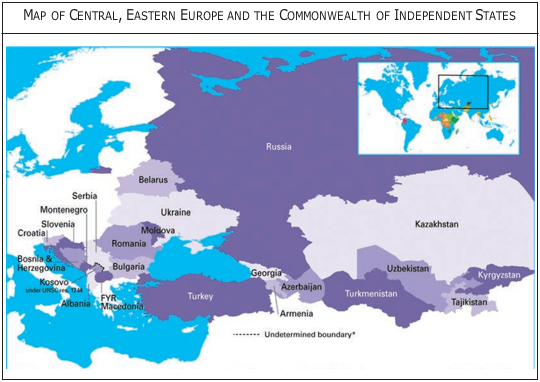
- Major producers: Azerbaijan, Kazakhstan, Russia, Turkmenistan and Uzbekistan produce significant oil and gas.
- Pipeline income: Other countries gained revenue by allowing oil pipelines to cross their territories.
Economic transition
- 1989Russia’s real GDP later fell below its level in this year.
- 1990sShock therapy was implemented across post-communist regimes.
- 1998Inkombank, Russia’s second-largest bank, went bankrupt.
- 1999Russia’s real GDP remained below its 1989 level.
- Around 2000Most post-Soviet economies, especially Russia, began to revive.
Tensions and Conflicts
Conflicts across the former Soviet region
- Russia: Chechnya and Dagestan experienced violent secessionist movements. Indiscriminate Russian military bombing in Chechnya caused human-rights violations but did not end demands for independence.
- Tajikistan: A civil war lasted ten years, ending in 2001; sectarian conflicts also affect the wider region.
- Azerbaijan: Local Armenians in Nagorno-Karabakh sought to secede and join Armenia.
- Georgia: Independence demands in two provinces led to civil war. Movements against existing regimes also arose in Ukraine, Kyrgyzstan and Georgia.
- Shared pressures: States and provinces disputed river waters; recurring conflict and instability made life difficult for ordinary people.
Central Asia: resources and outside powers
- Strategic resources: Vast hydrocarbon reserves bring economic benefits and attract competition among outside powers and oil companies.
- United States: After 11 September 2001, the US sought military bases in Central Asia and paid governments to host bases and permit overflights during the wars in Afghanistan and Iraq.
- Russia: It views the Central Asian states as its “Near Abroad” and seeks to keep them within its sphere of influence.
- China: It has interests in the region’s oil resources and has expanded settlement near the borders and regional trade.
- Location: Central Asia borders Russia, China, Afghanistan and Pakistan and lies near West Asia, adding to its strategic importance.
| Point | Czechoslovakia | Yugoslavia |
|---|---|---|
| Break-up | Split peacefully into independent Czech and Slovak states. | Broke apart after 1991 as provinces declared independence. |
| Conflict | The separation was peaceful. | Ethnic Serbs opposed independence; non-Serb Bosnians were massacred, and inter-ethnic civil war followed. |
| Outside involvement | No major conflict is described. | NATO intervened and bombed Yugoslavia after the civil war. |
Conflict-related dates
- After 1991Yugoslavia broke apart as provinces including Croatia, Slovenia, and Bosnia and Herzegovina declared independence.
- 2001Tajikistan’s ten-year civil war ended.
- After 11 September 2001The US sought military access in Central Asia.
- Shock therapy
- Rapid, comprehensive transition from state socialism to capitalism.
- Privatisation
- Transfer of state-owned property or enterprises to private ownership.
- Currency convertibility
- The ability to exchange a country’s currency for foreign currencies.
- Near Abroad
- Russia’s term for neighbouring former Soviet states it considers within its sphere of influence.
What were the main features of shock therapy?
Describe two major consequences of shock therapy in Russia.
Why did Central Asia become an area of international competition?
Quick recap
- Shock therapy aimed to replace post-Soviet socialism rapidly with capitalism, privatisation and free trade.
- Russia experienced industrial decline, inflation, lost savings, poverty and rising inequality.
- Democratic institutions often remained weak while executive presidents gained extensive powers.
- Resource exports helped many post-Soviet economies begin reviving around 2000.
- Secessionist, ethnic, civil-war and water disputes created instability across the former Soviet region.
- Central Asia’s energy reserves and strategic location drew competition from the US, Russia and China.
India and Post-communist Countries
India’s Relations with Post-Communist Countries
India’s Relations with Post-Communist Countries
- Strongest ties: India has good relations with all post-communist countries, but its strongest relationship is with Russia.
- Foundation: India–Russia relations rest on historical trust, common interests and popular goodwill.
- Cultural connection: Indian films, songs and stars such as Raj Kapoor and Amitabh Bachchan are popular in Russia and several post-Soviet countries.
- Example: Indian films and Hindi songs remain popular in Uzbekistan, including in Tashkent.
Shared Vision of World Order
Multipolar world order — An international system in which several powers coexist, rather than one power dominating.
India and Russia’s Shared Principles
- Collective security: An attack on any country is treated as a threat to all and calls for a collective response.
- International relations: Support greater regionalism, negotiated settlements of conflicts and independent foreign policies for all countries.
- International institutions: Decision-making should take place through bodies such as the UN, which should be strengthened, democratised and empowered.
Indo-Russian Strategic Agreement
- 2001The Indo-Russian Strategic Agreement was made; more than 80 bilateral agreements have been signed as part of it.
India–USSR Relations During the Cold War
Overall Relationship
- Nature: India and the USSR had a special, multi-dimensional relationship.
- Criticism: This closeness led critics to describe India as part of the Soviet camp.
| Dimension | Key features |
|---|---|
| Economic | The USSR aided Indian public-sector companies and provided technical assistance for steel plants at Bhilai, Bokaro and Durgapur, and machinery plants such as Bharat Heavy Electricals Ltd. It accepted Indian currency for trade when India lacked foreign exchange. |
| Political | The USSR supported India’s position on Kashmir at the UN and supported India during major conflicts, especially the 1971 war with Pakistan. India also supported Soviet foreign policy in some indirect but important ways. |
| Military | The USSR supplied most of India’s military hardware and agreed to joint production of military equipment when few countries would share military technology. |
| Cultural | Hindi films and Indian culture were popular in the USSR; many Indian writers and artists visited. |
Benefits of the India–Russia Relationship
| Area | Benefit to India | Benefit to Russia |
|---|---|---|
| Defence | India gets most of its military hardware from Russia. | India is Russia’s second-largest arms market. |
| Strategic interests | Russia matters to India on Kashmir, access to Central Asia, information-sharing on international terrorism and balancing relations with China. | — |
| Energy | Russia has assisted India during oil crises; India seeks to increase energy imports from Russia, Kazakhstan and Turkmenistan. | — |
| Energy cooperation with Central Asian republics | India’s cooperation with Kazakhstan and Turkmenistan includes partnership and investment in oilfields. | — |
| Nuclear energy, space and science | Russia is important to India’s nuclear-energy plans and has supported its space industry, including by providing a cryogenic rocket when needed. The two countries have also collaborated on scientific projects. | — |
- Post-communist countries
- Countries that followed the collapse of communist systems, including former Soviet republics.
- Multipolarity
- An international order in which several powers coexist.
- Collective security
- The principle that an attack on one country is a threat to all and calls for a shared response.
- Indo-Russian Strategic Agreement
- The 2001 agreement associated with extensive bilateral cooperation between India and Russia.
What are the main elements of the India–Russia vision of a multipolar world?
Describe the main dimensions of the India–USSR relationship during the Cold War.
Why is Russia important to India?
Quick recap
- India has good relations with post-communist countries, with Russia as its strongest partner among them.
- India and Russia share a vision of multipolarity, collective security and stronger international institutions.
- The 2001 Indo-Russian Strategic Agreement is associated with more than 80 bilateral agreements.
- India–USSR ties during the Cold War covered economic, political, military and cultural cooperation.
- Russia is important to India for defence, energy, strategic interests, nuclear and space programmes, and scientific cooperation.
- India is Russia’s second-largest arms market; oilfield partnerships and investment mentioned in the lecture relate to India’s cooperation with Kazakhstan and Turkmenistan.
Political Science — ALL CHAPTERS
1
THE END OF BIPOLARITY
2
CONTEMPORARY CENTRES OF POWER
3
CONTEMPORARY SOUTH ASIA
4
INTERNATIONAL ORGANISATIONS
5
SECURITY IN THE CONTEMPORARY WORLD
6
ENVIRONMENT AND NATURAL RESOURCES
7
GLOBALISATION
1
Challenges of Nation Building
2
Era of one-party dominance
3
Politics Of Planned Development
4
India’s external relations
5
Challenges to and Restoration of the Congress System
6
The Crisis of Democratic Order
7
Regional Aspirations
8
Recent Developments in Indian Politics