Class 12 Humanities . Political Science . Politics In India Since Independence . Era of One Party Dominance
Chapter 2: Era of one-party dominance
Ch 2
Political Science
Class 12 Humanities
Chapter Overview
Electoral Politics After Independence
The chapter’s focus
- Two challenges: Nation-building was accompanied by the task of establishing democratic politics.
- Party competition: Electoral competition among political parties began immediately after Independence.
- Scope: The chapter studies the first decade of electoral politics in India.
Main Themes
Questions explored in the chapter
- Election system: How was a system of free and fair elections established?
- Congress: How did the Congress party become dominant in the years immediately after Independence?
- Opposition: Which opposition parties emerged, and what policies did they advocate?
Quick recap
- Nation-building after Independence went alongside the challenge of instituting democratic politics.
- Electoral competition among parties began immediately after Independence.
- The chapter examines the first decade of electoral politics.
- A key theme is the establishment of free and fair elections.
- The chapter studies Congress dominance and the emergence and policies of opposition parties.
Challenge of building democracy
Choosing Democracy
- Democratic choice: Despite the challenges facing newly independent India, its leaders chose democratic rule rather than authoritarianism.
- Purpose of politics: Democratic politics provides a way to resolve competing aspirations and pursue the public interest.
Preparing for India’s First General Election
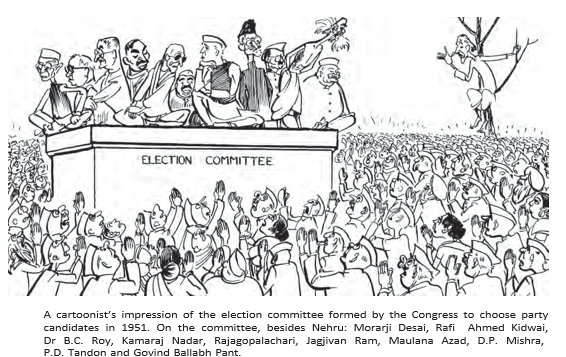
The First Election: A Test of Democracy
Constitution and Election Milestones
- 26 November 1949The Constitution was adopted.
- 24 January 1950The Constitution was signed.
- 26 January 1950The Constitution came into effect.
- January 1950The Election Commission of India was established; Sukumar Sen became the first Chief Election Commissioner.
- October 1951–February 1952India held its first general election, usually referred to as the 1952 election.
Changing Methods of Voting

Why was the first general election a major test of democracy in India?
What voting methods were used in India, in order?
Quick recap
- India chose democracy despite concerns that it could deepen conflict or weaken unity.
- The Election Commission was established in January 1950, with Sukumar Sen as its first Chief Election Commissioner.
- The first election required preparing electoral rolls and constituencies for about 17 crore eligible voters.
- Held from October 1951 to February 1952, the election was competitive, well-attended and accepted as fair.
- Its success showed that democracy could work despite poverty and widespread illiteracy.
- Voting moved from separate candidate boxes to stamped ballot papers and then EVMs.
Congress dominance in the first three general elections
Congress Victory in the First General Election
Why Congress was expected to win
- National movement legacy: Congress had inherited the prestige of leading India’s freedom movement.
- Nationwide organisation: It was the only party with an organisation spread across the country.
- Nehru’s popularity: Jawaharlal Nehru was the most popular and charismatic leader; he led the campaign and toured India.
| Party | Seats won | Result |
|---|---|---|
| Indian National Congress | 364 of 489 | Won a sweeping majority |
| Communist Party of India | 16 | Next-largest party by seats |
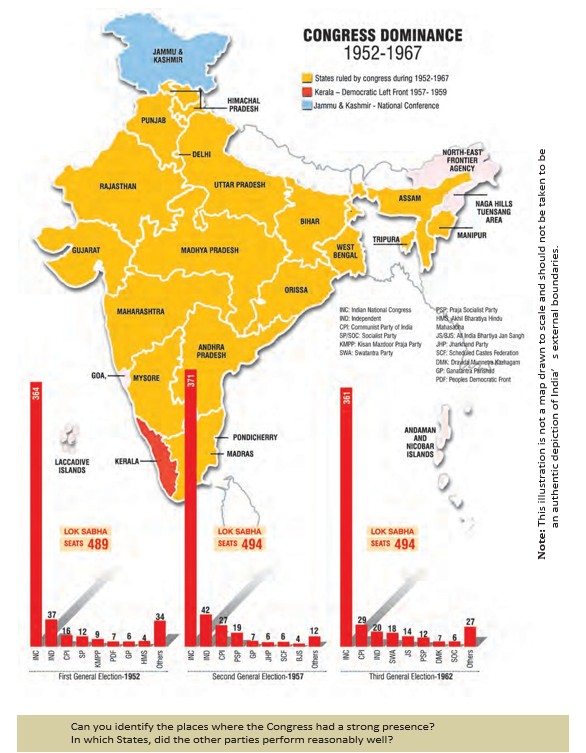
Congress at the Centre and in the States
- State elections: Held alongside the Lok Sabha election; Congress won majorities in every state except Travancore-Cochin, Madras and Orissa.
- Government formation: Congress eventually formed governments even in those three states, and ruled nationally and across the states.
- Prime Minister: Jawaharlal Nehru became Prime Minister after the first general election.
Congress Dominance from 1952 to 1962
Continued electoral dominance
- Second and third elections: Held in 1957 and 1962; Congress maintained its position, winning about three-fourths of Lok Sabha seats.
- Opposition weakness: No opposition party won even one-tenth as many seats as Congress.
- State-level exceptions: Congress missed majorities in a few state elections; the most significant case was Kerala in 1957, where a CPI-led coalition formed the government.
- Overall pattern: Apart from such exceptions, Congress controlled the Union and almost all state governments.
How the Electoral System Amplified Congress’s Victory
First-past-the-post system — In each constituency, the candidate with more votes than any other candidate wins the seat; a majority of all votes is not required.
| Party | Share of votes | Share of seats |
|---|---|---|
| Congress | 45% | 74% |
| Socialist Party | More than 10% | Less than 3% |
Why Congress won far more seats than its vote share suggested
- First-past-the-post awards each constituency to the candidate with the most votes.
- Congress often finished ahead of its rivals in individual constituencies.
- Non-Congress votes were split among competing parties and candidates.
- Congress won many seats despite receiving less than half of the total votes.
Do not assume that winning most seats means winning most votes: in 1952 Congress won 74% of seats with 45% of the votes.
The Communist Victory in Kerala
The elected CPI government
- March 1957: CPI won the largest number of seats in Kerala’s assembly election—60 of 126—and had the support of five independents.
- Government formation: Governor invited E. M. S. Namboodiripad, leader of the CPI legislature party, to form the ministry.
- Significance: It was the first time anywhere in the world that a Communist party came to power through democratic elections.
- Policy programme: CPI had campaigned on promises of radical and progressive measures.
The Kerala government’s dismissal
- Congress lost power in Kerala to the elected CPI government.
- Congress began a “liberation struggle” against the government.
- Communists argued that vested interests and religious organisations led the agitation.
- In 1959, the Congress government at the Centre dismissed the Kerala government under Article 356.
- The decision became controversial and was widely cited as a misuse of constitutional emergency powers.
The Socialist Party
Origins and Development
- 1934Young leaders formed the Congress Socialist Party (CSP) within Congress, seeking a more radical and egalitarian party.
- 1948Congress banned dual party membership; Socialists left and formed a separate Socialist Party.
- 1955Congress declared the goal of a socialist pattern of society, making it harder for Socialists to present a distinct alternative.
Ideology and political choices
- Democratic socialism: The Socialists’ ideology distinguished them from both Congress and the Communists.
- Criticism of Congress: They accused Congress of favouring capitalists and landlords while neglecting workers and peasants.
- Different responses: Rammanohar Lohia and his supporters distanced themselves from Congress; Asoka Mehta supported limited cooperation.
- Electoral record: The party had a presence across much of India but achieved electoral success only in a few pockets.
| Development | Examples |
|---|---|
| Splits and reunions produced several parties | Kisan Mazdoor Praja Party; Praja Socialist Party; Samyukta Socialist Party |
| Important leaders | Jayaprakash Narayan; Achyut Patwardhan; Asoka Mehta; Acharya Narendra Dev; Rammanohar Lohia; S. M. Joshi |
| Contemporary parties tracing origins to the Socialist Party | Samajwadi Party; Rashtriya Janata Dal; Janata Dal (United); Janata Dal (Secular) |
- First-past-the-post
- An electoral system in which the candidate with the most votes in a constituency wins.
- Democratic socialism
- The Socialist Party’s ideology, presented as distinct from Congress and the Communists.
- Liberation struggle
- The campaign Congress launched against Kerala’s elected CPI government.
- Article 356
- The constitutional provision used by the Centre in 1959 to dismiss the Kerala government.
Why did Congress win a much larger share of seats than votes in 1952?
What made the CPI victory in Kerala in 1957 significant?
How did the Socialist Party emerge, and what challenges did it face?
Quick recap
- Congress’s national movement legacy, nationwide organisation and Nehru’s popularity helped it dominate the first general election.
- In 1952, Congress won 364 of 489 Lok Sabha seats; the CPI came second with 16.
- Congress retained about three-fourths of Lok Sabha seats in 1957 and 1962, with Kerala as a major state-level exception.
- First-past-the-post and divided opposition votes amplified Congress’s share of seats beyond its vote share.
- Kerala’s CPI government, elected in 1957, was dismissed by the Centre in 1959 under Article 356.
- Socialists formed a separate party in 1948; internal divisions and Congress’s socialist positioning weakened their distinct electoral alternative.
Nature of Congress dominance
Democratic One-Party Dominance
One-party dominance — A situation in which one party repeatedly wins elections and remains politically dominant.
| Context | How dominance was maintained | Examples |
|---|---|---|
| Non-democratic one-party states | A single party is constitutionally permitted to rule | China, Cuba, Syria |
| Effectively one-party states | Legal or military measures restrict political competition | Myanmar, Belarus, Egypt, Eritrea |
| Democratic dominance | Many parties contest free and fair elections, but one party repeatedly wins | Congress in India; African National Congress in South Africa after apartheid |
- Key distinction: Congress dominance in India occurred under democratic conditions, unlike dominance imposed by restricting or eliminating political competition.
- Other examples: Mexico, South Korea and Taiwan were effectively one-party dominant states until a few years before the text was written.
Roots of Congress Success
- Freedom-struggle legacy: Congress was widely seen as the inheritor of the national movement, and many freedom-struggle leaders stood as its candidates.
- Organisation: It had a strong nationwide structure extending to local levels and began election campaigns before newer parties could organise.
- First-mover advantage: Many rival parties formed only around or after independence, while Congress was already an established national organisation.
- Inclusive character: As a broad national movement, it brought different groups and interests into one political organisation.
Congress as a Social and Ideological Coalition
Social coalition — An alliance that brings diverse social groups and interests together within one political party.
Ideological coalition — A party that accommodates groups and individuals with different, sometimes opposing, political beliefs.
How Congress Became a Broad Coalition
- Early base: Congress began as a pressure group for educated, professional and commercial classes; it was initially led mainly by English-speaking, upper-caste, urban and upper-middle-class people.
- Expansion: Each civil disobedience movement widened its social base and drew in peasants, industrialists, workers, owners, urban and rural communities, and different classes and castes.
- Leadership change: Agriculture-based leaders with rural concerns increasingly joined and shaped its leadership.
- By independence: Congress had become a broad social coalition representing diverse classes, castes, religions, languages and interests.
- Range of views: It housed revolutionary and pacifist, conservative and radical, extremist and moderate, right-wing, left-wing and centrist positions.
- Platform: Different organisations and parties could participate in the national movement while retaining their own structures; some, such as the Congress Socialist Party, later left and became opposition parties.
- Consensus-building: Congress often contained disagreements and built consensus even when it could not fully resolve differences.
| Point | Coalition within Congress | Coalition government |
|---|---|---|
| Meaning | Different groups and viewpoints coexist inside one party. | Two or more separate parties share power in government. |
| Congress-era example | Congress contained diverse interests and factions. | This does not mean India had a coalition government from 1952. |
The Communist Party of India
Origins, Position and Electoral Role
- Origins: Communist groups emerged in different parts of India in the early 1920s, inspired by the Bolshevik Revolution and advocating socialism.
- Congress link: From 1935, Communists worked mainly within Congress; they parted ways in December 1941 after deciding to support Britain in its war against Nazi Germany.
- Party organisation: At independence, CPI had an effective party organisation and a dedicated cadre compared with other non-Congress parties.
- Debate over independence: CPI leaders disagreed over whether the 1947 transfer of power gave India genuine freedom or only a sham independence.
- Change of strategy: CPI initially rejected the transfer of power as true independence and encouraged violent uprisings in Telangana. After failing to gain popular support and being suppressed by the armed forces, it abandoned violent revolution in 1951.
- Election results: CPI contested the first general election and won 16 seats, becoming the largest opposition party. Its support was concentrated in Andhra Pradesh, West Bengal, Bihar and Kerala.
| Topic | Key facts |
|---|---|
| Notable leaders | A. K. Gopalan, S. A. Dange, E. M. S. Namboodiripad, P. C. Joshi, Ajay Ghosh and P. Sundarraya |
| 1964 split | An ideological rift connected to the Soviet Union–China divide split the party. |
| After the split | The pro-Soviet faction remained CPI; opponents formed CPI(M). Both parties continue to exist. |
Tolerance and Management of Factions
Faction — A group within a political party, often formed around shared views, ambitions or rivalries.
Why Factionalism Strengthened Congress
- Congress's coalition character accommodated varied groups and avoided extreme positions.
- Groups with competing views and ambitions could remain inside the party.
- They competed internally instead of leaving to form new parties.
- Political debate and competition occurred within the ruling party, while opposition parties influenced Congress from the margins.
- Congress functioned as both the ruling party and, in some ways, the opposition: this arrangement was called the Congress system.
How Factions Operated
- Different bases: Factions could reflect ideological differences, personal ambitions or rivalries.
- Balancing role: Competing factions acted as a balancing mechanism within the ruling party.
- Policy influence: Opposition parties often tried to influence Congress factions and thereby affect policy, but remained far from direct authority.
- Not automatically a weakness: In Congress, factionalism helped keep diverse leaders and interests within one party; this does not mean every faction in every context is beneficial.
The Bharatiya Jana Sangh
Origins and Ideology
- Formation: The Bharatiya Jana Sangh (BJS) was formed in 1951; Shyama Prasad Mukherjee was its founder-president. Its roots went back to the RSS and Hindu Mahasabha.
- National vision: It promoted “one country, one culture and one nation” and argued that Indian culture and traditions could support a modern, progressive and strong nation.
- Akhand Bharat: It called for the reunion of India and Pakistan.
- Language and minorities: It supported replacing English with Hindi as India’s official language and opposed concessions to religious and cultural minorities.
- Nuclear policy: It consistently advocated Indian nuclear weapons, especially after China’s atomic tests in 1964.
| Aspect | Key facts |
|---|---|
| Lok Sabha seats | 3 in 1952; 4 in 1957 |
| Early support | Mainly urban areas in Hindi-speaking states, including Rajasthan, Madhya Pradesh, Delhi and Uttar Pradesh |
| Leaders | Shyama Prasad Mukherjee, Deen Dayal Upadhyaya and Balraj Madhok |
| Later connection | The Bharatiya Janata Party (BJP) traces its roots to the BJS. |
Key Dates
- 1885Congress began as a pressure group for educated professional and commercial classes.
- Early 1920sCommunist groups emerged in different parts of India.
- 1935Communists began working mainly within Congress.
- December 1941Communists parted ways with Congress after deciding to support Britain in its war against Nazi Germany.
- 1947The CPI debated whether the transfer of power represented genuine independence.
- 1951CPI abandoned violent revolution and decided to contest elections; BJS was also formed.
- 1952CPI won 16 seats and became the largest opposition party; BJS won 3 Lok Sabha seats.
- 1957BJS won 4 Lok Sabha seats.
- 1964The CPI split into CPI and CPI(M) amid the Soviet Union–China ideological rift.
- Social coalition
- Different social groups and interests united within one party.
- Ideological coalition
- A party accommodating a wide range of political beliefs.
- Faction
- An organised group within a party, based on views, ambitions or rivalries.
- Congress system
- The early electoral arrangement in which Congress dominated government while internal competition and opposition pressure shaped political debate.
Quick recap
- Congress dominance was achieved through repeated victories in free and fair elections, unlike dominance enforced by restricting political competition.
- Its freedom-struggle legacy, nationwide organisation, early start and inclusive character helped it win election after election.
- Congress became a social and ideological coalition representing diverse classes, castes, religions, languages and political views.
- Its internal factions allowed competing interests to remain within the party and made Congress a forum for political competition.
- CPI became the largest opposition party in the first general election, then split into CPI and CPI(M) in 1964.
- BJS, founded in 1951, promoted cultural nationalism and had limited early electoral support, especially in Hindi-speaking urban areas.
Emergence of opposition parties
Opposition Parties in Early India
Their presence and role
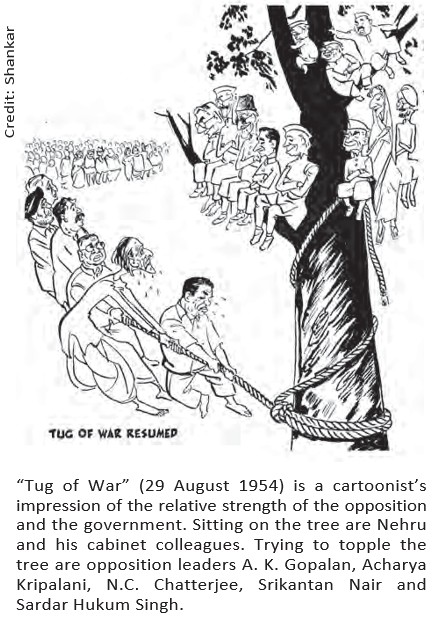
- Diverse opposition: India had more numerous, diverse and vibrant opposition parties than many other multi-party democracies; some formed before the first general election in 1952.
- Limited seats: These parties usually won only token representation in the Lok Sabha and state assemblies.
- Democratic check: Their sustained criticism scrutinised Congress policies and practices, sometimes shifting the balance within Congress itself.
- Political alternative: Opposition parties kept democratic alternatives alive, helping prevent public resentment from turning against democracy.
- Future leadership: They groomed leaders who later helped shape Indian politics; the roots of almost all present-day non-Congress parties can be traced to opposition parties of the 1950s.
- Later influence: Some opposition parties became important in national politics during the 1960s and 1970s.
Respect and Cooperation Among Political Rivals
Early political relationships
- Mutual respect: In the early years, Congress and opposition leaders often treated each other with respect.
- Shared government: The interim government after Independence included opposition leaders Dr. B. R. Ambedkar and Shyama Prasad Mukherjee.
- Nehru and socialists: Nehru admired the Socialist Party and invited socialist leader Jayaprakash Narayan to join his government.
- Growing competition: Personal respect between political rivals weakened as competition between parties became more intense.
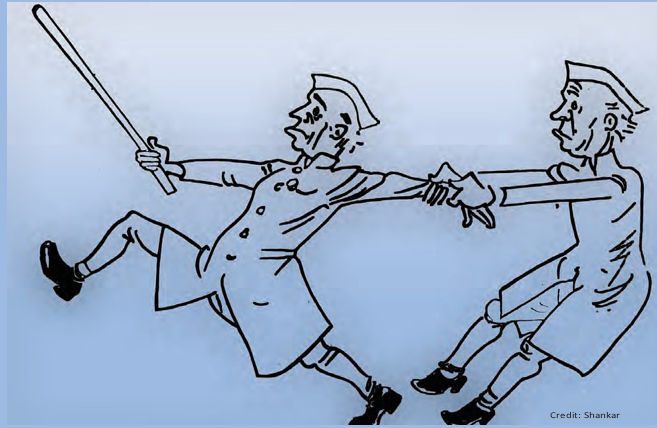
- Congress tensions: Nehru opposed Purushottam Das Tandon’s election as Congress president; he later wrote that the election seemed more important to Congress members than his role in government or the party.
Shyama Prasad Mukherjee
- Political roles: Leader of the Hindu Mahasabha, founder of the Bharatiya Jana Sangh, and a minister in Nehru’s first cabinet; he was also a member of the Constituent Assembly and the first Lok Sabha.
- Resignation: He resigned from the cabinet in 1950 because of differences over relations with Pakistan.
- Jammu and Kashmir: He opposed India’s policy of autonomy for Jammu and Kashmir.
- Agitation and death: Arrested during the Jana Sangh agitation against the Kashmir policy, he died while in detention in 1953.
- Lifespan: 1901–1953.
Why Congress Dominated—and Why It Later Declined
The basis and limits of Congress dominance
- Broad coalition: The inclusive national movement allowed Congress to bring together varied social groups, interests and political ideas.
- Head start: Congress’s leading role in the freedom struggle gave it an advantage over other parties.
- Changing balance: As Congress became less able to accommodate different interests and people seeking political power, other parties gained importance.
- Limited phase: Congress dominance was one phase in Indian politics, not a permanent feature.
From Congress Dominance to Stronger Opposition
- The inclusive freedom movement brings diverse groups and interests into Congress
- Congress gains a head start and dominates early politics
- Congress’s ability to accommodate interests and political aspirants declines
- Opposition parties gain greater significance
Key Periods
- Before 1952Some opposition parties had formed before India’s first general election.
- 1950Shyama Prasad Mukherjee resigned from Nehru’s cabinet over differences concerning relations with Pakistan.
- 1952India held its first general election.
- 1960s and 1970sSome opposition parties played an important role in national politics.
- Opposition party
- A party outside the ruling party that can question government policies and offer a political alternative.
- Token representation
- A small number of elected representatives compared with the ruling party.
- Broad-based coalition
- A party or political movement that brings together different social groups and interests.
- Congress dominance
- The phase when Congress held a leading position in Indian politics.
How did opposition parties strengthen democracy despite having few seats?
Why did opposition parties become more significant over time?
Quick recap
- India had numerous, diverse and vibrant opposition parties, although they won few seats in the early years.
- Opposition parties scrutinised Congress, preserved democratic alternatives and groomed future leaders.
- Early Congress and opposition leaders often showed mutual respect, which declined as competition intensified.
- Congress gained a head start through its inclusive role in the freedom struggle.
- As Congress’s ability to accommodate interests declined, opposition parties became more significant.
Political Science — ALL CHAPTERS
1
THE END OF BIPOLARITY
2
CONTEMPORARY CENTRES OF POWER
3
CONTEMPORARY SOUTH ASIA
4
INTERNATIONAL ORGANISATIONS
5
SECURITY IN THE CONTEMPORARY WORLD
6
ENVIRONMENT AND NATURAL RESOURCES
7
GLOBALISATION
1
Challenges of Nation Building
2
Era of one-party dominance
3
Politics Of Planned Development
4
India’s external relations
5
Challenges to and Restoration of the Congress System
6
The Crisis of Democratic Order
7
Regional Aspirations
8
Recent Developments in Indian Politics