Class 12 Humanities . Political Science . Contemporary World Politics . Globalisation
Chapter 7: GLOBALISATION
Ch 7
Political Science
Class 12 Humanities
The Concept of Globalisation
Globalisation in everyday life
| Example | Global connection |
|---|---|
| Janardhan’s call-centre work | Services connect workers in India with clients thousands of miles away; work hours and holidays may follow clients’ schedules. |
| Ramdhari’s purchases | A cycle made in China and a Barbie doll made in the US are marketed and sold in India. |
| Sarika’s career opportunity | Changing ideas and opportunities affect choices about women’s work and independence. |
Globalisation can have mixed effects
- Negative effects: Farmers may face losses after buying expensive seeds from a multinational company and suffering crop failure.
- Competition: Local shopkeepers may fear losing livelihoods when international retail chains enter the country.
- Cross-border business: An Indian company may acquire a major rival based in Europe, despite protests from its owners.
- Cultural influence and conflict: A film may be accused of copying a Hollywood story; a militant group may oppose girls wearing Western clothes.
- Key point: Globalisation is not always positive, purely economic, or a one-way influence from rich to poor countries.
Meaning: flows and interconnectedness
Globalisation — A process involving flows across the world that create and sustain worldwide interconnectedness.
| Flow | Example |
|---|---|
| Ideas | Ideas move from one part of the world to another. |
| Capital | Money is transferred between places. |
| Commodities | Goods are traded across borders. |
| People | People move to different places in search of better livelihoods. |
Dimensions and uneven impact
| Dimension | What to recognise |
|---|---|
| Political | Globalisation has political manifestations; it cannot be reduced to economics or culture alone. |
| Economic | Economic connections include flows of capital, commodities and services. |
| Cultural | Cultural connections and changes in values are also part of globalisation. |
Why impact must be assessed in context
- Uneven impact: Globalisation affects societies differently, and can affect groups within the same society differently.
- Avoid overgeneralising: Assess its effects in specific contexts rather than assuming the same outcome everywhere.
- Globalisation
- Flows across the world that create and sustain worldwide interconnectedness.
- Worldwide interconnectedness
- Connections between places and people sustained by continuing global flows.
- Multinational company (MNC)
- A company operating in more than one country.
- Uneven impact
- Globalisation affects different societies and groups to different degrees.
What is the central idea behind globalisation?
Why should globalisation be understood as a multidimensional and uneven process?
Quick recap
- Globalisation connects places through ongoing flows across the world.
- Its flows include ideas, capital, commodities, services and people.
- Everyday examples include call-centre services, imported goods and changing opportunities.
- Globalisation can create opportunities but can also have negative effects.
- It has political, economic and cultural dimensions.
- Its impact is uneven, so conclusions must account for specific contexts.
Causes of Globalisation and Political Consequences
Causes of Globalisation and Distinctive Features Today
Historical flows and what is distinctive today
- Global flows include the movement of ideas, capital, commodities and people between parts of the world.
- Historical continuity: these flows existed through much of human history; globalisation is not entirely new.
- Contemporary distinction: the scale and speed of these flows make present-day globalisation distinctive.
- Different speeds: capital and commodities generally move more quickly and widely than people.

Technology and Global Awareness
Key causes
- Technology is a critical factor, though globalisation has no single cause. The telegraph, telephone and microchip transformed communication.
- Easier movement: technological advances help ideas, capital, commodities and people travel across the world.
- Changing collective life: printing helped create the basis for nationalism; newer technologies can shape how people think about personal and collective life.
- Awareness of interconnections is also essential; improved communication alone does not create globalisation.
Recognising Global Interconnections
- Events in one place can affect people and places elsewhere.
- Bird flu and tsunamis can cross national boundaries and affect multiple countries.
- Major economic events can have impacts beyond their local, national or regional setting.
- Recognising these worldwide effects makes people aware of global interdependence.
Political Consequences
State sovereignty — The state’s authority and ability to make decisions and govern within its political community.
State capacity — The government’s ability to carry out its functions and make decisions.
| Point | Capacity reduced | Capacity retained or strengthened |
|---|---|---|
| State functions | The welfare state gives way to a more minimalist state, focused on core duties such as law and order and citizen security; the state withdraws from some welfare functions. | States continue to discharge essential functions and may consciously choose which domains to withdraw from. |
| Decision-making | The increased role of multinational companies can reduce governments’ ability to make decisions independently; the market becomes a prime determinant of priorities. | States remain the basis of political community, and national rivalries and jealousies continue to matter in world politics. |
| Technology | — | Technology can help states collect information about citizens, strengthening their ability to rule. |
Understanding the Political Impact
- Mixed effect: globalisation can constrain governments, but it does not make states irrelevant or uniformly weaker.
- Welfare state: a state that takes responsibility for people’s economic and social well-being.
- Minimalist state: a state focused mainly on core functions such as law and order and security.
- State choice matters: states may withdraw from some areas while continuing to perform essential duties.
- Global flows
- Movement of ideas, capital, commodities and people across the world.
- State capacity
- The government’s ability to perform its functions and make decisions.
- Welfare state
- A state that takes responsibility for people’s economic and social well-being.
- Minimalist state
- A state focused mainly on core functions such as law and order and security.
What makes contemporary globalisation distinctive?
How can globalisation affect state capacity?
Quick recap
- Globalisation involves flows of ideas, capital, commodities and people; these flows have a long history.
- The contemporary scale and speed of global flows are distinctive.
- Technology enables communication and movement, while awareness of interdependence also matters.
- Globalisation can erode state capacity through market influence and multinational companies.
- States remain important, retain essential functions and may withdraw from welfare roles by choice.
- Technology can strengthen states by improving information collection and governance.
Economic Consequences
Understanding Economic Globalisation
Economic globalisation — Increasing economic flows and connections across countries, including the distribution of gains and losses.
What to consider
- Beyond institutions: The IMF and WTO influence economic policies, but economic globalisation involves many other actors and processes.
- Distribution matters: Ask who gains most, who gains less, and who may lose from globalisation.
- Flows may be voluntary or forced: Some cross-border economic flows are voluntary; others are driven by international institutions and powerful countries.
- Different outcomes: Similar policies can produce very different results in different places, so specific contexts matter.
| Flow | What it involves | Example or pattern |
|---|---|---|
| Commodities | Greater trade as countries reduce restrictions on imports. | Goods are exchanged across national borders. |
| Capital | Fewer restrictions on investment across countries. | Investors from rich countries may invest in developing countries to seek better returns. |
| People | Movement across borders has not increased to the same extent as other flows. | Developed countries use visa policies to guard borders and protect citizens’ jobs. |
| Ideas | Ideas and services move across national boundaries. | The spread of the internet and computer-related services. |

Debates about the Effects
| Point | Critics | Supporters |
|---|---|---|
| Main claim | State withdrawal may weaken jobs and welfare services, while gains may go to a small section of the population. | Deregulation and increased trade can promote economic growth and well-being for wider sections of society. |
| Impact on weaker groups | Poor people dependent on government jobs and welfare—such as education, health and sanitation—may be impoverished. | Greater trade allows each economy to do what it does best, which supporters argue benefits the world. |
| Impact on weaker countries | Some movements fear forced globalisation could cause economic ruin for weaker countries and the poor within them. Some economists call it recolonisation of the world. | Supporters often regard globalisation as inevitable; moderate supporters say it can be met intelligently without uncritical acceptance. |
| Suggested response | Critics call for institutional safeguards or social safety nets; some movements demand a halt to forced globalisation because they consider safety nets insufficient or unworkable. | Supporters emphasise the potential benefits of deregulation and trade; moderate supporters favour a thoughtful response. |
Globalisation and Interdependence
- More cross-border flows of commodities, capital, people and ideas
- Greater connections among countries and their economies
- Growing interdependence among governments, businesses and ordinary people
- Economic flows
- Movement and exchange of commodities, capital, people and ideas across countries.
- Deregulation
- Reducing government rules or restrictions on economic activity.
- Social safety nets
- Institutional protections intended to reduce globalisation’s harmful effects on economically weak people.
- Interdependence
- A condition in which countries, governments, businesses and people increasingly rely on one another.
Why is it too narrow to define economic globalisation only through the IMF and WTO?
What are the main arguments made by critics of economic globalisation?
How do supporters justify economic globalisation?
Quick recap
- Economic globalisation involves cross-border flows and the distribution of economic gains and losses.
- Flows include commodities, capital, people and ideas; some are voluntary, while others are driven by powerful institutions and countries.
- People’s movement has faced stronger restrictions than other flows, including visa controls in developed countries.
- Similar global economic policies can lead to different outcomes in different contexts.
- Critics highlight state withdrawal, inequality and risks to poor people and weaker countries; they advocate safeguards or resistance.
- Supporters link deregulation and trade with growth and well-being, while moderate supporters favour a thoughtful response.
- Globalisation has increased interdependence among governments, businesses and ordinary people.
Cultural Consequences
Cultural Homogenisation
Cultural homogenisation — The process through which globalisation makes cultures more uniform.
- Everyday life: Globalisation can affect what people eat, wear, drink and think, including their preferences.
- Cultural threat: A uniform culture may reduce the diversity and richness of cultures around the world.
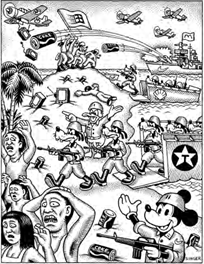
- Not a truly global culture: What is presented as global culture may instead be the imposition of Western culture on other societies.
- US soft power: American lifestyles can influence others without direct force; burgers and blue jeans are common examples. This influence is described as the soft power of US hegemony.
- Unequal influence: The culture of a politically and economically dominant society can leave its imprint on less powerful societies.
- McDonaldisation: The spread of American consumer culture encourages societies to buy into the dominant American dream.
- Risk: Dominant cultural influence can shrink the rich cultural heritage of the whole world, not only threaten poorer countries.

Cultural Exchange and New Combinations
- Cultures change: Cultures are not static; they continually accept outside influences.
- Different effects: External influences may reduce choices, enlarge them, or modify a culture without overwhelming its traditions.
- Added choices: A burger does not replace masala dosa; it can simply become another food choice.
- New combinations: Blue jeans worn with a homespun khadi kurta combine outside and local influences.
- Two-way flow: The khadi-kurta-and-jeans combination travelled back to the United States, where some young Americans wore it.
Cultural Heterogenisation
Cultural heterogenisation — The process through which globalisation can make cultures more different and distinctive.
- Opposite outcome: Globalisation can produce cultural differences as well as uniformity.
- Unequal but not one-way: Power differences remain when cultures interact, yet cultural exchange is rarely only in one direction.
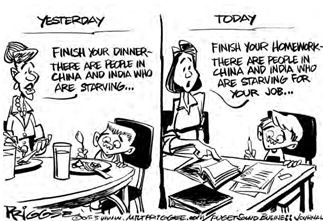
- Call-centre insight: Handling calls from Americans can give Indian workers a closer view of American culture, sometimes challenging their prior assumptions.
- Stressful encounters: Some callers become irate or abusive when they learn their call has been routed to India.
- Job-related resentment: Some Americans perceive Indians as having denied them their “rightful” jobs; callers may complain about speaking to an Indian and demand an American instead.
| Point | Cultural homogenisation | Cultural heterogenisation |
|---|---|---|
| Outcome | Cultures become more uniform. | Cultures become more different and distinctive. |
| Illustration | Spread of dominant American consumer influences. | Local traditions combine with outside influences, creating distinctive forms. |
| Exchange | Can reflect unequal influence from powerful societies. | Exchange is rarely one-way, even though power differences remain. |
Why can globalisation be seen as both a threat to cultures and a source of cultural diversity?
Quick recap
- Globalisation influences everyday life, including food, clothing, thinking and preferences.
- Cultural homogenisation is the growing uniformity of cultures, often through dominant Western and American influences.
- The spread of a dominant culture can threaten cultural diversity and heritage.
- Outside influences can expand choices or combine with traditions without replacing them.
- Cultural heterogenisation describes how globalisation can make cultures more distinctive.
- Cultural exchange is rarely one-way, although power differences remain; call-centre interactions reveal both cultural insight and unequal attitudes.
India and Globalisation, Resistance to Globalisation
India and Globalisation
- Historical flows: India has long been connected to global movements of capital, commodities, ideas and people.
- Economic reforms: After colonial trade patterns and post-independence protectionism, India began liberalising trade and foreign investment in 1991.
Resistance to Globalisation
Anti-globalisation movements
- Global networks: Anti-globalisation movements connect and cooperate with like-minded groups in other countries.
- Main objection: Many oppose a particular programme of globalisation—not global connections themselves—because they see it as a form of imperialism.
- Criticism of trade: Protesters argue that powerful states dominate global economic rules and developing countries’ interests receive too little attention.
Global protests and the World Social Forum
- 1999Widespread protests at the WTO Ministerial Meeting in Seattle challenged unfair trading practices and the dominance of economically powerful states.
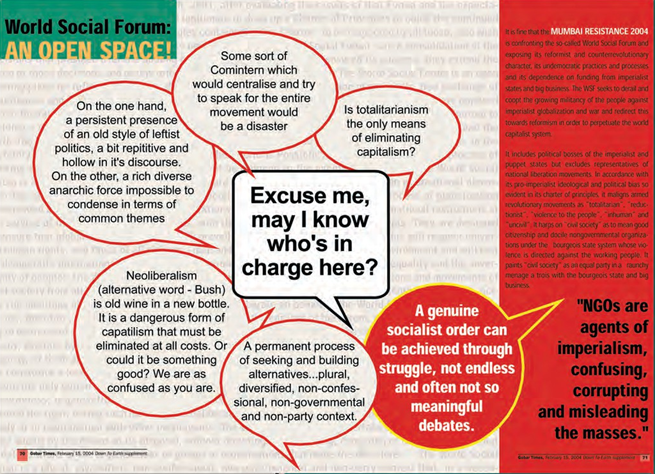
- 2001The first World Social Forum (WSF) meeting was held in Porto Alegre, Brazil.
- 2004The fourth WSF meeting was held in Mumbai, India.
- February 2024The latest WSF meeting mentioned in the lecture was held in Nepal.
World Social Forum (WSF) — A global platform bringing together a broad coalition opposed to neo-liberal globalisation, including human-rights, environmental, labour, youth and women activists.

India and Resistance to Globalisation
- Protectionism
- Restricting imports to protect domestic producers and encourage local production.
- Economic liberalisation
- Reducing government controls and restrictions on economic activity.
- Neo-liberal globalisation
- A market-oriented form of globalisation opposed by the World Social Forum coalition.
- Multinational company
- A company that operates in more than one country.
What were the main features of India’s economic policy after independence and from 1991?
What did the Seattle WTO protests and the World Social Forum oppose?
Quick recap
- Colonial rule made India an exporter of raw materials and an importer of finished goods.
- After independence, protectionism aimed to build domestic production but coincided with sluggish growth and neglected social sectors.
- Since 1991, India has increasingly deregulated trade and foreign investment; inclusive sharing of growth matters.
- Left-wing critics stress inequality and weaker protection for the poor; right-wing critics stress state, economic and cultural concerns.
- Anti-globalisation groups often oppose a particular, imperialist or neo-liberal programme rather than global connections themselves.
- Indian resistance has included protests by political groups, unions and farmers, opposition to plant patents, and cultural objections.
Political Science — ALL CHAPTERS
1
THE END OF BIPOLARITY
2
CONTEMPORARY CENTRES OF POWER
3
CONTEMPORARY SOUTH ASIA
4
INTERNATIONAL ORGANISATIONS
5
SECURITY IN THE CONTEMPORARY WORLD
6
ENVIRONMENT AND NATURAL RESOURCES
7
GLOBALISATION
1
Challenges of Nation Building
2
Era of one-party dominance
3
Politics Of Planned Development
4
India’s external relations
5
Challenges to and Restoration of the Congress System
6
The Crisis of Democratic Order
7
Regional Aspirations
8
Recent Developments in Indian Politics