Class 12 Humanities . Political Science . Politics In India Since Independence . The Crisis of Democratic Order
Chapter 6: The Crisis of Democratic Order
Ch 6
Political Science
Class 12 Humanities
Chapter Overview
Political developments leading to the Emergency
Key events
- 1971The Congress recovered, though it was no longer the same kind of party.
- 1973–1975A series of developments brought new challenges to democratic politics and constitutional institutional balance.
- June 1975The Emergency was imposed because of a perceived threat of internal disturbance.
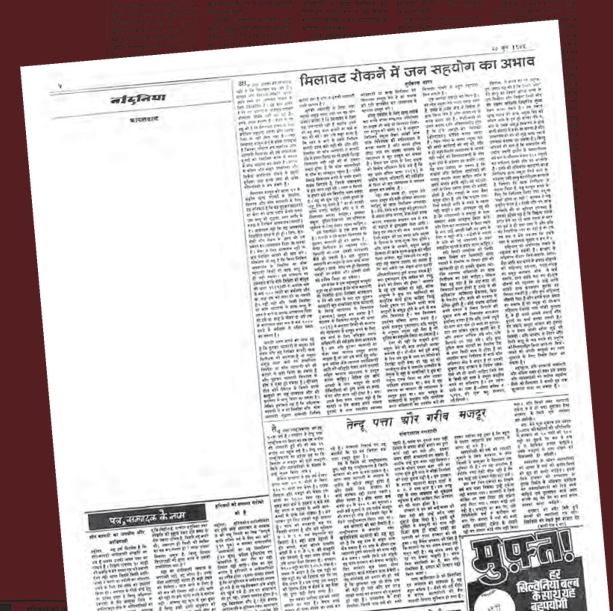
- 27 June 1975Nai Dunia’s editorial space was left blank after the editorial was censored.
- 1977The Emergency ended, and Congress was defeated in the Lok Sabha elections.
Censorship during the Emergency
Questions explored in the chapter
- Emergency
- Exceptional rule imposed in June 1975 over a perceived threat of internal disturbance.
- Censorship
- Control or suppression of material published in the press; during the Emergency, newspapers were censored using emergency powers.
- Institutional balance
- The balance among institutions sought by the Constitution.
What was the stated basis for imposing the Emergency in June 1975?
What does the blank editorial space in Nai Dunia’s 27 June 1975 issue represent?
Quick recap
- The Congress recovered after 1971 but had changed.
- Developments between 1973 and 1975 challenged democracy and constitutional institutional balance.
- The Emergency was imposed in June 1975 over a perceived internal disturbance.
- Emergency powers were used to censor newspapers, including Nai Dunia’s editorial.
- The Emergency ended in 1977 with Congress defeated in the Lok Sabha elections.
- The chapter examines the Emergency’s causes, practice, political consequences and lessons for democracy.
Background to Emergency
Political Background
Political tensions
- Indira Gandhi’s leadership: After 1967, Indira Gandhi became a highly popular and powerful national leader, while party competition grew sharper and more polarised.
- Government and judiciary: The Supreme Court found several government initiatives unconstitutional. Congress argued that the Court was undermining parliamentary supremacy and pro-poor welfare programmes.
- Opposition’s concern: Non-Congress parties accused the government of personalising politics and turning public authority into personal authority.
- Congress split: The split deepened divisions between Indira Gandhi and her opponents.
Economic Context
Economic pressures and public hardship
- Garibi hatao promise: Congress campaigned in 1971 on removing poverty, but living conditions improved little after 1971–72.
- Bangladesh crisis: About eight million people crossed from East Pakistan into India; the crisis and subsequent war placed heavy pressure on the economy.
- External pressures: After the war, the United States stopped aid to India. Rising international oil prices pushed up the cost of goods.
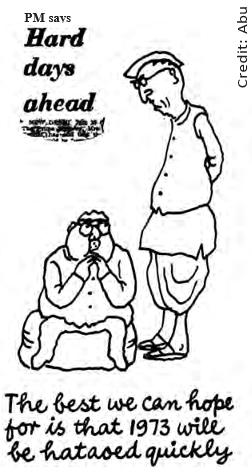
- Inflation: Prices rose by 23% in 1973 and 30% in 1974, causing severe hardship.
- Jobs and wages: Industrial growth was low and unemployment high, especially in rural areas. The government froze employees’ salaries to reduce spending, increasing dissatisfaction.
- Agriculture: Failed monsoons in 1972–73 reduced food-grain output by 8%.
- Political result: Economic hardship and dissatisfaction helped non-Congress parties organise popular protests.
Unrest and radical opposition
- Student unrest: Protests that had continued since the late 1960s became more intense amid economic hardship.
- Naxalites: Marxist-Leninist groups, later associated with Maoism, rejected parliamentary politics and used armed insurgency to challenge capitalism and the established political system.
- West Bengal: Naxalite activity was particularly strong there; the state government took stringent measures to suppress it.
Gujarat and Bihar Movements
| Point | Gujarat | Bihar |
|---|---|---|
| Beginning | Students protested against rising prices of food, cooking oil and other essentials, and corruption. | Students protested against rising prices, food scarcity, unemployment and corruption. |
| Leadership and spread | Opposition parties joined the protest, making it a widespread agitation. | Students invited Jayaprakash Narayan (JP), who agreed to lead on the conditions that it remain non-violent and spread beyond Bihar. |
| Demands and methods | Opposition parties demanded fresh state elections; Morarji Desai announced an indefinite fast if elections were not held. | JP demanded the Bihar Congress government’s dismissal and called for Total Revolution in social, economic and political life. Bandhs, gheraos and strikes were organised. |
| Outcome | President’s Rule was imposed; elections held in June 1975 resulted in a Congress defeat. | The government refused to resign. The movement drew people from different walks of life and acquired national appeal. |
JP movement and national politics
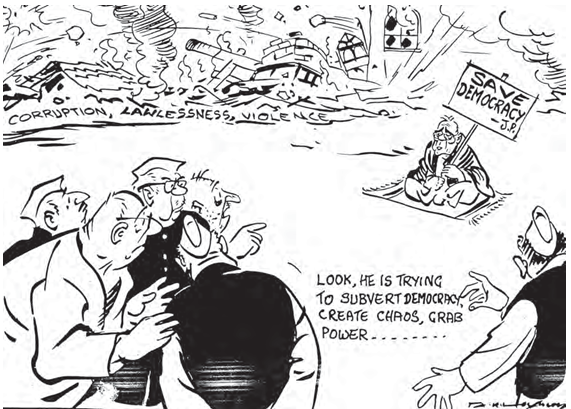
- Total Revolution: JP called for broad social, economic and political change to establish what he considered true democracy.
- National support: In 1975, JP led a large people’s march to Parliament and was backed by the Bharatiya Jana Sangh, Congress (O), Bharatiya Lok Dal, the Socialist Party and others.
- Political significance: Opposition parties presented JP as an alternative to Indira Gandhi; the movements increasingly challenged her national leadership, not just the state governments.
- Criticism: JP’s ideas and use of mass agitation were criticised. Indira Gandhi viewed the movements as motivated by personal opposition to her.
- Slogans: The Bihar movement used “Sampoorna Kranti ab nara hai, bhavi itihas hamara hai” (“With Total Revolution as our motto, the future belongs to us”). D. K. Barooah, Congress president, used “Indira is India, India is Indira” in 1974.
Railway strike of 1974
- Leadership and demands: The National Coordination Committee for Railwaymen’s Struggle, led by George Fernandes, called a nationwide railway strike over bonus and service conditions.
- Strike: Railway employees went on strike in May 1974, adding to labour unrest and raising debate about workers’ rights and strikes in essential services.
- Government response: The strike was declared illegal; leaders were arrested and the territorial army was deployed to protect railway tracks.
- Outcome: After 20 days, the strike was called off without a settlement. A prolonged stoppage threatened the transport of goods and wider economic activity.
Conflict with the Judiciary
| Issue | Supreme Court’s position |
|---|---|
| Could Parliament abridge Fundamental Rights? | The Court said Parliament could not. |
| Could Parliament curtail the right to property by amending the Constitution? | The Court said Parliament could not amend the Constitution in a way that curtailed rights. |
| Could Fundamental Rights be abridged to implement Directive Principles? | The Court rejected the constitutional provision permitting this. |
Kesavananda Bharati case and executive–judiciary tensions
- Basic structure: In the Kesavananda Bharati case, the Supreme Court ruled that the Constitution has basic features that Parliament cannot amend.
- Chief Justice appointment: After the 1973 judgment, the government bypassed the seniority of three judges and appointed Justice A. N. Ray as Chief Justice of India, breaking the practice of appointing the senior-most judge.
- Controversy: The superseded judges had ruled against the government’s position, making the appointment politically contentious and intensifying executive–judiciary tensions.
- Committed institutions: The idea was that judges and officials should support the government’s policies and vision; critics feared this would make them loyal to the ruling party and weaken their independence.
- Election ruling: The confrontation peaked when the High Court declared Indira Gandhi’s election invalid.
Key dates
- Since 1967Party competition became more polarised; student unrest continued.
- 1971Congress campaigned with the slogan “garibi hatao”.
- 1972–73Failed monsoons contributed to an 8% fall in food-grain output.
- 1973Prices rose by 23%; the Supreme Court gave its Kesavananda Bharati judgment, and Justice A. N. Ray was appointed Chief Justice.
- January 1974The Gujarat student agitation began.
- March 1974The Bihar student movement began.
- May 1974Railway employees began a nationwide strike, which lasted 20 days.
- 1974Prices rose by 30%; D. K. Barooah used the slogan “Indira is India, India is Indira”.
- 1975JP led a people’s march to Parliament.
- June 1975Gujarat assembly elections were held and Congress was defeated.
- Garibi hatao
- Congress’s 1971 slogan meaning “remove poverty”.
- Naxalites
- Armed Marxist-Leninist groups that rejected parliamentary politics.
- Total Revolution
- JP’s call for far-reaching social, economic and political change.
- Basic structure
- Constitutional features that Parliament cannot amend, according to the Supreme Court.
What were the main causes of popular unrest before the Emergency?
What was JP’s role in the Bihar movement?
Why did relations between the government and the judiciary worsen?
Quick recap
- Political polarisation and disputes between the government and judiciary intensified after 1967.
- Inflation, unemployment, falling agricultural output and other economic pressures deepened public dissatisfaction.
- Student-led Gujarat and Bihar agitations grew into major anti-Congress movements; JP called for Total Revolution.
- The 1974 railway strike added to labour unrest and raised questions about workers’ rights and essential services.
- The Kesavananda Bharati ruling established the basic-structure limit on Parliament’s amending power.
- The appointment of A. N. Ray and the High Court ruling on Indira Gandhi’s election further sharpened the confrontation.
Declaration of Emergency
The Allahabad High Court Judgment
Election petition and court orders
- 12 June 1975: Justice Jagmohan Lal Sinha of the Allahabad High Court declared Indira Gandhi’s 1971 Lok Sabha election invalid.
- Petition: Raj Narain, a socialist leader and her opponent in 1971, challenged the election, alleging that government servants had been used in her campaign.
- Effect: Legally, Indira Gandhi was no longer an MP and could not remain Prime Minister unless she was re-elected within six months.
- 24 June 1975: The Supreme Court granted a partial stay while her appeal was pending: she could remain an MP but could not take part in Lok Sabha proceedings.
Crisis and Response
Opposition and Emergency proclamation
- Opposition demand: Led by Jayaprakash Narayan, opposition parties demanded Indira Gandhi’s resignation and held a large demonstration at Delhi’s Ramlila grounds on 25 June 1975.
- Satyagraha: Jayaprakash announced a nationwide campaign for her resignation and asked the army, police and government employees not to obey “illegal and immoral orders.”
- Government’s grounds: On 25 June 1975, the government cited a threat of internal disturbances and invoked Article 352 to proclaim Emergency.
- Article 352 at the time: It allowed Emergency to be declared on grounds of an external threat or internal disturbances.
- Justification: The government said a grave crisis had arisen; the Constitution provided special powers for an extraordinary situation in which normal democratic politics could not function.
| Area | Effect |
|---|---|
| Federal powers | The federal distribution of powers was practically suspended, concentrating powers in the Union government. |
| Fundamental Rights | The government could curtail or restrict some or all Fundamental Rights. |
Proclamation and Immediate Actions
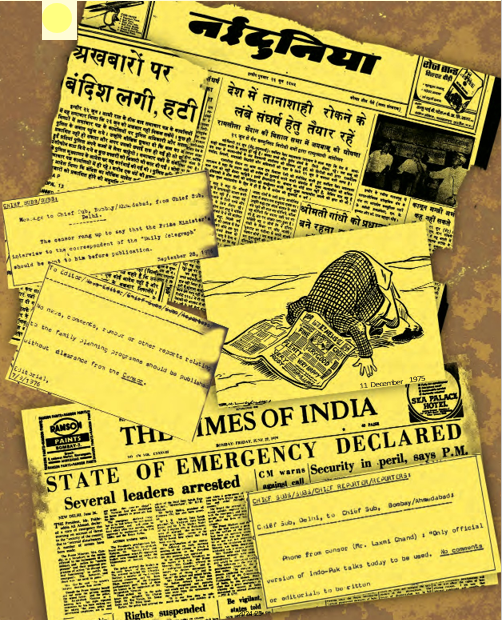
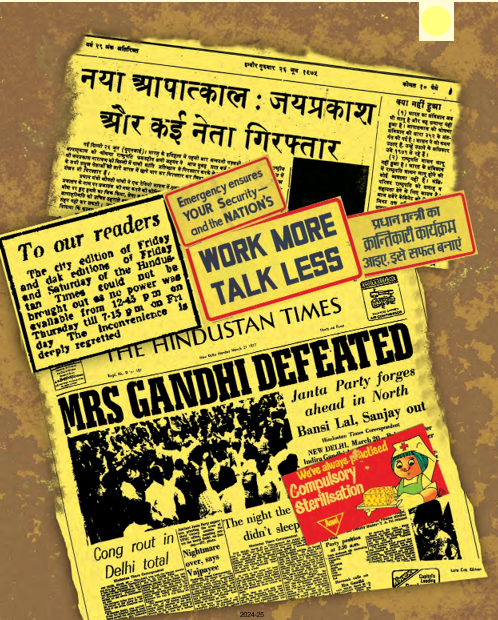
- Night of 25 June 1975Indira Gandhi recommended Emergency to President Fakhruddin Ali Ahmed, who issued the proclamation immediately.
- After midnight, 26 June 1975Electricity to major newspaper offices was disconnected.
- Early morning, 26 June 1975Many opposition leaders and workers were arrested.
- 6 a.m., 26 June 1975The Cabinet was informed at a special meeting, after the proclamation and initial actions.
Consequences of Emergency
Political restrictions and press censorship
- Public activity: Agitation was stopped; strikes, protests and public agitations were banned, and many opposition leaders were jailed.
- Press censorship: Newspapers had to obtain prior approval before publishing material; this restriction is known as press censorship.
- Banned organisations: The government banned the RSS and Jamait-e-Islami, citing fears of social and communal disharmony.
- Fundamental Rights: Rights were suspended, including the right to approach courts to restore Fundamental Rights.
- Press censorship
- The requirement to obtain prior government approval before publishing newspaper material.
- Preventive detention
- Arrest and detention based on the apprehension that a person may commit an offence, rather than an offence already committed.
- Habeas corpus
- A court petition challenging the legality of a person’s detention.
Preventive Detention and the Courts
- Preventive detention: The government used detention laws to make large-scale arrests of political workers.
- High Courts: Several High Courts ruled that they could hear habeas corpus petitions challenging detention even during Emergency.
- Supreme Court, April 1976: Its Constitution Bench overruled the High Courts and accepted the government’s plea that it need not even inform arrested people of the grounds for their arrest.
- Effect: The ruling meant citizens could not use habeas corpus to challenge detention and left them without judicial recourse to protect life and liberty; it is one of the Supreme Court’s most controversial judgments.
Dissent and Resistance
Forms of protest
- Underground resistance: Political workers who escaped the first arrests went underground and organised protests.
- Newspaper protest: The Indian Express and The Statesman left blank spaces where censored news should have appeared.
- Refusal to submit: Seminar and Mainstream closed rather than accept censorship; some journalists were arrested for writing against Emergency.
- Alternative publications: Underground newsletters and leaflets circulated to bypass censorship.
- Returned awards: Kannada writer Shivarama Karanth returned the Padma Bhushan; Hindi writer Fanishwarnath Renu returned the Padma Shri.
- Overall scale: Open acts of defiance and resistance were rare.
Constitutional Changes during Emergency
Changes to elections and legislatures
- Election challenges: An amendment declared that elections of the Prime Minister, President and Vice-President could not be challenged in court; it followed the Allahabad High Court ruling in Indira Gandhi’s case.
- Forty-second Amendment: It made wide-ranging changes to the Constitution and extended the term of legislatures from five years to six.
- Permanent change: The six-year legislative term was intended to apply permanently, not only during Emergency.
- Postponing elections: During Emergency, elections could be postponed by one year. After the 1971 election, the next election could therefore be held in 1978 instead of 1976.
Lessons of the Emergency
Democracy, safeguards and civil liberties
- Democratic resilience: The Emergency exposed weaknesses in India’s democracy, yet normal democratic functioning resumed within a short time, showing how difficult it is to do away with democracy in India.
- Safeguards added: An internal Emergency can now be proclaimed only on the grounds of armed rebellion; the Union Cabinet must give its advice to the President in writing.
- Civil liberties: The Emergency increased awareness of their importance. Courts became more active in protecting them, and many civil liberties organisations emerged.
- Institutions: The Shah Commission Report said the police and administration became vulnerable to political pressure and were turned into instruments of the ruling party; this problem continued after Emergency.
Questions raised by the Emergency
- Protest and government: What is the right balance between routine government functioning and continuous political protest?
- Limits of protest: Should citizens have full freedom to protest, and if so, what limits should apply?
What did the Supreme Court decide about habeas corpus during the Emergency?
What constitutional safeguards now apply to an internal Emergency?
Quick recap
- On 12 June 1975, the Allahabad High Court invalidated Indira Gandhi’s election; the Supreme Court later granted a partial stay.
- Emergency was proclaimed under Article 352 on 25 June 1975, citing internal disturbances.
- The proclamation concentrated power in the Union government and enabled restrictions on Fundamental Rights, public protest and the press.
- Preventive detention and the Supreme Court’s April 1976 ruling sharply restricted judicial remedies.
- Resistance included underground publications, blank newspaper spaces and writers returning national awards.
- After Emergency, internal Emergency was restricted to grounds of armed rebellion, with written advice from the Union Cabinet required.
Politics after Emergency
The Democratic Verdict
What the 1977 verdict showed
- Referendum: The 1977 Lok Sabha election became a verdict on the Emergency, especially in North India, where its impact was strongest.
- Campaign message: The opposition campaigned with the slogan “Save Democracy,” condemning the Emergency’s non-democratic rule and excesses.
- Electoral lesson: Voters can severely punish governments they consider anti-democratic; this lesson was repeated in later state elections.
- Democratic impact: The experience of 1975–77 ultimately strengthened the foundations of democracy in India.
Lok Sabha Elections, 1977
- January 1977After eighteen months of Emergency, the government announced elections and released political leaders and activists from jail.
- March 1977Lok Sabha elections were held, leaving the opposition little time to campaign.
- 1975–77The Emergency period became the central issue in the election and its aftermath.
Opposition unity before the election
- Janata Party: Major opposition parties united before the election to form the Janata Party, which accepted Jayaprakash Narayan’s leadership.
- Congress dissenters: Some Congress leaders opposed to the Emergency joined the Janata Party.
- Congress for Democracy: Jagjivan Ram led this separate party; it later merged with the Janata Party.
Election campaign
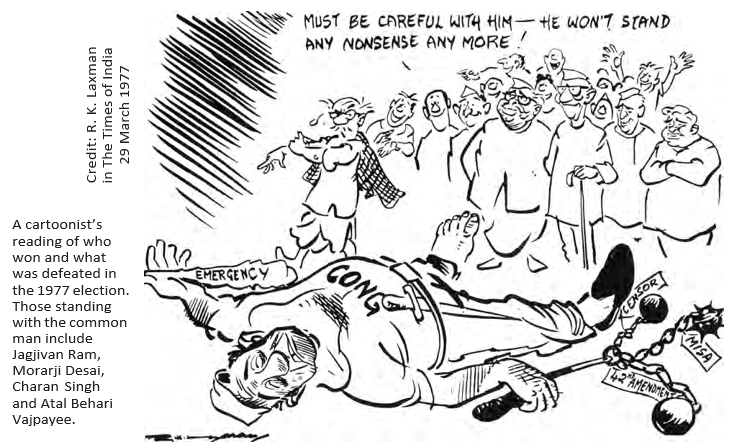
- Campaign focus: The Janata Party made the election a referendum on the Emergency’s non-democratic character and excesses.
- Public opinion: Arrests of thousands of people and press censorship helped turn public opinion against the Congress.
- Popular symbol: Jayaprakash Narayan became a symbol of the restoration of democracy.
- Electoral advantage: Opposition unity prevented non-Congress votes from being divided.
| Party/group | Result |
|---|---|
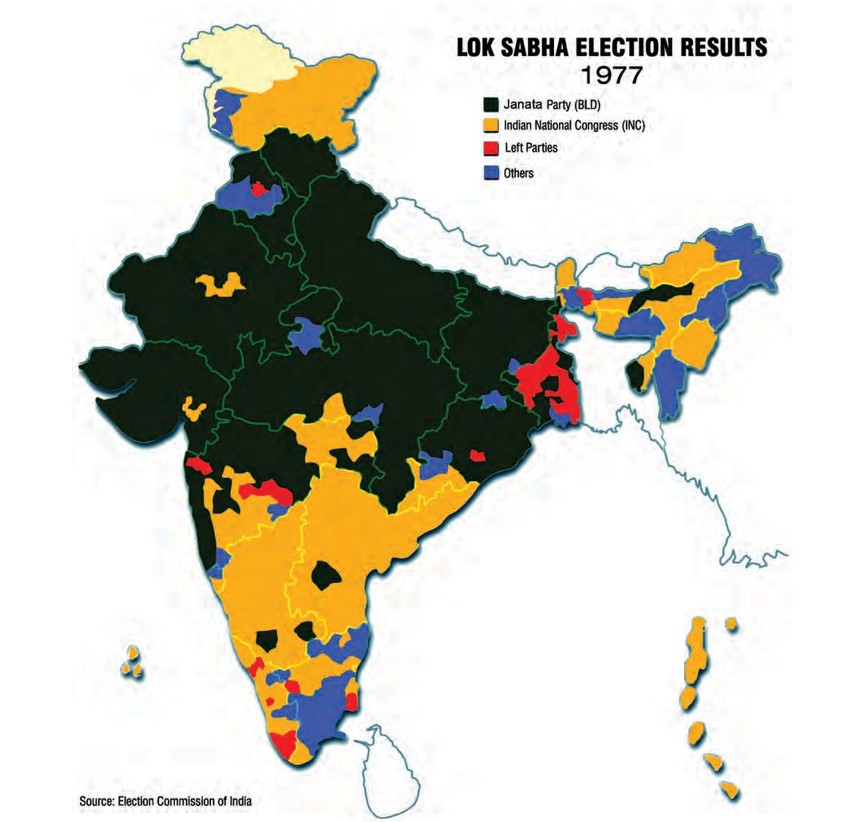
| Janata Party and allies | Won 330 of 542 seats. |
| Janata Party | Won 295 seats, securing a clear majority. |
| Congress | Won 154 seats; its popular vote share fell below 35%. |
The Congress defeat
- First defeat: For the first time since Independence, the Congress was defeated in a Lok Sabha election.
- Prominent defeats: Indira Gandhi lost from Rae Bareli, and Sanjay Gandhi lost from Amethi.
Regional pattern and its causes
- North India: Congress lost every constituency in Bihar, Uttar Pradesh, Delhi, Haryana and Punjab. It won only one seat each in Rajasthan and Madhya Pradesh.
- Elsewhere: Congress retained many seats in Maharashtra, Gujarat and Orissa, and virtually swept the southern states.
- Uneven Emergency impact: Forced relocation, displacement and sterilisation were concentrated mainly in northern states, so the Emergency was not experienced equally across India.
- Long-term political change: Middle castes in North India were moving away from Congress; the Janata Party became a platform for many of these groups to unite.
Why the 1977 election was more than a verdict on the Emergency
- Emergency excesses, including forced relocation and sterilisation, were concentrated more heavily in North India.
- North Indian voters reacted strongly against the Congress.
- Middle-caste groups were already moving away from Congress.
- The Janata Party united many of these groups and opposition voters.
- Therefore, the election reflected both opposition to the Emergency and longer-term changes in political competition.
- Referendum
- A vote treated as a direct expression of public opinion on a major issue; the 1977 election became a verdict on the Emergency.
- Janata Party
- A party formed through the unity of major opposition parties before the 1977 election.
- Congress for Democracy
- A party led by Jagjivan Ram that later merged with the Janata Party.
Why was the 1977 Lok Sabha election considered a referendum on the Emergency?
Why did Congress perform differently in North India and the rest of the country in 1977?
Quick recap
- The 1977 election became a referendum on the Emergency, especially in North India.
- The Janata Party united major opposition groups under Jayaprakash Narayan’s leadership.
- Janata and its allies won 330 of 542 seats; Congress won 154, marking its first Lok Sabha defeat since Independence.
- Congress suffered a sweeping defeat in North India but retained support in parts of western and southern India.
- Uneven Emergency impacts and changing middle-caste politics help explain the regional results.
- The voter verdict reinforced the democratic principle that anti-democratic governments can be punished.
Janata Government & Legacy
The Janata Government, 1977–79
Janata Party government — A government formed after the 1977 election, united mainly by opposition to the Emergency but divided over leadership and direction.
Leadership and instability
- Leadership contest: Morarji Desai, Charan Singh and Jagjivan Ram competed to become Prime Minister; Desai took office.
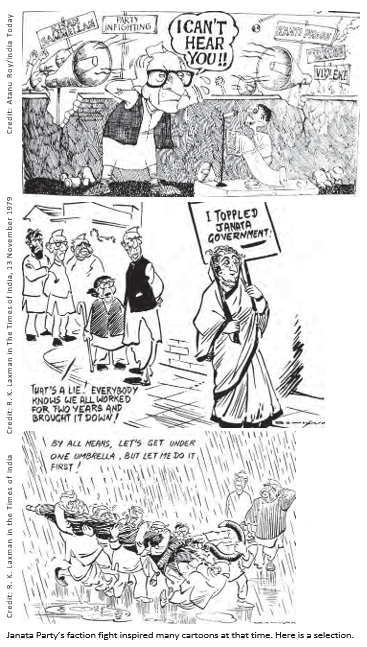
- Weak unity: Opposition to the Emergency held the party together only briefly. Critics said it lacked direction, leadership and a common programme.
- Policy continuity: The government did not bring about a fundamental change in policies pursued by Congress.
- Collapse: The Janata Party split, and Desai’s government lost its majority in less than 28 months.
| Leader | Role / significance |
|---|---|
| Morarji Desai | Became Prime Minister after the 1977 election. |
| Charan Singh | Bharatiya Lok Dal leader and farmers’ leader from Uttar Pradesh; later Prime Minister. |
| Jagjivan Ram | Experienced senior minister in Congress governments. |
Government changes and election result
- 1977The Janata Party came to power after defeating Congress.
- July 1979–January 1980Charan Singh served as Prime Minister. His government, formed with Congress’s assurance of support, lasted about four months; Congress later withdrew its support.
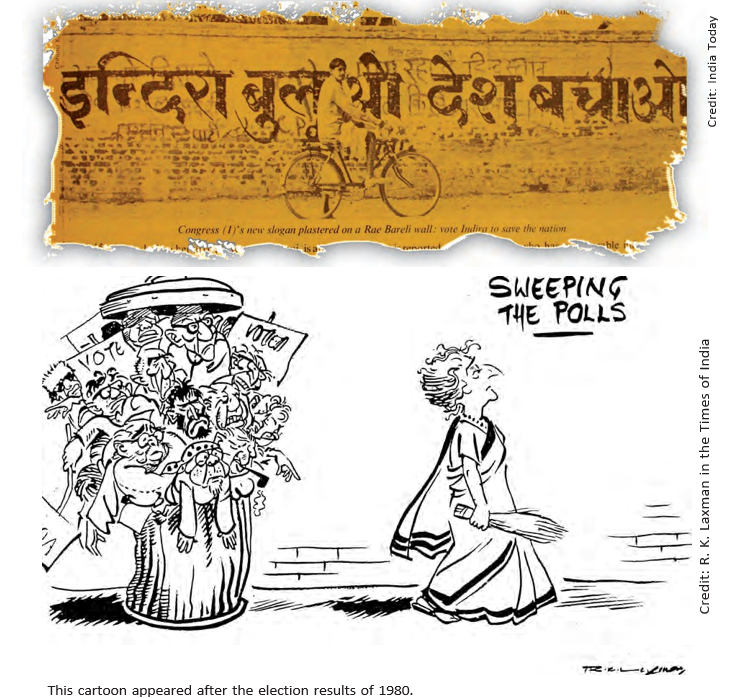
- January 1980Fresh Lok Sabha elections returned Indira Gandhi’s Congress to power.
Charan Singh and the 1980 election
- Charan Singh (1902–1987): A freedom fighter and advocate of rural and agricultural development, he was active in Uttar Pradesh politics and served twice as its Chief Minister.
- Political roles: He left Congress and founded the Bharatiya Kranti Dal in 1967; he later co-founded the Janata Party, served as Deputy Prime Minister and Home Minister during 1977–79, and founded Lok Dal.
- 1980 result: Congress, led by Indira Gandhi, won 353 seats and returned to power, nearly repeating its 1971 victory.
- Regional shift: Janata suffered a comprehensive defeat, especially in North India, where it had swept the polls in 1977.
- Democratic lesson: Voters can severely punish governments viewed as unstable and quarrelsome.
Changes in the Party System
Non-Congressism — A strategy in which opposition parties joined forces to defeat Congress and prevent non-Congress votes from being divided.
Congress and opposition strategy
- Congress’s changing character: Since 1969, Congress gradually moved away from being an umbrella party for leaders with different viewpoints.
- Ideological appeal: By the early 1970s, Congress presented itself as the socialist and pro-poor party, drawing on social divisions and Indira Gandhi’s personal appeal.
- Opposition response: Other parties increasingly relied on non-Congressism and sought unity to avoid splitting anti-Congress votes; this helped them in 1977.
Backward Castes and Reservations
Other Backward Classes (OBCs) — A category referred to in debates over the welfare of backward castes and reservations.
Rise of backward-caste politics
- Electoral shift: Support from backward castes in North India contributed to the Janata victory in 1977.
- State politics: In the 1977 Assembly elections, many northern states elected non-Congress governments in which backward-caste leaders played important roles.
- Reservations debate: Reservations for OBCs became a controversial issue in Bihar.
- Mandal Commission: Following these developments, the Janata government appointed the Commission.
Constitutional and Political Crisis
| Point | Constitutional crisis | Political crisis |
|---|---|---|
| Core issue | Conflict over the jurisdictions of Parliament and the judiciary. | The ruling party suspended democratic processes despite having an absolute majority. |
| Why it mattered | Raised questions about constitutional authority. | Broad emergency powers, expected to operate within the rule of law, were abused; this crisis was more serious. |
Mass Protest and Parliamentary Democracy
Popular participation — Spontaneous participation by people in democratic and political life.
Democratic tension
- Institutional vs popular democracy: Parliamentary democracy based on institutions can come into tension with spontaneous popular participation.
- Possible cause: This tension may arise when the party system cannot incorporate people’s aspirations.
Why did the Janata government fail?
What was the political significance of non-Congressism in 1977?
Why was the political crisis of the Emergency more serious than its constitutional crisis?
Quick recap
- The Janata Party united against the Emergency but was weakened by leadership struggles and the absence of a shared programme.
- Charan Singh became Prime Minister after Desai’s government fell; Congress later withdrew support, and fresh elections were held in January 1980.
- Congress won 353 seats in 1980, while Janata suffered a heavy defeat, especially in North India.
- Non-Congressism and the effort to unite opposition votes shaped the 1977 election.
- Backward-caste politics and OBC reservation debates gained prominence; the Janata government appointed the Mandal Commission.
- The Emergency involved a constitutional conflict and a deeper political crisis caused by the suspension and abuse of democratic powers.
- The period highlighted tension between parliamentary institutions and spontaneous mass participation.
Political Science — ALL CHAPTERS
1
THE END OF BIPOLARITY
2
CONTEMPORARY CENTRES OF POWER
3
CONTEMPORARY SOUTH ASIA
4
INTERNATIONAL ORGANISATIONS
5
SECURITY IN THE CONTEMPORARY WORLD
6
ENVIRONMENT AND NATURAL RESOURCES
7
GLOBALISATION
1
Challenges of Nation Building
2
Era of one-party dominance
3
Politics Of Planned Development
4
India’s external relations
5
Challenges to and Restoration of the Congress System
6
The Crisis of Democratic Order
7
Regional Aspirations
8
Recent Developments in Indian Politics