Class 12 Humanities . Political Science . Politics In India Since Independence . Recent Developments in Indian Politics
Chapter 8: Recent Developments in Indian Politics
Ch 8
Political Science
Class 12 Humanities
Chapter Overview
Purpose and Scope
- Scope: The chapter takes a synoptic view of the last two decades of Indian politics.
- Purpose: It provides information and tools to help readers understand the present through India’s political history since Independence.
Central Questions of the Chapter
- Key themes: The chapter explores coalition politics, the political representation of OBCs, the Ram Janmabhoomi movement, and the emergence of a new policy consensus.
- Focus: These themes raise questions about democracy, secularism, political choices, and changing representation.
Political Change in the 1990s
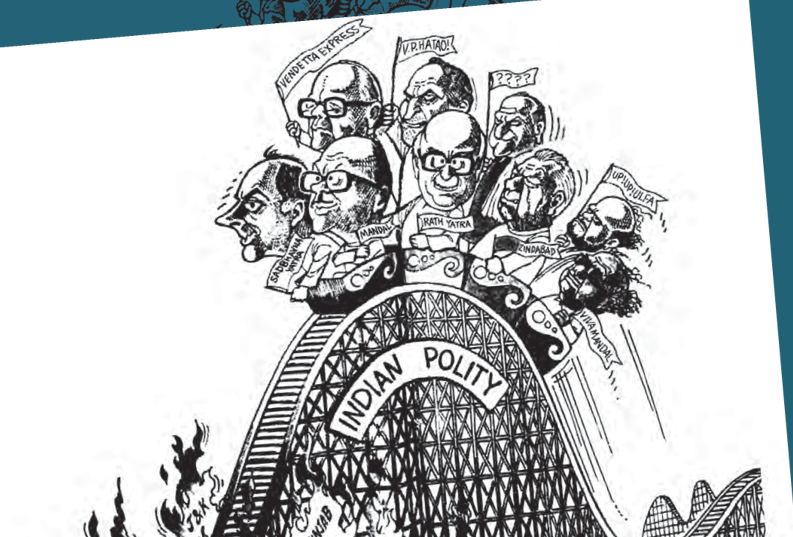
Leaders shown in the cartoon
- Leaders: Rajiv Gandhi, V. P. Singh, L. K. Advani, Chandrashekhar, Jyoti Basu, N. T. Rama Rao, Devi Lal, P. K. Mahanta and K. Karunanidhi.
Reference point
- 1990A political cartoon captured the roller-coaster-like ups and downs of party politics.
- Coalition politics
- A central theme examined through its implications for democracy.
- Mandalisation
- A political development examined for its effect on representation.
- Ram Janmabhoomi movement
- A movement whose political legacy is a central question.
- Policy consensus
- A consensus examined for its effect on political choices.
What is the purpose of this chapter?
Quick recap
- The chapter surveys major political developments in India over the last two decades.
- These changes are complex, controversial and difficult to predict or interpret.
- Its key themes include coalition politics, Mandalisation, the Ram Janmabhoomi movement and policy consensus.
- The chapter raises questions about democracy, representation, political legacies and political choices.
- A 1990 cartoon portrayed the ups and downs of party politics as a roller-coaster ride.
Context of the 1990s
Five Developments That Reshaped Indian Politics
1. Decline of Congress Dominance
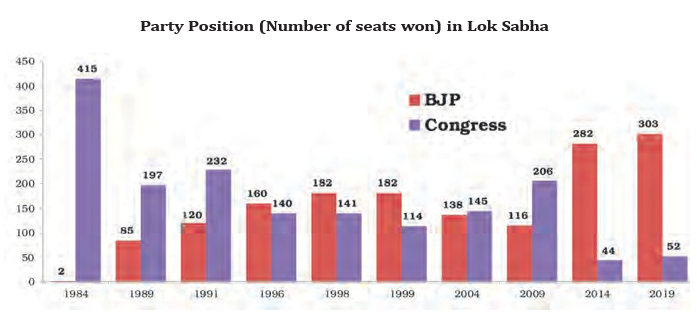
- 1984: After Indira Gandhi’s assassination, Rajiv Gandhi led Congress to a major Lok Sabha victory, winning 415 seats.
- 1989: Congress fell to 197 seats, marking the end of the ‘Congress system’—its earlier central position in the party system.
- 1991: Congress improved its performance and returned to power; it remained an important party but no longer enjoyed its former dominance.
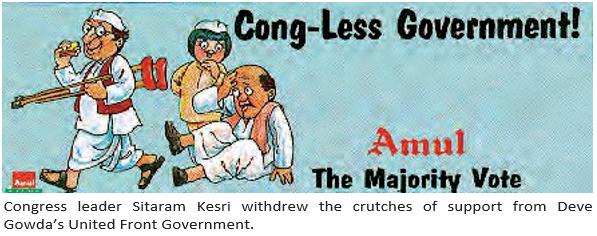
2. The Mandal Issue
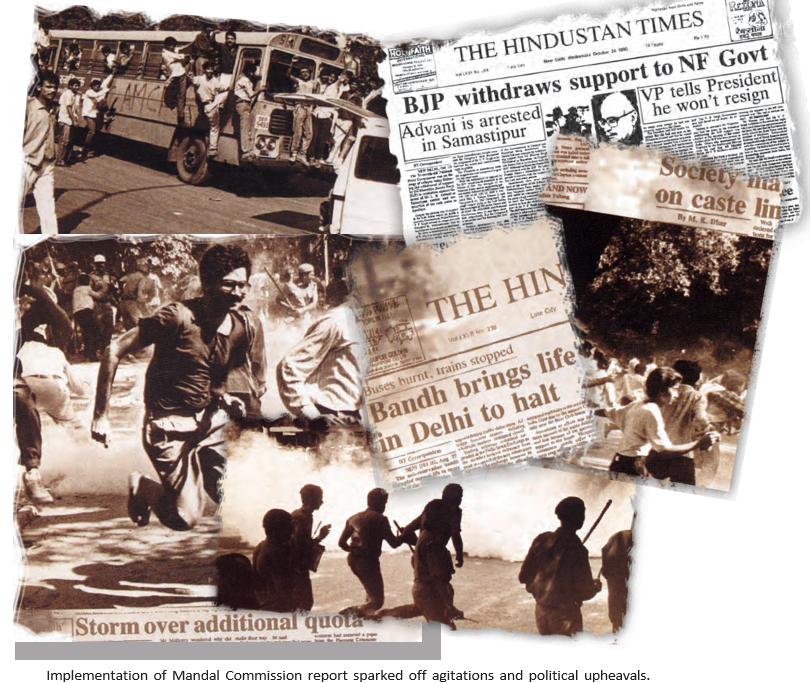
- Decision: In 1990, the National Front government decided to implement the Mandal Commission recommendation for reservations for Other Backward Classes (OBCs) in central government jobs.
- Response: The decision triggered violent anti-Mandal protests and a national dispute between supporters and opponents of OBC reservations.
- Impact: The Mandal issue became a major force shaping Indian politics from 1989 onward.
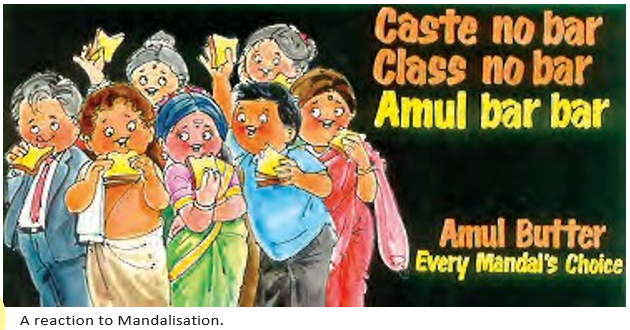
3. New Economic Reforms
- Name: The structural adjustment programme, also called the new economic reforms, changed the direction of India’s economy after Independence.
- Beginning: Rajiv Gandhi initiated the changes; they became especially visible in 1991.
- Political significance: The policies faced criticism from movements and organisations, yet successive governments continued to follow them.
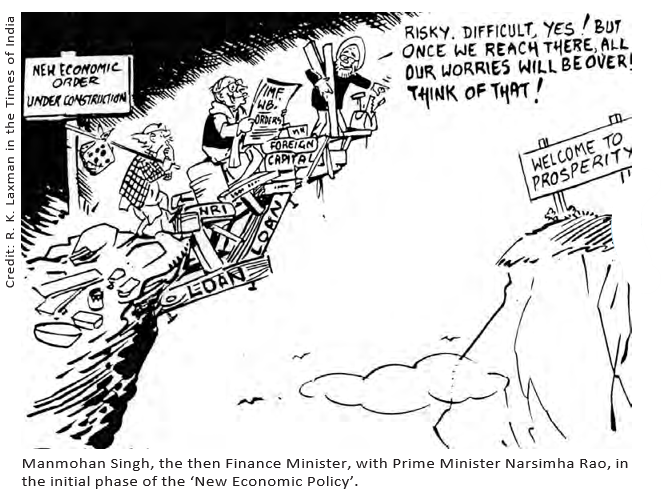
4. Ram Janmabhoomi Movement
- Background: The centuries-old legal and political dispute over the Ram Janmabhoomi Temple in Ayodhya began to strongly influence national politics.
- Effect: The temple movement became a central political issue and changed debates about secularism and democracy.
- Later development: The Supreme Court’s constitutional bench announced its decision on November 9, 2019; the Ram Temple was subsequently constructed in Ayodhya.
5. Rajiv Gandhi’s Assassination and Congress Leadership
Assassination and Change in Leadership
- Rajiv Gandhi was assassinated in May 1991 during an election campaign tour in Tamil Nadu.
- The assassin was a Sri Lankan Tamil linked to the LTTE.
- Congress emerged as the single largest party in the 1991 elections.
- After Rajiv Gandhi’s death, Congress chose Narsimha Rao as Prime Minister.
Key Dates
- 1984Rajiv Gandhi led Congress to 415 Lok Sabha seats.
- 1989Congress fell to 197 seats, ending its earlier centrality in the party system.
- 1990The National Front government decided to implement the Mandal Commission recommendation on OBC reservations in central government jobs.
- May 1991Rajiv Gandhi was assassinated during an election campaign tour in Tamil Nadu.
- 1991Congress became the single largest party, Narsimha Rao became Prime Minister, and the new economic reforms became especially visible.
- November 9, 2019The Supreme Court’s constitutional bench announced its decision in the Ayodhya dispute.
- Congress system
- The earlier party-system arrangement in which Congress held a central, dominant position.
- Mandal issue
- The political dispute over implementing OBC reservations recommended by the Mandal Commission.
- Structural adjustment programme
- The new economic reforms that changed the direction of India’s economy.
- Ram Janmabhoomi movement
- The movement around the Ayodhya temple dispute that reshaped debates on secularism and democracy.
Why did the 1989 election mark a turning point for Congress?
What was the Mandal issue, and why was it politically important?
Name the five developments that shaped politics as the 1980s ended.
Quick recap
- Congress’s steep 1989 seat loss ended its earlier dominance, though it returned to power in 1991.
- The 1990 decision on OBC job reservations made the Mandal issue a major political debate.
- New economic reforms, initiated under Rajiv Gandhi, became especially visible in 1991 and continued under later governments.
- The Ayodhya temple movement reshaped political debates about secularism and democracy.
- Rajiv Gandhi was assassinated in May 1991; Congress later chose Narsimha Rao as Prime Minister.
- These five developments transformed party competition and political debate in the 1990s.
Era of Coalitions
The 1989 Election and the National Front
Decline of Congress and the Multi-Party System
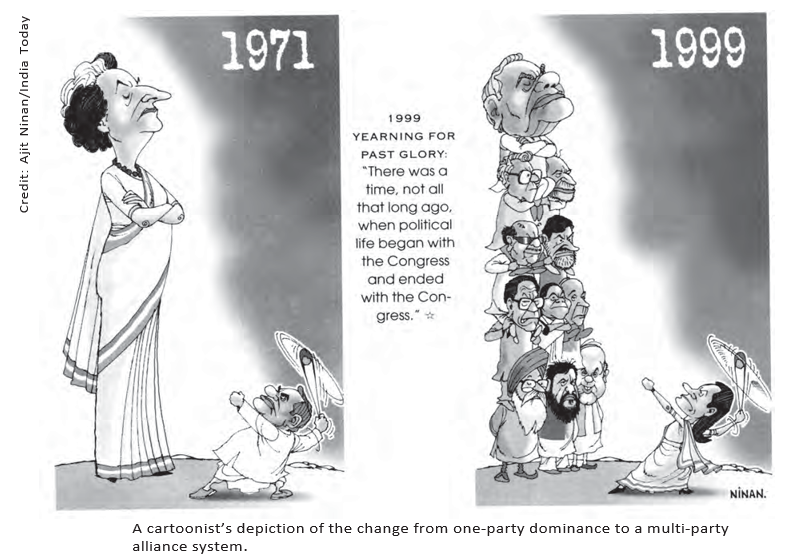
From Congress Dominance to Coalition Politics
- Social and political groups increasingly left the Congress fold and formed their own parties.
- Regional parties grew, especially after 1977.
- Congress weakened, but no single party became strong enough to replace it.
- Fragmented electoral support led to coalition and minority governments at the Centre.
Alliance Politics
The BJP and Coalition Governments
- Growth: The BJP strengthened its position in the 1991 and 1996 elections.
- 1996 result: It emerged as the largest party and was invited to form the government, but could not secure a Lok Sabha majority because most other parties opposed its policies.
- NDA government: The BJP led a coalition government from May 1998 to June 1999, with Atal Behari Vajpayee as Prime Minister.
- Return to power: The BJP was re-elected in October 1999; Vajpayee again became Prime Minister, and this government completed its full term.
Minority government — A government that lacks a majority of its own and depends on support from other parties, which may remain outside the government.
The Coalition Phase at the Centre
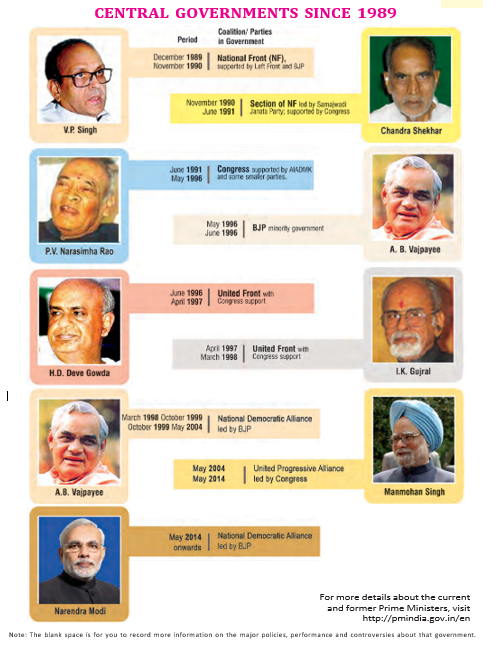
- Long phase: Coalition politics began with the 1989 elections. Eleven governments at the Centre since then were coalition governments or minority governments supported by other parties.
- Regional parties: A government generally needed the participation or support of multiple regional parties.
- Examples: The National Front (1989), United Front (1996 and 1997), BJP-led coalition (1998), NDA (1999), and UPA (2004 and 2009) illustrate this phase.
- Long-term roots: Coalition politics reflected gradual changes over several decades, including the departure of groups from Congress and the growth of regional parties.
- Congress system: Congress had once functioned as a broad coalition of different interests and social groups; this was known as the ‘Congress system’.
- National Front
- A Janata Dal-led alliance of regional parties that formed the government in 1989.
- United Front
- An alliance of Janata Dal and regional parties that formed governments in 1996 and 1997.
- NDA
- The BJP-led alliance that formed the government in 1999.
- UPA
- The alliance that formed governments in 2004 and 2009.
Major Milestones in Coalition Politics
- Late 1960sCongress dominance was challenged; it later restored its predominant position under Indira Gandhi.
- After 1977Many regional parties rose in importance.
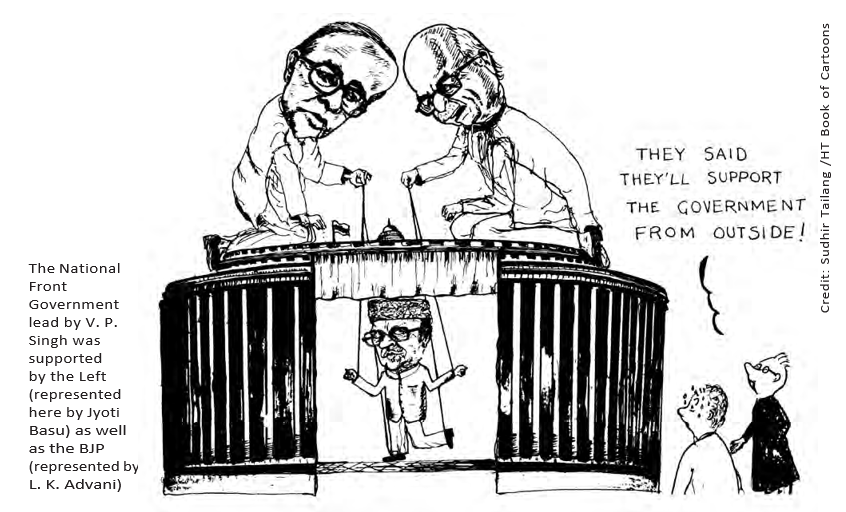
- 1989Congress lost power; the National Front formed a government with outside support from the BJP and Left Front.
- 1991 and 1996The BJP continued to consolidate its position.
- 1996 and 1997United Front governments formed with outside support from Congress and the Left.
- May 1998–June 1999The BJP led a coalition government under Atal Behari Vajpayee.
- October 1999The BJP was re-elected; the Vajpayee-led government completed its full term.
- 2004 and 2009UPA governments formed at the Centre.
- 2014 and 2019The BJP won a clear majority on its own.
Why did the 1989 election begin an era of coalition politics?
How did outside support differ between the National Front and United Front governments?
Quick recap
- The 1989 election produced no majority; the National Front governed with outside support from the BJP and Left Front.
- Congress dominance ended, but no single party replaced it immediately; a multi-party system emerged.
- Dalit, OBC and regional parties gained influence and helped shape coalition governments.
- United Front governments in 1996 and 1997 received support from Congress and the Left.
- The BJP-led NDA formed governments in 1998 and 1999; Vajpayee’s 1999 government completed its full term.
- Coalition or minority governments marked the period after 1989, until the BJP won clear majorities in 2014 and 2019.
Political Rise of Other Backward Classes
OBCs as a Political Force
Other Backward Classes (OBCs) — An administrative category for communities, other than Scheduled Castes and Scheduled Tribes, that experience educational and social backwardness.
Political emergence
- Changing support: As support for Congress declined among many backward-caste groups, non-Congress parties gained political space.
- Janata Party: OBC political expression at the national level grew with the Janata Party government in 1977; constituents such as the Bharatiya Kranti Dal and Samyukta Socialist Party had strong rural bases among some OBC groups.
- Janata Dal: In the 1980s, it brought together a similar combination of political groups with strong OBC support.
- Political demands: OBC-focused parties sought better access to education and employment, adequate representation in administration, and a fair share of political power.
The Mandal Commission and Its Implementation
Background and purpose
- Earlier reservations: OBC reservations existed in southern States from the 1960s or earlier, but were not in force in north Indian States.
- Demand in the north: The Janata Party government (1977–79) saw a strong demand for reservations for backward castes in north India and nationally. Bihar Chief Minister Karpoori Thakur pioneered this effort by introducing OBC reservations in Bihar.
- Commission: In 1978, the central government appointed the Second Backward Classes Commission. It is popularly called the Mandal Commission after its chairperson, Bindeshwari Prasad Mandal.
- Purpose: It investigated social and educational backwardness, proposed how to identify backward classes, and recommended measures to overcome their disadvantage.
Findings and recommendations
- Meaning of backward classes: The Commission treated the category as backward castes; castes outside the Scheduled Castes were also ranked low in the caste hierarchy.
- Finding: Its survey found backward castes had very low representation in educational institutions and public-service employment.
- Reservation recommendation: Reserve 27% of seats in educational institutions and government jobs for these groups.
- Other measures: The Commission also recommended measures such as land reform to improve OBC conditions.
- Report: The recommendations were submitted in 1980, after the Janata government had fallen.
Implementation and political impact
- August 1990: The National Front government decided to implement the recommendation reserving jobs for OBCs in the central government and its undertakings.
- Protests and challenge: The decision led to agitations and violent protests in many north Indian cities, and was challenged in the Supreme Court.
- Indira Sawhney case: In November 1992, the Supreme Court upheld the government’s decision in the case named after a petitioner.
- Long-term effect: Debate over job reservations strengthened OBC political awareness and helped parties mobilise OBC communities.
- Political consensus: Parties differed over how to implement the decision, but OBC reservation later gained support from all major political parties.
Political Fallouts: Dalit Politics and the BSP
From BAMCEF to the BSP
- BAMCEF: Formed in 1978, the Backward and Minority Communities Employees Federation was not an ordinary trade union; it supported political power for the bahujan—SCs, STs, OBCs and minorities.
- Organisational growth: The Dalit Shoshit Samaj Sangharsh Samiti and later the Bahujan Samaj Party (BSP) emerged from this political mobilisation under Kanshi Ram’s leadership.
- BSP breakthrough: Initially supported mainly by Dalit voters in Punjab, Haryana and Uttar Pradesh, the BSP made a major electoral breakthrough in Uttar Pradesh in 1989 and 1991.
- Significance: This was the first major success in independent India of a party supported mainly by Dalit voters.
- Expansion: The BSP was conceived as a pragmatic political organisation, drawing strength from the majority population represented by bahujans. It later became a major state-level party and entered government more than once.
- Continuing pattern: Dalit and OBC politics have often developed separately and sometimes competed with each other; the BSP’s strongest support remains among Dalit voters, though it has broadened its social base.
Key dates
- 1960s or earlierOBC reservations were in place in southern States.
- 1977–79The Janata Party government saw stronger demands for backward-caste reservations; Karpoori Thakur introduced OBC reservations in Bihar.
- 1978The central government appointed the Second Backward Classes Commission; BAMCEF was also formed.
- 1980The Mandal Commission submitted its recommendations, including 27% reservation.
- August 1990The National Front government decided to implement OBC job reservations in central government services and undertakings.
- 1989 and 1991The BSP achieved a major electoral breakthrough in Uttar Pradesh.
- November 1992The Supreme Court upheld the reservation decision in the Indira Sawhney case.
- OBC
- Socially and educationally backward communities other than SCs and STs.
- Mandal Commission
- The Second Backward Classes Commission, chaired by Bindeshwari Prasad Mandal.
- Bahujan
- The political grouping of SCs, STs, OBCs and religious minorities.
- BAMCEF
- Backward and Minority Communities Employees Federation, formed in 1978.
What were the Mandal Commission’s main findings and recommendations?
How did Mandal’s implementation affect OBC politics?
Quick recap
- OBCs are communities other than SCs and STs that face social and educational backwardness.
- Non-Congress parties and later the Janata Dal built strong support among sections of OBC communities.
- The Mandal Commission’s 1980 report recommended 27% reservation in education and government employment.
- The National Front announced central-government job reservations in August 1990; the Supreme Court upheld the decision in November 1992.
- BAMCEF and subsequent organisations helped build bahujan political mobilisation under Kanshi Ram.
- The BSP’s 1989 and 1991 Uttar Pradesh breakthroughs marked major electoral success for a party supported mainly by Dalit voters.
Communalism, Secularism, Democracy
Rise of the BJP and Religious Identity Politics
Formation and early political direction
- Formation: After the Janata Party broke up, former Jana Sangh supporters formed the Bharatiya Janata Party (BJP) in 1980.
- Initial platform: The BJP adopted a broader platform than the Jana Sangh, combining Gandhian socialism with cultural nationalism.
- Political shift: After its poor election performance in 1984, the BJP increasingly made nationalism central to its ideology after 1986.
- Mobilisation: The BJP also used Hindutva as a basis for political mobilisation.
BJP: key developments
- 1980Former Jana Sangh supporters established the BJP after the Janata Party's break-up.
- 1984The BJP did not achieve much success in the elections.
- After 1986The party emphasised nationalism as its core ideology.
Hindutva — An idea of Indian nationhood popularised by Vinayak Damodar Savarkar, linking Indian identity to India as both one's fatherland (pitrubhu) and holy land (punyabhu).
Hindutva and national culture
- Believers' view: A strong nation can be built on a united national culture; they argue that Hindutva can provide this basis in India.
- Political role: The BJP used Hindutva to mobilise political support.
Shah Bano Case and the Debate over Secularism
Case, ruling and political response
- Case: Shah Bano, a 62-year-old divorced Muslim woman, sought maintenance from her former husband.
- Supreme Court ruling: The Court ruled in Shah Bano's favour.
- Opposition: Orthodox Muslim groups saw the ruling as interference in Muslim Personal Law.
- Government response: Following demands from some Muslim leaders, the government passed the Muslim Women (Protection of Rights on Divorce) Act, 1986, nullifying the Court's judgment.
- Public criticism: Women's organisations, some Muslim groups and many intellectuals opposed the government's action.
- BJP's criticism: The BJP called the Congress government's action an unnecessary concession and minority appeasement.
Shah Bano case
- 1985The Supreme Court ruled in Shah Bano's favour in her maintenance case.
- 1986The government passed the Muslim Women (Protection of Rights on Divorce) Act, nullifying the judgment.
Ayodhya Issue: Dispute and Developments
Ayodhya issue — A long-running dispute about the birthplace of Shri Ram and the legal ownership of the religious site and structure associated with it.
Background and competing concerns
- Historical setting: The lecture traces the site's history from 1528 and notes repeated conflicts over several centuries.
- Structure: A three-dome structure was built at the site in 1528; the text notes Hindu symbols and relics inside and outside it.
- National significance: The issue became linked to national pride in India's ancient civilisation.
- Legal proceedings: The structure was sealed in 1949 as court proceedings began.
- Different concerns: Many Hindus regarded the site as Shri Ram's birthplace and felt their concerns were overlooked; Muslims sought assurance of their possession of the structure.
- Construction dispute: A Shilaanyas for a temple had taken place, but further construction remained prohibited.
- Tensions: Conflicting claims of ownership led to disputes and legal conflict between the communities.
Ayodhya: key developments
- 1528A three-dome structure was built at the disputed site.
- 1949The structure was sealed as court proceedings began.
- 1986The Faizabad district court ordered the structure unlocked, allowing worship there.
- 1992The structure was demolished; critics said this challenged the principles of Indian democracy.
- November 9, 2019A unanimous 5–0 verdict by a five-judge constitutional bench of the Supreme Court resolved the dispute through legal process.
Legal Resolution and Democratic Principles
How the dispute was resolved
- Long-running dispute and competing claims
- Court hearings, mediation attempts and popular movements
- Consideration of documentary and oral evidence, including archaeological and historical records
- Unanimous 5–0 Supreme Court verdict on November 9, 2019
- The disputed site was allotted to the Shri Ram Janmabhoomi Teertha Kshetra Trust for a temple; the government was directed to allot an appropriate site for a mosque to the Sunni Central Waqf Board
| Aspect | What the judgment stated |
|---|---|
| Equality before law | Citizens of all faiths and beliefs are subject to the law and equal before it. |
| Religious belief | The Constitution does not distinguish between the faith and belief of one religion and another; forms of belief, worship and prayer are equal. |
| Evidence and finding | The Court found that the Hindu belief that Ram Janmasthan was where the mosque was built was proved by documentary and oral evidence. |
Democracy and conflict resolution
- A plural society contains different religious and cultural claims
- Conflicting claims may lead to social and legal disputes
- Democratic processes provide hearings, mediation and lawful resolution
- Following due process can help reconcile stakeholder interests and uphold constitutional equality
- Communalism
- Politics organised or mobilised around religious identity.
- Hindutva
- A conception of Indian nationhood centred on India as both fatherland and holy land.
- Secularism
- The constitutional principle that people of all faiths are equal before the law, with no distinction between religions.
- Appeasement
- A term used by the BJP to criticise what it saw as excessive concessions to a minority community.
- Due process of law
- Resolving disputes through lawful procedures, including hearings and judicial decisions.
What was the Shah Bano case, and why did it become politically significant?
What was the outcome of the Supreme Court's Ayodhya verdict in 2019?
How does the Ayodhya resolution illustrate democracy in a plural society?
Quick recap
- The BJP was formed in 1980 and later made nationalism and Hindutva central to its political mobilisation.
- The Shah Bano case became a debate about personal law, government action and claims of minority appeasement.
- The Ayodhya dispute concerned religious claims and legal ownership of a historically contested site, and became linked to national pride in India's ancient civilisation.
- The 1986 unlocking and the 1992 demolition were major turning points in the dispute.
- A unanimous 5–0 verdict was delivered by the Supreme Court's five-judge bench on November 9, 2019.
- The verdict allotted the disputed site for a temple and directed the provision of an appropriate mosque site.
- Constitutional equality and due process are central to resolving conflicts in a plural democracy.
Emergence of a new consensus
Changing Electoral Competition after 1989
Lok Sabha Elections, 2004–2019
Key Election and Coalition Developments
- 2004The Congress-led UPA formed the government, supported by Left Front parties.
- July 2008Left parties withdrew support to the UPA over the Indo-US nuclear deal.
- 2009Congress won 206 seats; Manmohan Singh began his second term as Prime Minister.
- September 2013The BJP named Narendra Modi, then Gujarat Chief Minister, as its Prime Ministerial candidate.
- 2014The BJP won 282 seats, gaining a single-party majority; it nevertheless formed an NDA government.
- 2019The BJP won 303 seats, while coalition politics continued to matter.
From Coalition Governments to BJP Majorities
- 2014 watershed: The BJP’s single-party majority was the first such majority in 30 years. The NDA still included coalition partners.
- Policy decisions: The Narendra Modi-led NDA government took rapid decisions in social, foreign and economic policy.
- 2019: The BJP increased its own tally to 303 seats. Even with a full majority, coalition politics remained relevant.
- Overall change: The party system had changed dramatically from the period up to the 1970s.
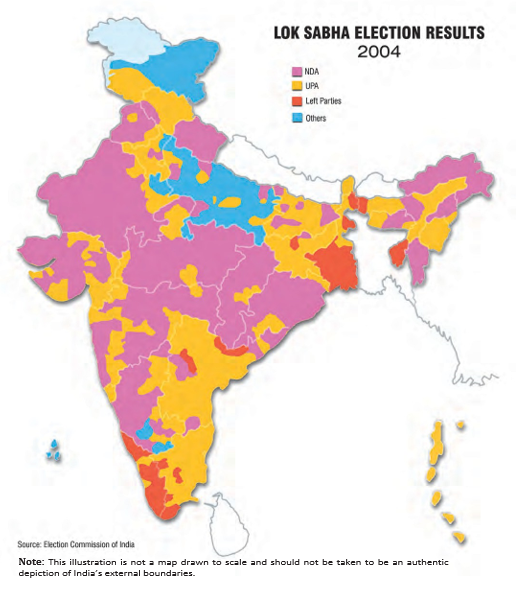
Growing Consensus among Political Parties
| Element | Shared position |
|---|---|
| Economic policy | Broad support for new economic policies. |
| Backward castes | Acceptance of their social and political claims, including reservation and adequate power-sharing. |
| State-level parties | Acceptance of their important role in national governance. |
| Pragmatic alliances | Coalition and power-sharing arrangements can cross ideological differences. |
Democracy, Movements and New Political Issues
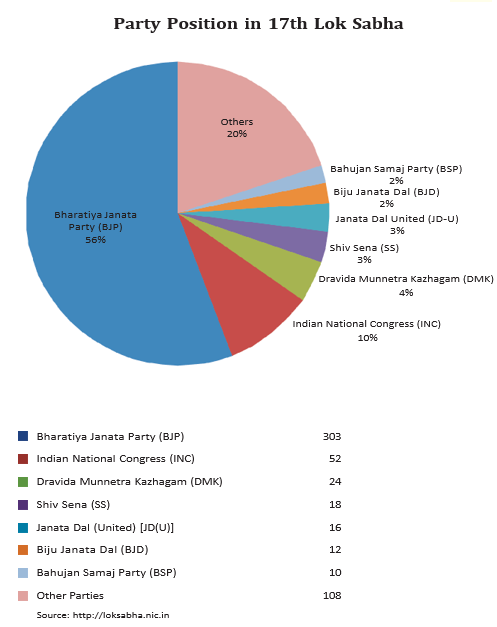
- NDA
- National Democratic Alliance, a BJP-led coalition.
- UPA
- United Progressive Alliance, a Congress-led coalition formed after the 2004 election.
- OBCs
- Other Backward Classes; parties recognised the need for their adequate share of power.
- Coalition politics
- Government and alliance-building through cooperation among multiple political parties.
What are the four elements of the new political consensus?
Why was the 2014 Lok Sabha election considered a watershed?
Quick recap
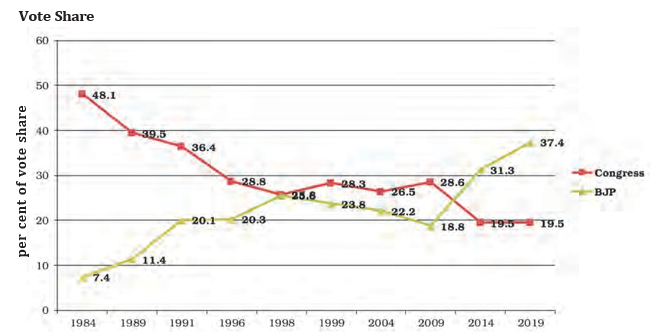
- After 1989, Congress declined and the BJP rose in a highly competitive party system.
- The 2004 and 2009 elections brought Congress-led UPA governments to power.
- The BJP won single-party majorities in 2014 and 2019, but coalition politics remained significant.
- Most parties share broad positions on economic policy, backward-caste claims, regional parties and pragmatic alliances.
- Movements and citizens keep issues of livelihoods, social security, equality and justice on the political agenda.
Political Science — ALL CHAPTERS
1
THE END OF BIPOLARITY
2
CONTEMPORARY CENTRES OF POWER
3
CONTEMPORARY SOUTH ASIA
4
INTERNATIONAL ORGANISATIONS
5
SECURITY IN THE CONTEMPORARY WORLD
6
ENVIRONMENT AND NATURAL RESOURCES
7
GLOBALISATION
1
Challenges of Nation Building
2
Era of one-party dominance
3
Politics Of Planned Development
4
India’s external relations
5
Challenges to and Restoration of the Congress System
6
The Crisis of Democratic Order
7
Regional Aspirations
8
Recent Developments in Indian Politics