Class 12 Humanities . Sociology . Social Change And Development In India . Cultural Change
Chapter 2: Cultural Change
Ch 2
Sociology
Class 12 Humanities
Social reform movements in the 19th and early 20th century
Social Structure, Culture and Cultural Change
- Social structure: Colonialism changed people’s relationships and institutions through industrialisation and urbanisation.
- Cultural change: These structural shifts also affected ways of life, norms, values and behaviour.
- Chapter focus: The chapter examines deliberate reform efforts and broader changes in cultural practices.
Origins and Character of 19th-Century Reform
| Reformer or idea | Traditional reference | Modern idea or contribution |
|---|---|---|
| Raja Ram Mohun Roy opposed sati | Hindu shastras | Humanitarian principles and natural-rights doctrines |
| Ranade supported widow remarriage | Shastric authority for widow marriage, explored in his writings | Reform through reinterpretation of Hindu law |
| Sir Syed Ahmed Khan promoted free enquiry (ijtihad) | Islamic thought and Koranic revelations | He emphasised similarities between revelation and laws of nature discovered by modern science |
| Kandukiri Viresalingam engaged with traditional scholarship | Navya-Nyaya logic | He translated works by biologist Julius Huxley |
| New education | Indian heritage and tradition remained important | Humanistic, secular and liberal ideas drawn from the European Renaissance, Reformation and Enlightenment |
The Modern Framework of Change
- Modern framework: Social reform in colonial India drew on new ideas while reinterpreting traditional knowledge and texts.
- Key dimensions: Faster communication, modern organisations and changing ideas helped reform debates spread across regions.
Education, Women and Competing Ideas of Tradition
Differences, Debates and Opposition
Key Dates in the Lecture
- 19th centurySocial reform movements emerged in response to the challenges of colonial Indian society.
- 1864Keshav Chandra Sen of Bengal visited Madras.
- 1868Vishnu Shastri published a Marathi translation of Vidyasagar's book in Indu Prakash.
- 1914The All-India Muslim Ladies Conference (Anjuman-E-Khawatn-E-Islam) was founded.
- Early 20th centuryNationalists continued efforts to change discriminatory social practices.
- Ijtihad
- Free enquiry in Islamic thought, emphasised by Sir Syed Ahmed Khan.
- Shastric sanction
- Support or authority for a practice drawn from Hindu sacred texts.
- Social reform
- Deliberate efforts to change discriminatory social practices.
What distinguished 19th-century social reform from earlier challenges to discrimination?
What three features shaped the modern framework of change in colonial India?
Why did reformers disagree about social reform?
Quick recap
- Colonial structural changes shaped cultural change, but structure and culture describe different aspects of social life.
- Nineteenth-century reform challenged sati, child marriage, restrictions on widow remarriage and caste discrimination.
- Reform combined Western liberal ideas with reinterpretations of Indian religious and intellectual traditions.
- Communication, modern organisations and new ideas helped reform debates spread across regions.
- Women's education was a central issue; Jotiba Phule opened the first school for women in Pune.
- Reform movements differed in priorities and faced opposition, including debates over polygamy, sati and authority to interpret sacred texts.
Different Kinds of Social Change
Four Processes and Their Interactions
How social-change processes coexist
- Four processes: The chapter examines Sanskritisation, modernisation, secularisation and westernisation.
- Overlap: These processes can overlap and operate together, but they can also affect people in different ways.
- Mixed patterns: One person may be modern in some respects and traditional in others; this coexistence is common in India and other non-Western societies.
- Sociological view: Such patterns should be explained through social conditions, rather than simply treated as natural.
Colonial modernity and its paradox
- Colonial rule expanded Western education.
- An English-educated Indian middle class encountered Enlightenment ideas and liberal democracy.
- Many hoped for a liberal, progressive India, yet colonial humiliation also encouraged pride in traditional learning and scholarship.
- The result was a combination of new political ideas and renewed interest in tradition, also visible in nineteenth-century reform movements.
Modernity, Culture and Tradition
Living culture and tradition — Culture and tradition are learned and continually modified by the people who practise them.
Tradition can be reinterpreted
- Modernity: It brings not only new ideas but also rethinking and reinterpretation of tradition.
- Sari example: Regional styles of wearing the traditional, unstitched sari changed as it was combined with a Western petticoat and blouse.
- Meaning: A modern practice can adapt traditional forms rather than simply replace them.
Diversity and Mixed Cultural Practices
Why social change varies
- Diversity: India’s structural and cultural diversity shapes how social-change processes affect different groups.
- Uneven effects: The effects may vary between regions, classes, castes, communities, and women and men within the same group.
- Mix-and-match: Everyday life can combine cultural elements from different traditions; such combinations also occur at wider social levels.
Example of a mixed cultural identity
- Clothing: A South Indian Brahmin man wore a traditional caste mark and dhoti, while pairing them with English-style ties, buttons, collar studs and a serge jacket.
- What it illustrates: Traditional identity and Western clothing could coexist in one person’s everyday life.
- Modernity
- A social condition involving new ideas and the reinterpretation of tradition.
- Cultural diversity
- Differences in cultural and social life across groups and settings.
- Coexistence
- Different or apparently contrasting ways of life operating together.
- Mix-and-match
- Combining elements from different cultural traditions in practice.
Period mentioned
- 19th centuryReform movements reflected the combination of Western ideas and renewed pride in traditional learning.
How can modernity and tradition coexist?
Why do social-change processes affect groups differently?
Quick recap
- Sanskritisation, modernisation, secularisation and westernisation may overlap or operate differently.
- People can combine modern and traditional practices in their lives.
- Colonial education spread Western ideas while colonial humiliation could renew pride in traditional scholarship.
- Modernity can reinterpret tradition rather than simply replace it.
- Cultural practices change through learning and adaptation, as the sari example shows.
- The effects of social change vary across regions and social groups.
Sanskritisation
Meaning and scope
Sanskritisation — A process in which a lower-status caste, tribe or group adopts the names, customs, beliefs, rituals, ideology and lifestyle of a culturally higher-status group, especially a twice-born (dwija) caste.
Features and regional variation
- Coined by: Sociologist M.N. Srinivas.
- Influence: Seen in language, literature, ideology, music, dance, drama, lifestyle and ritual.
- Reach: Primarily occurred within Hindu society, though Srinivas also observed it among sects and religious groups outside Hinduism.
- Regional patterns: Sanskritised castes shaped regional culture where they were dominant; non-Sanskritic dominant castes shaped it elsewhere.
- De-Sanskritisation: The stronger influence of non-Sanskritic castes in a region can be described by this term.
- Punjab: Sanskritic influence was relatively weak; Persian influence remained dominant until the third quarter of the 19th century.
Regional cultural influence
- Until the third quarter of the 19th centuryPersian influence was dominant in Punjab, where Sanskritic influence was relatively weak.
Status mobility and its limits
Conditions and obstacles
- Possible outcome: Sanskritisation could improve a group's position in the local caste hierarchy.
- Conditions: It usually followed improved economic or political status, or greater group self-consciousness through contact with a source of Hinduism's Great Tradition.
- Sources of contact: These could include a pilgrimage centre, monastery or proselytising sect.
- Material basis: The reference group was usually better off financially; the aspiration to imitate it generally arose as people became wealthier.
- Resistance: Dominant castes traditionally punished lower castes that attempted to adopt their customs.
Illustration: Kumud Pawade
- Experience: In her autobiography, Kumud Pawade recounts becoming a Dalit woman Sanskrit teacher.
- Barriers: Her studies brought reactions from surprise and guarded acceptance to hostility and rejection, reflecting caste and gender barriers.
- Significance: Her experience shows that access to a culturally valued field did not make caste identity or discrimination disappear.
Criticisms and later shifts
Major criticisms
- Limited mobility: It can exaggerate upward mobility; it generally changes the position of some individuals or groups, not the unequal social structure.
- Upper-caste norms: It treats upper-caste ways as superior and lower-caste ways as inferior, making imitation appear natural or desirable.
- Inequality and exclusion: It can seem to legitimise caste hierarchy and beliefs in purity and pollution.
- Gendered effects: Adopting upper-caste practices could involve secluding girls and women and replacing bride-price with dowry.
- Discrimination: The adopted practices could also reinforce caste discrimination against other groups.
- Cultural erosion: It can devalue Dalit work, crafts, artisanal skills and knowledge of medicine, ecology, agriculture and animal husbandry.
Alternative paths and identity
- Anti-Brahminical movements: In the 20th century, regional self-consciousness and anti-Brahminical movements encouraged efforts in several Indian languages to remove Sanskrit words and phrases.
- Backward Classes Movement: It highlighted secular factors as important to the upward mobility of caste groups and individuals.
- Dominant castes: Prestige increasingly came from belonging to a dominant caste, rather than claiming Vaishya, Kshatriya or Brahmin status.
- Dalit assertion: Dalits increasingly took pride in their Dalit identity rather than seeking status through imitation.
Later cultural and political shifts
- 20th centuryAnti-Brahminical movements and regional self-consciousness encouraged the removal of Sanskrit words and phrases in several Indian languages.
- Later yearsBackward Classes movements highlighted secular mobility, while dominant-caste and Dalit identities gained pride and prestige in their own right.
| Point | Positional change | Structural change |
|---|---|---|
| Meaning | A group or individual improves their place within the existing hierarchy. | The unequal social structure itself is transformed. |
| Sanskritisation | May enable some upward movement through adopting higher-status names and customs. | Does not, by itself, remove caste inequality. |
- Twice-born (dwija)
- A high-status caste treated as a cultural reference group in Sanskritisation.
- Great Tradition
- A wider Hindu cultural tradition encountered through sources such as pilgrimage centres, monasteries and proselytising sects.
- De-Sanskritisation
- A regional process in which non-Sanskritic caste influence is stronger.
- Positional change
- Improvement in status within an existing unequal social structure, without transforming that structure.
What is Sanskritisation, and under what conditions can it improve a group's status?
Give two major criticisms of Sanskritisation.
Quick recap
- Sanskritisation, a term coined by M.N. Srinivas, describes lower-status groups adopting the names and customs of higher-status groups, especially twice-born castes.
- Its influence and strength varied by region; non-Sanskritic dominance could produce de-Sanskritisation.
- It could improve local status, but usually depended on material advancement or increased group self-consciousness and could face dominant-caste resistance.
- It may produce positional mobility without structural change and can reinforce hierarchy, exclusion and gendered practices.
- It may erode Dalit identities and knowledge, while later movements stressed secular mobility, regional self-consciousness and pride in Dalit identity.
Westernisation
Meaning and Forms of Westernisation
Westernisation — M.N. Srinivas defined it as changes in Indian society and culture resulting from over 150 years of British rule, across technology, institutions, ideas and values.
| Form | Who or what it involves | Examples |
|---|---|---|
| Westernised subculture | A minority who first came into contact with Western culture | Western ideas, ways of thinking and lifestyles; some early 19th-century reformers promoted these patterns |
| Wider spread of cultural traits | Broader sections of society | Technology, clothing, food and everyday habits; many middle-class homes adopted televisions, fridges, sofas and dining tables |
External Forms and Social Values
- Imitation: Westernisation can involve adopting outward forms of Western culture.
- Not automatic: Western dress, education or technology does not necessarily mean acceptance of democracy or equality.
- Contradictions: A Western-educated person may hold prejudiced views; a Western-style home may still uphold conservative gender roles.
- Technology and discrimination: Female foeticide shows how modern technology can be used alongside discriminatory attitudes towards women.
Do not equate Western appearance or technology with democratic, egalitarian values; cultural forms and social attitudes can change at different rates.
Western Influence on Art and Literature
- Colonial encounter: Indian artists and writers engaged with Western influence while drawing on indigenous traditions.
- Examples: Ravi Varma, Abanindranath Tagore, Chandu Menon and Bankimchandra Chattopadhya grappled with this encounter.
- Ravi Varma’s commission: In 1870, he received his first paid commission to paint Kizhakke Palat Krishna Menon’s family.
- Mixed techniques: The work blended an older, flatter watercolour style with oil painting, perspective and illusionism.
- Social conventions: The figures’ arrangement reflected age and hierarchy, as well as European bourgeois portrait conventions.
- Social tension: The portrait represented a family in matrilineal Kerala in a style resembling a Western patrilineal nuclear family.
Key Dates and Periods
- Early 19th centurySome Indian reformers adopted and supported Western ideas and lifestyles.
- 1870Ravi Varma received his first paid commission to paint Krishna Menon’s family.
Generational Differences
- Cultural conflict: Differences in clothing, music, speech and ideas can be experienced as generational conflicts linked to westernisation.
- Not the only cause: Generational differences need not arise only from Western influence, and conflict is not necessarily harmful.
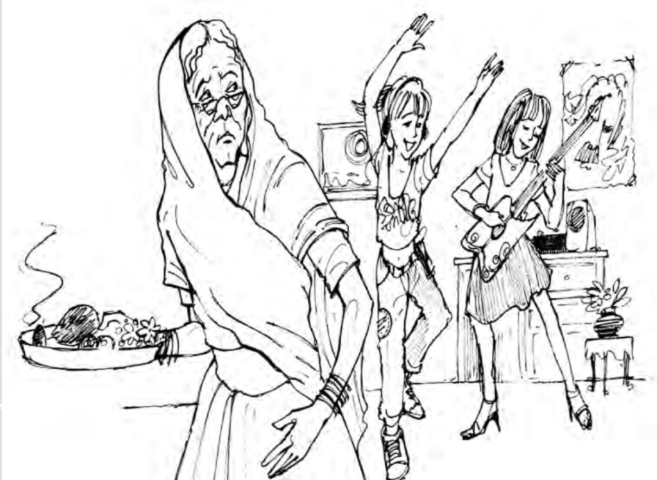
- Illustration: An older woman’s traditional cooking contrasts with younger people enjoying modern music.
Westernisation Across Caste and Region
- Srinivas’s observation: He suggested that lower castes sought Sanskritisation while upper castes sought westernisation.
- Limits of the generalisation: India’s diversity makes this pattern difficult to apply uniformly.
- Thiyyas in Kerala: Studies show that some Thiyyas, not considered an upper caste, consciously adopted Western culture.
- Purpose: Elite Thiyyas used British culture to pursue a cosmopolitan life and critique caste.
Western Education in the North-East
- Opportunity: For many Naga families, education offered a path to advancement and access to new opportunities.
- Communication: English connected communities whose nearby tribes spoke different languages and enabled communication with the wider world.
- Public role: Educated Nagas became voices for their people; English became the official state language.
- Example: One account describes a Naga mother educated away from home and a father who studied at a mission school and college in Shillong.
Westernisation and Claims of Modernity
- Jotiba Phule’s criticism: He challenged upper-caste leaders who presented themselves as modern while serving the British, then returned to Brahmanical practices after retirement.
- Key idea: Claims of being modern may conflict with traditional social practices and hierarchies.
- Westernisation
- Changes in Indian society and culture associated with British rule.
- Westernised subculture
- A pattern of Western ideas and lifestyles adopted and promoted by a minority.
- Cosmopolitan
- Open to influences and ways of life beyond one’s own local community.
- Matrilineal
- A social system in which descent or family relations are traced through the mother’s line.
Why does westernisation not necessarily lead to modern democratic values?
How does Ravi Varma’s commissioned family portrait show a mixture of Western and indigenous influences?
Quick recap
- Westernisation refers to changes in Indian society and culture associated with over 150 years of British rule.
- It includes both minority adoption of Western ways and the wider spread of Western cultural traits.
- Adopting Western styles or technology does not guarantee democratic or egalitarian values.
- Indian art and literature combined Western and indigenous influences in varied ways.
- Westernisation can shape generational differences, caste relations and opportunities across regions.
- English education in the North-East supported advancement, communication and public representation.
Modernisation and Secularisation
Modernisation
What Modernisation Changes
- Choices: Work and social associations increasingly depend on personal choice rather than family or caste birth.
- Achievement: A person’s status and identity are increasingly linked to what they achieve, not simply to who they are by birth.
- Outlook: Universal influences and a scientific attitude become more important than exclusively local or inherited perspectives.
Changing Use of the Term
- 19th centuryModernisation increasingly became associated with positive and desirable values.
- 20th centuryThe term gained wider use, referring to a broad path of social development.
Secularisation
- Meaning: Secularisation usually refers to a decline in religion’s influence on society and people’s lives.
- Indicators: It can be assessed through involvement in religious organisations, their social influence and people’s religious beliefs.
- Indian context: Modernisation has not simply displaced religion; religious consciousness and reform movements have also continued.
Secular Aspects of Rituals
- Socialising: Rituals provide occasions to meet peers and superiors and strengthen social relationships.
- Status display: Wealth, clothing, jewellery and the presence of prominent guests can signal a family’s standing.
- Changing emphasis: Economic, political and status dimensions of rituals have become increasingly conspicuous.
Secularisation of Caste
Caste and Political Mobilisation
- Kothari’s argument: Politics is competitive and seeks power to achieve goals; it therefore organises and mobilises existing social allegiances.
- Mass politics: When caste is a major structure through which people are organised, politicians may mobilise caste identities to build support.
- Mutual change: Politics changes the form of caste organisations, just as caste structures shape how political support is organised.
- Better question: Ask what form caste and politics take under each other’s influence, rather than simply asking whether caste is disappearing.
Do not equate secularisation with the disappearance of religion or caste: both may change their forms and social roles.
Modernity and Social Change in India
- Modernisation
- Social change associated with modern ideas, institutions, and ways of life.
- Secularisation
- A change commonly associated with declining religious influence, though religion may also persist or take new forms.
- Secular dimensions of ritual
- Social, economic, political, or status-related functions of rituals.
- Secularisation of caste
- The shift of caste towards political organisation and mobilisation, rather than disappearance of caste.
What are the main features of modernisation?
What is meant by secularisation of caste?
Quick recap
- Modernisation came to mean a broad path of development, not only improved technology and production.
- Modernity emphasises universal outlooks, science, individual choice, and achieved identity.
- Secularisation is often described as declining religious influence, but religion may persist, grow, or change.
- Rituals can have secular goals and also social, economic, political, and status dimensions.
- Caste has taken on political roles through associations and parties; this change is not its disappearance.
- Indian social change involved adopting, questioning, and reinterpreting Western ideas and tradition.
Sociology — ALL CHAPTERS
1
INTRODUCING INDIAN SOCIETY
2
THE DEMOGRAPHIC STRUCTURE OF THE INDIAN SOCIETY
3
SOCIAL INSTITUTIONS CONTINUITY AND CHANGE
4
THE MARKET AS SOCIAL INSTITUTIONS
5
PATTERNS OF SOCIAL INEQUALITY AND EXCLUSION
6
THE CHALLENGES OF CULTURAL DIVERSITY
7
SUGGESTIONS FOR PROJECT WORK
1
Structural Change
2
Cultural Change
3
The Constitution and Social Change
4
Change and Development in Rural Society
5
Patterns of Industrialisation and Urbanisation
6
Globalisation and Social Change
7
Mass Media and Communications
8
Social Movements