Class 12 Humanities . Sociology . Social Change And Development In India . Structural Change
Chapter 1: Structural Change
Ch 1
Sociology
Class 12 Humanities
Understanding Colonialism
Colonialism and Its Distinctive Impact
- Distinctive impact: British colonialism brought far-reaching changes to India’s economy and social structure, unlike earlier rule that generally left the economic base intact.
- Colonial policies: Laws and policies reshaped land ownership, crops, manufacturing, production and distribution to serve British interests.
Colonialism and the Movement of People
- Migration: Colonial rule moved people within India and across the seas, often to meet labour and administrative needs.
- Consequences: Many workers faced coercive recruitment and hardship; some migrants could not return and formed communities of Indian origin abroad.
Capitalism and Colonialism
- Capitalism: An economic system in which privately owned means of production are organised to accumulate profit through markets.
- Colonial connection: British colonial rule directly served the expansion and profits of British capitalism, shaping India’s economic development.
Nation-States, Nationalism and Colonial Rule
Colonial Rule and the Demand for Swaraj
- British rule over India imposed foreign authority.
- Nationalism asserted that Indians had an equal right to sovereignty.
- Indian nationalist leaders highlighted the contradiction between colonial rule and the principles of nationalism and democracy.
- Demand for swaraj expressed the struggle for political and economic freedom.
Travel and Indenture
- Before the First World WarPassports were not widely used for international travel; few people in most areas had one.
- 1834–1920Ships regularly carried workers from Indian ports to plantations in Mauritius, where they had to work for at least five years.
- Tribute
- Wealth or surplus extracted by a ruling power from a dominated region.
- Means of production
- Resources and tools used to produce goods and services.
- Sovereignty
- Supreme authority to govern a territory and its people.
- Swaraj
- Self-rule; the Indian nationalist demand for political freedom.
How did British colonialism differ from pre-capitalist empire-building?
Why are colonialism and nationalism contradictory?
Quick recap
- Colonialism: British rule brought deep changes and organised policies around expanding British capitalist profit.
- Economic change: Colonial authorities altered land laws, crops, manufacturing, trade and forest access.
- Movement: Colonialism moved people within India and across the world, including plantation workers sent to Mauritius.
- Capitalism: Private ownership and market-based profit, expansion and innovation are central features.
- Nation-state: A modern state exercises sovereignty over a defined territory whose people share citizenship.
- Nationalism: The right of people to govern themselves challenged foreign colonial rule and fuelled the demand for swaraj.
Urbanisation and Industrialisation
Industrialisation and Urbanisation
Britain’s Urban Growth
- 1800Well under 20% of Britain’s population lived in towns or cities with more than 10,000 people. London had about 1.1 million residents.
- 1900The share living in such towns and cities had risen to 74%; more than three-quarters of a century earlier, London had grown to over 7 million by the start of the twentieth century.
- Start of the twentieth centuryLondon was the world’s largest city of its time and a major manufacturing, commercial and financial centre.
Colonial Industrialisation and Indian Society
Why Some Indian Artisans Turned to Agriculture
- Cheap imported European goods and Western-style factories in India weakened village industries.
- High agricultural prices made farming more attractive to some village artisans.
- Many artisans left hereditary crafts and took up agriculture.
- The old village organisation was disrupted, with the extent of change varying by region.
Colonial Cities and Global Capitalism
| Proposed route to a middle class | Limitation in the colonial context |
|---|---|
| Land ownership | Zamindari landholding was often disconnected from agricultural productivity; zamindars were described as becoming parasites on the land. |
| English education | Education was disconnected from mainstream Indian cultural traditions, and many graduates became job seekers. |
| Overall outcome | These alternatives did not create a genuine, productive middle class. |
The Emergence of Kolkata
- 1690English merchant Job Charnock arranged to lease three villages—Kolikata, Gobindapur and Sutanuti—beside the Hugli River for a trading post.
- 1698Fort William was established for defence; the fort and the cleared open ground around it, called the Maidan, formed the core of the rapidly emerging city.
European and Native Towns
- Industrialisation
- The development of machine-based production using inanimate power.
- Urbanisation
- The growth of towns and cities and the movement towards urban living.
- Deindustrialisation
- The decline of existing manufacturing and craft industries.
- Core and periphery
- An unequal economic relationship in which a centre benefits from resources and markets in the margins.
How did colonial industrialisation affect Indian urban centres and occupations?
Why were colonial coastal cities important to the British empire?
Quick recap
- Industrialisation is machine-based production; it often accompanies urbanisation, but the two are not identical.
- Britain’s industrial growth coincided with rapid urban growth, including London’s dramatic expansion.
- British competition weakened Indian crafts and exports, contributing to the decline of some older towns.
- In India, colonial industrialisation initially pushed many artisans towards agriculture rather than urban factory work.
- Colonial port cities linked Britain’s economic core to India’s resource-exporting periphery.
- Kolkata grew from a trading post and Fort William settlement; European and native areas had unequal facilities.
The Tea Plantations
Colonial Industrialisation and Tea Plantations
Colonial influence
- Key point: India’s industrialisation and urbanisation followed a different course from Britain because they were shaped by colonial interests—not simply because they began later.
- Tea industry: Its development shows how colonial authorities supported British planters, including through unfair labour recruitment and workers’ forced retention.
- Double standard: Officials knew harsh measures served planter interests and that colonial laws did not have to follow the democratic norms applied in Britain.
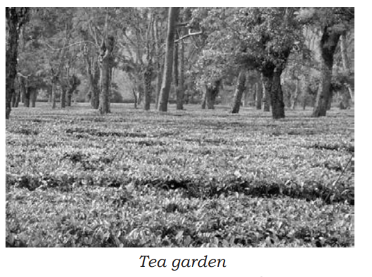
Recruitment and Control of Labour
Why labour was imported and how it was recruited
- Location: Most tea gardens were in Assam, often on remote, sparsely populated hillsides with unhealthy climates and unfamiliar fevers.
- Labour supply: Planters brought large numbers of workers from other provinces because local populations were insufficient.
- Recruitment: Planters were unwilling to provide adequate financial and other incentives; contractors used fraud and coercion to recruit workers.
- Control: Penal laws helped planters hire and forcibly retain labourers, with colonial government support.
Tea Industry and Labour Legislation
- 1851The tea industry began in India.
- 1863The Bengal Transport of Native Labourers Act (No. III) regulated recruitment for Assam tea gardens.
- 1865, 1870 and 1873The 1863 Act was amended.
- 1903The tea industry employed 4,79,000 permanent and 93,000 temporary workers.
Recruitment of Plantation Labour
- Remote, sparsely populated Assam gardens → insufficient local labour.
- Planters’ demand for many workers → recruitment from distant provinces.
- Unwillingness to offer incentives → reliance on contractor fraud and coercion.
- Government-backed penal laws → workers could be recruited and forcibly kept for planter benefit.
| Point | Labourers | Planters |
|---|---|---|
| Conditions | Recruited from far away, often through fraud or coercion; could be forcibly retained. | British managers and their families lived in comfort despite the gardens’ remoteness. |
| Living arrangements | Worked in plantations located in unhealthy, isolated areas. | Occupied large bungalows on stilts, with lawns, flower beds and many servants. |
| Access to goods and services | Faced difficult conditions in unfamiliar surroundings. | Servants and imported goods—from food and household items to bathtubs—supported a luxurious lifestyle. |
Industrialisation in Independent India
Nationalist aims and the role of the state
- Independent state: The Indian state actively promoted industrialisation, partly in response to colonialism’s effects on industry.
- Nationalist concern: Economic exploitation under colonial rule was central; the image of India’s pre-colonial riches contrasted with poverty under British rule.
- Swadeshi movement: Strengthened support for the national economy.
- Development vision: Nationalists saw poverty as preventable and rapid industrialisation as a route to economic growth and social equity.
- Priorities: Develop heavy and machine-making industries, expand the public sector and maintain a large cooperative sector.
Nationalist Industrialisation Vision
- Colonial economic exploitation and widespread poverty → demand for a stronger national economy.
- Swadeshi support and belief that poverty could be prevented → calls for rapid industrialisation.
- Industrialisation → intended to promote both growth and social equity.
- Development priorities → heavy and machine-making industries, public-sector expansion and a large cooperative sector.
- Penal laws
- Laws imposing legal penalties that were used to support the recruitment and control of plantation labour.
- Transport of Native Labourers Act
- A Bengal law of 1863, amended in 1865, 1870 and 1873, under which contractors recruited labour for Assam tea gardens.
- Swadeshi movement
- A movement that strengthened loyalty to and support for the national economy.
- Public sector
- Economic activity and industries owned or run by the state.
- Cooperative sector
- Economic organisations owned and managed collectively by their members.
How were labourers recruited for Assam’s tea plantations?
What were the main priorities of nationalist industrialisation?
Quick recap
- Colonial interests shaped India’s industrialisation; tea plantations reveal the exploitation of labour.
- Assam’s remote gardens depended on imported workers, often recruited through fraud and coercion.
- The colonial state supported planters through penal laws and recruitment legislation.
- Planters lived in luxury while plantation labourers faced harsh and isolated conditions.
- Independent India’s state promoted industrialisation in response to colonial economic effects.
- Nationalists linked industrialisation with growth and social equity, emphasising heavy industry, the public sector and cooperatives.
Urbanisation in Independent India
Urbanisation — The growth of urban populations and settlements, and the increasing influence of urban life on surrounding areas.
Urban influence on villages
- M.S.A. Rao: Writing about the first two decades after Independence, Rao argued that villages increasingly experience urban influences, but their effects vary according to each village’s relationship with a city or town.
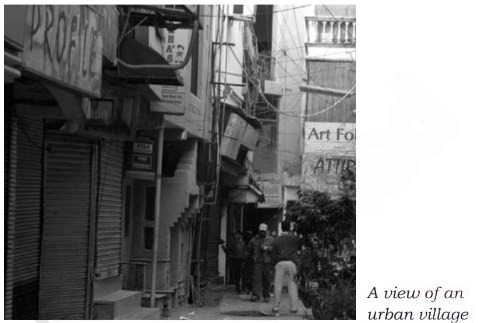
| Pattern | How urbanisation affects villages | Examples and effects |
|---|---|---|
| Migration to distant cities, including overseas migration | Some residents leave for work while family members remain in the natal village; migrants may maintain strong links with it. | In Madhopur, 77 of 298 households had migrants; just under half worked in Bombay and Calcutta. About 75% sent money regularly, and 83% visited between four or five times a year and once every two years. Migrants from Gujarat villages living in African and British towns built houses, invested in land and industry, and donated to educational institutions and trusts. |
| Village near an industrial town | Industrial development may uproot some villages and acquire part of the land of others. | Around a town such as Bhilai, immigrant workers can increase demand for housing and create a village market; relations between native residents and immigrants may become difficult to manage. |
| Expansion of a metropolitan city | Some villages are absorbed completely, while urban development uses the land of others outside their inhabited areas. | The effects depend on how city expansion reaches the surrounding villages. |
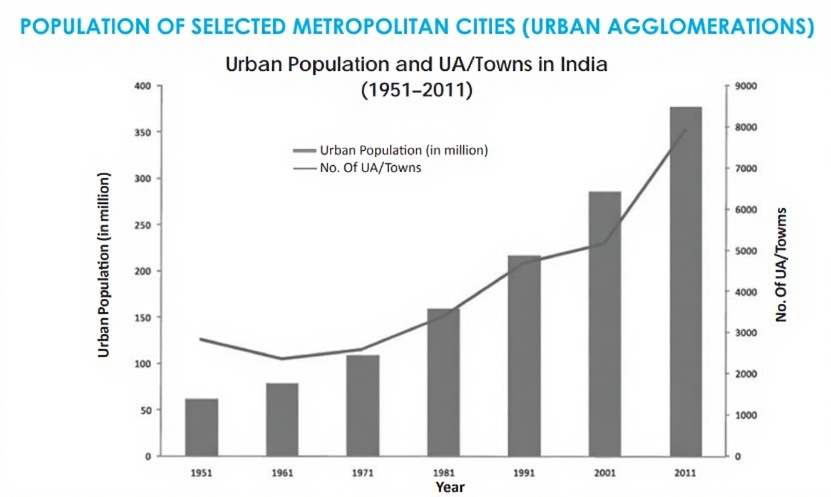
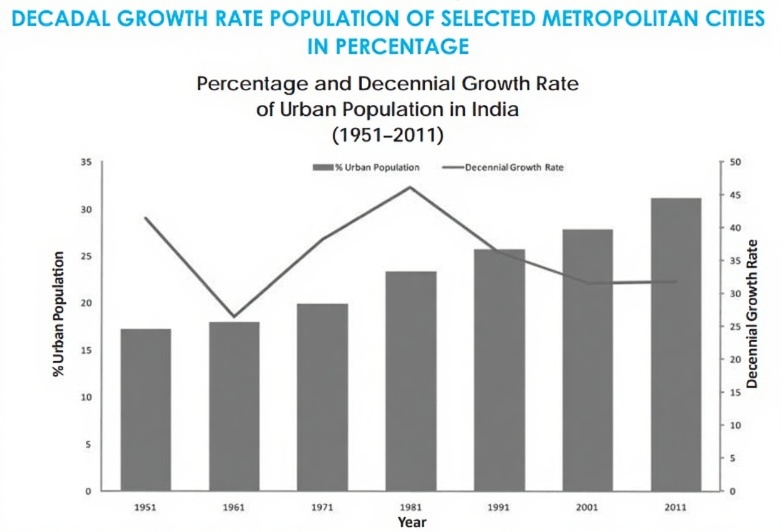
| Measure | 1951 | 2011 |
|---|---|---|
| Share of India's population living in urban areas | 17.29% | 31.16% |
| Urban population | 62.44 million | 377.10 million |
| Number of towns | 2,843 | 7,935 |
| Decennial urban population growth rate | 41.42% | 31.80% |
Trends in urban growth
- Overall rise: Urban population, the number of urban agglomerations and towns, and the urban share of the population all increased.
- Growth rate: The decennial growth rate declined during 1981–2001, then showed a marginal increase in 2011.
- Urban and rural increase: For the first time since Independence, the absolute population increase was greater in urban than rural areas.
- Reason: Rural population growth fell sharply, while the urban growth rate remained almost unchanged.
Urbanisation as social change
- Colonial legacy: Colonialism continues to shape contemporary life in complex ways.
- Beyond the economy: Industrialisation and urbanisation change production systems, technology and settlement density, as well as ways of life.
- Urban way of life: Wirth (1938) highlighted urbanisation as a change in how people live, not only where they live.
Key dates and periods
- 1938Wirth associated urbanisation with a way of life.
- 1951Urban areas contained 17.29% of India's population, or 62.44 million people, across 2,843 towns.
- 1981–2001The decennial growth rate of India's urban population declined.
- 2011Urban areas contained 31.16% of India's population, or 377.10 million people, across 7,935 towns.
- Urbanisation
- Growth of urban populations and settlements, alongside the spread of urban influences.
- Natal village
- A migrant's village of origin.
- Urban agglomeration
- An urban area counted as a connected settlement grouping.
- Decennial growth rate
- The rate of population growth over a ten-year period.
What are M.S.A. Rao's three patterns of urban impact on villages?
How did India's urban population change between 1951 and 2011?
Quick recap
- Urban influences reach villages in different ways depending on their links to cities and towns.
- Rao identified migration to distant cities (including overseas migration), nearby industrial towns and metropolitan expansion as three patterns of urban impact.
- From 1951 to 2011, India's urban population, urban share and number of towns increased substantially.
- The urban decennial growth rate generally declined, although it rose marginally in 2011.
- Urban population increase exceeded rural increase for the first time since Independence, as rural growth slowed sharply.
- Industrialisation and urbanisation transform production, technology, settlement density and ways of life.
Sociology — ALL CHAPTERS
1
INTRODUCING INDIAN SOCIETY
2
THE DEMOGRAPHIC STRUCTURE OF THE INDIAN SOCIETY
3
SOCIAL INSTITUTIONS CONTINUITY AND CHANGE
4
THE MARKET AS SOCIAL INSTITUTIONS
5
PATTERNS OF SOCIAL INEQUALITY AND EXCLUSION
6
THE CHALLENGES OF CULTURAL DIVERSITY
7
SUGGESTIONS FOR PROJECT WORK
1
Structural Change
2
Cultural Change
3
The Constitution and Social Change
4
Change and Development in Rural Society
5
Patterns of Industrialisation and Urbanisation
6
Globalisation and Social Change
7
Mass Media and Communications
8
Social Movements