Class 12 Humanities . Sociology . Indian Society . Suggestions for Project Work
Chapter 7: SUGGESTIONS FOR PROJECT WORK
Ch 7
Sociology
Class 12 Humanities
INTRODUCTION & Variety of Methods
Introduction to Practical Research
- Purpose: Practical projects let students experience systematic evidence-gathering and the excitement and difficulties of sociological research.
- Scope: The suggested projects are introductory exercises; students may develop their own ideas with their teachers.
Choosing a Suitable Research Method
From Question to Method
- Formulate a specific research question.
- Identify what evidence would answer it.
- Select a method that fits the question and practical constraints.
Example: Comparing Types of Schools
- Broad topic: Comparing co-educational schools with boys-only or girls-only schools.
- Make it specific: Ask, for example, whether students in single-sex schools are happier than students in co-educational schools.
- Possible approaches: Interview students about their feelings, observe their behaviour using decided criteria, or survey them with a questionnaire.
- Fair comparison: A survey could ask equal numbers of students from each type of school the same questions.
Practical Challenges in Research
- Preparation: Research requires time, effort, resources and, in some settings, permission to approach participants.
- Fieldwork: Participants may not return questionnaires or may leave answers incomplete, so researchers must decide how to handle these problems.
Variety of Methods
Interview — An interview is an in-person method, usually used with a smaller number of people, to explore their views or experiences.
| Type | How it is conducted |
|---|---|
| Structured | Follows a pre-determined pattern of questions. |
| Unstructured | Uses pre-decided topics; questions emerge during conversation. |
| Intensive | Explores a person’s account in depth, possibly in a 2–3 hour interview or through repeated visits. |
Observation — Observation is the systematic watching and recording of what happens in a selected research setting.
Combining Methods
| Point | Survey | Interview |
|---|---|---|
| People covered | Relatively large number | Usually a smaller number |
| Questions | Fixed; little or no follow-up | Can be clarified, refined or followed up |
| Main strength | Can represent a larger relevant group | Provides more detailed, flexible accounts |
| Main limitation | May miss misunderstandings or changing circumstances | Represents selected individuals, not a large population |
- Research question
- A specific question that guides an investigation.
- Survey
- A method that asks many people the same fixed questions.
- Structured interview
- An interview that follows a pre-set question pattern.
- Unstructured interview
- An interview guided by topics, with questions developing in conversation.
- Archival method
- Using records or materials from the past as research evidence.
What factors should guide the choice of a research method?
State one strength and one limitation of the survey method.
Quick recap
- Start by making the research question specific, then choose a suitable method.
- Method choice depends on both fit with the question and practical constraints.
- Surveys use fixed questions with many respondents; interviews allow flexible, detailed responses from fewer people.
- Observation requires systematic attention to both what happens and what does not happen.
- Questionnaire research may face access, return and incomplete-answer problems.
- Combining methods can provide evidence from different angles and time periods.
Possible themes and subjects for small research projects
Choosing a Research Project
| Theme | Possible focus |
|---|---|
| Public transport | Dependence, access, social effects, changing forms and transport history |
| Communication media | Media use, preferences, changing formats and media content |
| Household appliances and domestic work | Changes in household tasks, appliance use and division of labour |
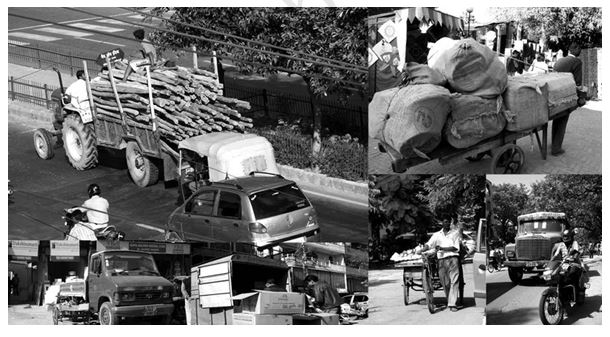
Public Transport
- Social role: Study who needs public transport, why they depend on it and how dependence varies among groups.
- Access and problems: Investigate user difficulties, unequal access and whether differences in access cause social problems; consider non-users’ attitudes too.
- Change over time: Examine how transport forms change and what role they play in people’s lives.
- One transport mode: Trace a tonga, rickshaw or train in a town or city: its history, changes, rivals, competition and likely future.
- Future project: A Delhi Metro scenario set in 2050 or 2060 should connect imagined developments coherently to present conditions and explain the Metro’s future role.
| Research angle | Example question |
|---|---|
| Users and dependence | Which groups rely most on public transport, and why? |
| Unequal access | Does access vary among groups, and what social effects follow? |
| History of a mode | How has a local transport mode changed, and how has it competed with alternatives? |
| Future of transport | How might the Metro develop from present conditions, and what role could it play? |
Communication Media in Social Life
Communication media — Means of conveying information to large audiences or communicating between individuals.
| Type | Examples |
|---|---|
| Mass media | Newspapers, television, films and the internet |
| Interpersonal communication media | Telephone, letters, mobile phones, email and the internet |
- Changing formats: Study shifts among print, radio, television and newer media, including whether each format retains a distinct role or niche.
- Group preferences: Compare likes and dislikes across social classes, age groups or genders—for example, preferences for films or books.
- Views and behaviour: Investigate how people perceive newer media, such as mobile phones and the internet, and how these fit into daily life.
- Observation: Compare what people say about media use with their actual behaviour, such as reported versus observed television viewing time.
- Content analysis: Examine how newspapers, magazines or television treat a selected theme, such as education, environment, caste, religious conflict, sport, or local, regional and national news.

Household Appliances and Domestic Work
Household appliances — Devices used for household work, such as stoves, mixers, grinders, food processors, irons, washing machines, ovens, toasters and pressure cookers.
- Changing work: Explore how household work has changed over time and whether appliances have made tasks easier or changed their nature.
- Division of labour: Study who does which domestic tasks and whether appliances have changed how work is divided within the household.
- Users: Investigate who uses appliances, considering gender, age and whether workers are paid or unpaid.
- Age-related tasks: Compare the household jobs done by younger and older people now and earlier.
- Focused study: Map the distribution of domestic tasks among household members and investigate recent changes.
- Research question
- A specific, investigable question developed from a broad topic.
- Mass media
- Media that convey information to large audiences, such as newspapers and television.
- Content analysis
- A method of examining how media sources treat selected themes or subjects.
- Division of labour
- The way tasks are distributed among people, including within a household.
How should a student turn a broad theme into a workable project?
How can observation strengthen a project on communication media?
Quick recap
- Treat suggested themes as starting points and turn them into specific research questions.
- Choose methods that suit the question; methods can also be combined.
- Public transport projects can examine dependence, access, social effects, changing forms and transport history.
- Media projects can study formats, group preferences, actual use and representations of selected themes.
- Household projects can investigate appliance use, changes in domestic work and its division by gender, age and paid status.
The Use of Public Space
Public Space: Uses and Research Questions
Public space — An open or shared area used by people for a range of social, commercial, and other purposes.
- Examples: Open fields, roadsides and footpaths, vacant plots in housing colonies, and areas outside public offices.
- Uses: Small-scale vending, temporary shops, parking, weddings, religious functions, public meetings, and dumping.
- Shelter: Homeless people may occupy some public spaces and use them as homes.
- Research focus: Compare how poor, middle-class, and affluent groups view these spaces and what resources they provide.
- Change and conflict: Trace how a specific local space’s use changes, whether this creates friction, and the reasons behind it.
| Research question | What to investigate |
|---|---|
| How do groups view public space? | Compare perspectives across poor, middle-class, and affluent groups. |
| What resource does it provide? | Examine how different groups use or depend on the space. |
| How has its use changed? | Trace changes in a specific neighbourhood space over time. |
| Has its use created conflict? | Identify the groups involved, sources of friction, and reasons for the conflict. |
Changing Aspirations of Different Age Groups
Changing aspirations — A research topic that examines how people’s ambitions change over time and whether patterns differ across groups.
- Compare groups: Study differences by age, gender, parental background, or type of school.
- School-age examples: Compare students in Classes V, VIII, and XI.
- Include adults: Ask adults to recall changes in their ambitions and look for patterns across generations.
- Compare periods: Examine changes during school years and changes after school.
| Research group | Possible comparison |
|---|---|
| Different ages | Compare school students in Classes V, VIII, and XI. |
| Gender | Compare the aspirations of boys and girls. |
| Parental backgrounds | Look for patterns associated with different family backgrounds. |
| Adults and generations | Use adults’ memories to compare changes during and after school. |
The Biography of a Commodity
Commodity biography — A study tracing a household item’s life-history through production, exchange, purchase, and social meaning.
- Choose an item: For example, a television, motorcycle, carpet, or piece of furniture.
- Trace its journey: Identify the circuits of exchange through which it reached its current owner.
- Explore social relations: Examine the connections among the people involved in producing, trading, and purchasing it.
- Examine symbolic meaning: Consider what the item represents to its owner, family, and community.
- Creative approach: Write as if the object were telling its own autobiography, including the people and households it encounters.
| Part of the biography | Questions to explore |
|---|---|
| Journey | Through which exchanges did the item pass before reaching the household? |
| Production and trade | What social relations connected its producers, traders, and buyers? |
| Ownership and use | How is the item used, and what does it mean to its owner and family? |
| Wider significance | What might it represent to the surrounding community? |
Choosing Observation and Survey Questions
| Research topic or area | Observation | Survey |
|---|---|---|
| Public transport: local railway or bus station | Observe behaviour, expected etiquette, and how people share space. | Ask about experiences, difficulties, and opinions on changes over time. |
| Domestic appliances and cooking modes | Study patterns of use, domestic division of labour, and gender aspects. | Ask about attitudes and memories relating to different appliances. |
| Use of public spaces | Compare how similar open spaces are used in different localities. | Ask a cross-section of people about different uses of specific spaces. |
| Schoolchildren’s changing aspirations | Observation is not suitable for this topic. | Compare boys and girls, or ask adults from different generations to recall their aspirations. |
| Communication in social life | Observe how people use mobile phones in public and what place these devices have in their lives. | Compare how much different groups watch television and which programmes they prefer. |
Matching Research Methods to a Project
| Research area | Archival sources | Interviews | Comments and suggestions |
|---|---|---|---|
| Public transport | Newspapers and other sources on its history of change. | Views of regular and occasional users; men and women. | May be most suitable for larger cities. |
| Domestic appliances | Advertisement patterns for different kinds of appliances. | Ask how different kinds of people respond to specific appliances. | Encourage boys to take part; do not treat this as only a girls’ topic. |
| Public spaces | Find out how a particular space was used over the years. | Compare views across social classes and groups. | Choose familiar, specific places that people know and can relate to. |
| Changing aspirations | Use past material where available, such as school essays. | Talk to one group about how its aspirations changed, or interview different age groups. | Interviewees should not be from the researcher’s own school. |
| Communication and social life | Analyse media coverage and content on a current issue. | Ask how people feel about changes such as the decline of letter writing after phones arrived. | Avoid prejudging the issue: ask questions rather than telling respondents what to think. |
What aspects of public space can be examined in a sociology project?
How can a project investigate changing aspirations?
What should a commodity biography investigate?
Quick recap
- Public spaces are used for varied activities, and different social groups may view or depend on them differently.
- A study of public space can examine its uses, changes over time, and conflicts around its use.
- Aspirations can be compared across ages, genders, parental backgrounds, and generations.
- A commodity biography follows an item’s journey and examines the social relations behind its production and exchange.
- Choose observation, surveys, interviews, or archival sources to suit the research question.
- Ask neutral questions and avoid telling respondents what to think.
Sociology — ALL CHAPTERS
1
INTRODUCING INDIAN SOCIETY
2
THE DEMOGRAPHIC STRUCTURE OF THE INDIAN SOCIETY
3
SOCIAL INSTITUTIONS CONTINUITY AND CHANGE
4
THE MARKET AS SOCIAL INSTITUTIONS
5
PATTERNS OF SOCIAL INEQUALITY AND EXCLUSION
6
THE CHALLENGES OF CULTURAL DIVERSITY
7
SUGGESTIONS FOR PROJECT WORK
1
Structural Change
2
Cultural Change
3
The Constitution and Social Change
4
Change and Development in Rural Society
5
Patterns of Industrialisation and Urbanisation
6
Globalisation and Social Change
7
Mass Media and Communications
8
Social Movements