Class 12 Humanities . Sociology . Indian Society . Social Institutions Continuity and Change
Chapter 3: SOCIAL INSTITUTIONS CONTINUITY AND CHANGE
Ch 3
Sociology
Class 12 Humanities
Caste and the Caste System
Caste as a Social Institution
Caste — A distinctive institution of the Indian subcontinent that organises people into groups with rules, ranks and social relationships.
Scope and Origins
- Distinctive form: Similar social arrangements have existed elsewhere, but caste’s exact form has not been found outside the Indian subcontinent.
- Spread: Caste is especially associated with Hindu society, but it is also present among major non-Hindu communities, including Muslims, Christians and Sikhs.
- Word origin: English “caste” comes from the Portuguese *casta*, meaning “pure breed.”
- Historical change: Caste has existed for a long time, but it took different forms in different periods; its past and present forms should not be treated as identical.
| Term | Meaning and scope |
|---|---|
| Varna | Literally means “colour”; a broad four-fold classification: brahmana, kshatriya, vaishya and shudra. It excluded groups such as outcastes, foreigners, slaves and conquered peoples, sometimes grouped as panchamas or a fifth category. |
| Jati | Means a kind or species; the common Indian-language term for caste. It refers to many regional or local castes and sub-castes. |
| Point | Varna | Jati |
|---|---|---|
| Scale | Broad, all-India classification | Local or regional classification |
| Number and variation | Four main categories | Hundreds or thousands of castes and sub-castes; ranks can vary by region |
| Relationship | A broad framework | A complex system of particular caste groups |
Caste in the Past
Changing Forms of Caste
- Roughly 3,000 years agoThe four-varna classification is generally thought to have taken shape.
- Late Vedic period, c. 900–500 BCCaste was mainly a varna system of four broad divisions; categories were relatively flexible and not strictly determined by birth.
- Post-Vedic periodCaste became more rigid and birth-based, taking on features familiar from later descriptions of the caste system.
Why Caste’s History Is Not One Unchanging System
- Early flexibility: In the late Vedic period, movement between varna categories appears to have been possible and fairly common.
- Later rigidity: The rigid, birth-based caste system developed after the Vedic period.
- Historical caution: The system meant different things in different periods, so it is misleading to imagine one unchanged system continuing for 3,000 years.
Defining Features of the Caste System
| Feature | Rule or structure |
|---|---|
| Birth-based membership | A person is born into the caste of their parents; caste is not a matter of choice. A person could be expelled, but could not freely choose, leave or change caste. |
| Endogamy | Marriage is restricted to members of the caste group. |
| Food rules | Rules prescribe what may be eaten and with whom food may be shared. |
| Hierarchy | Castes are ranked by status; every person is understood to have a caste and every caste a place in the hierarchy, though middle ranks can differ by region. |
| Segmental organisation | Castes contain sub-castes, which may themselves have further subdivisions. |
| Hereditary occupation | A person was traditionally expected to follow the occupation associated with their caste, passed from generation to generation. |
| Occupational restriction | In principle, an occupation was reserved for its associated caste and members of other castes could not enter it. |
Prescribed Rules and Lived Reality
- Prescriptions: These rules are described in ancient scriptural texts, but were not necessarily followed in every place or period.
- Empirical reality: Written prescriptions alone cannot show exactly how caste worked in people’s everyday lives.
- Inequality: Caste benefited some groups while condemning others to a life of labour and subordination.
- Status fixed by birth: Once caste became rigidly birth-based, a person could not, in principle, change their life circumstances. Upper-caste status remained high and lower-caste status remained low, regardless of personal merit.
| Principle | Meaning in the caste system |
|---|---|
| Difference and separation | Each caste is treated as distinct; rules on marriage, food-sharing, social interaction and occupation are intended to prevent mixing. |
| Wholism and hierarchy | Castes exist as parts of a larger social whole, but are ranked in an ordered ladder from high to low rather than treated as equal. |
Purity, Pollution and Social Rank
How Ritual Rank Is Explained
- Sacredness: Closeness to the sacred is associated with ritual purity.
- Ritual ranking: Groups regarded as purer are assigned higher status; those regarded as less pure or impure are assigned lower status.
- Material power: Economic or military power is closely associated with social status; those in power tend to have high status, and vice versa.
- Historical interpretation: Historians believe that people defeated in wars were often assigned low-caste status.
Complementarity and Division of Labour
- Complementary groups: Castes were understood to have distinct places in the system, with each group’s place not meant to be taken by another.
- Social division of labour: Caste divided work among groups through caste-linked occupations.
- Restricted mobility: In principle, people could not move freely between caste occupations, making this division of labour unequal and rigid.
- Endogamy
- Marriage within one’s own social group.
- Segmental organisation
- A structure in which castes are divided into sub-castes and sometimes further subdivisions.
- Ritual purity and pollution
- Ideas used to rank groups according to their supposed closeness to or distance from the sacred.
- Social division of labour
- Organisation of different kinds of work among social groups; in caste, occupations were traditionally linked to caste.
How do varna and jati differ?
Name the main features traditionally associated with caste.
What two principles combine in the theoretical understanding of caste?
Quick recap
- Caste’s distinctive form belongs to the Indian subcontinent, although similar social arrangements have existed elsewhere.
- Varna means “colour” and is a broad four-part classification; jati refers to numerous local and regional caste groups.
- The early varna system was relatively flexible; caste became more rigid and birth-based in the post-Vedic period.
- Traditional caste rules covered birth, marriage, food, hierarchy, subdivisions and occupation.
- Rigid birth-based status fixed people’s life circumstances in principle, while caste produced major inequalities.
- Caste combines separation between groups with their integration into a hierarchical whole based partly on ritual purity and pollution.
- Caste-linked occupations formed a hereditary social division of labour that allowed little mobility in principle.
Colonialism and Caste
Colonialism and the Formation of Modern Caste
Colonial rule and caste
- Colonial period: Roughly 1800–1947; Independence in 1947 marks the transition to the post-colonial period.
- Institutional change: Caste changed substantially under colonial rule. Some scholars argue that caste as known today is more a product of colonialism than of ancient Indian tradition.
- Administrative interest: British officials studied caste to govern more effectively, producing surveys and reports on the customs and practices of castes and tribes.
- Unintended effects: Administrative classification did not simply describe caste; by recording caste identities and rank, it helped make them more fixed and influential.
Colonial counting and classification
- 1860sThe British began collecting caste information through the census.
- 1881 onwardsThe census became a regular ten-yearly exercise.
- 1901Herbert Risley’s census sought to rank castes by their social position in particular regions. Caste representatives petitioned for higher rank, citing historical and scriptural claims.
- 1935The Government of India Act gave legal recognition to schedules of castes and tribes selected for special state treatment, giving rise to the terms Scheduled Castes and Scheduled Tribes.
How official classification affected caste
- British efforts to understand and govern India
- → Surveys and censuses recorded caste identities and local rankings
- → Communities petitioned to improve their official rank
- → Official counting and recording strengthened caste categories and made identities less fluid
Scheduled Castes and Scheduled Tribes
- Depressed classes: The colonial administration used this term for communities considered downtrodden.
- Scheduled Castes: Castes at the bottom of the hierarchy that faced severe discrimination, including communities labelled “untouchable”, were included in the schedules.
- State recognition: The schedules identified communities for special treatment by the state.
Caste in Independent India
Anti-caste organisation and politics
- Second half of the nineteenth centuryEfforts to organise depressed and untouchable castes began, led by both upper-caste reformers and lower-caste leaders.
- 1920s onwardsMahatma Gandhi and Babasaheb Ambedkar organised protests against untouchability.
- 1947Independence brought a major, but only partial, break with the colonial past.
- Since the 1980sExplicitly caste-based political parties emerged.
Reformers and the nationalist movement
- Leaders: Reform and anti-caste organising included Mahatma Jotiba Phule and Babasaheb Ambedkar in western India, and Ayyankali, Sri Narayana Guru, Iyotheedass and Periyar (E.V. Ramaswamy Naickar) in the South.
- Sri Narayana Guru: He preached universal brotherhood and opposed caste oppression; his watchwords were “One Caste, One Religion, One God for all men”.
- Nationalist position: Many nationalists viewed caste as a social evil and as a colonial strategy for dividing Indians; opposition to untouchability became an important part of the Congress agenda.
- Political balancing: Gandhi and other leaders supported lower-caste uplift and the abolition of untouchability and caste restrictions, while also reassuring landowning upper castes that their interests would be protected.
| Point | Commitment or assumption | Limit or consequence |
|---|---|---|
| Caste abolition | The Constitution committed the state to abolishing caste. | The state did not carry out radical reforms that would undermine the economic foundations of caste inequality. |
| Caste-blind policy | The state often assumed equal treatment would weaken caste privilege. | Equal competition favoured educated upper castes over lower castes who often lacked education and literacy. |
| Protective measures | Reservations were provided for Scheduled Castes and Scheduled Tribes. | These were an exception to the general caste-blind approach. |
Economic and Social Change: Change and Continuity
| Sphere | Change | Continuity |
|---|---|---|
| Industry and work | Modern industry created jobs without traditional caste rules. | Factory labour recruitment often followed caste and kinship networks; particular castes could dominate departments or shop floors. |
| Urban life | Cities and collective living made caste-segregated interaction harder to maintain. | Prejudice against untouchables remained, though it could be less extreme than in villages. |
| Education and ideas | Liberal ideas of individualism and merit encouraged some educated Indians to reject extreme caste practices. | Caste-linked differences in education and resources continued to shape opportunities. |
| Marriage and domestic life | Some caste boundaries became more flexible, and intercaste marriages increased. | Endogamy—marrying within one’s caste—remained common; boundaries between castes of similar socio-economic status were still strongly guarded. |
Caste and democratic politics
- Electoral politics: Caste has strongly shaped democratic politics since Independence and remains important in elections.
- Changing calculations: Early elections appeared to depend heavily on caste solidarities; as parties used similar caste calculations, political competition became more complex and less predictable.
- Party formation: Explicitly caste-based political parties emerged from the 1980s.
Sanskritisation and Dominant Castes
Concepts of change
- Attribution: M.N. Srinivas contributed the concepts of Sanskritisation and dominant caste; other scholars have also discussed and criticised them.
Sanskritisation — A process in which members of a usually middle or lower caste try to raise their social status by adopting the ritual, domestic and social practices of higher-status castes.
Dominant caste — A caste with a large population and significant economic and political power, often strengthened by gaining land rights after Independence.
How intermediate castes became dominant
- Partial land reforms reduced the rights of absentee upper-caste landlords
- → Land rights shifted to intermediate castes involved in managing agriculture
- → These castes gained economic power, while relying on lower-caste labour to cultivate and tend the land
- → Large population size gave them political strength under universal adult franchise
- → They became influential in rural economies and regional politics
Examples of dominant castes
- Examples: Yadavs in Bihar and Uttar Pradesh; Vokkaligas in Karnataka; Reddys and Khammas in Andhra Pradesh; Marathas in Maharashtra; Jats in Punjab, Haryana and western Uttar Pradesh; Patidars in Gujarat.
Unequal Visibility of Caste
| Point | Upper-caste urban middle and upper classes | Scheduled Castes, Scheduled Tribes and backward castes |
|---|---|---|
| How caste is experienced | Caste can appear less important in public life, though it may remain visible in marriage, kinship and religious practice. | Caste often remains highly visible and can overshadow other parts of a person’s identity. |
| Resources and opportunity | Inherited educational and social advantages helped many benefit from subsidised education, professional training and expanding public-sector jobs. | Lack of inherited educational and social capital makes competition with established upper-caste groups unequal. |
| Collective identity | Some privileged groups may believe their success is independent of caste, as advantages carry across generations. | Caste identity can be an important collective resource in seeking protection and opportunity. |
| Continuing inequality | Upper-caste people are not all privileged; some are poor. | Discrimination persists. Reservations and other protective measures can be lifelines, but may also cause caste to become the main identity recognised by others. |
- Endogamy
- Marriage within one’s own caste or social group.
- Depressed classes
- A colonial-era term for communities considered downtrodden, including groups facing severe caste discrimination.
- Protective discrimination
- State measures, including reservations, intended to address disadvantage and discrimination.
- Social capital
- Social resources and advantages that can help people access opportunities.
How did colonial censuses change caste?
What is a dominant caste, and how did such castes gain power?
Why can caste seem invisible to privileged groups but remain highly visible to disadvantaged groups?
Quick recap
- Colonial rule changed caste through surveys, censuses and legal classifications that made identities and ranks more fixed.
- Nationalist reformers mobilised against untouchability, while leaders also sought to balance lower-caste uplift with upper-caste interests.
- Independent India committed to caste abolition but did not fully remove the economic foundations of caste inequality.
- Modernisation altered work, urban life and social practices, but caste continued in recruitment, prejudice and endogamous marriage.
- Dominant castes combined landholding and large numbers to gain rural economic and political influence.
- Caste remains unequal in visibility: it may seem less important to privileged groups while remaining central to the lives of disadvantaged groups.
Tribal Communities
Meaning and Classification of Tribes
Tribe — A modern term for communities that are among the subcontinent’s oldest inhabitants.
Traditional descriptions
- Defined by contrast: Tribes were often described by what they supposedly lacked: a written religious text, a conventional state structure and sharp class divisions.
- Classification: Sociologists have also classified tribal societies through permanent traits and acquired traits.
Permanent Traits
| Trait | Main details |
|---|---|
| Region | Tribal communities are widely dispersed, with major concentrations in Middle India and the North-East. |
| Language | Groups are classified by the language families they speak. |
| Physical-racial categories | The text lists Negrito, Australoid, Mongoloid, Dravidian and Aryan categories. |
| Ecological habitat | Habitats include hills, forests, rural plains and urban industrial areas. |
| Region | Share of India’s tribal population | Key details |
|---|---|---|
| Middle India | About 85% | A broad belt from Gujarat and Rajasthan to West Bengal and Odisha; Madhya Pradesh, Jharkhand, Chhattisgarh and parts of Maharashtra and Andhra Pradesh form its core. |
| North-East | Over 11% | All states except Assam have tribal shares above 30%; Arunachal Pradesh, Meghalaya, Mizoram and Nagaland range from over 60% to as high as 95%. |
| Rest of India | A little over 3% | Tribal shares are below 12% in all states except Odisha and Madhya Pradesh. |
| Language group | Tribal population’s share of the group | Relationship to wider Indian population |
|---|---|---|
| Indo-Aryan | About 1% | Shared with the wider population. |
| Dravidian | About 3% | Shared with the wider population. |
| Austric | All speakers are tribal | Primarily spoken by tribal communities. |
| Tibeto-Burman | Over 80% | Primarily spoken by tribal communities. |
Size and population
- Range in size: Tribal groups range from around seven million people to Andamanese island communities with fewer than a hundred members.
- Large tribes: Gonds, Bhils, Santhals, Oraons, Minas, Bodos and Mundas each number at least a million.
- Census 2001: Tribes formed about 8.2% of India’s population, or around 84 million people.
- Census 2011: Tribes formed about 8.6% of India’s population, or around 104 million people.
Acquired Traits
| Basis | Categories or criteria |
|---|---|
| Livelihood | Fishermen; food gatherers and hunters; shifting cultivators; peasants; plantation and industrial workers. |
| Assimilation into Hindu society | Degree of incorporation and the status assigned to tribes within Hindu society. |
| Combined basis | Livelihood and degree of incorporation may be considered together. |
| Point | Tribal perspective | Dominant Hindu mainstream perspective |
|---|---|---|
| Main concern | Degree of assimilation and attitudes towards Hindu society. | The status accorded to tribes within Hindu society. |
| Differences within the view | Some tribes are positively inclined towards Hinduism; others resist or oppose it. | Some are accorded higher status, but most are generally assigned low status. |
Tribe: The Career of a Concept
Changing sociological views
- 1960sScholars debated whether tribes were one end of a continuum with caste-based peasant society or a fundamentally different kind of community.
- 1970sMajor definitions of tribe were challenged; common criteria did not reliably distinguish tribes from peasants or castes.
| Point | Continuum argument | Distinct-community argument |
|---|---|---|
| Relationship | Tribes were not fundamentally different from caste-peasant society. | Tribes were a wholly different kind of community from castes. |
| Social structure | Tribes were seen as less stratified, with more community-based resource ownership. | Tribes were seen as more egalitarian and kinship-based. |
| Key distinction | Differences were treated as differences of degree. | Caste hierarchy rests on purity and pollution, which were said to be absent among tribes. |
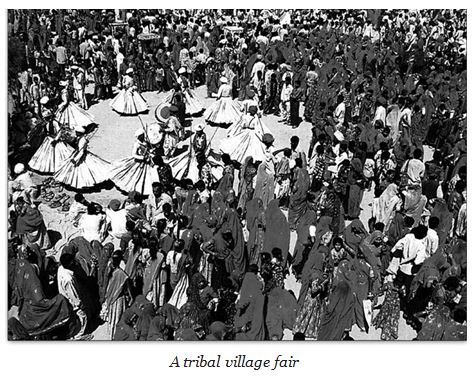
Why simple distinctions failed
- Size and territory: Santhals, Gonds and Bhils are large communities spread across extensive areas.
- Livelihood: Munda and Ho communities adopted settled agriculture; Birhors combined hunting and gathering with specialised household work such as basket-making and oil-pressing.
- Overlap: Some non-tribal castes also turned to hunting and gathering when alternatives were limited.
- Conclusion: Size, isolation, religion and livelihood could not provide a reliable boundary between tribes and peasantry.
Absorption into Hindu society
- Mechanisms: Incorporation occurred through Sanskritisation, entry into the Shudra fold after conquest, and acculturation.
- Historical process: Tribal lands were colonised and forests cleared as different groups entered caste-Hindu society at different levels.
- Interpretations: Absorption may be viewed as a natural process of incorporation, or as exploitative.
- Scholarly emphasis: Early anthropologists stressed cultural change; later writers focused more on the political and exploitative aspects.
| Point | Pristine-society view | Secondary-phenomenon view |
|---|---|---|
| Meaning | Tribes are imagined as original, pure societies untouched by civilisation. | Tribal identities develop through contact between non-state groups and pre-existing states. |
| Explanation | This view treats tribal societies as isolated from historical change. | Exploitative or colonial contact can create an ideology of tribalism, as groups define themselves in contrast to newcomers. |
Tribal societies and historical change
- Political power: Adivasis were not always oppressed; Central India had Gond kingdoms such as Garha Mandla and Chanda.
- Social change: Some Rajput kingdoms in central and western India emerged through stratification within adivasi communities.
- Regional influence: Adivasis sometimes dominated plains communities through raids and service as local militias.
- Trade: They occupied specialised roles in trading forest produce, salt and elephants.
- Mainstream contact: Capitalist demands for forest resources, minerals and cheap labour brought tribal societies into contact with the wider society long ago.
National Development Versus Tribal Development
Unequal costs of development
- National development: Particularly in the Nehruvian era, large dams, factories and mines were built.
- Disproportionate impact: Tribal areas are often forested and mineral-rich, so tribal communities bore heavy costs for development benefiting the wider society.
- Land dispossession: Mining and the use of suitable sites for hydroelectric plants displaced tribal communities from their land.
- Forest loss: Systematic forest exploitation began under British rule and continued after independence, damaging communities dependent on forests.
- Property change: Private ownership of land disadvantaged tribal communities whose customary systems relied on collective ownership.
Development pressures and tribal displacement
- Demand for minerals, forests and power sites grows.
- Dams, mines, factories and other projects expand in tribal regions.
- Tribal land and forest access are lost or reduced.
- Livelihoods and community-based ownership are weakened.
- Non-tribal in-migration increases, intensifying exploitation and cultural disruption.
In-migration and population change
- General effect: In-migration of non-tribal people can overwhelm tribal communities, disrupt cultures and accelerate exploitation.
- Jharkhand: Industrial development has diluted the tribal share of the population.
- North-East: Tripura’s tribal population share was halved within a single decade, making tribals a minority; Arunachal Pradesh also faces pressure.
- Permanent traits
- Regional, linguistic, physical and ecological characteristics used to classify tribal communities.
- Acquired traits
- Characteristics based mainly on livelihood and the extent of incorporation into Hindu society.
- Sanskritisation
- A process through which a group adopts practices associated with higher-status Hindu groups.
- Tribalism
- An identity formed as tribal groups distinguish themselves from newly encountered groups or states.
- Dispossession
- Loss of land or access to resources, often associated here with development projects.
What are the main bases for classifying tribal societies?
Why did scholars question a sharp tribe–caste distinction?
How has national development affected tribal communities?
Quick recap
- Tribes have often been described by contrast with written religion, conventional state structures and sharp class divisions.
- Tribal societies are classified by permanent traits and acquired traits.
- Middle India contains about 85% of India’s tribal population; the North-East has especially high tribal shares within several states.
- The tribe–caste distinction is debated because tribes vary greatly in size, livelihood and degree of integration.
- Tribal groups have long interacted with states and mainstream society; they were not isolated or unchanged.
- Development projects have caused land loss, forest loss, weakened collective ownership and increased pressure from in-migration.
Tribal Identity Today
How Tribal Identity Is Formed
Tribal identity today — Tribal identities today are formed through interaction with mainstream society, not by primordial characteristics peculiar to tribes.
- Unequal incorporation: Forced integration into mainstream processes has affected tribal culture, society and economy.
- Resistance: Since interaction has often been on unfavourable terms, many tribal identities express resistance to the power of the non-tribal world.
- Statehood and continuing challenges: Long struggles achieved statehood for Jharkhand and Chhattisgarh, but significant problems remain.
- Civil liberties: Some North-Eastern states have lived for decades under special laws that limit citizens’ civil liberties.
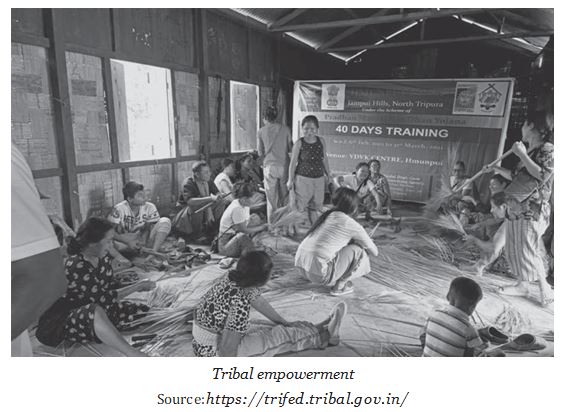
Education, Class and Identity
Tribal middle class — A growing educated, urbanised professional group within tribal communities is creating new ways of asserting tribal identity.
- Growth: This group is most visible in the North-East and is also emerging elsewhere, particularly among larger tribal communities.
- Drivers: Modern education, modern occupations and reservation policies have helped this class develop.
- Differentiation: As tribal societies develop class and other internal divisions, groups may assert tribal identity for different reasons.
- New concerns: Middle-class identity claims may include culture, tradition, livelihood, land and resources, and a share in the benefits of modern development.
Issues Behind Tribal Movements
Tribal movements — Tribal movements commonly arise around control of vital resources and the protection or assertion of ethnic-cultural identity.
- Economic resources: Land—and especially forests—are central concerns.
- Ethnic-cultural identity: Movements may seek recognition and protection of cultural identity.
- Overlap or divergence: Resource and identity issues can combine, but may also separate as tribal society becomes more differentiated.
- Different motivations: Middle-class members and poor, less-educated tribal people may join movements for different reasons.
Factors Shaping Tribal Identity
- Unequal interaction with mainstream society → experiences of pressure and disadvantage
- Modern education, occupations and reservation policies → emergence of an educated tribal middle class
- Class differentiation within tribal communities → varied reasons and forms of identity assertion
- Internal social dynamics interacting with external forces → shape the future of tribal identity and movements
- Social differentiation
- The development of class and other divisions within a society.
- Identity assertion
- The expression of claims about a community’s identity, interests and rights.
Family as a Social Institution
Family — Family is a social institution with its own structure, closely connected to wider social institutions and changes.
- Private and public spheres: Family life belongs to the private sphere, but is linked to economic, political, cultural and educational life in the public sphere.
- Multiple dimensions: Families can offer care and support, but may also involve conflict, injustice and violence.
- Changing forms and values: Family structures, cultural ideas, norms and values change alongside wider social changes.
- Change and resistance: Change may happen unintentionally through war or migration, or deliberately—for example, when young people choose their spouses or same-sex love is expressed openly. Changes in family and marriage norms may face strong resistance.
How Social Change Reshapes Families
- Men migrate from Himalayan villages for work → more women-headed families may remain in the villages
- Young parents work demanding schedules in the software industry → grandparents may move in to care for young children
- Changes in social and economic life → changes in family composition and structure
Nuclear and Extended Families
| Point | Nuclear family | Extended family |
|---|---|---|
| Members | One set of parents and their children | More than one couple, often across more than two generations |
| Examples | Parents living with their children | Brothers with their individual families; or an older couple living with sons, grandsons and their families |
Understanding the Extended Family
- Joint family: The extended family is commonly called the joint family, but it was not the dominant form in India, either historically or today; it was found in particular sections and regions.
- Term: I.P. Desai observed that “joint family” does not translate a traditional Indian term; many Indian-language expressions for it are themselves translations of the English phrase.
Residence, Inheritance and Authority
| Basis | Form | Meaning |
|---|---|---|
| Residence after marriage | Matrilocal | The newly married couple lives with the woman’s parents. |
| Residence after marriage | Patrilocal | The newly married couple lives with the man’s parents. |
| Inheritance | Matrilineal | Property passes from mother to daughter. |
| Inheritance | Patrilineal | Property passes from father to son. |
| Point | Patriarchy | Matriarchy |
|---|---|---|
| Meaning | Men exercise authority and dominance. | Women exercise authority and dominance. |
| Evidence | A recognised family and social structure. | A theoretical rather than empirical concept; no historical or anthropological evidence shows societies where women exercise dominance. |
Do not confuse matriliny with matriarchy: Matrilineal societies exist, but women’s inheritance does not necessarily mean they control the property or make public decisions.
What factors lie behind the assertion of tribal identities today?
How can changes in society lead to changes in family structure?
What is the difference between matriliny and matriarchy?
Quick recap
- Tribal identities are formed through interaction with mainstream society, often under unequal conditions that encourage resistance.
- Education, modern occupations and reservation policies have helped produce an educated tribal middle class and new forms of identity assertion.
- Tribal movements focus on control over land and forests, ethnic-cultural identity, or both; motivations can differ across social groups.
- Family structure is connected to wider economic, political, cultural and educational changes, and may change through migration, work patterns or changing norms.
- Nuclear families have one set of parents and their children; extended families include more than one couple and often several generations, but have not been the dominant Indian form.
- Matrilocality and patrilocality describe residence after marriage; matriliny and patriliny describe lines of inheritance.
- Matrilineal inheritance does not equal matriarchy: women may inherit without controlling property or making public decisions.
Sociology — ALL CHAPTERS
1
INTRODUCING INDIAN SOCIETY
2
THE DEMOGRAPHIC STRUCTURE OF THE INDIAN SOCIETY
3
SOCIAL INSTITUTIONS CONTINUITY AND CHANGE
4
THE MARKET AS SOCIAL INSTITUTIONS
5
PATTERNS OF SOCIAL INEQUALITY AND EXCLUSION
6
THE CHALLENGES OF CULTURAL DIVERSITY
7
SUGGESTIONS FOR PROJECT WORK
1
Structural Change
2
Cultural Change
3
The Constitution and Social Change
4
Change and Development in Rural Society
5
Patterns of Industrialisation and Urbanisation
6
Globalisation and Social Change
7
Mass Media and Communications
8
Social Movements