Class 12 Humanities . Sociology . Indian Society . The Market As Social Institutions
Chapter 4: THE MARKET AS SOCIAL INSTITUTIONS
Ch 4
Sociology
Class 12 Humanities
Sociological Perspectives on Markets and the Economy
Meanings of “Market”
| Meaning | Example |
|---|---|
| Physical place | A fruit market or wholesale market |
| Gathering of buyers and sellers | A weekly vegetable market |
| Area or category of trade | The market for cars or readymade clothes |
| Demand for a product or service | The market for computer professionals |
| The market in general | The whole spectrum of economic activities and institutions; broadly, the economy |
Market as a social institution — A market is not only an economic arrangement; it is also organised through social relationships, groups, culture and connections with other institutions.
Economics and Sociology
| Point | Economics | Sociology |
|---|---|---|
| Focus | How markets work in modern capitalist economies, including prices, investment, saving and spending | Economic institutions and processes within the larger social framework |
| View of the economy | Often studies the economy as a separate sphere governed by its own laws | Studies markets in relation to social, cultural and political contexts |
| Markets | Explains economic activity and market processes | Examines how markets are shaped by groups, classes and social institutions |
Adam Smith and the Market Economy
- Context: In eighteenth-century England, political economy began studying the emerging market economy.
- Adam Smith (1723–1790): In *The Wealth of Nations*, he described the economy as a series of individual exchanges or transactions.
- Unintended order: Many separate transactions can create an organised, functioning system, even though no participant intended to create that system.
- Rational self-interest: Smith explained how rational self-interest in a free-market economy can lead to economic well-being.
- Later economics: Modern economics developed from ideas such as Smith’s and often analyses the economy separately from wider social and political life.
Social embeddedness — An economy is socially embedded when economic activity is shaped by its surrounding social relationships, groups, culture and institutions.
The Sociological View
- Social construction: Markets are organised in culturally specific ways rather than existing as purely economic systems.
- Power and organisation: Particular social groups or classes may control or organise markets.
- Connections: Markets are linked to other institutions, social processes and structures.
- Examples: The weekly tribal haat and trading networks of traditional business communities show how economic activity is embedded in society.
Periodic Markets and the Weekly Haat
Periodic market — A market held at regular intervals that brings together people from surrounding settlements to exchange goods and services.
Roles of Periodic Markets
- Exchange: Villagers sell agricultural or other produce and buy manufactured goods and items unavailable locally.
- Range of participants: Traders from outside, moneylenders, entertainers, astrologers and other specialists also attend.
- Economic links: Weekly markets connect local and regional economies to towns, metropolitan centres and the national economy.
- Other markets: Specialised markets, such as cattle markets, may take place less frequently.
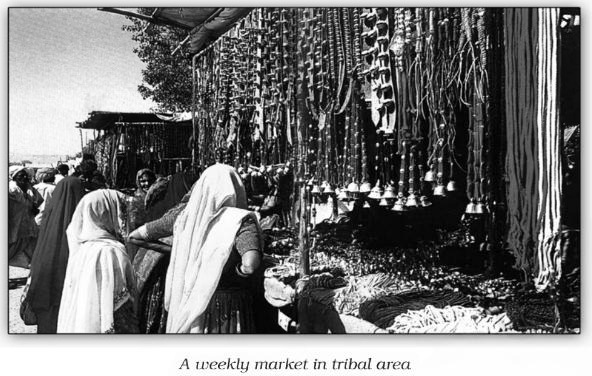
- Social role: In remote rural and tribal areas, a haat is also a major place for meeting and social interaction.
Why the Haat Matters in Remote Areas
- Setting: In hilly and forested areas, settlements may be scattered, transport and communication poor, and the economy relatively undeveloped.
- Trade: Local people sell agricultural or forest produce to traders and buy essentials such as salt and agricultural implements.
- Consumption: Visitors may also buy items such as bangles, jewellery and other goods.
- Social purposes: People meet kin, arrange marriages and exchange gossip; for many, these are the main reasons to attend.
Colonial Change in Tribal Economies
Colonial Incorporation and Its Effects
- Colonial control expanded into remote tribal regions.
- Road building and the suppression of resistance opened these regions to outside access and resource extraction.
- Traders, moneylenders and other non-tribal people entered; forest produce and new goods became part of wider trade.
- Tribal people were recruited as labourers on plantations and mines, creating a market for tribal labour.
- Local economies became linked to wider markets, often exploitatively: many adivasis were impoverished and lost land to outsiders.
The Weekly Market in Bastar
People and Goods in the Market
- Setting: The study concerns a weekly market in Bastar district, whose population is mainly Gond, an adivasi group.
- Participants: Local tribals and non-tribals, outside Hindu traders of different castes, forest officials and specialists selling goods or services attend.
- Manufactured goods: Jewellery, trinkets, pots and knives are among the goods sold.
- Food and produce: Non-local items include salt and turmeric; local goods include food, agricultural produce and bamboo baskets.
- Forest produce: Adivasis bring items such as tamarind and oil-seeds, which traders buy and carry to towns.
| Point | Adivasis | Traders and others |
|---|---|---|
| Typical role | Mostly buyers; also sell forest and agricultural produce and provide wage labour | Caste Hindu traders are mainly sellers; traders purchase forest produce for resale in towns |
| Income and spending | Earn cash from produce sales and wage labour; spend mainly on low-value trinkets, jewellery and manufactured cloth | Buy produce and conduct trade; forest officials also transact with adivasis employed by the Forest Department |
- Market
- A place, gathering, trade category, demand area, or—in a broad sense—the economy.
- Periodic market
- A market held at regular intervals, serving surrounding communities.
- Haat
- A weekly market that provides both exchange and social interaction.
- Social embeddedness
- The shaping of economic activity by social relationships and institutions.
- Adivasi
- An Indigenous or tribal person; the term is used in the account of Bastar.
How do economics and sociology differ in their study of markets?
What makes a weekly haat a social as well as an economic institution?
How did colonial expansion affect tribal economies?
Quick recap
- “Market” can mean a place, gathering, trade category, demand area or the economy as a whole.
- Sociology studies markets as social institutions embedded in groups, culture and wider relationships.
- Adam Smith (1723–1790) argued that many individual exchanges can create an ordered system; rational self-interest in a free market can lead to economic well-being.
- Periodic markets connect local communities and economies; the haat also serves important social purposes.
- Colonial expansion linked tribal economies to wider markets, often through exploitative relationships.
- In Bastar, adivasis mainly buy goods and sell produce, while outside traders purchase forest produce for resale.
Caste-based markets and trading networks in precolonial and colonial India
Rethinking the Precolonial Economy
Colonial Revenue and Economic Change
- Colonial revenue demand: Land revenue had to be paid in cash.
- Greater need for cash: This increased pressure on local agrarian economies to obtain money.
- Wider effects: Colonial rule contributed to major economic transformations and connected local economies more closely to commercial exchange.
Precolonial Trade and Merchant Networks
- Monetised economy: Precolonial India already used money extensively, and villages were linked to wider networks of exchange.
- Trade and banking: India had manufacturing centres, merchant communities and banking systems; goods such as handloom cloth and spices were traded widely.
Adivasi Village Market: Dhorai, Bastar
- Market-day transformation: Dhorai was a quiet hamlet on non-market days but drew crowds of tribal producers, Hindu sellers, craftsmen, traders and officials on market day.
- Exchange and social life: People brought forest, farm and handmade goods to trade, while the market also coincided with religious activity and served as a place for social interaction.
Caste-Based Banking: The Nakarattars
- Monetised economy
- An economy in which money is widely used in trade and exchange.
- Jajmani system
- A form of non-market exchange found in some villages and regions.
- Hundi
- A bill of exchange or credit note used to support trade, including long-distance trade.
- Caste-based banking
- A system of lending, deposits and trust organised through caste-linked relationships and institutions.
How did hundis support precolonial trade?
What does the Nakarattar example show about caste and banking?
Quick recap
- Precolonial India was already substantially monetised and connected to wider exchange networks.
- Non-market systems such as jajmani coexisted with money-based trade.
- Colonial cash revenue demands contributed to economic change but did not mark the first arrival of money-based trade in India.
- Merchant communities used caste and kinship ties, banking systems and hundis to support trade across regions.
- Dhorai’s Friday market combined trade, community life and religious activity.
- Nakarattar banking relied on caste-based relationships, shared reserves and communal institutions.
Social Organisation of Markets – ‘Traditional Business Communities'
Traditional Business Communities and Caste
- Caste and occupation: Trade has long been associated with the Vaisya varna, but Vaisya status could also be claimed by groups entering commerce as a form of upward mobility.
- Diverse communities: Traditional business communities included banias as well as Parsis, Sindhis, Bohras and Jains; merchant status varied across time and place.
Community Networks and Market Control
How Community Networks Shape Markets
- Shared caste or kinship ties → trust between traders
- Trust → business conducted within community networks
- Repeated network-based trade → particular communities dominate certain business areas
Colonialism and the Emergence of New Markets
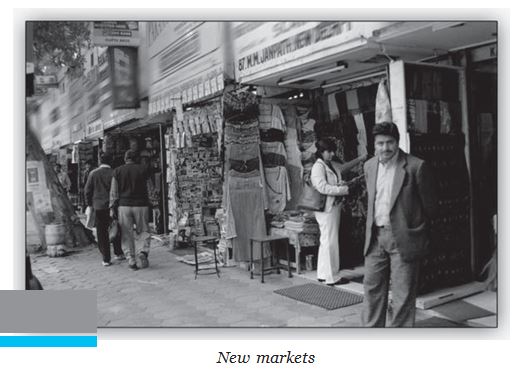
The Marwaris: From Traders to Industrialists
Marwari Economic Transformation
- Migrant traders → shopkeepers and traders in colonial cities
- Trade and moneylending → accumulation of wealth
- Wealth and trusted networks → merchant banking
- Merchant banking → modern industrial ownership
Capitalism as a Social System: Karl Marx
Capitalist Production and Surplus Value
- Capitalists own the means of production → workers must sell their labour power for wages
- Workers produce commodities → the value produced exceeds the wages they receive
- The difference is taken by capitalists → surplus value and profit result
- Mode of production
- The way production is organised, including its relations of production.
- Means of production
- Resources used to produce goods, such as factories.
- Labour power
- A worker’s capacity to work, sold in the labour market for wages.
- Surplus value
- The value produced by workers beyond the wages they receive, appropriated by capitalists.
How can caste and kinship networks shape the organisation of markets?
How did the Marwaris develop economic power?
How does Marx explain profit under capitalism?
Quick recap
- Caste, community identity and kinship networks can organise trade and create community specialisation or monopolies.
- Traditional business communities include Vaisyas and other groups; community status and occupations can change over time.
- Colonialism disrupted Indian production and trade and shifted India towards supplying raw materials and consuming manufactured goods.
- Marwaris used networks, trade, moneylending and banking to move from migrant traders towards industrialists.
- Marx described capitalism as commodity production using wage labour and analysed it through social relations and class structure.
- Capitalists own the means of production; workers sell labour power, and the unpaid value they produce is surplus value.
Commoditisation and Consumption
Commoditisation
Changing boundaries of the market
- Human beings: People were bought and sold as slaves in the past; treating people as commodities is now considered immoral.
- Bottled water: Drinking water, once unthinkable as a product for sale, is now widely bought as a convenient commodity.
- Key idea: Commodities can change over time: something may enter the market, or cease to have market or exchange value.
Consumption and Social Status
Symbolic consumption — Consumption communicates social meanings as well as meeting economic needs.
- Social distinction: What people buy and display can communicate their socio-economic status and cultural preferences.
- Advertising: Companies attach ideas of desirable lifestyles, culture, or status to goods to encourage people to buy them.
- Max Weber: He used the term status symbol for goods linked to a person’s social status.
- Example: Among India’s middle class, a mobile-phone brand or car model can act as a marker of socio-economic status.
- Lifestyle: Weber also noted that lifestyles help distinguish social classes and status groups.
Globalisation: Interlinked Markets
India’s economic shift
- Since the late 1980sIndia shifted from state-led development towards liberalisation, ushering in an era of globalisation.
Globalisation — The growing interconnectedness of the world economically, culturally, and politically.
- Cross-border movement: Commodities, money, information, and people move increasingly between countries.
- Enabling infrastructure: Computers, telecommunications, transport, and related technology make these movements possible.
- Market integration: Markets around the world are increasingly connected, so a change in one place can affect livelihoods far away.
How global market integration can affect India
- A downturn in the U.S. economy, such as the slump following the 9/11 attacks, reduces demand for services.
- India’s software and BPO industries depend partly on customers in developed Western countries.
- Lower demand can reduce business for Indian firms.
- Reduced business can lead to job losses in India.
India in the global market
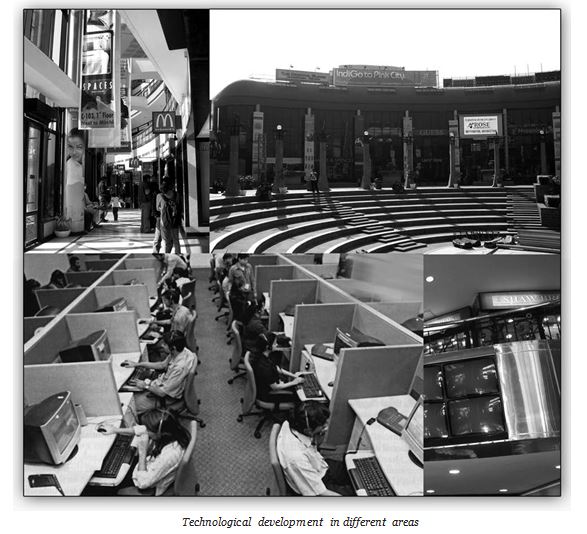
- Software and BPO: These industries connect India to the global economy through services such as call centres.
- Service exchange: Indian companies provide relatively low-cost services and labour to customers in developed Western countries.
- Global labour market: Indian software workers and service providers are part of a market that crosses national borders.
Culture and Markets under Globalisation
- Cultural circulation: People, cultural products, and images travel rapidly across borders and enter new markets.
- Commodifying culture: Practices and knowledge once outside the market can be packaged and sold; Indian yoga and Ayurveda are marketed in the West.
- Tourism: The growth of international tourism can turn cultural events and traditions into marketable attractions.
Pushkar fair: a market becomes a tourist commodity
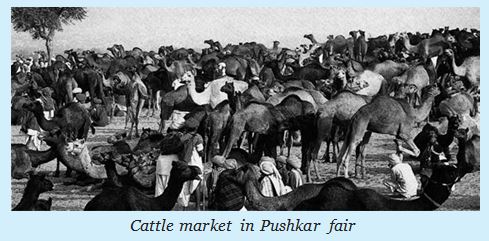
- The annual Pushkar fair brings pastoralists and traders together to buy and sell camels and other livestock.
- The fair is promoted internationally as a tourist attraction.
- Tourists join local traders and Hindu pilgrims, especially around Kartik Purnima and the holy bath in Pushkar Lake.
- The event becomes a new circuit for exchanging livestock, money, cultural symbols, and religious merit.
Pushkar fair: key features
- Scale: The guidebook passage describes around 200,000 people and 50,000 camels and cattle gathering at the fair.
- Multiple roles: It remains a local social and economic event while also serving as an international tourist attraction.
- Marketability: Livestock trading, pilgrimage, religious atmosphere, and cultural spectacle together draw visitors.
- Commodification
- Turning something previously outside market exchange into a commodity.
- Symbolic consumption
- Using goods to express status, identity, or cultural preferences.
- Status symbol
- A good associated with a person’s social standing.
- Globalisation
- Increasing worldwide economic, cultural, and political interconnection.
- Liberalisation
- A shift towards reducing state direction of the economy and expanding market activity.
What is commodification? Give two examples from contemporary India.
How can consumption communicate social status?
How has globalisation changed the significance of the Pushkar fair?
Quick recap
- Commodification brings previously untraded objects, services, skills, or labour into market exchange.
- What counts as a commodity can change over time; bottled water is a familiar example.
- Consumption can communicate status and cultural preferences; Weber called status-linked goods status symbols.
- Since the late 1980s, liberalisation has connected India more closely to global markets.
- Global integration links distant markets, so economic changes abroad can affect Indian industries and jobs.
- Globalisation can turn cultural practices and events, such as the Pushkar fair, into tourist commodities.
Debate on Liberalisation – Market Versus State
Liberalisation and Marketisation
Liberalisation in India
- Late 1980sIndia began liberalisation policies that helped drive the globalisation of its economy.
Expected Gains and Uneven Outcomes
| Point | May gain | May lose |
|---|---|---|
| Examples | Software and information technology; fish and fruit producers | Automobile, electronics and oilseed producers |
| Reason | Access to global markets can create new opportunities. | Some producers may be unable to compete with foreign producers. |
Effects on Farmers, Manufacturers and Workers
Subsidy — Government payment of part of the cost of farming inputs, such as fertilisers or diesel, which lowers farmers’ costs.
Liberalisation and Farmers’ Incomes
- Imports of agricultural products expose Indian farmers to competition from farmers in other countries.
- Market-oriented policies reduce or withdraw support prices and subsidies, which had protected farming incomes and lowered costs.
- Many farmers find it harder to earn a decent living from agriculture.
Effects on Manufacturers and Employment
- Foreign goods and brands enter the market, exposing small manufacturers to global competition.
- Some small manufacturers cannot compete and may lose business.
- Privatisation or closure of public sector industries can cause job losses in some sectors.
- Employment may shift from the organised sector to the unorganised sector, where jobs are generally less well paid and less regular or permanent.
Markets as Social Institutions in a Changing Economy
- Liberalisation
- Policies that reduce government controls and increase the role of markets and private businesses.
- Marketisation
- Using market-based processes instead of government regulation to address problems.
- Support price
- A price at which the government agrees to buy agricultural commodities.
- Subsidy
- Government payment of part of an input cost, reducing the cost borne by the user.
What is meant by liberalisation?
Why is the impact of liberalisation on India described as mixed?
Quick recap
- India’s liberalisation began in the late 1980s and reduced controls while expanding the role of markets.
- The programme stimulated growth and opened markets, but its overall costs and benefits remain contested.
- Some sectors may benefit from global access, while others may lose to foreign competition.
- Reduced support prices and subsidies, import competition and changes in employment can disadvantage farmers and workers.
- Markets are social institutions connected to caste and class, and exchange carries social and symbolic meaning.
- Liberalisation and globalisation are transforming the circulation of goods, services, money and cultural symbols from local to global networks.
Sociology — ALL CHAPTERS
1
INTRODUCING INDIAN SOCIETY
2
THE DEMOGRAPHIC STRUCTURE OF THE INDIAN SOCIETY
3
SOCIAL INSTITUTIONS CONTINUITY AND CHANGE
4
THE MARKET AS SOCIAL INSTITUTIONS
5
PATTERNS OF SOCIAL INEQUALITY AND EXCLUSION
6
THE CHALLENGES OF CULTURAL DIVERSITY
7
SUGGESTIONS FOR PROJECT WORK
1
Structural Change
2
Cultural Change
3
The Constitution and Social Change
4
Change and Development in Rural Society
5
Patterns of Industrialisation and Urbanisation
6
Globalisation and Social Change
7
Mass Media and Communications
8
Social Movements