Class 12 Humanities . Sociology . Indian Society . Patterns of Social Inequality and Exclusion
Chapter 5: PATTERNS OF SOCIAL INEQUALITY AND EXCLUSION
Ch 5
Sociology
Class 12 Humanities
INTRODUCTION & What Is Social About Social Inequality and Exclusion?
Why Study Social Inequality and Exclusion?
Institutions and everyday inequality
- Institutions: Family, caste, tribe and the market help form communities, but they can also create and sustain inequality and exclusion.
- Everyday examples: Child labour and denial of schooling, caste discrimination, violence against women, prejudice against minorities and exclusion of people with disabilities.
- Common-sense trap: When inequality is familiar, it can seem natural or deserved; people may blame poverty on a lack of effort or ability.
- Unequal life chances: Hard work matters, but people do not start with equal resources or opportunities. Group-based conditions shape what individuals can achieve.
What Makes Inequality and Exclusion Social?
| Sense | Meaning |
|---|---|
| Group-based | Inequality and exclusion concern categories or groups of people, not merely differences between individuals. |
| Not only economic | They are not reducible to income or wealth, although social and economic inequality are often strongly linked. |
| Structured | They follow recurring patterns that are organised and sustained within society. |
Social Inequality and Social Stratification
Social inequality — Unequal access to valued social resources among people or social groups.
| Form | What it includes | Example |
|---|---|---|
| Economic capital | Material assets and income. | A well-off family can pay for expensive higher education. |
| Cultural capital | Educational qualifications and status. | Higher education can provide qualifications and status. |
| Social capital | Networks of contacts and social associations. | Influential contacts may provide advice, recommendations or job information. |
How capital can reinforce advantage
- Overlap and conversion: Forms of capital often support one another: economic resources can help acquire education, while social contacts can help secure well-paid work.
- Individual differences: Ability and effort may explain some differences, but most social inequality is produced by the society people live in, not simply by innate or natural differences.
Social stratification — A system that ranks categories of people in a hierarchy, shaping their identities, experiences, relationships and access to resources and opportunities.
| Principle | Explanation | Example or implication |
|---|---|---|
| Society-wide system | Stratification is not simply the result of individual differences; society distributes resources unequally among categories of people. | Hunting-and-gathering societies produced little surplus and had limited stratification; advanced societies can distribute surplus unequally. |
| Persists across generations | Social position is often inherited through family; an ascribed position is assigned rather than achieved. | In caste, birth shapes occupational opportunities. Endogamy—marriage within the same caste—helps maintain caste boundaries. |
| Supported by beliefs | Stratification is more likely to persist when people see it as fair or inevitable. | Caste hierarchy has been justified through ideas of purity and pollution, ranking Brahmins as superior and Dalits as inferior by birth and occupation. |
Legitimacy and resistance
- Unequal support: People with the greatest privileges are often the strongest supporters of systems such as caste or race.
- Challenge: People who experience exploitation and humiliation at the bottom of a hierarchy are more likely to oppose it.
Prejudice, Stereotypes and Discrimination
Exclusion is not only economic
- Sources of exclusion: Gender, religion, ethnicity, language, caste and disability can all lead to discrimination, even when a person has economic privilege.
- Examples: A woman from a privileged background may face sexual harassment; a middle-class professional from a minority group may be refused housing in a middle-class neighbourhood.
- Learned attitudes: People form ideas about their own and other communities, castes, classes and genders; these ideas may include prejudice.
Prejudice — A pre-judgement: an opinion or attitude about another group formed before considering adequate evidence or direct familiarity.
How prejudice works
- Basis: Prejudices often rely on hearsay rather than direct evidence and can resist change even when new information appears.
- Direction: Prejudice can be negative or favourable; for example, someone may assume their own caste or group is superior without evidence.
- Common foundation: Prejudices are often grounded in stereotypes—fixed, inflexible descriptions of a group.
Stereotypes and their effects
- Group labels: Stereotypes assign a single trait to a whole group, such as calling a community lazy, cunning, cowardly or naturally brave.
- Colonial influence: In India, colonial rule helped create labels such as “martial races” and descriptions of some communities as effeminate or untrustworthy.
- Why misleading: Individuals vary, and a person’s behaviour can change across situations and over time; stereotypes ignore this variation and treat a community as one person.
Discrimination — Actual behaviour or practice that treats a person or group unfairly, such as denying them opportunities available to others.
| Point | Prejudice | Stereotype | Discrimination |
|---|---|---|---|
| What it is | An attitude or pre-judgement. | A fixed characterisation of a group. | An action or practice. |
| How it appears | Believing a group is inferior or superior without adequate evidence. | Assuming all members of a group share one trait. | Refusing someone a job or other opportunity because of group membership. |
| Key caution | May be favourable or unfavourable. | Ignores differences among individuals and contexts. | Can be concealed behind a more acceptable explanation, such as claiming a decision was based only on merit. |
Why is social stratification more than a result of individual ability or effort?
Distinguish prejudice, stereotype and discrimination.
Quick recap
- Social inequality involves unequal access to valued resources and is shaped by social conditions, not just individual effort.
- Capital has economic, cultural and social forms that can overlap and convert into one another.
- Social stratification ranks social categories, persists across generations and is supported by beliefs or ideology.
- Ascription and endogamy help reproduce caste position and boundaries across generations.
- Prejudice is a pre-judgement; stereotypes fix group traits; discrimination is unfair treatment in practice.
- Social exclusion can be based on gender, religion, ethnicity, language, caste or disability, not only economic position.
Social Exclusion & Caste and Tribe – Systems Justifying and Perpetuating Inequality
Social Exclusion
- Social exclusion: The systematic cutting off of individuals or groups from full participation in wider society.
- Restricted access: Exclusion can limit access to education, health care, transport, banking, social security and justice.
- Structural roots: It arises from features of society, so laws alone may not end it; lasting change also requires shifts in awareness and attitudes.
Transgender and Third-Gender Identities
- Transgender: Refers to people whose gender identity differs from the sex assigned to them at birth.
- Third gender: A social category for people who identify as neither male nor female; identity may be self-defined or shaped by family and society.
- Recognition: Third-gender persons have legal recognition in India and can contest elections.
Caste as a Discriminatory System
- Social movements, changing production and state efforts to reduce caste’s public role have brought change, but caste still affects life chances in twenty-first-century India.
- Reduced rigidity does not mean caste-class inequality has disappeared: broad economic advantages and disadvantages remain patterned by caste.
Race and Caste: Apartheid in South Africa
Apartheid and Resistance
- Mid-seventeenth centuryDutch traders settled in South Africa.
- Early nineteenth centuryBritish colonisation pushed Dutch descendants inland.
- Beginning of the twentieth centuryBritain gained control of what became the Union and later the Republic of South Africa.
- 1948Apartheid became law.
- Latter half of the twentieth centuryMillions of Black people were forcibly relocated to Bantustans or homelands.
- 1994After decades of struggle, the African National Congress came to power and formed the government.
Quick recap
- Social exclusion is structural and limits full participation and access to essential services.
- Legislation must be supported by sustained social campaigns that challenge prejudice.
- Transgender refers to gender-status change through choice or compulsion; third-gender identity is neither male nor female and has legal recognition in India.
- Caste historically linked birth to occupation and ranked ritual and social status; caste-class inequality persists despite weaker occupational restrictions.
- Apartheid became law in 1948 and used racial classification, dispossession and forced relocation to maintain White dominance.
- The African National Congress formed the South African government in 1994; racial discrimination was banned, but economic capital remained concentrated in White hands.
Untouchability
Caste, Poverty and Affluence
| Caste or community group | Rural | Urban |
|---|---|---|
| Scheduled Tribes (ST) | 45.3 | 24.1 |
| Scheduled Castes (SC) | 31.5 | 21.7 |
| FC (upper-caste category) | 15.5 | 8.1 |
| Other Backward Classes (OBCs) | 22.7 | 15.4 |
| Muslims | 26.9 | 22.7 |
| Hindus | 25.6 | 12.1 |
| Christians | 22.2 | 5.5 |
| Sikhs | 6.2 | 5.0 |
| All groups | 25.4 | 13.7 |
Reading the Poverty Figures
- National average: Poverty affected 25.4% of rural residents and 13.7% of urban residents.
- Highest listed poverty: STs had the highest rates in both rural India (45.3%) and urban India (24.1%).
- Lowest listed poverty: Sikhs had the lowest rates in both rural India (6.2%) and urban India (5.0%).
- Rural comparisons: ST poverty was about 1.8 times the national average; SC poverty was about 1.2 times it; OBC poverty was below it.
- Urban comparisons: ST poverty was about 1.8 times the national average, SC about 1.6 times, and OBC about 1.1 times.
- Rural–urban pattern: Poverty rates were generally higher in rural than urban India, though the size of the gap differed by group.
| Caste or community group | Rural | Urban |
|---|---|---|
| Scheduled Tribes (ST) | 1.4 | 1.8 |
| Scheduled Castes (SC) | 1.7 | 0.8 |
| OBCs | 3.3 | 2.0 |
| Muslims | 2.0 | 1.6 |
| Hindus | 8.6 | 8.2 |
| Christians | 18.9 | 17.0 |
| Sikhs | 31.7 | 15.1 |
| Others | 17.9 | 14.4 |
| All groups | 4.3 | 4.5 |
Reading the Affluence Figures
- Lowest affluence: STs had the lowest rural proportion (1.4%); SCs had the lowest urban proportion (0.8%).
- Compared with national averages: Both figures are below the rural average of 4.3% and urban average of 4.5%, respectively.
- OBC position: OBC affluence was 3.3% in rural and 2.0% in urban India—below the national average in both settings.
- Comparison caution: The table gives figures for Hindus overall, not upper-caste Hindus separately; it cannot establish the requested upper-caste Hindu-to-lower-caste ratio.
Meaning and Dimensions of Untouchability
Untouchability — An extreme form of caste discrimination that imposes severe social sanctions on communities treated as outside the caste hierarchy and at the bottom of the purity–pollution scale.
Beyond Physical Contact
- Pollution beliefs: The touch of an “untouchable” was believed to pollute others, who might then perform purification rituals.
- Distance pollution: In some regions, especially parts of southern India, even a person’s presence or shadow was considered polluting.
- Broader institution: Untouchability is a system of social restrictions and sanctions, not simply avoidance of physical contact.
- Regional pattern: It exists across India, but its forms and intensity vary by region and socio-historical context.
| Dimension | Meaning and examples |
|---|---|
| Exclusion | Extreme restrictions unique to untouchability, such as denial of shared water sources, collective worship, ceremonies and festivals. |
| Humiliation-subordination | Practices that degrade Dalits and mark them as socially inferior. |
| Exploitation | Economic coercion, commonly forced or unpaid/underpaid labour and confiscation of property. |
How It Differs from Other Low-Caste Disadvantage
- All dimensions matter: Exclusion, humiliation-subordination and exploitation are all essential to defining untouchability.
- Distinctive exclusion: Other low castes may experience subordination and exploitation, but not the extreme forms of exclusion imposed on Dalits.
Names and Dalit Identity
| Point | Harijan | Dalit |
|---|---|---|
| Meaning and usage | Means “children of God”; Mahatma Gandhi popularised it in the 1930s to counter derogatory caste names. | Means “downtrodden”; adopted by ex-untouchable communities and leaders to express oppression and assert identity. |
| Significance | A term popularised by an outside leader. | The generally accepted term, linked with empowerment, rights and dignity. |
Dalit Assertion
- Earlier usage: Dalit was not coined by Dr. B.R. Ambedkar or frequently used by him, but it resonates with his philosophy and empowerment movement.
- Wider currency: The term gained wide currency during caste riots in Mumbai in the early 1970s.
- Dalit Panthers: This radical group, which emerged in western India, used “Dalit” to assert identity and demand rights and dignity.
- Derogatory labels: Many older names for these communities are pejorative; using them as abuse is now a criminal offence.
State Action Against Caste Discrimination
Reservations and Development Programmes
- Purpose: Reservations seek to compensate for past and continuing caste discrimination by setting aside places for disadvantaged groups.
- Where used: Reserved places apply in State and Central legislatures, government employment and public-sector companies, and educational institutions.
- SC/ST proportion: Reserved seats for Scheduled Castes and Scheduled Tribes correspond to their shares of the total population.
- OBC proportion: The method for deciding the OBC reservation proportion differs from the SC/ST population-share principle.
- Development programmes: Some programmes are exclusively for SCs or STs; others give them preference.
- Policy history: Special programmes for STs and SCs existed even before Independence; many new programmes followed, and OBCs were included from the early 1990s.
Key Laws and Policy Milestones
- 1850The Caste Disabilities Removal Act barred curtailing a citizen’s rights solely because of a change of religion or caste; it was used to allow Dalits into government schools.
- 1935The British Indian government drew up Schedules listing castes and tribes recognised as deserving special treatment because of discrimination.
- 1950The Constitution of India abolished untouchability under Article 17 and established reservation provisions.
- 1989The Scheduled Castes and Scheduled Tribes (Prevention of Atrocities) Act strengthened legal punishment for violence and humiliation against Dalits and adivasis.
- 23 January 2006The Constitution (Ninety Third Amendment) Act became law, enabling reservation for OBCs in institutions of higher education.
Limits of Legislation
- Repeated lawmaking: Important measures include the Constitution, the 1850 Act and the 1989 Prevention of Atrocities Act.
- Ongoing discrimination: Continued cases of discrimination and atrocities show that legislation alone cannot end a social practice.
Dalit Organisation and Assertion
Collective Action
- Agency: Oppressed communities are not only victims; they organise and struggle for justice and dignity despite heavy odds.
- Earlier leaders: Jyotiba Phule, Iyotheedas, Periyar and Ambedkar led pre-Independence struggles and movements.
- Contemporary organisations: Examples include the Bahujan Samaj Party in Uttar Pradesh and the Dalit Sangharsh Samiti in Karnataka.
- Cultural contribution: Dalit writers have enriched Marathi, Kannada, Tamil, Telugu and Hindi literature; Daya Pawar’s poem criticises caste divisions that persisted in the twentieth century.
Other Backward Classes (OBCs)
Other Backward Classes (OBCs) — Groups constitutionally described as “socially and educationally backward classes,” generally identified through caste and facing disadvantage short of untouchability.
Who Are the OBCs?
- Position: OBCs are neither the “forward” castes at the upper end nor Dalits at the lower end of the status spectrum.
- Diversity: OBCs are more diverse than Dalits or adivasis; backward-caste groups also exist in religions beyond Hinduism.
- Background: Many OBCs were service or artisanal castes with low status and traditional occupational identities.
- Population and representation: OBCs are about 41% of the national population and have substantial political representation, including many MLAs and MPs.
- Uneven conditions: Upper OBCs are often landed and locally dominant in rural areas; lower OBCs are very poor and may be socio-economically close to Dalits.
- Under-representation: OBCs are under-represented in most spheres except landholding and political representation; urban OBCs are often closer in conditions to SCs and STs than to upper castes.
OBC Commissions and Political Mobilisation
- Early twentieth centuryBackward-caste political agitation developed in southern states, leading to state-level policies earlier than in many northern states.
- 1953The First Backward Classes Commission, chaired by Kaka Kalelkar, submitted its report; it was sidelined by the political climate.
- Late 1970sAfter the Emergency, the Janata Party government appointed the Second Backward Classes Commission, headed by B.P. Mandal.
- 1990The central government decided to implement the Mandal Commission report, making the OBC issue prominent in national politics.
- Since the early 1990sSpecial programmes were extended to OBCs; lower-caste movements resurged, especially in north India.
OBC Political Mobilisation
- OBCs formed a large but disadvantaged population and were often neglected at the national level.
- The Kalelkar report was sidelined, while the Mandal report remained unimplemented for years.
- The 1990 decision to implement the Mandal report brought the OBC issue into national politics.
- Political organisation enabled OBCs to turn their large numbers into greater political influence.
Quick recap
- Untouchability is a system of exclusion, humiliation-subordination and exploitation—not merely avoidance of physical touch.
- In 2011–12, poverty affected 25.4% of rural and 13.7% of urban India; STs had the highest listed rates.
- STs had the lowest rural affluence proportion, while SCs had the lowest urban proportion; both were below their national averages.
- Dalit means “downtrodden”; the term gained wide currency in the early 1970s through the Dalit Panthers.
- Reservations cover legislatures, public employment and education; SC/ST reserved shares follow population proportions, while OBC proportions are decided differently.
- Article 17 of the 1950 Constitution abolished untouchability; the 1989 Act strengthened protections, and the 93rd Amendment became law in 2006.
- OBCs are diverse; implementing the Mandal Commission report in 1990 helped increase their national political influence.
Adivasi Struggles & Struggle for women’s equality and rights
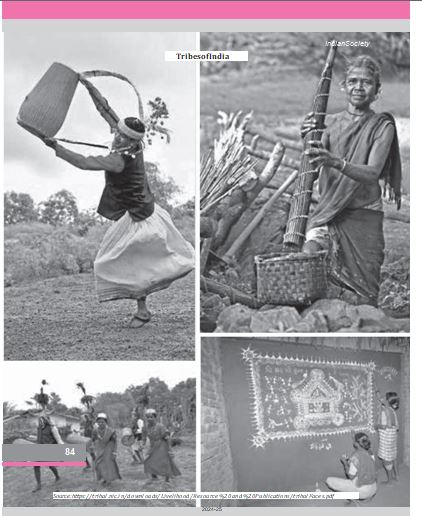
Adivasi Struggles
- Adivasi identity: The term means “original inhabitants” and expresses a shared identity and assertion of rights.
- Social position: Scheduled Tribes are constitutionally recognised communities, often concentrated in particular regions and closely connected with wider society.
Resource Loss, Displacement and Adivasi Movements
How Adivasi Livelihoods Were Undermined
- Forest reservation and resource extraction → customary access to forests and land was restricted.
- Loss of livelihoods → poverty and insecurity increased.
- Limited choices → Adivasis used forests illegally and faced prosecution, or migrated for wage labour.
- Industrial development → land acquisition for mines and dams caused displacement, often without adequate rehabilitation.
Adivasi Identity and Political Struggles
- The term “Adivasi”: Coined in the 1930s amid struggles against colonial intrusion, outside settlers and moneylenders.
- Shared experience: Adivasi identity reflects forest loss, land alienation and repeated displacement, especially through post-Independence development projects.
- Movements: Many tribal groups have struggled against outsiders (“dikus”) and the state.
- Political achievement: Adivasi movements helped secure statehood for Jharkhand and Chhattisgarh, formerly parts of Bihar and Madhya Pradesh respectively.
- Difference from Dalit struggles: Adivasis were concentrated in contiguous areas, enabling demands for states of their own.
Key Periods in Adivasi Struggles
- Mid-nineteenth century onwardsNon-tribals moved into central Indian tribal districts, while tribal people migrated for work in plantations, mines and factories.
- Late nineteenth centuryColonial forest reservation restricted Adivasi access to forests and customary livelihoods.
- 1930sThe term Adivasi was coined as part of struggles against colonial and outside intrusion.
- After 1947Government control of forests continued and development projects displaced Adivasis.
- Since the 1990sEconomic liberalisation made corporate land acquisition easier and intensified displacement pressures.
Gender Inequality and Social Reform
- Gender inequality: Unequal relations between women and men are socially produced, not explained by biological differences.
- Social reform: Women’s rights became a public issue in modern India as people challenged inequalities in social life.
- Changing concerns: The section traces how ideas of gender justice and the issues raised by women’s movements have changed over time.
Nineteenth-Century Reformers and Women’s Rights
Key Dates in Women’s Rights
- About a decade before 1828Raja Rammohun Roy began his campaign against sati.
- 1828Raja Rammohun Roy established the Brahmo Samaj.
- 1860sRanade drew on moral philosophy and Hindu texts in support of widow remarriage.
- 1882Tarabai Shinde published Stree Purush Tulana.
- 1905Begum Rokeya Sakhawat Hossain wrote Sultana’s Dream.
- Early twentieth centuryWomen’s organisations grew locally and nationally, and women increasingly participated in the national movement.
- 1931The Karachi Session of the Indian National Congress declared commitments to women’s equality and rights.
- 1970sWomen’s issues re-emerged, including media representation and unequal development.
- 1980s and afterLaw became a major site of reform for women’s rights.
- Twenty-first centuryThe falling child sex ratio and bias against the girl child emerged as major challenges.
Women’s Voices and Early Feminist Visions
- Women’s writing: Tarabai Shinde’s Stree Purush Tulana challenged the double standards of a male-dominated society.
- Gender roles: Begum Rokeya’s Sultana’s Dream imagined a society where women held public and scientific roles while men stayed indoors.
Women’s Rights in Nationalism and Later Movements
- Adivasi
- “Original inhabitants”; a political identity linked to rights and shared experiences of dispossession.
- Diku
- An outsider, especially in the context of Adivasi struggles against intrusion and exploitation.
- Internal colonialism
- The subjugation of Adivasis and alienation of their resources within India, often under the label of development.
- Matrilineal society
- A society in which descent or inheritance is traced through the mother’s line.
Why are gender inequalities understood as social rather than purely biological?
How did development projects affect Adivasis?
What rights did the 1931 Karachi declaration affirm for women?
Quick recap
- Adivasi identity expresses rights, shared histories of dispossession and the loss of forests and land.
- Colonial forest policies and post-Independence development restricted livelihoods and caused large-scale displacement.
- Adivasi movements challenged outsiders and the state, and contributed to the creation of Jharkhand and Chhattisgarh.
- Gender inequality is social, not simply biological; different family and work arrangements across societies demonstrate this.
- Women’s rights reformers included Rammohun Roy, Ranade, Phule and Sir Syed Ahmed Khan, while Shinde and Rokeya offered influential women’s perspectives.
- Women’s rights became part of the nationalist vision and continued to develop through later movements, legal reform and new challenges.
The Struggles of the Disabled
Understanding Disability
Disability — Disability arises not only from impairment but also from social arrangements that fail to meet people’s needs.
| Focus | Impairment-centred view | Social construction view |
|---|---|---|
| Source of difficulty | Problems are assumed to originate from the person’s impairment. | Society’s design and attitudes create or intensify barriers. |
| Example | A person is assumed to be unable to enter a building because of their impairment. | A building has no accessible entrance, preventing the person from entering. |
| Implication | The person is treated as the problem or as a victim needing help. | Society must address barriers that exclude people. |
Recognition and Invisibility
- Recent recognition: Compared with struggles over Dalit, Adivasi and women’s rights, the rights of disabled people have been recognised relatively recently.
- Disabled-led efforts: Disabled people themselves have played a leading role in building awareness and demanding a rethink of disability.
- Invisibility: Activist and scholar Anita Ghai compares disabled people’s social invisibility to Ralph Ellison’s *Invisible Man*.
Public Perceptions and Cultural Attitudes
Common Assumptions and Labels
- Biological assumption: Disability is often treated as a biological given, and problems are automatically blamed on impairment.
- Victim status: Disabled people may be viewed as victims who need help, with disability assumed to define their self-perception.
- Labels in India: Terms such as “disability”, “handicap”, “crippled”, “blind” and “deaf” are often used interchangeably and sometimes as insults.
- Bodily perfection: A cultural ideal of the “perfect body” can make bodily differences seem abnormal, defective or distorted.
- Fate and karma: Disability may be attributed to fate or past karma, portraying disabled people as victims with no reprieve.
- Cultural portrayal: Popular mythological images of disabled people have often been extremely negative.
Language and Social Construction
Social Disablement
- Changing language: Terms such as “mentally challenged”, “visually impaired” and “physically impaired” came to replace derogatory labels such as “retarded”, “crippled” and “lame”.
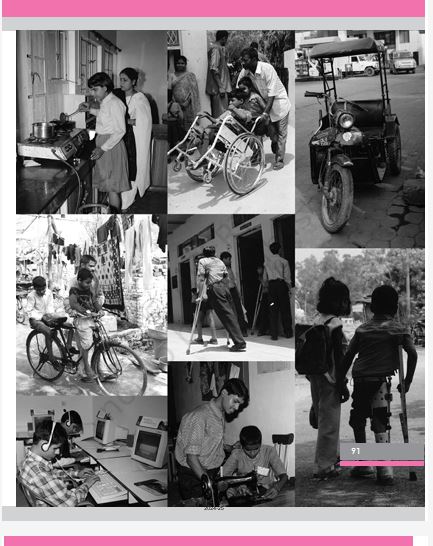
- Social barriers: Buildings and institutions not designed to include disabled people can restrict access and participation.
- Further effects: Inaccessible environments can limit education, employment opportunities and social life.
- Core idea: People are disabled not only by bodily or mental conditions, but also by the way society is constructed.
Disability and Poverty
The Disability–Poverty Cycle
- Poverty-related conditions—such as malnutrition, weakened mothers from frequent childbirth, inadequate immunisation and accidents in overcrowded homes—can increase the incidence of disability.
- Disability can increase isolation and economic strain for individuals and their families.
- Reduced participation and added economic pressures can worsen poverty.
- Disabled people are among the poorest in poor countries, and disability can deepen existing poverty.
Awareness, Education and Wider Inequalities
Education and Changing Social Attention
- Disabled-led change: Efforts by disabled people have helped build awareness and press governments to respond.
- Educational exclusion: Disability has often been absent from wider educational discussion; separate streams for disabled students and others have marginalised the issue.
- Inequality and struggle: Caste, tribe, gender and disability can generate inequality and exclusion, and also provoke struggles against them.
- Changing focus: Social-science attention has historically centred on class and race, and later gender; caste and tribe have since received greater attention in India.
- Further categories: Religion and overlapping identities—such as religion and caste, gender and religion, or caste and region—also need attention.
- Example: The Sachar Committee Report on the Muslim community illustrates attention to a marginalised group.
- Impairment
- A physical or mental condition that may affect a person.
- Social construction of disability
- The idea that social arrangements and attitudes can create barriers that disable people.
- Social exclusion
- Restriction from full participation in education, work or social life.
- Intersection
- The overlapping of categories such as caste, gender, religion and region in shaping inequality.
How does society contribute to disability?
Explain the relationship between disability and poverty.
How has disability been marginalised in education?
Quick recap
- Disability results from impairments as well as social barriers and exclusion.
- Public attitudes can frame disabled people as victims and blame disability on fate or karma.
- Inaccessible buildings and institutions can restrict education, work and social participation.
- Poverty can increase disability risks, while disability can deepen poverty and economic strain.
- Disabled people’s efforts have helped build awareness and prompt government responses.
- Inequality also involves overlapping categories such as caste, gender, religion and region.
Activities
Disability and Social Barriers
Social constitution of disability — Disability is shaped by a person’s physical condition as well as by social barriers, institutions and attitudes.
How disability is socially shaped
- Inaccessible spaces: Buildings without ramps can prevent people from entering or using public services.
- Institutional exclusion: Barriers in education, employment and public institutions can limit participation.
- Different contexts: Support needs may depend on a person’s surroundings and everyday priorities.
How social barriers can create exclusion
- Inaccessible buildings and services → difficulty reaching or using them
- Difficulty accessing institutions → reduced participation and independence
- Limited participation → greater social exclusion for disabled people
Census 2011: Counting Disability
Census approach
- Collection: Disability information was gathered during population enumeration through the Household Schedule.
- Coverage: Questions were asked about everyone in the household; enumerators were also instructed to contact the disabled person, as well as the respondent.
- Household types: National, institutional and household types were covered.
- Question development: Questions were tested in selected areas and pre-tested across rural and urban samples in all States, with input from civil society organisations and the nodal ministry.
- Design priorities: Categories had to be easy to understand, useful for planners and policy-makers, and feasible for covering disabilities listed in the Persons with Disabilities Act, 1995, and the National Trust Act, 1999.
- Identification: A filter question was included to establish disability status.
- Better coverage: Questions aimed to cover eight types of disability, compared with five in Census 2001.
- Implementation: The disability question was moved earlier in the Schedule; enumerators received extensive training and publicity measures were used.
| Census | Types of disability targeted |
|---|---|
| 2001 | Five |
| 2011 | Eight |
Public Buildings and Equal Access
Court access
- High Court: A 2006 report described entrances with staircases but no ramps; even the limited elevator facility required climbing steps.
- City Civil Court: Disabled, injured and older people could struggle to reach courtrooms; some were carried upstairs by companions.
- Institutional exclusion: A senior jurist criticised the non-consideration of disabled people for Judge posts as an exclusive policy that violated a statutory mandate.
- Key point: Formal rights do not ensure equal participation when public buildings and institutions remain inaccessible.
Education, Work and Everyday Priorities
Social context and inclusion
- Education context: Anita Ghai’s 2002 discussion states that half of children aged 5–14 were out of school; disabled children face further barriers, especially when segregated schooling is advocated.
- Village context: Some parents may value practical support—such as easier access to water or improved agricultural facilities—more than schooling they do not see as increasing their child’s autonomy.
- Urban-slum context: Parents may expect education to connect with work and improve their child’s basic quality of life.
- Planning lesson: Inclusion must respond to people’s circumstances and priorities, not merely make education or legislation formally available.
Dates and legal references
- 1995The Persons with Disabilities Act is cited as a reference for disability categories.
- 1999The National Trust Act is cited as a reference for disability coverage.
- 2001The Census attempted to collect information on five types of disabilities.
- 2002Anita Ghai discussed disability and social context in the Indian context.
- 2 August 2006The Hindu reported concerns about inaccessible court buildings and exclusion.
- 2011The Census aimed to collect information on eight types of disabilities.
- Accessibility
- The ability to enter, use and participate in places, services and institutions.
- Social exclusion
- Being prevented or limited from participating in social institutions and public life.
- Segregated schooling
- Education provided separately for disabled children rather than in shared settings.
Quick recap
- Disability is shaped by physical conditions as well as social barriers, institutions and attitudes.
- Census 2011 asked about all household members and sought information on eight disability types.
- Question testing, consultation, training and publicity were used to improve Census coverage.
- Inaccessible courts can make legal participation difficult despite formal rights.
- The source notes that half of children aged 5–14 were out of school, with additional barriers for disabled children.
- Inclusive support should reflect the different contexts and priorities of disabled people and their families.
Sociology — ALL CHAPTERS
1
INTRODUCING INDIAN SOCIETY
2
THE DEMOGRAPHIC STRUCTURE OF THE INDIAN SOCIETY
3
SOCIAL INSTITUTIONS CONTINUITY AND CHANGE
4
THE MARKET AS SOCIAL INSTITUTIONS
5
PATTERNS OF SOCIAL INEQUALITY AND EXCLUSION
6
THE CHALLENGES OF CULTURAL DIVERSITY
7
SUGGESTIONS FOR PROJECT WORK
1
Structural Change
2
Cultural Change
3
The Constitution and Social Change
4
Change and Development in Rural Society
5
Patterns of Industrialisation and Urbanisation
6
Globalisation and Social Change
7
Mass Media and Communications
8
Social Movements