Class 12 Humanities . Sociology . Social Change And Development In India . Social Movements
Chapter 8: Social Movements
Ch 8
Sociology
Class 12 Humanities
Introduction
Social Movements and Rights
Social movement — A collective struggle that seeks to bring about change in society or protect people’s rights.
How movements shape everyday life
- Workers’ rights such as weekends, an eight-hour workday, equal pay for equal work, social security and pensions were won through struggle.
- Rights are not automatic: many freedoms people take for granted exist because of earlier movements.
- Social change can result from movements, and one movement can inspire others.
The Right to Vote
Universal adult franchise — The right of every adult to vote; in India, it is guaranteed by the Constitution.
Why voting rights matter
- Representation: people elect those who govern and represent them.
- Historical contrast: under colonial rule, ordinary people were subject to colonial officers representing the British Crown.
- Earlier restrictions in Britain: voting was limited to property-owning men; women’s suffrage activists faced strong opposition and violent repression.
Chartism — A social movement in England that demanded parliamentary representation and wider voting rights.
The People’s Charter
- Demands: universal male suffrage, voting by ballot, and the right to stand for election without owning property.
- Support: over 1.25 million signatures were collected in 1839; 3.25 million were collected in 1842.
Voting rights in Britain in 1918
- Who gained the vote: all men over 21, married women, women who owned houses, and women university graduates over 30.
- Important distinction: this was an expansion of voting rights, not the right of every adult woman to vote.
Key milestones
- 1839Chartists collected over 1.25 million signatures for the People’s Charter.
- 1842The People’s Charter gained 3.25 million signatures.
- 1918Voting rights in Britain were extended to the groups of men and women listed above.
Movements and Social Change
Examples of movements and their impact
- India: 19th-century social reform movements challenged caste and gender discrimination; the nationalist movement ended colonial rule in 1947.
- Around the world: nationalist movements in Asia, Africa and the Americas helped end colonial rule.
- Other examples: socialist movements; the US civil rights movement for Black people’s equal rights in the 1950s and 1960s; and the anti-apartheid struggle in South Africa.
How movements can create further change
- A social movement challenges an existing injustice or system.
- Collective struggle can win rights or transform society.
- Those changes can inspire other movements.
- In India, the national movement shaped the Constitution, which in turn became an important means of social change.
- Universal adult franchise
- The right of every adult to vote.
- Chartism
- An English movement demanding wider voting rights and parliamentary representation.
- Suffragettes
- Women activists who campaigned for women’s right to vote.
- Social change
- A transformation in society, which social movements can help bring about.
Quick recap
- Many everyday rights, including workers’ rights, were won through social movements.
- Universal adult franchise gives every adult the right to vote; it is guaranteed by the Indian Constitution.
- Chartism campaigned for wider voting rights in England and gathered millions of signatures for the People’s Charter.
- In Britain, voting rights were extended in 1918 to specified groups of men and women.
- Movements have challenged discrimination, colonial rule and unequal rights in India and across the world.
- Movements can inspire further movements, while constitutions can also become instruments of social change.
Features of a Social Movement
Defining Features of a Social Movement
Social movement — Sustained, organised collective action by people with shared objectives and ideologies, often directed against the state to seek changes in state policy or practice, or to bring about or prevent change.
Core features
- Sustained action: It continues over time; a spontaneous, disorganised protest alone is not a social movement.
- Organisation: It involves some structure, which may include leadership and ways for members to relate, make decisions and act.
- Shared direction: Participants have common objectives and ideologies, and a general approach to achieving or preventing change.
- Public issues: Movements may seek change on issues such as tribal communities’ forest rights or settlement and compensation for displaced people.
- Changing features: A movement’s organisation, objectives or approach may shift during its course.
Social Movements and Counter-Movements
Counter-movement — Collective action that arises to defend the status quo or oppose the changes sought by a social movement.
| Movement or reform | Opposition or response |
|---|---|
| Raja Rammohun Roy’s campaign against sati and the Brahmo Samaj | Defenders of sati formed the Dharma Sabha and petitioned the British against legislation. |
| Reformers’ demand for girls’ education | Some opposed it, claiming it would be disastrous for society. |
| Campaign for widow remarriage | Reformers faced social boycott. |
| Enrolment of so-called lower-caste children in schools | Some so-called upper-caste families withdrew their children. |
| Peasant movements | They have often been brutally suppressed. |
| Movements by formerly excluded groups, including Dalits | They have often faced retaliatory action. |
| Proposals to extend reservation in educational institutions | Counter-movements arose to oppose them. |
Why social change faces resistance
- Movements seek change in society
- Their aims challenge entrenched interests and values
- Opposition and resistance arise, sometimes through counter-movements or suppression
- Change may still occur over time
How Social Movements Act
Beyond protest
- Meetings: Activists mobilise people, build a shared understanding of an issue and develop agreement on a collective agenda.
- Campaigns: Movements lobby the government, media and other influential makers of public opinion.
- Protest repertoire: Actions may include candle or torch processions, black cloth, street theatre, songs and poetry.
- Gandhian methods: Ahimsa, satyagraha and the charkha offered distinctive forms of protest.
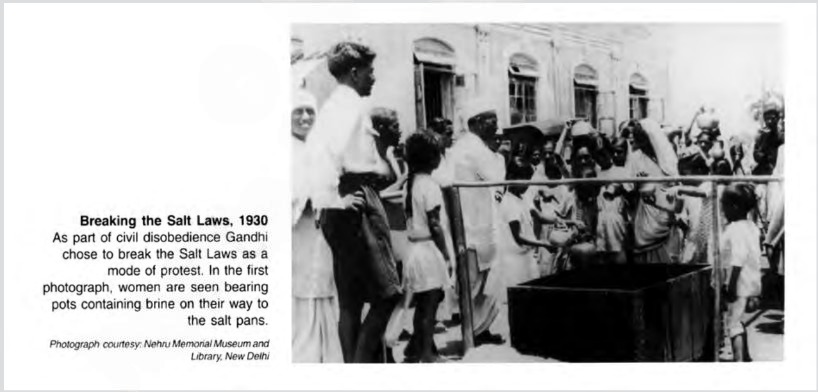
- Civil disobedience: Picketing and defying the colonial ban on producing salt were innovative protest methods.
Satyagraha as resistance
- Khadi: Gandhi wore hand-spun, hand-woven cloth to support Indian cotton-growers, spinners and weavers whose livelihoods were harmed by policies favouring mill-made cloth.
- Salt: The Dandi March protested British taxes on an everyday necessity, which burdened consumers to benefit the empire.
- Symbolic action: Gandhi turned everyday goods such as cloth and salt into symbols of resistance to foreign power and capital.
Examples in the lecture
- 19th centurySocial reformers sought to change society; their efforts are examples of social movements.
- 1930The civil disobedience movement included breaking the Salt Laws.
Social Change and Social Movements
| Point | Social change | Social movement |
|---|---|---|
| Nature | Continuous and ongoing; the accumulated result of countless individual and collective actions across time and space. | Organised, long-term social effort and action by people. |
| Direction | May occur through broad historical processes without one specific goal. | Directed towards specific goals. |
| Examples | Sanskritisation and westernisation. | 19th-century social reformers’ efforts to change society. |
Why Sociology Studies Social Movements
Social order and early sociological concerns
- French Revolution: It was the violent culmination of several movements aimed at overthrowing the monarchy and establishing liberty, equality and fraternity.
- Industrial Revolution in Britain: Urban labourers and artisans protested against inhuman living conditions; food riots were often suppressed.
- Elite concerns: Protests were seen by elites as a threat to established social order.
- Émile Durkheim: His work on division of labour, religion and suicide reflects concern with how social structures create social integration; movements were often viewed as forces of disorder.
| Point | Order-focused perspective | Marx-influenced perspective |
|---|---|---|
| View of protest | Social movements were often seen as forces that could produce disorder and threaten social order. | Violent collective action could express legitimate grievances rather than aim to destroy society. |
| Interpretation | Emphasis on social structures and integration, as in Durkheim’s work. | E. P. Thompson argued that crowds and mobs had a “moral economy”: shared ideas about right and wrong shaped their actions. |
| Reasons for protest | Protest appeared as a threat to established order. | Poor urban people had reasons to protest deprivation and often had no other way to express anger and resentment. |
- Satyagraha
- A Gandhian mode of protest associated with non-violence and resistance.
- Moral economy
- Shared understandings of right and wrong that inform people’s actions.
- Status quo
- The existing social arrangements that counter-movements seek to defend.
- Repertoire of protest
- The range of methods and symbolic actions used by a movement.
What distinguishes a social movement from spontaneous protest?
How do social movements act beyond visible protest?
How did E. P. Thompson reinterpret crowd protest?
Quick recap
- A social movement is sustained, organised collective action with shared goals and a general approach to change; it often seeks changes in state policy or practice.
- Movements can face counter-movements because they challenge established interests and values.
- Meetings, campaigns, lobbying and distinctive protest methods all matter—not protest alone.
- Gandhi used khadi and salt as symbols of resistance to colonial power and policy.
- Social change is continuous and broad; social movements pursue specific goals through collective effort.
- Sociologists have examined movements as threats to social order and, alternatively, as responses to justified grievances.
Types of Social Movements
Types of Social Movements
| Type | Aim | Example |
|---|---|---|
| Redemptive (transformatory) | Change members’ personal consciousness and actions. | Narayana Guru led people in the Ezhava community in Kerala to change social practices. |
| Reformist | Change existing social and political arrangements gradually, through incremental steps. | The 1960s movement to reorganise Indian states by language; the Right to Information campaign. |
| Revolutionary | Radically transform social relations, often by capturing state power. | The Bolshevik Revolution deposed the Tsar and created a communist state; the Naxalite movement seeks to remove oppressive landlords and state officials. |
Movements Change Over Time
- Mixed aims: A movement may combine redemptive, reformist and revolutionary elements, so classification is not always clear-cut.
- Shifting orientation: A movement may begin with revolutionary objectives and later become reformist.
- Institutionalisation: Mass mobilisation and collective protest may develop into more organised forms called social movement organisations.
Interpretation and Meaning
- Interpretation matters: How a movement is named or classified depends on the standpoint of the group describing it.
- 1857: British colonial rulers called the uprising a mutiny or rebellion; Indian nationalists called it the First War of Independence.
| Viewpoint | Meaning attached to the uprising |
|---|---|
| British colonial rulers | A mutiny: defiance against an authority regarded as legitimate. |
| Indian nationalists | A struggle for independence: a challenge to the legitimacy of British rule. |
Old and New Social Movements
| Point | Old social movements | New social movements |
|---|---|---|
| Main focus | Reorganisation of power relations; class-based demands such as better wages, living conditions, social security, free schooling and health security. | Quality-of-life concerns, such as a clean environment, as well as identity, culture and aspirations; economic inequality may also remain important. |
| Political role | Political parties were central; movements often operated within party frameworks. | People excluded from formal politics may organise outside parties to pressure the state. |
| Organisation and examples | Trade unions and workers’ parties were important. The Indian National Congress led the Indian National Movement; the Communist Party of China led the Chinese Revolution. | Includes NGOs, women’s groups, environmental groups and tribal activists; participants may unite across class boundaries. |
| Participants and issues | Often associated with workers and class-based political action. | Not organised along class lines alone. Women’s movements, for example, can include urban middle-class feminists and poor peasant women; separate-state movements can bring together groups with different class identities. |
| Scope and context | Socialist movements sought to establish new kinds of states and societies. | Many movements address international issues shaped by globalisation. |
Changing Views of Class-Based Movements
- Decline argument: Some believed old class-based political action led by trade unions and workers’ parties was declining.
- Affluent West argument: Others argued that, in affluent Western welfare states, class exploitation and inequality were no longer central concerns; new movements therefore focused more on quality of life.
Why Movements Grew Outside Party Politics
- Rajni Kothari linked the rise of Indian social movements in the 1970s to growing dissatisfaction with parliamentary democracy.
- State institutions were seen as captured by elites.
- Electoral representation through political parties seemed ineffective for poor people seeking to make their voices heard.
- People excluded from formal politics joined social movements and non-party political formations to pressure the state from outside.
Civil society — The broad sphere that includes political parties and trade unions as well as NGOs, women’s groups, environmental groups and tribal activists.
Globalisation and New Alliances
- Global connections: Globalisation reshapes industry, agriculture, culture and media; firms may be transnational and binding rules may be international, such as World Trade Organisation (WTO) regulations.
- Shared risks: Environmental and health risks, as well as fears of nuclear warfare, cross national borders.
- International alliances: Old and new movements can work together. The World Social Forum raises awareness about the hazards of globalisation.
Issues and Participation in New Movements
- Beyond class: New movements are not only about economic inequality; identity politics, cultural anxieties and aspirations also shape them.
- Cross-class participation: Movements may unite participants from different class backgrounds, such as middle-class feminists and poor peasant women.
- Multiple concerns: Social inequality can coexist with other important issues within a movement.
- Redemptive movement
- A movement aimed at changing its members’ personal consciousness and actions.
- Reformist movement
- A movement seeking gradual change within existing social and political arrangements.
- Revolutionary movement
- A movement seeking radical transformation of social relations, often by capturing state power.
- Social movement organisation
- A more institutionalised form that a movement may develop over time.
- Civil society
- The broad sphere of party-based and non-party organisations and groups.
Dates and Periods Mentioned
- 1857The uprising was interpreted by British colonial rulers as a mutiny and by Indian nationalists as the First War of Independence.
- 1960sThe movement to reorganise Indian states on the basis of language was an example of reformist action.
- 1970sRajni Kothari linked the surge of Indian social movements to dissatisfaction with parliamentary democracy.
Distinguish redemptive, reformist and revolutionary social movements.
How can the same movement be classified differently by different groups?
Give two differences between old and new social movements.
Quick recap
- Social movements may be redemptive, reformist or revolutionary, and can combine or shift between these orientations.
- Movements may develop from mass mobilisation and protest into more institutionalised social movement organisations.
- Classification depends on interpretation: the 1857 uprising was described as mutiny by colonial rulers and independence by Indian nationalists.
- Old movements centred on power relations and class demands; new movements also address quality of life, identity and culture.
- Some argued that class-based action was declining and that class exploitation mattered less in affluent Western welfare states.
- Kothari linked the rise of Indian movements in the 1970s to dissatisfaction with parliamentary democracy and elite capture of state institutions.
- Global concerns have encouraged international movements and alliances, including the World Social Forum.
Ecological Movements
Development and Ecological Concerns
Why ecological movements emerge
- Development model: Unchecked resource use and continually rising needs can intensify the exploitation of already depleted natural resources.
- Unequal benefits: Development does not benefit everyone equally; dams and industries can displace people from homes and livelihoods.
- Environmental costs: Industrial pollution and damage to natural environments are important concerns.
- Interlinked concerns: Ecological movements often connect environmental protection with people’s livelihoods and social justice.
The Chipko Movement
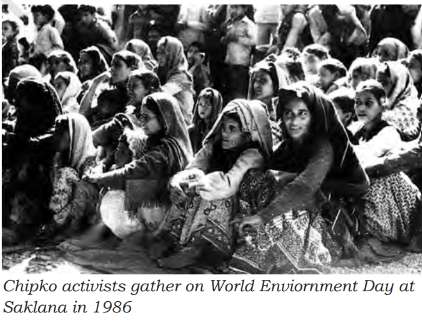
Chipko Movement — An ecological movement in the Himalayan foothills in which villagers hugged trees to prevent contractors from cutting them.
What was at stake
- Forest dependence: Villagers relied on forests for firewood, fodder and other daily necessities.
- Competing interests: The livelihood needs of poor villagers clashed with the government’s interest in earning revenue from timber sales.
- Subsistence vs profit: The movement challenged an economy based on villagers’ subsistence against an economy based on commercial profit.
- Forest protection: Villagers valued forests both as essential to their survival and as ecological wealth with value in itself.
| Concern | What it involved |
|---|---|
| Livelihood and inequality | Poor villagers’ access to forest resources versus commercial timber interests. |
| Ecology | Forest felling was linked to environmental destruction, floods and landslides. |
| Political representation | Hill villagers resented a distant government in the plains that seemed indifferent or hostile to their needs. |
Red and green issues
Red refers to social and livelihood concerns; green refers to ecological protection. Chipko linked both because villagers’ survival depended on healthy forests.
Floods, Forest Felling and Protest
Deforestation and flood damage
- Heavy monsoon in 1970
- Severe flooding in the Alaknanda valley
- Villagers noticed that some landslide-hit villages lay below forests where trees had been felled
- Growing recognition of links between deforestation, landslides and floods
- Local protests against forest felling gained support
Scale of the 1970 flood
- Damage: Water inundated 100 square kilometres; 6 metal bridges and 10 kilometres of motor roads were washed away.
- Losses: 24 buses and other vehicles were swept away; 366 houses collapsed and 500 acres of paddy crops were destroyed.
- Impact: Human and bovine lives were also lost; the flood became a turning point in the region’s ecological history.
Reni forest protest
- Organisation: The Dashauli Gram Swaraja Sangh (DGSS), a cooperative based in Chamoli district, supported the villagers’ cause.
- Trigger: Despite earlier protests, the government continued its annual forest auctions; the Reni forest was among the plots scheduled for assignment.
- Gaura Devi: When workers headed to fell trees, a girl alerted Gaura Devi, head of the village Mahila Mandal (Women’s Club).
- Action: Gaura Devi mobilised local women, who confronted the labourers and refused to move; the men eventually withdrew.
Environmental Initiatives and Wider Networks
Government initiatives
- Since 2014: The Government of India has initiated systematic efforts to improve ecological balance, structure and quality.
- Examples: These include the Integrated Ganga Conservation Mission (Namami Gange) and Swachh Bharat Abhiyan.
- Environmental basics: Forests support environmental conservation, while clean water is essential for a healthy environment.
Information-age movement networks
- Global links: Social movements can connect NGOs, religious and humanitarian groups, human-rights associations, consumer advocates and environmental activists.
- Public-interest campaigns: These networks enable groups across regions and countries to work together.
- Example: Internet-based networks helped organise large protests against the World Trade Organisation in Seattle.
- Ecological movement
- Collective action focused on environmental protection and related social concerns.
- Subsistence economy
- An economy centred on meeting people’s everyday needs, such as forest resources for villagers.
- DGSS
- Dashauli Gram Swaraja Sangh, the Chamoli cooperative that supported the villagers’ cause.
- Mahila Mandal
- The village Women’s Club, headed at Reni by Gaura Devi.
How did the Chipko Movement connect livelihood concerns with ecological protection?
Describe the Reni forest protest.
What were the main issues raised by the Chipko Movement?
Quick recap
- Uncontrolled resource exploitation can make development harmful and unequal.
- Chipko villagers hugged trees to protect forests essential to their livelihoods and the environment.
- The movement linked social inequality, ecological sustainability and political representation.
- The 1970 flood strengthened awareness of connections between forest felling, landslides and floods.
- Gaura Devi and local women led the Reni forest protest with support from DGSS.
- Since 2014, Namami Gange and Swachh Bharat Abhiyan have been among India’s environmental initiatives.
- Internet-based networks can connect social movements across regions and countries.
Class Based Movements
Peasant Movements
Peasant movements — Collective agrarian struggles against exploitation and other grievances.
Early agrarian struggles
- 1858–1914: Many peasant struggles were localised, disconnected, and focused on particular grievances.
- Bengal Indigo Revolt (1859–62): Opposed the indigo plantation system.
- Deccan Riots (1857): Directed against moneylenders.
- Gandhian-era struggles: Some agrarian issues became partly linked with the Independence movement.
| Movement | Date and place | Main issue |
|---|---|---|
| Champaran Satyagraha | 1917–18 | Opposed indigo plantations. |
| Bardoli Satyagraha | 1928; Surat District | A non-tax campaign refusing land revenue, described as part of the nationwide non-cooperation movement. |
Peasant organisations and major struggles
- Forest-policy protests: During the 1920s, peasants in some regions opposed the forest policies of the British government and local rulers.
- Kisan organisations: The Bihar Provincial Kisan Sabha was founded in 1929; the All India Kisan Sabha followed in 1936.
- Demands: Kisan Sabhas sought freedom from economic exploitation for peasants, workers, and other exploited classes.
| Movement | Period and region | Main cause and features |
|---|---|---|
| Tebhaga | 1946–47; Bengal and North Bihar | Sharecroppers demanded two-thirds of the produce instead of the customary half; supported by the Kisan Sabha and CPI. |
| Telangana | 1946–51; Hyderabad princely state | Opposed feudal conditions; led by the Communist Party of India (CPI). |
Radical peasant struggles
- Naxalbari area (1967): Peasants formed village committees and armed guards, occupied land, destroyed land records, cancelled debts, and established a parallel administration.
- Organisation: Kanu Sanyal later claimed that villagers were organised from March to April 1967, with 15,000–20,000 peasants enrolled as full-time activists.
- Parvatipuram Agency (1968): Girijans raided a landlord-moneylender’s house, seized grain, property, and documents.
New Farmers’ Movements
Farmer — A market-involved agricultural producer who both sells commodities and purchases inputs.
| Point | Earlier peasant movements | New farmers’ movements |
|---|---|---|
| Rise | Agrarian struggles existed from pre-colonial times; many early movements were local. | Began in Punjab and Tamil Nadu in the 1970s. |
| Organisation | Included peasant organisations such as Kisan Sabhas. | Regionally organised and non-party. |
| Focus | Often opposed landlordism, feudal conditions, or economic exploitation. | Focused on prices and related issues, including procurement, remunerative prices, input costs, taxation, and non-repayment of loans. |
| Methods and outlook | Methods varied by region and struggle. | Used road and railway blockades and barred politicians and officials from villages; ideology was strongly anti-state and anti-urban. |
Changing agenda
- Broader concerns: Some farmers’ movements extended their agenda to environmental and women’s issues.
- Classification: With this wider agenda, they can be viewed as part of the worldwide ‘new social movements’.
Workers’ Movements
Workers under colonial industrialisation
- Industrial growth: Factory production began in India in the early 1860s; factories first developed in Calcutta and Bombay, followed by Madras.
- Colonial trade pattern: India supplied raw materials, while manufactured goods from the United Kingdom were sold in the colony.
- Plantations: Tea plantations in Assam were established as early as 1839.
- Working conditions: Labour was cheap, and the colonial government initially regulated neither wages nor working conditions.
Early worker protests
- Before strong unions: Worker protests were often spontaneous rather than sustained; some nationalist leaders drew workers into the anti-colonial movement.
- War-time hardship: Industrial expansion coincided with food shortages and sharp price rises, prompting waves of strikes.
- Strikes in 1917: About 30 strikes were recorded in September and October; jute workers struck in Calcutta, and workers at Madras’s Buckingham and Carnatic Mills demanded higher wages.
- Ahmedabad: Textile workers demanded a 50 per cent wage increase.
Trade Union Development
- April 1918B.P. Wadia established the first trade union in Madras.
- 1918Mahatma Gandhi founded the Textile Labour Association (TLA).
- 1920The All India Trade Union Congress (AITUC) was formed in Bombay.
- May 1947The Indian National Congress formed the Indian National Trade Union Congress (INTUC).
- 1947A split in AITUC paved the way for further divisions along political-party lines.
- Late 1960sRegional parties began forming their own unions.
Trade union ideologies and divisions
- AITUC: A broad-based organisation involving diverse ideologies.
- Communists: The main communist leaders included S.A. Dange and M.N. Roy.
- Moderates: The moderate group included M. Joshi and V.V. Giri.
- Nationalists: The nationalist group included Lala Lajpat Rai and Jawaharlal Nehru.
- Political divisions: Communists gained considerable control over AITUC in the final years of British rule; later unions split along national and regional party lines.
Post-Independence Worker Struggles
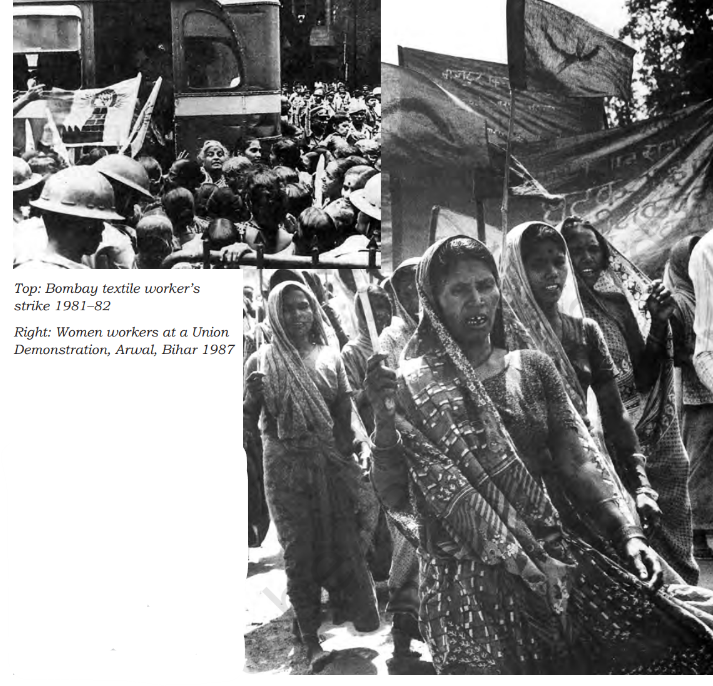
- 1966–67A major recession reduced production and employment, contributing to widespread unrest.
- 1974A major railway workers’ strike intensified confrontation between the state and trade unions.
Workers and civil liberties
- Wider struggle: The workers’ movement became part of the broader struggle for civil liberties.
- Sharecropper
- A cultivator who gives a share of the crop to the landowner.
- Kisan Sabha
- A peasant organisation representing agrarian interests.
- AITUC
- All India Trade Union Congress, formed in 1920.
- INTUC
- Indian National Trade Union Congress, formed by the Indian National Congress in 1947.
Compare the Tebhaga and Telangana movements.
State the key features of new farmers’ movements.
Quick recap
- Early peasant struggles were often local and addressed specific agrarian grievances.
- Kisan Sabhas organised peasants, while Tebhaga and Telangana were major struggles around Independence.
- New farmers’ movements from the 1970s focused on prices, input costs, taxation, and non-repayment of loans.
- Colonial industrialisation relied on cheap labour and weak regulation, prompting protests and strikes.
- AITUC formed in 1920; the Indian National Congress formed INTUC in 1947, amid growing political divisions in unions.
- The recession of 1966–67 and the 1974 railway strike intensified worker–state conflict and linked labour struggles to civil liberties.
Caste Based Movements
Dalit Movements
Dalit movement — A struggle for recognition, dignity and self-determination, and against untouchability and its stigma.
Meaning and aims
- Beyond material oppression: Dalit movements cannot be explained only by economic exploitation or political oppression.
- Human recognition: They demand recognition as fellow human beings—the struggle “to be touched”—and seek confidence and self-determination.
- Dalit: Used in Marathi, Hindi, Gujarati and other Indian languages for poor and oppressed people; neo-Buddhist followers of Babasaheb Ambedkar used it in a new context in Marathi in the early 1970s.
- Rejection of hierarchy: The term conveys being deliberately broken down by those above and rejects ideas of pollution, karma and justified caste hierarchy.
Shared aims and varied movements
- No single movement: Dalit movements have differed in their issues and ideologies; there has not been one unified movement.
- Common ground: They assert Dalit identity and share a quest for equality, self-dignity and the eradication of untouchability.
- Examples: Satnami Movement (Chamars, Chhattisgarh plains in eastern Madhya Pradesh); Adi Dharma Movement (Punjab); Mahar Movement (Maharashtra); Jatava mobilisation (Agra); Anti-Brahman Movement (South India).
- Public presence: In contemporary India, Dalit movements have a significant place in public life, alongside a growing body of Dalit literature.
Dalit literature
- Voice: Dalit writers use imagery and expression rooted in their own experiences and perceptions.
- Purpose: Dalit literature calls for social and cultural revolt and seeks dignity and identity.
- Scope: Some writing centres on cultural struggle; some also address structural inequalities, including economic conditions.
| Type | Main focus | Examples or character |
|---|---|---|
| Reformative | Limited change and social mobility within society | The movement as a whole has often been described as reformist. |
| Redemptive | Change in individual life and ways of living | Could include behavioural change, such as giving up eating beef, or religious conversion. |
| Revolutionary | Transform society by ending caste oppression and economic exploitation | The anti-caste movement had revolutionary features; post-Ambedkar movements have also had revolutionary practices. |
Origins, leadership and overall assessment
- Origins and leadership: The anti-caste movement began in the 19th century under Jotiba Phule, was carried forward by non-Brahmin movements in Maharashtra and Tamil Nadu in the 1920s, and later developed under Dr. Ambedkar.
- Mixed character: It combined reformative, redemptive and revolutionary features; at its strongest, it was revolutionary for society and redemptive for individuals.
- Post-Ambedkar approaches: Movements offered alternative ways of living, from individual behavioural change and religious conversion to efforts to change society.
- Achievements and limits: They brought real but limited change, especially for educated Dalits, but did not transform society enough to end widespread poverty and caste oppression.
Backward Class Caste Movements
Caste as a basis for political mobilisation
- Colonial patronage was often distributed by caste.
- Caste became useful for social and political identity in institutional life.
- Similarly placed caste groups united in a “horizontal stretch.”
- Caste lost some ritual significance and became increasingly secularised as a basis for political mobilisation.
Growth of Backward Class mobilisation
- Late 19th centuryThe term “Backward Classes” came into use in different parts of India.
- 1872The term began to be used more widely in the Madras Presidency.
- 1918It was in use in the princely state of Mysore.
- 1925It was in use in the Bombay Presidency.
- From the 1920sOrganisations united around caste issues in different parts of India.
- 1954Eighty-eight organisations working for Backward Classes were counted.
Organisations and constitutional concern
- Organisations: Examples included the United Provinces Hindu Backward Classes League, All-India Backward Classes Federation and All India Backward Classes League.
- G.B. Pant’s argument: The Depressed Classes, Scheduled Castes and Backward Classes needed particular support to rise towards the general level.
- Weakest-link idea: A society’s wellbeing depends on revitalising its most disadvantaged groups.
| Point | G.B. Pant’s statement | 2019 reservation |
|---|---|---|
| Who is addressed | Depressed Classes, Scheduled Castes and Backward Classes | Economically weaker sections among upper castes |
| Measure or emphasis | Take particular care to bring disadvantaged groups towards the general level | Introduced 10% reservation in education and government jobs |
- Horizontal stretch
- The coming together of similarly placed caste groups for collective social or political purposes.
- Secularisation of caste
- The shift of caste from primarily ritual significance towards use as a basis for political mobilisation.
- Self-determination
- The ability of a group to assert its identity and shape its own choices and future.
Why can Dalit movements not be explained only in terms of economic exploitation?
What are the reformative, redemptive and revolutionary features of Dalit movements?
How did colonial patronage help caste groups become political entities?
Quick recap
- Dalit movements seek recognition, dignity, self-determination and an end to untouchability.
- Dalit movements differ in ideology and focus but share a quest for equality and self-dignity.
- Dalit literature expresses lived experience and calls for social and cultural change.
- Dalit movements have reformative, redemptive and revolutionary features, though their overall transformation has been limited.
- Colonial caste-based patronage encouraged caste groups to organise and mobilise politically.
- Backward Class organisations grew across regions; G.B. Pant stressed uplifting disadvantaged sections.
The Tribal Movements
Tribal Movements in India
Shared concerns and differences
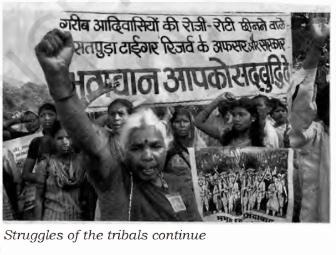
- Diversity: Tribal groups may share concerns, but their histories and specific movements differ; they should not be treated as one uniform group.
- Central tribal belt: Many movements arose in middle India, including among the Santhals, Hos, Oraons and Mundas in Chota Nagpur and the Santhal Parganas.
- Jharkhand: This region forms the main part of what came to be known as Jharkhand; its movement provides an example of a long history of tribal resistance.
The Jharkhand Movement
Jharkhand movement — A long-running movement for a separate state, rooted in adivasi resistance, shared identity and experiences of marginalisation.
State formation
- More than a century before 2000Resistance that later fed into the demand for Jharkhand had a history spanning over a century.
- 2000Jharkhand was formed as a separate state, carved out of south Bihar.
Identity, leadership and mobilisation
- Birsa Munda: Adivasi leader of a major uprising against British rule; after his death, he became an important movement icon, remembered through stories, songs and writing.
- Literacy and history: Christian missionaries helped spread literacy in south Bihar. Literate adivasis researched and recorded tribal histories, myths, customs and cultural practices.
- Shared identity: Circulating this knowledge helped build ethnic consciousness and a common identity as Jharkhandis.
- Leadership: Access to government jobs helped an adivasi middle-class intellectual leadership emerge; it formulated the separate-state demand and lobbied for it in India and abroad.
- Adivasi
- An indigenous tribal person or community.
- Dikus
- Migrant traders and moneylenders who settled in the area and were seen as taking local wealth.
- Ethnic consciousness
- Awareness of a shared cultural identity and common group interests.
- Alienation of land
- Loss of tribal control over land, including land taken for projects or transferred away from communities.
- Autonomy
- The ability of a group or region to govern its affairs within a larger political framework.
How a shared Jharkhandi identity grew
- Mining and industrial projects in a mineral-rich region brought most benefits to dikus, while adivasi lands were alienated.
- Adivasis experienced marginalisation and injustice, alongside resentment toward dikus.
- Recording and sharing tribal history and culture strengthened a common Jharkhandi identity.
- Collective mobilisation and leadership advanced the demand for a separate state.
| Issue | Response or concern |
|---|---|
| Land acquisition for large irrigation projects and firing ranges | Opposed by movement leaders |
| Survey and settlement operations | Operations were held up and camps closed down |
| Collection of loans, rent and cooperative dues | Collection was resisted |
| Nationalisation of forest produce | Boycotted |
Tribal Movements in the North East
Ethnicity and political demands
- After independence, government-led state formation unsettled major hill districts in the North East.
- Tribes with distinct identities and traditions of autonomy were unsure about incorporation into Assam’s administration.
- Contact with a powerful external system challenged communities that had long maintained their own worldview and social and cultural institutions.
- Ethnic mobilisation emerged as a response to this new situation.
| Phase | Political tendency |
|---|---|
| Earlier phase | A tendency towards secessionism |
| Later trend | Search for autonomy within the Indian Constitution |
Common concerns across tribal movements
- Forest-land alienation: A central issue linking tribal movements across different parts of India.
- Ecology: Forest and land struggles make ecological concerns central to tribal movements.
- Multiple dimensions: Tribal mobilisation also involves cultural identity and economic inequality.
- Old and new movements: Tribal struggles show how ecological, cultural and economic demands can overlap, blurring the distinction between old and new social movements.
How did a shared Jharkhandi identity support the demand for a separate state?
What change occurred in the political demands of North-Eastern tribal movements?
Quick recap
- Tribal groups can share concerns while retaining distinct histories and movement demands.
- Jharkhand became a state in 2000 after more than a century of resistance and mobilisation.
- Birsa Munda became an icon; literacy and cultural documentation helped build a Jharkhandi identity.
- Land alienation, unequal benefits from development and opposition to dikus fuelled Jharkhand mobilisation.
- North-Eastern tribal politics shifted from secessionist tendencies towards constitutional autonomy.
- Forest-land alienation, ecology, cultural identity and economic inequality connect many tribal movements.
The Women’s Movement
Social Reform and Early Women’s Organisations
Women’s movement — Organised efforts to address women’s concerns and bring change to public issues affecting them.
- 19th-century reform: Social reform movements raised issues concerning women.
- Early organisations: In the early 20th century, women’s organisations grew at national and local levels.
- Key organisations: Women’s India Association (WIA, 1917), National Council for Women in India (NCWI, 1925) and All India Women’s Conference (AIWC, 1926).
- Changing focus: Some organisations began with limited concerns but broadened their work over time. AIWC initially separated women’s welfare from politics, then recognised national freedom as essential to achieving reforms.
- Movement features: Early activism included organisations, ideology, leadership, shared understanding and an aim to change a public issue. It created an atmosphere in which women’s concerns could not be ignored, though whether it constituted a social movement is debated.
Early Women’s Organisations
- 1917Women’s India Association (WIA) was established.
- 1925National Council for Women in India (NCWI) was established.
- 1926All India Women’s Conference (AIWC) was established.
Women in Agrarian Struggles and Revolts
- Participation: Women’s activism was not limited to educated, middle-class women; women joined rural and tribal struggles alongside men during the colonial period.
- Examples: Women participated in Bengal’s Tebhaga movement, the Telangana armed struggle under the former Nizam’s rule, and the Warli tribal revolt against bondage in Maharashtra.
Post-1947 Lull and Renewal
- Lull after 1947: Many women activists who had participated in the nationalist movement became involved in nation-building; the trauma of Partition is another explanation for reduced activity.
- Renewal: The movement revived in the mid-1970s, sometimes called the second phase of the Indian women’s movement.
- Changes: The renewed movement retained many earlier concerns but developed new organisational strategies, ideologies and areas of focus.
Campaigns and Changing Concerns
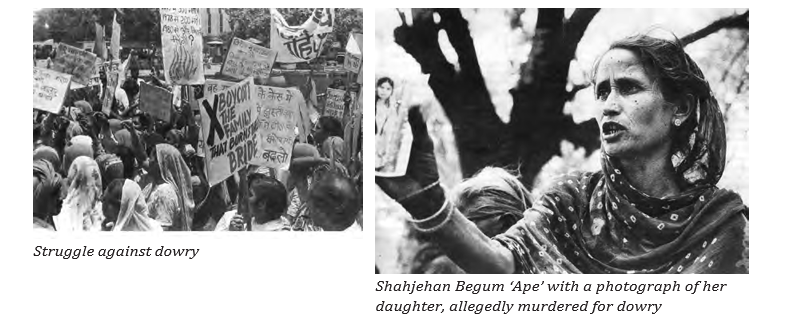
- Issues: Campaigns addressed violence against women, dowry, land rights, employment and sexual harassment, and sought legal change.
- Everyday change: Campaigning helped make it more common for school forms to include both the father’s and mother’s names.
- Legal change: The women’s movement contributed to important changes in laws.
| Point | Example 1 | Example 2 |
|---|---|---|
| Shared disadvantage | Women face disadvantages in relation to men. | The level and kind of discrimination differ among women. |
| Class and livelihood | An educated middle-class woman’s concerns | A peasant woman’s concerns |
| Caste | A Dalit woman’s concerns | An upper-caste woman’s concerns |
Gender Justice
- Restrictive gender identities: Patriarchal norms constrain both women and men; men may feel pressured to be strong and successful and discouraged from expressing emotion.
- Gender-just society: A society that allows both women and men to live freely; this requires ending injustices of all kinds.
- Key factors: The idea rests on educated women having multiple roles and on an improved sex ratio.
- Government effort: Beti Bachao, Beti Padhao Yojana is an important effort towards realising a gender-just society.
Social Movements and Society
Individuals, Groups and Social Change
- Individuals and social groups seek to change their conditions.
- Their efforts change their own lives and identities.
- These changes also transform society.
What features support viewing early women’s activism as a social movement?
Give examples of women’s participation in rural and tribal struggles.
What two factors are named as important to a gender-just society?
Quick recap
- Nineteenth-century social reform movements raised women’s issues; national and local women’s organisations grew in the early 20th century.
- Early women’s activism had key social-movement features, although its classification as a movement is debated.
- Women participated in rural and tribal struggles, including Tebhaga, Telangana and the Warli revolt.
- The post-1947 lull is linked to nation-building and Partition; the movement renewed in the mid-1970s.
- Campaigns addressed violence, dowry, land rights, employment, sexual harassment and legal change.
- Gender justice recognises differences in women’s experiences and seeks freedom from restrictive gender roles.
- Social movements emerge as people seek to change their conditions, transforming themselves and society.
Sociology — ALL CHAPTERS
1
INTRODUCING INDIAN SOCIETY
2
THE DEMOGRAPHIC STRUCTURE OF THE INDIAN SOCIETY
3
SOCIAL INSTITUTIONS CONTINUITY AND CHANGE
4
THE MARKET AS SOCIAL INSTITUTIONS
5
PATTERNS OF SOCIAL INEQUALITY AND EXCLUSION
6
THE CHALLENGES OF CULTURAL DIVERSITY
7
SUGGESTIONS FOR PROJECT WORK
1
Structural Change
2
Cultural Change
3
The Constitution and Social Change
4
Change and Development in Rural Society
5
Patterns of Industrialisation and Urbanisation
6
Globalisation and Social Change
7
Mass Media and Communications
8
Social Movements