Class 6 . Science . Curiosity . A Journey Through States of Water
Chapter 8: A JOURNEY THROUGH STATES OF WATER
Ch 8
Science
Class 6
Investigating Water’s Disappearing Act
Water in Different States
- States of water: Water exists as ice, liquid water, and water vapour.
- One substance: Ice and liquid water are different states of the same substance.
Evaporation and Disappearing Water
- Water vapour is invisible. The visible appearance of steam comes from tiny water droplets in it.
Quick recap
- Ice, liquid water and water vapour are different states of the same substance.
- Water can disappear from a surface without seeping through it.
- Evaporation changes liquid water into water vapour.
- Evaporation happens continuously, even at room temperature.
- Wet clothes, mopped floors and sweat drying are examples of evaporation.
- Puddles may shrink through evaporation, seepage into the ground, or both.
- Water vapour is invisible; visible steam contains tiny water droplets.
Another Mystery
Water Droplets on a Cold Surface
Everyday Examples
- Dew: Water vapour condenses into droplets on plants and other surfaces; dew is commonly seen in the morning because surfaces are cool.
- Steel plate: Water vapour from boiling water touches the cooler inner side of a steel plate and condenses into droplets.
How Condensation Forms Droplets
- Water vapour in the air touches a cold surface
- The water vapour cools and changes into liquid water
- Liquid droplets collect on the surface
Evidence for Condensation
Do not assume that droplets on a cold tumbler leak from inside it: they form when water vapour in the air condenses on the cold outer surface.
Where do the droplets on the outside of a cold tumbler come from?
Quick recap
- Condensation is the change of water vapour into liquid water.
- Water vapour condenses when it touches a cold surface.
- Droplets on an icy tumbler come from water vapour in the air.
- Dew and droplets on the inner side of a steel plate are examples of condensation.
- Condensation on the tumbler adds mass, but a mass increase alone does not rule out seepage.
- An unchanged marked water level shows that the tumbler is not seeping.
What Are the Different States of Water?
Water in Three States
- Three states: Water occurs as a solid (ice), a liquid (water), and a gas (water vapour).
- Changing states: Water can change from one state to another when heated or cooled.
Properties of the Three States
| State | Shape | Flow and spread | Volume | Examples |
|---|---|---|---|---|
| Solid (ice) | Keeps its shape, whatever the container | Does not flow or spread | Fixed volume | Ice |
| Liquid (water) | No fixed shape; takes the shape of its container | Flows and spreads | Remains constant | Water, milk, oil |
| Gas (water vapour) | No fixed shape | Spreads throughout the available space | No fixed volume | Water vapour, oxygen, carbon dioxide |
Water Vapour Around Us
- At room temperature: Water vapour is present in the air, even though it is invisible.
- Evaporation: Water from drying clothes and mopped floors adds water vapour to the surrounding air.
- Spreading: The smell of cooking travels through air and can reach us outside the kitchen.
Examples of Solids, Liquids and Gases
| State | Examples |
|---|---|
| Solid | Stone, wood, glass |
| Liquid | Milk, oil |
| Gas | Oxygen, carbon dioxide |
How do ice and liquid water differ in shape and movement?
Why can the smell of cooking reach someone outside the kitchen?
Quick recap
- Water occurs as ice, liquid water and water vapour.
- Ice keeps its shape and does not flow or spread.
- Liquid water flows, spreads and takes the container's shape while its volume stays constant.
- Water vapour is invisible, present in air at room temperature, and spreads through available space.
- Examples include stone, wood and glass as solids; milk and oil as liquids; oxygen and carbon dioxide as gases.
How Can We Change the States of Water?
Changing States by Heating and Cooling
Melting — Melting is the conversion of a solid into a liquid, usually by heating.
Freezing — Freezing is the conversion of a liquid into a solid by cooling.
Water Vapour and Condensation
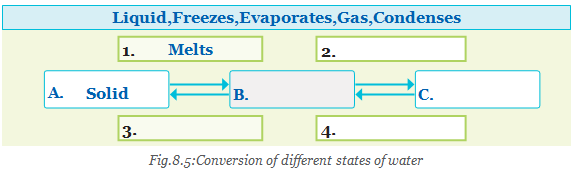
Do not confuse melting with freezing: melting is solid to liquid, while freezing is liquid to solid.
How can water change from ice to water vapour?
How does an Atmospheric Water Generator collect water from air?
Quick recap
- Heating can change ice to water and water to water vapour.
- Cooling can change water to ice and water vapour to liquid water.
- Melting is the change from solid to liquid; freezing is liquid to solid.
- Condensation forms liquid water when water vapour cools.
- AWGs collect water by cooling humid air and condensing its water vapour.
How Can Water Be Evaporated Faster or Slower?
Evaporation — Evaporation is the change of liquid water into water vapour from its surface.
Conditions That Affect Evaporation
| Factor | Condition | Effect and example |
|---|---|---|
| Exposed surface area | Larger area exposed to air | Evaporation is faster; the same amount of water evaporates faster in a plate than in a small bottle cap. |
| Temperature | Sunlight or warmer conditions | Evaporation is faster; a cap in sunlight loses water faster than one kept in the shade. |
| Humidity | More water vapour already in the air | Evaporation is slower; clothes dry slowly on rainy days because the air is more humid. |
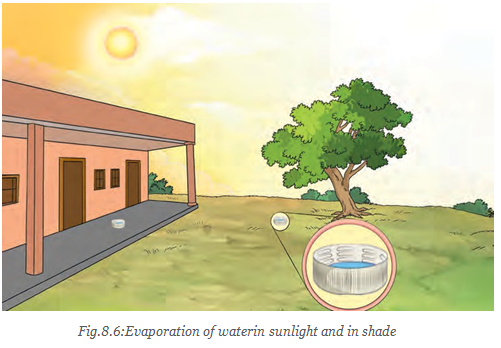
Making Evaporation Faster or Slower
- Faster evaporation: Expose a larger surface area or keep the water in sunlight.
- Slower evaporation: A smaller exposed area, shade, or humid air is associated with slower evaporation.
- Rainy days: The air contains more water vapour, so water evaporates slowly and clothes take longer to dry.
Why does water evaporate faster from a plate than from a small bottle cap?
Why do clothes dry slowly on a rainy day?
Quick recap
- A larger exposed surface area makes water evaporate faster.
- Water evaporates faster in sunlight than in shade.
- High humidity slows evaporation because the air already contains more water vapour.
- Rainy, humid conditions make clothes dry more slowly.
Cooling Effect
Cooling by evaporation
How an earthen pot cools water
- Water seeps through the porous pot wall.
- The water on the outer surface evaporates.
- Evaporation takes heat from the pot and its contents.
- The water inside becomes cooler.
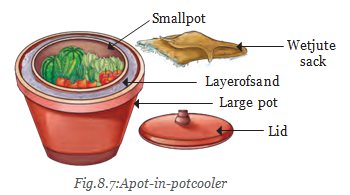
Pot-in-pot cooler
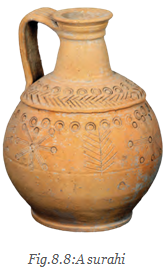
Traditional earthen water vessel
- Surahi: This traditional clay vessel is used in summer to keep water cool through evaporative cooling.
Why does water in an earthen pot become cool?
Quick recap
- Evaporation takes heat from the surroundings and causes cooling.
- Water seeping and evaporating through an earthen pot cools the water inside.
- Sprinkled water and evaporating sanitiser are other examples of evaporative cooling.
- A pot-in-pot cooler uses moist sand between two pots and needs regular watering.
- A surahi is a traditional clay vessel used to keep water cool.
How Do Clouds Give Us Rain ?
Cloud Formation and Rain
From Water Vapour to Rain
- Rising vapour: Water vapour rises into the atmosphere because it is lighter than air.
- Cooling air: As air rises higher above Earth’s surface, it becomes cooler.
- Condensation: At a certain height, water vapour cools and changes into tiny droplets, usually around dust particles.
- Clouds: The tiny droplets float in the air and gather to form clouds.
- Rain: Droplets join to form larger drops. When drops become heavy, they fall as rain; under special conditions, water may fall as hail or snow.
Condensation — The change of water vapour into tiny liquid water droplets when it cools.
Role of Dust Particles
- Droplet formation: Tiny dust particles in the air provide surfaces around which water vapour condenses.
- Cloud formation: The resulting water droplets gather and create clouds.
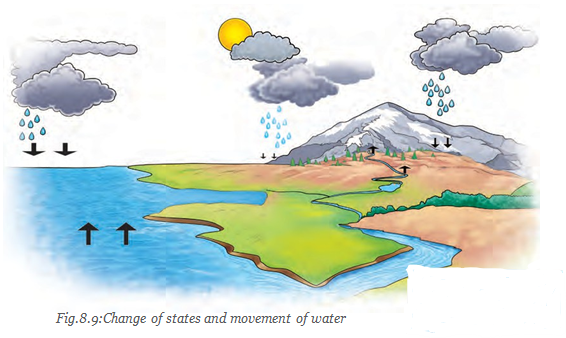
The Water Cycle
Water cycle — The continuous circulation of water from Earth’s surface to the atmosphere and back to Earth.
Water’s Journey
- Water from oceans and Earth’s surface evaporates into the atmosphere as water vapour.
- Water vapour cools and condenses to form clouds.
- Water returns to Earth as rain, hail or snow.
- Water flows back towards the oceans, and the cycle continues.
Using Water Wisely
Water Availability and Conservation
- Limited usable water: Only a small portion of Earth’s water is fit for use by plants, animals and humans.
- Ocean water: Most of Earth’s water is in the oceans and cannot be used directly.
- Growing demand: As the population increases, demand for water rises and shortages occur in many parts of the world.
- Conservation: Use water wisely, avoid wasting it and keep water bodies free from pollution.
How do clouds form and produce rain?
Quick recap
- Water vapour rises and cools as it moves higher in the atmosphere.
- Water vapour condenses into tiny droplets, often around dust particles, to form clouds.
- Cloud droplets join into larger drops that fall as rain; special conditions can produce hail or snow.
- The water cycle moves water from Earth’s surface to the atmosphere and back.
- Usable water is limited, so conserve it and keep water bodies pollution-free.
Keywords and Summary
Key Words
| Keyword | Meaning |
|---|---|
| Solid | A state of water, such as ice. |
| Liquid | The state of water commonly found as liquid water. |
| Gas | The state water takes as water vapour. |
| Evaporation | Conversion of liquid water into water vapour. |
| Condensation | Conversion of water vapour into liquid water. |
| Melting | Change from solid to liquid on heating. |
| Freezing | Change from liquid to solid on cooling. |
| Water cycle | The continuous movement of water through different states and places. |
| Humidity | The amount of water vapour present in the air. |
Scientific Investigation Words
- Experiment: A planned way to investigate a question.
- Investigate: To study or find out about something.
- Observe: To notice and examine what happens.
- Predict: To say what may happen based on what is known.
- Question: Something asked to guide an investigation.
- Reason: To think about why something happens.
- Record: To write down observations or results.
Summary
Main Ideas
- States: Water occurs as a solid, liquid or gas.
- State changes: Heating or cooling can change water from one state to another.
- Evaporation: Liquid water changes into water vapour; this process causes cooling.
- Condensation: Water vapour changes into liquid water.
- Evaporation rate: Exposed area, humidity and air movement affect how quickly evaporation happens.
Quick recap
- Water exists as a solid, liquid and gas.
- Heating and cooling can change water’s state.
- Evaporation changes liquid water into water vapour and causes cooling.
- Condensation changes water vapour into liquid water.
- Exposed area, humidity and air movement affect evaporation.
Science — ALL CHAPTERS
1
THE WONDERFUL WORLD OF SCIENCE
2
DIVERSITY IN THE LIVING WORLD
3
MINDFUL EATING: A PATH TO A HEALTHY BODY
4
EXPLORING MAGNETS
5
MEASUREMENT OF LENGTH AND MOTION
6
MATERIALS AROUND US
7
TEMPERATURE AND ITS MEASUREMENT
8
A JOURNEY THROUGH STATES OF WATER
9
METHODS OF SEPARATION IN EVERYDAY LIFE
10
LIVING CREATURES: EXPLORING THEIR CHARACTERISTICS
11
NATURE’S TREASURES
12
BEYOND EARTH