Class 6 . Science . Curiosity . Materials Around Us
Chapter 6: MATERIALS AROUND US
Ch 6
Science
Class 6
Observing Objects Around Us
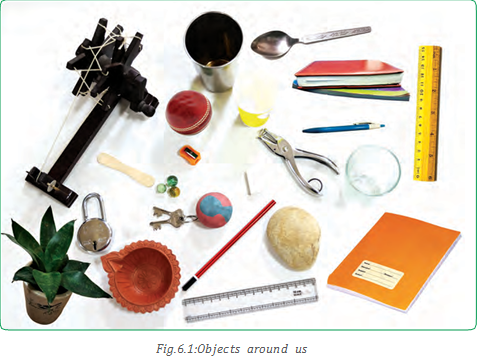
Objects and Materials
Material — A material is a substance used to make an object.
Key idea
- Objects around us are made from different materials.
- Materials include paper, wood, cloth, glass, metal, plastic and clay.
- Example: Rasaratnasamuchchaya 10.3 states that a crucible is made from clay and iron.
Observing and Comparing Objects
Properties to observe
- Shape and colour help describe and compare objects.
- Feel describes how an object seems when touched.
- Heaviness helps compare the weight of objects.
- Comparison: objects may be similar in some properties and different in others.
What is a material?
Quick recap
- A material is the substance used to make an object.
- Objects around us are made from materials such as paper, wood, cloth, glass, metal, plastic and clay.
- A crucible is made from clay and iron, as stated in Rasaratnasamuchchaya 10.3.
- Objects can be described by their shape, colour, feel and heaviness.
- Compare objects by noticing which properties they share and which differ.
How to Group Materials?
Classification by Common Properties
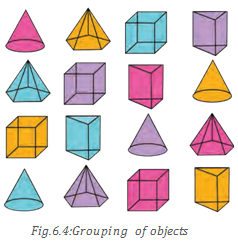
Classification — Arranging objects or materials into groups based on a property they share.
- Objects and materials: An object may be made from different materials; one material can also be used to make many objects.
- Grouping: Objects can be grouped by properties such as shape, colour, hardness, softness, shine or the material they are made from.
- Different groupings: The same objects can be sorted in different ways depending on the property chosen.
| Property | Example of grouping |
|---|---|
| Shape | Objects with similar shapes |
| Colour | Objects of the same colour |
| Material | Objects made from the same material |
| Hardness or softness | Hard objects grouped apart from soft ones |
| Shine | Shiny objects grouped apart from dull ones |
Choosing Materials for an Object
- Material choice: Choose a material according to its properties and the purpose of the object.
- Tumbler: Its material must be able to hold water; cloth is unsuitable for storing water, and paper-like materials are unsuitable for cooking utensils.
- Parts of an object: Different parts may be made from different materials; for example, a pen may use plastic, metal and ink.
Materials for Different Sports Balls
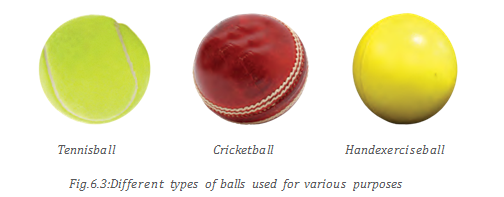
- Ball properties: Balls used in different sports vary in material, texture and bounce, even when they are the same size.
- Purpose matters: A ball’s properties suit its sport; a cricket ball is not suitable for playing tennis.
- Bounce: The height a ball bounces to can be compared as high, medium or low.
Grouping in Everyday Life
- Everyday sorting: Kitchen utensils are often stored with similar utensils together; grocers group spices separately from pulses and grains.
- Useful systems: Grouping items by shared properties helps people arrange and find them.
Quick recap
- Classification means grouping by a shared property.
- Objects and materials may be grouped in more than one way.
- Choose a material according to its properties and the object’s purpose.
- A tumbler’s material must hold water; a pen may combine plastic, metal and ink.
- Different parts of one object may be made from different materials.
- Materials used for sports balls affect their properties, including how high they bounce.
Different Properties of Materials and Hard Materials
Appearance and Lustre
Not everything that shines is a metal: polishing or a thin coating of plastic, wax or another material can make a surface look shiny.
Hardness and Softness
Are all lustrous materials metals?
How are hard and soft materials distinguished?
Quick recap
- Lustre is the shiny appearance of a material's surface.
- Metals are usually lustrous, but air and moisture can make them look dull.
- Some non-metals look shiny because they are polished or coated.
- Hard materials resist compression or scratching; soft materials are compressed or scratched easily.
- Hardness is relative: rubber is harder than sponge but softer than iron.
Explore Materials Part 1
Seeing Through Materials
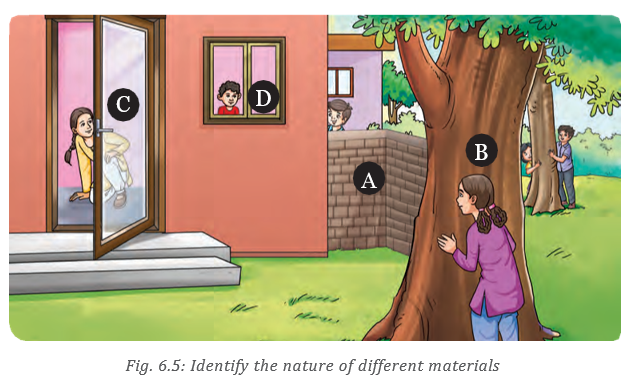
Opaque materials — Materials through which you cannot see objects at all.
Translucent materials — Materials through which objects can be seen, but not clearly.
Classifying Materials
What is the difference between transparent and translucent materials?
Classify an eraser, butter paper and window glass.
Quick recap
- Transparent materials let you see objects clearly.
- Translucent materials let you see objects indistinctly.
- Opaque materials do not let you see through them.
- Glass, water and air are transparent; butter paper and frosted glass are translucent.
- Wood, cardboard, metals, an eraser and a wooden board are opaque.
Explore Materials Part 2
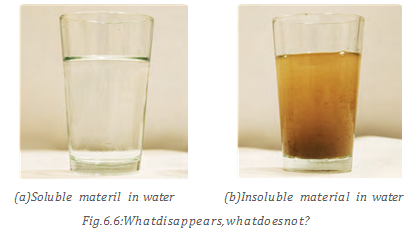
Soluble and Insoluble Materials
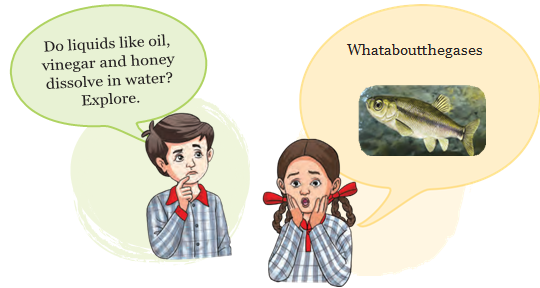
Liquids and Gases in Water
Oral Rehydration Solution (ORS)
- Purpose: Oral Rehydration Solution (ORS) helps treat dehydration caused by diarrhoea or other illnesses.
- Preparation: Dissolve an ORS packet in 1 L of water, or mix 6 teaspoons of sugar and ½ teaspoon of salt in 1 L of boiled and cooled water.
Mass
What is the difference between soluble and insoluble materials?
How can ORS be prepared at home?
Quick recap
- Sugar and salt dissolve in water; chalk powder, sand and sawdust do not.
- Some liquids mix completely with water, while others form a separate layer.
- Oxygen dissolves in water and is important for aquatic life.
- Homemade ORS uses six teaspoons of sugar and half a teaspoon of salt per litre of boiled, cooled water.
- A heavier object has more mass than a lighter object.
- “Weight” is sometimes used informally to mean mass.
Space and Volume
Space Occupied and Volume
Volume — Volume is the amount of space occupied by a material or an object.
Key points
- Space occupied: Bags on seats take up the space where students could sit.
- Different volumes: In identical tumblers, different water levels show that the amounts—and volumes—of water differ.
- All materials: Every material has mass and occupies space.
| Volume of contents | Capacity of container | |
|---|---|---|
| Meaning | Space occupied by the material inside | Amount the container can hold |
| Example | Water currently in a tumbler | The tumbler’s holding capacity |
| Key point | Can differ between containers with the same capacity | Identical tumblers have the same capacity |
Measuring liquid volume
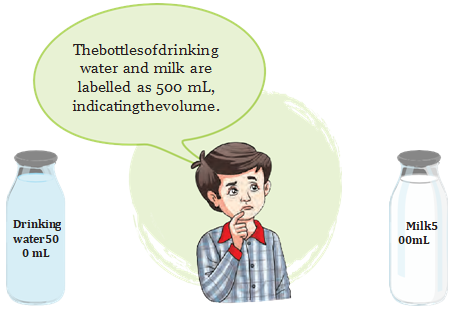
- Common units: Liquid volumes are commonly stated in litres (L) and millilitres (mL).
- Bottle labels: A label such as 500 mL indicates the volume of liquid in the bottle.
Two identical tumblers have different water levels. What does this show?
Quick recap
- Volume is the space occupied by a material or object.
- Different water levels in identical tumblers indicate different amounts and volumes of water.
- Capacity is how much a container can hold; volume is the space occupied by what is inside.
- Liquid volume is commonly shown in litres (L) or millilitres (mL).
- The lecture says materials do not necessarily share all properties and leaves open whether any property is common to all.
What Is Matter?
Matter and Its Properties
Matter — Anything that has mass and occupies space is called matter.
Mass, Volume and Materials
- Mass tells us the quantity of matter in an object; common units are gram (g) and kilogram (kg).
- Volume is the space occupied by matter; common units are litre (L) and millilitre (mL).
- SI units: Mass is measured in kilogram (kg); volume is measured in cubic metre (m³).
- Conversion: 1 m³ = 1000 L.
- Writing units: Leave a space between the number and unit: 7 kg, 500 mL, 2 m³. Write kg, not kgs.
- Materials are types of matter used to make objects. Water, sand, pebbles and a cup are examples of matter.
- Classification groups materials by similarities or differences in their properties, helping us study patterns.
Ayurveda’s Classification of Properties
Ten Opposite Property Pairs
- Ayurveda groups physical matter using ten pairs of opposite properties; these can also describe living things, the environment and food.
| Property pair | Meaning |
|---|---|
| Guru – laghu | Heavy – light in weight |
| Manda – tīkṣhṇa | Slow – quick or fast |
| Hima – uṣhṇa | Cold – hot |
| Snigdha – rukṣha | Unctuous – dry |
| Śhlakṣhaṇa – khara | Smooth – rough |
| Sāndra – drava | Solid – liquid |
| Mṛidu – kaṭhina | Soft – hard |
| Sthira – khāla | Stable – moving or unstable |
| Sūkṣhma – sthūla | Subtle or small – big or gross |
| Viśhada – picchhila | Non-slimy – slimy |
Quick recap
- Matter has mass and occupies space.
- Mass measures the quantity of matter; volume measures the space it occupies.
- Mass units include g and kg; volume units include L, mL and the SI unit m³.
- 1 m³ = 1000 L; write a space between the value and its unit.
- Materials are types of matter used to make objects and can be classified by their properties.
- Ayurveda describes matter using ten pairs of opposite properties.
Keywords and Summary
Objects, materials and classification
Objects and materials
- Objects are made from materials; an object may contain one material or a combination of materials.
- Uses Different materials can be used to make objects with similar functions.
- Properties A material’s properties help determine what it is suitable for.
Classification — The method of arranging objects or materials into groups is called classification.
Grouping materials
- Basis Materials are grouped by similarities or differences in their properties.
- Appearance and feel Groups can be based on whether materials are lustrous or non-lustrous, and hard or soft.
| Property | Groups | Meaning |
|---|---|---|
| Appearance | Lustrous / non-lustrous | Shiny / not shiny |
| Feel | Hard / soft | Materials differ in how hard or soft they feel. |
| Light passing through | Transparent / translucent / opaque | How much can be seen through the material: clearly / partly / not at all. |
| Behaviour in water | Soluble / insoluble | Dissolves in water / does not dissolve in water. |
Matter, mass and volume
Matter — Anything that occupies space and has mass is called matter.
Volume — The space occupied by matter is its volume.
Mass — Mass measures the amount of matter present in an object.
- Matter has mass and occupies space.
- Volume tells the space occupied; mass tells the amount of matter.
Quick recap
- Objects are made of one or more materials, and different materials can serve similar functions.
- Classification arranges objects or materials into groups based on shared or different properties.
- Materials may be lustrous or non-lustrous, and hard or soft.
- Materials are transparent, translucent or opaque according to how much can be seen through them.
- Materials may be soluble or insoluble in water.
- Matter occupies space and has mass; the space it occupies is its volume.
Science — ALL CHAPTERS
1
THE WONDERFUL WORLD OF SCIENCE
2
DIVERSITY IN THE LIVING WORLD
3
MINDFUL EATING: A PATH TO A HEALTHY BODY
4
EXPLORING MAGNETS
5
MEASUREMENT OF LENGTH AND MOTION
6
MATERIALS AROUND US
7
TEMPERATURE AND ITS MEASUREMENT
8
A JOURNEY THROUGH STATES OF WATER
9
METHODS OF SEPARATION IN EVERYDAY LIFE
10
LIVING CREATURES: EXPLORING THEIR CHARACTERISTICS
11
NATURE’S TREASURES
12
BEYOND EARTH