Class 6 . Science . Curiosity . Living Creatures Exploring Their Characteristics
Chapter 10: LIVING CREATURES: EXPLORING THEIR CHARACTERISTICS
Ch 10
Science
Class 6
Living and Non-living Things
What Sets Living Things Apart?
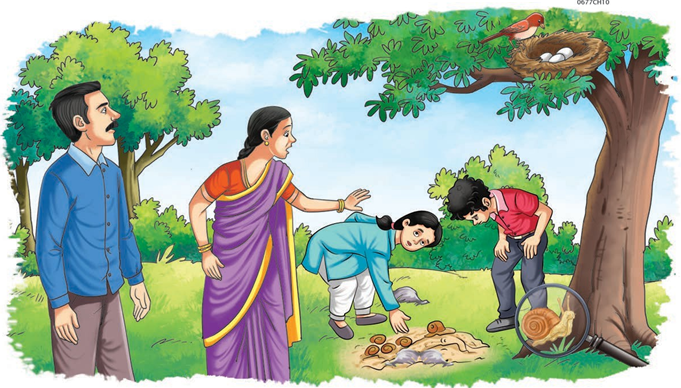
Living things — Organisms that have life, such as people, pigeons, plants, worms and snails.
Non-living things — Things without life, such as pencils, books and cars.
How to Decide
- Movement is not enough: A car can move, but that does not make it living.
- Growth matters: A car does not grow; compare its characteristics with those of living beings.
- Stillness is not enough: A snail may be inside a shell that is not moving; the shell is part of the snail’s body.
- Compare carefully: Use several characteristics of living beings rather than relying on one visible feature.
| Point | Living | Non-living |
|---|---|---|
| Examples | Pigeon, plant, snail | Pencil, book, car |
| Movement | Living beings may move | A car can move, so movement alone does not prove something is living |
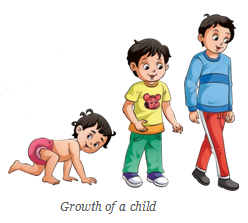
| Growth | Growth is a characteristic to consider | A car does not grow |
Why is movement alone not a reliable way to identify living things?
How can a snail be living when its shell is not moving?
Quick recap
- Living things include people, animals and plants; non-living things include pencils, books and cars.
- Movement alone cannot distinguish living from non-living things.
- A moving car is still non-living.
- A car does not grow; growth is a characteristic to consider.
- A snail’s shell is part of its body, even when the snail is not visibly moving.
Characteristics of Living and Non-living Things Part 1
Movement
Movement — Movement is a change in position or movement of body parts; it is a characteristic of living things, but movement alone does not prove that something is living.
Movement in Plants
- Locomotion: Animals can move from one place to another; plants generally do not.
- Plant movements: Flowers open, and climbers wind around nearby objects.
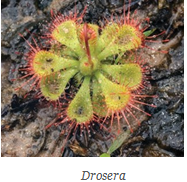
- Drosera: This insectivorous plant depends on insects for nutrition. Its saucer-shaped leaves have hair-like projections with sticky ends.
- Insect trapping: When an insect enters a Drosera leaf, the hairs move inward and trap it.
Do not assume that anything able to move on its own is living; movement alone is not enough to identify something as living.
Breathing and Respiration
Breathing — Breathing is the movement of air into and out of the body.
Breathing in Living Beings
- Inhaling: Air moves from outside the body to inside.
- Breathing out: Air moves from inside the body to outside.
- Animals: Dogs, cats, cows and buffaloes breathe; abdominal movement can be noticed while they rest.
- Breathing rate: It can be compared after activities such as walking, running and dancing.
Respiration — Respiration is a process of living beings of which breathing is a part.
Respiration in Plants
- Stomata: Tiny pores on the surface of leaves that help plants take air in and out.
- Living beings: All living beings respire.
How do plants show movement even though they do not move from place to place?
What are stomata, and what do they do?
Quick recap
- Movement alone is not enough to decide whether something is living.
- Plants do not move from place to place, but they show movements.
- Drosera traps insects when hairs on its leaves move inward.
- Inhaling brings air into the body; breathing out moves it outside.
- Stomata help plants take air in and out.
- All living beings respire.
Characteristics of Living and Non-living Things Part 2
Excretion
Response to Stimuli
Reproduction
- Reproduction: Living beings produce new individuals of their own kind.
- Importance: Reproduction maintains the continuity of life.
Recognising Living, Non-Living and Dead Things
Why is reproduction necessary?
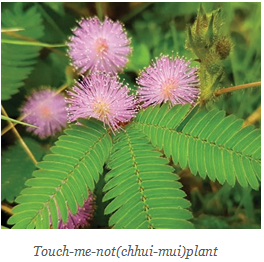
How do plants respond to stimuli?
Quick recap
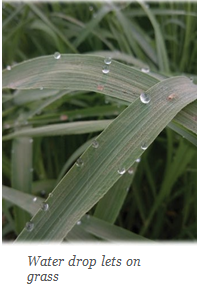
- Excretion removes wastes; animals excrete through sweat and urine, while some plants release droplets of excess water and minerals.
- A stimulus prompts a response, and all living beings respond to stimuli.
- Touch-me-not responds to touch; some plants fold their leaves after sunset.
- Reproduction produces new individuals of the same kind and maintains continuity of life.
- Living beings show life characteristics; a seed is living because it can germinate under suitable conditions.
Essential Conditions for Germination of a Seed
Seed Germination
Conditions That Affect Germination
Essential conditions — Most seeds need the right amount of water and air to germinate; sunlight is generally not needed during germination.
| Pot | Conditions | Likely result | Reason |
|---|---|---|---|
| A | Dry soil; air and sunlight available | Does not germinate | Water is absent. |
| B | Soil covered by excess water; sunlight available | Does not germinate | Excess water limits the air available to seeds. |
| C | Moist soil; kept in darkness | Germinates | It has water and air; light is not needed for most seeds. |
| D | Moist soil; kept in direct sunlight | Germinates | It has water and air. |
How Water and Air Help
- Water: Seeds need water to carry out processes necessary for growth.
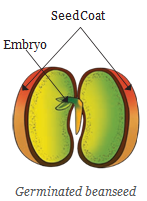
- Seed coat: Water softens the seed coat and helps the embryo inside develop into a plant.
- Air: Seeds use air available in the spaces between soil particles.
- Soil spaces: These spaces also allow roots to grow easily.
Germination
- Seed absorbs water
- Seed coat softens
- Embryo develops
- A sprout emerges
Light and Darkness
- Most seeds: Can germinate in light or darkness; bean seeds do not need light to germinate.
- Light-requiring seeds: Coleus and Petunia seeds need light; covering them with soil can inhibit sprouting.
- Darkness-requiring seeds: Calendula and Zinnia seeds need darkness and should be covered with sufficient soil.
- After germination: Sunlight is required for the seedling’s further growth.
Do not confuse germination with later seedling growth: most seeds can germinate without sunlight, but seedlings need sunlight to grow further.
Why do seeds in waterlogged soil generally fail to germinate?
Which conditions are generally essential for seed germination?
Quick recap
- Germination is the development of a seed into a sprout.
- Most seeds need the right amount of water and air to germinate.
- Water softens the seed coat and helps the embryo develop.
- Seeds obtain air from spaces between soil particles; excess water can limit this air.
- Most seeds germinate without light, but some seeds need light or darkness.
- Sunlight is needed for a seedling’s further growth.
Growth and Movement in Plant
How Roots and Shoots Grow
Growth and movement in plants — Plant roots and shoots grow in particular directions and can change their growth direction in response to light and gravity.
| Condition | Shoot growth | Root growth |
|---|---|---|
| Plant upright; light from all directions | Upwards | Downwards |
| Plant inverted; light from all directions | Bends and grows upwards | Bends and grows downwards |
| Plant upright; light from one direction | Grows towards the light | Continues to grow downwards |
Jagadish Chandra Bose
Plant Responses to Stimuli
- Jagadish Chandra Bose (1858–1937): An Indian scientist who studied how plants respond to stimuli.
- Crescograph: Bose’s machine recorded plant responses to light, heat, electricity and gravity, and measured how fast plants grow.
Quick recap
- Roots grow downwards, even when a seedling is inverted.
- Shoots grow upwards, even when a seedling is inverted.
- A shoot bends and grows towards light coming from one direction.
- Roots continue to grow downwards when light comes from one direction.
- Jagadish Chandra Bose used the crescograph to measure plant growth and record responses to stimuli.
Life Cycle of a Plant
From Seed to Next Generation
Bean Plant Life Cycle
- Seed
- Germination
- Young plant
- Mature plant with flowers
- Fruit (pod) containing seeds
- Seeds grow into a new generation of bean plants
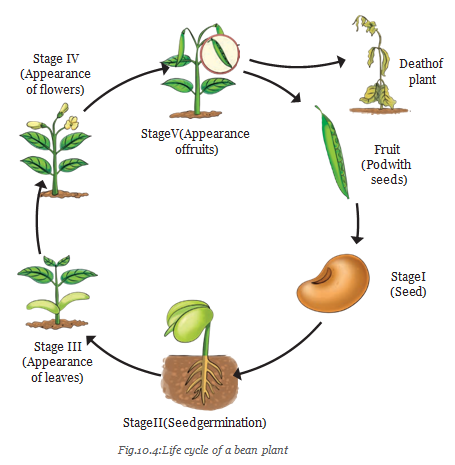
Dead plant — A plant is considered dead when it stops growing and its life activities gradually come to an end, even when necessary conditions are available.
Quick recap
- A plant's life cycle begins with a seed.
- The seed germinates and grows into a young plant.
- A mature plant produces flowers that develop into fruits.
- Fruits contain seeds that can produce the next generation of plants.
- A bean fruit is a pod.
- A plant is considered dead when its growth and life activities gradually end, even with necessary conditions available.
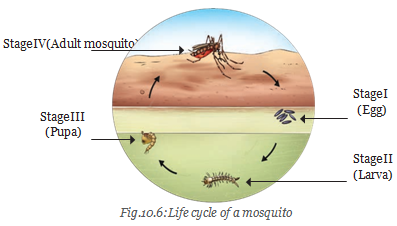
Life Cycle of Animals : Life Cycle of a Mosquito
Mosquitoes and Breeding Sites
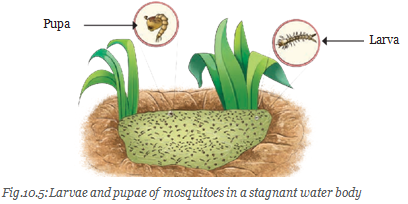
Larvae and Pupae in Water
- Habitat: Mosquito larvae and pupae live in water and come to the surface to obtain air for respiration.
- Breeding sites: Stagnant water in places such as coolers, pots and open containers can support mosquito development.
Four Stages of Mosquito Development
| Stage | Key features |
|---|---|
| Egg | Laid by the adult female directly on or near water. |
| Larva | Lives in water, breathes air at the surface and develops into a pupa. |
| Pupa | Lives in water, breathes air at the surface and transforms into an adult. |
| Adult | Emerges from the pupa, rests briefly on the water surface, then flies away; may survive for 10–15 days. |
Development Sequence
- Adult female lays eggs on or near water.
- Egg hatches into a larva.
- Larva grows and changes into a pupa.
- Pupa transforms into an adult mosquito.
- Adult female lays eggs, and the cycle repeats.
Silk Moth Life Cycle
Why do mosquito larvae and pupae come to the surface of water?
How can a kerosene layer disrupt mosquito development in stagnant water?
Quick recap
- Mosquitoes develop through egg → larva → pupa → adult.
- The female lays eggs directly on or near water.
- Larvae and pupae live in water and come to the surface to breathe air.
- Removing stagnant water helps prevent mosquito breeding.
- A kerosene film blocks air access and kills aquatic larvae and pupae.
- Adult mosquitoes may survive for 10–15 days; females can transmit malaria, dengue and chikungunya.
Life Cycle of a Frog
Frog Eggs and Spawn
- Spawn: A frog’s eggs occur in a white, jelly-like cluster called spawn.
- Location: Spawn may float near the edge of a pond or be attached to plants in or around the water.
Changes During the Life Cycle
- Development: Tadpoles grow legs and gradually develop into froglets.
- Body changes: Froglets lose their tails, and their legs become strong for jumping and landing.
- Habitat: Froglets begin to spend time on land before becoming adults that live both on land and in water.
Why Life-Cycle Changes Matter
Describe the stages in a frog's life cycle.
How do the tadpole's features and the frog's habitat change as it develops?
Quick recap
- Frog eggs form clusters called spawn, usually found in water or attached to nearby plants.
- The four main stages are egg and embryo, tadpole, froglet and adult frog.
- Early tadpoles have tails but no legs; later tadpoles develop legs while retaining their tails.
- Froglets begin spending some time on land and gradually lose their tails.
- Adult frogs have strong legs and live both in water and on land.
- Life-cycle changes support survival and continuity; protecting habitats helps living things.
Keywords and Summary
Keywords
- Key terms: Important words in this chapter describe life processes, growth and development.
- Life cycles: The terms also help explain the stages through which plants and animals develop.
Living and Non-living Things
Living things — Living things show essential life features and pass through stages during their lives.
- Essential features: Living things move, take in nutrition, grow, breathe, excrete wastes, respond to stimuli, reproduce and eventually die.
- Classification: Objects around us can be grouped as living or non-living; according to the summary, absence of any listed life feature indicates that an object is non-living.
Germination and Plant Life Cycle
- Germination: A seed begins to grow when it has water, air and suitable light and/or dark conditions.
- Growth direction: During germination, roots generally grow downwards and shoots grow upwards.
- Plant life cycle: Seed germination → growth and development → flowering → seed production → new seeds germinate, continuing the cycle.
Animal Life Cycles
- Animal life cycle: Reproduction produces a new individual, which grows and develops into an adult and eventually dies.
- Continuity of a kind: Reproduction allows a kind of living thing to continue across generations.
- Life stages: Living things pass through several stages during their lives; some, such as frogs and mosquitoes, change greatly in form and sometimes habitat.
| Animal | Life stages in order | Major change |
|---|---|---|
| Mosquito | Egg → larva → pupa → adult | Significant changes in body shape and structure occur across stages. |
| Frog | Egg → tadpole → froglet → adult | Body shape, structure and sometimes habitat change during development. |
What conditions are needed for seed germination, and which way do roots and shoots grow?
Write the life stages of a mosquito and a frog in order.
Quick recap
- Living things move, take in nutrition, grow, breathe, excrete, respond to stimuli, reproduce and die.
- Seeds need water, air and suitable light and/or dark conditions to germinate.
- Roots generally grow downwards; shoots grow upwards.
- A plant cycle proceeds from seed germination through growth, flowering and seed production.
- Animal life cycles include growth and development to adulthood and eventually death; reproduction maintains continuity of a kind.
- Mosquitoes develop through egg, larva, pupa and adult; frogs through egg, tadpole, froglet and adult.
Science — ALL CHAPTERS
1
THE WONDERFUL WORLD OF SCIENCE
2
DIVERSITY IN THE LIVING WORLD
3
MINDFUL EATING: A PATH TO A HEALTHY BODY
4
EXPLORING MAGNETS
5
MEASUREMENT OF LENGTH AND MOTION
6
MATERIALS AROUND US
7
TEMPERATURE AND ITS MEASUREMENT
8
A JOURNEY THROUGH STATES OF WATER
9
METHODS OF SEPARATION IN EVERYDAY LIFE
10
LIVING CREATURES: EXPLORING THEIR CHARACTERISTICS
11
NATURE’S TREASURES
12
BEYOND EARTH