Class 6 . Science . Curiosity . Methods of Separation in Everyday Life
Chapter 9: METHODS OF SEPARATION IN EVERYDAY LIFE
Ch 9
Science
Class 6
Introduction & Methods of Separation , Handpicking Method
Why Separate Materials?
- Purpose: Separation removes unwanted materials and helps obtain useful components from a mixture.
- Examples: Separating unwanted substances makes materials suitable for cooking or other uses.
Handpicking
Handpicking — A method of separating unwanted particles from a mixture by picking them out by hand.
When and how it is used
- Basis: Particles differ in visible features such as size, colour or shape.
- Suitable when: The unwanted particles are present in small quantities and can be picked out easily.
- Examples: Removing small stones or husk from wheat or rice; picking whole black peppers out of pulao.
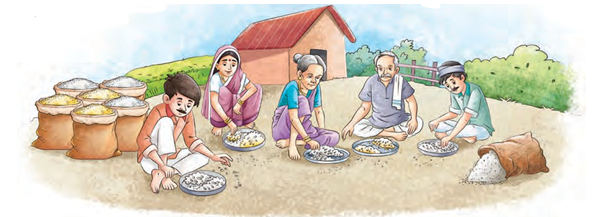
When is handpicking a convenient method?
Quick recap
- Separation removes unwanted substances or separates useful parts from a mixture.
- Handpicking means removing particles by picking them out by hand.
- It relies on visible differences in size, colour or shape.
- It is suitable when unwanted particles are few and easy to pick out.
- Stones from grains and black peppers from pulao are examples.
Threshing and Winnowing Methods
Threshing
- Threshing: This process separates grains from harvested stalks.
- Method: Farmers traditionally beat the stalks against a hard surface to loosen the grains.
Winnowing
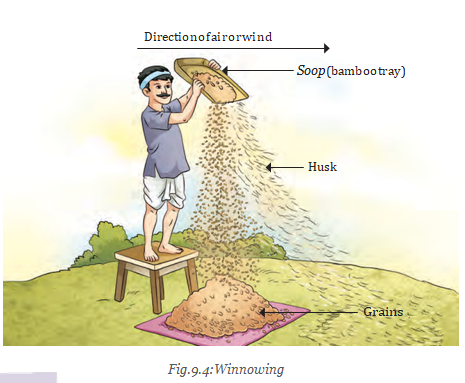
| Point | Threshing | Winnowing |
|---|---|---|
| Separates | Grains from stalks | Lighter husk from heavier grains |
| Main method | Beating stalks | Using wind or blown air |
| Typical order | Done first | Can follow threshing to remove husk |
Threshing Machines
How does winnowing separate grains from husk?
Why is winnowing difficult in a closed room?
Quick recap
- Threshing separates grains from harvested stalks, usually by beating.
- After threshing, grains may still be mixed with husk.
- Winnowing uses wind or blown air to separate lighter husk from heavier grains.
- A soop is a traditional bamboo tray used during winnowing.
- Threshers can carry out threshing and winnowing together.
Sieving and Evaporates Methods
Sieving
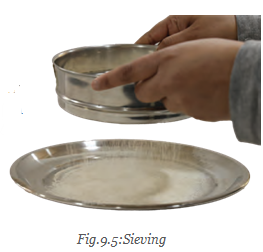
Sieving — A method of separating solid particles of different sizes by passing a mixture through a sieve.
- How it works: Smaller particles pass through the sieve’s holes; larger particles remain on it.
- Suitable mixture: The solid components must differ in particle size, and the holes must be sized to separate them.
- Examples: Removing bran or small stones from flour; separating pebbles and stones from sand at construction sites.
| Mixture | Passes through | Remains on sieve |
|---|---|---|
| Flour containing bran | Fine flour | Bran and larger particles |
| Sand containing stones | Sand | Pebbles and stones |
Evaporation
Evaporation — The process in which liquid water changes into water vapour and leaves dissolved solids behind.
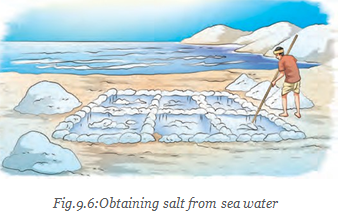
Obtaining Salt from Seawater
- Seawater: It contains a mixture of salts and other substances dissolved in water.
- Evaporation: Seawater is kept in shallow pits and exposed to sunlight and air; after the water evaporates, a solid mixture remains.
- Purification: Common salt is obtained from this solid mixture by further purification.
Evaporating a Salt Solution
- When water evaporates: Dissolved salt does not evaporate with the water, so solid salt remains.
- Everyday example: White patches on dark clothes in hot weather form when salty sweat dries and leaves salt behind.
- Other use: Evaporation can dry excess water from medicinal plant parts, leaving the plant material behind.
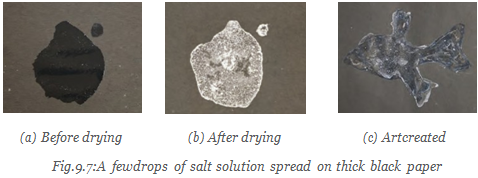
- Evaporation removes the liquid; dissolved solids are left behind.
- Salt recovered by evaporating seawater still needs further purification.
Quick recap
- Sieving separates solid components with different particle sizes.
- Fine particles pass through the sieve; larger particles are retained.
- Evaporation changes liquid water into water vapour, leaving dissolved solids behind.
- Evaporating seawater leaves a mixture of salts and other substances.
- Common salt is separated from that mixture by further purification.
- Evaporating a salt solution leaves solid salt behind.
Sedimentation ,decantation Methods
Sedimentation
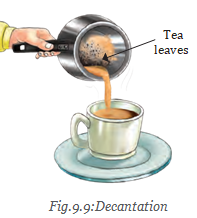
- Sedimentation: Heavier insoluble particles settle at the bottom of a liquid when the mixture is left undisturbed.
- Example: Tea leaves settle at the bottom of tea if it is left to stand.
Decantation
Separating Oil and Water
- Key fact: Oil does not mix with water; when left undisturbed, it forms a separate layer.
- Method: Carefully pour off one layer using decantation.
Separating a Settled Solid from a Liquid
- Leave the mixture undisturbed → the heavier insoluble solid settles (sedimentation).
- Gently tilt the vessel and pour off the liquid → the solid remains behind (decantation).
How can tea leaves be separated from tea without a strainer?
Which method can be used to separate oil and water?
Quick recap
- Sedimentation is the settling of a heavier insoluble component at the bottom of a liquid.
- Decantation removes liquid by gently pouring it away from the settled material.
- Tea leaves can be separated from tea by sedimentation followed by decantation.
- Decantation is also used when washing rice and pulses.
- Oil and water form separate layers and can be separated by decantation.
Filtration Method
What Is Filtration?
Filtration — A method of separating insoluble solid particles from a liquid by passing the mixture through a material with small pores.
How filtration works
- Filter: The material with pores that lets the liquid pass through but holds back some solid particles.
- Tea example: A tea strainer holds the tea leaves while the tea passes through.
- Cloth: Tiny pores between woven threads can trap particles; a finer filter may be needed if the water remains muddy.
- Filter paper: Its very fine pores can trap small mud particles.
| Point | Decantation | Filtration |
|---|---|---|
| How it separates | Liquid is poured off from settled solids. | The mixture passes through a porous filter. |
| Tea leaves | Some leaves may remain in the tea. | A tea strainer can hold back the leaves. |
Filter, Residue and Filtrate
| Term | Meaning | Muddy-water example |
|---|---|---|
| Filter | Porous material that holds back solid particles. | Filter paper placed in a funnel. |
| Residue | Solid left behind on the filter. | Mud on the filter paper. |
| Filtrate | Liquid that passes through the filter. | Clearer water collected in the flask. |
Choosing a filter
- Materials: Cotton, charcoal and sand can also be used as filters.
- Choice: Select a filter according to the size of the particles to be removed; smaller particles generally need finer pores.
Filtration in Nature and Everyday Life
- Fishing net: Water drains through the mesh while fish are held back, similar to filtration.
- Plastic waste: Bags, bottles and food wrappers can be caught in nets; plastic can also harm aquatic animals, as when a fish has a straw stuck in its mouth.
What are the residue and filtrate when muddy water is filtered through filter paper?
Quick recap
- Filtration separates insoluble solids from liquids using a porous material.
- A tea strainer, cloth or filter paper can hold back particles while liquid passes through.
- The solid left on the filter is the residue; the liquid that passes through is the filtrate.
- Choose the filter based on the size of the particles to be removed.
- A fishing net works in a similar way: water passes through its mesh while fish are held back.
Churning & Magnetic Separation
Churning
- Churning: Curd is churned to separate butter from the buttermilk.
- Result: The lighter butter floats to the top, while the buttermilk remains below.
Magnetic Separation
Uses of Magnetic Separation
- Recycling: Magnets are used to separate iron objects from heaps of waste so the iron can be recycled and reused.
- Industry: Magnets fitted to cranes lift scrap iron out of waste material.
Why We Separate Substances
What is magnetic separation? Give an example.
Quick recap
- Churning separates butter from curd; butter floats and buttermilk remains below.
- Magnetic substances are attracted to magnets; iron is one example.
- Magnetic separation uses a magnet to separate magnetic materials from nonmagnetic materials.
- Magnets help recover scrap iron for recycling and reuse.
- Separation is done either to remove unwanted components or to obtain useful components.
Keywords and Summary
Methods of Separation
| Method | How it works | Use |
|---|---|---|
| Handpicking | Selects solid materials using differences in size, colour or shape. | Separating visibly different solid materials from a mixture. |
| Threshing | Stalks are beaten to separate the grains. | Separating grains from stalks. |
| Winnowing | Wind or blown air carries away lighter husk while heavier grains fall. | Separating husk from grains. |
| Sieving | A sieve separates solids according to differences in particle size. | Separating particles of different sizes. |
| Evaporation | A liquid changes into vapour. | Separating a dissolved solid from a liquid. |
| Sedimentation | Heavier, insoluble particles settle at the bottom of a liquid. | Separating an insoluble solid from a liquid by settling. |
| Decantation | The liquid is removed by carefully tilting the vessel. | Removing liquid after heavier particles have settled. |
| Filtration | A filter separates insoluble solid particles from a liquid. | Separating an insoluble solid from a liquid. |
| Churning | The mixture is churned to separate a component. | Extracting butter from curd. |
| Magnetic separation | A magnet separates magnetic substances from non-magnetic substances. | Separating magnetic and non-magnetic materials. |
Sedimentation and Decantation
- Sedimentation: Heavier insoluble particles settle at the bottom of the liquid.
- Decantation: Tilt the vessel to pour off the liquid, leaving the settled particles behind.
Quick recap
- Handpicking, threshing, winnowing and sieving separate solid materials in different ways.
- Evaporation can recover a dissolved solid by converting the liquid into vapour.
- Sedimentation settles heavier insoluble particles; decantation pours off the liquid.
- Filtration separates insoluble solids from liquids.
- Churning extracts butter from curd.
- Magnetic separation uses a magnet to separate magnetic from non-magnetic substances.
Science — ALL CHAPTERS
1
THE WONDERFUL WORLD OF SCIENCE
2
DIVERSITY IN THE LIVING WORLD
3
MINDFUL EATING: A PATH TO A HEALTHY BODY
4
EXPLORING MAGNETS
5
MEASUREMENT OF LENGTH AND MOTION
6
MATERIALS AROUND US
7
TEMPERATURE AND ITS MEASUREMENT
8
A JOURNEY THROUGH STATES OF WATER
9
METHODS OF SEPARATION IN EVERYDAY LIFE
10
LIVING CREATURES: EXPLORING THEIR CHARACTERISTICS
11
NATURE’S TREASURES
12
BEYOND EARTH