Class 6 . Science . Curiosity . Mindful Eating a Path to a Healthy Body
Chapter 3: MINDFUL EATING: A PATH TO A HEALTHY BODY
Ch 3
Science
Class 6
Introduction and Consumed Food in Different Regions
Food and Health
Wholesome and moderate eating — A healthy person eats food that is wholesome, in moderate quantities, and suited to the season, time, and place.
Food Gives Life
- Sanskrit saying: “Annena jātāni jīvanti” means “Food gives life to living beings.”
- Daily choices: People may eat different foods at different meals and on different days.
Food in Different Regions
Food Diversity
- Variety: People and communities may eat different kinds of food; some foods are shared across regions, while others are more local.
- Regional patterns: Traditional foods are usually related to the crops grown in that region.
| State | Locally grown crops | Traditional food items | Beverages |
|---|---|---|---|
| Punjab | Maize, wheat, chickpea, pulses | Makki di roti, sarson da saag, chhole bhature, parantha, halwa, kheer | Lassi, chhach (buttermilk), milk, tea |
| Karnataka | Rice, ragi, urad, coconut | Idli, dosa, sambhar, coconut chutney, ragi mudde, palya, rasam, rice | Buttermilk, coffee, tea |
| Manipur | Rice, bamboo, soya bean | Rice, eromba (chutney), utti (curry made with yellow peas and green onion), singju, kangsoi | Black tea |
Why Traditional Foods Differ
- India has diverse soil and climatic conditions
- Different crops grow well in different regions
- Locally grown crops help shape traditional foods
- Taste preferences, culture, and traditions also influence food choices
To explain regional food differences, link soil and climate to local crops, then mention taste, culture, and traditions.
Changes in Cooking Practices
Culinary practices — Culinary practices are the ways people prepare and cook food.
Why Practices Change
- Changing habits: Food choices and ways of preparing food may differ between people and change over time.
- Influences: Technological development, improved transportation, and better communication have contributed to these changes.
| Task | Traditional tool | Modern tool |
|---|---|---|
| Cooking | Chulha | Gas stove |
| Grinding | Manual sil-batta | Electrical grinder |
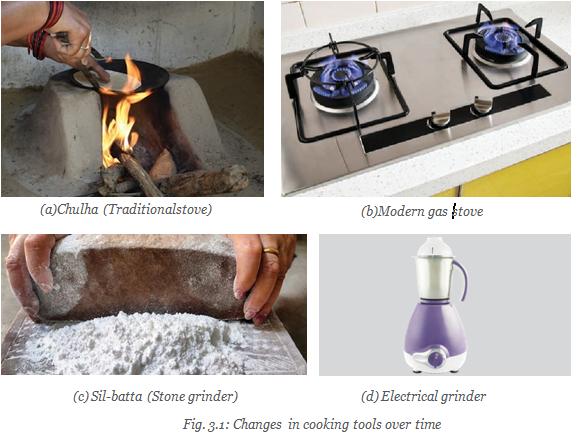
Why do traditional foods vary between Indian states?
Give two examples of changes in cooking practices.
Quick recap
- Food is essential for life; wholesome food should be eaten in moderate quantities and suited to the season, time, and place.
- Food choices can vary between people, meals, and days.
- Traditional foods are usually connected to crops grown locally.
- Soil, climate, taste, culture, and traditions shape regional food choices.
- Cooking practices change over time due to technology, transportation, and communication.
- Chulhas and sil-battas are traditional tools; gas stoves and electric grinders are modern alternatives.
Components of Food: Carbohydrates , Proteins, Vitamins, Minerals, Water
Carbohydrates and Fats
Carbohydrates — Food components that are a major source of energy for the body.
Carbohydrates
- Quick energy: Glucose provides energy quickly; it is a carbohydrate.
- Other examples: Common sugar is also a carbohydrate.
- Sources: Wheat, rice, maize, potato, sweet potato, banana, pineapple and mango.
Fats — Food components that provide stored energy to the body.
Fats
- Sources: Ghee, oils, groundnuts, walnuts, coconuts, almonds, pumpkin seeds and sunflower seeds; fats can come from plants or animals.
- Energy: Carbohydrates and fats are called energy-giving foods.
- Example: Polar bears store fat under their skin; this energy reserve helps them survive long winter hibernation.
Proteins
Proteins — Nutrients that help the body grow and repair itself; they are called body-building foods.
Protein sources and needs
- Plant sources: Pulses, beans, peas, nuts and edible mushrooms.
- Animal sources: Milk, paneer, eggs, fish and meat.
- Greater need: Growing children need enough protein for proper growth and development; sportspersons need more to build muscles.
Vitamins and Minerals
Protective nutrients
- Vitamins and minerals protect the body from diseases and help keep it healthy.
- Small amounts: They are needed in small quantities but are essential for good health.
- Sources: Fruits, vegetables, milk and wholegrains supply vitamins and minerals.
| Vitamin | Function | Some sources | Deficiency disease and symptoms |
|---|---|---|---|
| A | Keeps eyes and skin healthy | Papaya, carrot, mango, milk | Loss of vision; poor vision in darkness (night blindness) |
| B₁ | Supports heart health and body functions | Legumes, nuts, wholegrains, seeds, milk products | Beriberi: swelling, tingling or burning in hands and feet; breathing difficulty |
| C | Helps the body fight diseases | Amla, guava, green chilli, orange, lemon | Scurvy: bleeding gums and slow wound healing |
| D | Helps the body absorb calcium for healthy bones and teeth | Sunlight, milk, butter, fish, eggs | Rickets: soft, bent bones |
| Mineral | Function | Some sources | Deficiency disease/disorder and symptoms |
|---|---|---|---|
| Calcium | Keeps bones and teeth healthy | Milk or soymilk, curd, cheese, paneer | Weak bones and tooth decay |
| Iodine | Supports physical and mental activities | Seaweed, water chestnut (singhada), iodised salt | Goitre: swelling at the front of the neck |
| Iron | Important component of blood | Green leafy vegetables, beetroot, pomegranate | Anaemia: weakness and shortness of breath |
Deficiency examples
- Scurvy: In 1746, physician James Lind observed that sailors with bleeding, swollen gums recovered after consuming lemons and oranges; the disease is caused by vitamin C deficiency.
- Goitre: In the 1960s, Indian scientists noted neck swelling in parts of India. Iodised salt—common salt mixed with iodine salts—helped reduce these symptoms.
Do not confuse a deficiency disease with its symptom: for example, goitre is the disorder, while swelling at the front of the neck is a symptom.
Nutrients, Dietary Fibre and Water
Nutrients — Food components that provide energy, support growth and repair, protect the body from diseases, or help maintain bodily functions.
Nutrients
- Major nutrients: Carbohydrates, proteins, fats, vitamins and minerals.
- Cooking: High heat can destroy some vitamins, including vitamin C. Washing fruits or vegetables after cutting or peeling can also cause some vitamin loss.
- Safe preparation: Wash all fruits and vegetables thoroughly before eating; include fruits and uncooked vegetables in the diet.
Dietary fibre (roughage) — A mainly plant-based part of food that does not provide nutrients but helps remove undigested food and supports the smooth passage of stools.
Fibre and water
- Fibre sources: Green leafy vegetables, fresh fruits, wholegrains, pulses and nuts.
- Water: Helps the body absorb nutrients and remove waste through sweat and urine.
- Daily habit: Drink sufficient water regularly; eating locally grown, plant-based foods can benefit both health and the environment.
Why are carbohydrates and fats called energy-giving foods?
What are the roles of proteins and dietary fibre?
How can vitamin C deficiency and iodine deficiency be linked to health problems?
Quick recap
- Carbohydrates provide energy; glucose gives quick energy, and sugar is also a carbohydrate.
- Fats are stored-energy sources; carbohydrates and fats are energy-giving foods.
- Proteins help the body grow and repair itself; they come from plant and animal foods.
- Vitamins and minerals are needed in small amounts and help protect health and maintain body functions.
- Deficiencies can cause disorders such as scurvy, goitre, rickets, beriberi and anaemia.
- Dietary fibre supports the removal of undigested food; water aids nutrient absorption and waste removal.
Test of Food Components
Food component test — A food component test checks whether a particular nutrient is present in a food.
Nutrients that can be tested
- Simple tests: Starch, fat and protein can be detected using simple tests.
- Other nutrients: Some nutrients can be detected only in a well-equipped laboratory.
Testing for Starch
Starch — Starch is a type of carbohydrate.
Starch test — Diluted iodine solution is used to detect starch in food.
| Test | Positive result | Meaning |
|---|---|---|
| Add 2–3 drops of diluted iodine solution to a small food sample. | The food turns blue-black. | Starch is present. |
| Iodine does not produce a blue-black colour. | No blue-black colour appears. | Starch is not detected. |
- Samples to test: Potato, cucumber, boiled rice, boiled gram, peanuts, bread or chapati, butter and coconut can be tested.
Testing for Fats
Fat test — A lasting oily patch on paper indicates that a food contains fat.
- Test: Press a small amount of food onto paper without tearing it.
- Moist foods: Let the paper dry if the food contains water.
- Positive result: A lasting oily patch that allows light to shine through faintly indicates fat.
- Examples: Oil and butter leave oily patches.
Testing for Proteins
Protein test — Copper sulphate solution followed by caustic soda solution is used to test food for protein.
Test and result
- Prepare the sample: Make the food into a paste or powder, add water and shake.
- Add reagents: Use about 2 drops of copper sulphate solution, then about 10 drops of caustic soda solution; shake and leave for a few minutes.
- Positive result: A violet colour indicates protein is present.
Chemical safety
- Avoid contact: Do not touch the chemicals unless instructed; never taste or smell them.
- Spills: If a chemical gets on the body, wash the affected area immediately with water.
Interpreting Test Results
| Observation | Nutrient indicated |
|---|---|
| Blue-black colour after iodine | Starch |
| Lasting oily patch on paper | Fat |
| Violet colour after the protein-test reagents | Protein |
- Multiple nutrients: A food may contain more than one nutrient.
- Example: Peanuts show the presence of both protein and fat.
What indicates the presence of starch in the iodine test?
How are fats and proteins detected in food?
Quick recap
- Starch is a type of carbohydrate and is indicated by a blue-black colour after adding diluted iodine.
- A lasting, faintly translucent oily patch on paper indicates fat.
- A violet colour after copper sulphate and caustic soda are added indicates protein.
- Foods can contain multiple nutrients; peanuts show both protein and fat.
- Some nutrients need a well-equipped laboratory to be detected.
- Handle the test chemicals carefully; do not touch, taste or smell them, and wash spills from skin with water.
Balanced Diet and Millets
Balanced Diet
- Nutritional needs: They vary with age, gender, physical activity, health status and lifestyle.
- Balanced diet: It supplies essential nutrients, roughage and water in the right amounts for proper growth and development.
Choosing Healthy Foods
- Healthy choices: Choose foods that provide a range of nutrients and support the body’s growth and health.
- Junk food: Foods high in sugar and fat but low in protein, vitamins, minerals and fibre are unhealthy when eaten frequently.
- Healthy habits: A balanced diet and avoiding frequent junk food help support good health.
Packaged and Fortified Foods
- Food labels: Packaged foods must list the amounts of nutrients on their covers.
- Fortification: Nutrients may be added during processing to improve a food’s nutritional quality; iodised salt and some baby foods are examples.
- FSSAI: The Food Safety and Standards Authority of India regulates food quality in India.
Millets: Nutrition-Rich Cereals
What is a balanced diet?
Why are millets called nutri-cereals?
Quick recap
- A balanced diet supplies essential nutrients, roughage, and water in suitable amounts.
- Nutritional requirements vary with age, gender, activity, health, and lifestyle.
- Frequent junk-food consumption can contribute to obesity and health problems.
- Food labels list nutrient amounts; fortification adds nutrients during processing.
- FSSAI regulates food quality in India.
- Jowar, bajra, ragi, and sanwa are Indian millets rich in useful nutrients and fibre.
Food Miles: From Farm to Our Plate
The Journey of Food
Farm to Plate
- Food journey: Wheat grown on a farm is processed and reaches consumers as food such as chapati.
- Community effort: Farmers and other community members contribute time and effort to bring food to us.
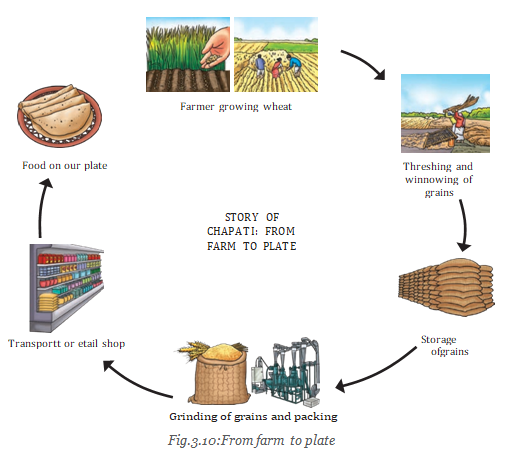
Food Miles and Local Food
Food miles — The total distance a food item travels from its producer to the consumer.
Why Reduce Food Miles?
- Local food: Choosing locally produced food reduces the distance it must travel.
- Benefits: Shorter transport distances help reduce transport cost and pollution.
- Freshness and health: Reducing food miles helps keep food fresher and healthier.
- Local support: Buying local produce supports local farmers and producers.
Respecting Food and Preventing Waste
- Take only what you can eat: This helps prevent food from being left uneaten and wasted.
- Respect food: Remember the effort of farmers and community members who help bring food to our plates.
- Mindful choices: Eat healthy, share food and support local producers.
What are food miles, and why should they be reduced?
How can we reduce food wastage?
Quick recap
- Food reaches our plates through a farm-to-plate journey involving people and effort.
- Food miles measure the distance food travels from producer to consumer.
- Local food usually travels a shorter distance, helping reduce transport costs and pollution.
- Reducing food miles supports local farmers and helps food stay fresher and healthier.
- Take only as much food as you can eat to avoid waste.
- Eat healthy, share, and respect food.
Keywords and Summary
Keywords
| Keyword | Meaning |
|---|---|
| Carbohydrate | A major nutrient and a primary source of energy. |
| Fats | Major nutrients that are also a primary source of energy. |
| Proteins | Body-building nutrients. |
| Vitamins and minerals | Nutrients that strengthen the body, protect against infections and help keep it healthy. |
| Nutrients | Useful substances in food that support energy, growth, repair and health. |
| Food components | The different substances present in food, including nutrients, dietary fibre and water. |
| Roughage | Dietary fibre in food. |
| Deficiency diseases | Diseases or disorders that can result from a long-term lack of nutrients. |
| Rickets | A deficiency disease. |
| Millets | Nutri-cereals that provide most nutrients needed for normal body functioning and grow in different climatic conditions. |
| Culinary practices | Ways of preparing and cooking food. |
| Iodized salt | Salt containing iodine. |
| Food miles | The distance food travels from where it is produced to the consumer. |
| Keyword | Meaning |
|---|---|
| Analyse | Examine information by breaking it into parts. |
| Compare | Identify similarities and differences. |
| Infer | Reach a conclusion from available information. |
| Interpret | Explain the meaning of information. |
| Investigate | Study a question carefully to find out more. |
| Observe | Notice and record what is seen. |
| Prediction | A statement about what may happen. |
| Survey | Collect information by asking questions or gathering responses. |
Summary
Food, culture and cooking
- Food diversity: People across India eat many kinds of food containing different food components.
- Food choices: Choices vary with local crops, taste preferences, culture and traditions.
- Cooking practices: Culinary practices have changed over time; traditional and modern cooking methods can differ significantly.
Food and nutrients
- Functions of food: Food provides energy, supports growth, repairs the body and helps protect it from diseases.
- Main nutrients: Carbohydrates, fats, proteins, vitamins and minerals are the major nutrients in food.
- Other components: Food also contains dietary fibre (roughage) and water.
- Energy: Carbohydrates and fats are primary energy sources.
- Growth and protection: Proteins help build the body; vitamins and minerals strengthen it, protect against infections and help keep it healthy.
Balanced diet — A diet that provides all essential nutrients in the right quantities, along with adequate roughage and water.
Nutrient deficiency
- One or more nutrients are missing from the diet for a long time.
- The body does not receive enough of those nutrients.
- Deficiency diseases or disorders may develop.
| Point | Balanced diet | Junk food |
|---|---|---|
| Nutrient content | Provides essential nutrients in suitable quantities, with roughage and water. | Contains high levels of sugar and fats but little protein, minerals, vitamins and dietary fibre. |
| Effect | Supports the body's needs and health. | Unhealthy. |
Millets and mindful food choices
- Millets: Called nutri-cereals because they provide most of the nutrients needed for normal body functioning and can grow in different climatic conditions.
- Local, plant-based food: Eating locally grown, plant-based foods where possible benefits both health and the environment.
- Food miles: Aim to reduce the distance food travels from its place of production to the consumer.
- Avoid waste: Take only as much food as you can eat, and do not waste food.
What is a balanced diet?
Why are millets called nutri-cereals?
What are food miles, and why should they be minimized?
Quick recap
- Food choices reflect local crops, tastes, culture and traditions.
- Food provides energy, supports growth and repair, and helps protect health.
- Carbohydrates and fats supply energy; proteins build the body; vitamins and minerals strengthen and protect the body and help keep it healthy.
- A balanced diet includes essential nutrients in suitable quantities, plus roughage and water.
- Long-term nutrient deficiency can lead to diseases or disorders; junk foods are high in sugar and fats but low in several nutrients.
- Millets provide most nutrients needed for normal body functioning and can grow in varied climates; local, plant-based choices can benefit people and the environment.
- Reduce food miles, avoid food waste and take only what you can consume.
Science — ALL CHAPTERS
1
THE WONDERFUL WORLD OF SCIENCE
2
DIVERSITY IN THE LIVING WORLD
3
MINDFUL EATING: A PATH TO A HEALTHY BODY
4
EXPLORING MAGNETS
5
MEASUREMENT OF LENGTH AND MOTION
6
MATERIALS AROUND US
7
TEMPERATURE AND ITS MEASUREMENT
8
A JOURNEY THROUGH STATES OF WATER
9
METHODS OF SEPARATION IN EVERYDAY LIFE
10
LIVING CREATURES: EXPLORING THEIR CHARACTERISTICS
11
NATURE’S TREASURES
12
BEYOND EARTH