Class 6 . Science . Curiosity . Temperature and Its Measurement
Chapter 7: TEMPERATURE AND ITS MEASUREMENT
Ch 7
Science
Class 6
Hot, Cold and Temperature
Hot or Cold?
Why touch can mislead
- Touch can help us compare hotness in some situations, but it is not always a reliable way to judge whether something is hot or cold.
- Example: After one hand is kept in warm water and the other in ice-cold water, the same tap water may feel cool to one hand and warm to the other.
- Conclusion: Our sense of touch can give different impressions of the same body's hotness or coldness.
Temperature
Temperature — A reliable measure of how hot or cold a body is.
Understanding temperature
- Higher temperature: A hotter body has a higher temperature than a colder body.
- Comparison: The temperature difference between two bodies indicates how hot one is compared with the other.
- Measurement: Temperature is measured using a thermometer.
Thermometer — A device used to measure temperature.
| Point | Clinical thermometer | Laboratory thermometer |
|---|---|---|
| Use | Measures human body temperature. | Measures temperature for many other purposes. |
Why is touch not always a reliable way to judge whether a body is hot or cold?
What is temperature, and what instrument measures it?
Quick recap
- Touch may give different impressions of the same body's hotness or coldness.
- Temperature is a reliable measure of how hot or cold a body is.
- A hotter body has a higher temperature than a colder body.
- A thermometer measures temperature.
- Clinical thermometers measure human body temperature; laboratory thermometers serve many other purposes.
Measuring Temperature - Clinical Thermometer
Clinical Thermometers
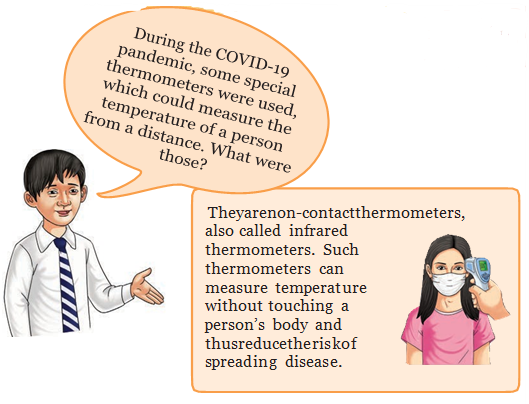
Clinical thermometer — A thermometer designed to measure a person’s body temperature when placed in contact with the body.
- Digital type: Usually battery-powered; heat sensors determine temperature and the display shows the reading.
- Scale: Clinical thermometers commonly use the Celsius scale, whose unit is degree Celsius, written as .

Mercury and Digital Thermometers
- Earlier thermometers: Mercury thermometers were used to measure body temperature.
- Safety concern: Mercury is extremely toxic and difficult to dispose of safely if a thermometer breaks.
- Digital advantage: Digital thermometers avoid the mercury risk, and their displayed numbers are easier to read.

| Scale | Illustrated range |
|---|---|
| Celsius | to |
| Fahrenheit | to |
Safe Use and Body Temperature
Precautions for Digital Thermometers
- Instructions: Read the thermometer’s instruction manual before use.
- Cleaning: Wash the tip with soap and water before and after use.
- Keep dry: Keep the display and other digital parts out of water while washing.
- Handling: Do not hold the thermometer by its tip.
Normal body temperature — The average body temperature of a large number of healthy people is taken as .
Variation in Body Temperature
- Individual variation: A healthy person’s temperature may be slightly higher or lower than ; this is an average, not a fixed value for everyone.
- Influences: Body temperature can vary with age, time of day and activity level.
- Usual limits: Human body temperature does not normally fall below or rise above .
- Armpit reading: For small children or older people, a digital thermometer may be placed in the armpit; this reading is about to lower than the actual body temperature.
Pulse Rate and Fever
- Pulse rate: Fever can affect pulse rate, but other situations also affect it; pulse rate alone is not a reliable indicator of fever.
Temperature Scales and Conversion
| Scale | Unit and symbol | Use or note |
|---|---|---|
| Celsius | degree Celsius, | Commonly used for body temperature. |
| Fahrenheit | degree Fahrenheit, | is equivalent to ; this scale is not used in most scientific studies today. |
| Kelvin | kelvin, | The SI unit of temperature. |
Use these formulas to convert between Celsius and Fahrenheit; for example, .
Add to a Celsius temperature to express it in kelvin.
Writing Temperature Units Correctly
- Capitalisation: Scale names are Celsius, Fahrenheit and Kelvin. Write the unit names as “degree Celsius”, “degree Fahrenheit” and “kelvin”.
- Symbols: Write , and ; the kelvin symbol has no degree sign.
- Spacing: Leave a space between the number and unit, as in . Do not put a full stop after a unit symbol unless it ends the sentence.
- Plural form: Use “degrees” when writing the full unit name for temperatures above one degree.
Limits of a Clinical Thermometer
- Range limitation: A clinical thermometer is designed for body temperature; the temperatures of ice and boiling water are outside its range.
Why may a healthy person’s body temperature differ slightly from ?
What is the SI unit of temperature, and how is it related to Celsius?
Quick recap
- Clinical thermometers measure body temperature; digital types use heat sensors and display the reading.
- Digital thermometers have replaced mercury types in part because mercury is toxic and difficult to dispose of safely.
- A healthy person’s temperature may differ slightly from because it is an average and body temperature varies.
- Celsius, Fahrenheit and Kelvin are temperature scales; kelvin () is the SI unit.
- Use to convert Celsius to Fahrenheit and to convert Celsius to kelvin.
- Ice and boiling water are outside the range of a clinical thermometer.
Laboratory Thermometer
Structure and Working

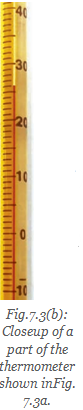
Range and Smallest Scale Division
Smallest scale division — The smallest scale division is the smallest temperature change that the thermometer can read.
Here, is the temperature difference between two bigger marks, and is the number of small divisions between them.
Correct Use and Reading
Handling Precautions
- Handle carefully: The glass thermometer can break if it strikes a hard object.
- Hold correctly: Do not hold the thermometer by its bulb.
Do not remove the thermometer before reading: its liquid column begins to fall after it is taken out of the water.
Temperature During Melting and Boiling
- Constant temperature: Ice remains at the same temperature while melting, and water remains at the same temperature while boiling.
Comparing Temperature Readings
- Why readings may differ: Students may not all have followed the correct method of reading the thermometer.
How do you find the smallest division of a laboratory thermometer?
State the correct way to read a laboratory thermometer.
Quick recap
- A laboratory thermometer has a liquid-filled bulb, a narrow tube and a Celsius scale.
- Check the thermometer’s range and smallest scale division before use.
- Smallest division = temperature interval between bigger marks ÷ number of small divisions.
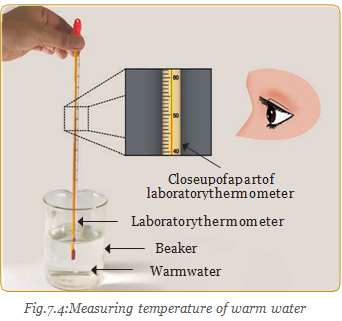
- Keep the thermometer vertical and the bulb immersed without touching the beaker.
- Read at eye level while the thermometer is still in the liquid.
- Ice stays at a constant temperature while melting, and water stays at a constant temperature while boiling.
Air Temperature
Measuring Air Temperature
- Room temperature: Wall-mounted thermometers give an approximate idea of the temperature indoors.
- Weather reports: They often include the day’s maximum and minimum air temperatures.
- Daily variation: Air temperatures usually change from day to day because weather depends on several factors.
- Seasonal change: Temperatures generally rise as summer approaches and fall during winter.
- Weather stations: They monitor air temperature, and this data helps in making weather forecasts.
Quick recap
- Air temperature is the temperature of air at a place and time.
- Room thermometers give an approximate room temperature; weather reports give daily maximum and minimum temperatures.
- Air temperatures usually vary daily and generally rise towards summer and fall during winter.
- Weather stations collect air-temperature data used with other measurements to make forecasts.
- Anna Mani developed weather instruments and explored wind and solar energy in India; her work helped India become one of the global leaders in renewable energy.
Keywords and Summary
Keywords
| Science terms | Instruction words |
|---|---|
| Air temperature | Analyse |
| Celsius scale | Calculate |
| Clinical thermometer | Compare |
| Degree Celsius | Discuss |
| Degree Fahrenheit | Infer |
| Fahrenheit scale | Investigate |
| Kelvin | Measure |
| Kelvin scale | Observe |
| Laboratory thermometer | Precaution |
| SI unit of temperature | Predict |
| Temperature | Record |
Summary
Temperature — Temperature tells how hot or cold a body is.
| Scale | Unit | Symbol |
|---|---|---|
| Celsius | degree Celsius | |
| Fahrenheit | degree Fahrenheit | |
| Kelvin | kelvin |
- SI unit: The SI unit of temperature is kelvin ().
- Clinical thermometer: Used to measure body temperature.
- Normal adult temperature: A healthy human adult's normal temperature is or .
- Laboratory thermometer: Its typical temperature range is from to .
Quick recap
- Temperature indicates how hot or cold a body is.
- The common scales are Celsius, Fahrenheit and Kelvin.
- Their units are degree Celsius (), degree Fahrenheit () and kelvin ().
- Kelvin is the SI unit of temperature.
- A clinical thermometer measures body temperature; a typical healthy adult temperature is or .
- A laboratory thermometer typically covers to .
Science — ALL CHAPTERS
1
THE WONDERFUL WORLD OF SCIENCE
2
DIVERSITY IN THE LIVING WORLD
3
MINDFUL EATING: A PATH TO A HEALTHY BODY
4
EXPLORING MAGNETS
5
MEASUREMENT OF LENGTH AND MOTION
6
MATERIALS AROUND US
7
TEMPERATURE AND ITS MEASUREMENT
8
A JOURNEY THROUGH STATES OF WATER
9
METHODS OF SEPARATION IN EVERYDAY LIFE
10
LIVING CREATURES: EXPLORING THEIR CHARACTERISTICS
11
NATURE’S TREASURES
12
BEYOND EARTH