Class 6 . Science . Curiosity . Nature S Treasures
Chapter 11: NATURE’S TREASURES
Ch 11
Science
Class 6
Nature’s Treasures : Air
Treasures of Nature
Treasures of nature — Useful things provided by nature that support life and make our lives more comfortable.
Examples and importance
- Examples: Air, water, fertile soil, sunlight, and trees are treasures of nature.
- Benefits: Soil supports many living beings; sunlight is useful in many ways; trees provide food and shelter for animals, birds, and insects.
- Need: These natural treasures are essential for survival; life on Earth is not possible without them.
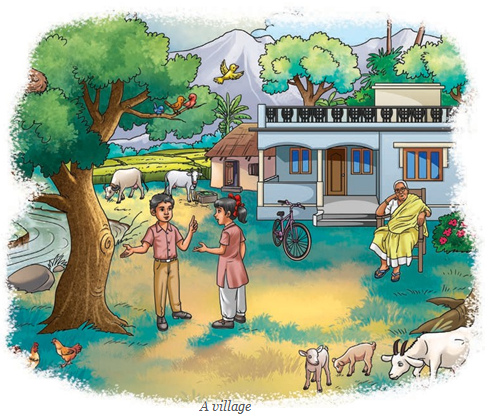
Air and the Need for Oxygen
Breathing and oxygen
- Breathing: We breathe air in and out; deep breaths bring more fresh air into the lungs.
- Oxygen: The air we breathe contains oxygen, which the body needs to perform its functions.
- Survival: Most living beings need oxygen to survive.
- Lack of oxygen: Holding the breath for a long time makes it difficult for the body to get enough oxygen to function.
- Important: People may survive without food or water for a few days, but cannot survive without oxygen for even a few minutes.
- Air contains oxygen, and oxygen is essential for the body's functions and survival.
- Never hold your breath so long that you feel uncomfortable.
Why is oxygen necessary for living beings?
Quick recap
- Air, water, soil, sunlight, and trees are examples of nature’s treasures.
- Nature’s treasures support survival and make life more comfortable.
- The air we breathe contains oxygen.
- The body needs oxygen to perform its functions, and most living beings need it to survive.
- People cannot survive without oxygen for even a few minutes.
Air Mixture of Gases & Windmills
Composition of Air
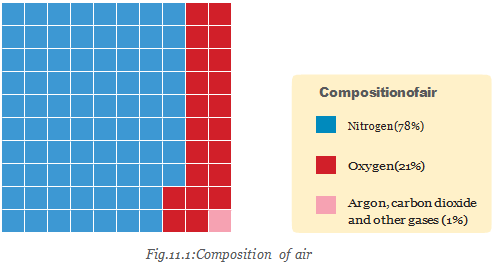
Air — Air is a mixture of gases surrounding the Earth.
| Gas group | Approximate percentage |
|---|---|
| Nitrogen | |
| Oxygen | |
| Argon, carbon dioxide and other gases | combined |
Percentage — Percentage tells how many parts there are in every 100 parts; it is written using the symbol .
Moving Air and Wind
Wind — Wind is moving air.
How we notice moving air
- Signs of wind: Leaves rustle, clothes sway and open-book pages flutter when air moves.
- Different strengths: Wind may blow gently as a breeze or strongly during a storm.
Windmills and Wind Farms
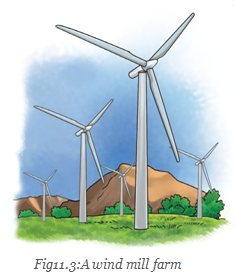
Windmill — A windmill uses wind to rotate its wings and perform useful work.
Uses and examples
- Working principle: Wind pushes the wings of a windmill, making them rotate, much like a paper pinwheel.
- Uses: Windmills can run flour mills, draw water from wells and generate electricity.
- Windmill farm: An area containing many windmills that use wind energy to generate electricity.
- Indian examples: Muppandal Wind Farm in Tamil Nadu, Jaisalmer Wind Park in Rajasthan and Brahmanvel Wind Farm in Maharashtra.
What is wind, and how does it make a windmill useful?
What are the main gases in air and their approximate proportions?
Quick recap
- Air is a mixture of gases surrounding the Earth.
- Air is about nitrogen, oxygen and other gases combined.
- Moving air is called wind; it may be a gentle breeze or a strong storm wind.
- Wind rotates the wings of windmills, which can do useful work.
- Windmill farms contain many windmills that generate electricity.
- Muppandal, Jaisalmer and Brahmanvel are examples of windmill farms in India.
Water Uses & Resource
Uses of Water
Everyday and body uses
- Daily life: Water is used for drinking, cooking, bathing, washing and cleaning.
- Farming and care: It is used to grow crops, water plants and provide for animals.
- Industry: Water is also used for industrial purposes.
- Body functions: Drinking water helps regulate body temperature, aids digestion and nutrient absorption, removes waste through urine and sweat, and keeps skin and tissues healthy.
Water molecule — A water molecule has the chemical formula and contains two hydrogen atoms and one oxygen atom.
Water Sources and Availability
Freshwater — Water with low salt content, needed for domestic, agricultural and industrial uses.
Where water is found
- Earth’s surface: Water covers about two-thirds of Earth, but most of it is in oceans and seas.
- Saline water: Ocean and sea water is salty and unsuitable for domestic, agricultural and industrial use.
- Freshwater sources: Freshwater occurs in ice sheets and snow, in rivers and lakes at the surface, and underground.
- Accessibility: Ice, snow and underground water can be difficult to access; only a small fraction in ponds, rivers, lakes and wells is easily accessible.
| Water source | Availability and use |
|---|---|
| Oceans and seas | Contain most of Earth’s water; salty and generally unsuitable for everyday use |
| Ice sheets and snow | Freshwater, but difficult to access |
| Underground water | Freshwater, but often difficult to access |
| Ponds, rivers, lakes and wells | A small fraction of freshwater that is more easily accessible |
Reducing Water Wastage
Water conservation — Water conservation means using water carefully and preventing avoidable waste.
Ways to save water
- Common causes of waste: Leaving taps running, using more water than needed, and ignoring leaks.
- Simple actions: Turn off taps when they are not in use and repair leaking taps or pipes.
- Reuse and collect: Recycling suitable water and harvesting rainwater also help save water.
| Activity | Possible way water may be wasted | Possible way to reduce wastage |
|---|---|---|
| Hand washing | Leaving the tap running while soaping hands | Turn off the tap while soaping |
| Washing clothes | Using more water than needed | Use only the water needed |
| Washing utensils | Keeping the tap running throughout | Turn off the tap when water is not needed |
| Taking a shower | Using more water than needed | Use water carefully |
| Cooking | Using more water than needed | Use only the amount required |
| Gardening | Using more water than plants need | Water plants carefully |
| Brushing teeth | Leaving the tap running | Turn off the tap while brushing |
Water Pollution and Conservation
Water pollution — Water pollution occurs when waste or other harmful materials contaminate water sources.
Why clean water must be protected
- Pollution sources: Plastic bags and wrappers thrown into water, and household or industrial waste dumped into water sources.
- Effect: Polluted water is not fit for consumption by living beings.
- Limited supply: Freshwater sources are limited, and many parts of India face water shortages; some people travel long distances to fetch drinking water.
- Unequal access: Not everyone has the same access to water, so water must be conserved and kept clean for all living beings.
Rainwater Harvesting
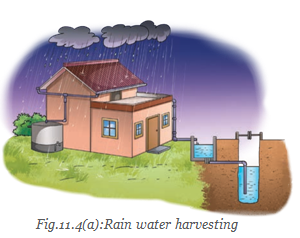
Rainwater harvesting — Rainwater harvesting is collecting and storing rainwater for later use.
Rainwater collection
- Modern buildings: Rooftop rainwater can be directed into a tank and stored.
- Benefit: Stored rainwater provides water for later use and helps conserve water.
- Long-standing practice: Water harvesting has been practised in India for a long time.
Traditional Stepwells
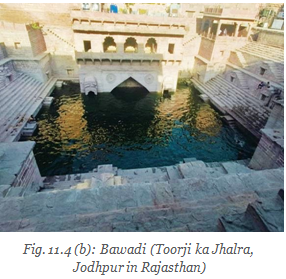
Stepwell — A stepwell is a traditional structure used to collect and store water.
How stepwells store water
- Regional names: Stepwells are called Bawadi in Rajasthan and Vav in Gujarat.
- Water sources: They store rainwater and water seeping from nearby lakes, ponds and rivers.
- Structure: Their deep trenches are lined with stone blocks that allow water to seep in.
World Water Day
- Date: World Water Day is observed every year on 22 March.
Why is most water on Earth not suitable for everyday use?
How do stepwells help conserve water?
Quick recap
- Water is used for daily needs, farming, animal care and industry, and supports important body functions.
- A water molecule is : two hydrogen atoms and one oxygen atom.
- Most of Earth’s water is salty; only a small fraction of freshwater is easily accessible.
- Save water by turning off taps, fixing leaks and reusing suitable water.
- Keep household and industrial waste and litter out of water sources.
- Rainwater harvesting collects and stores rainwater; stepwells are a traditional method.
- World Water Day is observed every year on 22 March.
Energy From the Sun
The Sun: Earth’s Main Energy Source
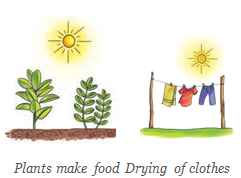
Energy Moves Through Living Things
How energy from the Sun reaches animals and people
- Sunlight helps plants make food.
- Animals eat plants and get energy.
- People get food and energy from plants and animals.
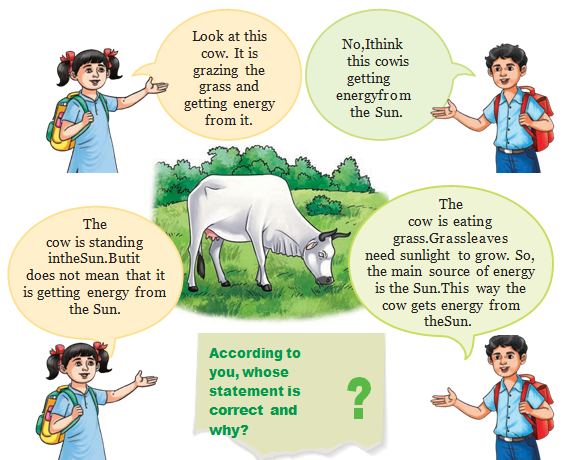
Using Solar Energy
If sunlight is unavailable
- Less natural light is available during the day.
- People may need artificial lighting.
- Plants receive less sunlight to make food.
- Animals and people are affected because they depend on plants and the food chain.
Why is the Sun called the main source of energy on Earth?
Give three ways people use the Sun’s energy.
Quick recap
- The Sun is Earth’s main source of heat, light and energy.
- Plants use sunlight to make food.
- Animals get energy by eating plants; people get food from plants and animals.
- Solar panels convert the Sun’s energy into electricity.
- Solar cookers and solar water heaters use sunlight directly.
- Without sunlight, natural light and plant food-making are affected.
Forests
Forests and Their Resources
Forest — A forest is a large area with dense growth of different kinds of plants.
Life and resources in forests
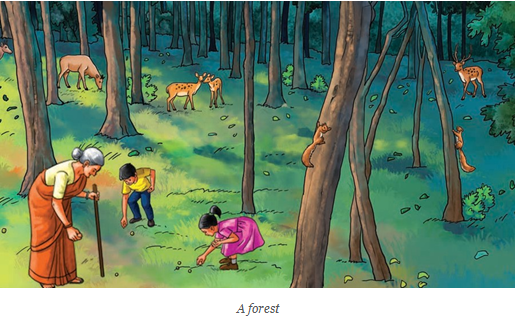
- Plant life: Forests contain herbs, shrubs and trees.
- Wildlife: Forests are natural homes that provide food and shelter for animals, birds and insects.
- Interdependence: Living things depend on other life forms for survival; the diversity of life helps provide food for them.
- Example: Nellikai (Indian gooseberries) is a fruit found in forests.
- Responsible use: Leave some fruits for animals and birds, and use forest resources in ways that allow forests to regenerate.
Protecting Forests
Forest loss and its effects
- Large-scale cutting of trees → decreasing forest cover.
- Less forest habitat → animals, birds and insects lose food and shelter.
- Fewer plant roots holding the soil → greater risk of soil being washed away.
- Forest restoration takes many years → forests need protection and time to regenerate.
Van Mahotsav
- When: A week-long forest festival celebrated across India in July.
- Activities and aim: New plants and trees are planted, and awareness about respecting forests is raised to increase green cover.
Chipko Movement
- When and where: It began in the early 1970s in Uttarakhand, then part of Uttar Pradesh.
- How people protected trees: Local women actively joined by encircling and hugging trees to prevent them from being felled.
Soil and Recycling in Forests
How forests enrich the soil
- Plant roots hold the soil together and help prevent it from being washed away.
- Fallen leaves decay on the forest floor.
- Decay adds nutrients to the soil.
- New plants and trees use the nutrient-rich soil to grow: this is recycling in nature.
How do forests support wildlife and help maintain soil?
What is Van Mahotsav, and what is its aim?
What was the Chipko movement?
Quick recap
- Forests are large areas with dense growth of varied plants.
- Forests provide food and shelter for wildlife; living things depend on one another.
- Nellikai (Indian gooseberries) is an example of a forest fruit; leave fruit for animals and birds.
- Large-scale tree cutting reduces forest cover, and restoration takes many years.
- Van Mahotsav is celebrated across India for a week in July to encourage planting and awareness.
- The Chipko movement used tree-hugging to prevent felling.
- Roots help prevent soil loss; decaying leaves return nutrients to the soil.
Soil, Rocks and Minerals
Soil: Contents and Importance
Soil — A natural material formed mainly from broken-down rocks, containing particles and living or decaying matter.
What soil contains and does
- Contents: Soil may contain sand, pebbles, insects, worms and tiny organisms; decaying plants and animals also become part of it.
- Differences: Soil samples can vary in colour and texture because they contain different materials; a magnifying lens reveals details not easily seen by the naked eye.
- Plant growth: Spaces between soil particles provide air and room for roots to grow.
- Earthworms: They naturally turn and loosen the soil.
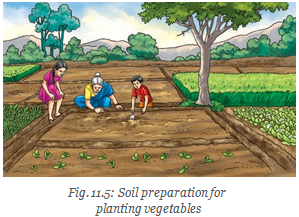
- Importance: Soil supports biodiversity and is useful for growing plants; some soils are also suitable for making bricks.
How Soil Forms
Disintegration — The breaking apart of rocks into smaller pieces.
Soil formation
- Rocks are broken apart by the action of the Sun, water and living organisms.
- Over thousands of years, the broken material contributes to the formation of soil.
Rocks and Their Uses
Rocks — Naturally occurring solid materials made up of minerals.
Uses and examples
- Construction: Rocks are used for houses, buildings, temples, roads, dams and tabletops.
- Examples: Granite, sandstone and marble are important rocks.
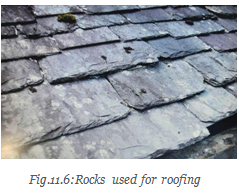
- Slate: Used for roofing.
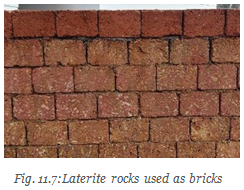
- Laterite: Can be used as a building material, like bricks.
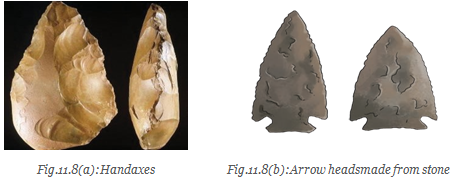
- Tools: People have shaped rocks into hand axes and arrowheads for thousands of years.
Minerals and Their Uses
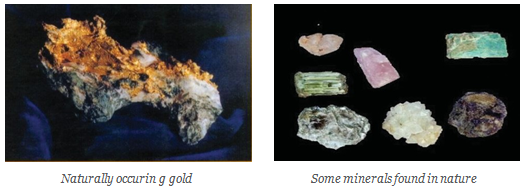
Minerals — The materials that make up rocks and provide useful substances, including metals.
Uses of minerals
- Metals: Aluminium, gold, copper and iron are extracted from minerals.
- Products: Minerals are used to manufacture airplanes, cars, jewellery, cosmetics, and electrical and electronic equipment.
- Example: A basic mobile phone contains about a dozen minerals, including gold, silver, copper and cobalt.
Responsible Use of Rocks and Minerals
- Formation time: Rocks take thousands to millions of years to form.
- Conservation: Because rocks and minerals form very slowly and are important in daily life, they should be conserved and used responsibly.
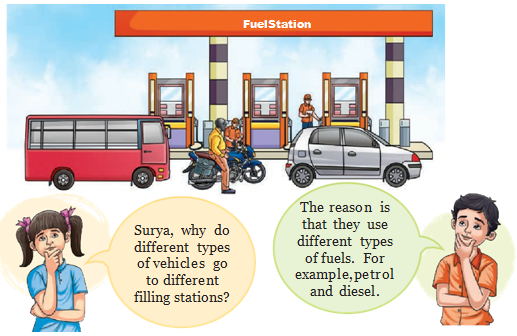
- Connection: Most vehicles used for transport run on fossil fuels.
How is soil formed?
Give two uses of rocks and two uses of minerals.
Why should rocks and minerals be conserved?
Quick recap
- Soil contains mineral particles, organisms and decaying matter, and its samples can differ in colour and texture.
- Spaces in soil support air circulation and root growth; earthworms help loosen soil.
- The Sun, water and living organisms break down rocks to form soil over thousands of years.
- Rocks are made of minerals and are used in construction, tools and roofing.
- Minerals provide metals and materials for many everyday products and technologies.
- Rocks form very slowly, so rocks and minerals should be conserved and used responsibly.
Fossil Fuels
What Are Fossil Fuels?
Key Facts
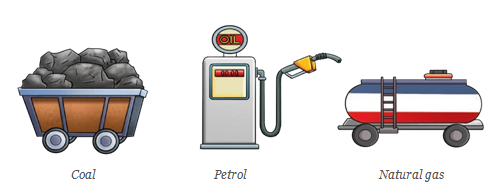
- Main fossil fuels: Coal, petroleum and natural gas.
- Formation: Buried plant and microorganism remains are converted into these fuels over millions of years.
- Limited supply: Fossil fuels are available in finite quantities and may run out if used at the current rate.
How Fossil Fuels Form
- Plants and microorganisms die and are buried deep inside the Earth.
- Over millions of years, their remains are converted into coal, petroleum and natural gas.
Fuels and Their Uses
| Fuel | Uses and examples |
|---|---|
| Petroleum | Provides petrol, diesel and kerosene; petrol and diesel are widely used in vehicles. |
| Natural gas | Used for cooking and generating electricity. Compressed Natural Gas (CNG) is used in vehicles and is cleaner than petrol or diesel. |
| Coal | Mainly used to produce electricity; found in several parts of India. |
Changing Domestic Fuels
- Earlier: Coal, wood and dung cakes were commonly used for cooking.
- Nowadays: Less-polluting natural gas and Liquefied Petroleum Gas (LPG) have gradually replaced these fuels.
Conserving Fossil Fuels
Fossil Fuel Use and Air Pollution
- Fossil fuels are burnt for transport and domestic needs.
- Burning them produces smoke and carbon dioxide.
- These emissions pollute the air; over-dependence on fossil fuels contributes to large-scale air pollution.
Ways to Conserve Fuel
- Explore alternate energy sources: This helps avoid running out of limited fossil fuels.
- Walk or cycle when travelling to nearby places.
- Use public transport instead of travelling alone in a vehicle.
- Share rides where possible and avoid unnecessary vehicle trips.
- Fossil fuels are useful but limited, and they take millions of years to form.
- Reducing fuel use and exploring alternate energy sources help conserve fossil fuels and reduce air pollution.
What are fossil fuels, and how are they formed?
What are the main uses of coal, petroleum and natural gas?
Why should we conserve fossil fuels?
Quick recap
- Coal, petroleum and natural gas are fossil fuels formed from buried remains over millions of years.
- Petroleum provides petrol, diesel and kerosene.
- Natural gas is used for cooking, electricity and as CNG for vehicles; CNG is cleaner than petrol or diesel.
- Coal is mainly used to produce electricity.
- Fossil fuels are limited, and burning them produces smoke and carbon dioxide that pollute the air.
- Explore alternate energy sources, walk or cycle nearby, and use public transport to help conserve fuel.
Natural Resources: Renewable and Non-renewable
Natural and Human-Made Resources
- Natural resources: Materials and energy obtained from nature that support life and meet our needs.
- Human-made resources: Useful things created by people from natural resources, such as furniture, bicycles and solar panels.
Renewable and Non-Renewable Resources
Non-renewable resources — Resources found in limited quantities that are not produced or replenished within a reasonable period.
How a Forest Resource Can Be Renewed
- Animals and birds eat fallen fruits.
- Seeds spread in their droppings.
- New trees grow and produce fruits after some years.
Resources We Use and Their Conservation
How do renewable and non-renewable resources differ?
Why should we conserve natural resources?
Quick recap
- Natural resources come from nature; human-made resources are made by people.
- Air, water and forests are examples of renewable resources.
- Minerals, soil, rocks, coal, petroleum and natural gas are listed as non-renewable resources.
- Fossil fuels take millions of years to form and exist in limited quantities.
- Vehicle smoke from fossil fuels contributes to air pollution; electric vehicles do not release smoke.
- Use natural resources responsibly and avoid wasting them to protect future needs and the environment.
Keywords and Summary
Keywords
- Key terms: Important words help explain the natural resources discussed in this chapter.
- Main idea: Understanding these terms shows how people depend on nature and why resources should be used responsibly.
Resources from Nature
Natural resource — A resource provided by nature is called a natural resource.
Examples of Natural Resources
- Examples: air, water, energy from the Sun, forests, soil, rocks, minerals and fossil fuels.
Human-made resource — A resource created by people to meet their needs is called a human-made resource.
Renewable and Non-renewable Resources
| Type | Meaning |
|---|---|
| Renewable resources | Get renewed, replenished or restored by natural processes within a reasonable period. |
| Non-renewable resources | Are limited in quantity and do not get replenished within a reasonable period. |
All living beings, including humans, depend on natural resources; use them judiciously.
Quick recap
- Resources required for survival are provided by nature.
- Natural resources include air, water, energy from the Sun, forests, soil, rocks, minerals and fossil fuels.
- Human-made resources are created by people to meet their needs.
- Renewable resources are restored naturally within a reasonable period.
- Non-renewable resources are limited and are not replenished within a reasonable period.
- All living beings depend on natural resources, so they should be used judiciously.
Science — ALL CHAPTERS
1
THE WONDERFUL WORLD OF SCIENCE
2
DIVERSITY IN THE LIVING WORLD
3
MINDFUL EATING: A PATH TO A HEALTHY BODY
4
EXPLORING MAGNETS
5
MEASUREMENT OF LENGTH AND MOTION
6
MATERIALS AROUND US
7
TEMPERATURE AND ITS MEASUREMENT
8
A JOURNEY THROUGH STATES OF WATER
9
METHODS OF SEPARATION IN EVERYDAY LIFE
10
LIVING CREATURES: EXPLORING THEIR CHARACTERISTICS
11
NATURE’S TREASURES
12
BEYOND EARTH