Class 6 . Science . Curiosity . The Wonderful World of Science
Chapter 1: THE WONDERFUL WORLD OF SCIENCE
Ch 1
Science
Class 6
Introduction to the Wonderful World of Science
What Is Science?
- Science: A way of thinking, observing and doing things to understand the world and uncover the secrets of the universe.
- Purpose: Science helps us ask questions, explore how things work and build knowledge about the world around us.
Curiosity and Discovery
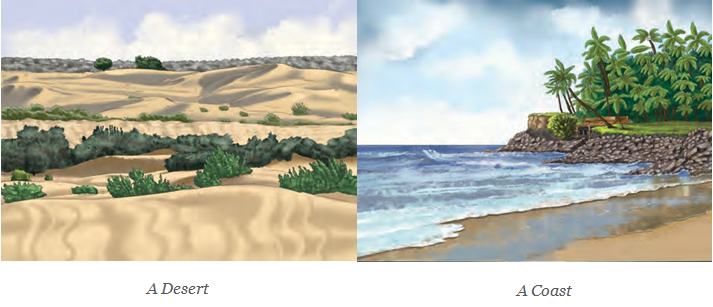
Science Is All Around Us
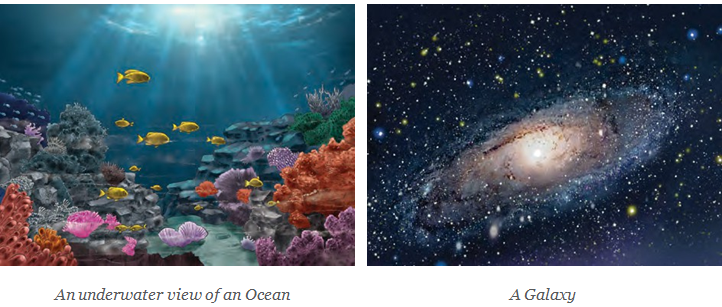
Science as an Ongoing, Connected Search
A Scientific Search
- Curiosity raises a question
- Observation and exploration help investigate it
- New understanding adds to knowledge and may raise further questions
Quick recap
- Science is a way of thinking, observing and doing things to understand the world.
- Curiosity and questions help begin scientific exploration.
- Science can be found everywhere, from nature and space to everyday activities.
- Discoveries add to knowledge but can also lead to new questions.
- New discoveries may change earlier ideas, and scientific ideas are connected.
How the Plants and Animals Grows
Life and Growth on Earth
Living things
- Earth is the only planet known to support life; its environment needs protection.
- Diversity: Plants and animals survive and thrive in different regions of Earth.
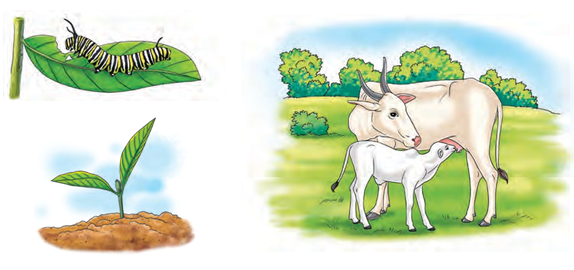
- Growth and change can be seen as a seed develops into a plant, a caterpillar becomes a butterfly, and a calf grows into a cow.
Food and Water for Life
Food and water
- Food is needed for growth. India has many cuisines and dishes; we can ask what ingredients they are made from and how to find out.
- Water is needed for survival, along with food.
The Water Cycle
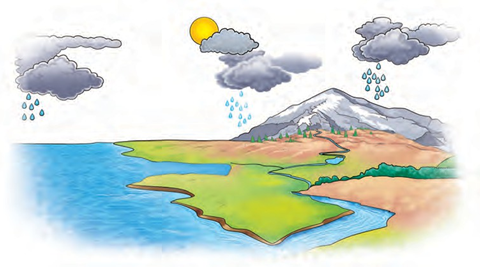
Water cycle — The continuous movement of water between Earth's surface and the atmosphere.
| Stage | What happens |
|---|---|
| Evaporation | The Sun heats water in rivers, lakes and oceans; liquid water changes into water vapour, which rises. |
| Condensation | Water vapour cools in the atmosphere and becomes tiny liquid droplets that form clouds. |
| Precipitation | Cloud droplets fall when heavy enough—as rain, snow, sleet or hail. |
| Runoff | Water flows over the land into rivers, lakes or oceans. |
| Collection | Rivers carry runoff back to larger bodies of water, where the cycle can begin again. |
Cycle sequence
- The Sun heats surface water, causing evaporation.
- Water vapour cools and condenses into droplets, forming clouds.
- Cloud droplets fall as precipitation.
- Water flows over land as runoff and collects in rivers and other water bodies.
- The Sun heats the collected water again, and the cycle continues.
Water, temperature and why the cycle matters
- Heating and cooling: Water freezes into ice when cooled and boils into steam when heated.
- Hotness: Knowing how hot something is can matter, for example when checking whether a person has a fever.
- Importance: The water cycle distributes water, supports plant and animal life, and helps regulate weather patterns.
Differentiate evaporation and condensation.
What is precipitation? Name its forms mentioned in the lesson.
Everyday Materials
Objects and materials
- Everyday objects include paper, a metal key, a plastic ruler, a rubber eraser, a magnet, clothes and a cup.
- Materials: Objects may be made from different materials. A key question is how to separate different materials from one another.
Quick recap
- Earth supports diverse plant and animal life, and its environment needs protection.
- Growth and change are illustrated by a seedling, a caterpillar becoming a butterfly, and a calf growing into a cow.
- Food is needed for growth, and water along with food is needed for survival.
- The Sun heats surface water, causing evaporation; cooling water vapour condenses into cloud droplets.
- Precipitation falls as rain, snow, sleet or hail; runoff returns water to rivers and larger bodies of water.
- The water cycle distributes water, supports life and helps regulate weather; heating and cooling also change water's state.
- Everyday objects are made from materials, and different materials may need to be separated.
Discover New Things and Solve Problem
The Scientific Method
Scientific method — A step-by-step way to ask questions, test possible answers and use results to solve problems or discover new things.
How science works
- More than facts: Science involves observing, asking questions, testing ideas and analysing results—not just memorising facts or doing experiments.
- Possible answer: A guess is a proposed answer that can be checked through experiments or further observations.
- Who can use it? Anyone who follows this process is working like a scientist.
Steps in the Scientific Method
- Observe something interesting or puzzling.
- Ask a question about what you observed.
- Suggest a possible answer or guess.
- Test the guess using an experiment or more observations.
- Analyse the results to decide whether they answer the question.
Using the Method in Everyday Life
Everyday examples
- Pen stops writing: Ask why; guess the ink is empty and check the refill. If it is not empty, form another guess, such as dried ink, and test it.
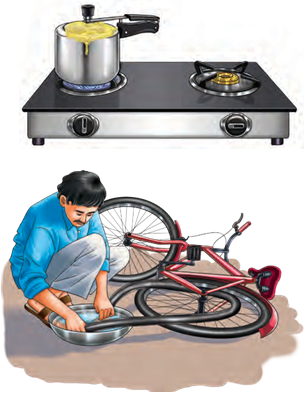
- Cooking: Someone may investigate whether too much water caused dal to spill from a cooker.
- Bicycle repair: A repair person may look for where air is leaking from a flat tyre.
- Electrical fault: An electrician may check whether a bulb or its switch is causing a light not to work.
Curiosity and Working Together
Thinking like a scientist
- Be curious: Observe your surroundings keenly and ask how and why questions about the world, including things beyond Earth.
- Explore: Many things remain unknown and can be investigated by asking questions and testing possible answers.
- Collaborate: Scientists often work in teams; asking friends for help can make discovery easier and more enjoyable.
- Keep learning: Not every question can be answered in Grade 6; learning science continues beyond this class.
What are the main steps of the scientific method?
How can checking a pen that has stopped writing show the scientific method?
Why can an everyday problem-solving situation count as science?
Quick recap
- Science uses a step-by-step process to investigate questions and solve problems.
- The process is: observe, question, suggest an answer, test it and analyse results.
- A possible answer must be checked through experiments or further observations.
- Everyday problem-solving, such as checking a pen, can use the scientific method.
- Curiosity, keen observation and teamwork help people explore and learn science.
- Learning science is an ongoing journey; some questions take further study to answer.
Science — ALL CHAPTERS
1
THE WONDERFUL WORLD OF SCIENCE
2
DIVERSITY IN THE LIVING WORLD
3
MINDFUL EATING: A PATH TO A HEALTHY BODY
4
EXPLORING MAGNETS
5
MEASUREMENT OF LENGTH AND MOTION
6
MATERIALS AROUND US
7
TEMPERATURE AND ITS MEASUREMENT
8
A JOURNEY THROUGH STATES OF WATER
9
METHODS OF SEPARATION IN EVERYDAY LIFE
10
LIVING CREATURES: EXPLORING THEIR CHARACTERISTICS
11
NATURE’S TREASURES
12
BEYOND EARTH