Class 6 . Science . Curiosity . Measurement of Length and Motion
Chapter 5: MEASUREMENT OF LENGTH AND MOTION
Ch 5
Science
Class 6
Introduction How Do We Measure?
Measuring Length
Ways to measure length
- Body-based measures: People have used handspans, arm lengths, feet, fingers and strides to measure length.
- Examples: A farmer may count strides to estimate a field’s length; a tailor may use a flexible measuring tape.
- Traditional term: A handspan is also called a balisht; char angula means the width of four fingers.
- Tools: Measuring rods, scales and measuring tapes are used to measure length.

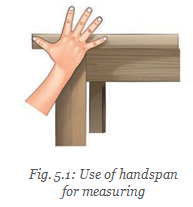
Measurement — Measurement compares an unknown length with a chosen unit.
Number and unit
- A measurement has two parts: a number and a unit.
- Example: If a table is 13 handspans long, 13 is the number and handspan is the unit.
| Student | Number of handspans |
|---|---|
| Anish | Slightly more than 13 |
| Padma | 13 |
| Tasneem | Slightly less than 13 |
| Deepa | Between 13 and 14 |
| Hardeep | 14 |
Why standard units are needed
- Different results: Handspan measurements vary because people’s hands are different sizes.
- Need for a standard unit: Measurements of the same length should not differ when made by different people.
- Result: A standard unit allows measurements to be compared consistently.
Traditional Indian units
- Units mentioned in ancient literature: angula (finger width), multiples of angula, dhanusa and yojana.
- Uses: These units were used to measure artefacts, architecture and town planning.
- Continuing use: Traditional craftspeople, including carpenters and tailors, still use angula.
- Harappan evidence: Objects with ruled markings, possibly scales, have been excavated from Harappan Civilisation sites.
Quick recap
- Length can be measured using body parts or tools such as rods, scales and tapes.
- A measurement consists of a number and a unit.
- Body-based units include handspan, foot, finger width and stride.
- Body-based measurements differ because people’s body parts differ in size.
- Standard units are needed so different people obtain consistent measurements.
- Traditional Indian units included angula, multiples of angula, dhanusa and yojana.
Standard Units
Standard Units and the SI System
- Standardisation: Common standards make measurements consistent and avoid confusion between places.
- SI system: The International System of Units (SI) is the internationally adopted system of standard measurement units.
Units for Measuring Length
| Unit | Conversion | Typical use |
|---|---|---|
| Kilometre () | Large distances | |
| Metre () | Lengths around a metre | |
| Centimetre () | Smaller everyday lengths | |
| Millimetre () | Very small lengths | |
| Inch | inch | A non-SI marking found on some rulers |
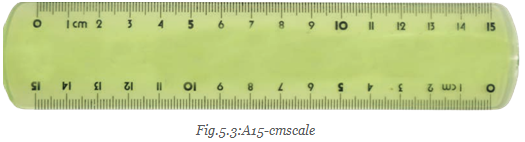

How many millimetres are there in one metre?
Quick recap
- The International System of Units (SI) provides a common standard for measurement.
- The SI unit of length is the metre ().
- and .
- .
- Choose larger units for long distances and smaller units for short lengths.
- Some rulers also show inches; inch .
Correct Way of Measuring Length
Choosing and Placing a Measuring Device
Appropriate measuring device — Choose a scale or tape suited to the object and the length being measured.
- Short, straight lengths: A small ruler, such as a scale, is suitable for a pencil.
- Long lengths: Use a metre scale or measuring tape for something like the height of a room.
- Curved or around-the-body lengths: A flexible tape is suitable for measuring a tree’s girth or chest size because it can bend around the object.
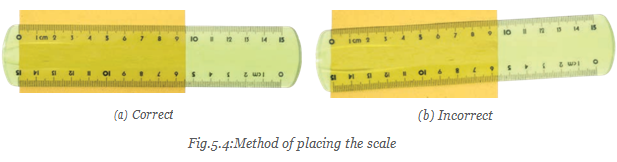
Reading a Scale Correctly
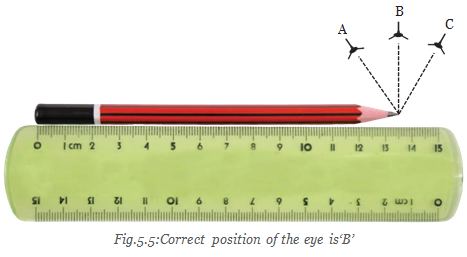
Eye position — Look straight down at the scale mark being read, with your eye directly above the object’s end.
- Avoid parallax error: Viewing the scale mark from an angle can make the reading appear different.
- Correct position: Keep the eye directly above the tip or endpoint.
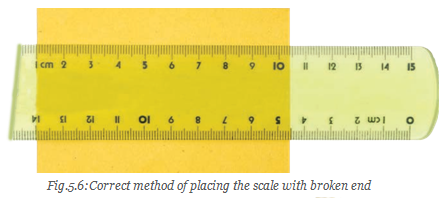
Measuring with a Broken or Unclear Zero Mark
Length from two scale readings — If the zero mark or end of a scale is damaged, measure from another clear mark and subtract its reading from the reading at the object’s other end.
- Method: Record the scale readings at both ends of the object.
- Calculation: Object length = ending reading − starting reading.
- Example: If the readings are and , the length is .
Accessible Measurement and Recording Results
Tactile scale — A scale with raised markings lets visually challenged students feel the marks and measure lengths by touch.

- Record both parts: A measurement consists of a number and a unit.
- Write a space: Put a space between the number and unit, such as .
- Unit names: Write kilometre, metre, centimetre and millimetre in lowercase, except at the beginning of a sentence.
- Unit symbols: Use lowercase , , and . Do not add “s” for plurals or a full stop, except at the end of a sentence.
- Compare measurements: Lengths measured by different students may be the same or slightly different; compare results and consider possible reasons for any differences.
How can you measure an object if the zero mark of the scale is damaged?
Quick recap
- Choose a measuring device suited to the length and shape of the object.
- Place the scale against the object and along its length.
- Read the scale with your eye directly above the endpoint to avoid parallax error.
- With a damaged zero mark, subtract the starting reading from the ending reading.
- Write every measurement with a correctly formatted unit.
- Compare measurements and consider possible reasons if they differ.
Measuring the Length of a Curved Line and Describing Position
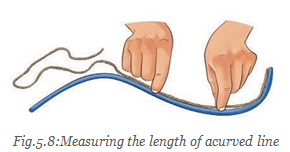
Measuring the Length of a Curved Line
Ways to measure a curved line
- Flexible measuring tape: Place it along the curve and read the length.
- Thread method: Lay a thread along the curve, mark its ends, then straighten it and measure it with a metre scale.
Describing Position
Reference point — A fixed object or point from which a distance or position is described.
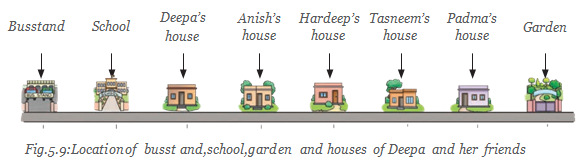
Why a reference point matters
- Different starting points: Distances to the same places can seem different when measured from different houses.
- Same reference point: Describing distances from one shared point, such as a bus stand, gives a common basis for comparison.
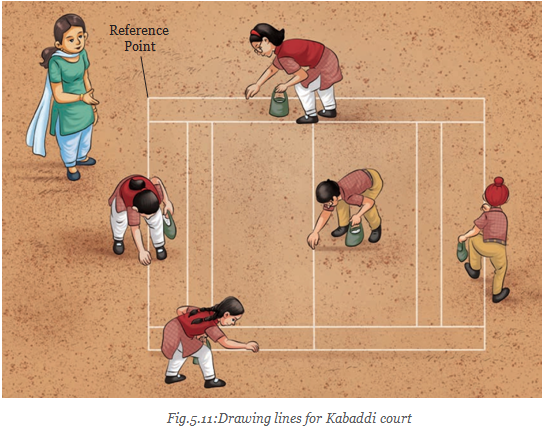
- Example: When marking lines for a Kabaddi court, first choose a point on the ground from which to measure.
Position shown by kilometre stones
- Destination as reference point: A stone marked “Delhi 70 km” means the traveller is 70 km from Delhi.
- Position description: If a later stone reads “Delhi 60 km,” the traveller is then 60 km from Delhi.
- Getting closer: A smaller distance shown from Delhi indicates that the traveller is nearer to Delhi.
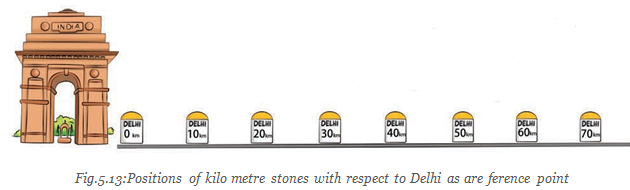
- Always state the reference point when describing a distance or position.
- The kilometre stones give Padma’s distance from Delhi; 70 km followed by 60 km means she is getting closer.
Quick recap
- Measure a curved line with a flexible tape or a thread that is straightened and measured.
- A reference point is the fixed point from which distance or position is described.
- Distances can appear different when they are measured from different starting points.
- Kilometre stones describe distance from a named place used as the reference point.
- A decreasing distance on the stones shows that Padma is getting closer to Delhi.
Moving Things and Types of Motion
Motion and Rest
Motion — An object is in motion if its position changes with time relative to a chosen reference point.
Rest — An object is at rest if its position does not change with time relative to a chosen reference point.
Why the reference point matters
- Reference point is the object or place used to judge whether another object changes position.
- Passengers in a moving bus are at rest relative to the bus, but in motion relative to a building outside.
- Motion and rest are relative: the same object can be at rest relative to one reference point and in motion relative to another.
Types of Motion
| Type | What the object does | Examples |
|---|---|---|
| Linear motion | Moves along a straight-line path. | A falling object or fruit; people marching in a line; a pushed box. |
| Circular motion | Moves along a circular path. | An object whirled on a thread; a merry-go-round. |
| Oscillatory motion | Moves to and fro about a fixed position. | A swing; a released metal strip moving up and down. |
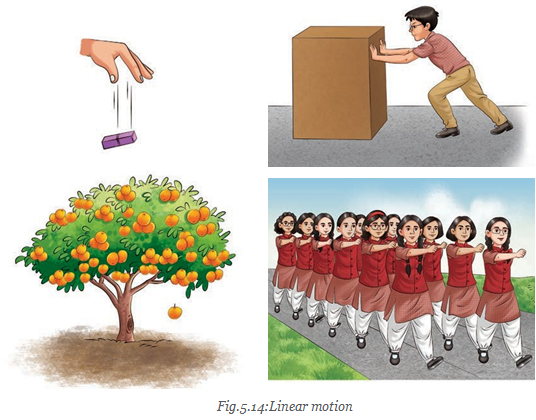
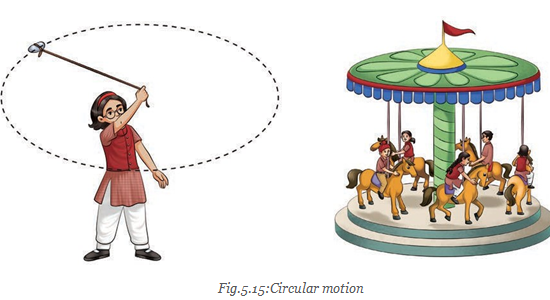
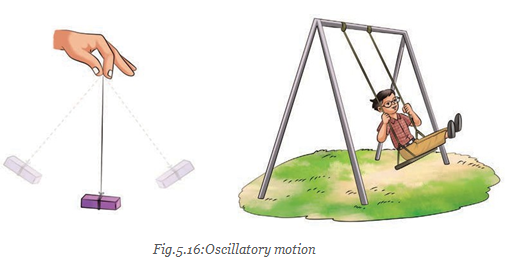
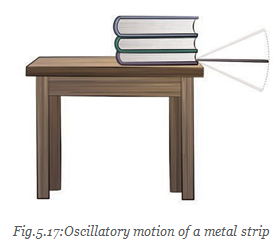
Periodic motion — Motion is periodic when an object repeats its path after a fixed interval of time.
Periodic motion and other types
- Circular motion repeats as the object travels around the same circular path.
- Oscillatory motion repeats as the object moves to and fro.
- Both circular and oscillatory motion are periodic when they repeat after a fixed time interval.
What is the difference between circular and oscillatory motion?
Do not decide that an object is moving or at rest without naming a reference point; its motion can appear different from different reference points.
Quick recap
- Motion means a change in position over time relative to a reference point.
- Rest means no change in position over time relative to a reference point.
- An object can be at rest relative to one point and moving relative to another.
- Linear motion follows a straight line; circular motion follows a circular path.
- Oscillatory motion moves to and fro about a fixed position.
- Circular and oscillatory motions are periodic when they repeat after fixed time intervals.
Keywords and Summary
Standard Units of Length and Their Conversions
Use these relationships to convert between common units of length.
Reference Point and Motion
Reference point — A fixed object or point used to describe an object's position or distance is called a reference point.
Motion — An object is in motion if its position changes with time relative to a reference point.
| Type of motion | Path or movement |
|---|---|
| Linear motion | Movement along a straight line. |
| Circular motion | Movement along a circular path. |
| Oscillatory motion | To-and-fro movement about a fixed position. |
Quick recap
- Countries have adopted the SI system as the standard system of measurement.
- The SI unit of length is the metre, symbol .
- ; ; .
- A reference point is a fixed object or point used to describe position or distance.
- Motion is a change in position over time relative to a reference point.
- Straight-line movement is linear motion; movement along a circular path is circular motion.
- To-and-fro movement about a fixed position is oscillatory motion.
Science — ALL CHAPTERS
1
THE WONDERFUL WORLD OF SCIENCE
2
DIVERSITY IN THE LIVING WORLD
3
MINDFUL EATING: A PATH TO A HEALTHY BODY
4
EXPLORING MAGNETS
5
MEASUREMENT OF LENGTH AND MOTION
6
MATERIALS AROUND US
7
TEMPERATURE AND ITS MEASUREMENT
8
A JOURNEY THROUGH STATES OF WATER
9
METHODS OF SEPARATION IN EVERYDAY LIFE
10
LIVING CREATURES: EXPLORING THEIR CHARACTERISTICS
11
NATURE’S TREASURES
12
BEYOND EARTH