Class 6 . Science . Curiosity . Beyond Earth
Chapter 12: BEYOND EARTH
Ch 12
Science
Class 6
Introduction
Observing the night sky
Why the stars are clearly visible in Nubra
- Clear skies: Nubra has almost cloudless weather and little air or light pollution, making the night sky easy to see.
- Navigation: In ancient times, some stars helped caravans travelling through Nubra find their direction.
- Questions about stars: Yangdol and Dorjay wonder how far away and how large the stars are.
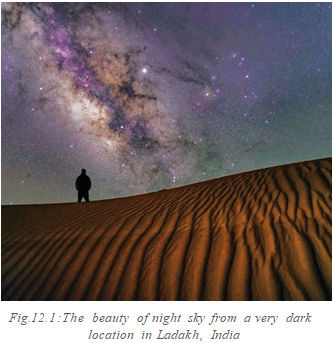
Patterns among stars
Star pattern — A shape imagined by connecting stars in the sky with lines.
What star patterns show
- Imagination: A group of stars may remind an observer of a familiar object or animal.
- Different interpretations: People may imagine different patterns and create different names or stories from the same stars.
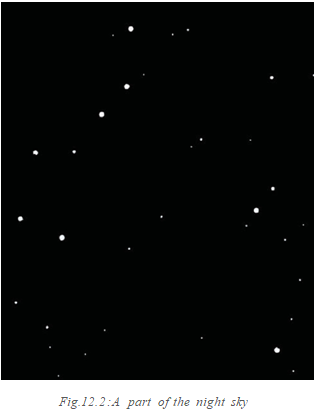
- Star pattern
- An imagined shape formed by connecting stars.
- Navigation
- Finding or following a direction during travel.
Quick recap
- Nubra’s almost cloudless skies and low pollution make stars clearly visible.
- Some stars helped ancient caravans travelling through Nubra find directions.
- Star patterns are imagined by connecting stars with lines.
- Different observers may see different shapes and tell different stories about the same stars.
Stars and Constellations
Stars and Star Patterns
- Stars: They shine with their own light and appear bright or dim in the night sky.
- Star patterns: People imagine lines joining stars to form familiar shapes; recognising these patterns has helped travellers find directions.
Constellations and Their Uses
- Constellations: These are regions of the sky that include groups of stars appearing to form patterns.
- Official boundaries: The International Astronomical Union defined 88 constellations in the early 20th century.
- Use: Recognising star patterns has helped people navigate on land and at sea.
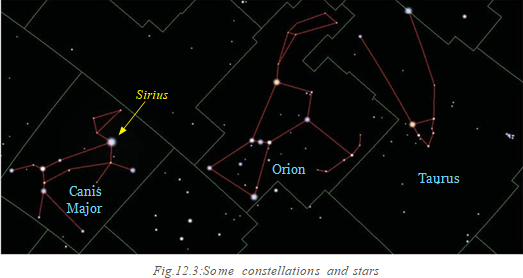
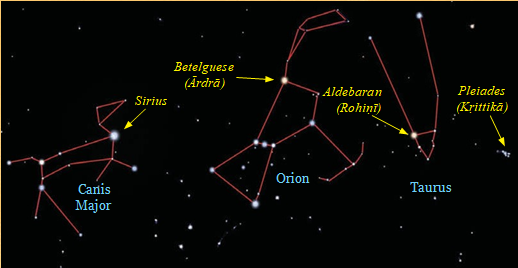
Orion, Canis Major and Taurus
Indian Names for Stars and Star Groups
The Dippers and the Pole Star
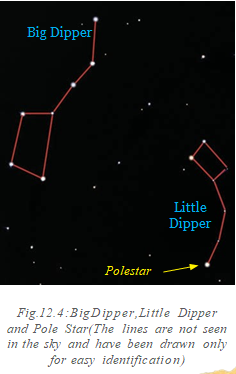
How did people use constellations before modern technology?
How does Polaris help observers in the Northern Hemisphere?
- Sirius is the brightest star in the night sky.
- Polaris is part of the Little Dipper and indicates north in the Northern Hemisphere.
Quick recap
- Stars shine with their own light and can appear to form familiar patterns.
- Constellations are officially defined regions of the sky; the IAU lists 88.
- Star patterns helped people navigate and can still be a backup for finding directions.
- Orion’s three central stars form the hunter’s belt; Sirius is in Canis Major.
- In Indian astronomy, nakshatra can mean a star or a group of stars.
- Polaris appears stationary in the north and helps locate north in the Northern Hemisphere.
Night Sky Watching
Conditions for Viewing the Night Sky
Light pollution — Excessive artificial light at night, which makes it harder to see and study objects in the night sky.
Why some places show fewer stars
- Bright cities: Light pollution, smoke and dust reduce the number of stars we can see.
- Obstructions: Tall buildings and trees can block the view of the sky.
- Best location: Choose an open, dark area away from lights and obstructions.
- Dark sky reserves: Artificial light is controlled in these areas to preserve dark skies for research.
Finding Stars and Constellations
- Visibility varies: Not every star or constellation can be seen from every place on Earth or on every night of the year.
- Pole Star: It is not visible from the Southern Hemisphere.
- Identification: Learn a constellation’s pattern and where to look for it; sky-map apps and online resources can help.
- Examples of apps: Sky Map and Stellarium can help identify stars, constellations and planets.
Preparing for Night Sky Watching
- Choose a place: Use an open, dark location away from lights, tall buildings and trees; go with an adult.
- Choose the time: Check when your chosen star or constellation is visible from your location.
- Choose the night: A clear, moonless night is best, especially for finding the faint Pole Star.
- Bring useful aids: A sky map or constellation images, a magnetic compass for directions, and a notebook for observations may help.
- Allow your eyes to adjust: Wait about half an hour in the dark before observing.
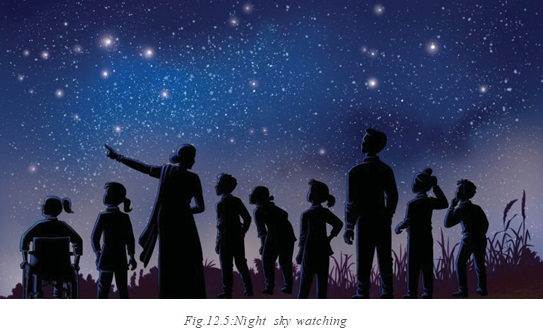
Locating the Big Dipper, Pole Star, Orion and Sirius
| Target | When and where | How to identify |
|---|---|---|
| Big Dipper | Summer, early in the night (around 9 pm); look above the northern horizon. | Identify its distinctive group of stars. |
| Pole Star | Look north after finding the Big Dipper. | Imagine a line through the two stars at the end of the Dipper’s cup. Continue it about five times the distance between those stars to reach the not-very-bright Pole Star. |
| Orion | In India, it is best viewed from December to April, after sunset. | Look for three bright stars in a short straight line near the middle; these form Orion’s belt. |
| Sirius | Look near Orion. | Extend an imaginary line through Orion’s three belt stars towards the east to locate the very bright Sirius. |
The Pole Star is not one of the two end stars of the Big Dipper’s cup; those stars help point towards it.
How can the Pole Star be located using the Big Dipper?
How can Orion and Sirius be found?
Quick recap
- Light pollution, smoke, dust and physical obstructions make fewer stars visible.
- An open, dark location and a clear, moonless night give better views.
- Stars and constellations are not visible from every location or at every time of year.
- Use sky maps or apps such as Sky Map and Stellarium to help identify objects.
- The Big Dipper’s two cup-end stars point towards the Pole Star.
- In India, Orion is best seen from December to April after sunset; its belt helps locate Sirius to the east.
Our Solar System : the Sun
The Sun: Our Nearest Star
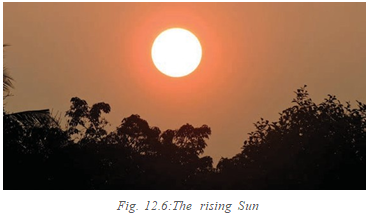
Sun — The Sun is a star and the star closest to Earth; it is a very hot, spherical ball of gases.
Why the Sun Matters
- Energy: The Sun gives out a huge amount of energy as heat and light, making it Earth's main source of energy.
- Life on Earth: The Sun's heat keeps Earth at a temperature suitable for life; sunlight helps plants grow and provide food and oxygen.
- Earth's systems: Solar energy drives climate, seasons, weather, the water cycle and winds.
The Sun's Size and Distance
- Size: The Sun's diameter is about 100 times Earth's diameter.
- Distance: The Sun is about 150 million km from Earth.
- Astronomical unit (au): A unit for distances within the Solar System; 1 au is approximately the distance from the Sun to Earth.
- Apparent size: Although enormous, the Sun looks small because it is very far from Earth.
The Sun and Other Stars
- Why the Sun looks bigger: It is much closer to Earth than other stars, so it appears much bigger and brighter.
- Other stars: They are so far away that they appear as bright points, even though some are larger than the Sun.
- During daytime: The Sun's extreme brightness makes it impossible to see the other stars.
- Nearest star after the Sun: Proxima Centauri is about 269,000 au from Earth—about 269,000 times the Earth–Sun distance.
The Solar System and Revolution
Solar System — The Sun, Earth and some other objects in space together form our Solar System.
Revolution — The movement of an object around the Sun is called revolution.
- Movement: Most objects in the Solar System move around the Sun.
- Key idea: The Sun is a star; it appears especially large and bright because it is much closer to Earth than other stars.
Why does the Sun appear larger and brighter than other stars?
What is an astronomical unit (au)?
Quick recap
- The Sun is a hot, spherical star and the closest star to Earth.
- It supplies heat and light and is Earth's main energy source.
- The Sun's diameter is about 100 times Earth's; it is about 150 million km away.
- One au is approximately the Earth–Sun distance.
- Other stars look like points because they are far away; Proxima Centauri is about 269,000 au away.
- The Sun and other space objects form the Solar System; most move around the Sun, a motion called revolution.
The Planets
What Is a Planet?
Planet — A planet is a large, nearly spherical object that revolves around the Sun.
Planetary motion
- Revolution: Earth takes nearly one year to complete one revolution around the Sun.
- Rotation: Earth also spins about its axis; one full rotation takes about 24 hours, making one day.
- Other planets: Like Earth, they rotate on their axes while revolving around the Sun.
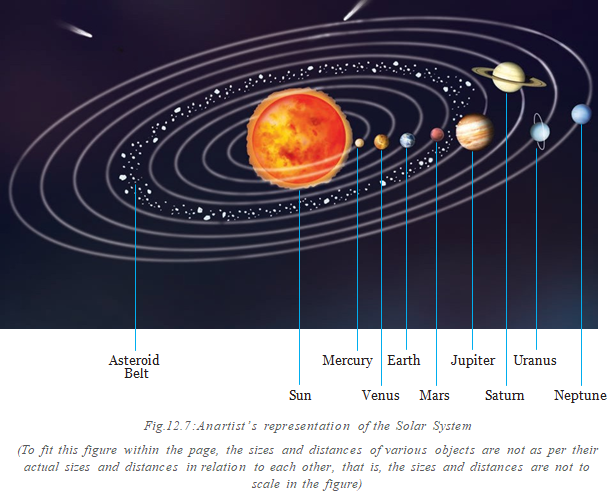
Order and Groups of Planets
| Group | Planets | Main features |
|---|---|---|
| Inner planets | Mercury, Venus, Earth, Mars | Smaller; solid, rocky surfaces. |
| Outer planets | Jupiter, Saturn, Uranus, Neptune | Much larger than Earth; mostly made of gases, with large, flat ring-like structures of dust and rocky material. |
Planet order
My Very Eager Mother Just Served Us Noodles = Mercury, Venus, Earth, Mars, Jupiter, Saturn, Uranus, Neptune.
Planet Appearance and Temperature
| Planet | Common name or appearance | Reason |
|---|---|---|
| Venus | Morning Star or Evening Star | It often appears very bright at dawn or dusk, but it is a planet, not a star. |
| Mars | Red Planet | Its soil is reddish. |
| Earth | Blue Planet | Water covers a large part of its surface, making Earth appear blue from space. |
Distance from the Sun and heat
- General pattern: Planets get most of their energy from the Sun, so more distant planets are generally colder.
- Atmosphere: An atmosphere can trap heat and significantly affect a planet's temperature.
- Example: Venus is hotter than Mercury even though Venus is farther from the Sun, because its atmosphere traps heat.
Dwarf Planets
Dwarf planet — A small object that revolves around the Sun but does not meet the International Astronomical Union's (IAU) definition of a planet.
Pluto
- Location: Pluto revolves around the Sun beyond Neptune and is smaller than Earth's Moon.
- Classification: Pluto was once called a planet; after the IAU redefined the requirements in 2006, it was classified as a dwarf planet, along with similar small objects.
Observing Planets
Planets in the sky
- Venus: The easiest planet to identify because it is very bright. After the Sun and Moon, it is the brightest object in the sky.
- Other naked-eye planets: Mercury, Mars, Jupiter and Saturn can also be seen without instruments; their great distance makes them look like shining dots.
- Finding Venus: It is commonly visible near the eastern direction before sunrise or near the western direction after sunset.
- Planets vs stars: Stars appear to twinkle a lot, unlike planets.
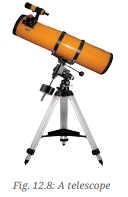
| Point | Naked eye | Binoculars or telescope |
|---|---|---|
| What can be seen | Many sky objects can be viewed directly. | Objects appear brighter and larger; telescopes also help reveal dim objects not visible directly. |
Why is Venus hotter than Mercury although it is farther from the Sun?
How can planets be distinguished from stars in the sky?
Quick recap
- The eight planets revolve around the Sun in the order Mercury, Venus, Earth, Mars, Jupiter, Saturn, Uranus and Neptune.
- The four inner planets are smaller and rocky; the four outer planets are much larger and mostly gaseous.
- Venus, Mars and Earth are called the Morning/Evening Star, Red Planet and Blue Planet respectively, for different reasons.
- Planets farther from the Sun are generally colder, but atmospheres can trap heat; Venus is hotter than Mercury.
- Since the IAU's 2006 redefinition, Pluto is classified as a dwarf planet.
- Venus is the brightest planet; planets can be distinguished from twinkling stars, and telescopes help reveal dim objects.
Natural Satellites : the Moon
Natural Satellites
- Satellites: These are objects that move around planets and are smaller than planets.
- Natural satellites: Moons are the natural satellites of planets.
- Examples: Earth has one moon, Mars has two, and Jupiter, Saturn, Uranus and Neptune have many.
The Moon
Crater — A crater is a circular, bowl-like structure on the Moon’s surface.
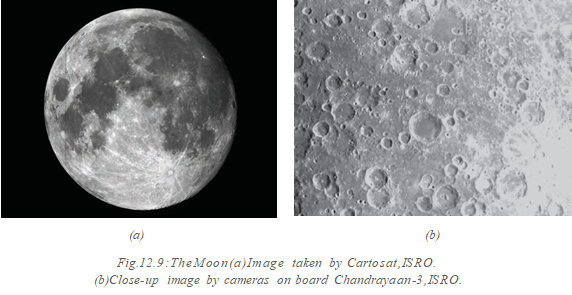
India’s Chandrayaan Missions
Chandrayaan Mission Milestones
- 2008Chandrayaan-1, India’s first Moon mission, was launched.
- 2019Chandrayaan-2 was launched.
- July 2023Chandrayaan-3 was launched.
- August 23, 2023The Vikram lander, carrying the Pragyan rover, successfully soft-landed near the Moon’s little-explored south pole. August 23 was declared National Space Day in India.
- PlannedChandrayaan-4 aims to bring soil and rock samples back from the Moon.
Quick recap
- A satellite moves around a larger object; moons are natural satellites of planets.
- Earth has one Moon, while Mars has two; Jupiter, Saturn, Uranus and Neptune have many moons.
- The Moon is about 384,000 km from Earth, takes about 27 days to orbit Earth and has about one-quarter of Earth’s diameter.
- Lunar craters are mainly impact features; the Moon’s lack of atmosphere, water and life helps them persist.
- Chandrayaan-3’s Vikram lander, carrying Pragyan, soft-landed near the Moon’s south pole on August 23, 2023; India observes this date as National Space Day.
- Chandrayaan-4 is planned to bring lunar soil and rock samples back.
Asteroids & Comets
Asteroids
- Asteroids: Small, rocky objects in the Solar System that have irregular shapes.
- Asteroid belt: Many asteroids orbit the Sun between the paths of Mars and Jupiter.
- Near Earth: Some asteroids occasionally pass very close to Earth.
Comets
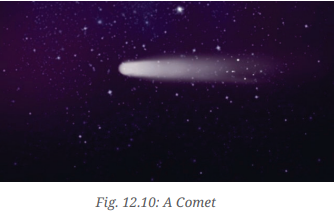
The Solar System
How does a comet’s tail form?
What is the asteroid belt, and where is it found?
Quick recap
- Asteroids are irregular rocky objects; many orbit between Mars and Jupiter.
- Asteroids range from about to in size.
- Comets contain dust, gases, rocks and ice.
- Near the Sun, evaporating frozen material forms a comet’s tail.
- Halley’s Comet returns about every years and last appeared in .
- The Solar System includes the Sun, eight planets, their moons, asteroids, comets and other smaller objects.
- The Sun produces almost all Solar System energy; other objects shine by reflecting its light.
The Milky Way Galaxy & the Universe
The Milky Way Galaxy
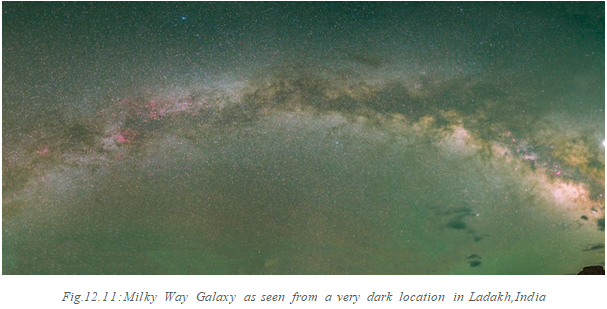
The Universe
What is the Milky Way Galaxy?
What are exoplanets, and what is known about life on them?
Quick recap
- A galaxy contains millions to billions of stars.
- The Milky Way, also called Ākāśha Gangā, is our home galaxy.
- Our Solar System is part of the Milky Way.
- Many galaxies exist beyond the Milky Way in the Universe.
- The search for life focuses largely on exoplanets; no evidence has been found so far.
Keywords and Summary
Stars and Constellations in the Sky
Constellation — A region of the sky containing stars that appear to form a pattern.
Finding North
- Pole Star: Appears stationary in the north and helps people in the Northern Hemisphere locate the north direction.
The Sun and the Planets
Sun — The Sun is a star that produces heat and light.
Planet — A large, nearly spherical object that revolves around the Sun.
Planets in Increasing Distance from the Sun
- Order: Mercury → Venus → Earth → Mars → Jupiter → Saturn → Uranus → Neptune.
- Earth’s revolution: Earth revolves around the Sun in nearly one year.
Satellites and the Solar System
Satellite — An object that moves around a planet.
Moon and Solar System
- Moon: Earth’s natural satellite; it revolves around Earth in nearly 27 days.
- Solar System: The Sun, eight planets, their moons, and smaller objects such as asteroids and comets.
- Milky Way Galaxy: Our Solar System is part of this galaxy.
- Other keywords: Asteroid, comet, draw, explore, identify, observe, revolution, and stars.
Quick recap
- Constellations are sky regions where stars appear to form patterns; the Pole Star helps locate north in the Northern Hemisphere.
- The Sun is a star that produces heat and light.
- The planets in order of increasing distance from the Sun are Mercury, Venus, Earth, Mars, Jupiter, Saturn, Uranus, and Neptune.
- Earth revolves around the Sun in nearly one year; the Moon revolves around Earth in nearly 27 days.
- The Moon is Earth’s natural satellite; satellites move around planets.
- The Solar System includes the Sun, eight planets, their moons, asteroids, and comets, and lies within the Milky Way Galaxy.
Science — ALL CHAPTERS
1
THE WONDERFUL WORLD OF SCIENCE
2
DIVERSITY IN THE LIVING WORLD
3
MINDFUL EATING: A PATH TO A HEALTHY BODY
4
EXPLORING MAGNETS
5
MEASUREMENT OF LENGTH AND MOTION
6
MATERIALS AROUND US
7
TEMPERATURE AND ITS MEASUREMENT
8
A JOURNEY THROUGH STATES OF WATER
9
METHODS OF SEPARATION IN EVERYDAY LIFE
10
LIVING CREATURES: EXPLORING THEIR CHARACTERISTICS
11
NATURE’S TREASURES
12
BEYOND EARTH