Class 7 . Science . Curiosity . Changes Around Us Physical and Chemical
Chapter 5: Changes Around Us: Physical and Chemical
Ch 5
Science
Class 7
Introduction
Changes Around Us
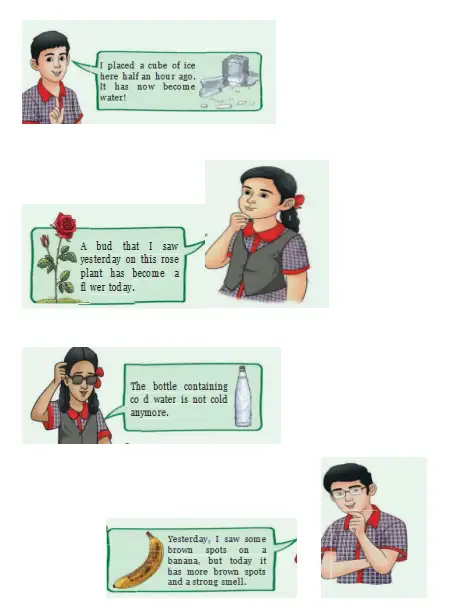
Change — A change occurs when an object or substance becomes different in one or more of its properties.
What can change?
- Properties: Changes may affect an object's size, shape, smell, or another property.
- Examples: Ice melts, a bud blooms, water warms, and brown spots develop on a banana.
- Observing changes: We use sight, smell, touch, hearing, and taste to notice changes around us.
| Examples |
|---|
| Melting ice cubes |
| Chopping vegetables |
| Boiling water |
| Making popcorn from corn |
| Cutting a piece of paper |
| Adding beetroot extract to water |
| Burning wood |
| Drying wet clothes |
| Making small balls of dough |
| Rolling small balls of dough into chapatis |
Quick recap
- A change occurs when an object or substance becomes different in one or more properties.
- Changes may involve size, shape, smell, or another property.
- Examples include melting ice, blooming buds, warming water, and browning bananas.
- Changes can be noticed using sight, smell, touch, hearing, and taste.
A Substance May Change in Appearance but Remain the Same!
Physical Changes
- Physical change: A change in which physical properties such as shape, size, or state change, but no new substance is formed.
- Appearance: The substance may look different while remaining the same material.
- Examples: Folding paper, inflating a balloon, crushing chalk, and changing water from one state to another.
Quick recap
- A physical change affects appearance or physical properties, not the substance’s identity.
- Shape, size and state can change in a physical change.
- Folding paper changes its shape, but it remains paper.
- Crushed chalk remains chalk even if it is hard to restore to its original shape.
- A physical change does not form a new substance.
A Substance May Change in Appearance and Not Remain the Same!
Chemical Change
Chemical change — A change in which one or more new substances are formed.
- Chemical reaction: The process through which new substances are formed.
- Water: Blowing air into water creates bubbles, but its appearance does not change.
- Lime water: Blowing air into it makes it milky; a white solid may settle at the bottom, indicating a new substance.
- Bubbles alone: Bubbling does not prove that a chemical change has occurred.
Lime Water Test for Carbon Dioxide
Lime water — Lime water is a solution of calcium hydroxide; it turns milky when carbon dioxide reacts with it.
- Cause: Carbon dioxide in exhaled air reacts with calcium hydroxide in lime water.
- Product: Insoluble calcium carbonate forms, making the liquid cloudy or milky; some may settle as a white solid.
- Test: Turning lime water milky is used to identify carbon dioxide.
Vinegar, Baking Soda, and Carbon Dioxide
- Reactants: Vinegar or lemon juice reacts with baking soda (sodium hydrogen carbonate).
- Evidence: The mixture fizzes and releases gas bubbles.
- Gas test: Passing the gas through lime water turns it milky, showing that the gas is carbon dioxide.
- Conclusion: Formation of carbon dioxide and other substances means the reaction is a chemical change.
- Word equation: Vinegar + baking soda → carbon dioxide + other substances.
Baking Soda and Water
- Note: Baking soda dissolves in water without forming bubbles or a new substance; this is a physical change.
Why does lime water turn milky when carbon dioxide is passed through it?
How can the gas formed from vinegar and baking soda be identified?
Quick recap
- A chemical change forms one or more new substances.
- Bubbles alone do not prove that a chemical change has occurred.
- Carbon dioxide turns lime water milky by forming insoluble calcium carbonate.
- Vinegar and baking soda react to produce carbon dioxide and other substances.
- Mixing baking soda with water produces no bubbles and is a physical change because no new substance forms.
Some Other Processes Involving Chemical Changes
Rusting
Combustion and the Need for Oxygen
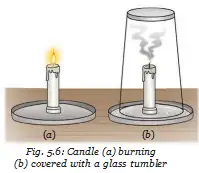
Oxygen supports combustion
- Oxygen supply: A candle covered by a glass tumbler goes out after using up the available oxygen; an uncovered candle keeps burning.
- Carbon dioxide test: Carbon dioxide produced during burning turns limewater milky.
- Conclusion: Oxygen from air is needed for combustion.
Fire safety and biological light
- Clothes on fire: Wrap the person in a blanket or cloth to cut off air and extinguish the flames.
- Warning: Never use a synthetic blanket or cloth; it may melt and stick to the skin.
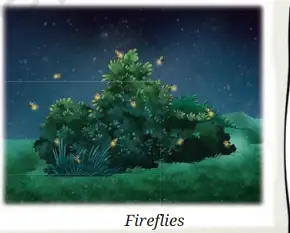
- Bioluminescence: Light produced by a chemical change in living organisms without heat; fireflies are an example.
Ignition Temperature and the Fire Triangle
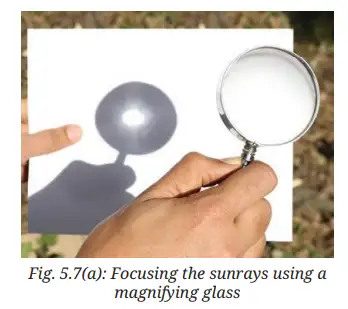
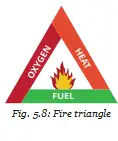
What three conditions are necessary for combustion?
How can carbon dioxide be identified?
Quick recap
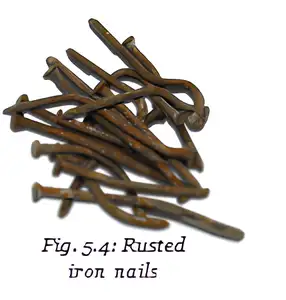
- Rusting forms a new brown substance, iron oxide, so it is a chemical change.
- Combustion is a reaction with oxygen that releases heat and/or light.
- Oxygen supports combustion; carbon dioxide can be tested with limewater, which turns milky.
- Bioluminescence is light produced without heat by living organisms, such as fireflies.
- Ignition temperature is the minimum temperature at which a substance catches fire.
- Combustion requires fuel, oxygen and sufficient heat.
Can Physical and Chemical Changes Occur in the Same Process?
Candle Burning
Candle burning — Burning a candle involves both physical changes in the wax and a chemical change when wax vapour burns.
Changes as a Candle Burns
- Heat from the flame melts the solid wax; melted wax moves up the wick.
- The wax evaporates near the flame, forming wax vapour.
- Wax vapour burns and produces the flame.
| Change | Type | What happens |
|---|---|---|
| Melting of wax | Physical | Solid wax becomes liquid wax. |
| Evaporation of wax | Physical | Liquid wax forms vapour due to the flame's heat. |
| Solidification of wax | Physical | Wax can become solid again on cooling. |
| Burning of wax vapour | Chemical | Wax vapour burns and produces a flame. |
Do not classify the whole candle-burning process as only physical or only chemical: wax changing state is physical, while wax vapour burning is chemical.
How does burning a candle show that physical and chemical changes can occur in the same process?
Quick recap
- A burning candle involves both physical and chemical changes.
- Wax melts, moves up the wick and evaporates due to heat.
- Melting, evaporation and solidification of wax are physical changes.
- Burning of wax vapour is a chemical change.
- The flame's heat causes wax to evaporate; the vapour then burns.
Are Changes Permanent?
Reversible and Irreversible Changes
Reversible change — A change is reversible if the original object or substance can be brought back.
Examples
- Melting and freezing: Melted ice can be refrozen into ice.
- Evaporation and condensation: Water vapour can condense back into liquid water.
- Boiling water: The liquid water can be recovered by condensing its vapour.
Irreversible change — A change is irreversible if the original object or substance cannot be brought back.
| Change | Reversible? | Reason or example |
|---|---|---|
| Melting ice cubes | Yes | Water can be refrozen into ice. |
| Boiling water | Yes | Water vapour can be condensed back into liquid water. |
| Chopping vegetables | No | The original size and shape cannot be restored. |
| Making popcorn from corn | No | The original corn form cannot be restored. |
Quick recap
- A change is reversible when the original state can be restored.
- Melting ice and boiling water are reversible changes.
- Freezing and condensation can return materials to earlier states.
- A change is irreversible when the original form cannot be recovered.
- Chopping vegetables and making popcorn are irreversible changes.
Are All Changes Desirable?
Desirable and Undesirable Changes
Desirable change — A change considered useful or beneficial in a particular situation.
Undesirable change — A change considered unwanted or harmful in a particular situation.
| Desirable changes | Undesirable changes |
|---|---|
| Milk changing into curd; fruit ripening; cutting fruit; cooking food | Rusting of iron; food decay during storage |
A Change Can Be Useful or Harmful
- Context matters: Whether a change is desirable depends on the situation and its effects.
- Food decomposition: Food decay is undesirable during storage, but decomposition is useful when food waste is converted into compost.
Long-term Environmental Effects
- Human activities: Changes caused by people over many years can have long-term environmental impacts.
- Fuel use: Greater consumption of fuels by cars, trains and aeroplanes increases the amount of carbon dioxide in the atmosphere.
- Drying paint: Paint drying on walls, doors and furniture releases substances through evaporation; these can cause atmospheric pollution.
How can food decomposition be both undesirable and useful?
Quick recap
- Desirability depends on the situation and the effects of a change.
- Curd formation, fruit ripening, cutting fruit and cooking food are desirable changes.
- Iron rusting and food decay during storage are undesirable changes.
- Food decomposition can be useful for making compost.
- Greater fuel use increases atmospheric carbon dioxide.
- Substances released as paint dries can cause atmospheric pollution.
Some Slow Natural Changes
Weathering of Rocks
Weathering — The physical and chemical changes that break rocks down and eventually help form soil.
Types and effects
- Physical weathering: Temperature changes, growing tree roots, and water freezing in rock cracks can break rocks into smaller pieces.
- Chemical weathering: Water or chemicals dissolved in water can react with rocks and change their composition.
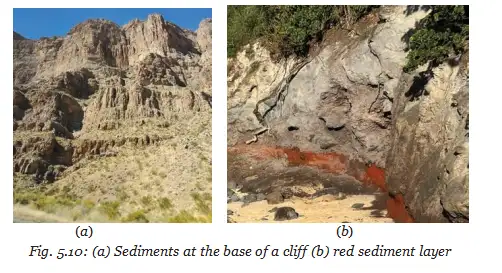
- Basalt example: Iron-containing black basalt can develop a red surface layer after long exposure to water or moist air; the red colour is due to iron oxide.
- Result: Rock fragments collect as sediments, often at the base of mountains; weathering eventually contributes to soil formation.
| Type | Cause or process | Effect |
|---|---|---|
| Physical weathering | Temperature changes, roots, or freezing water | Breaks rocks into smaller pieces |
| Chemical weathering | Water or chemicals react with rocks | Changes the rock's composition |
Erosion and Formation of New Rocks
Erosion — The breaking down and movement of rocks, soil, and sediments from one place to another by natural forces such as wind and flowing water.
Key points
- Agents: Wind and flowing water carry rock fragments, soil, and sediments from one place to another.
- Examples: Erosion during a landslide is a physical change; continuous erosion by flowing water makes river rocks and pebbles smoother.
- Deposition: When wind or water slows, such as in a lake or ocean, transported material settles at the bottom.
- New rocks: Settled sediments harden over time and become new rocks.
- Time and reversibility: Most of these natural changes take thousands of years and cannot be reversed.
| Point | Weathering | Erosion |
|---|---|---|
| Main process | Breaks rocks down | Moves broken material from one place to another |
| Main result | Rock fragments that can contribute to soil | Transported material that may settle as sediments |
From Rock to New Rock
- Weathering breaks rocks into smaller pieces.
- Erosion transports the pieces by wind or flowing water.
- Slower wind or water allows the material to settle as sediments.
- Sediments harden over time and form new rocks.
How does basalt develop a red surface layer during weathering?
How can transported sediments form new rocks?
Quick recap
- Weathering includes physical and chemical changes that break down rocks and contribute to soil formation.
- Temperature changes, roots, and freezing water can cause physical weathering.
- Water or chemicals can change rock composition; iron oxide can make basalt surfaces red.
- Erosion carries broken rock, soil, and sediments by wind or flowing water.
- Transported material settles when wind or water slows, and sediments can harden into new rocks.
- Most of these natural changes take thousands of years and cannot be reversed.
Summary
Physical and Chemical Changes
- Physical changes: Change physical properties without forming a new substance.
- Chemical changes: Form one or more new substances through a chemical reaction.
Combustion
- Combustion: A chemical change in which a substance reacts with oxygen and produces heat and/or light.
- Examples: Burning wood, paper, cotton, or kerosene; burning magnesium forms magnesium oxide.
- Requirements: Combustion needs a fuel, oxygen, and enough heat to reach the fuel’s ignition temperature.
Reversibility and Desirability
- Reversibility: Some changes can be reversed to restore the original substance or object, while others cannot.
- Desirability: Changes may be useful or undesirable depending on their effects and situation.
Weathering and Erosion
- Weathering: Physical and chemical processes break rocks into smaller pieces and eventually help form soil.
- Causes: Temperature changes, plant roots, freezing water, and water or chemicals can weather rocks.
- Erosion: Wind and flowing water break down and transport rock, soil, and sediments from one place to another.
- Sediments: Transported materials settle when wind or water slows; they can harden over time and form new rocks.
Quick recap
- A physical change alters physical properties without forming a new substance.
- A chemical change forms one or more new substances through a reaction.
- Combustion is a chemical change that gives out heat and/or light.
- Ignition temperature is the lowest temperature at which a substance catches fire.
- Changes may be reversible or irreversible, and desirable or undesirable.
- Weathering changes rocks physically and chemically to help form soil; erosion by water or wind is physical.
Science — ALL CHAPTERS
1
The Ever-Evolving World of Science
2
Exploring Substances: Acidic, Basic, and Neutral
3
Electricity: Circuits and their Components
4
The World of Metals and Non-metals
5
Changes Around Us: Physical and Chemical
6
Adolescence: A Stage of Growth and Change
7
Heat Transfer in Nature
8
Measurement of Time and Motion
9
Life Processes in Animals
10
Life Processes in Plants
11
Light: Shadows and Reflections
12
Earth, Moon, and the Sun