Class 7 . Science . Curiosity . The World of Metals and Non Metals
Chapter 4: The World of Metals and Non-metals
Ch 4
Science
Class 7
Introduction
Metals in everyday objects
A village ironsmith’s work
- Iron is used to make everyday objects such as pans, buckets, tongs and farming tools.
- Examples of tools include spades, axes, trowels and rakes.
- Other materials are used too: wood for handles and coal to heat iron in the furnace.
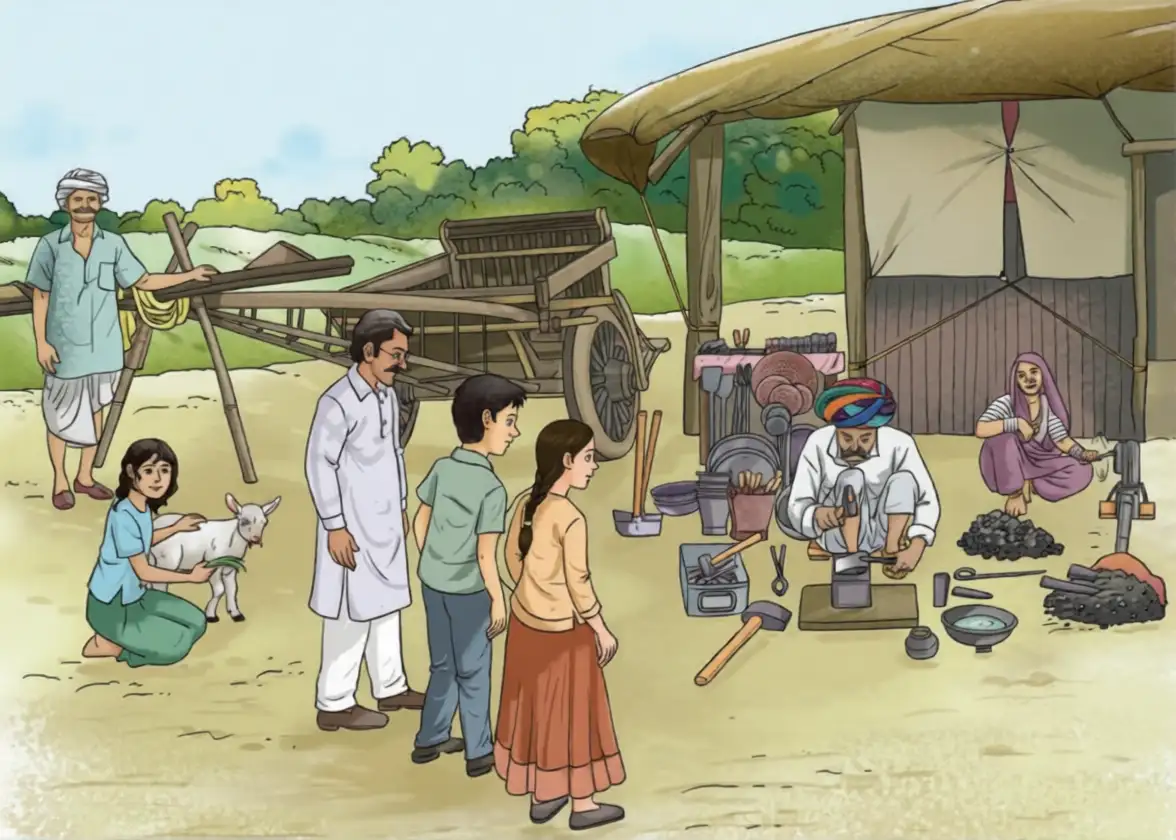
Heating and shaping iron
How an iron object is shaped
- Heating makes the iron block red-hot in the furnace.
- Hammering the hot iron lets the craftsperson shape it—for example, into an axe.
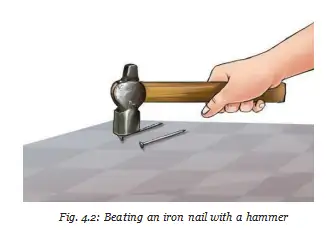
- Key idea: Iron can be beaten into a different shape, including a flat shape.
How does an ironsmith shape iron into an object such as an axe?
Quick recap
- Iron is used to make household objects and farming tools.
- Wood may be used for handles, while coal heats the iron in a furnace.
- An ironsmith heats iron until red-hot and hammers it into the required shape.
- The ability to beat iron into shape is a key property explored in this chapter.
Properties of Materials – Malleability, Ductility
Metals and their properties
Metallic lustre — The lustre shown by metals is called metallic lustre.
Typical material properties
- Metals: Copper, aluminium and iron are typically lustrous and hard.
- Non-metals: Coal, sulfur and wood are non-lustrous and generally not as hard as metals.
- Exceptions: Sodium and potassium are soft enough to cut with a knife; mercury is liquid at room temperature.
Malleability
Malleability — The property by which a material can be beaten into thin sheets is called malleability.
| Material | Effect of hammering | Property |
|---|---|---|
| Copper, aluminium, iron | Flatten into sheets | Malleable |
| Coal, sulfur | Break into pieces | Brittle |
| Wood | Neither flattens into a sheet nor breaks into pieces | Neither malleable nor brittle |
Examples and key points
- Metals: Most metals are malleable; copper, aluminium and iron can be flattened by hammering.
- Everyday examples: Thin silver foil on sweets and aluminium foil used to wrap food are metal sheets.
- Most malleable: Gold and silver are the most malleable metals.
Iron and the progress of civilisation in India
- Harappans: They used metals such as copper and gold for objects including utensils and jewellery; there is little evidence of their use of iron.
- Later use: Iron became prominent later and its strength made tools such as ploughs superior to earlier tools, supporting agricultural progress.
Ductility
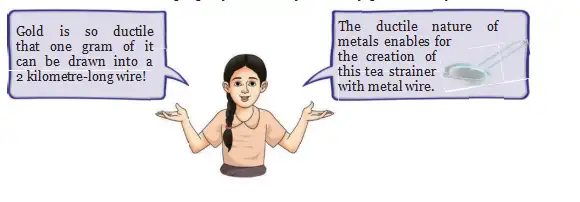
Ductility — The property by which a material can be drawn into wires is called ductility.
Ductility in everyday life
- Metals: Ductility is mainly possessed by metals; copper and aluminium are commonly drawn into wires.
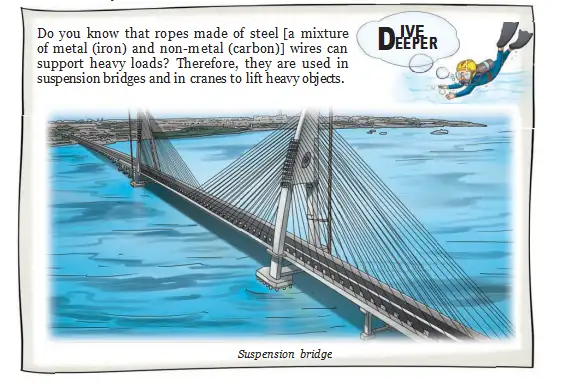
- Uses: Metal wires are used in electrical fittings, ornaments and stringed instruments such as the veena, sitar, violin and guitar.
- Non-metals: Coal and sulfur are not ductile, so they cannot be drawn into wires.
Quick recap
- Copper, aluminium and iron are typically lustrous, hard and malleable.
- Malleability is the ability to be beaten into thin sheets; gold and silver are the most malleable metals.
- Coal and sulfur are brittle, while wood is neither malleable nor brittle.
- Ductility is the ability to be drawn into wires; it is mainly a property of metals.
- Copper and aluminium wires are used in electrical fittings; coal and sulfur are not ductile.
- Iron's strength made tools such as ploughs useful in later agricultural development.
Properties of Materials – Sonority, Conduction of Heat & Electricity
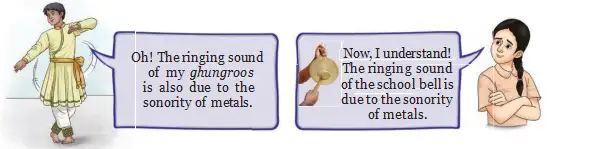
Sonority
Conduction of Heat
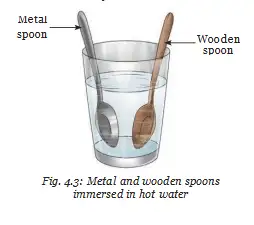
Heat Conduction: Key Comparison
- Observation A metal spoon becomes hotter at its upper end than a wooden spoon immersed in the same hot water for the same time.
- Conclusion Heat travels along the metal spoon more readily; wood transfers heat poorly.
Conduction of Electricity
| Type | Examples | Tester result |
|---|---|---|
| Good conductors | Aluminium foil, iron nail, copper wire | Bulb glows |
| Poor conductors | Sulfur, coal, dry wood, stone, rubber eraser, nylon rope | Bulb does not glow |
Electrical Safety
- Insulating materials Plastic screwdriver handles and rubber gloves are poor conductors.
- Protection These materials help protect electricians from electric shock by limiting the flow of electricity.
- Metals are generally hard, lustrous, malleable, ductile, sonorous and good conductors of heat and electricity.
What is sonority?
Why are metal vessels used for cooking, but their handles may be made of wood?
Why do electricians use plastic-covered screwdriver handles and rubber gloves?
Quick recap
- Sonority is the ringing sound produced by metals when struck or dropped.
- Conduction is the transfer of heat through a material.
- Metals generally conduct heat well; wood conducts heat poorly.
- Aluminium, iron and copper conduct electricity in the tester examples.
- Rubber, plastic and several other tested materials are poor electrical conductors.
- Poor conductors such as wood and rubber are useful for reducing heat or electrical transfer.
Effect of Air and Water on Metals: Iron
Rusting of Iron
| Condition | Water present? | Air present? | Rust forms? |
|---|---|---|---|
| Dry air only | No | Yes | No |
| Water only | Yes | No | No |
| Both air and water | Yes | Yes | Yes |
Corrosion of Metals
- Corrosion: The gradual deterioration of a metal’s surface due to air, water, or other substances.
- Examples: Iron develops rust, copper can form a green coating, and silver can develop a black coating.
Preventing Rusting
- Protective coatings: Painting, oiling, or greasing iron helps keep air and moisture away from its surface.
- Galvanisation: Coating iron with zinc helps protect it from rusting.
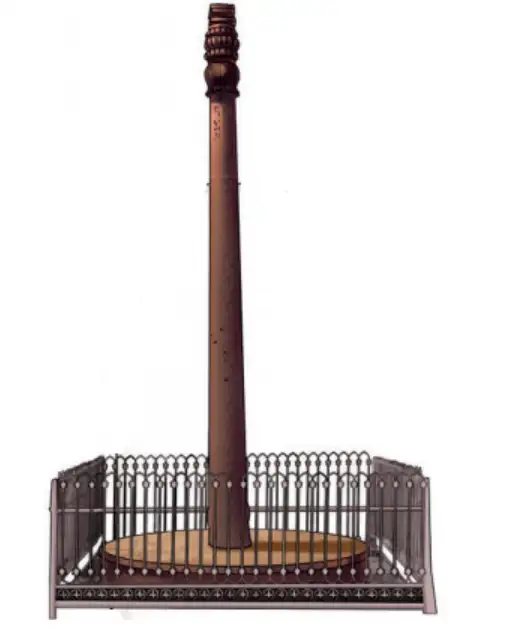
The Iron Pillar of Delhi
What conditions are necessary for iron to rust?
What is corrosion? Give two examples.
Quick recap
- Rust is the brown deposit formed on iron.
- Both air and water are required for iron to rust.
- Corrosion is the gradual deterioration of metals; copper may turn green and silver may turn black.
- Painting, oiling, greasing, and galvanisation can prevent rusting.
- The Iron Pillar of Delhi, made in Chandragupta II's time, is over 1,600 years old and has barely rusted.
Effect of Air and Water on Other Metals
Magnesium and Air
Magnesium reacting with oxygen
- Reaction: Magnesium burns in air with a dazzling white flame and forms a white powder, magnesium oxide.
- Product: Magnesium oxide forms when magnesium combines with oxygen in the air.
Metal Oxides and Water
Nature of metal oxides
- Magnesium oxide: When mixed with water, it forms a basic solution that turns red litmus blue.
- General rule: Oxides of metals are generally basic; sodium oxide is therefore expected to be basic.
Sodium and Its Storage
Why sodium is stored in kerosene
- Reactivity: Sodium reacts vigorously with both oxygen and water, generating a lot of heat.
- Storage: It is kept in kerosene to prevent contact with air and moisture.
Quick recap
- Magnesium burns in air with a dazzling white flame.
- The white product, magnesium oxide, forms when magnesium reacts with oxygen.
- Magnesium oxide mixed with water forms a basic solution and turns red litmus blue.
- Metal oxides are generally basic; sodium oxide is expected to be basic.
- Sodium reacts vigorously with oxygen and water, producing a lot of heat.
- Kerosene keeps sodium away from air and moisture.
Substances that Behave Differently from Metals in Air and Water
Sulfur in Air and Water
Non-metals: Properties and Examples
Phosphorus and Air
- Storage: Phosphorus is stored in water because it catches fire when exposed to atmospheric air.
Elements and Materials
- Elements: Metals and non-metals are categories of elements, distinguished by their properties.
- Materials: An object or material is not necessarily an element; many materials are made from substances or mixtures.
- Not metals or non-metals: Plastic, glass, wood, rubber, and paper are not classified as metals or non-metals because they are not elements.
Quick recap
- Burning sulfur in oxygen forms sulfur dioxide.
- Sulfur dioxide dissolves in water to form acidic sulfurous acid, but sulfur itself does not react with water.
- Phosphorus is stored in water because it catches fire in atmospheric air.
- Non-metals are usually soft and dull, non-malleable, non-ductile, non-sonorous and poor conductors of heat and electricity.
- Non-metal oxides are acidic; examples of non-metals include sulfur, phosphorus, oxygen, hydrogen, nitrogen and carbon.
- Metals and non-metals are categories of elements; 118 elements are known, some natural and some made artificially.
- Plastic, glass, wood, rubber and paper are not elements, so they are neither metals nor non-metals.
Are Non-metals Essential in Everyday Life?
Importance of Non-metals
- Essential to life: Non-metals such as oxygen and carbon are vital for living things.
- Everyday importance: Non-metals also support plant growth, water purification, and wound care.
Metals, Alloys and Their Uses
- Alloys: Mixtures of two or more metals, or of a metal and a non-metal.
- Everyday uses: Metals and alloys are used to make utensils and tools and are important in many industries.
- Modern technology: Zirconium is used in atomic energy, while titanium is used in aerospace.
- Recycling: Recycling metals such as iron and aluminium helps reduce waste and support sustainability.
Quick recap
- Oxygen is essential for breathing and survival.
- Carbon is a building block of life and occurs in proteins, fats and carbohydrates.
- Nitrogen supports plant growth and is used to make fertilisers and other chemicals.
- Chlorine purifies water; iodine solution is used as an antiseptic.
- An alloy is a mixture of two or more metals, or a metal and a non-metal; metals and alloys are used in utensils, tools, technology and industry.
- Zirconium is used in atomic energy, titanium in aerospace, and iron and aluminium are recycled in India to minimise waste and support sustainability.
Summary
Properties and Reactions of Metals and Non-metals
Key points
- Classification: Metals and non-metals are distinguished by their physical and chemical properties.
- Appearance: Metals are generally lustrous; most non-metals are non-lustrous.
- Shape: Metals are generally malleable and ductile; non-metals usually lack these properties.
- Conductivity: Metals conduct heat and electricity well; non-metals are generally poor conductors.
- Reaction with oxygen: Metal + oxygen → metal oxide; non-metal + oxygen → non-metal oxide.
- Nature of oxides: Metal oxides are generally basic, while non-metal oxides are generally acidic.
- Reaction with water: Non-metals generally do not react with water.
- Corrosion: Damage to metal objects exposed to moist air is called corrosion.
- Uses: Metals and non-metals have many applications in everyday life.
Quick recap
- Metals are generally lustrous; most non-metals are non-lustrous.
- Metals are generally malleable and ductile; non-metals usually lack these properties.
- Metals conduct heat and electricity well; non-metals are generally poor conductors.
- Metals react with oxygen to form generally basic oxides; non-metals react with oxygen to form generally acidic oxides.
- Non-metals generally do not react with water.
- Damage to metals exposed to moist air is called corrosion.
- Metals and non-metals have many everyday applications.
Science — ALL CHAPTERS
1
The Ever-Evolving World of Science
2
Exploring Substances: Acidic, Basic, and Neutral
3
Electricity: Circuits and their Components
4
The World of Metals and Non-metals
5
Changes Around Us: Physical and Chemical
6
Adolescence: A Stage of Growth and Change
7
Heat Transfer in Nature
8
Measurement of Time and Motion
9
Life Processes in Animals
10
Life Processes in Plants
11
Light: Shadows and Reflections
12
Earth, Moon, and the Sun