Class 7 . Science . Curiosity . Measurement of Time and Motion
Chapter 8: Measurement of Time and Motion
Ch 8
Science
Class 7
Introduction
Motion and timing
- Timing races: A stopwatch measures the time taken in a race; highly precise timing can distinguish runners finishing almost together.
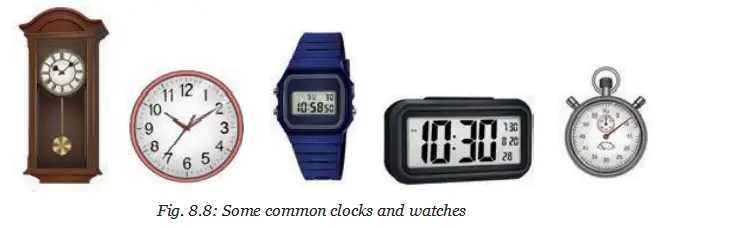
- Timekeeping devices: Clocks, wristwatches, mobile phones, Braille watches and talking watches help people check the time.
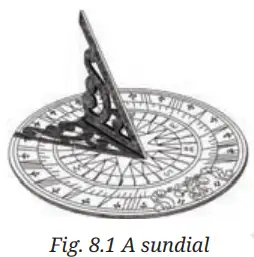
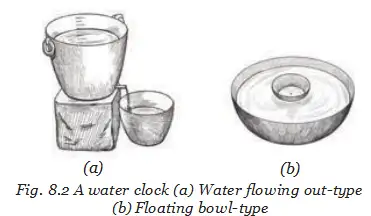
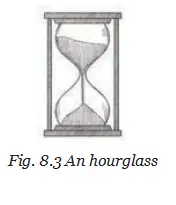
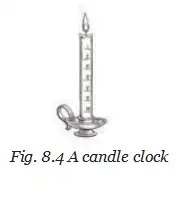
- Early methods: People used repeating natural events and devices such as sundials, water clocks, hourglasses and candle clocks to measure time.
- Modern clocks: Quartz and atomic clocks use regularly repeating processes to measure time with great accuracy.
Quick recap
- Running along a track is an example of motion.
- Race timing measures how long runners take to finish.
- Precise timing can separate runners in a close finish.
- A stopwatch is commonly used to time races.
- Time can be checked using devices such as clocks, watches and mobile phones.
- Braille and talking watches provide accessible ways to check the time.
Measurement of Time
Natural Cycles and Timekeeping
Natural cycle — A natural cycle is an event that repeats after a definite interval and can be used to keep track of time.
Early timekeeping
- Natural cycles: People used the rising and setting of the Sun, phases of the Moon and changing seasons to track time.
- Calendars: Early calendars were based on recurring natural events.
- A day: It was defined by one cycle of the Sun rising and setting.
- Within a day: People developed devices to measure shorter intervals.
Early Time-Measuring Devices
| Device | Principle | Key detail |
|---|---|---|
| Sundial | The Sun casts a shadow whose position changes during the day. | The shadow’s position indicates the time. |
| Outflow water clock | Water flows out of a vessel marked with time divisions. | Its flow rate decreases as the water level drops, reducing accuracy. |
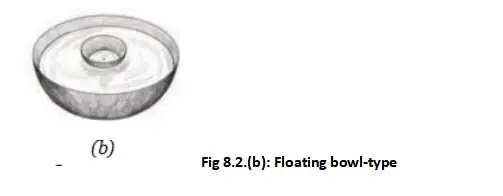
| Floating-bowl water clock | A bowl with a fine hole gradually fills while floating on water. | It sinks after a fixed interval, then can be lifted and floated again. |
| Hourglass | Sand flows from one bulb into another. | The flow measures a set interval. |
| Candle clock | A marked candle burns down. | The markings show the passage of time. |
Sundials and Water Clocks in India
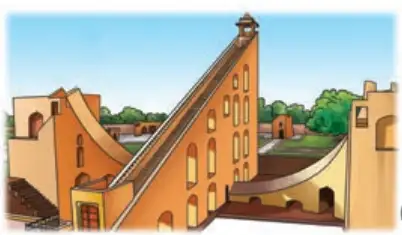
Samrat Yantra
- Location: The world’s largest stone sundial, the Samrat Yantra, stands at Jantar Mantar in Jaipur, Rajasthan.
- Scale and precision: Built around 300 years ago, it is 27 m high; its shadow moves about 1 mm per second and its scale measures intervals as short as 2 seconds.
- Time shown: Like other sundials, it gives local solar time, which must be corrected to obtain Indian Standard Time.
Historical use of water clocks
- Shadow-based timekeeping: The earliest reference in India appears in Kautilya’s *Arthasastra*, composed and revised between the 2nd century BCE and 3rd century CE.
- Shadow measurement: Around 530 CE, Varahamihira gave an accurate way to express time using the shadow of a vertical stick.
- Outflow clocks: These were described in the *Arthasastra*, *Sardulakarnavadana* and other early CE texts; their changing flow rate made them less accurate.
- Ghatika-yantra: The sinking-bowl clock, developed to improve accuracy, was first mentioned by Aryabhata and later appeared in astronomical texts.
- Use and signals: Ghatika-yantras kept time in monasteries, palaces and town squares; each sinking was announced with drums, conch shells or a gong.
- Later use: Pendulum clocks progressively replaced them in the late 19th century, though Ghatika-yantras continued to be used for religious rituals.
Mechanical and Pendulum Clocks
Development of mechanical timekeeping
- Need for precision: Long-distance travel made reliable time measurement increasingly important.
- Mechanical clocks: From the 14th century onward, clocks increasingly used weights, gears and springs.
- Pendulum breakthrough: The pendulum clock marked a major advance in the 17th century.
- Invention: Christiaan Huygens invented the pendulum clock in 1656 and patented it in 1657, inspired by Galileo Galilei’s investigations of pendulums.
- Pendulum observation: For a pendulum of a given length, the time for one complete oscillation is the same.
How does a floating-bowl water clock measure time?
Why was the sinking-bowl clock more accurate than an outflow water clock?
Who invented the pendulum clock, and when?
Quick recap
- Recurring natural events such as the Sun’s cycle, Moon phases and seasons helped people track time.
- Sundials, water clocks, hourglasses and candle clocks measured intervals within a day using different physical processes.
- A sundial gives local solar time; the Samrat Yantra can measure intervals as short as 2 seconds.
- The Ghatika-yantra was a sinking-bowl water clock used widely in India, including for religious rituals.
- Mechanical clocks using weights, gears and springs developed from the 14th century onward.
- Huygens invented the pendulum clock in 1656 and patented it in 1657; a pendulum’s period is constant for a given length.
A Simple Pendulum
Parts and Motion of a Simple Pendulum
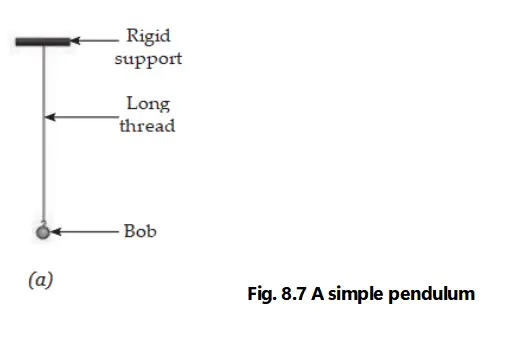
Simple pendulum — A small bob suspended from a rigid support by a long thread, free to move to and fro.
Parts and positions
- Bob: The small metallic ball or other heavy object attached to the thread.
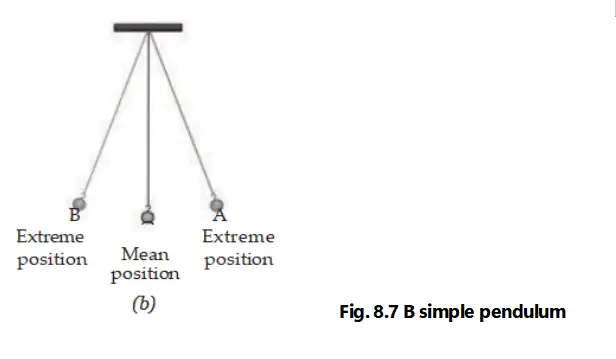
- Mean position: The bob’s resting position, labelled .
- Extreme positions: The farthest positions on either side of the mean position, labelled and .
Oscillatory and periodic motion
- Oscillatory motion: When displaced slightly to one side and released, the bob moves to and fro about its mean position.
- Periodic motion: The pendulum’s motion repeats the same path after a fixed time interval.
Oscillation and Time Period
One oscillation — One complete to-and-fro motion of the bob, returning to its starting position after reaching both extremes.
Recognising one complete oscillation
- From the mean position: is one oscillation.
- From an extreme position: is also one oscillation.
Time period — The time taken by a pendulum to complete one oscillation.
Measure the time for several oscillations and divide by their number; for oscillations, divide the measured time by .
What the symbols mean
- : Time period; : total time measured; : number of oscillations.
What Affects the Time Period?
Dependence on length and mass
- Length matters: The time period depends on the length of the pendulum.
- Bob’s mass does not matter: For the same length, changing the bob’s mass does not change the time period.
- At a given location: Pendulums of the same length have the same time period.
Do not confuse one-way travel with one oscillation: a full oscillation returns the bob to its starting position after it reaches both extremes.
Pendulums and Timekeeping
Repeating processes in clocks
- Use in time measurement: A pendulum of a given length has a constant time period at a place, making it useful for measuring time.
- Basic clock principle: Old and modern clocks use a process that repeats continuously to mark equal time intervals.
- Modern clocks: Quartz clocks use rapid vibrations of a quartz crystal; atomic clocks use specific atoms.
- Accuracy: Huygens’ early pendulum clocks could gain or lose about seconds per day; atomic clocks lose only about second in millions of years.
What is the time period of a simple pendulum?
Does the bob’s mass affect a simple pendulum’s time period?
Quick recap
- A simple pendulum has a bob suspended from a rigid support by a long thread.
- One oscillation is a complete to-and-fro motion that returns the bob to its starting position.
- Time period is the time for one oscillation; calculate it by dividing total time by the number of oscillations.
- A pendulum’s time period depends on its length, not the bob’s mass, at a given location.
- Clocks use continuously repeating processes; quartz and atomic clocks use rapid vibrations.
SI Unit of Time
Time Units and Their Symbols
Second — The second is the SI unit of time; its symbol is .
- Larger units: A minute has symbol , and an hour has symbol .
Writing Time Correctly
- Lowercase: Write unit names and symbols in lowercase, except when a unit name begins a sentence.
- Singular symbols: Symbols do not change for plural quantities; write , and .
- Punctuation: Do not put a full stop after a unit symbol unless it ends the sentence.
- Spacing: Leave a space between the number and unit, as in .
- Incorrect forms: Use , not “sec”; use , not “hrs”.
Measuring Short Time Intervals
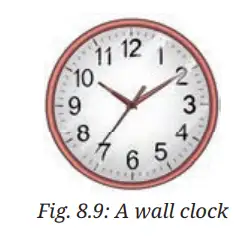
- Wall clock: An analogue clock with hour, minute and second hands can measure intervals as short as .
- Sports: Timing devices can record to one-hundredth or one-thousandth of a second to decide race winners.
- Millisecond: One millisecond is one-thousandth of a second; ECG machines measure tiny heartbeat variations in milliseconds.
- Music: Digital recordings capture sound thousands of times per second for smooth playback.
- Microsecond: One microsecond is one-millionth of a second; smartphones and computers process signals in microseconds.
- Precision: More accurate clocks support applications in space exploration, medicine and scientific experiments.
Traditional Timekeeping: Ghati
Ghati (ghatika) — A traditional time unit measured using a Ghatika-yantra.
- Measurement: The bowl of the Ghatika-yantra took to fill and sink; this interval was one ghati.
- Day division: A -hour day was divided into equal ghatis.
- Use: The ghati remained a standard time unit until the end of the nineteenth century.
What is the SI unit of time, and how is it converted to minutes and hours?
Quick recap
- The SI unit of time is the second, symbol .
- and .
- Write time units in lowercase, singular symbols, and leave a space between the number and unit.
- An analogue wall clock with a second hand measures intervals down to .
- One millisecond is one-thousandth of a second; one microsecond is one-millionth of a second.
- A ghati was , and ghatis made a -hour day.
Slow or Fast
Comparing How Fast Objects Move
Speed — Speed tells how fast an object is moving.
How to compare speed
- Same time: The object that covers more distance in a given time interval is moving faster.
- Less distance: An object covering less distance in the same time is moving slower.
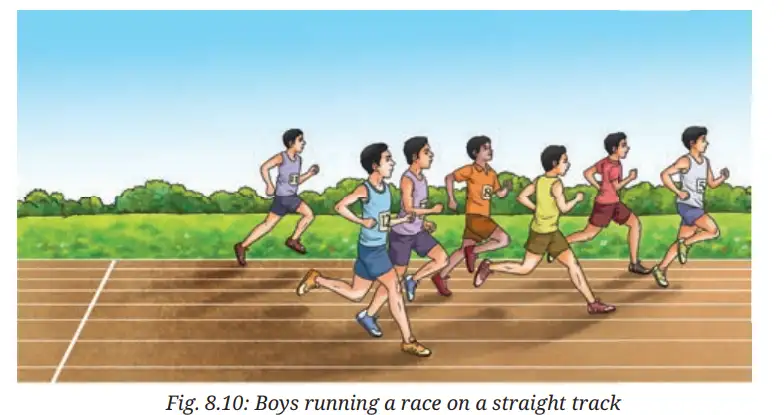
- Race example: If runners start together, the runner farther ahead at a given instant has covered more distance and is running faster.
- Compare distances covered during the same time interval to decide which object is faster.
Quick recap
- Speed describes how fast an object moves.
- Compare objects over the same time interval.
- More distance in the same time means greater speed.
- Less distance in the same time means lower speed.
- In a race, a runner farther ahead has covered more distance since the shared start.
Speed
Meaning and Calculation of Speed
Speed — Speed is the distance an object covers in a unit of time.
- Comparing motion: For the same time interval, the object covering more distance has the greater speed.
- Calculation: Find speed by dividing the total distance covered by the total time taken.
Here, is speed, is distance covered, and is time taken.
Units of Speed
- SI unit: Since speed is distance divided by time, its SI unit is metre per second, written as .
- Other unit: If distance is measured in kilometres and time in hours, speed is expressed in kilometres per hour, written as .
- Unit consistency: Use matching distance and time units in the calculation, or convert them before dividing.
Worked Example: Bicycle Speed
- Given: Swati cycles in .
- Convert units: and .
- Calculate: .
Comparing Speeds
- Train speeds: Calculate each train’s speed between two stations using the distance travelled and time taken.
- Fastest train: The train with the greatest speed covers the maximum distance per unit time.
Quick recap
- Speed is distance covered per unit time.
- Calculate speed by dividing total distance by total time.
- The SI unit of speed is ; another common unit is .
- Convert distance and time to compatible units before calculating speed.
- The object with the greatest speed covers the most distance in the same time.
Relationship between Speed, Distance, and Time
Speed — Speed is the distance travelled by an object per unit time.
Use when the total distance and total time are known.
Use when speed and time are known.
Use when distance and speed are known.
Applying the relationship
- Bus journey: At for , distance = .
- Train journey: At over , time = .
- Units: Keep units consistent; for example, use distance in kilometres with speed in kilometres per hour to get time in hours.
Average speed — Average speed is the total distance covered divided by the total time taken.
Speed may change during a journey
- Changing motion: An object may move faster at some times and slower at others.
- Calculated speed: When based on the whole journey, the result is the average speed, even if the object's speed varied.
Instruments in Vehicles
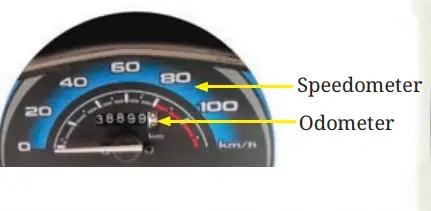
| Instrument | What it measures | Usual display/unit |
|---|---|---|
| Speedometer | Speed of the vehicle | km/h |
| Odometer | Distance travelled by the vehicle | kilometres |
| Point | Same speed throughout | Speeding up or slowing down |
|---|---|---|
| Motion | The runner maintains the same speed over the stretch. | The runner's speed changes during the stretch. |
| Speed for the whole stretch | Average speed matches the steady speed. | Average speed is calculated from total distance and total time. |
What distance does a bus cover at in ?
What is the difference between a speedometer and an odometer?
Quick recap
- Speed = total distance ÷ total time.
- Distance = speed × time.
- Time = distance ÷ speed.
- Speed calculated for a whole journey is its average speed; the object's speed may vary during that journey.
- A speedometer displays speed, usually in km/h; an odometer measures distance travelled in kilometres.
- Runners who maintain the same speed move differently from those who speed up or slow down.
Uniform and Non-uniform Linear Motion
Linear Motion
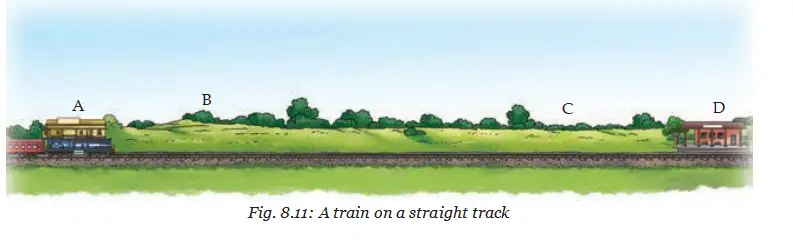
Uniform and Non-uniform Linear Motion
Non-uniform linear motion — An object moving in a straight line with changing speed is in non-uniform linear motion.
| Time interval | Train X distance (km) | Train Y distance (km) |
|---|---|---|
| 10:00–10:10 AM | 20 | 20 |
| 10:10–10:20 AM | 20 | 15 |
| 10:20–10:30 AM | 20 | 15 |
| 10:30–10:40 AM | 20 | 25 |
| 10:40–10:50 AM | 20 | 20 |
| 10:50–11:00 AM | 20 | 25 |
| Point | Train X | Train Y |
|---|---|---|
| Distance in equal intervals | Covers 20 km in every 10-minute interval | Covers varying distances in 10-minute intervals |
| Type of motion | Uniform linear motion | Non-uniform linear motion |
Motion in everyday life
- Idealisation: Uniform linear motion is an ideal case; objects seldom maintain constant speed over long distances or periods.
- Practical use: Average speeds are therefore used to describe motion over a journey.
How can you identify uniform linear motion from distances measured over equal time intervals?
Which train shows uniform linear motion from 10:00 AM to 11:00 AM, and why?
Quick recap
- Linear motion is motion along a straight line.
- Uniform linear motion has constant speed and equal distances in equal time intervals.
- Non-uniform linear motion has changing speed and unequal distances in equal time intervals.
- Train X is uniform; Train Y is non-uniform over the given hour.
- Uniform motion is an idealisation in everyday life, so average speeds are often used.
Summary
Time and the Pendulum
- Measuring time: People developed ways to measure time, from early clocks to modern devices, using repeating processes to mark intervals.
- Standard unit: The SI unit of time is the second, symbolized by s.
Speed and Linear Motion
Divide the total distance by the total time.
| Type | Description |
|---|---|
| Uniform linear motion | Motion along a straight line at constant speed. |
| Non-uniform linear motion | Motion along a straight line with changing speed. |
Quick recap
- A pendulum’s time period is the time for one complete oscillation.
- For a given pendulum length, its time period is constant at a particular place.
- The SI unit of time is the second ().
- Average speed = total distance ÷ total time.
- Constant speed in a straight line is uniform linear motion; changing speed is non-uniform linear motion.
Science — ALL CHAPTERS
1
The Ever-Evolving World of Science
2
Exploring Substances: Acidic, Basic, and Neutral
3
Electricity: Circuits and their Components
4
The World of Metals and Non-metals
5
Changes Around Us: Physical and Chemical
6
Adolescence: A Stage of Growth and Change
7
Heat Transfer in Nature
8
Measurement of Time and Motion
9
Life Processes in Animals
10
Life Processes in Plants
11
Light: Shadows and Reflections
12
Earth, Moon, and the Sun