Class 7 . Science . Curiosity . Earth Moon and the Sun
Chapter 12: Earth, Moon, and the Sun
Ch 12
Science
Class 7
Introduction
Changing Shadows and the Sun’s Apparent Motion
Observation and question
- Morning: Coconut tree shadows can be long.
- Afternoon: The shadows may be shorter than in the morning.
- Apparent motion: The Sun seems to move across the sky during the day.
- Question: Does the Sun move across the sky, or does Earth’s motion explain its apparent movement? Earth moves around the Sun.
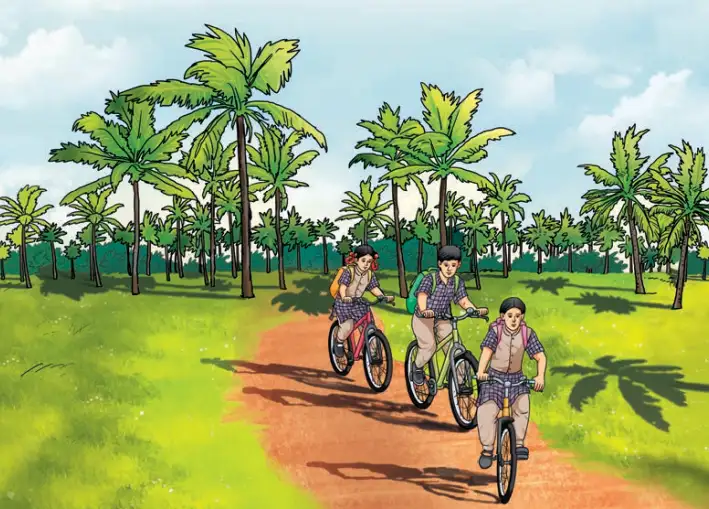
- Key idea: Changes in shadow length prompt questions about the Sun’s apparent motion and Earth’s motion around the Sun.
Quick recap
- Tree shadows can be long in the morning and shorter in the afternoon.
- The Sun appears to move across the sky during the day.
- Earth moves around the Sun.
- These observations raise a question about the Sun’s apparent motion and Earth’s motion.
Rotation of the Earth Part-1
Why the Sun Appears to Move
Apparent movement of the Sun
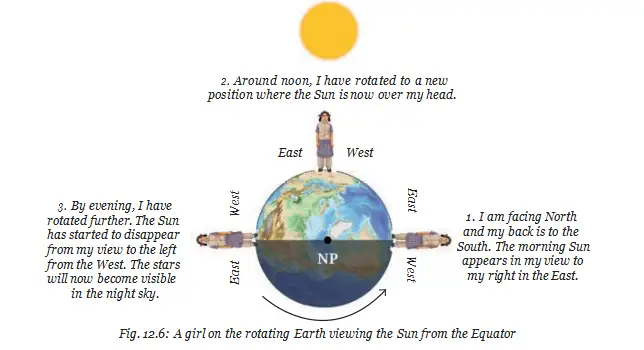
- Daily appearance: The Sun appears to rise in the East, move across the sky, and set in the West.
- Cause: The Sun appears to move because we observe it from the rotating Earth.
- Merry-go-round analogy: When you rotate anti-clockwise, nearby objects appear to move clockwise in the opposite direction.
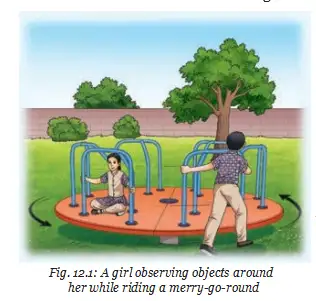
Earth’s Rotation
Rotation — The motion of an object in which all its parts move in circles around an imaginary line passing through it.
Earth’s axis and direction
- Axis of rotation: The imaginary line through which an object rotates; Earth’s axis passes through the geographic North and South Poles.
- Direction: Earth rotates from West to East; viewed from above the North Pole, it turns anti-clockwise.
- Time taken: Earth completes one rotation in about 24 hours.
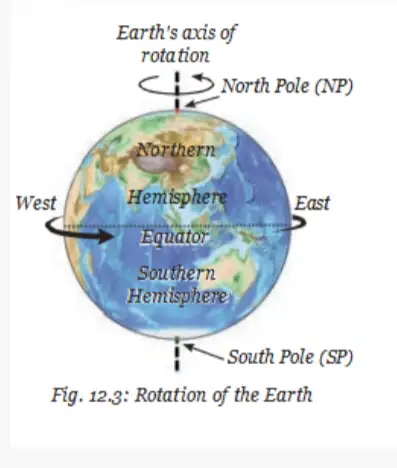
How Rotation Causes Day and Night
The day–night cycle
- Sunlit half: The half of Earth facing the Sun receives light and experiences daytime.
- Dark half: The half facing away from the Sun does not receive direct sunlight and experiences night.
- Rotation’s role: As Earth rotates from West to East, a location moves into sunlight and then into darkness.
- Sunrise and sunset: Sunrise occurs as a location moves into the lit half; sunset occurs as it moves into the dark half.
- East first: In India, the eastern parts experience sunrise before the western parts because Earth rotates from West to East.
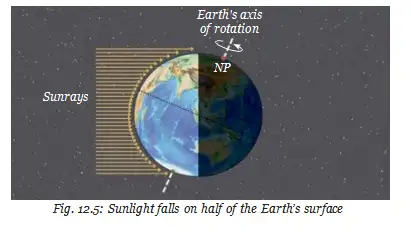
Do not conclude that the Sun’s apparent daily movement means it travels across the sky around Earth; Earth’s rotation causes this appearance.
What causes the apparent daily movement of the Sun?
How does Earth’s rotation cause day and night?
Quick recap
- Earth’s rotation is its spinning motion around an imaginary axis through the North and South Poles.
- Earth rotates from West to East and completes one rotation in about 24 hours.
- Viewed from above the North Pole, Earth rotates anti-clockwise.
- The Sun’s apparent east-to-west movement is caused by Earth’s rotation.
- The side of Earth facing the Sun has day; the side facing away has night.
- A location experiences sunrise as it moves into sunlight and sunset as it moves into darkness.
Rotation of the Earth Part-2
Apparent Motion of the Sun
Evidence of Earth’s Rotation
- Foucault pendulum: A long pendulum provides a simple demonstration of Earth’s rotation.
Apparent Motion of Stars and the Moon
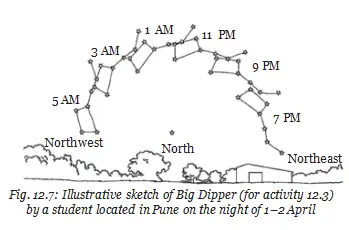
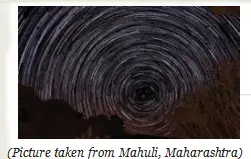
Star trails — Arcs recorded in long-exposure photographs, showing the apparent motion of stars across the sky.
Aryabhata’s Explanation
The Sun and stars do not circle Earth each day; their daily apparent motion is caused by Earth’s rotation from west to east.
Quick recap
- Earth rotates from west to east.
- The Sun and Moon appear to rise in the east and set in the west.
- The Pole Star appears nearly stationary; other stars seem to move around it.
- Long-exposure photographs record apparent star motion as star trails.
- Aryabhata’s stated rotation time was about 23 hours, 56 minutes, and 4.1 seconds.
Revolution of the Earth
Earth’s Revolution and Orbit
- Yearly motion: Earth’s journey around the Sun is distinct from its daily rotation.
- Effects: Earth’s yearly motion is linked to changes in the night sky and the cycle of seasons.
Changing View of the Night Sky
- Annual changes: Earth’s changing position as it travels around the Sun leads to changes in the stars seen after sunset over the year.
- Seasonal cycle: The chapter also explains how Earth’s motion and orientation relate to recurring seasons.
How Earth’s Tilt Causes Seasons
| Time | Northern Hemisphere | Southern Hemisphere |
|---|---|---|
| June | Tilted towards the Sun; more intense sunlight and longer days; summer | Tilted away from the Sun; less intense sunlight and shorter days; winter |
| December | Tilted away from the Sun; less intense sunlight and shorter days; winter | Tilted towards the Sun; more intense sunlight and longer days; summer |
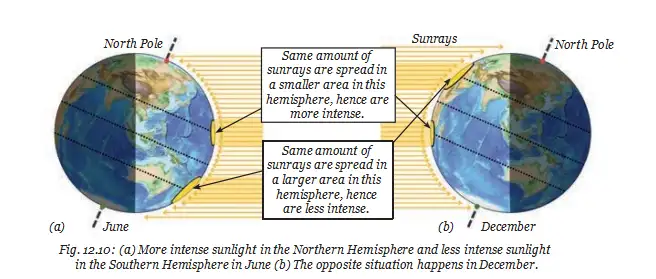
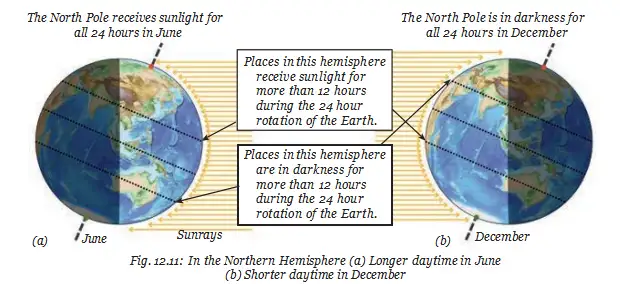
Seasons are not caused by one hemisphere being closer to the Sun, or by Earth’s changing distance from the Sun. Earth is closest to the Sun in January, so distance cannot explain the Northern Hemisphere’s summer in June.
Solstices and Equinoxes
- Summer solstice: Around 21 June, the Northern Hemisphere has its longest day and shortest night.
- Winter solstice: Around 22 December, the Northern Hemisphere has its shortest day and longest night.
- Equinoxes: Around 21 March and 23 September, day and night are each about 12 hours long; these are the spring and autumn equinoxes in the Northern Hemisphere.
Daylight at the Poles and Equator
Why do seasons occur on Earth?
What are the solstices and equinoxes in the Northern Hemisphere?
Quick recap
- Earth revolves around the Sun in a nearly circular orbit, taking about 365 days and 6 hours.
- Revolution changes which star patterns are visible at night over the year.
- Earth’s axial tilt and spherical shape cause seasons by changing sunlight intensity and daylight length.
- The Northern and Southern Hemispheres have opposite seasons.
- Solstices mark the longest and shortest days; equinoxes have about 12 hours of day and night.
- The poles experience long periods of daylight and darkness, while the equator has about 12 hours of each year-round.
Eclipses - Solar eclipse
What Is a Solar Eclipse?
Solar eclipse — An event in which the Moon comes between the Sun and Earth and blocks some or all of the Sun’s light from reaching parts of Earth.
- Alignment: A solar eclipse occurs when the Moon is positioned between the Sun and Earth.
- Apparent size: An object’s apparent size depends on its actual size and its distance from the observer.
- Why the Moon can cover the Sun: The Moon is much smaller than the Sun but much closer to Earth, so they appear similar in size in the sky.
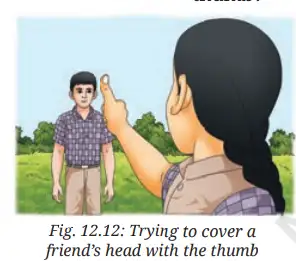
- Mercury and Venus: Though larger than the Moon, they are much farther from Earth and appear too small to cover the Sun.
- Transit of Venus: Venus can pass between the Sun and Earth, appearing as a tiny black dot on the Sun’s bright face; this is rare.
Total and Partial Solar Eclipses
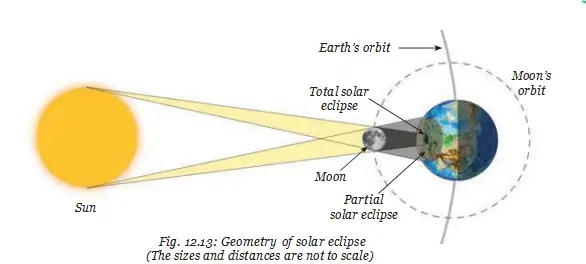
| Type | What observers see |
|---|---|
| Total solar eclipse | In the area covered by the Moon’s shadow, the Sun is completely hidden and no part of it can be seen. |
| Partial solar eclipse | The Moon blocks only part of the Sun, so some of the Sun remains visible. |
- Duration: During totality, it becomes dark during the day for a few minutes because sunlight is blocked from reaching that area.
- Moving shadow: Earth’s rotation and the Moon’s orbital motion move the Moon’s shadow across Earth, so totality lasts only briefly at a given place.
- Eclipse sequence: As the Moon moves away from the Sun’s face, the total eclipse becomes partial and daylight returns.
Safe Viewing and Understanding Eclipses
- Never look directly at the Sun during an eclipse: its intense light can damage the eyes and cause blindness.
- Do not use ordinary sunglasses, binoculars, or telescopes to view the Sun.
- Safer option: Attend an eclipse-viewing event run by astronomy organisations, which provide specialised eye protection and explanations.
- Past beliefs: Before the cause of eclipses was understood, people feared them and associated them with restrictions such as not eating, cooking, or going outside.
- Scientific understanding: Eclipses are natural events; scientists observe them to study phenomena that may otherwise be difficult to observe.
- Names and texts: An eclipse is called *grahan* in Sanskrit and many Indian languages. The *Surya Siddhanta*, written in classical Sanskrit poetic verses, includes calculations for predicting eclipses.
Why can the Moon cover the Sun during a solar eclipse?
What is the difference between a total and a partial solar eclipse?
How should a solar eclipse be viewed safely?
Quick recap
- A solar eclipse happens when the Moon moves between the Sun and Earth and blocks sunlight.
- The Moon can cover the Sun because their apparent sizes in the sky are similar.
- A total eclipse hides the entire Sun; a partial eclipse hides only part.
- The Moon’s moving shadow makes totality last only a few minutes at a place.
- Never view the Sun directly, even during an eclipse.
- The *Surya Siddhanta* contains calculations for predicting eclipses.
Eclipses - Lunar eclipse
How a Lunar Eclipse Occurs
- Alignment: A lunar eclipse occurs when Earth comes between the Sun and the Moon, blocking sunlight from reaching the Moon.
- Earth’s shadow: The shadow falls on the full Moon, making its disc appear dark.
- Total eclipse: When the Moon is completely inside Earth’s shadow, it may appear dark red.
- Partial eclipse: When only part of the Moon enters Earth’s shadow, the rest of the Moon remains visible.
- Safe viewing: An eclipsed Moon can be viewed safely with the naked eye.
Quick recap
- A lunar eclipse happens when Earth blocks sunlight from reaching the Moon.
- During the eclipse, Earth is between the Sun and the full Moon.
- A total lunar eclipse occurs when the Moon is entirely in Earth’s shadow.
- A partial lunar eclipse occurs when only part of the Moon enters Earth’s shadow.
- A totally eclipsed Moon can appear dark red.
- It is safe to watch an eclipsed Moon with the naked eye.
Science — ALL CHAPTERS
1
The Ever-Evolving World of Science
2
Exploring Substances: Acidic, Basic, and Neutral
3
Electricity: Circuits and their Components
4
The World of Metals and Non-metals
5
Changes Around Us: Physical and Chemical
6
Adolescence: A Stage of Growth and Change
7
Heat Transfer in Nature
8
Measurement of Time and Motion
9
Life Processes in Animals
10
Life Processes in Plants
11
Light: Shadows and Reflections
12
Earth, Moon, and the Sun