Class 7 . Science . Curiosity . Light Shadows and Reflections
Chapter 11: Light: Shadows and Reflections
Ch 11
Science
Class 7
Introduction
Light and the Moon
Luminous object — An object that emits its own light.
Non-luminous object — An object that does not emit its own light; it may be seen by reflecting light from another source.
| Object type | Meaning | Examples |
|---|---|---|
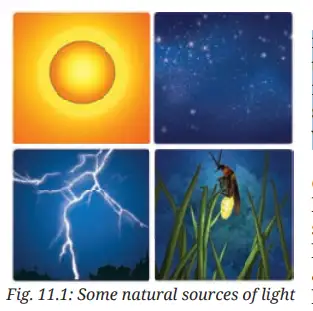
| Luminous | Emits its own light | Sun, stars, lightning, natural fire, fireflies |
| Non-luminous | Does not emit its own light | Moon; it reflects sunlight |
Sources of Light
Natural and artificial sources
- Sun: The main source of natural light on Earth.
- Other natural sources: Stars, lightning, natural fire and certain animals, such as fireflies, emit their own light.
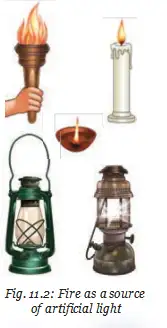
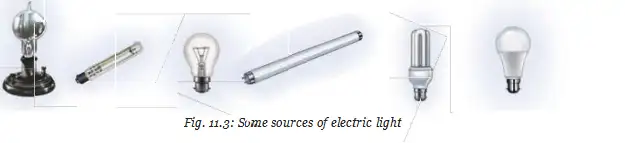
- Artificial lighting: Humans first used fire, then fuels such as animal fat, oil, wax and gas; electricity later enabled many kinds of lamps and bulbs.
Fireflies and light pollution
- Communication: Fireflies use their light to communicate and are seasonal insects.
- Declining numbers: Light pollution, reduced forest cover and excessive tourism contribute to fewer fireflies.
LED Lamps and Responsible Use
- LED advantages: LED lamps consume less power, are brighter and last longer than traditional lamps; they can reduce electricity bills and environmental impact.
- Disposal: At the end of their life, LED lamps should be properly disposed of or recycled, not thrown in the garbage.
- Promotion: The Indian government has made substantial efforts to promote LED use nationwide.
Quick recap
- Luminous objects emit their own light; non-luminous objects do not.
- The Sun is the main source of natural light on Earth; the Moon reflects sunlight.
- Natural light sources include stars, lightning, natural fire and certain animals such as fireflies.
- Artificial lighting developed from fire and fuel lamps to electric lights.
- Fireflies use light to communicate; pollution, forest-cover loss and excessive tourism contribute to their decline.
- LED lamps use less power, are brighter and last longer; dispose of or recycle them responsibly.
Does Light Travel in a Straight Line?
Straight-Line Travel of Light
Straight-line propagation of light — Light travels along a straight path.
Evidence for straight-line travel
- Aligned holes: Light from a torch passes through three holes when they lie in one straight line; shifting one box out of line blocks the light spot.
- Straight pipe: A candle flame can be seen through a straight hollow pipe, but not through a bent pipe.
- Laser beam: A laser beam made visible in water with a drop of milk follows a straight path.
Do not conclude that light can never bend: it generally travels straight, though it can sometimes bend around corners.
Explain the aligned-holes or straight-pipe observation as evidence that light travels in a straight line.
What do the aligned-hole and bent-pipe observations show?
Safety
- Candle: Use a lighted candle only under adult supervision.
- Laser: Use only under teacher supervision; avoid high-power lasers and never point a beam at anyone’s eyes.
Quick recap
- Light travels in a straight line.
- Light passes through holes only when they are aligned along its path.
- A candle flame is visible through a straight pipe but not a bent pipe.
- A laser beam made visible in water follows a straight path.
- Light can sometimes bend around corners.
Light through Transparent, Translucent, and Opaque Materials
How Materials Affect Light
- Transparent materials: Let almost all light pass through them.
- Translucent materials: Let some light pass through them.
- Opaque materials: Do not let light pass through them.
Quick recap
- Transparent materials let almost all light pass through.
- Translucent materials let some light pass through.
- Opaque materials do not let light pass through.
- Examples: Glass is transparent; tracing paper is translucent; cardboard is opaque.
- An opaque object in the path of light blocks the light and can form a shadow on a screen.
Shadow Formation
How a Shadow Forms
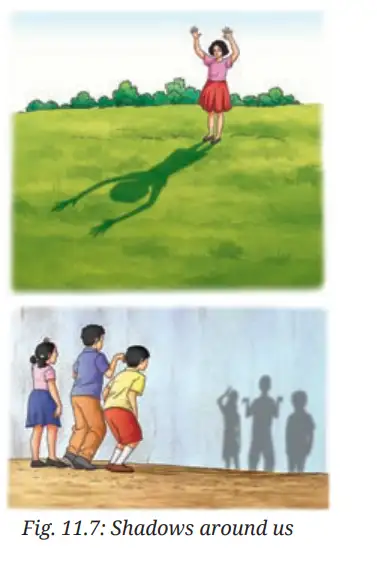
Shadow — A shadow is the dark patch formed where an object blocks light from reaching a surface.
- Light travels in straight lines. An object in its path blocks light, leaving a shadow where the light does not reach.
- Screen: A wall, floor, ground, or another surface can act as a screen on which to see a shadow.
Objects and Shadows
- Opaque objects block light and form darker shadows.
- Translucent objects let some light through and form lighter shadows.
- Transparent objects may also form faint shadows.
What Affects a Shadow?
| Change or condition | Effect on observing the shadow |
|---|---|
| Remove the screen | There is no screen on which to observe the shadow. |
| Remove the object | Nothing blocks the light, so no shadow forms. |
| Switch off the light source | There is no light to be blocked, so no shadow forms. |
| Change the object's position relative to the light source and screen | The shadow's size, shape, and sharpness depend on this position. |
| Change the colour of an opaque object | The shadow's colour does not change. |
- Requirements: A light source, an opaque object, and a screen are needed to observe a shadow.
- Appearance: A shadow may give clues about an object, but it may not reveal exactly what the object is.
A shadow does not take on the object's colour. Changing the colour of an opaque object does not change its shadow's colour.
What three things are needed to observe a shadow?
Does changing the colour of an opaque object change its shadow's colour?
Quick recap
- A shadow forms where an object blocks light travelling in a straight line.
- A light source, an opaque object, and a screen are needed to observe a shadow.
- Opaque objects form darker shadows; translucent objects form lighter ones; transparent objects may form faint ones.
- An object's position relative to the light source and screen affects the shadow's size, shape, and sharpness.
- Changing an opaque object's colour does not change the colour of its shadow.
Reflection of Light
Reflection at Shiny Surfaces
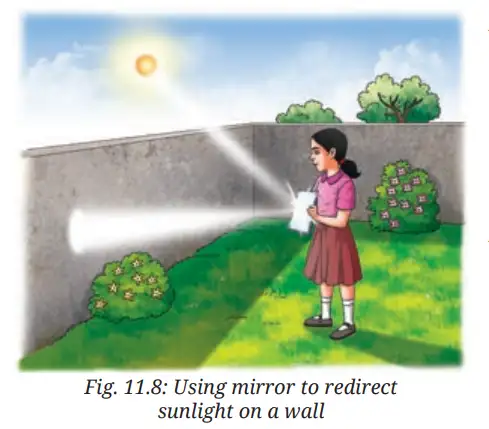
Tracing a Reflected Beam
- Set-up: A comb with one narrow slit makes a thin beam from a torch.
- Observation: Placing a plane mirror in the beam changes its path.
- Reflection: The change in direction of light by a mirror is called reflection of light.
Quick recap
- Reflection is the change in direction of light at a mirror or another shiny surface.
- Opaque objects block light and form shadows; shiny opaque objects also reflect light.
- Light travels in straight lines and changes direction when it reaches a reflecting surface.
- Tilting a mirror changes where the reflected beam falls.
- We see our face in a mirror because light reflected from the face reaches our eyes.
Images Formed in a Plane Mirror
Object and Image
Image — The image is the appearance of the object seen in the mirror; it seems to be behind the mirror.
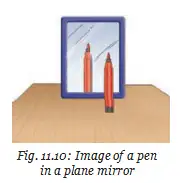
Properties of an Image in a Plane Mirror
Main properties
- Same size: The image is the same size as the object, even when the object is moved.
- Erect: The image is upright; an upright image is called erect.
- Virtual: The image cannot be obtained on a screen.
- Position: The image appears closer to the mirror when the object is close, and farther away when the object is farther away.
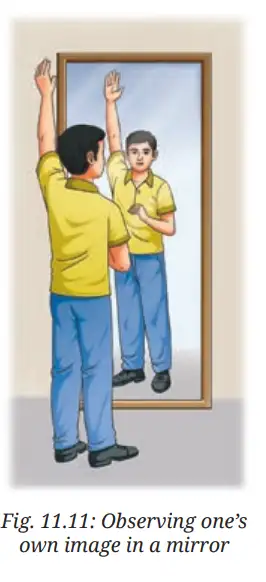
Lateral Inversion
Lateral inversion — The apparent left-right reversal in an image formed by a plane mirror.
How it appears
- Reversal: Your left appears to be the image’s right, and your right appears to be its left.
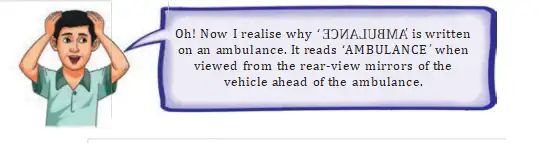
- Example: “AMBULANCE” is written in reverse on the front of an ambulance so it appears correctly in drivers’ rear-view mirrors.
State three properties of an image formed by a plane mirror.
What is lateral inversion?
Quick recap
- A plane-mirror image appears behind the mirror, while the object is in front.
- The image is the same size as the object and is erect.
- The image cannot be obtained on a screen; it is virtual.
- The image appears closer or farther from the mirror as the object moves closer or farther away.
- Plane mirrors produce lateral inversion: left and right appear reversed.
- Reverse ambulance lettering appears correctly in a rear-view mirror.
Pinhole Camera
Pinhole Camera and Its Image
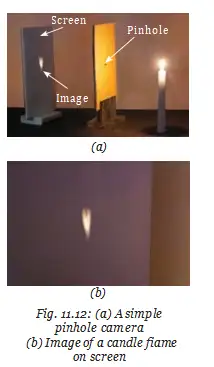
Sliding Pinhole Camera
| Feature | Pinhole camera | Mirror |
|---|---|---|
| Orientation | Upside down (inverted) | Not upside down |
| Other feature | Forms on a screen | Laterally inverted |
Quick recap
- Pinhole camera: Light from an object passes through a tiny hole to form an image on a screen.
- Image orientation: The pinhole camera image is upside down.
- Sliding design: The outer box has a pinhole; the inner box has a translucent screen.
- Focusing: Sliding the inner box adjusts the image on the screen.
- Mirror comparison: A mirror image is laterally inverted but not upside down.
Making Some Useful Items
Periscope
Kaleidoscope
Quick recap
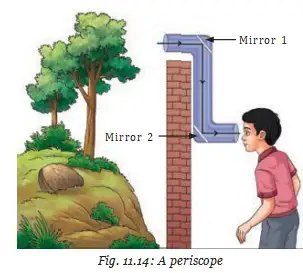
- A periscope uses two plane mirrors in a Z-shaped arrangement.
- Two reflections help a periscope show objects hidden from direct view.
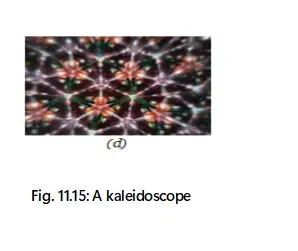
- A kaleidoscope uses three mirrors joined in a triangular arrangement.
- Repeated reflections of coloured pieces form patterns.
- Turning a kaleidoscope produces a different pattern.
- Artists and designers use kaleidoscopes for pattern ideas.
Summary
Light and Materials
- Light sources: Luminous objects emit their own light; non-luminous objects are seen by reflected light.
- Light path: Light travels in a straight line.
- Materials: Materials differ in how much light passes through them.
Shadows
- Formation: A shadow forms when an object blocks light from reaching a surface.
- Requirements: A light source, an opaque object, and a screen are needed to observe a shadow.
- Appearance: Opaque objects form darker shadows; translucent objects form lighter ones.
Reflection and Plane-Mirror Images
- Reflection: A mirror changes the direction of light that falls on it.
- Plane-mirror image: It is erect, the same size as the object, and cannot be obtained on a screen.
- Lateral inversion: The image appears to reverse left and right.
Pinhole Camera
- Principle: Light from an object passes through a tiny hole and forms an image on a screen.
- Image: A pinhole camera forms an upside-down (inverted) image.
- Construction: A small hole in one end of a box lets light reach a translucent-paper screen at the other end.
Quick recap
- Luminous objects produce their own light.
- Light travels in straight lines.
- Transparent, translucent and opaque materials transmit almost all, some and no light, respectively.
- A shadow forms when light is blocked; its darkness depends on how much light the material transmits.
- A plane mirror forms an erect, same-size, laterally inverted image that cannot be caught on a screen.
- A pinhole camera forms an inverted image on a screen.
Science — ALL CHAPTERS
1
The Ever-Evolving World of Science
2
Exploring Substances: Acidic, Basic, and Neutral
3
Electricity: Circuits and their Components
4
The World of Metals and Non-metals
5
Changes Around Us: Physical and Chemical
6
Adolescence: A Stage of Growth and Change
7
Heat Transfer in Nature
8
Measurement of Time and Motion
9
Life Processes in Animals
10
Life Processes in Plants
11
Light: Shadows and Reflections
12
Earth, Moon, and the Sun