Class 7 . Science . Curiosity . Electricity Circuits and Their Components
Chapter 3: Electricity: Circuits and their Components
Ch 3
Science
Class 7
Introduction- A Torchlight
Uses and Sources of Electricity
Electricity in everyday life
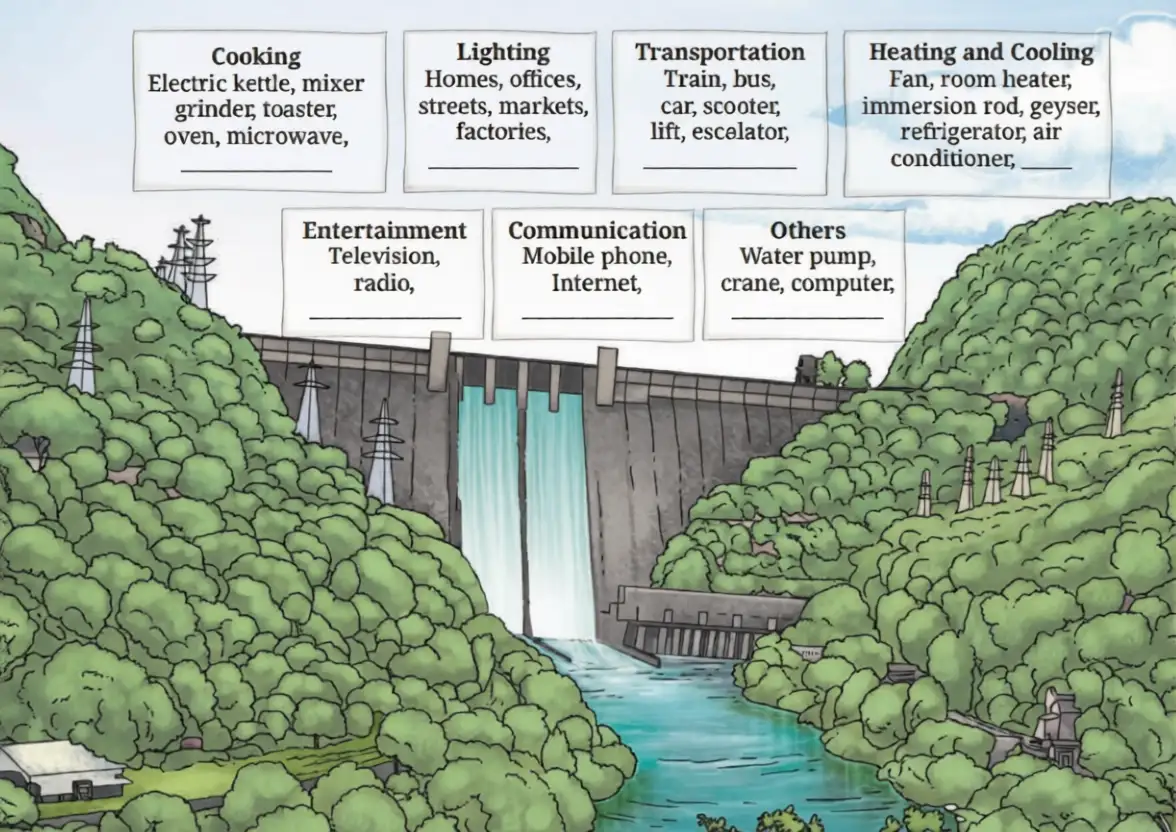
- Uses: Electricity powers devices in homes, schools, neighbourhoods and workplaces, including lights and household appliances.
- Grouping uses: Uses can be grouped by place, such as home or school, or by purpose, such as lighting, heating or communication.
- Sources: Electricity can be generated using wind, sunlight, falling water, natural gas or coal.
- Supply: Electricity from generating sources reaches homes and factories through wires.
Electrical Safety
Safe use of electricity
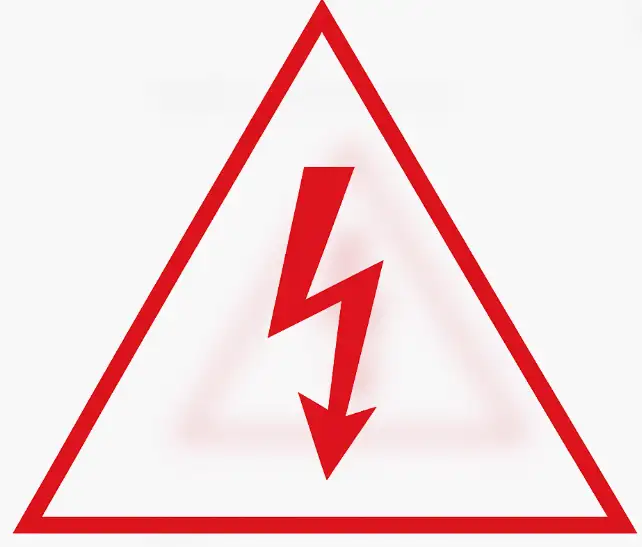
- Danger: Electricity can be harmful if not handled carefully; warning signs indicate electrical hazards.
- Avoid experiments: Never experiment with the electricity supply at home or school.
- Portable generators: Electricity from portable generators can also be dangerous.
- Safer choice: Use only batteries or electric cells for learning experiments, such as those used in torches, clocks, radios or remotes.
A Torchlight
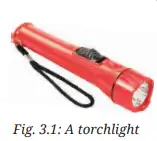
Torchlight — A portable electrical device, also called a torch or flashlight, that has a lamp and uses electric cells.
Main parts and operation
- Parts: A torch has a lamp and a switch; inside, it may contain two or more electric cells.
- Switch positions: In one position the lamp glows; in the other position it does not glow.
Quick recap
- Electricity is used in homes, schools, workplaces and many other places.
- Wind, sunlight, falling water, natural gas and coal can be used to generate electricity.
- Electricity reaches homes and factories through wires.
- Do not experiment with household or school power supplies; portable generators can also be dangerous.
- Use batteries or cells for learning experiments.
- A torch has a lamp, a switch and usually two or more electric cells; its lamp glows in one switch position.
A Simple Electrical Circuit
Electric Cell
Battery
Electric Lamps
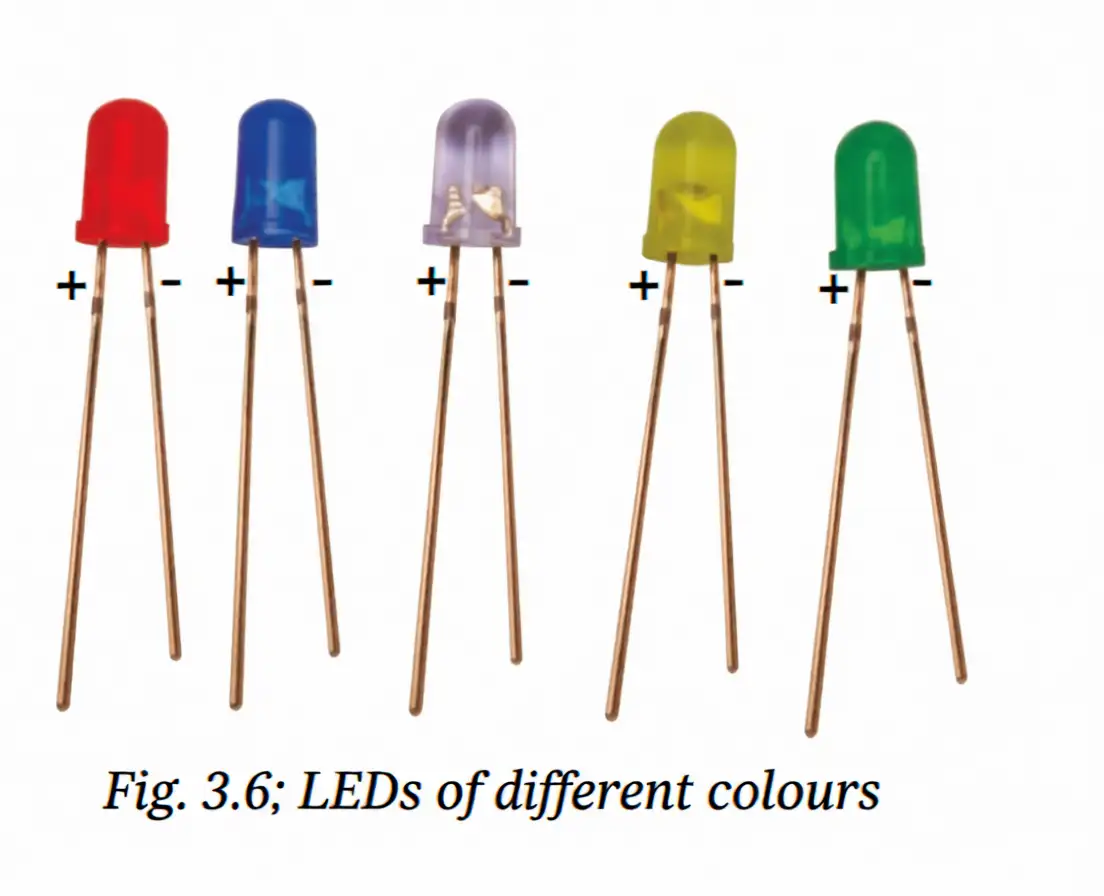
LED — A Light Emitting Diode (LED) is a type of lamp used in many modern torches.
| Point | Incandescent lamp | LED |
|---|---|---|
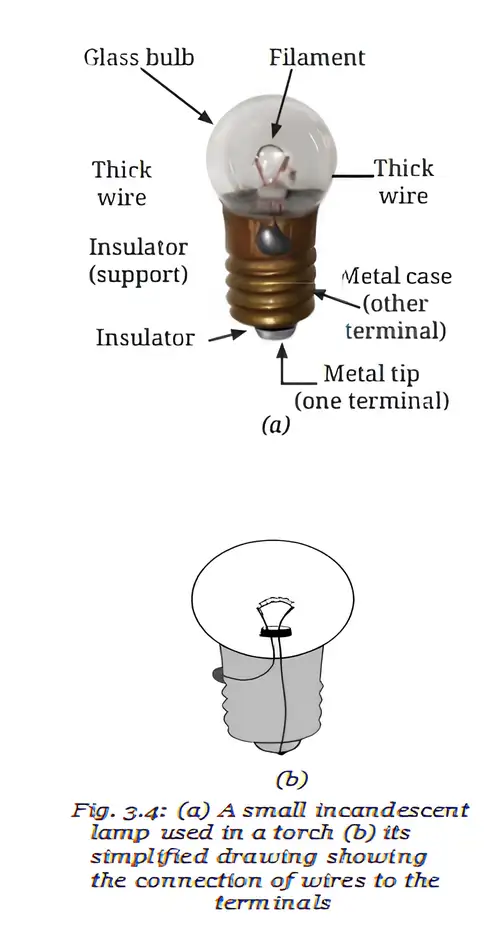
| Light-producing part | A filament that heats up and glows | No filament |
| Terminals | Connected to the metal case and metal tip at the base | Positive terminal has the longer wire; negative has the shorter wire |
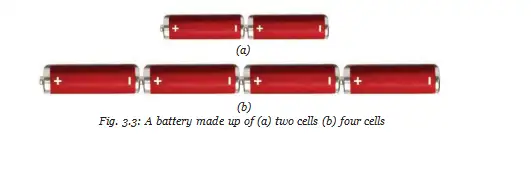
How are cells connected to make a battery?
How can you identify the positive and negative terminals of an LED?
Quick recap
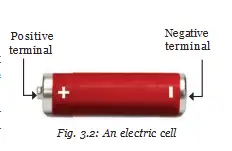
- An electric cell is a portable energy source with positive and negative terminals.
- A battery is made of two or more cells, usually connected positive-to-negative.
- An incandescent lamp produces light when its filament heats up and glows.
- An incandescent lamp has two separate terminals connected to its support wires.
- An LED has no filament; its longer wire is positive and its shorter wire is negative.
Making an electric lamp glow using an electric cell or battery
Results of the Cell-and-Lamp Arrangements
What was observed
- Lamp glows: In the arrangements numbered 1 and 6, the lamp glows.
- Lamp does not glow: In all the other arrangements shown, the lamp does not glow.
- Key observation: Whether the lamp glows depends on how the cell and lamp are arranged.
| Observation | Arrangements |
|---|---|
| Lamp glows | 1 and 6 |
| Lamp does not glow | All remaining arrangements shown |
Which arrangements make the lamp glow?
Quick recap
- A cell and a lamp can be connected in different arrangements.
- The lamp glows in arrangements 1 and 6.
- The lamp does not glow in the other arrangements shown.
- The observed result differs according to the arrangement.
An Electrical Circuit
Electrical Circuit and Current
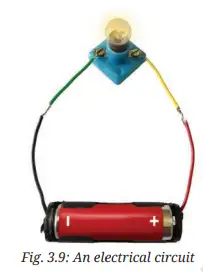
Electrical circuit — A complete conducting path through which electric current can flow.
- Complete path: A lamp glows when its two terminals are connected to opposite terminals of a cell, completing the circuit.
- Current flow: Current passes through an incandescent lamp’s filament and makes it glow.
- Conventional direction: Electric current is taken to flow from the cell’s positive terminal to its negative terminal.
- Lamp connection: An incandescent lamp glows whichever way its terminals are connected, provided the circuit is complete.
Fused Lamps
- Fused lamp: An incandescent lamp may stop glowing if its filament breaks.
- Effect: A broken filament interrupts the circuit, so current cannot flow through the lamp.
Connecting an LED
- One-way current: Current can pass through an LED in only one direction.
- Correct polarity: Connect the LED’s longer lead (positive) to the battery’s positive terminal and its shorter lead (negative) to the battery’s negative terminal.
- Glow: The LED glows when connected with this polarity and current flows through it; reversed connections do not make it glow.
- Battery terminals: In a holder with two cells, the holder end connected to a cell’s positive terminal is positive; the other end connected to a cell’s negative terminal is negative.
Do not assume an LED works whichever way it is connected: its longer positive lead must connect to the battery’s positive terminal.
Quick recap
- A complete circuit is needed for current to flow and a lamp to glow.
- Conventional current direction is from the positive terminal to the negative terminal.
- An incandescent lamp works either way around in a complete circuit.
- A broken filament interrupts current and causes the lamp to fuse.
- An LED conducts in only one direction: longer lead to positive, shorter lead to negative.
Electric Switch
How a Switch Controls a Circuit
Electric switch — A simple device that completes or breaks an electric circuit.
Key points
- ON position: The switch closes the circuit, completing the path for current to flow.
- OFF position: The switch opens the circuit, leaving a gap that stops current flow.
- Effect on a lamp: A closed circuit lets the lamp glow; an open circuit does not.
- Placement: A switch can be placed anywhere in a circuit.
- Home switches: Switches for lights and other devices work on the same principle, though their designs may differ.
| Position | Circuit | Current | Lamp |
|---|---|---|---|
| ON | Closed; path is complete | Flows from the cell’s positive terminal to its negative terminal | Glows |
| OFF | Open; a gap remains | Does not flow | Does not glow |
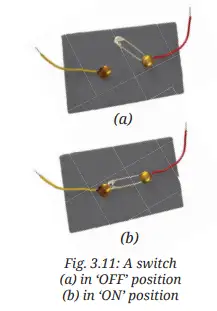
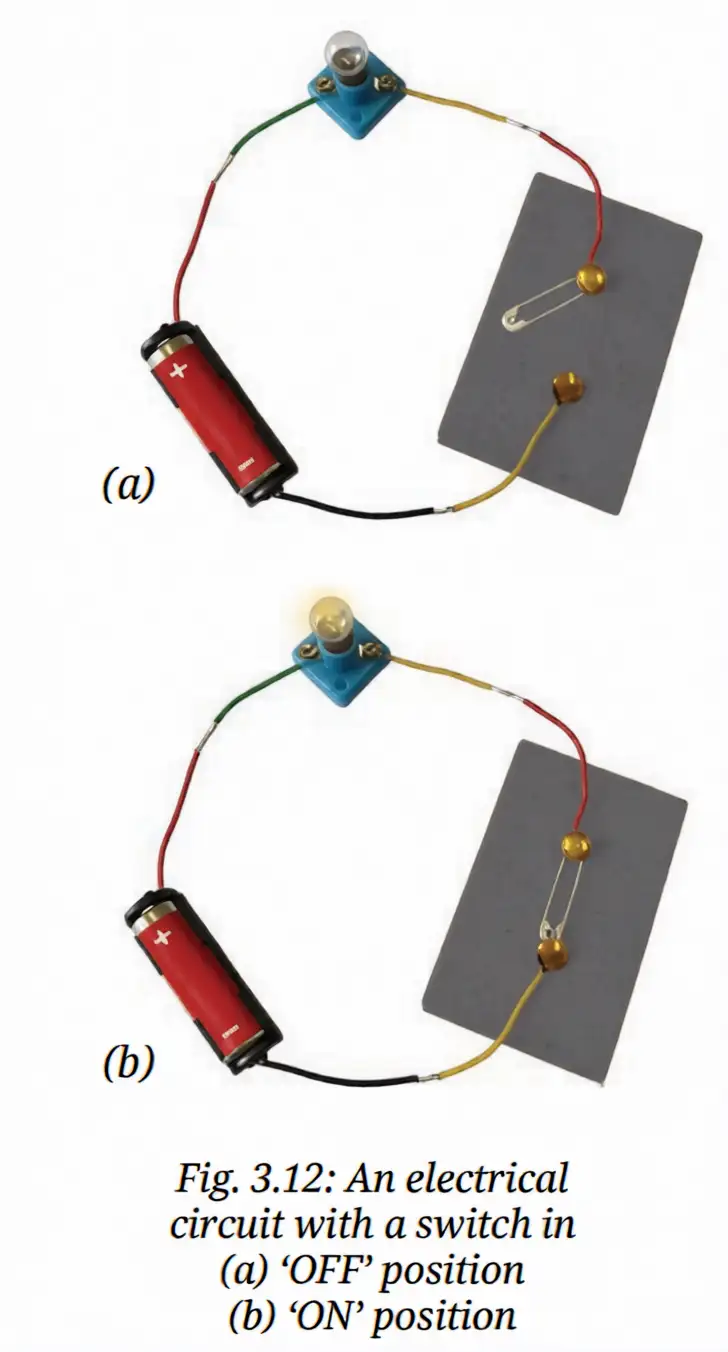
- ON means a closed circuit and flowing current.
- OFF means an open circuit and no current flow.
Quick recap
- An electric switch controls a circuit by completing or breaking its path.
- In the ON position, the circuit is closed and current flows.
- In the OFF position, a gap opens the circuit and stops current.
- A lamp glows when the circuit is closed and does not glow when it is open.
- A switch can be placed anywhere in a circuit.
Circuit Diagrams
Electrical Component Symbols
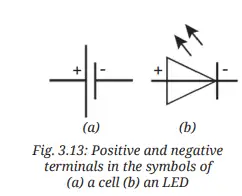
Reading the LED Symbol
- Direction: The triangle points in the direction in which current can flow through the LED.
- Light: The two arrows pointing outward show that the LED emits light.
Circuit Diagrams in Practice
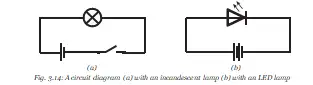
Standard Symbols
- Organisations: The International Electrotechnical Commission (IEC), American National Standards Institute (ANSI), and Institute of Electrical and Electronics Engineers (IEEE) create standard symbols for electrical and electronic parts.
- Why standards matter: Using common symbols helps people in different countries and industries understand circuit diagrams.
Quick recap
- A circuit diagram represents electrical components using symbols.
- A cell symbol has a long positive line and a short negative line.
- An LED symbol has outward arrows to indicate light emission; its triangle indicates current direction.
- A closed switch is ON; an open switch is OFF.
- IEC, ANSI, and IEEE develop standard symbols to support clear communication.
Electrical Conductors and Insulators
Conductors and Insulators
Electrical insulator — An insulator, or poor conductor, is a material through which electric current cannot pass easily.
| Material group | Examples | Use or behaviour |
|---|---|---|
| Conductors | Metals, including silver, copper and gold | Allow current to flow easily; used in wires, switches, plug connectors and sockets. |
| Insulators | Plastic, rubber and ceramics | Do not allow current to pass easily; used to cover wires, plug tops and switches. |
Why Wires Have Insulating Covers
Do not assume every material conducts electricity: the lamp glows only when current passes through the object and completes the tester circuit.
Electrical Safety
- Body safety: The human body conducts electricity, and a shock can cause severe injury or death.
- Precautions: Keep hands dry around switches and plugs; avoid wet areas and damaged electrical equipment.
Electricity from Batteries and Wall Sockets
| Point | Direct Current (DC) | Alternating Current (AC) |
|---|---|---|
| Source | Batteries | Power plants supplying wall sockets |
| Typical use | Usually powers small devices | Can run larger appliances |
Why are electrical wires usually made of metal and covered with plastic or rubber?
State one difference between DC and AC.
Quick recap
- Conductors allow electric current to flow easily; insulators do not.
- Metals conduct electricity; plastic, rubber and ceramics are insulators.
- Copper is commonly used for electrical wires because it is relatively inexpensive and abundantly available.
- Conducting wire cores carry current, while insulating covers help prevent electric shocks.
- The human body conducts electricity; avoid wet electrical equipment and damaged insulation or plugs.
- Batteries usually supply DC; wall sockets supply AC.
Summary
Electric Cells and Lamps
- Electric cell: A portable source of electrical energy with positive and negative terminals.
- Incandescent lamp: Current heats its filament, making it glow and produce light.
LEDs and Circuit Direction
- LED terminals: The longer wire is positive; the shorter wire is negative.
- Current direction: An LED glows only when connected with the correct polarity, because current passes through it in one direction.
Switches and Circuit Diagrams
- Switch: It completes or breaks a circuit; a closed circuit allows current to flow.
- Circuit diagram: It represents an electrical circuit using symbols for its components.
Conductors and Insulators
- Conductors: Materials that allow electric current to flow easily; metals are common conductors.
- Insulators: Materials through which current cannot pass easily, such as plastic, rubber and ceramics.
- Uses: Conductors make wires and electrical connections; insulators cover wires, plugs and switches to help prevent shocks.
Quick recap
- An electric cell is a portable source of electrical energy with positive and negative terminals.
- Current heats the incandescent lamp’s filament, causing it to glow.
- An LED conducts in one direction and lights when connected with matching terminal polarities.
- A switch completes or breaks the circuit; a circuit diagram uses symbols to represent it.
- Conventional current direction in a closed circuit is from positive to negative.
- Conductors allow current to flow easily; insulators do not allow current to pass.
Science — ALL CHAPTERS
1
The Ever-Evolving World of Science
2
Exploring Substances: Acidic, Basic, and Neutral
3
Electricity: Circuits and their Components
4
The World of Metals and Non-metals
5
Changes Around Us: Physical and Chemical
6
Adolescence: A Stage of Growth and Change
7
Heat Transfer in Nature
8
Measurement of Time and Motion
9
Life Processes in Animals
10
Life Processes in Plants
11
Light: Shadows and Reflections
12
Earth, Moon, and the Sun