Class 7 . Science . Curiosity . Life Processes in Animals
Chapter 9: Life Processes in Animals
Ch 9
Science
Class 7
Introduction
Life Processes
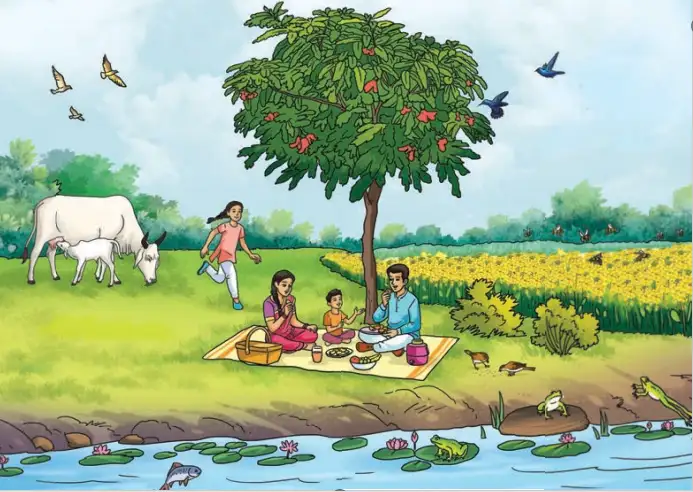
Different Ways Animals Feed
| Animal | Food and feeding method |
|---|---|
| Bees and sunbirds | Suck nectar from flowers |
| Human infants and many other young animals | Feed on their mother’s milk |
| Python | Swallows animals it preys upon |
| Some aquatic animals | Filter tiny food particles floating nearby |
Food and Digestion
Digestion — The breakdown of complex food components into simpler forms that the body can use.
- Energy from food enables animals, including humans, to carry out life processes.
- Complex food components include carbohydrates, proteins and fats.
- Alimentary canal is a long tube where complex food is broken down; it begins at the mouth and ends at the anus.
- Digestive juices are secreted at different parts of the canal and break food into simpler forms.
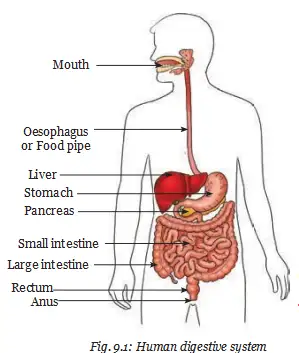
How Food Is Used
- Food enters the alimentary canal through the mouth.
- Digestive juices break complex food into simpler forms as it moves through the canal.
- The simpler forms are absorbed by parts of the canal.
- Absorbed food is transported to different body parts to carry out their functions.
Quick recap
- Nutrition, respiration, excretion and reproduction are life processes essential for survival.
- Animals obtain energy from food to carry out life processes.
- Animals feed in different ways, such as sucking nectar, drinking milk, swallowing prey or filtering food particles.
- Food contains complex components such as carbohydrates, proteins and fats.
- Digestion breaks complex food into simpler forms in the alimentary canal, from mouth to anus.
- Simpler food forms are absorbed and transported to different parts of the body.
Nutrition in Animals
Digestion in Human Beings
- Digestion: Complex food is broken down into simpler forms that the body can absorb and use.
- Alimentary canal: Food travels through this long tube, from the mouth to the anus, as digestive juices act on it.
Digestion Begins in the Mouth
- Mechanical digestion: Teeth crush and chew food into smaller pieces.
- Saliva: It moistens food and begins breaking down starch into simple sugars.
- Tongue: It mixes food with saliva and helps push the softened food for swallowing.
How Iodine Shows Starch
Digestion — Digestion is the process of breaking complex food components into simpler forms in the body.
Oral Hygiene
Why can chapati or rice taste sweet after being chewed for a long time?
What does a blue-black colour in the iodine test indicate?
Quick recap
- Teeth mechanically break food into smaller pieces by crushing and chewing.
- Saliva helps break down starch into simpler sugars in the mouth.
- Iodine turns blue-black when starch is present.
- Chewed rice may show little or no iodine colour change because much of its starch has been broken down.
- Digestion is the breakdown of complex food components into simpler forms.
- Brushing twice daily, cleaning the tongue and rinsing after meals help maintain oral hygiene.
Food pipe (Oesophagus): A passage from the mouth to the stomach
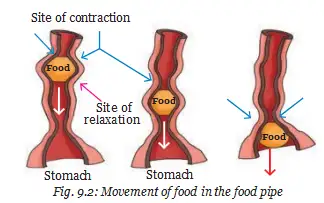
Food Pipe and Peristalsis
How food reaches the stomach
- Saliva Moistens chewed food and helps digest starch, making food soft and easier to swallow.
- Tongue Mixes food with saliva and pushes the softened food into the food pipe, or oesophagus.
- Food pipe A long, flexible tube that carries food from the mouth to the stomach.
Peristalsis — Wave-like contraction and relaxation of the walls of the food pipe and alimentary canal that pushes food forward.
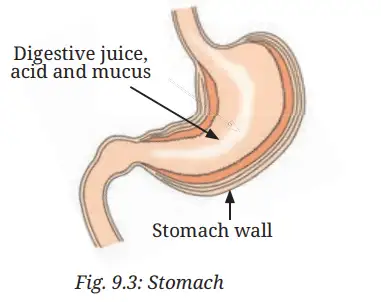
Stomach
Digestion in the stomach
- Churning Stomach walls contract and relax, mixing and churning food.
- Stomach secretion Contains digestive juice, acid and mucus.
- Digestive juice Breaks proteins in food into simpler components.
- Acid Helps break down proteins and kills many harmful bacteria.
- Mucus Protects the stomach lining from damage by acid.
- Result Food is partly digested and becomes a semi-liquid mass before moving to the next stage.
Small Intestine
Digestion in the small intestine
- Length Nearly 6 metres long; it is the longest part of the alimentary canal.
- Secretions Receives digestive secretions from its own inner lining, the liver and the pancreas.
- Bile Made by the liver; it is mildly basic, neutralises acid from the stomach and breaks fats into tiny droplets.
- Pancreatic juice Basic in nature; it neutralises acid and helps break down carbohydrates, proteins and fats.
- Intestinal digestive juice Further breaks down fats, proteins and partly digested carbohydrates into simpler forms.
| Source | Secretion | Main action |
|---|---|---|
| Liver | Bile | Neutralises stomach acid and breaks fats into tiny droplets. |
| Pancreas | Pancreatic juice | Neutralises acid and breaks down carbohydrates, proteins and fats. |
| Small-intestine lining | Digestive juice | Further breaks down fats, proteins and partly digested carbohydrates. |
Absorption — The passage of digested nutrients from the small intestine into the blood.
How nutrients are absorbed
- Inner lining Thin and covered with thousands of finger-like projections.
- Large surface area The projections increase the area available for efficient absorption.
- Into the blood Digested nutrients pass through the lining into blood vessels and are carried around the body.
- Use of nutrients Nutrients provide energy, support growth and repair, and help the body function properly.
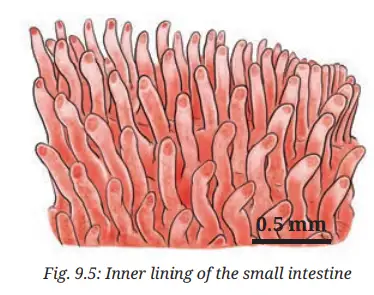
Celiac disease and gluten
- Celiac disease A condition in which the body reacts to gluten, a protein found in wheat, barley and rye.
- Effect The reaction damages the small intestine’s inner lining, affecting its ability to absorb nutrients.
- Management Avoid gluten-containing foods; jowar, bajra and ragi are naturally gluten-free alternatives.
Large Intestine and Egestion
| Point | Small intestine | Large intestine |
|---|---|---|
| Length and width | Nearly 6 metres long; narrower. | About 1.5 metres long; wider. |
| Main role | Completes digestion and absorbs nutrients into the blood. | Absorbs water and some salts from undigested food. |
Formation and removal of waste
- Undigested food enters the large intestine.
- Water and some salts are absorbed, making the waste semi-solid.
- The semi-solid waste, called stool, is stored in the rectum.
- Stool leaves the body through the anus; this process is called egestion.
Keeping the digestive system healthy
- Fibre-rich foods Fruits, vegetables and whole grains help make stool easier to pass.
- Gut bacteria Bacteria in the large intestine help break down undigested food, especially fibre, and produce useful nutrients.
- Fermented foods Curd, buttermilk, shrikhand, kanji, pickles, gundruk and poita bhat support digestive health.
- Charaka Samhita This ancient Ayurvedic text highlights easily digestible foods and judicious use of spices such as ginger, black pepper and cumin to support digestion.
- Healthy eating habits Eat meals at proper times, practise mindful eating and avoid overeating.
- Digestion pathway: food pipe → stomach → small intestine → large intestine → rectum → anus.
- Egestion removes waste; absorption is the movement of digested nutrients into the blood.
What is peristalsis?
How are nutrients absorbed in the small intestine?
What happens to undigested food in the large intestine?
Quick recap
- Saliva softens food; the tongue moves it into the food pipe, and peristalsis pushes it toward the stomach.
- The stomach churns food and uses digestive juice, acid and mucus; food becomes a semi-liquid mass.
- Bile, pancreatic juice and intestinal digestive juice help complete digestion in the small intestine.
- Finger-like projections in the small intestine increase surface area for absorption of nutrients into the blood.
- The large intestine absorbs water and some salts; stool is stored in the rectum and expelled through the anus.
- Fibre and fermented foods support digestive health; mindful eating, regular meal times and avoiding overeating are also recommended.
Do all animals digest food the same way as humans do?
Digestion in Ruminants
How ruminants digest grass
- First chewing: Cows and buffaloes partially chew grass and swallow it; partial digestion begins in the stomach.
- Return to the mouth: Partly digested food comes back up to be chewed gradually and thoroughly.
- Further digestion: After thorough chewing, food passes down the alimentary canal again for further digestion.
- Chewing time: A cow may spend about 8 hours a day chewing food.
Rumination — The process of bringing partially digested food back to the mouth for gradual chewing.
Ruminants — Animals that bring partly digested food back to the mouth and chew it again.
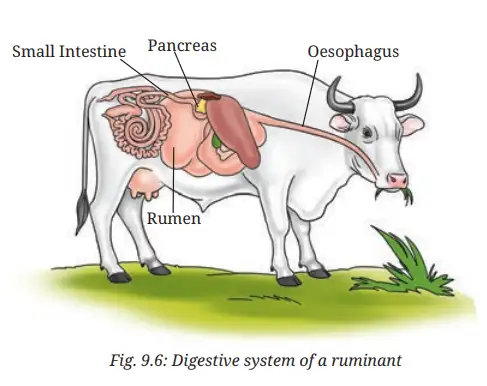
Digestion in Birds
The gizzard
- No teeth: Birds do not have teeth, so they use a chamber called the gizzard to break down food.
- Muscular action: Contraction and relaxation of the gizzard walls help break down food.
- Grit: Small stones swallowed by birds can help the gizzard break down food.
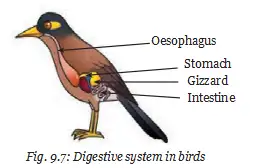
Different Digestive Adaptations
- Variation: Animals’ alimentary canals differ in structure and function.
- Adaptation: These differences help animals digest different kinds of food in different ways.
From Digested Food to Energy
- Nutrients: Nutrients from digested food are carried to different parts of the body.
- Body building and repair: Some nutrients help build and repair the body.
- Energy: Other nutrients, such as sugar, are broken down inside the body to release energy.
Respiration — The process by which nutrients are converted into usable energy.
What is rumination, and which animals are called ruminants?
How does a bird’s gizzard help break down food?
Quick recap
- Cows and buffaloes partially chew and swallow grass, then bring it back to chew thoroughly.
- Rumination is the return of partly digested food to the mouth for further chewing.
- Birds use a gizzard instead of teeth to help break down food.
- Gizzard contractions and swallowed grit help break down food.
- Alimentary canals vary to suit animals’ different foods and digestive needs.
- Respiration converts nutrients into usable energy.
Respiration in Animals
Breathing and the Human Respiratory System
Breathing — The physical process of taking air into the body (inhalation) and releasing it (exhalation).
The human respiratory system
- Air pathway: nostrils → nasal passages → windpipe → two branches entering the lungs → finer branches → alveoli.
- Nasal hairs and mucus trap dust and dirt; breathing through the nose helps filter inhaled air.
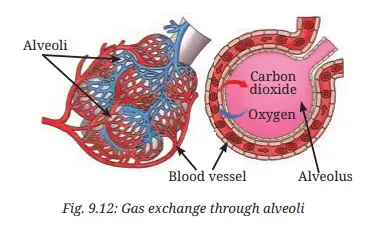
- Alveoli are small, balloon-like sacs in the lungs where gases exchange with the blood.
- Rib cage protects the lungs.
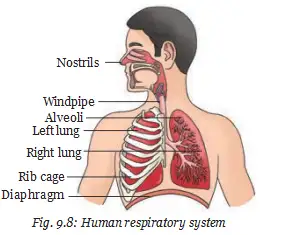
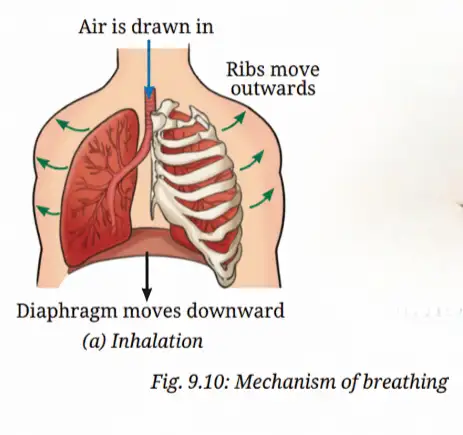
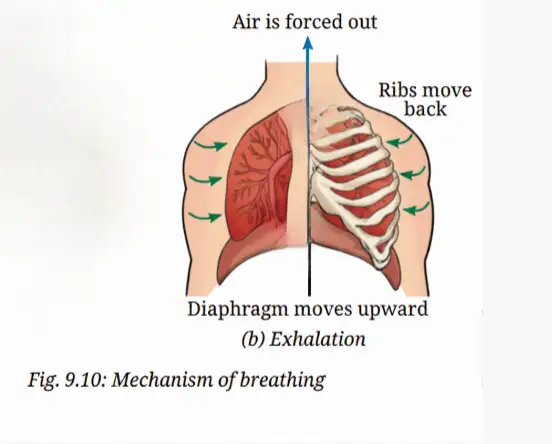
How Breathing Works
| Point | Inhalation | Exhalation |
|---|---|---|
| Ribs | Move up and out | Move down and in |
| Diaphragm | Moves downward | Moves upward |
| Chest space and airflow | Chest space increases; air enters the lungs | Chest space decreases; air is pushed out |
Gas Exchange and Respiration
Gas exchange in the lungs
- Oxygen passes from the air in the alveoli into the surrounding blood.
- Carbon dioxide is carried by the blood from the body to the alveoli and released into the air.
- Exhaled air contains more carbon dioxide than inhaled air, but not all inhaled oxygen is used.
Respiration
- Respiration is the chemical process in which oxygen helps break down glucose and release energy.
- Word equation: Glucose + oxygen → carbon dioxide + water + energy.
- Limewater test: exhaled air turns limewater milky because it contains carbon dioxide; ordinary inhaled air does not make it turn milky as readily.
| Point | Breathing | Respiration |
|---|---|---|
| Process | Physical movement of air into and out of the body | Chemical breakdown of glucose using oxygen |
| Main result | Brings in oxygen and removes carbon dioxide | Releases energy; produces carbon dioxide and water |
Transport of Materials and Healthy Lungs
The circulatory system
- Parts: heart, blood and blood vessels.
- Function: the heart pumps blood through vessels to carry oxygen, nutrients and other substances to the body; blood also carries waste products away.
Protecting respiratory health
- Smoking damages the lungs and increases the risk of lung cancer, other respiratory illnesses, persistent coughing and infections.
- Passive smoking is breathing air polluted by someone else's smoke; it can be especially harmful to children, pregnant women and older people.
- Breathing practices: Pranayama and deep breathing are used for relaxation and concentration; Tummo breathing in Ladakh is practised to support lung function and warmth in cold conditions.
Breathing in Other Animals
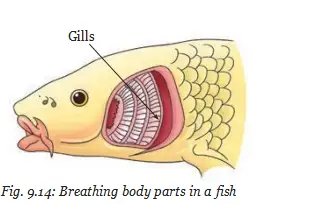
| Animal/group | Breathing organ or surface | Key detail |
|---|---|---|
| Birds and many land animals, including elephants, lions, cows, goats, lizards and snakes | Lungs | Lung structures differ among animals. |
| Fish | Gills | Take up oxygen dissolved in water and release carbon dioxide; gills have many blood vessels. |
| Tadpoles | Gills | Breathe through gills during the tadpole stage. |
| Adult frogs | Lungs on land; skin in water | Use lungs to breathe on land and exchange gases through the skin while in water. |
| Earthworms | Moist skin | Oxygen and carbon dioxide exchange across the moist skin. |
How do ribs and the diaphragm change during inhalation and exhalation?
How does gas exchange occur in the alveoli?
Quick recap
- Breathing moves air through the respiratory system; nasal hairs and mucus trap dust, and the rib cage protects the lungs.
- Inhalation expands the chest as ribs move up and out and the diaphragm moves down; exhalation reverses these movements.
- Oxygen passes from alveoli into blood, while blood carries carbon dioxide to alveoli for release.
- Respiration is a chemical process that uses oxygen to break down glucose and release energy; breathing is physical.
- The circulatory system transports oxygen and nutrients and carries waste away using the heart, blood and blood vessels.
- Animals breathe through lungs, gills or moist skin, with the breathing method suited to their life stage and habitat.
Summary
Life Processes
- Life processes: Nutrition, circulation, respiration, excretion, and reproduction are essential for the survival of living beings.
Digestion and Absorption
- Digestion: The alimentary canal breaks down food into simpler nutrients.
- Absorption: Digested nutrients pass mainly through the small intestine into the blood and are carried around the body.
Ruminants
- Ruminants: Grass-eating animals such as cows and goats swallow partially chewed food, then bring it back to the mouth.
- Rumination: They chew this partially digested food thoroughly before it passes through the alimentary canal again.
Breathing and Respiration
Respiration — The chemical process in which nutrients are broken down to release usable energy.
Circulation
| Point | Breathing | Respiration |
|---|---|---|
| Nature | Physical process | Chemical process |
| Main event | Air moves into and out of the lungs | Glucose is broken down to release usable energy |
Breathing in Different Animals
- Adaptation: Animals have different breathing mechanisms suited to their habitats.
Where are digested food and gases absorbed or exchanged?
How are breathing and respiration different?
Quick recap
- Life processes include nutrition, circulation, respiration, excretion and reproduction.
- The digestive canal runs from the mouth to the anus; the liver and pancreas are associated organs.
- The small intestine mainly absorbs digested food; the large intestine absorbs most remaining water and some salts.
- Ruminants bring partially digested food back to the mouth and chew it thoroughly.
- Breathing moves air; respiration breaks down glucose using oxygen to release usable energy.
- The circulatory system transports oxygen and nutrients and helps carry wastes away.
Science — ALL CHAPTERS
1
The Ever-Evolving World of Science
2
Exploring Substances: Acidic, Basic, and Neutral
3
Electricity: Circuits and their Components
4
The World of Metals and Non-metals
5
Changes Around Us: Physical and Chemical
6
Adolescence: A Stage of Growth and Change
7
Heat Transfer in Nature
8
Measurement of Time and Motion
9
Life Processes in Animals
10
Life Processes in Plants
11
Light: Shadows and Reflections
12
Earth, Moon, and the Sun