Class 7 . Science . Curiosity . Heat Transfer in Nature
Chapter 7: Heat Transfer in Nature
Ch 7
Science
Class 7
Introduction
Heat from the Sun and differences in climate
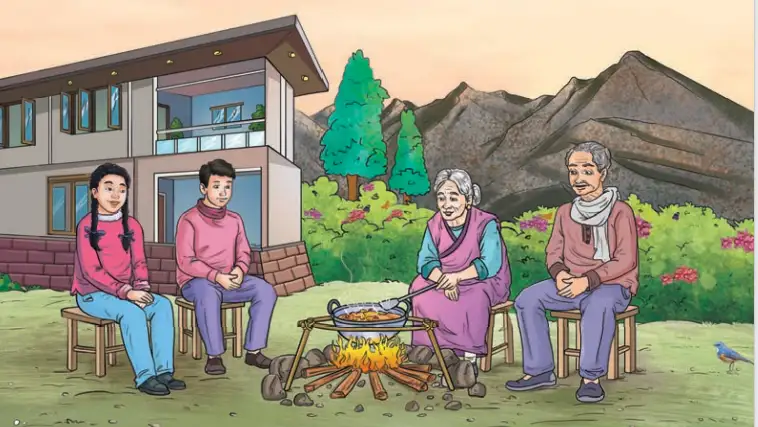
Heat conductors and cooking utensils
- Sun: The main source of heat and light for Earth.
- Metals: Good conductors of heat, making them useful for cooking utensils.
Quick recap
- The Sun is Earth’s main source of heat and light.
- Places around the equator generally have a hot climate.
- Kerala is warmer and more humid in winter than Gangtok.
- Kerala’s location nearer the equator and its long coastline are linked to its warmer, humid weather.
- Metals conduct heat well and are commonly used for cooking utensils.
Conduction of Heat
Conduction of Heat
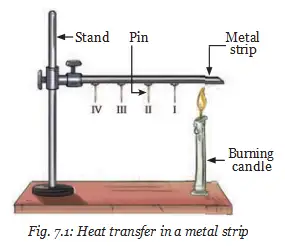
Conduction — The transfer of heat from the hotter part of an object to its colder part, while the particles remain in their positions.
How conduction happens
- Direction: Heat moves from a hotter region towards a colder region.
- Particle transfer: Heated particles pass heat to neighbouring particles, which pass it on; the particles themselves do not move from their positions.
- In solids: Heat transfer takes place mainly by conduction.
- Metal-strip example: Heating one end melts the wax along the strip; pin I, nearest the flame, falls first, followed by pins II, III and IV.
Conductors and Insulators
Good conductor of heat — A material that allows heat to pass through it easily.
Poor conductor (insulator) of heat — A material that does not allow heat to pass through it easily.
| Type | Materials / examples | Use or effect |
|---|---|---|
| Good conductors | Metals such as steel | Metal utensils are used for cooking because they transfer heat readily. |
| Poor conductors | Wood, glass, clay, porcelain and air | Pins do not fall from a heated wood or glass strip as heat passes through them poorly. |
| Poor conductors | Clay and porcelain | Tea or coffee in these cups stays hot longer. |
Trapped Air as an Insulator
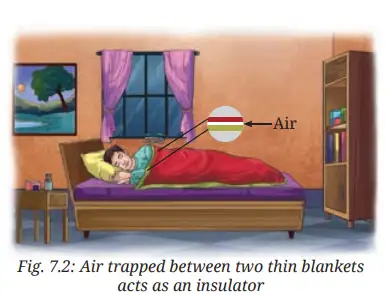
- Woollen clothes: Air trapped in the fabric is a poor conductor, so it reduces heat flow from the body to the surroundings and helps keep us warm.
- Blankets: Air trapped between two thin blankets reduces heat loss; this is why two thin blankets can keep us warmer than one thick blanket.
Insulation in Houses
- Cold regions: Some Himalayan houses have two wooden wall layers with cow dung and mud between them. These poor conductors reduce heat loss and help keep the houses warm.
- Hollow bricks: Air trapped inside hollow bricks is a poor conductor, helping houses stay warm in winter and cool in summer.
Quick recap
- Conduction: Heat transfers from a hotter part to a colder part without particles moving from their positions.
- Sequence: In a heated metal strip, pins fall in order: I, II, III, then IV.
- Conductors: Metals conduct heat well and are used for cooking utensils.
- Insulators: Wood, glass, clay, porcelain and air are poor conductors of heat.
- Trapped air: Air in wool, between blankets or inside hollow bricks slows heat transfer.
- Buildings: Poor-conducting wall layers help keep houses warm in cold weather and hollow-brick houses cooler in hot weather.
Convection
Convection in Air and Liquids
Convection current in water
- Water at the bottom is heated → it expands, becomes lighter, and rises.
- Cooler, heavier water sinks from the sides to replace it.
- The cooler water is heated and rises → the cycle continues, spreading heat through the water.
Land and Sea Breeze
| Point | Sea breeze | Land breeze |
|---|---|---|
| When | Day | Night |
| Warmer surface | Land | Sea |
| Air that rises | Warm air above the land | Warm air above the sea |
| Direction of cooler air | Sea → land | Land → sea |
| Cause | Land heats faster than the sea | Land cools faster than the sea |
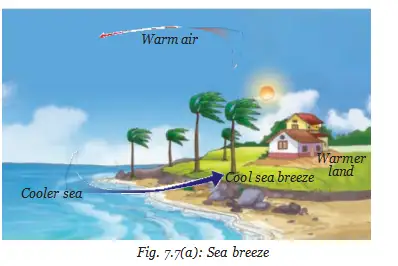
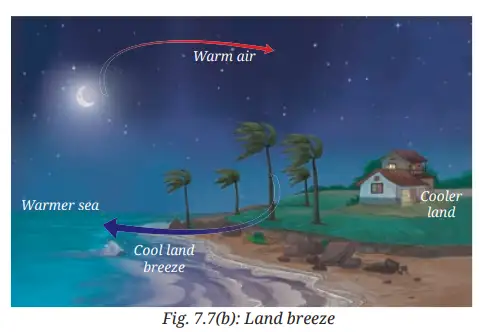
Coastal effects
- Sea breeze: Brings cooler air from the sea during the day, helping relieve heat in coastal areas.
- House design: Coastal homes often have windows facing the sea to let the sea breeze in.
- Reversal: Wind direction near the shore reverses between day and night.
Why does heated air rise?
Explain how a sea breeze forms during the day.
Why does wind direction reverse at night near the seashore?
Quick recap
- Convection transfers heat through the movement of particles in liquids and gases.
- Heating makes a fluid expand, become lighter, and rise; cooler, heavier fluid sinks to replace it.
- Convection currents spread heat through water and air.
- Land heats and cools faster than sea water.
- Daytime sea breeze flows from sea to land; nighttime land breeze flows from land to sea.
Radiation
Radiation
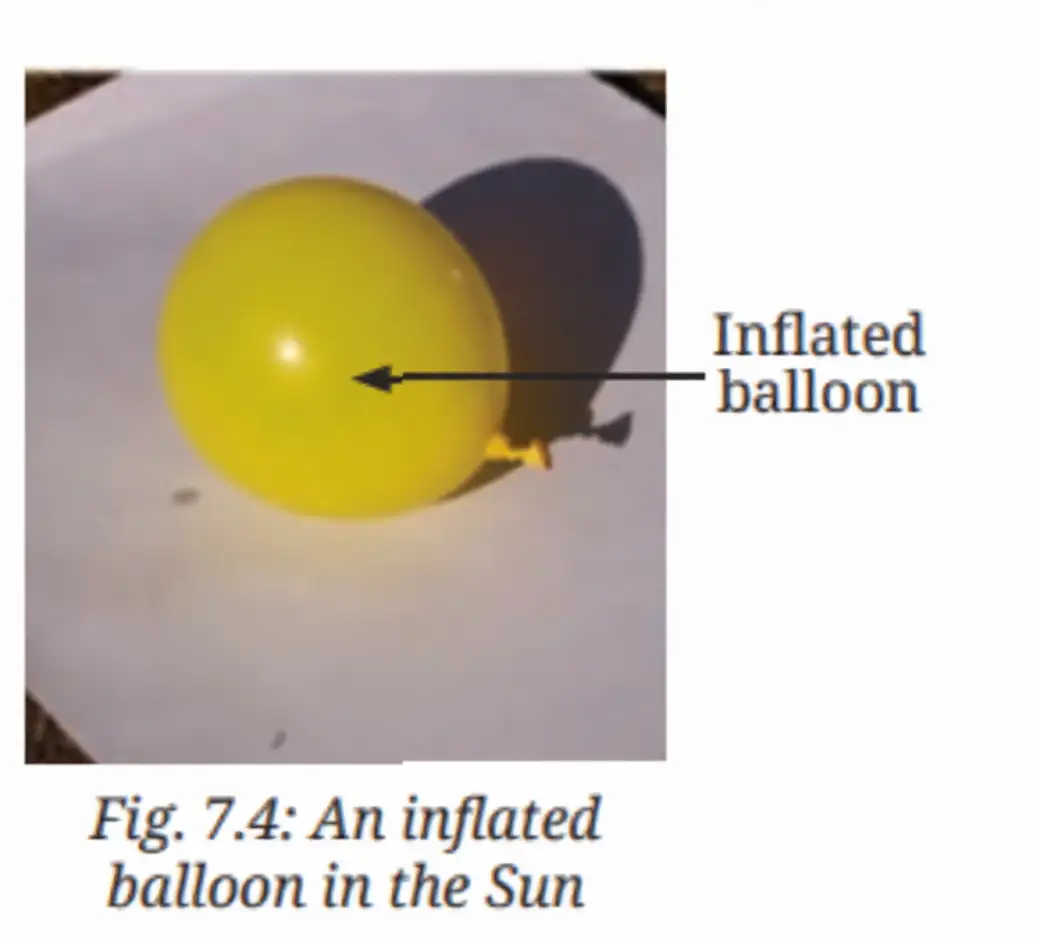
- Examples: Heat from a fireplace reaches people nearby, and heat from the Sun reaches the Earth.
Heat Transfer in Everyday Situations
| Process | How heat is transferred | Is a medium required? |
|---|---|---|
| Conduction | Particles pass heat to neighbouring particles in contact; the particles do not move from their positions. | Yes |
| Convection | Heat is transferred by the actual movement of particles. | Yes |
| Radiation | Heat travels from one place to another without a material medium. | No |
Bukhari and Combined Heat Transfer
- Bukhari: This traditional Himalayan room heater burns wood or charcoal; its chimney carries smoke outside, and its flat top can be used for cooking.
- Combined heat transfer: A bukhari involves conduction, convection, and radiation while warming a room or cooking.
Sunlight and Evaporation
Why are light-coloured clothes preferred in summer and dark-coloured clothes in winter?
Name the heat-transfer processes involved when water is heated in a pan.
Quick recap
- Radiation transfers heat without a material medium.
- All objects radiate heat; a hot utensil cools by radiating heat to its surroundings.
- Light surfaces reflect most heat; dark surfaces absorb more.
- Conduction transfers heat between particles in contact; convection involves particle movement.
- A pan of water and a bukhari can involve all three heat-transfer processes.
- The Sun's heat speeds evaporation from wet clothes and water bodies.
Water Cycle
Water in Nature and the Water Cycle
Water’s three states
- Liquid: Water occurs in oceans, rivers and lakes.
- Solid: It forms snow, ice sheets and glaciers, especially in mountains and polar regions.
- Gas: Water vapour is present in Earth’s atmosphere.
- Seasonal change: Sunlight melts some snow and ice in summer; the meltwater flows into rivers and eventually oceans. Fresh winter snow replenishes the ice.
Water cycle — The continuous movement of water between Earth’s surface, underground and the atmosphere, including its return to water bodies.
Main stages and importance
- Evaporation: The Sun heats water in oceans, rivers and lakes, changing it into water vapour.
- Transpiration: Plants release water vapour into the atmosphere.
- Condensation: Rising water vapour cools and forms clouds.
- Precipitation: Water falls from clouds as rain, snow or hail.
- Return flow: Water flows into ponds, lakes, rivers and oceans, or seeps into the ground.
- Importance: The cycle redistributes and replenishes water in water bodies and conserves Earth’s total amount of water.
Water cycle at a glance
- Sun heats surface water → evaporation; plants also add vapour through transpiration.
- Water vapour rises and cools → condensation forms clouds.
- Clouds release rain, snow or hail → precipitation.
- Water flows over land or infiltrates underground → it returns to water bodies and groundwater.
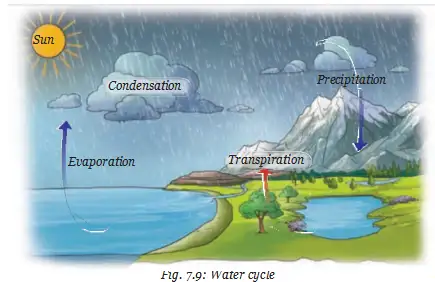
Varahamihira and seasonal rainfall
- Varahamihira: A sixth-century CE astronomer and mathematician from Ujjaini (modern-day Ujjain), Madhya Pradesh.
- Brihatsamhita: His work described methods for predicting seasonal rainfall.
- Prediction factors: He considered cloud formation, wind patterns, the positions of stars and the moon, and other natural phenomena.
Seepage and Groundwater
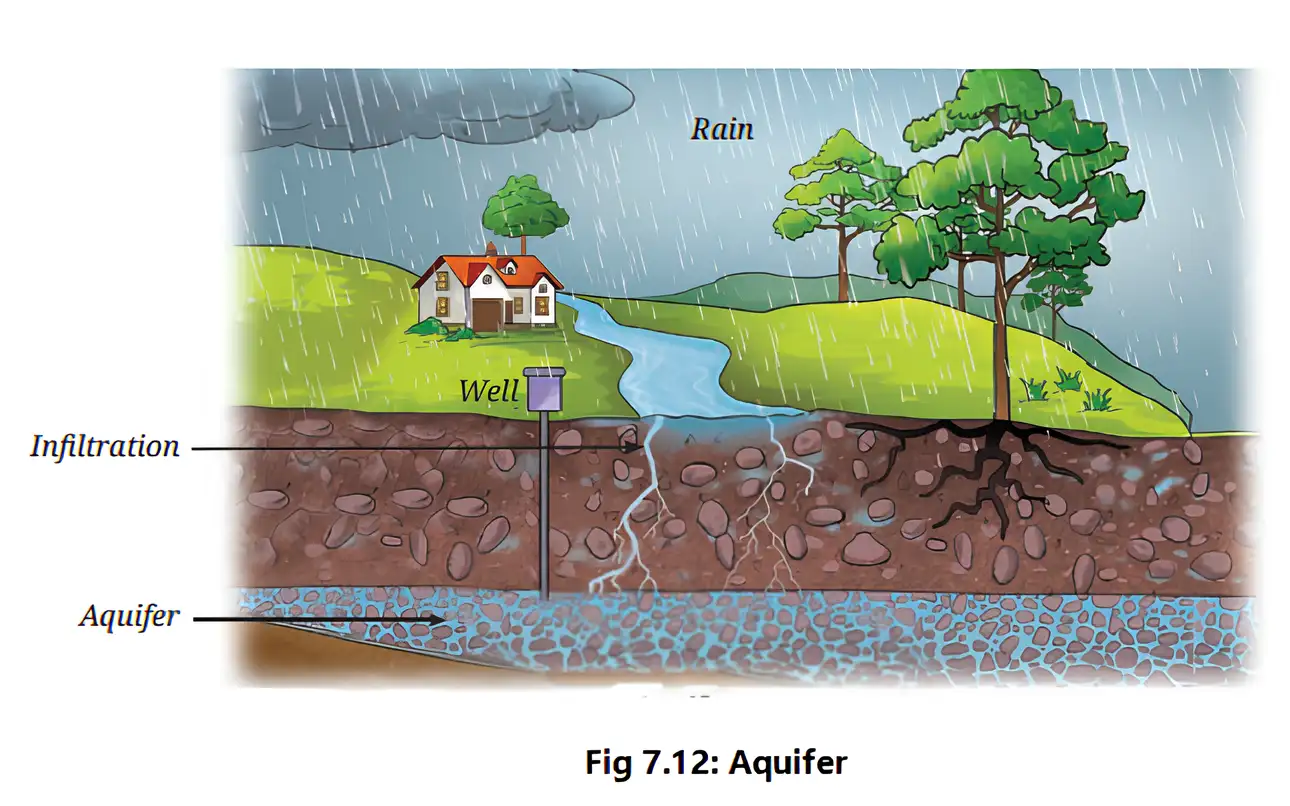
Infiltration — The process by which surface water seeps through soil and rocks into the ground.
| Material | Relative seepage rate | Reason |
|---|---|---|
| Gravel | Fastest | Wide spaces between particles allow water to pass easily. |
| Sand | Slower than gravel | Spaces between particles are less wide than in gravel. |
| Clay | Slowest | Very small spaces make water seep through less readily. |
What affects infiltration?
- Greater infiltration: Water enters more readily when spaces between soil and rock particles are wide, open and interconnected.
- Groundwater storage: Infiltrated water collects in sediment pore spaces and openings in rocks beneath Earth’s surface.
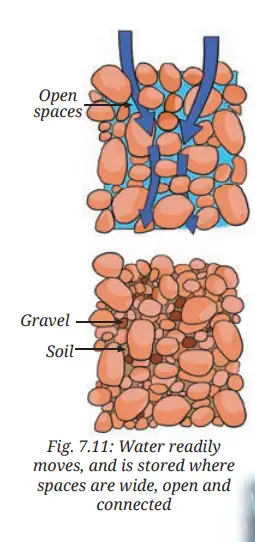
Aquifer — An underground layer of sediments or rocks that stores water in its pore spaces and openings.
Groundwater
- Extraction: Wells and bore wells draw groundwater from aquifers.
- Depth: Groundwater may lie from a few metres to hundreds of metres below the ground, depending on location.
- Recharge: Infiltration replenishes groundwater stores.
Groundwater Depletion and Conservation
Why groundwater is being depleted
- Growing population increases water requirements → excessive groundwater extraction.
- Reduced vegetation cover and more concrete surfaces in urban areas → less water infiltrates the ground.
- Excessive extraction plus reduced infiltration → groundwater stores are depleted.
Ways to conserve groundwater
- Rainwater harvesting and recharge pits help water enter the ground and replenish groundwater.
- Water cycle: By recharging groundwater sources, the cycle supports a more sustainable water supply.
Ice Stupas in Ladakh
Purpose and formation
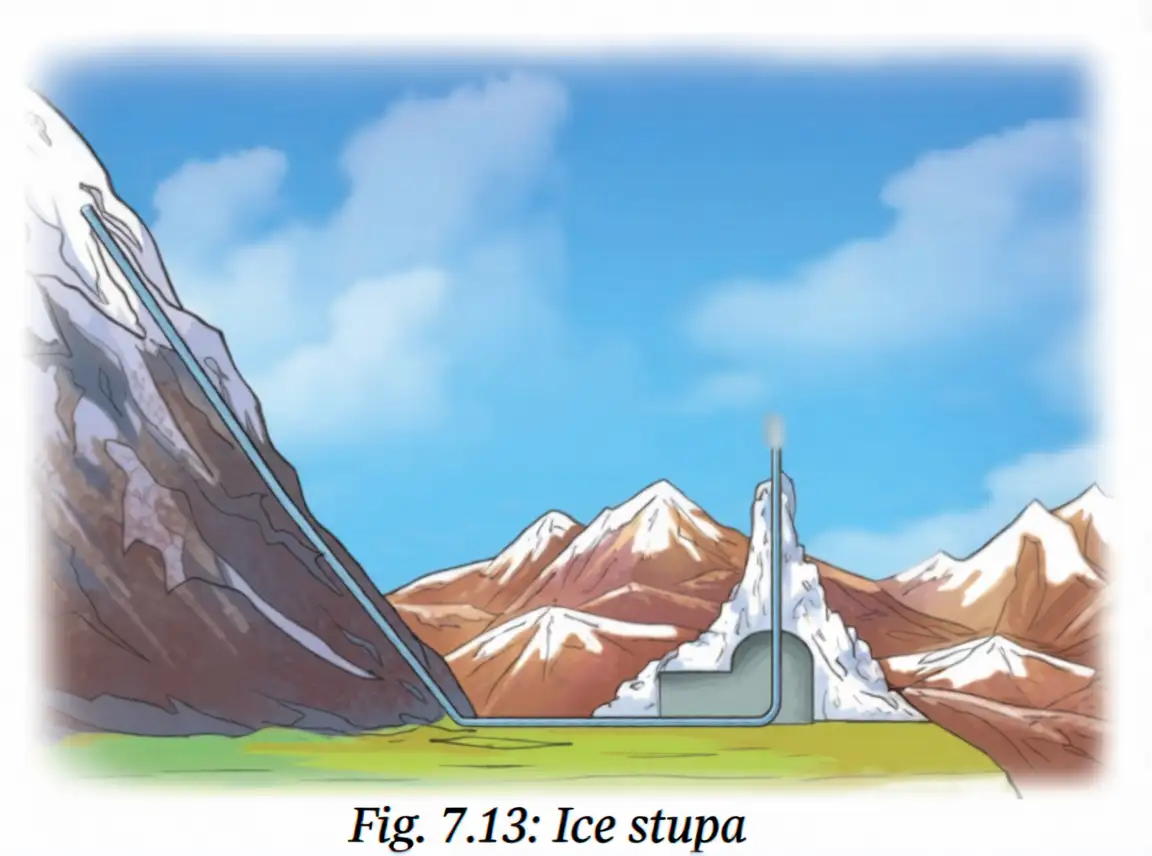
- Need: In spring, streams in Ladakh may dry up before mountain snow melts enough to provide water.
- Winter construction: Stream water is directed through underground pipes and sprayed into the cold air.
- Freezing: The sprayed water freezes in the low temperatures and builds up layer by layer into a tall, cone-shaped ice stupa.
- Use: The ice stupa melts slowly in spring, supplying water for farming and other needs through summer.
What is infiltration, and what conditions help it occur?
How are groundwater stores depleted, and how can they be replenished?
How does an ice stupa help people in Ladakh?
Quick recap
- The water cycle moves water continuously through the atmosphere, land, underground and water bodies.
- Evaporation and transpiration add water vapour; condensation forms clouds; precipitation returns water to Earth.
- Varahamihira’s Brihatsamhita described seasonal-rainfall predictions using natural factors such as clouds and winds.
- Infiltration is fastest through gravel and slowest through clay because particle spaces differ in size.
- Aquifers store groundwater, which wells and bore wells can extract.
- Excessive extraction and reduced infiltration contribute to groundwater depletion; harvesting and recharge pits help replenish it.
- Ice stupas store winter water as ice and release it gradually during spring and summer.
Summary
Ways Heat Is Transferred
| Method | How heat is transferred | Where it mainly occurs | Example |
|---|---|---|---|
| Conduction | From the hotter part to the colder part; particles do not move from their positions. | Solids | Heat passing through a solid object |
| Convection | By the actual movement of particles. | Liquids and gases | Land and sea breezes |
| Radiation | Heat is transferred without requiring a medium. | Can occur without a medium | Heat from the Sun reaching Earth |
Good conductor — A material that allows heat to pass through it easily.
Poor conductor (insulator) — A material that does not allow heat to pass through it easily.
| Point | Conduction and convection | Radiation |
|---|---|---|
| Medium needed | Yes | No |
| How transfer occurs | Conduction: particles stay in place; convection: particles move. | Heat is transferred without a medium. |
Heat Transfer in Daily Life
- Radiation: All objects exchange heat with their surroundings through radiation.
- Applications: Principles of heat transfer are used in designing houses and clothing.
Water Cycle and Groundwater
Water cycle — The continuous movement of water as vapour upward and precipitation downward, eventually returning to water bodies.
Water Movement
- Water moves upward as water vapour.
- Water returns downward through precipitation.
- It passes through soil, rocks and plants, and eventually returns to water bodies.
Infiltration — The process by which surface water seeps through soil and rocks.
Groundwater — Water that seeps underground and is stored in sediment pore spaces and openings in rocks.
Aquifer — An underground layer of sediments and rocks that stores water in pore spaces.
Quick recap
- Heat transfers by conduction, convection and radiation.
- Conduction transfers heat without particle movement; convection involves actual particle movement.
- Conduction and convection need a medium, while radiation does not.
- Water continuously moves through the water cycle and returns to water bodies.
- Infiltration is surface water seeping through soil and rocks.
- Groundwater is stored underground; aquifers are layers of sediments and rocks that store it.
Science — ALL CHAPTERS
1
The Ever-Evolving World of Science
2
Exploring Substances: Acidic, Basic, and Neutral
3
Electricity: Circuits and their Components
4
The World of Metals and Non-metals
5
Changes Around Us: Physical and Chemical
6
Adolescence: A Stage of Growth and Change
7
Heat Transfer in Nature
8
Measurement of Time and Motion
9
Life Processes in Animals
10
Life Processes in Plants
11
Light: Shadows and Reflections
12
Earth, Moon, and the Sun