Class 7 . Science . Curiosity . Life Processes in Plants
Chapter 10: Life Processes in Plants
Ch 10
Science
Class 7
How Do Plants Grow?
Plant Growth
- Plant growth: Plants grow by increasing in height, developing new leaves and branches, and thickening their stems.
- Growth needs: Plants need food and water to grow and develop.
Conditions Needed for Growth
- Sunlight: Plants need sunlight for healthy growth.
- Water: Plants need an adequate supply of water to grow.
- Best growth: A plant given both sunlight and water grows better than one kept without either condition.
- Without water: A plant may die even when it receives sunlight.
Quick recap
- Growth brings new leaves and branches, increased height, and a thicker stem.
- Nutrients and water are essential for plant growth.
- Sunlight and water together support better plant growth.
- A plant without water may die, even if it receives sunlight.
- A plant with water but no sunlight grows less well than one receiving both.
How Do Plants Get Food for their Growth? – Role of Leaves
Leaves: Food Factories of Plants
Plant food — Plants make their own food, which they store mainly as starch, a type of carbohydrate.
Why leaves can make food
- Leaves are the main places where plants prepare starch.
- Shape: Leaves are generally broad and flat.
- Chlorophyll is the green pigment in leaves that helps capture sunlight efficiently and is essential for preparing starch.
- Growth: Water and sunlight are essential for plant growth; sunlight also contributes to food production.
Testing Leaves for Starch
Iodine test
- Starch indicator: Iodine solution turns blue-black when starch is present.
- Decolourising a leaf makes the iodine colour change easier to see.
Sunlight and Chlorophyll in Food Production
| Plant condition | Leaf area tested | Result after iodine test |
|---|---|---|
| Kept in sunlight | Green patches | Turned blue-black, showing starch was present. |
| Kept in sunlight | Non-green patches | Did not turn blue-black; they may not have enough chlorophyll to make detectable starch. |
| Kept in the dark for 36 hours | Green and non-green patches | No blue-black colour appeared; no starch was detected. |
What the results show
- Sunlight matters: Green patches formed detectable starch when the plant was kept in sunlight, but not after the plant was kept in darkness.
- Chlorophyll matters: Starch was detected in the green patches, showing that chlorophyll is essential for preparing starch in sunlight.
- Non-green patches: Their failure to show starch does not prove chlorophyll is completely absent; there may be too little to make detectable starch.
- Other pigments: Red, violet or brown pigments may hide the green colour. Some of these pigments also help in photosynthesis.
Quick recap
- Plants make their own food and store it mainly as starch, a carbohydrate.
- Leaves are the main food-making sites and are generally broad and flat.
- Chlorophyll helps capture sunlight and is essential for preparing starch in sunlight.
- Iodine turns blue-black when starch is present; decolourising a leaf makes this change easier to observe.
- Green patches exposed to sunlight show starch, while leaves kept in darkness do not show detectable starch.
- Non-green colour may hide chlorophyll, and some coloured pigments also help in photosynthesis.
How Do Plants Get Food for their Growth? - Role of Air
Carbon Dioxide Is Needed to Make Food
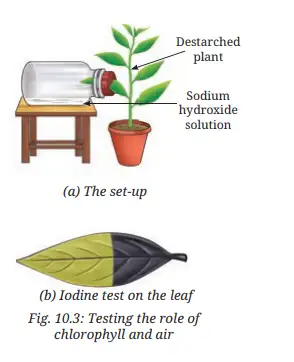
Evidence That Carbon Dioxide Is Essential
- Setup: Caustic soda (sodium hydroxide) absorbs carbon dioxide from the air inside the bottle.
- Inside the bottle: The leaf part has water, sunlight and chlorophyll, but no carbon dioxide; it does not form starch.
- Outside the bottle: The leaf part has access to carbon dioxide and forms starch, shown by a blue-black colour in the iodine test.
- Conclusion: Carbon dioxide from the air is essential for plants to prepare starch (food).
| Leaf part | Carbon dioxide available? | Starch detected? |
|---|---|---|
| Inside bottle | No; absorbed by caustic soda | No |
| Outside bottle | Yes | Yes; iodine turns blue-black |
Oxygen Is Released During Photosynthesis
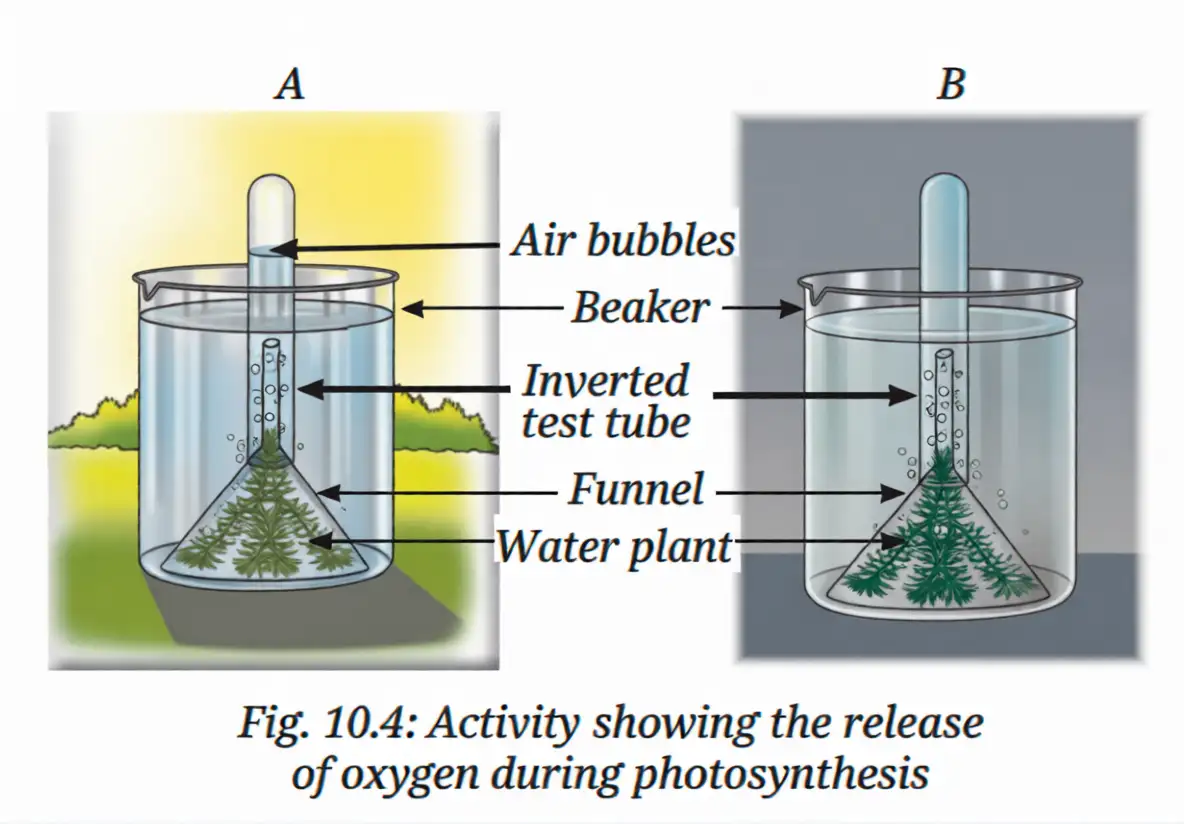
Evidence for Oxygen Release
- In sunlight: Gas bubbles emerge from the aquatic plant and collect in an inverted test tube; the gas is rich in oxygen.
- Test: A lit matchstick burns with an intense flame in the collected gas, indicating oxygen.
- Conclusion: Photosynthesis releases oxygen and occurs in the presence of sunlight.
What does the bottle experiment show?
What does the gas collected from the aquatic plant show?
Quick recap
- Photosynthesis requires carbon dioxide, water, sunlight and chlorophyll.
- Leaves are the primary site; other green parts containing chlorophyll can also photosynthesise.
- Caustic soda absorbs carbon dioxide, so the leaf part inside the bottle does not form starch.
- Iodine turns blue-black where starch is present.
- Oxygen is released during photosynthesis, which takes place in sunlight.
Photosynthesis and Gas Exchange in Plants
Photosynthesis and Food Formation
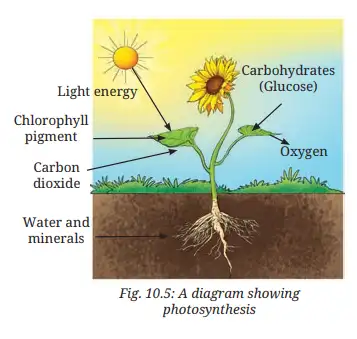
Photosynthesis — The process by which green plants use sunlight, water and carbon dioxide to make food, with chlorophyll present.
Food formed
- Requirements: Water, carbon dioxide, sunlight and chlorophyll are needed for photosynthesis.
- Glucose: The food is first made as glucose, a simple carbohydrate that provides energy.
- Storage: Some glucose is later converted into starch for storage.
- Scientist: R. H. Dastur studied the effects of water amount, temperature and light colour on photosynthesis.
Word equation
- Carbon dioxide + water —(sunlight and chlorophyll)→ glucose + oxygen
Gas Exchange in Leaves
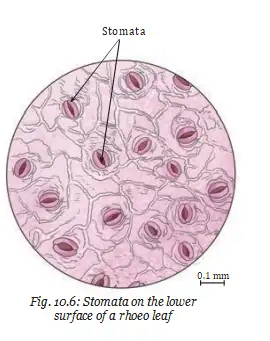
Stomata — Tiny pores on the surface of leaves that help exchange gases.
Role in photosynthesis
- Carbon dioxide enters the leaf through stomata and is used in photosynthesis.
- Oxygen produced during photosynthesis leaves the leaf through stomata.
- Location: Stomata are found on leaf surfaces; the lower surface is one place where they can be seen.
What are the raw materials and products of photosynthesis?
Quick recap
- Photosynthesis requires water, carbon dioxide, sunlight and chlorophyll.
- Glucose is the first food formed; some is stored as starch.
- Oxygen is released during photosynthesis.
- Stomata are tiny leaf pores that help exchange gases.
- Carbon dioxide enters and oxygen exits through stomata during photosynthesis.
Transport in Plants
Transport of Water and Minerals
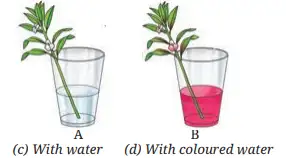
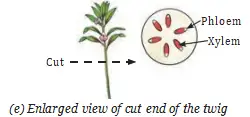
Transport of Food
| Point | Xylem | Phloem |
|---|---|---|
| Transports | Water and dissolved minerals | Food made in the leaves |
| Route / source | Carries water and minerals upwards from the roots | Carries food from the leaves to other parts |
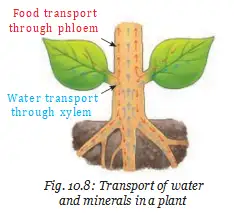
How do water and minerals move from roots to other parts of a plant?
How is food transported in a plant, and where may it be stored?
Quick recap
- Roots absorb water and dissolved minerals from the soil.
- Xylem transports water and minerals upwards through the plant.
- Red colour spreading through a plant in coloured water demonstrates water transport.
- Leaves are the primary site of photosynthesis and prepare food.
- Phloem transports food from the leaves to other parts of the plant.
- Food may be stored in roots and seeds.
Do Plants Respire?
Respiration in Plants
- Respiration: Plants release energy by breaking down glucose using oxygen.
- Importance: The energy released supports plant growth and development.
Evidence of Respiration
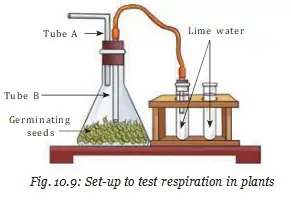
Why does limewater connected to germinating seeds turn milky?
Obtaining Energy from Food
- Plant processes: Plants have different mechanisms for synthesising, transporting and utilising food to obtain energy.
Quick recap
- Plants respire by breaking down glucose in the presence of oxygen.
- Respiration produces carbon dioxide and water and releases energy.
- Carbon dioxide turns limewater milky; germinating seeds release it as they respire.
- All plant parts, green and non-green, carry out respiration.
- Plants use respiration energy for growth and development.
- Plants synthesise, transport and utilise food through different mechanisms to obtain energy.
Summary
Why Living Organisms Need Food
- Food provides energy needed for growth and development.
Photosynthesis
Photosynthesis — The process by which plants use carbon dioxide and water, with sunlight and chlorophyll, to make glucose and release oxygen.
- Leaves are the plant’s “food factories” because they make food by photosynthesis.
- Requirements: carbon dioxide, water, sunlight and chlorophyll.
- Products: glucose and oxygen.
Gas Exchange and Transport
- Stomata are tiny pores on leaf surfaces that allow oxygen and carbon dioxide to exchange during photosynthesis and respiration.
- Xylem transports water and minerals from the roots.
- Phloem carries food made in the leaves to all parts of the plant.
| Tissue | What it transports | Direction or destination |
|---|---|---|
| Xylem | Water and minerals | From roots |
| Phloem | Food | From leaves to all parts of the plant |
Respiration
Respiration — The process in which plants break down glucose using oxygen and release energy.
- Respiration: plants use oxygen and release carbon dioxide as glucose is broken down.
- Outcome: energy is released for the plant’s life processes.
Quick recap
- Food provides living organisms with energy for growth and development.
- Photosynthesis uses carbon dioxide and water, with sunlight and chlorophyll, to make glucose and oxygen.
- Leaves are the food-making parts of plants; stomata allow gas exchange.
- Xylem carries water and minerals from roots; phloem distributes food from leaves.
- Respiration breaks down glucose using oxygen, releasing energy and carbon dioxide.
Science — ALL CHAPTERS
1
The Ever-Evolving World of Science
2
Exploring Substances: Acidic, Basic, and Neutral
3
Electricity: Circuits and their Components
4
The World of Metals and Non-metals
5
Changes Around Us: Physical and Chemical
6
Adolescence: A Stage of Growth and Change
7
Heat Transfer in Nature
8
Measurement of Time and Motion
9
Life Processes in Animals
10
Life Processes in Plants
11
Light: Shadows and Reflections
12
Earth, Moon, and the Sun