NEET UG . NEET Botany . Botany . Biotechnology Principles and Processes
Chapter 12: Biotechnology :Principles and Processes
Ch 12
NEET Botany
NEET UG
Principles of Biotechnology
Biotechnology: Meaning and Development
Scope and development
- EFB definition: Biotechnology integrates natural science with organisms, cells, their parts and molecular analogues to provide products and services.
- Scope: It also includes in vitro fertilisation, gene synthesis, DNA vaccine development and gene therapy.
- Recombinant DNA technology: It enables organisms to gain valuable, novel capabilities that may not occur naturally; this is also called genetic engineering.
- Key contributors: Paul Berg is often called the father of genetic engineering and received the Nobel Prize in 1980. Herbert Boyer studied restriction enzymes; Stanley Cohen studied plasmids.
- Boyer and Cohen: They combined DNA segments in a chosen arrangement and introduced them into bacteria, which could then produce specific proteins.
Core Principles and Techniques
| Technique | What it involves | Purpose/examples |
|---|---|---|
| Genetic engineering | Altering DNA or RNA and introducing it into a host organism. | Changes the host's phenotype through desired genetic material. |
| Chemical engineering | Maintaining sterile, contamination-free conditions so only the desired microbe or eukaryotic cell grows in large quantities. | Manufacture of products such as antibiotics, vaccines and enzymes. |
Genetic engineering and recombinant DNA
- Main techniques: Create recombinant DNA, clone genes and transfer genes into a host.
- Selectivity: These methods introduce only one or a few desirable genes, avoiding the transfer of unwanted genes.
- First recombinant DNA: Stanley Cohen and Herbert Boyer constructed it in 1972 using a plasmid carrying an antibiotic-resistance gene from *Salmonella typhimurium*.
- Plasmid: A small, circular, extra-chromosomal DNA molecule that can replicate independently.
Creating a Genetically Modified Organism
Three basic steps
- Identify the DNA containing the desired gene(s).
- Introduce the identified DNA into the host.
- Maintain the introduced DNA in the host and ensure it is transferred to the host's progeny.
How introduced DNA is copied
- Foreign DNA alone cannot multiply in a host.
- It must integrate into the host's replicating genetic material, or be linked to a DNA sequence that permits replication.
- The origin of replication (ori) is the specific DNA sequence where replication begins.
- Linking foreign DNA to an ori allows it to replicate in the host; producing many identical copies of template DNA is called cloning.
Making Recombinant DNA
Joining foreign DNA to a vector
- Restriction enzymes cut DNA at specific locations and are called molecular scissors.
- A vector, such as a plasmid, carries the cut foreign DNA into a host.
- DNA ligase joins the ends of the foreign DNA and vector DNA.
- The resulting in vitro combination is recombinant DNA; when circular and able to replicate independently, it can multiply in the host.
- Origin of replication (ori)
- DNA sequence that initiates replication.
- Cloning
- Producing multiple identical copies of a template DNA.
- Vector
- DNA molecule that carries foreign DNA into a host.
- Recombinant DNA
- DNA formed by joining foreign DNA to vector DNA in vitro.
Name the two core techniques of modern biotechnology.
What are the three basic steps in creating a genetically modified organism?
Quick recap
- Biotechnology uses organisms, cells or their components to make useful products and services.
- Modern biotechnology relies on genetic engineering and sterile large-scale growth of desired cells.
- Recombinant DNA technology combines desired foreign DNA with a vector for transfer and replication.
- A host needs an ori-linked or integrated DNA sequence for the introduced DNA to replicate.
- Restriction enzymes cut DNA, vectors carry it, and DNA ligase joins DNA ends.
- GMOs are made by identifying, introducing and maintaining desired DNA through progeny.
Tools of Recombinant DNA Technology
Biological Tools
- Three biological tools: Recombinant DNA technology uses restriction enzymes, cloning vectors and competent host cells.
- Purpose: Together, these tools enable foreign DNA to be joined to a vector and introduced into a host for replication or expression.
Restriction Enzymes and DNA Cutting
| Type | Features | Use in recombinant DNA technology |
|---|---|---|
| Type I | Three subunits; requires ATP, and S-adenosyl methionine. | Not used |
| Type II | Requires for restriction. | Used; cuts at specific recognition sites |
| Type III | Two different subunits. | Not used |
Recognition Sequences and Ends
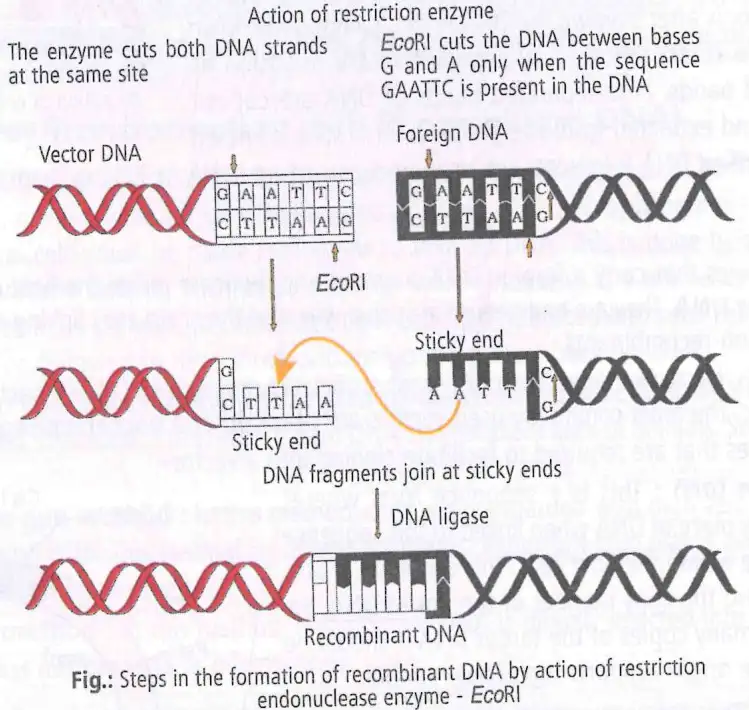
- Palindromic sequence: the base sequence reads the same on both DNA strands when each is read in the same direction, .
- Example: pairs with ; reading the complementary strand also gives GAATTC.
- Cutting: many restriction enzymes cut the two DNA strands at staggered positions, creating protruding ends.
- Sticky ends have complementary overhangs that can pair by hydrogen bonds; DNA ligase seals the DNA backbone to join the fragments.
- Examples: EcoRI and HindIII produce sticky ends; EcoRII and HindII produce blunt ends.

| Enzyme | Function |
|---|---|
| Alkaline phosphatase | Removes the 5′ phosphate group from DNA and modifies its terminus. |
| DNA ligase | Seals gaps in DNA fragments and joins DNA pieces. |
| Reverse transcriptase | Uses mRNA as a template to synthesise DNA or complementary DNA (cDNA). |
Separation and Recovery of DNA Fragments
DNA Fragment Recovery
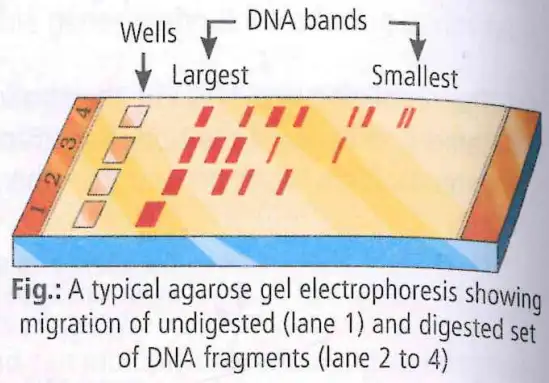
- Restriction digestion produces DNA fragments.
- Gel electrophoresis separates fragments by size.
- EtBr staining and UV exposure reveal DNA bands.
- The required band is excised and eluted to recover purified DNA.
Cloning Vectors
| Feature | Function |
|---|---|
| Origin of replication (ori) | DNA sequence where replication begins; it controls the copy number of linked DNA in the host. |
| Selectable marker | Identifies transformants and helps eliminate non-transformants; antibiotic-resistance genes are commonly used in *E. coli*. |
| Unique cloning site | A restriction-enzyme recognition site where foreign DNA can be inserted; a unique site lets that enzyme cut the vector at one position. |
| Multiple cloning site (MCS) | A small region containing unique recognition sites for several restriction enzymes; also called a polylinker. |
Selectable Markers and Recombinant Identification
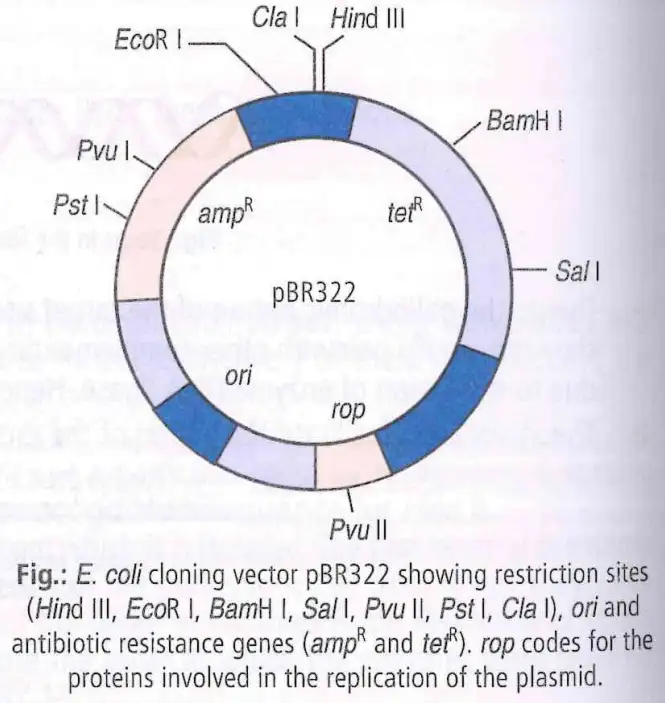
- Antibiotic markers: genes for resistance to ampicillin, chloramphenicol, tetracycline or kanamycin can select transformed *E. coli*; normal *E. coli* lacks these resistances.
- pBR322: restriction sites within its tetracycline-resistance and ampicillin-resistance genes allow selection by insertional inactivation.
- Insertional inactivation: insertion of foreign DNA disrupts a gene, preventing its functional product from being made.
- Blue-white screening: insertion into the coding sequence for β-galactosidase inactivates the gene; with a chromogenic substrate, recombinant colonies are colourless, while non-recombinant colonies produce colour.
- Antibiotic selection limitation: identifying recombinants this way can require plating on two different antibiotic plates.
Specialised Vectors
- pBR322 was the first artificial cloning vector, constructed in 1977 by Bolivar and Rodriguez.
- Shuttle vectors can replicate in both eukaryotic cells and *E. coli*; most eukaryotic vectors are shuttle vectors.
- Plant vectors: the Ti plasmid of *Agrobacterium tumefaciens* has been modified to deliver genes into plants without causing disease.
- Animal vectors: disarmed retroviruses can deliver desirable genes into animal cells.
Competent Hosts and DNA Transfer
| Method | How it works | Use or note |
|---|---|---|
| Biolistic or gene gun | Bombards cells with high-velocity gold or tungsten particles coated with DNA. | Suitable for plants; used to transform wheat, rice and maize. |
| Microinjection | Injects recombinant DNA directly into an animal-cell nucleus using a glass micropipette or microsyringe. | Used for animal cells. |
| Electroporation | An electric pulse creates temporary pores in the host-cell plasma membrane, allowing DNA entry. | A physical method of DNA delivery. |
| Chemical-assisted transfer | Chemicals such as polyethylene glycol (PEG) help foreign DNA enter host cells. | A chemical method of DNA delivery. |
What makes Type II restriction endonucleases especially useful in recombinant DNA technology?
State the main features of a cloning vector.
Quick recap
- Restriction endonucleases recognise specific DNA sequences; Type II enzymes are used in recombinant DNA technology.
- Palindromic recognition sites can yield sticky or blunt ends; DNA ligase joins DNA fragments.
- Gel electrophoresis separates negatively charged DNA by size, and elution recovers selected fragments.
- Vectors need an ori, a selectable marker and a cloning site; insertional inactivation can identify recombinants.
- pBR322 is an artificial vector; modified Ti plasmids and disarmed retroviruses deliver genes into plant and animal cells.
- Competence enables host cells to take up DNA; transfer methods include heat shock, gene gun, microinjection, electroporation and PEG.
Processes of Recombinant DNA Technology
Overview of Recombinant DNA Technology
Recombinant DNA technology — A set of processes used to combine DNA from different sources and produce or study a desired gene product.
Main sequence
- Isolate DNA → cut DNA at specific sites → amplify the gene of interest using PCR.
- Insert recombinant DNA into a host cell → obtain the foreign gene product → downstream processing.
Isolation of Genetic Material
DNA isolation — The removal of plasmid or genomic DNA from cells in a pure form, ready for restriction-enzyme treatment.
- Cell lysis: Cell membrane, and sometimes the cell wall, must be broken to release DNA.
- Cell-wall enzymes: Lysozyme acts on bacteria; cellulase on plant cells; chitinase on fungi.
- DNA purification: Ribonuclease removes RNA, while protease removes proteins such as histones; other contaminants are removed by suitable treatments.
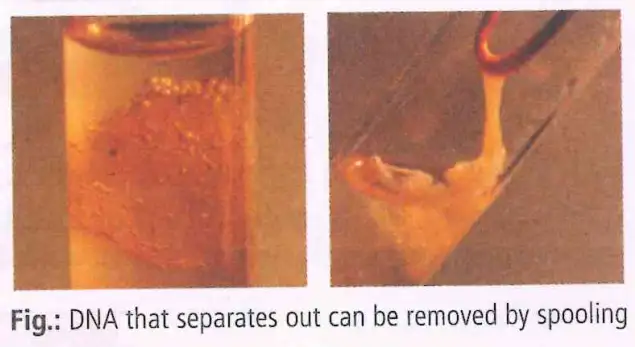
- Precipitation: Chilled ethanol causes purified DNA to precipitate so it can be collected by spooling.
Cutting DNA at Specific Locations
- Restriction digestion: Incubate purified DNA with the restriction enzyme that recognises the required specific site, under optimal conditions.
- Monitoring: Agarose gel electrophoresis is used to check the progress of restriction digestion.
- Recombinant DNA formation: Cut source DNA containing the desired gene and cut vector DNA with the same restriction enzyme; mix them and add DNA ligase to join them.
Amplification of the Gene of Interest Using PCR
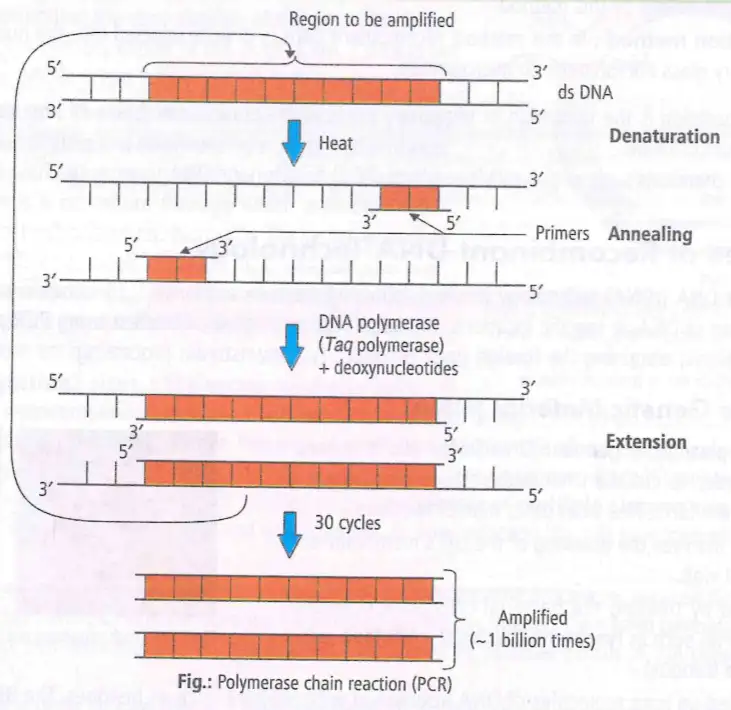
Polymerase chain reaction (PCR) — An in-vitro DNA replication technique that makes many copies of a selected DNA segment.
PCR essentials
- Requirements: Template DNA, two primers, supplied nucleotides and DNA polymerase.
- Extension: DNA polymerase extends the primers, copying the region between them; repeated cycles can produce approximately a billion copies.
- Taq polymerase: The thermostable enzyme from the thermophilic bacterium *Thermus aquaticus* remains active through the high-temperature DNA-denaturation step.
- Origin: Kary Mullis invented PCR in 1985.
- Uses: Diagnosis of pathogens and specific mutations, DNA fingerprinting, prenatal diagnosis and gene therapy.
| Step | What happens | Typical temperature |
|---|---|---|
| Denaturation | Heat separates double-stranded DNA into single strands. | 90–98°C |
| Primer annealing | Two oligonucleotide primers bind to complementary sites on the template strands. | 40–60°C |
| Extension | Taq DNA polymerase synthesises DNA between the primers. | Optimum: 72°C |
Insertion of Recombinant DNA into the Host
- Competent cells: Recipient cells are made capable of taking up DNA from their surroundings.
- Joining DNA: The vector and alien DNA are cut with the same restriction endonuclease. Their complementary sticky ends pair, and DNA ligase joins them to form recombinant DNA.
- Transformation: Uptake of recombinant DNA makes the recipient cell a transformed cell.
- Selectable marker: A marker such as an ampicillin-resistance gene allows transformed cells to be selected; on ampicillin-containing agar, resistant transformants grow while untransformed cells die.
Obtaining the Foreign Gene Product
Recombinant protein — A protein produced when a protein-coding foreign gene is expressed in a heterologous host.
Culturing cells and producing protein
- Expression: After cloning the gene, maintain suitable conditions to induce target-gene expression and produce the desired protein, including at large scale.
- Continuous culture: Used medium is removed as fresh medium is added, keeping cells in the physiologically active log (exponential) phase.
- Yield: Continuous culture builds greater biomass and can increase the yield of the desired protein.
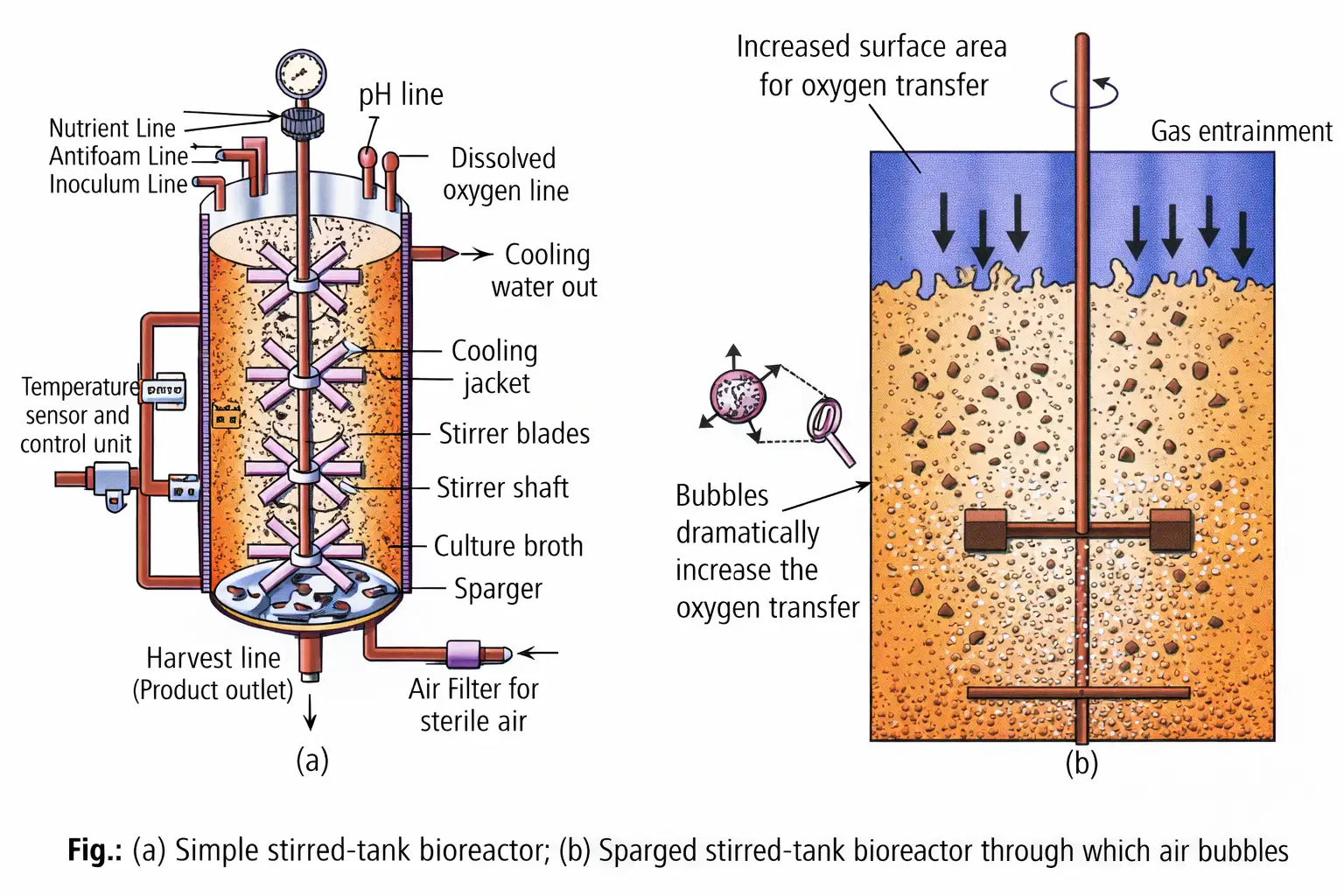
Bioreactor — A vessel in which cells or microbes biologically convert raw materials into specific products under controlled conditions.
Bioreactor conditions and components
- Conditions controlled: Temperature, pH, substrate, vitamins, oxygen and salts are maintained to support product formation.
- Mixing and oxygen: A cylindrical vessel, often with a curved base, facilitates mixing; the stirrer distributes contents and oxygen evenly. Air may also be bubbled through the vessel.
- Systems: Bioreactors include an agitator, oxygen delivery, foam control, temperature and pH controls, and sampling ports for periodic culture checks.
| Type | How oxygen/mixing is provided |
|---|---|
| Simple stirred-tank bioreactor | A stirrer mixes the contents and helps distribute oxygen. |
| Sparged stirred-tank bioreactor | A stirrer mixes the contents while air is bubbled through the culture. |
Downstream Processing
Downstream processing — The separation and purification steps performed after biosynthesis to prepare a product for use or marketing.
From biosynthesis to finished product
- Biosynthesis complete → separate and purify the product.
- Formulate the product with suitable preservatives → conduct clinical trials, as in the case of drugs.
- Apply strict quality-control testing; processing and testing requirements vary by product.
Name the three steps of one PCR cycle and their typical temperatures.
How does an ampicillin-resistance gene act as a selectable marker?
Quick recap
- Isolate and purify DNA before restriction-enzyme digestion.
- Cut source and vector DNA with the same restriction enzyme; DNA ligase joins compatible ends.
- PCR amplifies the target segment through denaturation, primer annealing and extension using Taq polymerase.
- Competent host cells take up recombinant DNA; selectable markers help identify transformants.
- Controlled culturing and bioreactors support recombinant-protein production at scale.
- Downstream processing includes product separation, purification, formulation, clinical trials and quality control.
NEET Botany — ALL CHAPTERS
1
The Living World
2
Plant Kingdom
3
Morphology of Flowering Plants
4
Anatomy of Flowering Plants
5
The Unit of Life
6
Photosynthesis in Higher Plants
7
Respiration in Plants
8
Plant Growth and Development
9
Sexual Reproduction in Flowering Plants
10
Principles of Inheritance and Variation
11
Molecular Basis of Inheritance
12
Biotechnology :Principles and Processes
13
Biotechnology and its Applications