NEET UG . NEET Botany . Botany . Principles of Inheritance and Variation
Chapter 10: Principles of Inheritance and Variation
Ch 10
NEET Botany
NEET UG
Mendel’s Laws of Inheritance
Genetics, Inheritance and Variation
Genetics — The study of inheritance and variation of characters from parents to offspring.
- Inheritance
- The process by which characters pass from parents to progeny; it is the basis of heredity.
- Variation
- The degree to which progeny differ from their parents.
- Selective breeding
- Choosing organisms with desirable characteristics and breeding them to develop preferred varieties.
Early breeding and Mendel’s experiments
- 8000–1000 BCEarly agriculturists recognized that the causes of variation are linked to sexual reproduction and used natural variation and selective crossing to develop domesticated plants and animals.
- 1856–1863Gregor Johann Mendel conducted hybridisation experiments on garden peas.
Selective breeding
- Variation occurs naturally in wild populations, with its causes associated with sexual reproduction.
- Breeders select organisms with desirable characters.
- Selected organisms are crossed, and offspring with preferred traits are chosen.
- Repeated selection and crossing develop domesticated varieties.
Key names and example
- Gregor Johann Mendel is known as the Father of Genetics.
- William Bateson gave the term “genetics.”
- Sahiwal cattle of Punjab are a domesticated breed derived from an ancestral wild cow.
Mendel’s Pea-Plant Experiments
Experimental setup
- Organism and duration: Mendel studied garden pea, *Pisum sativum*, in hybridisation experiments for seven years.
- Contrasting traits: He examined characters with two opposing forms, such as tall versus dwarf plants and yellow versus green seeds.
- True-breeding line: After continuous self-pollination, it shows stable inheritance and expression of a trait for several generations.
- Selection: Mendel chose 14 true-breeding varieties in pairs; each pair differed in one character with contrasting traits.
- Pollination: He used artificial cross-pollination to carry out controlled crosses.
| Character | Dominant trait | Recessive trait |
|---|---|---|
| Plant height | Tall (T) | Dwarf (t) |
| Flower position | Axillary (A) | Terminal (a) |
| Pod colour | Green (G) | Yellow (g) |
| Pod shape | Inflated (I) | Constricted (i) |
| Flower colour | Violet (V) | White (v) |
| Seed shape | Round (R) | Wrinkled (r) |
| Seed colour | Yellow (Y) | Green (y) |
| Feature | Importance |
|---|---|
| Short life cycle | An annual plant with a life cycle of about 2–3 months allows generations to be studied quickly. |
| Contrasting traits | Many clearly distinguishable pairs of traits are available for study. |
| Natural self-pollination | This helps maintain true-breeding lines. |
| Artificial cross-pollination is possible | Controlled hybridisation can be carried out. |
| Easy cultivation | Plants are convenient to grow and study. |
| Many seeds | Large numbers of offspring can be examined. |
What is a true-breeding line?
Quick recap
- Genetics studies inheritance and variation; inheritance passes characters from parents to progeny.
- Early agriculturists linked variation to sexual reproduction and used natural variation for selective breeding.
- Mendel is the Father of Genetics; William Bateson gave the term “genetics.”
- Mendel conducted pea hybridisation experiments for seven years, from 1856 to 1863.
- He selected 14 true-breeding varieties in pairs that differed in one contrasting character.
- Peas were suitable because they have a short life cycle, contrasting traits, controllable pollination, easy cultivation and many seeds.
Inheritance of One Gene
Mendel’s Monohybrid Cross
Monohybrid cross — A cross between individuals differing in one character, such as pea plant height.
Pea plant height
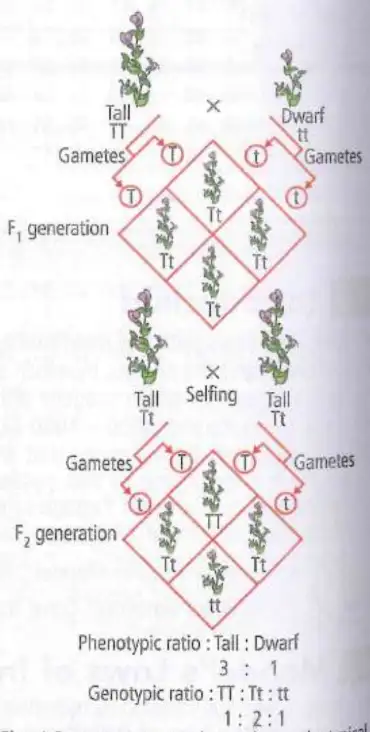
- Parental cross: Mendel crossed true-breeding tall and dwarf pea plants.
- F₁ generation: The first hybrid generation is called the filial generation or ; all its plants were tall.
- F₂ generation: Self-pollination of tall plants produced both tall and dwarf offspring.
- Observed ratio: About were tall and were dwarf, giving a phenotypic ratio.
- No blending: Offspring were tall or dwarf, not intermediate; the hidden dwarf trait reappeared unchanged in .
Genetics Terminology
- Alleles: Slightly different forms of the same gene, such as and .
- Homozygous: Having identical alleles for a character; examples: , , and .
- Heterozygous: Having different alleles for a character; examples: and .
- Monohybrid: An organism heterozygous for one character, such as ; the cross producing it is a monohybrid cross.
- Dominant allele: Expresses its effect in both homozygous and heterozygous states; gives tallness in and .
- Recessive allele: Its effect is masked by a contrasting dominant allele in a heterozygote; produces dwarfness only in .
- Phenotype: Observable external or morphological appearance of a character; it depends on genotype and environmental conditions.
- Genotype: The genetic constitution of an organism for a character. Wilhelm Johannsen coined the terms “genotype” and “phenotype.”
A homozygous tall parent crossed with a homozygous dwarf parent produces heterozygous tall offspring.
Segregation during gamete formation
- Separation: The two alleles of a pair separate during meiosis, so each gamete receives only one allele.
- Random transmission: A heterozygous plant forms and gametes in equal proportions; each allele has a chance of entering a gamete.
- Fertilisation: Fusion of a gamete with a gamete restores the pair in the zygote.
Punnett Square and Test Cross
Punnett square
- Purpose: A graphical representation for calculating the probability of possible offspring genotypes from parental gametes.
- Origin: The method was developed by British geneticist Reginald C. Punnett.
- F₂ cross: Each parent produces and gametes.
Test cross
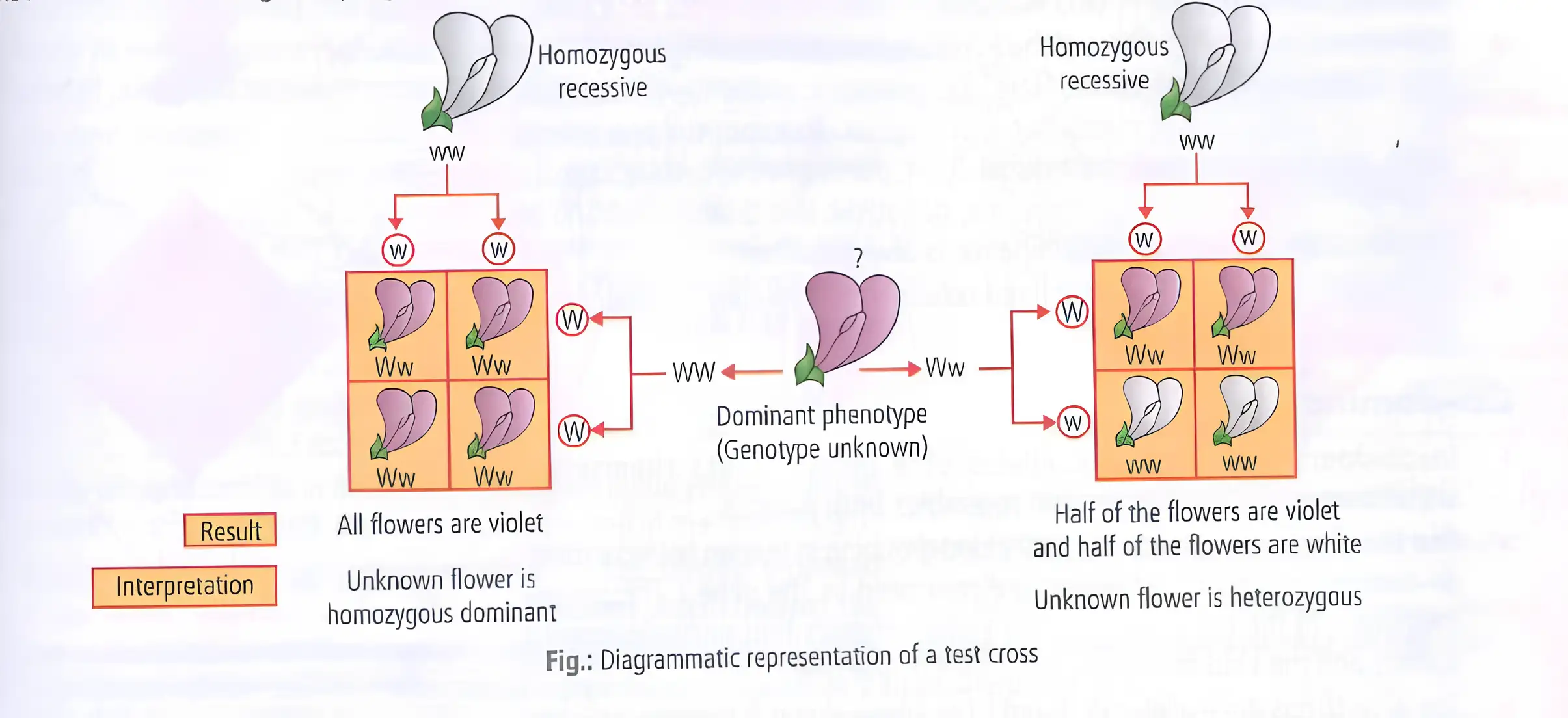
- Definition: Cross an individual with a dominant phenotype but unknown genotype with a homozygous recessive individual.
- Purpose: The offspring reveal whether the unknown parent is homozygous dominant or heterozygous.
- All dominant offspring: Indicate that the unknown parent is homozygous dominant, .
- A dominant-to-recessive ratio: Indicates that the unknown parent is heterozygous, .
Mendel’s Laws of Inheritance
- Mendel’s experiments: Pea-plant crosses revealed predictable patterns in how traits pass from parents to offspring.
- Inheritance principles: Mendel’s observations led to rules explaining how hereditary factors are expressed and transmitted across generations.
Law of Dominance
- Discrete factors: Characters are controlled by paired factors; in a dissimilar pair, the dominant factor is expressed while the recessive factor is masked.
- F₁ and F₂: Dominance explains why only one parental trait appears in the F₁ generation and why both traits reappear in the F₂ generation, typically in a 3:1 phenotypic ratio.
Law of Segregation
- Segregation: The two alleles of a gene separate during gamete formation, so each gamete receives only one allele.
- Gametes: A homozygous parent produces one kind of gamete; a heterozygous parent produces two kinds in equal proportions.
- Purity of gametes: Each gamete carries either the dominant or the recessive allele, without blending.
Incomplete Dominance
Co-dominance and Multiple Alleles
- Co-dominance: Both alleles are expressed together in a heterozygote; in the human ABO system, alleles Iᴬ and Iᴮ are co-dominant.
- Multiple alleles: A gene may have more than two alleles in a population, although each individual carries only two; the ABO gene has Iᴬ, Iᴮ and i.
Gene Products and Dominance
State the Law of Segregation and explain why it is called the Law of Purity of Gametes.
How does a test cross determine the genotype of an individual showing a dominant phenotype?
Differentiate incomplete dominance from co-dominance.
Quick recap
- A monohybrid cross for height gives all tall plants in the filial generation and a tall-to-dwarf ratio in .
- Alleles are alternative forms of a gene; they segregate into gametes, each of which receives one allele.
- Dominance explains why one allele’s trait appears in a heterozygote; segregation explains the reappearance of a recessive trait.
- A test cross uses a homozygous recessive individual to reveal an unknown dominant-phenotype genotype.
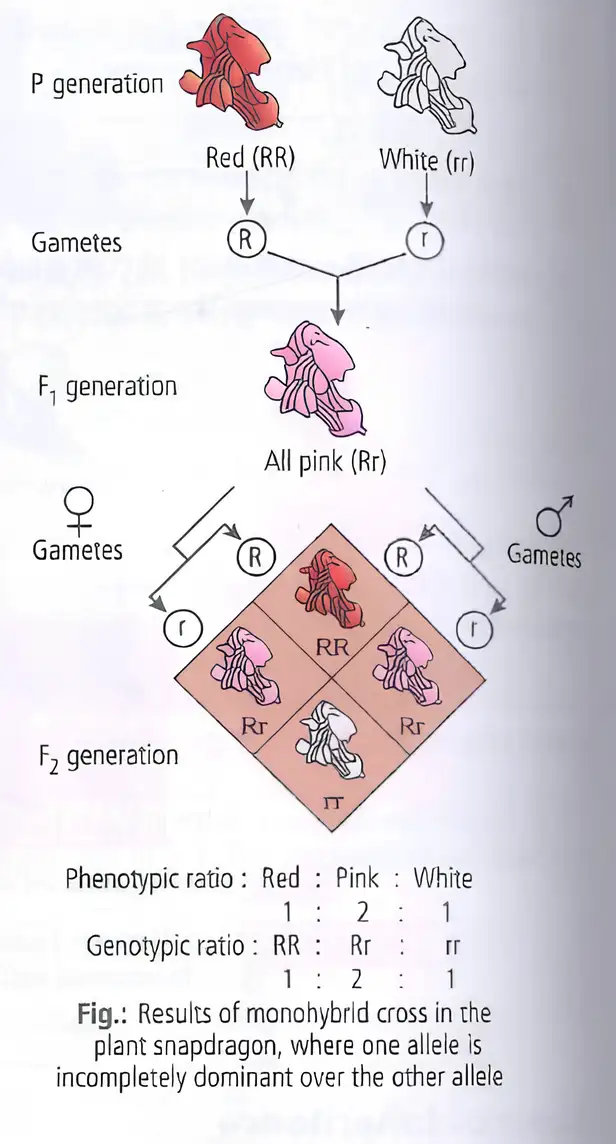
- Incomplete dominance gives an intermediate heterozygote and matching genotype and phenotype ratios.
- Co-dominant ABO alleles and both express; ABO also demonstrates multiple alleles.
- Dominance depends on the gene product and the phenotype being examined.
Inheritance of Two Genes
Law of Independent Assortment
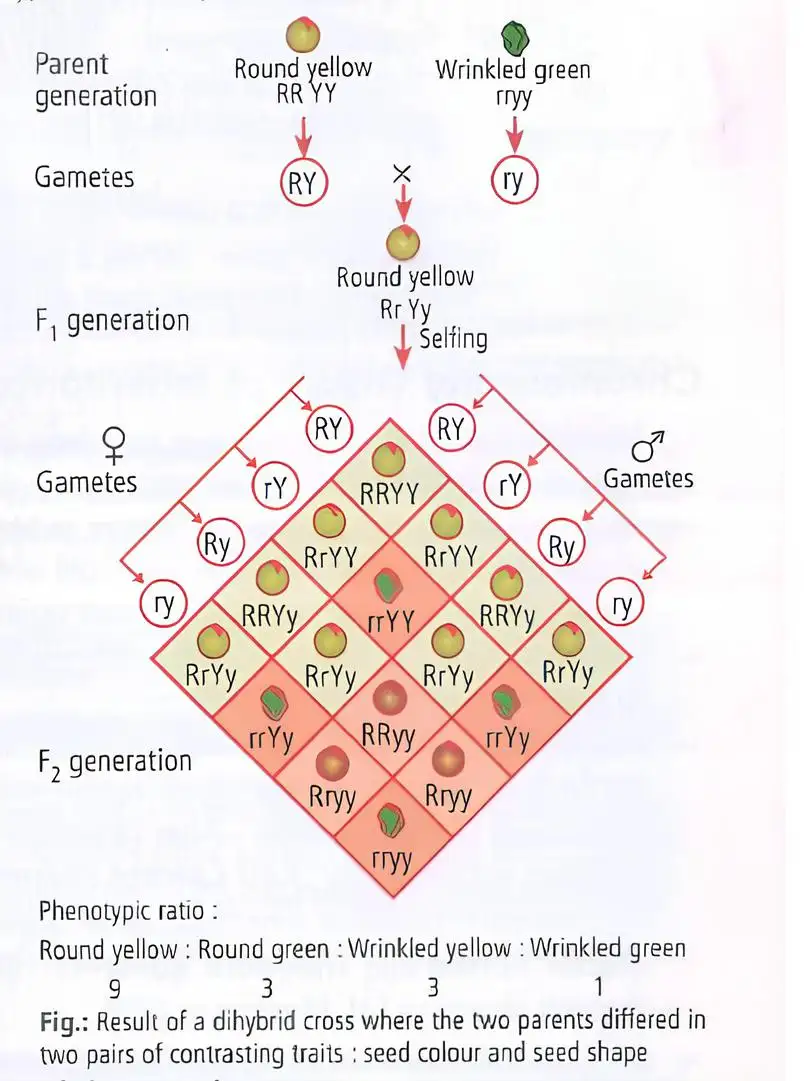
Law of Independent Assortment — When two pairs of traits are combined in a hybrid, the segregation of one pair is independent of the segregation of the other pair.
| Outcome | Number |
|---|---|
| Different gamete types | |
| Different genotypes | |
| Different phenotypes | |
| Example when | 2 gamete types, 3 genotypes, 2 phenotypes |
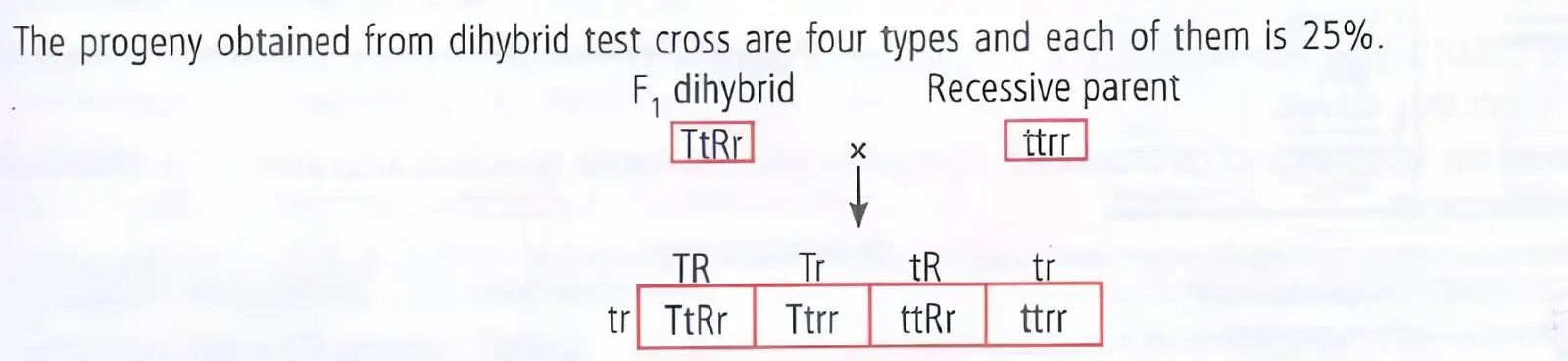
Dihybrid Test Cross
Intergenic Interactions
| Type | Meaning | Key result |
|---|---|---|
| Complementary genes | Two genes at different loci produce the same effect separately but interact to produce a new trait together. | phenotypic ratio: |
| Supplementary genes | One gene produces its effect independently; a second gene produces its effect only when the first is present, often creating a new trait. | phenotypic ratio: |
| Epistasis | One gene suppresses or masks the expression of another gene. | The masking gene affects the other gene’s expression. |
| Pleiotropy | One gene affects several aspects of the phenotype or controls several phenotypes. | One gene has multiple phenotypic effects. |
Chromosomal Theory of Inheritance
Key developments
- 1900Correns, de Vries and von Tschermak independently rediscovered Mendel’s postulates.
- 1902Sutton and Boveri proposed the chromosomal theory of inheritance.
- 1933T. H. Morgan provided experimental verification of the theory.
Main features of the chromosomal theory
- Inheritance: Both sperm and egg contribute equally to the heredity of offspring; chromosomes carry hereditary traits.
- Continuity: Chromosomes retain their number, structure and individuality through an organism’s life and across generations.
- Pairs: Chromosomes and genes occur in pairs in diploid cells; the two alleles of a gene occupy corresponding sites on homologous chromosomes.
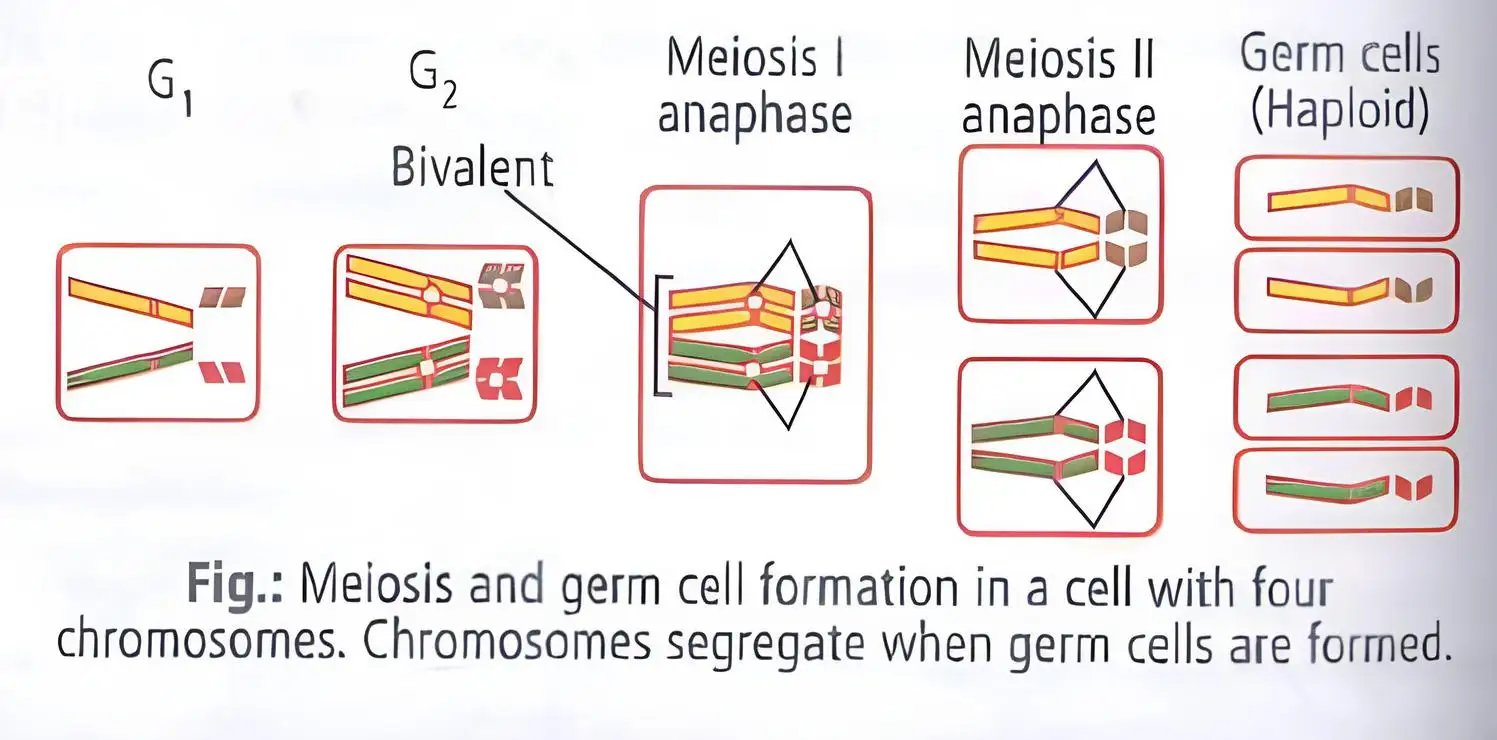
- Independent alignment: During metaphase I, chromosome pairs can align independently at the metaphase plate.
- Segregation: Pairing and separation of homologous chromosomes leads to the segregation of the gene pair they carry.
- Synthesis: Sutton connected chromosome segregation with Mendelian principles to formulate the chromosomal theory of inheritance.
Chromosomal Explanation of Segregation
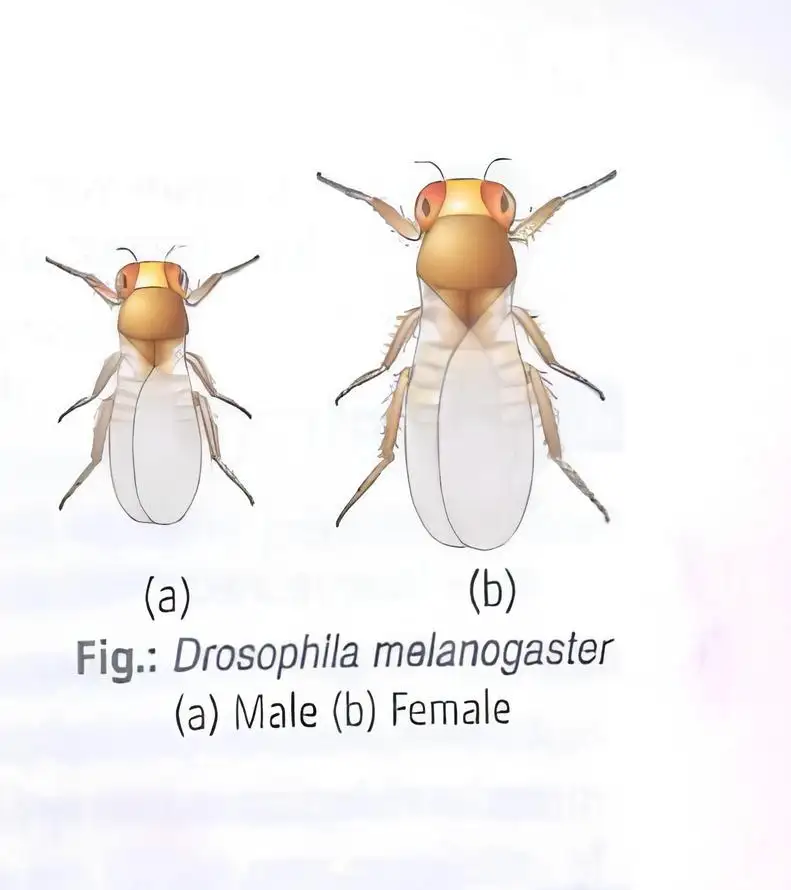
Morgan’s Work with Drosophila
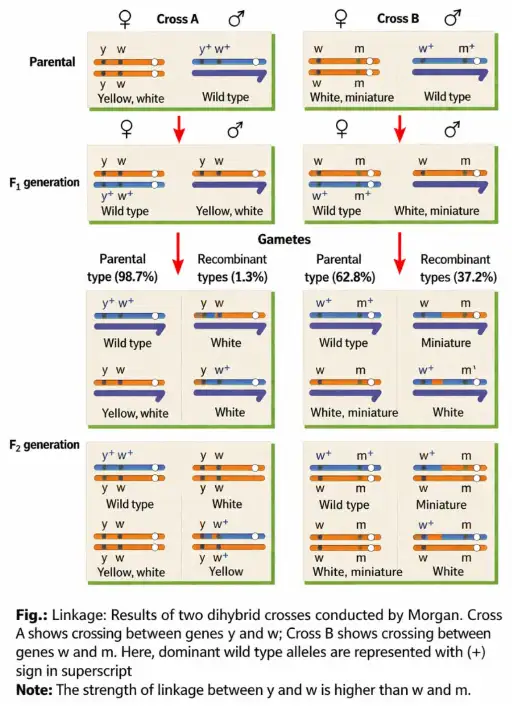
Linkage and Recombination
| Point | Complete linkage | Incomplete linkage |
|---|---|---|
| Crossing over | Absent; the gene grouping remains unchanged. | Occurs between homologous chromosomes. |
| Offspring | Genes are inherited together as a group. | Both parental and recombinant types are produced. |
| Proportions | No recombinant types from crossing over. | Parental types exceed 50%; recombinant types are below 50%. |
Linkage strength and gene mapping
- Linkage strength: Closely linked genes show low recombination; genes farther apart show higher recombination.
- Morgan’s examples: White and yellow genes showed 1.3% recombination; white and miniature-wing genes showed 37.2%.
- Gene mapping: Alfred Sturtevant used recombination frequency between genes on the same chromosome to estimate their distance and map their positions.
- Use today: Genetic maps provide a starting point for sequencing whole genomes.
State Mendel’s law of independent assortment and give the F₂ phenotypic ratio of a dihybrid cross.
Distinguish linkage from recombination.
How did Sturtevant use recombination frequency?
Quick recap
- A dihybrid cross follows two trait pairs; independent assortment gives an ratio of .
- A dihybrid test cross gives a ratio when the genes assort independently.
- Complementary genes, supplementary genes, epistasis and pleiotropy are forms of intergenic interaction.
- The chromosomal theory connects chromosome behaviour during meiosis with Mendelian inheritance.
- Linkage favours parental combinations; recombination produces non-parental combinations.
- Higher recombination frequency generally indicates greater distance between linked genes.
Polygenic Inheritance
Polygenic Inheritance
Polygenic inheritance — Inheritance of a trait controlled by three or more genes, in which the effects of alleles are additive.
Key points and examples
- Additive effect: Each contributing allele adds to the overall expression of the phenotype.
- Examples: Human skin colour and height, and wheat kernel colour are polygenic traits.
- Human skin colour: Melanin pigment determines skin colour; its quantity is influenced by three pairs of polygenes: , and .
- Allele contribution: has the darkest skin colour, while has the lightest.
- Intermediate colour: A genotype with three dominant and three recessive alleles, such as , gives an intermediate skin colour.
Pleiotropy
Pleiotropy — A condition in which one gene influences more than one trait.
Cause and example
- Basis: One gene can affect two or more interrelated metabolic pathways, producing different phenotypic effects.
- Example: Phenylketonuria in humans is caused by mutation in the gene coding for phenylalanine hydroxylase.
- Enzyme role: Phenylalanine hydroxylase is required to convert phenylalanine into tyrosine.
- Effects: Phenylketonuria is associated with intellectual disability (described in older texts as mental retardation) and reduced hair and skin pigmentation.
Quick recap
- Polygenic inheritance involves three or more genes whose allele effects add together.
- Examples include skin colour and height in humans, and kernel colour in wheat.
- Human skin-colour variation involves three gene pairs and the pigment melanin.
- Pleiotropy occurs when one gene influences multiple traits.
- Phenylketonuria is a pleiotropic disorder caused by mutation in the gene for phenylalanine hydroxylase.
Sex Determination
Sex Determination and Chromosomes
Sex determination — The process by which an individual’s sex is established in a species.
Sex chromosomes and autosomes
- Sex chromosomes (allosomes): Chromosomes involved in determining sex; the common sex chromosomes are and .
- Autosomes: All chromosomes other than the sex chromosomes.
- Henking: Reported an -body in about of sperm in some insects.
Types of Chromosomal Sex Determination
| Type | Female | Male | Heterogametic sex and gametes | Examples |
|---|---|---|---|---|
| – | ; homogametic, produces only eggs | ; heterogametic, produces - or -bearing sperm | Male; -bearing sperm are gynosperms and -bearing sperm are androsperms | Humans and *Drosophila* |
| – | ; homogametic | ; heterogametic, produces sperm with or without | Male; an egg fertilised by an -bearing sperm develops as female, while one fertilised by a sperm without develops as male | Some insects, including grasshoppers and cockroaches, and roundworms |
| – | ; heterogametic, produces - or -bearing eggs | ; homogametic, produces one type of sperm | Female | Birds and some reptiles |
| – | (also written in the source) | (also written in the source) | Female has a single sex chromosome; male has two chromosomes | Some butterflies and moths |
Key features of the XX–XY system
- Homogametic: An individual that produces one type of sex-chromosome-bearing gamete; in this system, the female is .
- Heterogametic: An individual that produces two types of gametes; in this system, the male is .
- Autosomes: Males and females have the same number of autosomes.
Haploid–Diploid Mechanism
Sex determined by chromosome-set number
- Occurrence: Found in Hymenoptera, including ants, honeybees and wasps.
- Females: Queens and workers develop from fertilised eggs and are diploid, with chromosomes in honeybees.
- Males: Drones develop from unfertilised eggs by parthenogenesis and are haploid, with chromosomes.
- Sperm formation: Haploid males produce sperm by mitosis; meiosis does not occur during sperm formation.
- Lineage: A male has no father and cannot have sons, but he has a grandfather and can have grandsons.
Sex Determination in Humans
Human chromosome complement and fertilisation
- Chromosome pairs: Humans have pairs: pairs of autosomes and one pair of sex chromosomes.
- Female: The sex-chromosome pair is ; each ovum carries an chromosome.
- Male: The sex-chromosome pair is ; about of sperm carry and carry .
- Outcomes: -bearing sperm + ovum → zygote (female); -bearing sperm + ovum → zygote (male).
- Probability: Each fertilisation has an equal chance of producing either sex; the sperm’s sex chromosome determines the zygote’s chromosomal sex.
- Correct understanding: The mother is not responsible for a child’s sex; blaming or mistreating women for this is based on a false belief.
Sex-Linked and Criss-Cross Inheritance
Sex-linked inheritance — Inheritance of characters whose genes are located on sex chromosomes and are transmitted along with those chromosomes.
Sex-linked traits
- Expression: Recessive sex-linked traits are often more apparent in males because a single recessive allele on their chromosome can be expressed.
- Carriers: Females can carry a recessive allele without showing the trait; it is generally expressed in females only when present in the homozygous state.
- Examples: Colour blindness and haemophilia.
Criss-cross inheritance — A pattern in which a sex-linked trait passes between generations through an offspring of the opposite sex.
| Route | Transmission |
|---|---|
| Diagenic | Father → daughter → grandson |
| Diandric | Mother → son → granddaughter |
In humans, which parent determines the chromosomal sex of the child, and why?
How does sex determination occur in honeybees?
Quick recap
- Sex chromosomes (allosomes) participate in sex determination; other chromosomes are autosomes.
- In –, males are heterogametic; in –, males produce sperm with or without .
- In –, females are heterogametic; – occurs in some moths and butterflies.
- Hymenopteran females are diploid and develop from fertilised eggs; males are haploid and develop from unfertilised eggs.
- Human sperm carrying or have equal probability of fertilising an ovum, producing or offspring.
- Sex-linked traits include colour blindness and haemophilia; criss-cross routes are diagenic and diandric.
Mutation
Mutation — A mutation is an alteration in a DNA sequence that can change an organism’s genotype and phenotype.
Mutation and variation
- Variation: Both mutation and recombination contribute to variation in DNA.
- Chromosomal changes: Loss or gain of a DNA segment alters chromosomes; because genes are located on chromosomes, this can cause abnormalities or aberrations.
- Cancer: Chromosomal aberrations are commonly observed in cancer cells.
Chromosomal Mutations
| Type | Change | Key detail |
|---|---|---|
| Deletion | Loss of a chromosome segment. | May be terminal (from an end) or intercalary (within the chromosome); remaining terminal segments reunite. |
| Duplication | A gene block is present more than once in a haploid complement. | Increases the copy number of that block. |
| Translocation | Chromosomal segments are exchanged between non-homologous chromosomes. | An interchromosomal rearrangement. |
| Inversion | A chromosome segment breaks at two points, rotates through , and rejoins in reverse order. | The segment’s gene order is reversed. |
| Euploidy | Loss of a complete chromosome set or gain of one or more sets beyond the diploid complement. | Types: monoploidy (one set) and polyploidy (more than two sets). |
| Aneuploidy | Addition or loss of one or more chromosomes from the complete diploid complement. | Involves individual chromosomes, not a complete set. |
| Type | Chromosome number |
|---|---|
| Trisomy | |
| Tetrasomy | |
| Monosomy | |
| Nullisomy |
Gene Mutations
Point mutation — A mutation involving a change in a single base pair.
Gene mutation patterns
- Occurrence: Gene mutations may arise naturally due to internal causes.
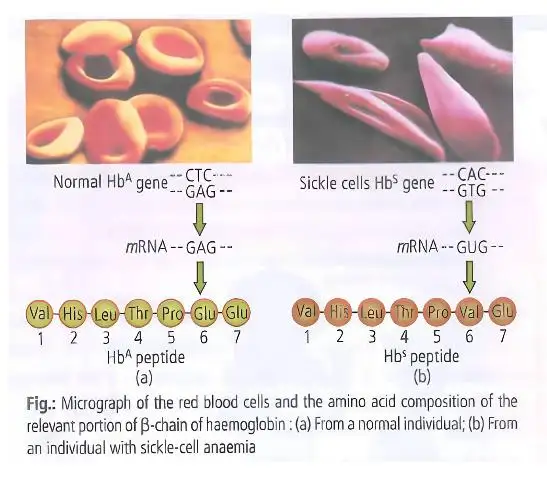
- Example: Sickle-cell anaemia is an example of a point mutation.
- Frameshift mutation: Insertion or deletion of DNA base pairs can shift the reading frame.
Mutagens
Mutagen — A chemical or physical factor that induces mutation.
- Example: Ultraviolet (UV) radiation is a physical mutagen.
Differentiate euploidy from aneuploidy.
What is a frameshift mutation, and what can cause it?
Quick recap
- Mutation changes DNA sequence and may alter genotype and phenotype.
- Mutation and recombination both contribute to DNA variation.
- Chromosomal mutations include deletion, duplication, translocation, inversion, euploidy and aneuploidy.
- Euploidy changes complete chromosome sets; aneuploidy changes individual chromosome numbers.
- A point mutation changes one base pair; insertions or deletions can cause frameshifts.
- Mutagens induce mutations; UV radiation is one example.
Genetic Disorders
Pedigree Analysis
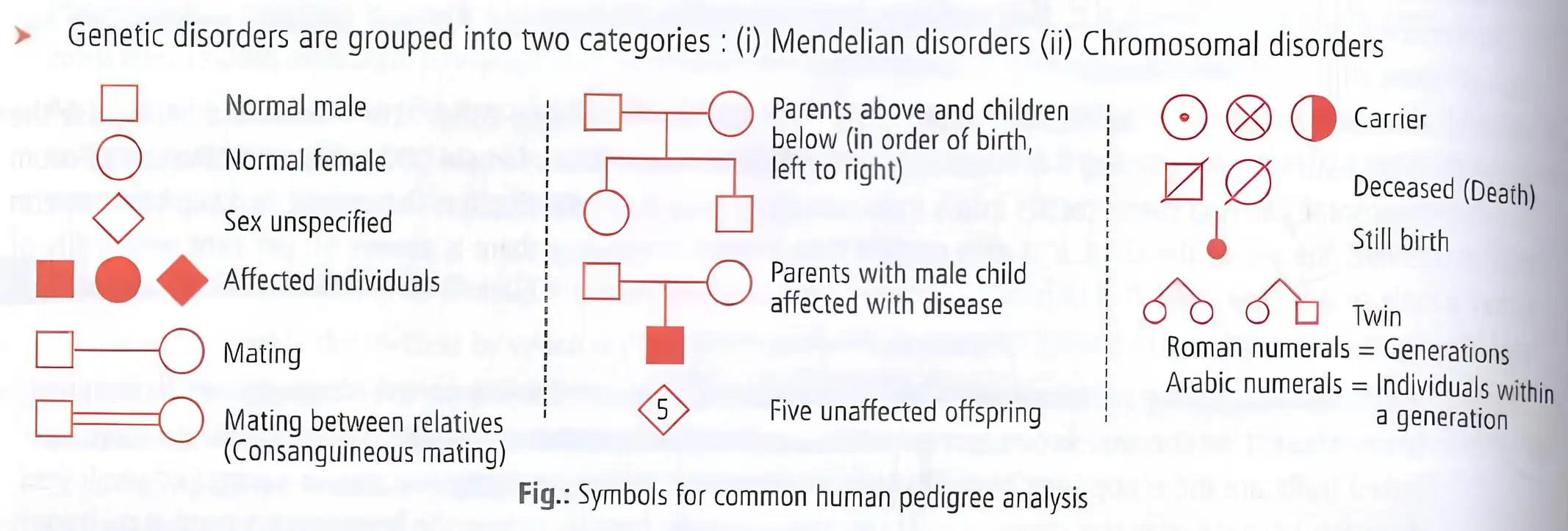
Mendelian Disorders
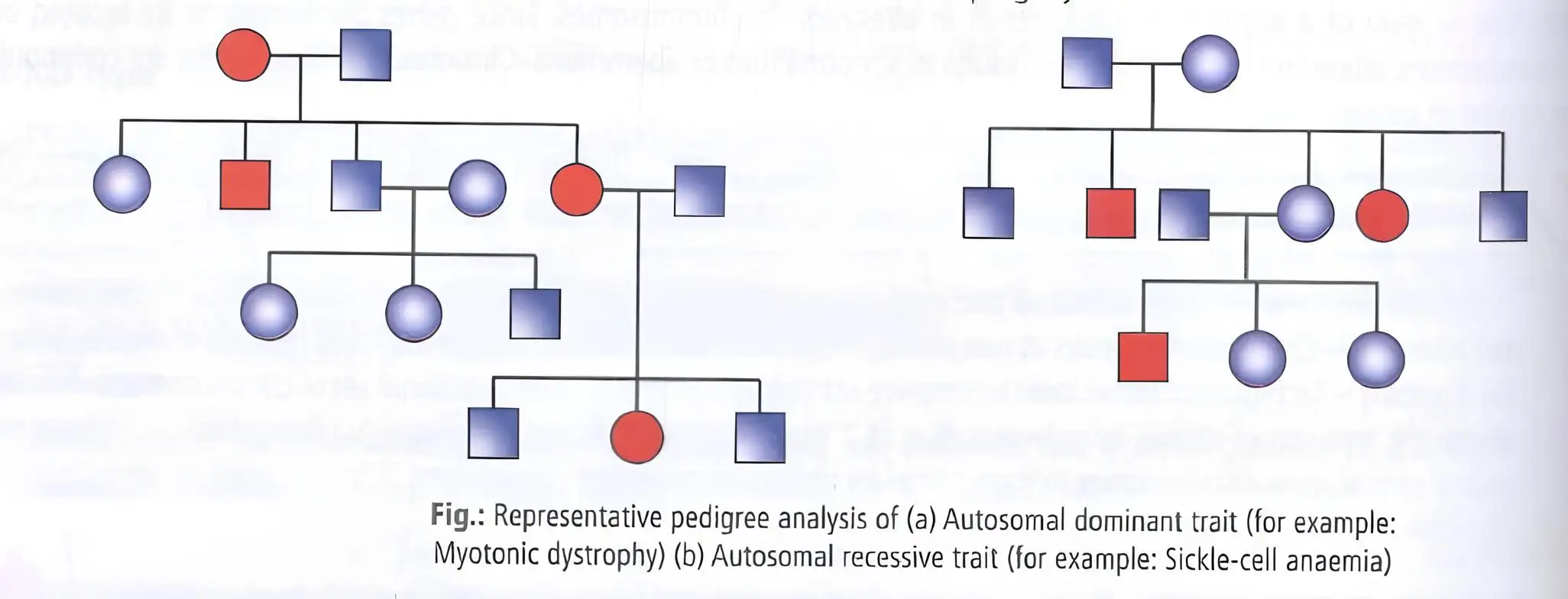
Colour Blindness
- Inheritance: Red-green colour blindness is an X-linked recessive disorder caused by a defect in a red or green cone.
- Occurrence: It affects about 8% of males and 0.4% of females because males have one X chromosome, while females have two.
- Transmission: A carrier mother has a 50% chance of passing the allele to each son; a daughter is usually affected only if her father is colour blind and her mother carries the allele.
Sickle-Cell Anaemia
Haemophilia
- Inheritance: Haemophilia is an X-linked recessive disorder, commonly transmitted from an unaffected carrier mother to some of her sons.
- Effect: A blood-clotting protein is affected, so even a small cut may cause prolonged bleeding.
- Historical example: Queen Victoria was a carrier, and haemophilia occurred among her descendants.
Phenylketonuria
- Inheritance: Phenylketonuria is an autosomal recessive inborn error of metabolism.
- Cause: The affected individual lacks the enzyme that converts phenylalanine into tyrosine.
- Effects: Phenylalanine and its derivatives accumulate; their accumulation in the brain can cause intellectual disability, and they are excreted in urine.
Thalassemia
| Type | Affected globin | Gene and chromosome |
|---|---|---|
| α-thalassemia | Reduced/defective α-globin formation | and on chromosome 16 |
| β-thalassemia | Reduced β-globin synthesis | Alleles of on chromosome 11 |
| δ-thalassemia | Defective δ-globin formation | Defective allele of on chromosome 11 |
| Point | Thalassemia | Sickle-cell anaemia |
|---|---|---|
| Main defect | Quantitative: too few globin molecules are synthesised. | Qualitative: globin is made with an amino-acid substitution and functions abnormally. |
Chromosomal Disorders
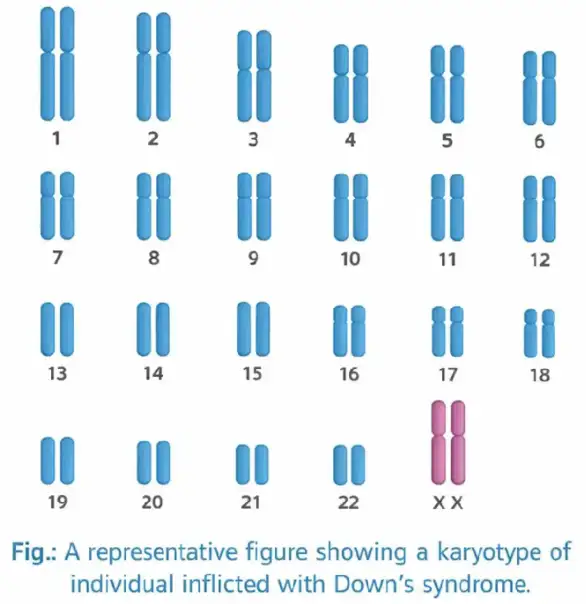
Named Chromosomal Syndromes
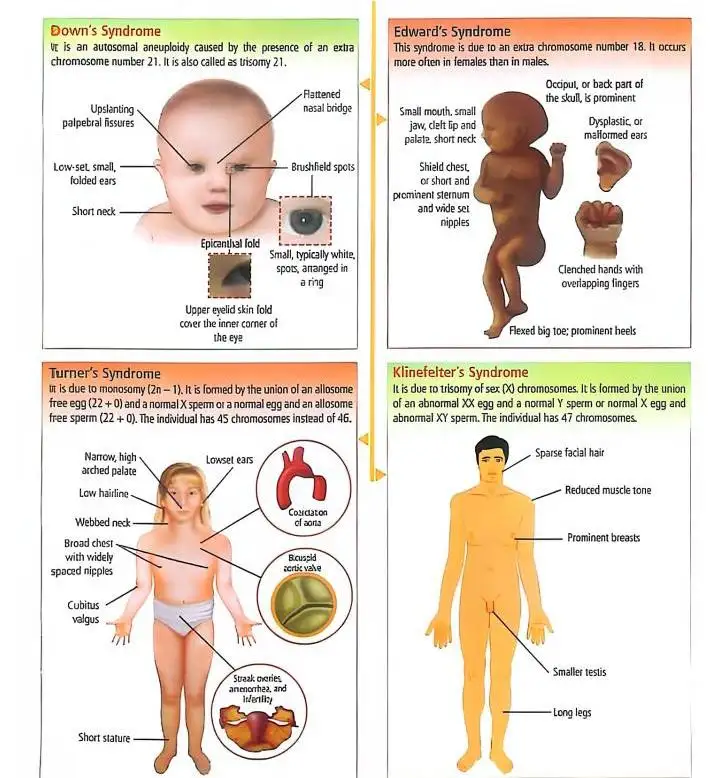
- Examples shown: Down, Edwards, Turner and Klinefelter syndromes are associated with chromosomal abnormalities.
What causes the sickling of red blood cells in sickle-cell anaemia?
How does thalassemia differ from sickle-cell anaemia?
Quick recap
- Pedigree analysis uses family patterns to infer genotypes and identify dominant, recessive or sex-linked inheritance.
- Mendelian disorders result mainly from single-gene changes; examples include cystic fibrosis, haemophilia and colour blindness.
- Colour blindness and haemophilia are X-linked recessive; sickle-cell anaemia, phenylketonuria and thalassemia are autosomal recessive.
- Sickle-cell anaemia involves a β-globin Glu-to-Val substitution; affected individuals are and heterozygotes are carriers.
- Thalassemia reduces globin-chain production and is classified as α-, β- or δ-thalassemia.
- Aneuploidy changes chromosome number; polyploidy adds whole chromosome sets. Down syndrome involves trisomy 21 and Turner syndrome loss of an chromosome.
NEET Botany — ALL CHAPTERS
1
The Living World
2
Plant Kingdom
3
Morphology of Flowering Plants
4
Anatomy of Flowering Plants
5
The Unit of Life
6
Photosynthesis in Higher Plants
7
Respiration in Plants
8
Plant Growth and Development
9
Sexual Reproduction in Flowering Plants
10
Principles of Inheritance and Variation
11
Molecular Basis of Inheritance
12
Biotechnology :Principles and Processes
13
Biotechnology and its Applications