NEET UG . NEET Botany . Botany . Morphology of Flowering Plants
Chapter 3: Morphology of Flowering Plants
Ch 3
NEET Botany
NEET UG
The Root
Plant Morphology and Root Systems
Plant morphology — The study of the form and features of plant organs, including roots, stems, leaves, flowers, fruits and seeds.
Plant Body and Root Systems
- Angiosperms: Despite their diversity in external form, flowering plants have roots, stems, leaves, flowers and fruits.
- Plant body: The root system is below ground; the shoot system is above ground.
| Root system | Origin and structure | Typical occurrence |
|---|---|---|
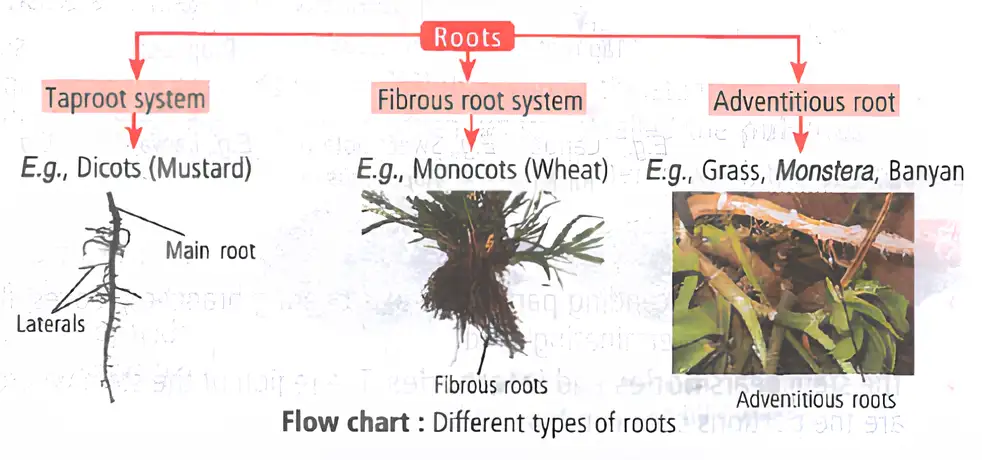
| Taproot | The radicle elongates into a primary root, which bears lateral roots of secondary and tertiary orders. | Most dicotyledonous plants |
| Fibrous root | The short-lived primary root is replaced by many roots arising from the base of the stem. | Monocotyledonous plants |
| Adventitious root | Roots arise from plant parts other than the radicle. | Some plants |
Functions of the Root System
- Absorption: Takes up water and minerals from the soil.
- Anchorage: Holds the plant firmly in the soil.
- Storage: Stores reserve food in some plants.
- Synthesis: Produces some plant growth regulators.
Regions of the Root
| Region | Key feature | Main role |
|---|---|---|
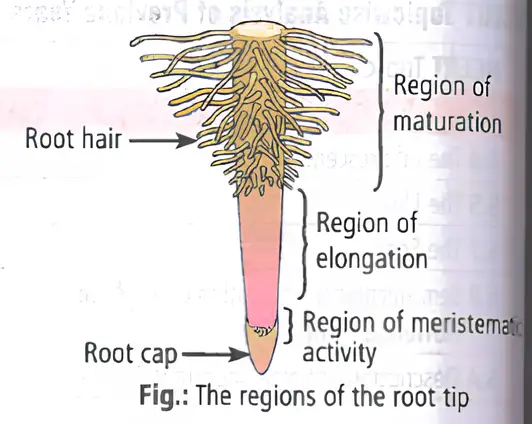
| Root cap (calyptra) | Thimble-like structure covering the root apex. | Protects the tender apex as the root grows through soil; absent in epiphytes, parasitic hydrophytes and mycorrhizal roots. |
| Meristematic region | Small, thin-walled cells with dense protoplasm divide repeatedly. | Produces new cells. |
| Region of elongation | Cells rapidly elongate and enlarge. | Increases root length. |
| Region of differentiation (maturation) | Cells differentiate; some epidermal cells form fine, delicate, thread-like root hairs. | Root hairs absorb water and minerals from the soil; they are absent in mycorrhizal roots. |
| Mature region | Cells do not undergo further change and the region is impermeable to water. | Anchors the plant firmly in the soil. |
Root Modifications
Modified roots — Roots whose shape or structure changes to perform functions beyond water and mineral absorption and conduction.
| Modification | Function | Examples |
|---|---|---|
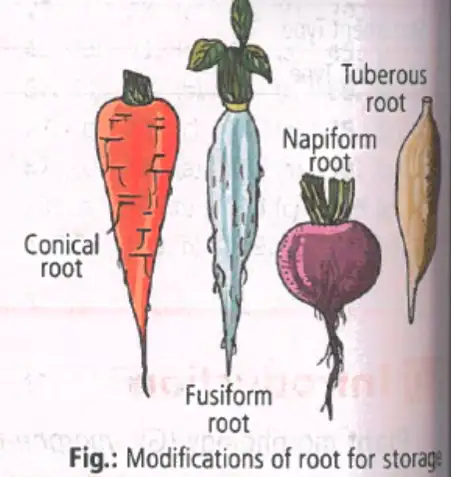
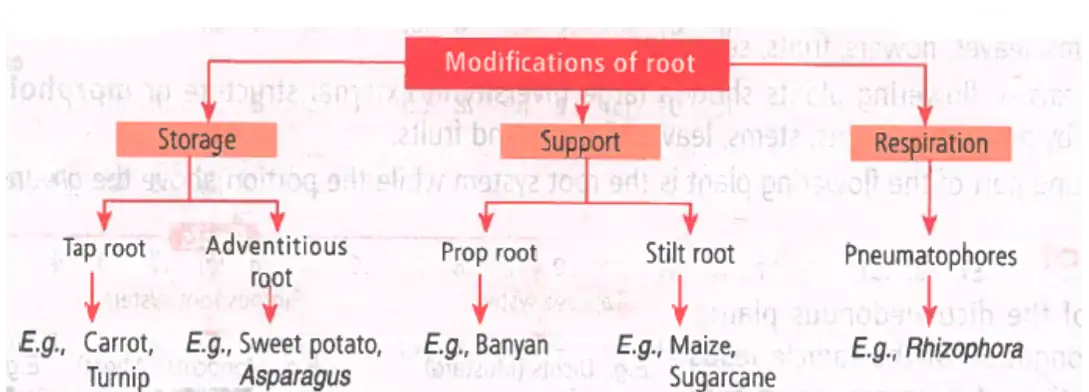
| Storage roots | Become swollen and store food. | Taproots of carrot and turnip; adventitious roots of sweet potato. |
| Prop roots | Hanging roots provide support. | Banyan. |
| Stilt roots | Roots from lower stem nodes provide support. | Maize and sugarcane. |
| Pneumatophores (breathing roots) | Grow vertically upwards out of swampy ground and help obtain oxygen for respiration. | Mangroves such as Rhizophora and Sonneratia. |
Differentiate between taproot and fibrous root systems.
Name the root modifications used for support and give examples.
What are pneumatophores, and what is their function?
Quick recap
- The root system is the below-ground part of a flowering plant; the shoot system is above ground.
- Taproots develop from the radicle; fibrous roots replace a short-lived primary root; adventitious roots arise elsewhere.
- Roots absorb water and minerals, anchor plants, store food and synthesize some growth regulators.
- Root-tip regions progress from the root cap and meristematic region through elongation and maturation to the mature region.
- Root hairs absorb water and minerals; the root cap protects the apex.
- Root modifications provide storage, support or respiration functions.
The Stem
Structure and Functions
Stem — The stem is the ascending part of the plant axis, developing from the plumule of the embryo in a germinating seed.
- Nodes and internodes: Nodes are regions where leaves arise; internodes are the stem portions between successive nodes.
- Appearance: Stems are generally green when young and often become woody and dark brown later.
- Support and transport: The stem spreads branches bearing leaves, flowers and fruits; it conducts water, minerals and photosynthates.
- Other functions: Some stems store food, provide support or protection, and enable vegetative propagation.
Bud — A bud is a compact, undeveloped young shoot with a growing point overlapped by young, immature leaves.
Modifications of the Stem
Underground Stems
- Main roles: Underground stems store food, help plants survive unfavourable conditions (perennation), and may enable vegetative propagation.
- Examples: Potato, ginger, turmeric, zamikand and Colocasia have underground stem modifications.
- Tuber: The potato stem modification stores food and also helps in vegetative propagation.
- Rhizome: A horizontal underground stem with nodes, internodes, scaly leaves and buds; examples: ginger (*Zingiber officinale*) and turmeric (*Curcuma longa*).
- Corm: An unbranched, spherical, vertical underground stem that stores food and enables vegetative reproduction; examples: Colocasia and Amorphophallus.
| Modification | Structure and function | Examples |
|---|---|---|
| Stem tendril | Slender, spirally coiled structure developing from an axillary bud; helps the plant climb. | Cucumber, grapevine |
| Phylloclade | Flattened or fleshy cylindrical stem with indefinite growth; contains chlorophyll and photosynthesises. | Flattened: Opuntia; cylindrical: Euphorbia |
| Cladode | A leaf-like, one-internode stem capable of photosynthesis. | Ruscus, Asparagus |
| Modification | Structure and growth | Examples |
|---|---|---|
| Runner | An underground stem that spreads to new sites; when older parts die, new plants develop. | Grass, strawberry |
| Stolon | A slender lateral branch grows aerially from the base of the main axis, then arches down to touch the ground. | Mint, jasmine |
| Offset | A lateral branch with short internodes; each node bears a rosette of leaves and a tuft of roots. | Pistia, Eichhornia |
| Sucker | A lateral branch from the basal underground region grows horizontally below the soil, then emerges obliquely upward as a leafy shoot. | Banana, pineapple, Chrysanthemum |
Protective Structures
- Function: Thorns, spines, prickles and bristles protect plants from grazing animals and excessive transpiration.
- Thorns: Modified axillary buds of stems; examples include Citrus and Bougainvillea.
| Thorns | Spines | Prickles | Bristles | |
|---|---|---|---|---|
| Origin / structure | Modified stems; a vascular cylinder is surrounded by bark of thick-walled cells. | Modified leaves or leaf parts; have a vascular strand without well-developed bark. | Superficial outgrowths of stems or leaves; lack a vascular cylinder. | Stiff hairs. |
| Key feature | Hard, pointed structures. | Hard, pointed structures. | Can be pulled off easily. | Thickened by silica or calcium carbonate deposits. |
How do a phylloclade and a cladode differ?
Quick recap
- The stem develops from the plumule and bears nodes, internodes, leaves, branches, flowers and fruits.
- Stems support plant parts and transport water, minerals and photosynthates; some also store food or aid propagation.
- Underground stem forms include the potato tuber, ginger and turmeric rhizomes, and Colocasia and Amorphophallus corms; zamikand is also listed as an underground stem.
- Stem tendrils aid climbing; phylloclades and cladodes carry out photosynthesis.
- Runners, stolons, offsets and suckers are stem modifications involved in vegetative propagation.
- Thorns are modified stems, spines are modified leaves, prickles are superficial outgrowths, and bristles are stiff hairs.
The Leaf
Leaf Structure
Main features and parts
- Origin and arrangement: Leaves develop from the shoot apical meristem and are arranged in acropetal order.
- Importance: Leaves are the most important vegetative organs for photosynthesis.
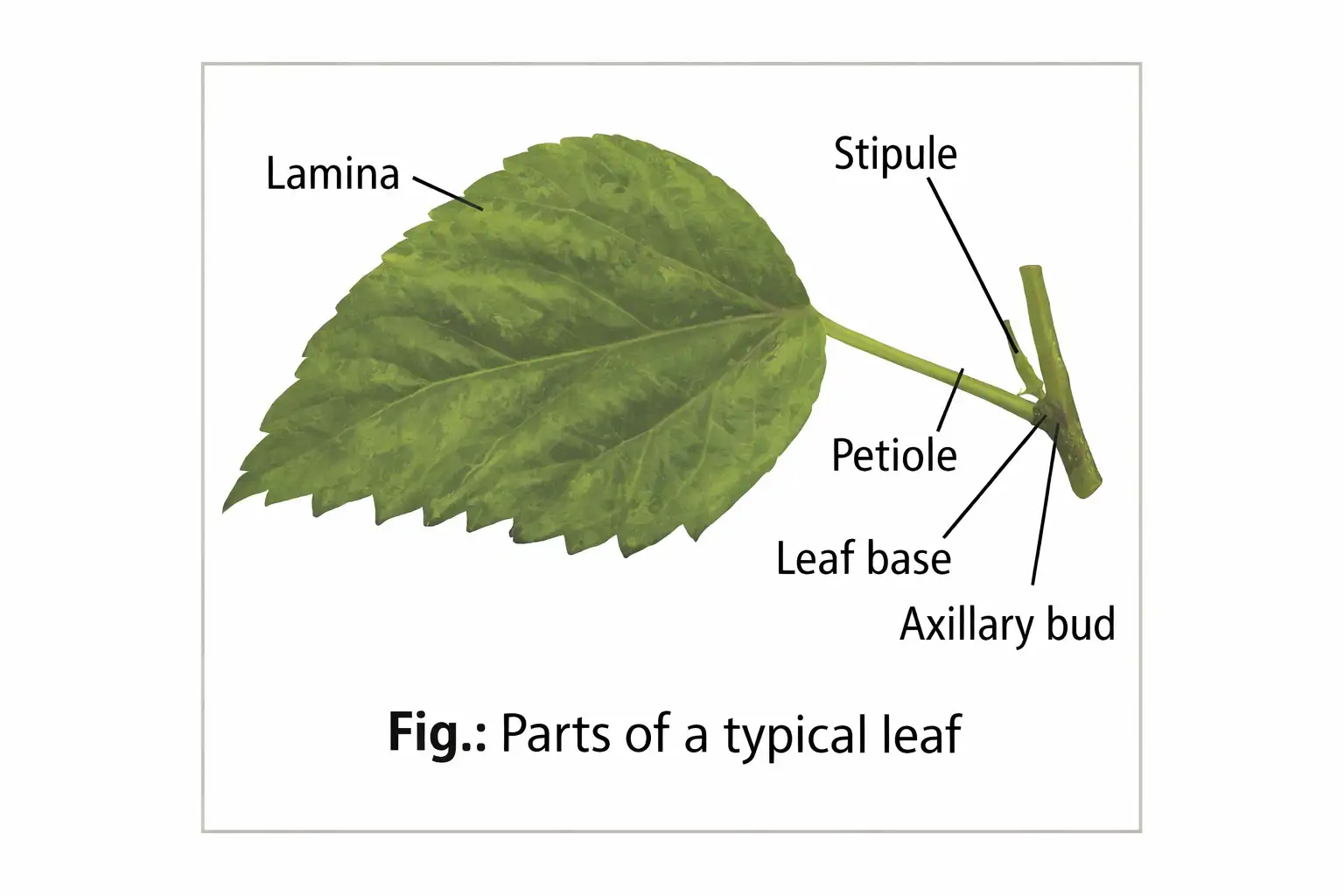
- Main parts: A typical leaf has a leaf base, petiole and lamina.
- Leaf base: Attaches the leaf to the stem; it may bear two small, lateral, leaf-like stipules.
- Monocot leaf base: In maize and sugarcane, it expands into a sheath that covers the stem partially or wholly.
- Pulvinus: In some legumes, such as pea and gram, the leaf base becomes swollen.
- Petiole: Holds the blade towards light; a long, flexible petiole lets it flutter, cooling the leaf and bringing fresh air to its surface.
- Lamina: The green expanded blade bears veins and veinlets. Its prominent central vein is the midrib.
- Veins: Provide rigidity and transport water, minerals and food materials.
Venation
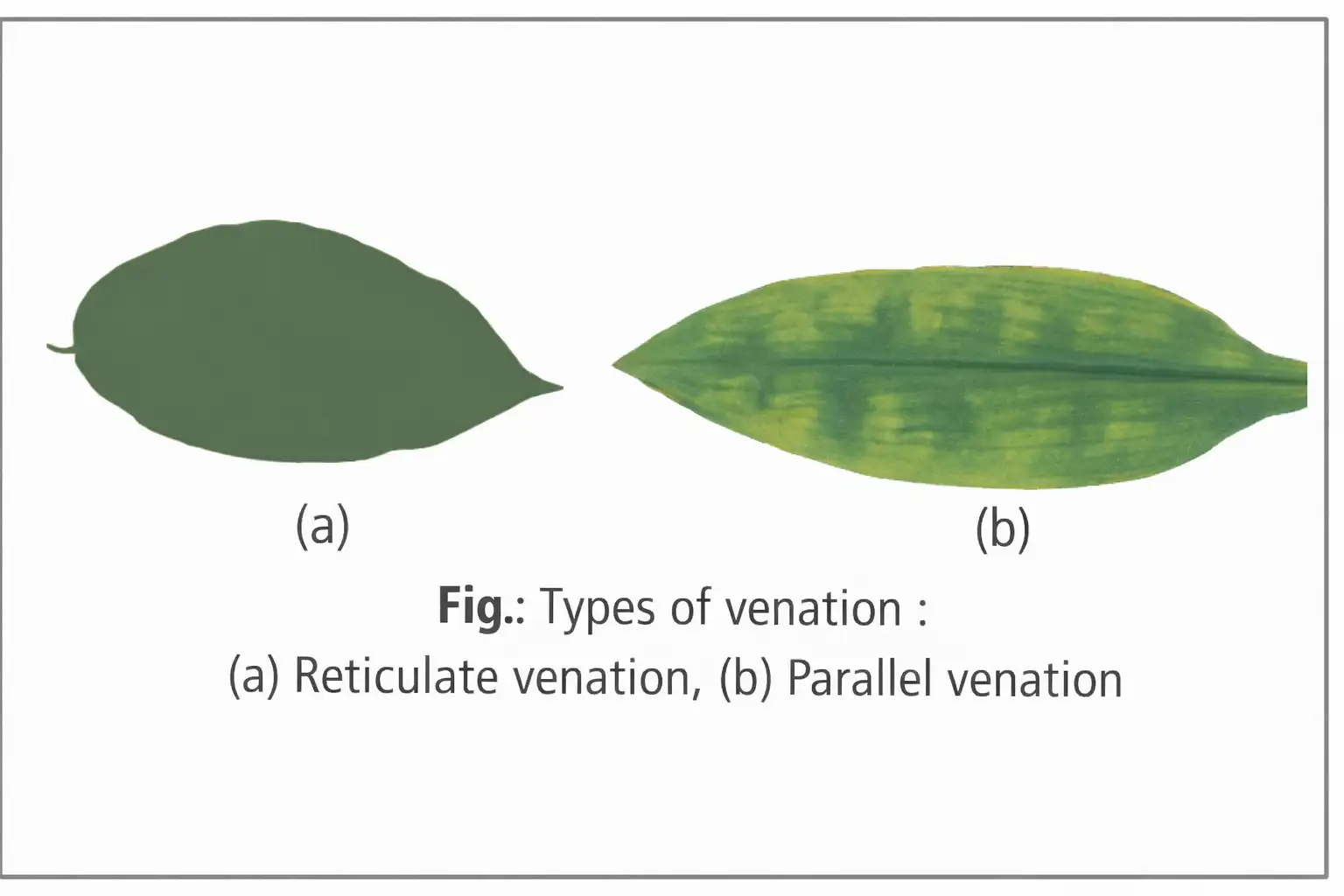
Venation — The arrangement of veins and veinlets in the leaf lamina is called venation.
| Type | Vein arrangement | Common in |
|---|---|---|
| Reticulate | Veinlets form a network. | Dicotyledons |
| Parallel | Veins run parallel to one another. | Monocotyledons |
Types of Leaves
| Point | Simple leaf | Compound leaf |
|---|---|---|
| Lamina | Entire, or incised without the incisions reaching the midrib. | Incisions reach the midrib and divide the lamina into leaflets. |
| Axillary bud | Present in the axil of the petiole. | Present in the axil of the petiole, not in the axils of leaflets. |
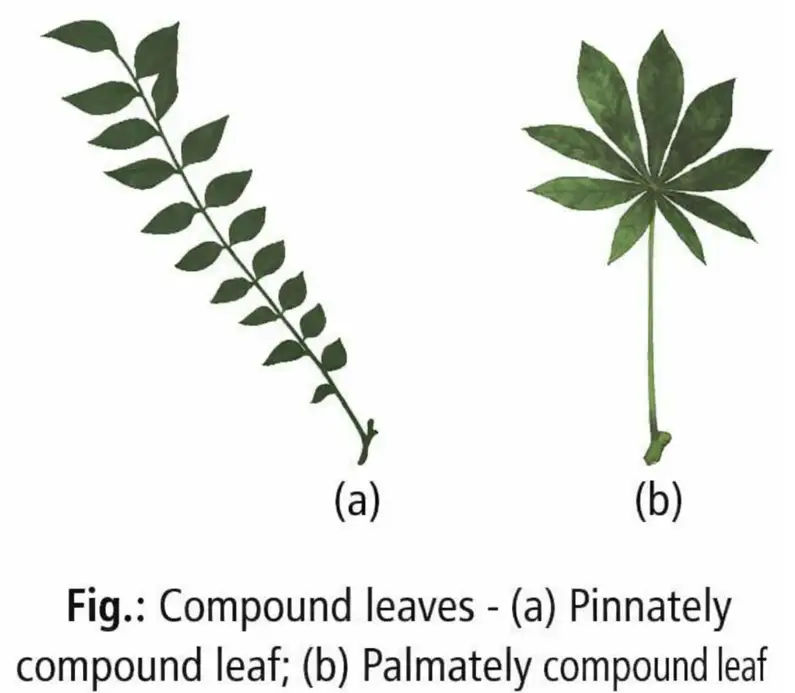
| Type | Leaflet arrangement | Example |
|---|---|---|
| Pinnately compound | Leaflets occur along a common axis called the rachis, which represents the midrib. | Neem |
| Palmately compound | Leaflets attach at one common point at the tip of the petiole. | Silk cotton |
Modifications of Leaves
Leaf modification — A leaf modification is a structural change that adapts a leaf or leaf part to a specialized function, which may include photosynthesis.
| Modification | Example | Function |
|---|---|---|
| Tendril | Garden pea (*Pisum sativum*) | Climbing |
| Spine | Cactus and *Opuntia* | Defence |
| Fleshy leaf | Onion and garlic | Food storage |
| Expanded green petiole | Australian acacia | Photosynthesis when leaves are small and short-lived |
| Insect-trapping leaf | Pitcher plant (*Nepenthes*) and Venus-flytrap (*Dionaea*) | Catching and digesting insects |
How can a simple leaf be distinguished from a compound leaf?
What is the difference between pinnately and palmately compound leaves?
Quick recap
- Leaves arise from the shoot apical meristem, occur in acropetal order and are the most important vegetative organs for photosynthesis.
- A typical leaf has a leaf base, petiole and lamina; the axillary bud may later develop into a branch.
- Monocot leaf bases can form sheaths that cover the stem partly or wholly; swollen leaf bases are called pulvini.
- Reticulate venation is usual in dicots, while parallel venation is characteristic of monocots.
- Simple-leaf incisions do not reach the midrib; compound-leaf incisions reach it and divide the lamina into leaflets.
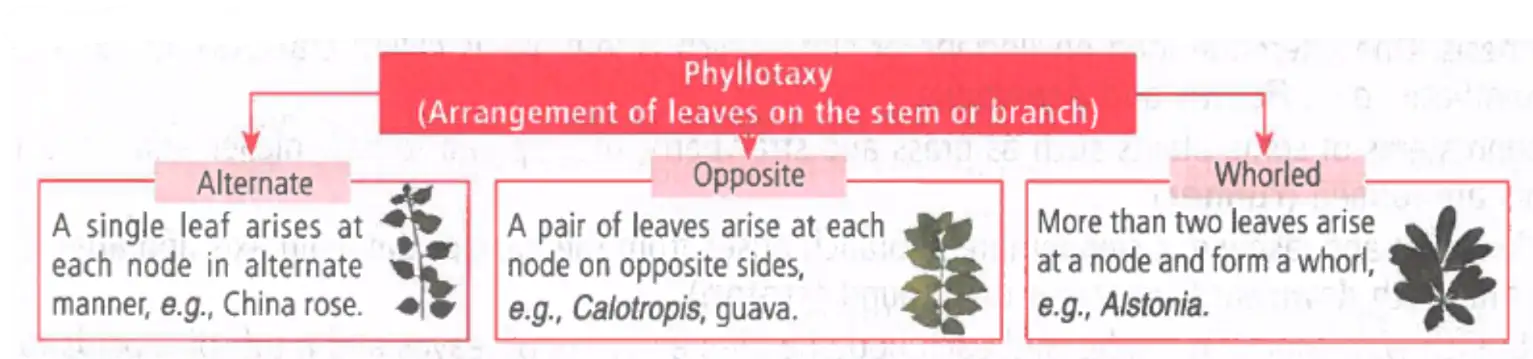
- Compound leaves are pinnate (leaflets along a rachis) or palmate (leaflets from one point); leaf arrangements shown include alternate, opposite and whorled.
- Leaves may be modified for climbing, defence, food storage, photosynthesis or insect capture and digestion.
The Inflorescence
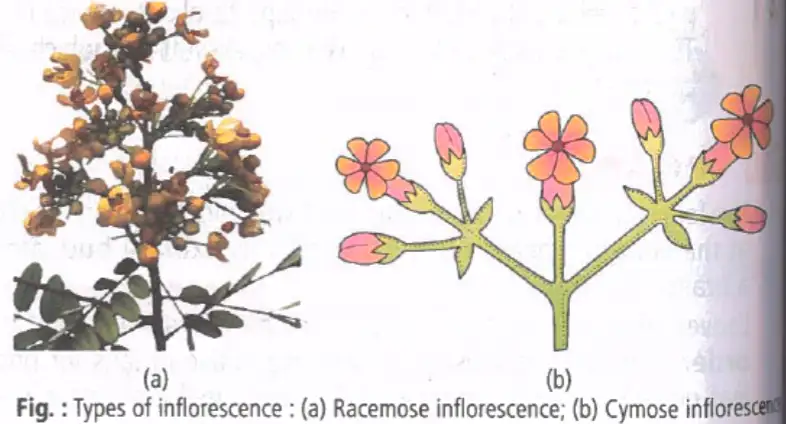
Meaning and Main Types
Special Types of Inflorescence
Differentiate between racemose and cymose inflorescences.
What are the characteristic features of cyathium?
Quick recap
- Inflorescence is the arrangement of flowers on the floral axis.
- A flower is a modified shoot formed when the shoot apical meristem becomes a floral meristem.
- Racemose: the main axis continues growing; flowers show acropetal succession.
- Cymose: the main axis terminates in a flower; flowers show basipetal order.
- Hypanthodium has a fleshy hollow receptacle with a scale-guarded opening.
- Verticillaster is a condensed dichasial cyme; cyathium has one female flower and many male flowers inside a cup-shaped involucre.
The Flower
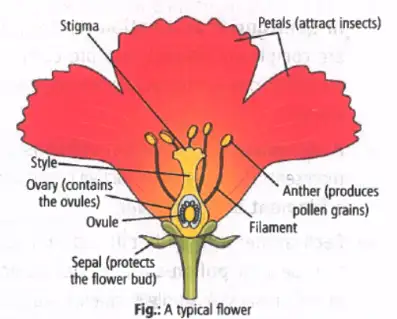
Flower: Basic Structure and Types
Symmetry, Floral-Appendage Number and Bracts
Other classifications
- Trimerous, tetramerous, pentamerous: Floral appendages occur in multiples of 3, 4 or 5, respectively.
- Bracteate: A flower has a bract, a reduced leaf at the base of the pedicel.
- Ebracteate: A flower has no bract.
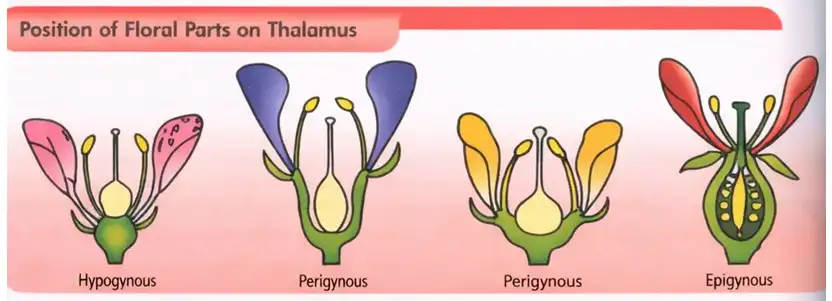
Position of Floral Parts Relative to the Ovary
Parts of the Flower
Corolla — The floral whorl composed of petals.
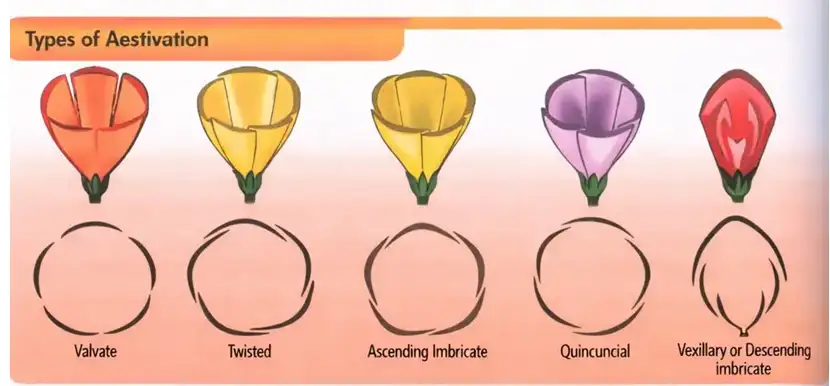
Aestivation
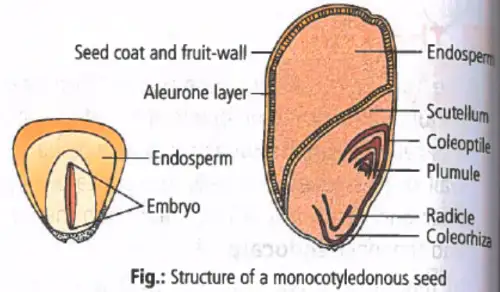
Structure of a Monocotyledonous Seed
How do hypogynous, perigynous and epigynous flowers differ?
What is vexillary aestivation?
Quick recap
- A typical flower has four whorls on the thalamus: calyx, corolla, androecium and gynoecium.
- Flowers are classified by sexual organs, completeness, symmetry, appendage number and presence of bracts.
- Hypogynous, perigynous and epigynous flowers have superior, half-inferior and inferior ovaries, respectively.
- Calyx consists of sepals; corolla consists of petals, which may be free or united.
- Aestivation describes how sepals or petals are arranged in the bud.
- A monocot embryo has a scutellum, plumule and radicle; the coleoptile and coleorhiza protect its growing parts.
The Fruit
Fruit: Structure and Development
Fruit Classification
Simple fruit — Develops from a monocarpellary or multicarpellary, syncarpous ovary.
| Group | Type | Example |
|---|---|---|
| Dry—dehiscent | Pod | Pea |
| Dry—dehiscent | Follicle | Delphinium |
| Dry—dehiscent | Siliqua | Mustard |
| Dry—dehiscent | Silicula | Iberis |
| Dry—dehiscent | Capsule | Cotton |
| Dry—indehiscent | Cypsela | Marigold |
| Dry—indehiscent | Caryopsis | Maize |
| Dry—indehiscent | Achene | Mirabilis |
| Dry—indehiscent | Samara | Holoptelia |
| Dry—indehiscent | Nut | Litchi |
| Dry—schizocarpic | Lomentum | Acacia |
| Dry—schizocarpic | Cremocarp | Coriander |
| Dry—schizocarpic | Double samara | Acer |
| Dry—schizocarpic | Regma | Ricinus |
| Fleshy | Drupe | Mango |
| Fleshy | Berry | Tomato |
| Fleshy | Pepo | Cucurbits |
| Fleshy | Pome | Pear |
| Fleshy | Hesperidium | Orange |
| Fleshy | Balausta | Pomegranate |
Aggregate fruit — Develops from a multicarpellary, apocarpous ovary.
| Type | Example |
|---|---|
| Etaerio of achenes | Ranunculus |
| Etaerio of follicles | Michelia |
| Etaerio of drupes | Raspberry |
| Etaerio of berries | Custard apple |
Composite fruit — Develops from a complete inflorescence.
| Type | Example |
|---|---|
| Sorosis | Pineapple |
| Syconus | Banyan |
Quick recap
- A fruit is usually the mature ovary formed after fertilisation; banana forms a parthenocarpic fruit.
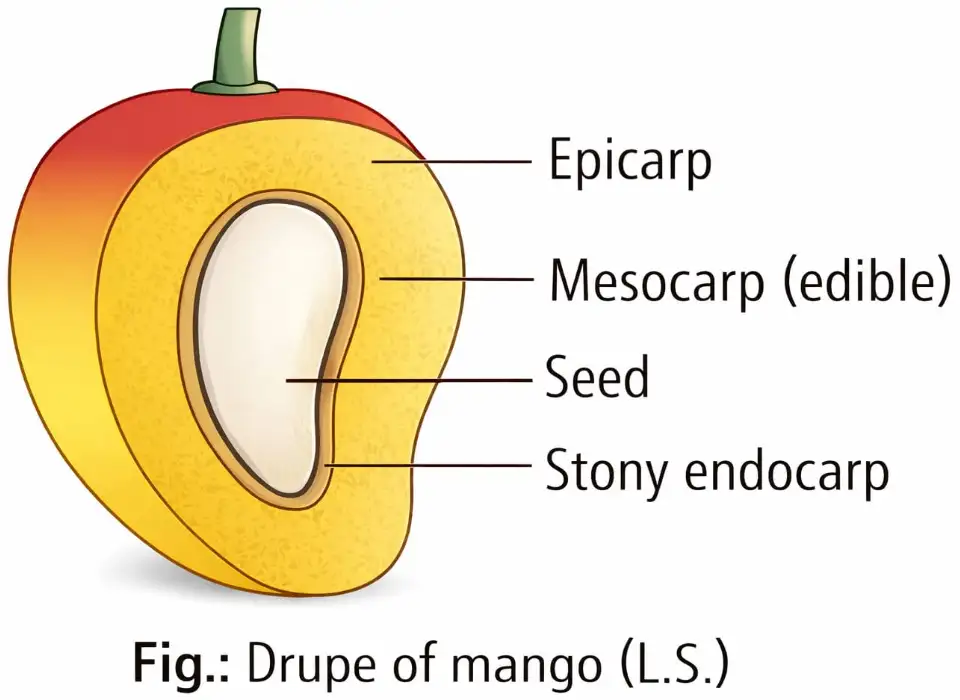
- The fruit wall is the pericarp; a thick fleshy pericarp has epicarp, mesocarp and endocarp.
- Mango and coconut are one-seeded drupes from monocarpellary superior ovaries; mango has stony endocarp and coconut fibrous mesocarp.
- Simple fruits develop from syncarpous ovaries and may be dry (dehiscent, indehiscent or schizocarpic) or fleshy.
- Aggregate fruits develop from multicarpellary apocarpous ovaries; types include etaerios of achenes, follicles, drupes and berries.
- Composite fruits develop from complete inflorescences: sorosis (pineapple) and syconus (banyan).
The Seed
Seed: Basic Structure
Seed — A seed develops from a fertilised ovule and consists of a seed coat and an embryo.
Embryo
- Parts: The embryo has an embryonal axis, a radicle and cotyledons; the axis bears the plumule and radicle at its two ends.
- Cotyledon number: Monocots have one cotyledon (e.g. wheat and maize); dicots have two (e.g. gram and pea).
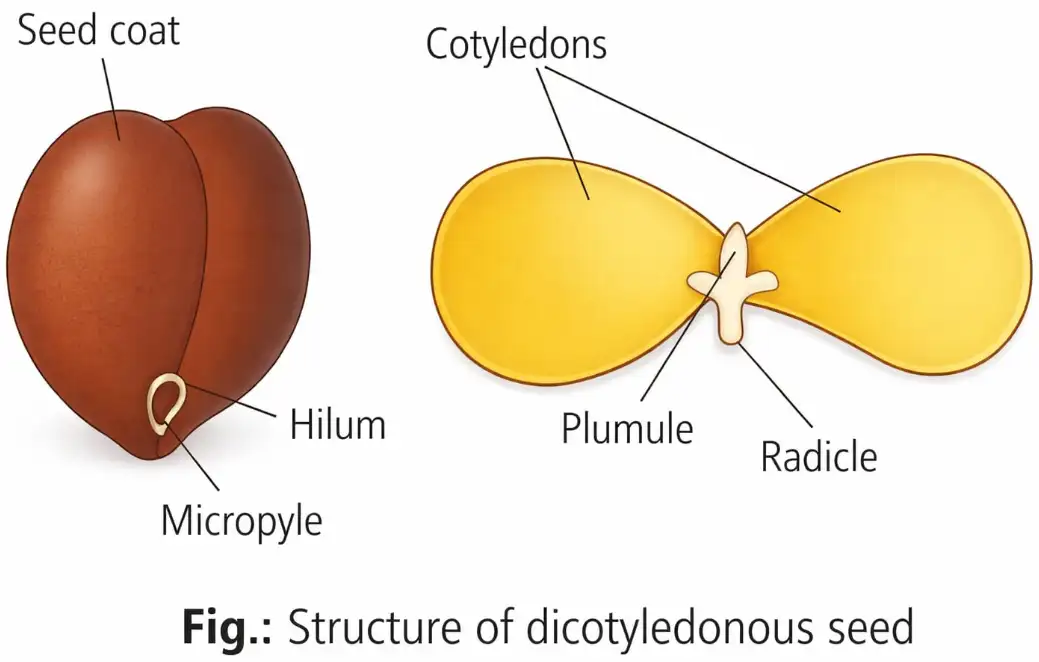
Structure of a Dicotyledonous Seed
Seed Coat and Embryo
- Seed coat: The outer covering has two layers: the outer testa and inner tegmen.
- Hilum: A scar marking where the developing seed was attached to the fruit.
- Micropyle: A small pore situated above the hilum.
- Embryo: It consists of an embryonal axis and two cotyledons, which store reserve food.
- Axis ends: The radicle and plumule occur at opposite ends of the embryonal axis.
| Seed type | Endosperm in mature seed | Examples |
|---|---|---|
| Endospermic | Present; stores food. In castor, it forms as a result of double fertilisation. | Castor |
| Non-endospermic | Absent | Bean, gram and pea |
Structure of a Monocotyledonous Seed
Cereal Seed Structure
- Endosperm: Usually present and bulky, storing food; orchids are an exception with non-endospermic seeds.
- Seed coat: In cereals such as maize, it is membranous and generally fused with the fruit wall.
- Aleurone layer: A proteinaceous layer forms the outer covering of the endosperm and separates it from the embryo.
- Embryo position: The small embryo lies in a groove at one end of the endosperm.
- Scutellum: The single cotyledon is large and shield-shaped.
- Embryonal axis: It is short and bears a plumule and a radicle.
- Protective sheaths: The plumule is enclosed by the coleoptile; the radicle is enclosed by the coleorhiza.
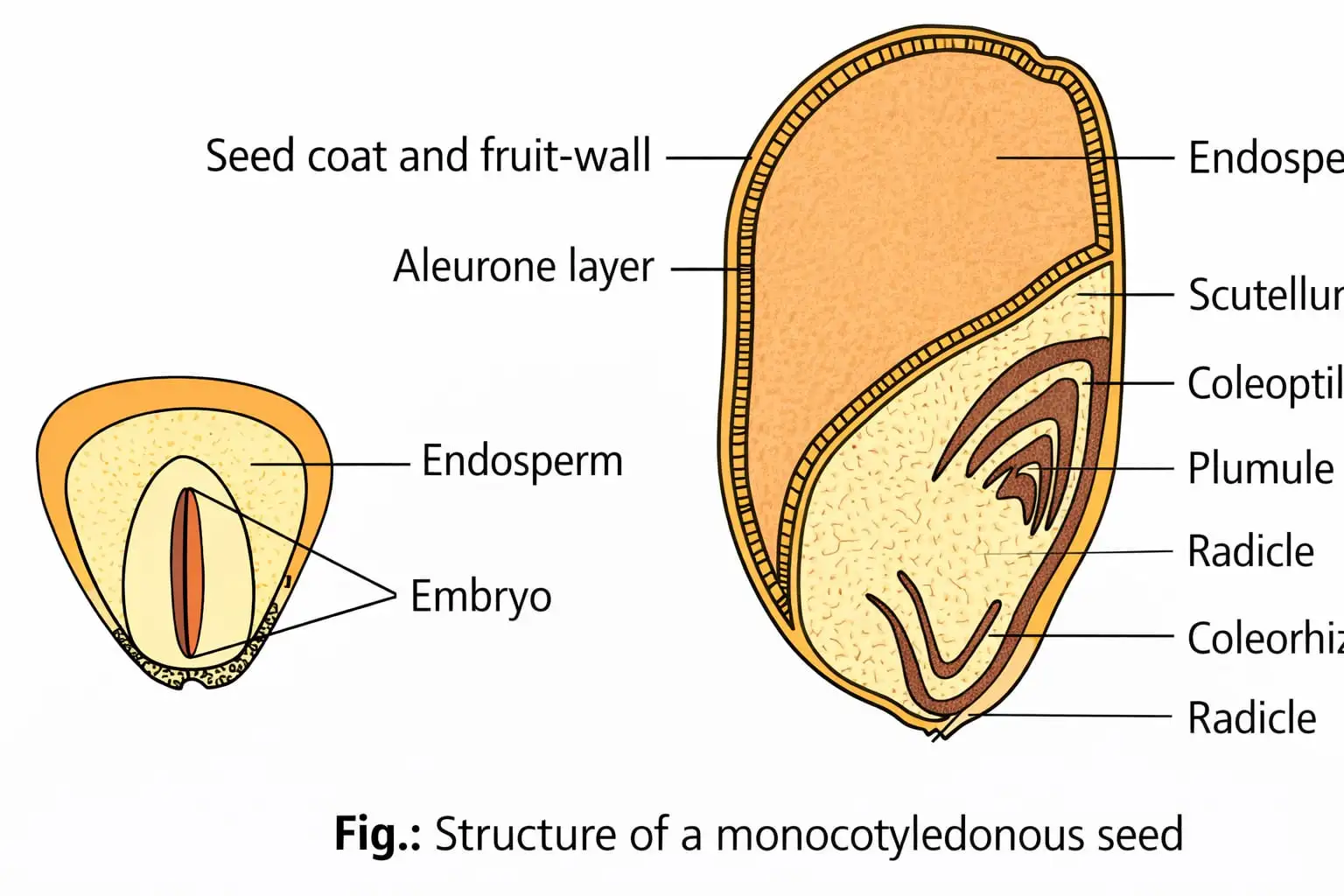
Name the two layers of a dicot seed coat and the scar marking seed attachment.
What are the protective sheaths of the maize embryo?
Quick recap
- A seed develops from a fertilised ovule and contains a seed coat and embryo.
- Dicot seed coats have an outer testa and inner tegmen; the hilum is the attachment scar and the micropyle is a pore.
- Dicot cotyledons store food; castor is endospermic, and its endosperm forms as a result of double fertilisation.
- Bean, gram and pea are non-endospermic; monocot seeds are usually endospermic, with orchids as an exception.
- Maize has a bulky endosperm, an aleurone layer and a single shield-shaped cotyledon called the scutellum.
- The coleoptile encloses the plumule, while the coleorhiza encloses the radicle.
Semi-technical Description of a Typical Flowering Plant
Floral Formula and Floral Diagram
Floral formula — A concise symbolic summary of the floral characters of a plant or family.
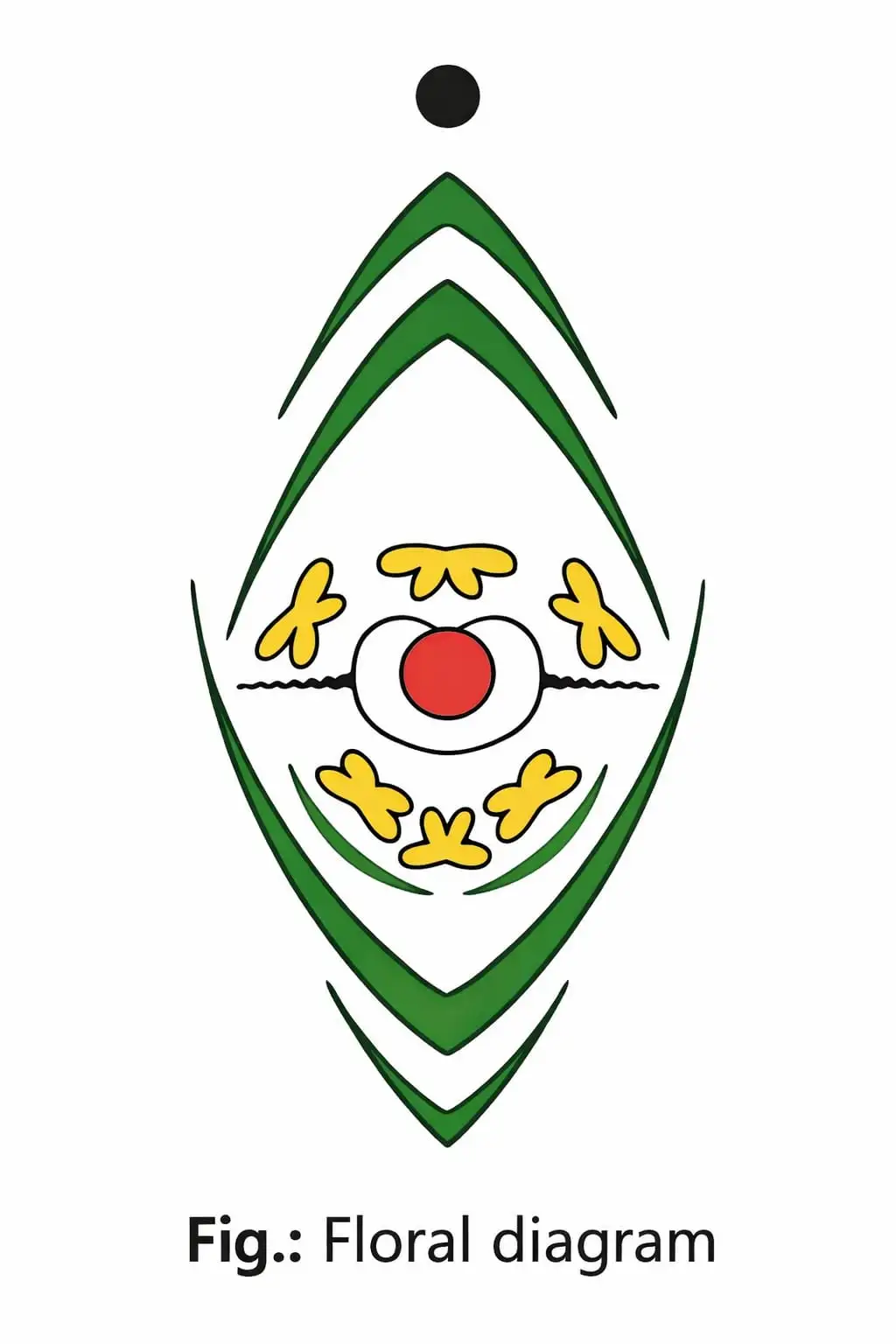
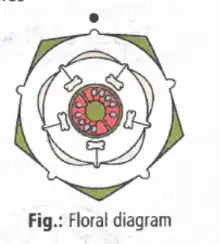
Floral diagram — A diagrammatic representation of information pooled from transverse sections of a flower bud, showing floral parts and their relationships in relation to the mother axis.
Reading the representations
- Symbols: = bracteate; = calyx; = corolla; = perianth; = androecium; = gynoecium.
- Sex and symmetry: = male; = female; = bisexual; = actinomorphic; = zygomorphic.
- Ovary position: An underline below indicates a superior ovary; an overline above indicates an inferior ovary.
- Fusion and adhesion: Parentheses enclose fused parts; a line above floral-part symbols indicates adhesion between parts or whorls.
- Diagram layout: Whorls are drawn from the outside inward: calyx, corolla, androecium and central gynoecium. A dot at the top marks the mother axis.
- Information: A diagram shows the number, arrangement and relationships of floral parts; a formula can also show cohesion and adhesion.
| Representation | What it shows |
|---|---|
| Floral formula | Floral characters in compact symbolic form. |
| Floral diagram | Number, arrangement and relationships of parts, with orientation to the mother axis. |
Actinomorphic and bisexual; four sepals in two pairs, four petals, six stamens in a arrangement, and a fused superior bicarpellary ovary.
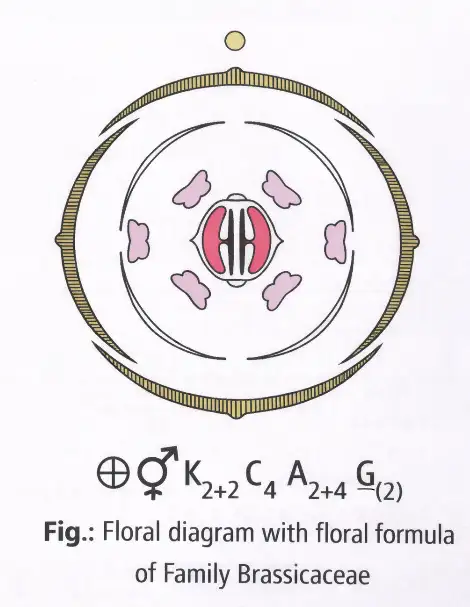
Brassicaceae (Cruciferae or Mustard Family)
- Habit and root: Mostly annual or perennial herbs; taproot often becomes fleshy through food storage.
- Stem and leaves: Stem erect, cylindrical, hairy or smooth, usually herbaceous and rarely woody. Leaves radical or cauline, alternate or subopposite, exstipulate, often sessile with a sheathing base; simple or rarely compound.
- Inflorescence and flower: Racemose; flowers usually bisexual, actinomorphic, hypogynous and tetramerous. They are rarely zygomorphic, as in *Iberis*.
- Calyx and corolla: Four free sepals in two whorls of two; four free, usually cruciform petals, which may be reduced or absent in some plants.
- Androecium: Six free stamens, tetradynamous: four inner long and two outer short; anthers dithecous and introrse.
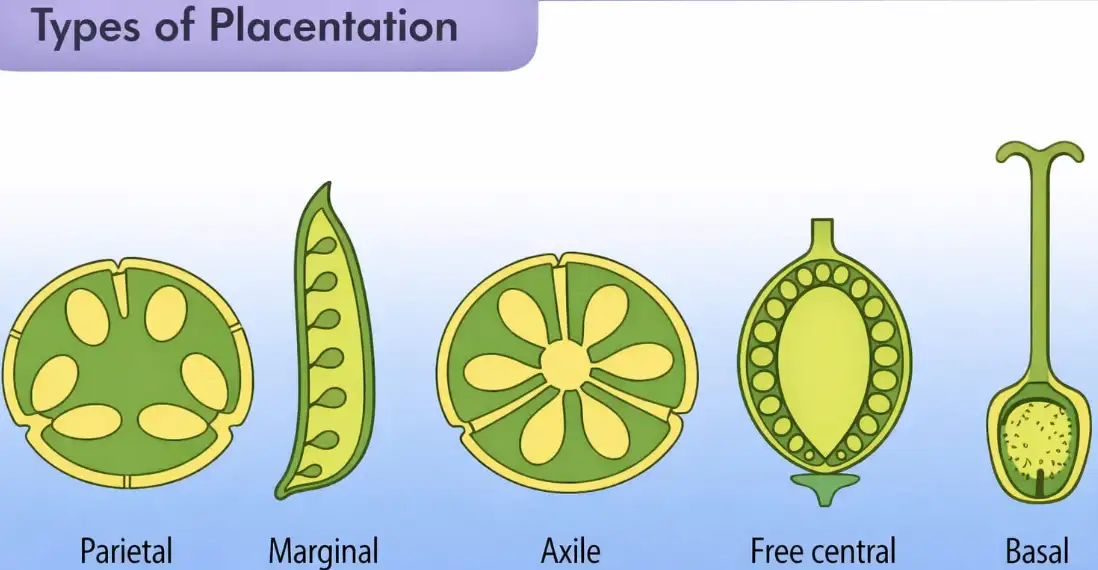
- Gynoecium: Usually two fused carpels; ovary superior and unilocular, with parietal placentation.
- Fruit and seed: Fruit usually a siliqua or silicula, rarely a lomentum (e.g., *Raphanus*); seeds non-endospermic and often oily.
| Use | Examples |
|---|---|
| Vegetables | Cauliflower, cabbage, turnip, radish. |
| Oils | *Brassica campestris*, *Brassica juncea* (Indian mustard or rai). |
| Medicine | *Rorippa montana*. |
| Ornamentals | *Iberis amara* (candytuft or chandni); *Cheiranthus cheiri* (wallflower). |
Malvaceae (Cotton or Mallow Family)
- Habit and root: Mostly annual or perennial herbs or shrubs; taproot.
- Stem and leaves: Stems generally have stellate (star-shaped branched) hairs. Leaves simple or palmately lobed, alternate and stipulate; plant parts commonly contain mucilaginous sap.
- Inflorescence and flower: Flowers solitary, axillary or terminal; bisexual, actinomorphic, complete, hypogynous and pentamerous.
- Calyx: Five sepals, free or united at the base; persistent, with valvate aestivation.
- Corolla: Five free, generally large and showy petals; aestivation imbricate or twisted.
- Androecium: Numerous stamens, monadelphous and epipetalous; anthers monothecous.
- Gynoecium: Two to many fused carpels; ovary superior and multilocular, with one or more ovules per locule. Style long; stigmas equal in number to carpels.
- Fruit and seed: Fruit generally a capsule; seeds may be endospermic or non-endospermic.
denotes the epicalyx; the formula represents a superior ovary with two to many fused carpels.
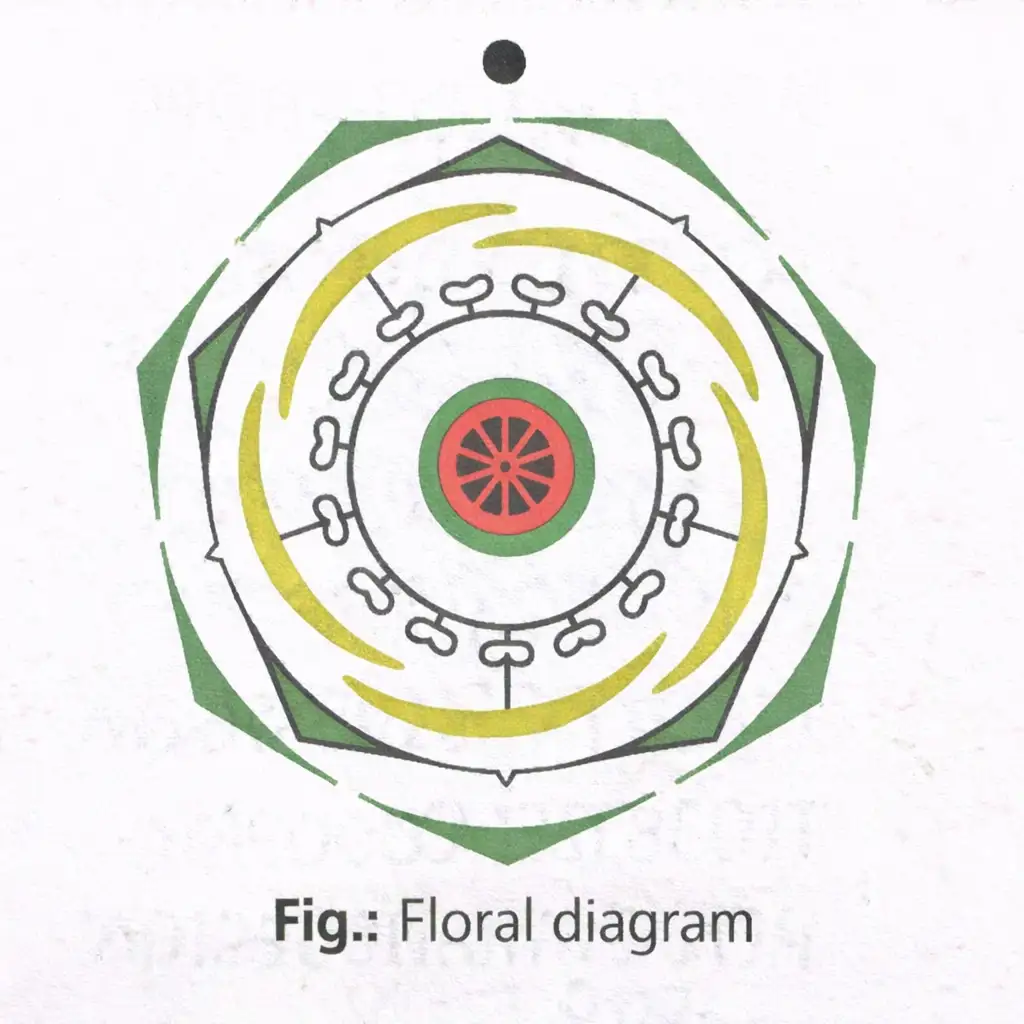
| Use | Examples |
|---|---|
| Fibre | Cotton, patsan (Deccan hemp), Indian mallow (China jute). |
| Food | *Abelmoschus esculentus* (bhindi or okra). |
| Ornamentals | *Althaea rosea*; *Hibiscus rosa-sinensis* (China rose). |
Fabaceae (Papilionaceae or Pea Family)
- Habit and root: Trees, herbs or shrubs; taproot commonly bears root nodules.
- Stem and leaves: Stem erect or climbing, herbaceous or woody. Leaves alternate, simple or pinnately compound, stipulate, with a pulvinus at the base and reticulate venation.
- Inflorescence and flower: Racemose; flowers bisexual and zygomorphic.
- Calyx: Five fused sepals; aestivation valvate or imbricate.
- Corolla: Five free petals: posterior standard, two lateral wings and two anterior keel petals enclosing stamens and pistil; vexillary aestivation.
- Androecium: Ten dithecous stamens, usually diadelphous: nine united and one free.
- Gynoecium: One carpel; ovary superior and unilocular, with many ovules and a single style.
- Fruit and seed: Fruit a legume; seeds one to many and non-endospermic.
The corolla represents one standard, two wings and two keel petals; the androecium has nine united and one free stamen.
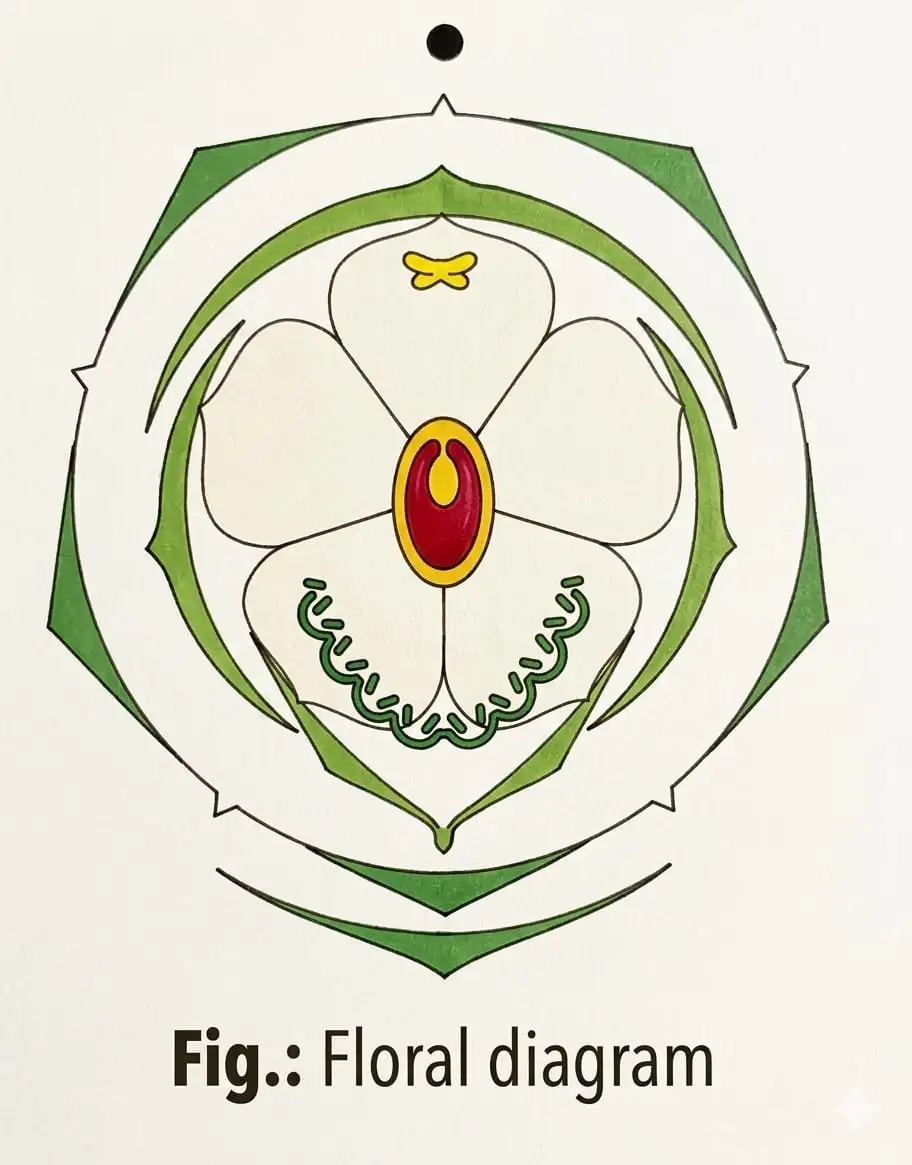
| Use | Examples |
|---|---|
| Pulses and food | Pea (*Pisum sativum*), gram (*Cicer arietinum*), arhar, moong, sem, soybean. |
| Oils | Groundnut, soybean. |
| Fibre | *Crotalaria juncea* (sunn hemp), *Sesbania* species. |
| Dye | *Indigofera tinctoria*. |
| Fodder | *Sesbania*, *Trifolium*. |
| Gum | *Butea monosperma*, *Astragalus gummifer*. |
| Ornamentals | *Lathyrus odoratus*, *Lupinus*. |
| Medicine | Muliathi. |
Asteraceae (Compositae or Sunflower Family)
- Habit and root: Mostly herbs, rarely shrubs or trees; taproot.
- Stem: Erect, prostrate, climbing or twining; herbaceous or woody, hairy or smooth; latex tubes or oil ducts may occur.
- Leaves: Alternate, rarely opposite or whorled; exstipulate, simple or compound, with reticulate venation that may be unicostate or multicostate.
- Inflorescence: Capitulum (head), a racemose type in which many sessile florets are borne on a common flat, concave or convex receptacle.
- Heterogamous head: Has two floret types: peripheral ray florets are zygomorphic and ligulate, and may be neuter or female; disc florets are actinomorphic and tubular.
- Homogamous head: Contains only one type of floret; *Xanthium* is an example.
- Pollination: A single insect can pollinate multiple florets in one capitulum.
- Flower: Bracteate and sessile; epigynous and pentamerous. Disc florets are actinomorphic and ray florets zygomorphic; flowers may be bisexual or unisexual.
- Calyx: Five sepals are usually reduced to a persistent pappus of hairs or thin membranes, which helps disperse the fruit.
- Corolla: Five fused petals; tubular in disc florets and ligulate (strap-shaped) in ray florets; valvate aestivation.
- Androecium: Five epipetalous stamens; anthers fused together (syngenesious), while filaments remain free.
- Gynoecium: Two fused carpels; ovary inferior and unilocular, with one basal ovule.
- Fruit and seed: Fruit is a cypsela; seed is non-endospermic.
| Floret | Structure and symmetry | Sex and stamens |
|---|---|---|
| Ray | Peripheral, zygomorphic and ligulate. | Neuter or female; stamens absent. |
| Disc | Actinomorphic and tubular. | Usually bisexual; five stamens with fused anthers. |
Ray florets may be female or neuter; they lack stamens. The calyx is represented by a pappus, and the ovary is inferior and bicarpellary.
Disc florets are bisexual and have five stamens; the calyx is represented by a pappus, and the ovary is inferior and bicarpellary.
| Use | Examples |
|---|---|
| Food | *Cichorium intybus*, *Lactuca sativa*. |
| Insecticide | *Chrysanthemum marshallii* (guldaudi). |
| Oil | *Helianthus annuus* (sunflower). |
| Ornamentals | Sunflower, guldaudi, marigold. |
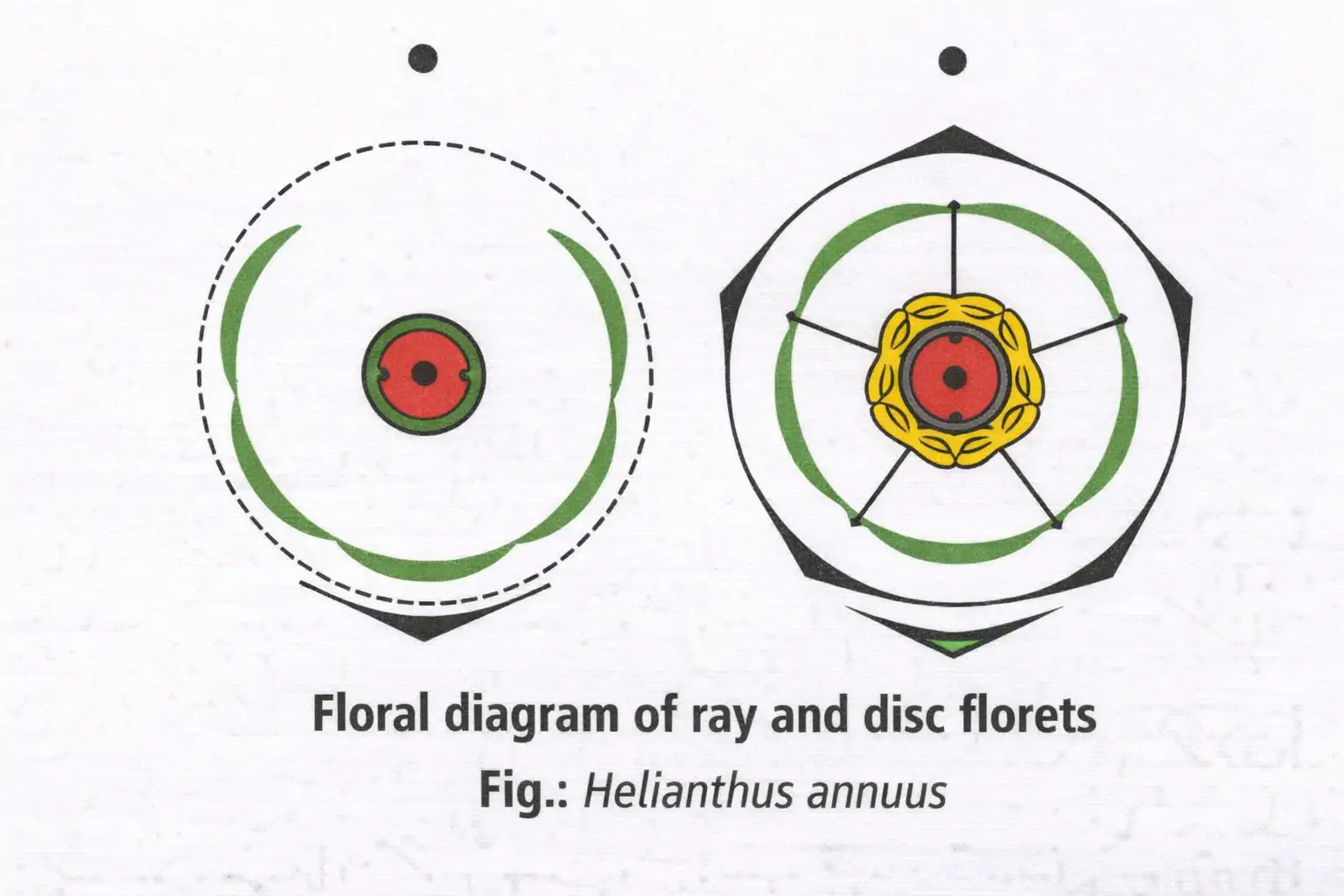
Poaceae (Gramineae)
- Habit and roots: Annual or perennial herbs; perennials may have runners, suckers or rhizomes, and some members are shrubs. Roots adventitious; maize has stilt roots.
- Stem: Erect or prostrate, cylindrical and jointed; called a culm, with hollow internodes.
- Leaves: Cauline and ramal, alternate, usually sessile (petioles occur in bamboos) and exstipulate. Base sheathing; blade simple, long and narrow, with parallel veins.
- Inflorescence and flower: Racemose; florets zygomorphic, incomplete and hypogynous, and may be bisexual or unisexual (e.g., maize).
- Perianth: Reduced to two or three small hyaline or succulent scales called lodicules; several occur in *Ochlandra*.
- Androecium: Three or six free stamens in one or two whorls; six occur in *Oryza* and *Bambusa*.
- Gynoecium: Three fused carpels that appear monocarpellary; ovary superior, unilocular and uniovulate, with basal placentation.
- Fruit and seed: Fruit is a caryopsis; seed is endospermic with one cotyledon.
- Food: Important cereals include *Triticum aestivum*, *Hordeum vulgare* and *Oryza sativa*.
The perianth is represented by lodicules; the androecium may have three or six stamens.
What is the tetradynamous condition in Brassicaceae?
Distinguish the two types of florets in an Asteraceae capitulum.
What are the key floral features of Fabaceae?
Quick recap
- Floral formulas summarize floral characters symbolically; floral diagrams show number, arrangement, relationships and orientation.
- Brassicaceae has cruciform petals and tetradynamous stamens; the ovary is superior with parietal placentation.
- Malvaceae commonly has stellate hairs, mucilaginous sap and numerous monadelphous stamens.
- Fabaceae has a papilionaceous corolla with vexillary aestivation and usually nine united plus one free stamen.
- Asteraceae, the largest dicot family, has capitula, a pappus and syngenesious anthers; its ovary is inferior and its fruit is a cypsela.
- Asteraceae leaves may be alternate or rarely opposite or whorled, with reticulate, unicostate or multicostate venation.
- Poaceae has a culm, sheathing leaves, lodicules and caryopsis fruit; its seed is endospermic with one cotyledon.
Solanaceae
Solanaceae — A large flowering-plant family commonly known as the potato family.
Floral characters
Flower structure
- Inflorescence: Flowers may be solitary and axillary, or arranged in cymes, as in *Solanum*.
- Flower: Bisexual and actinomorphic.
- Calyx: Five united, persistent sepals; aestivation is valvate.
- Corolla: Five united petals; aestivation is valvate.
- Androecium: Five stamens, epipetalous (attached to the petals).
- Gynoecium: Bicarpellary and syncarpous; ovary superior and bilocular, with swollen placentae bearing many ovules.
- Fruit: Berry or capsule.
Economic importance
| Use | Examples |
|---|---|
| Food | Tomato, brinjal, potato |
| Spice | Chilli |
| Medicine | Belladonna, Ashwagandha |
| Fumigatory | Tobacco |
| Ornamental | Petunia |
Describe the gynoecium and fruit of Solanaceae.
Quick recap
- Solanaceae is a large family commonly called the potato family.
- Plants are mainly herbs or shrubs; leaves are alternate and exstipulate with reticulate venation.
- Flowers are bisexual and actinomorphic; sepals and petals are five and united.
- There are five epipetalous stamens; the ovary is superior, bicarpellary and bilocular.
- The fruit is a berry or capsule.
- Family uses include food, spice, medicine, fumigation and ornamentals.
NEET Botany — ALL CHAPTERS
1
The Living World
2
Plant Kingdom
3
Morphology of Flowering Plants
4
Anatomy of Flowering Plants
5
The Unit of Life
6
Photosynthesis in Higher Plants
7
Respiration in Plants
8
Plant Growth and Development
9
Sexual Reproduction in Flowering Plants
10
Principles of Inheritance and Variation
11
Molecular Basis of Inheritance
12
Biotechnology :Principles and Processes
13
Biotechnology and its Applications