NEET UG . NEET Botany . Botany . Plant Kingdom
Chapter 2: Plant Kingdom
Ch 2
NEET Botany
NEET UG
Algae
Plant Kingdom: Classification
Classification approaches
- Plant Kingdom: Multicellular photosynthetic organisms that are major producers in the biosphere; they occupy aquatic, terrestrial and other habitats.
- Artificial classification: Linnaeus (1754) divided plants into 25 classes using floral sexual characters such as stamens and carpels.
- Limitation: Artificial systems use few traits, can separate closely related species and give equal weight to vegetative and sexual characters; vegetative traits are more environmentally affected.
- Natural classification: Groups plants by natural affinities using external and internal features, including ultrastructure, anatomy, embryology and phytochemistry. Bentham and Hooker proposed a system for flowering plants.
- Phylogenetic classification: Groups organisms by evolutionary relationships and assumes members of a taxon share a common ancestor; this is the currently accepted approach.
- Numerical taxonomy: Uses computers to code and process many observable characters, assigning equal importance to each.
- Cytotaxonomy and chemotaxonomy: Cytotaxonomy uses chromosome number, structure and behaviour; chemotaxonomy uses plant chemical constituents.
- Major groups: Plants are broadly classified as Cryptogamae and Phanerogamae based on phylogeny and interrelationships.
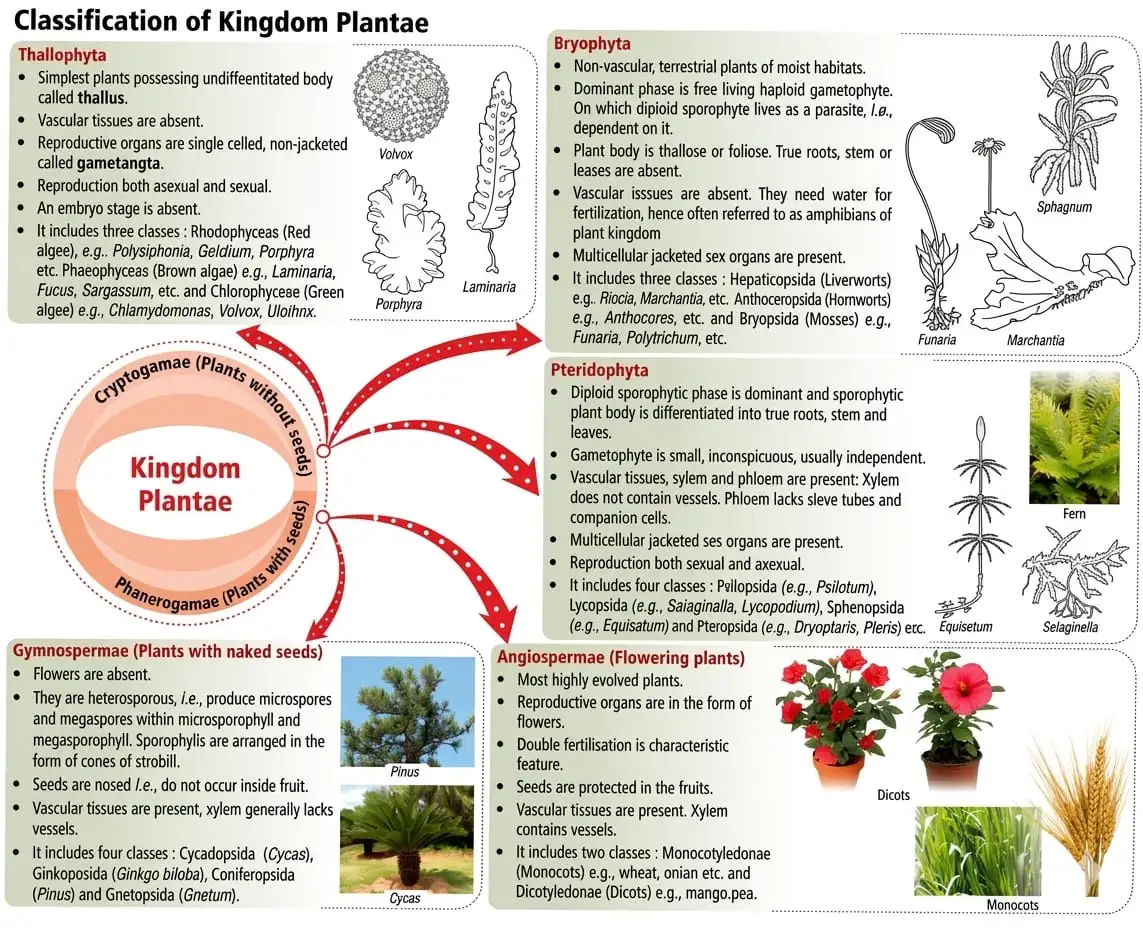
Algae: General Characteristics
Algae — Simple, chlorophyll-bearing, autotrophic organisms with a thalloid body; most live in freshwater or marine habitats.
Habitats and body forms
- Habitats: Algae also grow on moist stones, soil and wood; some live symbiotically with fungi in lichens or are associated with animals.
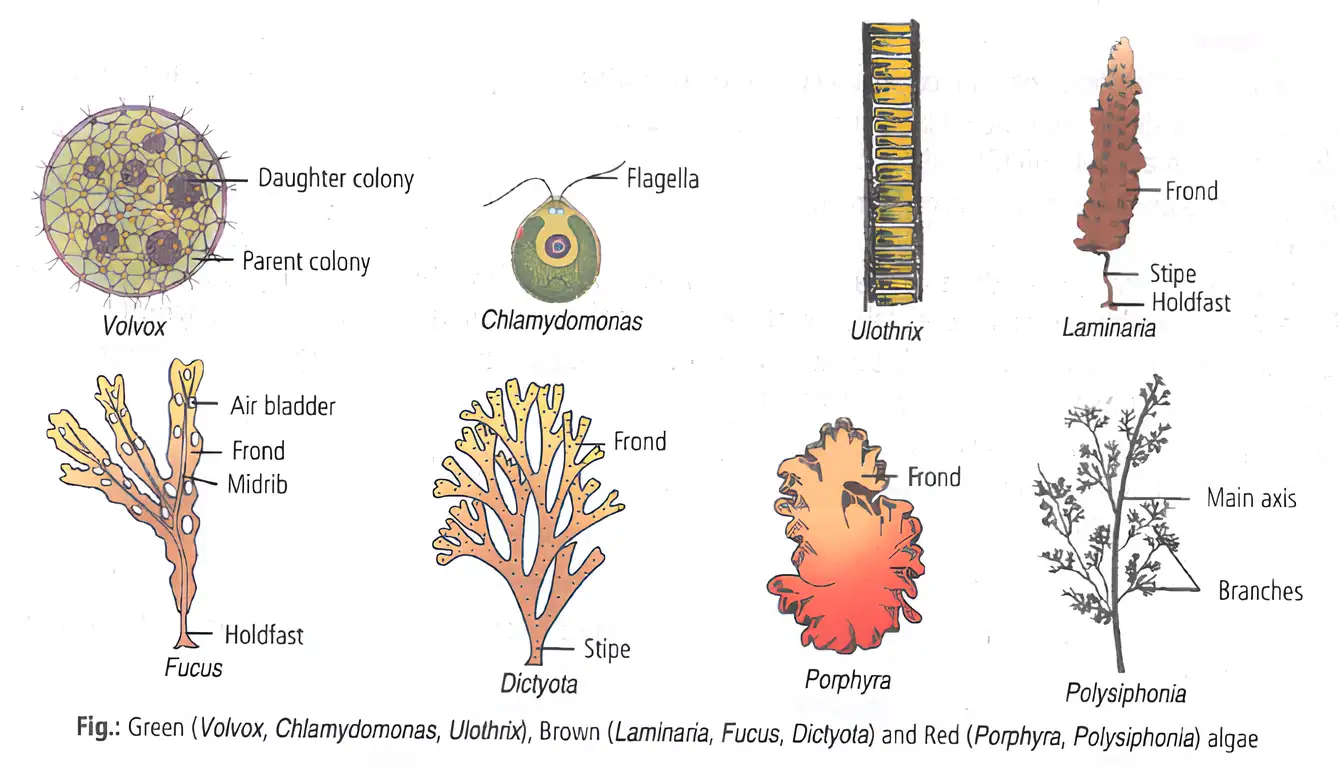
- Body forms: Unicellular (Chlamydomonas, Chlorella), colonial (Volvox) or filamentous (Ulothrix, Spirogyra). Chlamydomonas is motile; Chlorella and Spirulina are non-motile.
- Large forms: Some marine brown algae, called kelps or trees of the sea, develop massive thalli.
- Thallus: The algal vegetative body is not differentiated into true roots, stems and leaves.
- Cell wall: Generally has an inner cellulose layer and an outer pectin layer.
| Type | Habitat | Example / note |
|---|---|---|
| Halophytic | Saline seas and salt lakes | Chlamydomonas ehrenbergii; Stephnoptera |
| Epiphytic | On larger algae, bryophytes or angiosperms | Oedogonium and Microspora can grow attached to larger algae |
| Epizoic | On animal surfaces | Cladophora crispata on snail shells |
| Endozoic | Within animal tissues or bodies | Zoochlorella in freshwater protozoans and invertebrates |
| Parasitic | On plants or animals | Cephaleuros virescens causes red rust in tea and coffee |
| Thermophytic | Hot springs, about 50–70°C | Oscillatoria brevis; high-temperature survival is attributed to the absence of a well-organised nucleus |
Pigments and stored food
- Common pigment: Chlorophyll a occurs in all major algal groups; accessory pigments vary among groups.
- Accessory pigments: Chlorophylls b, c and d, carotenes, xanthophylls and phycobilins.
- Carotenoids: Carotenes are orange and xanthophylls are yellow. Phycobilins include phycocyanins and phycoerythrins.
- Reserve food: Algae may store starch, laminarin, mannitol or floridean starch; the main reserve differs by class.
| Mode | How it occurs |
|---|---|
| Vegetative | Fragmentation; each fragment can grow into a new thallus. |
| Asexual | Spores are produced; motile, flagellated zoospores are common and germinate into new plants. |
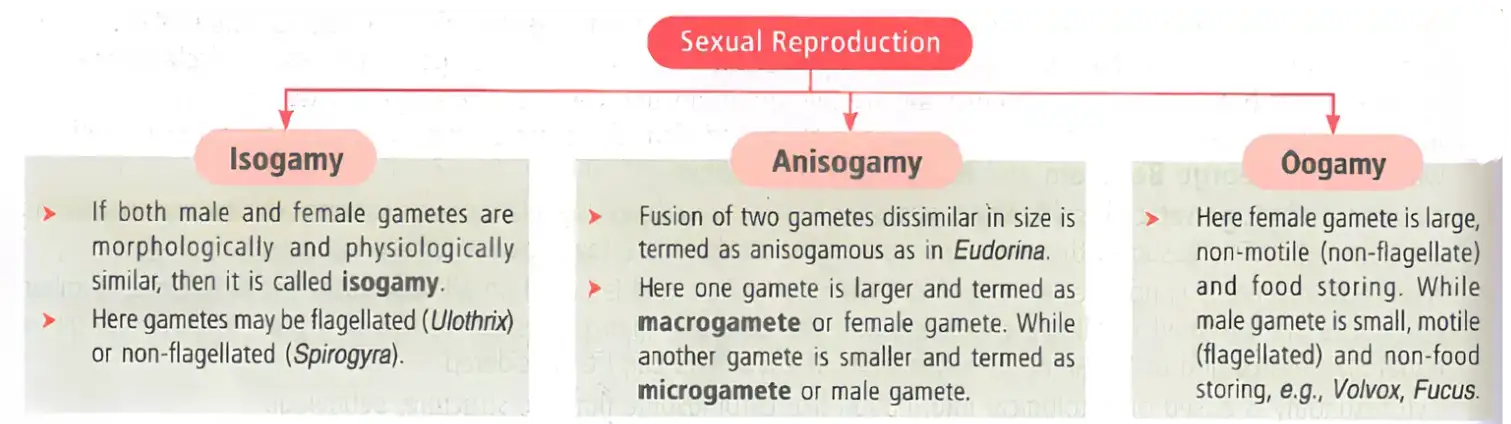
| Sexual | Fusion of two gametes; may be isogamous, anisogamous or oogamous. |
| Type | Gametes |
|---|---|
| Isogamy | Gametes are similar in form and size. |
| Anisogamy | Gametes differ in size or form. |
| Oogamy | A large, non-motile egg fuses with a smaller male gamete. |
Classification of Algae
- F. E. Fritsch: Classified algae using phylogeny, affinities and interrelationships.
- Whittaker’s system: Groups algae mainly into Chlorophyceae (green), Phaeophyceae (brown) and Rhodophyceae (red).
Chlorophyceae (Green Algae)
- Forms and habitat: Unicellular, colonial, coenobial, filamentous or siphonaceous; mostly freshwater, with some marine and terrestrial representatives.
- Pigments: Chlorophylls a and b, with carotenes and xanthophylls; pigments are located in chloroplasts.
- Chloroplasts: May be discoid, plate-like, reticulate, cup-shaped, spiral or ribbon-shaped.
- Pyrenoids: Chloroplast storage bodies containing protein as well as starch; some green algae also store oil droplets.
- Cell wall: Rigid, with an inner cellulose layer and outer pectose layer; motile cells have 2–4 equal flagella.
- Reproduction: Vegetative fragmentation or spores; asexual reproduction commonly uses flagellated zoospores formed in zoosporangia. Sexual reproduction may be isogamous, anisogamous or oogamous.
- Examples: Spirogyra and Ulothrix.
Phaeophyceae (Brown Algae)
- Habitat and size: Mostly marine, ranging from branched filaments such as Ectocarpus to large kelps; some kelps may reach about 100 m.
- Pigments: Chlorophylls a and c, carotenoids and xanthophylls; fucoxanthin gives the characteristic brown colour.
- Body structure: Commonly differentiated into a holdfast (attachment), stipe (stalk) and frond (leaf-like photosynthetic part).
- Cell wall and reserves: Wall contains cellulose, alginic and fucinic acids; food is stored mainly as laminarin and mannitol.
- Reproduction: Vegetative fragmentation; asexual pear-shaped zoospores have two unequal, laterally attached flagella. Sexual reproduction may be isogamous, anisogamous or oogamous.
- Gametes: Usually pear-shaped with two laterally attached flagella; fusion may occur in water or within the oogonium.
- Examples: Ectocarpus, Fucus, Sargassum, Laminaria and Macrocystis.
Rhodophyceae (Red Algae)
- Pigments: Red colour is mainly due to the accessory pigment r-phycoerythrin; chlorophylls a and d, phycocyanins, allophycocyanin and carotenoids are also present.
- Habitat: Found in well-lit surface waters and at great ocean depths, where little light penetrates.
- Body forms: May be unicellular, filamentous or pseudoparenchymatous; most red algal thalli are multicellular and some have complex organisation.
- Cell wall and pyrenoids: Cell wall is cellulosic and pectic; pyrenoids may be simple or compound and sometimes stalked.
- Reserve food: Floridean starch, similar in structure to glycogen and amylopectin.
- Reproduction: Vegetative fragmentation and non-motile asexual spores; sexual reproduction is oogamous with non-motile gametes and complex post-fertilisation development.
- Examples: Polysiphonia, Porphyra, Gelidium and Gracilaria.
| Feature | Chlorophyceae | Phaeophyceae | Rhodophyceae |
|---|---|---|---|
| Common name | Green algae | Brown algae | Red algae |
| Typical habitat | Mostly freshwater; some marine and terrestrial | Mostly marine | Marine; from surface waters to great depths |
| Forms and structure | Unicellular, colonial, coenobial, filamentous or siphonaceous | Branched, filamentous or parenchymatous; often differentiated into holdfast, stipe and frond | Unicellular, filamentous or pseudoparenchymatous; pyrenoids simple or compound, sometimes stalked |
| Major pigments | Chlorophylls a and b; carotenes and xanthophylls | Chlorophylls a and c; fucoxanthin and other carotenoids | Chlorophylls a and d; phycoerythrin, phycocyanins, allophycocyanin and carotenoids |
| Cell wall | Cellulose and pectose | Cellulose, alginic and fucinic acids | Cellulose and pectin |
| Reserve food | True starch and sugars; sometimes oil | Laminarin and mannitol | Floridean starch |
| Asexual reproduction | Flagellated zoospores | Biflagellate zoospores | Non-motile spores |
| Sexual reproduction | Isogamous to oogamous | Isogamous, anisogamous or oogamous | Oogamous; gametes are non-motile |
| Examples | Spirogyra, Ulothrix | Fucus, Sargassum | Polysiphonia, Porphyra |
Economic Importance and Key Facts
| Use / product | Source | Importance |
|---|---|---|
| Food | Porphyra, Laminaria, Sargassum | Used as food; Chlorella is protein-rich and used as a food supplement. |
| Photosynthesis | Algae generally | Carry out nearly 50% of Earth's total photosynthesis and support respiration in aquatic ecosystems. |
| Alginic acid | Brown algae such as Laminaria, Macrocystis and Fucus | Phycocolloid used to stabilise emulsions and in flameproof plastics and security glass. |
| Agar-agar | Red algae such as Gelidium and Gracilaria | Used as a solidifying agent in culture media. |
| Carrageen | Red alga Chondrus crispus | Used as a pharmaceutical emulsifier and in cleaning, textile, leather and brewing industries. |
| Medicinal substances | Corallina | Capable of curing worm infections. |
| Medicinal substances | Brown algae Laminaria and Ascophyllum | Have antibiotic properties. |
| Medicinal substances | Brown alga Durvillea | Has vermifuge properties. |
| Medicinal substances | Green algae Chlorella and Caulerpa | Antibiotics are extracted from these algae. |
| Sewage disposal | Green algae such as Chlamydomonas, Chlorella and Scenedesmus | Used in oxidation tanks; they provide aerobic conditions for decomposers. |
- Phycology
- The study of algae.
- Non-embryophytes
- Algae do not form an embryo; their sex organs are unicellular and lack a jacket.
- Fucosan vesicles
- Refractile vesicles in some brown-algal cells containing the phenolic chemical fucosan.
- Pond silk
- Common name for Spirogyra; its mucilage-covered filaments shine like silk.
- Frog spawn alga
- Common name for the freshwater filamentous red alga Batrachospermum.
- Devil's Apron
- Common name applied to some Laminaria species; Macrocystis pyrifera is the largest alga.
Compare the reserve food and major pigments of the three algal classes.
State the main methods of algal reproduction.
Name important algal phycocolloids and state their sources and uses.
Quick recap
- Algae are chlorophyll-bearing, autotrophic thalloid organisms with diverse habitats and body forms.
- Algal reproduction is vegetative by fragmentation, asexual by spores and sexual by gamete fusion.
- Chlorophyceae are green algae, Phaeophyceae are brown algae and Rhodophyceae are red algae.
- Main reserves: starch in green algae, laminarin and mannitol in brown algae, and floridean starch in red algae.
- Algae contribute nearly 50% of Earth's photosynthesis and provide food, useful phycocolloids, medicines and support for sewage treatment.
- Phycology is the study of algae; Spirogyra is called pond silk and Batrachospermum is called frog spawn alga.
Bryophytes
General Characteristics
Sexual Reproduction and Life Cycle
- Antheridium: Multicellular male sex organ that produces biflagellate antherozoids.
- Archegonium: Multicellular, flask-shaped female sex organ that produces one egg.
- Fertilisation: Antherozoids reach the archegonium through water; fusion with the egg forms a zygote.
- Sporophyte formation: The zygote does not undergo meiosis immediately; it develops into a multicellular sporophyte attached to the gametophyte.
- Spore formation: Meiosis in sporophyte cells produces haploid spores, which germinate into gametophytes.
Bryophyte Life Cycle
- Haploid gametophyte produces antheridia and archegonia
- Water enables antherozoid to reach egg; fertilisation forms diploid zygote
- Zygote develops into attached sporophyte
- Meiosis in sporophyte produces haploid spores
- Spores germinate and grow into gametophytes
Types of Bryophytes
- Main groups: Bryophytes are broadly classified into liverworts and mosses.
Liverworts
Liverwort Reproduction
- Asexual reproduction: Thalli reproduce by fragmentation or by gemmae.
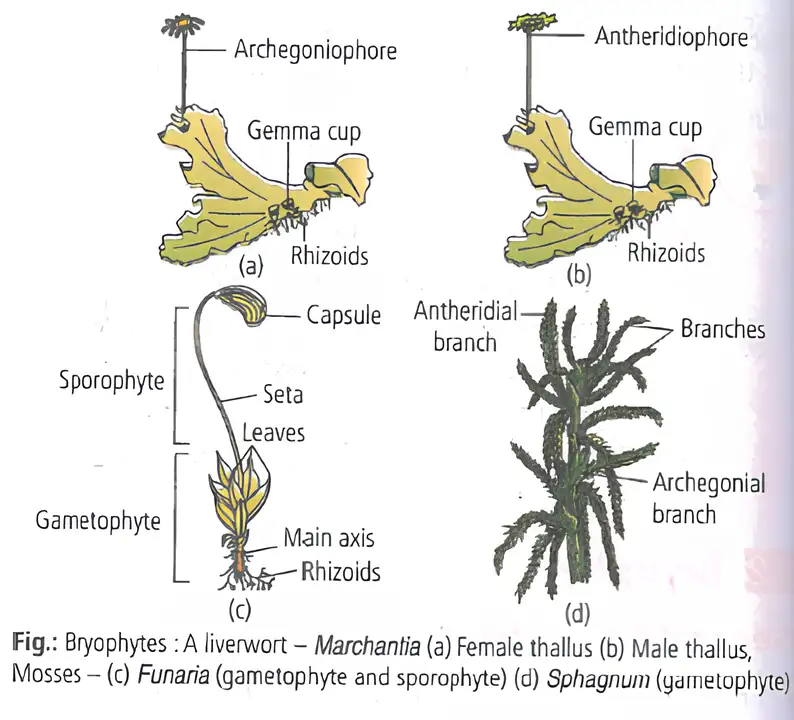
- Gemmae: Green, multicellular asexual buds formed in gemma cups on the thallus; detached gemmae germinate into new individuals.
- Sexual reproduction: Male and female sex organs may occur on the same thallus or on separate thalli.
- Sporophyte: Differentiated into foot, seta and capsule; meiosis in the capsule produces spores that germinate into free-living gametophytes.
- Examples: *Riccia* and *Marchantia*.
Mosses
Moss Reproduction and Examples
- Sex organs: Antheridia and archegonia occur at the tips of leafy shoots.
- Sporophyte: After fertilisation, the zygote develops into a sporophyte with foot, seta and capsule.
- Spores: Meiosis in the capsule produces spores.
- Examples: *Funaria*, *Polytrichum* and *Sphagnum*.
Economic and Ecological Importance
Names and Study
- Bryology: The study of bryophytes.
- Dawsonia: The tallest bryophytes may reach about 70 cm in length; *Dawsonia* is an example.
- Polytrichum: Also called hair-cap moss.
- Sphagnum: Also called famine food.
Why are bryophytes called the amphibians of the plant kingdom?
Name the two gametophyte stages in mosses and state how they arise.
How does peat form, and mention two uses.
Quick recap
- Bryophytes are non-vascular land plants that need water for sexual reproduction.
- The haploid gametophyte is the main plant body; the sporophyte remains attached and nourished by it.
- Antherozoid and egg fuse to form a zygote; meiosis in the sporophyte produces haploid spores.
- Liverworts reproduce asexually by fragmentation or gemmae; examples include *Riccia* and *Marchantia*.
- Moss gametophytes develop through protonema and leafy stages; examples include *Funaria*, *Polytrichum* and *Sphagnum*.
- *Sphagnum* is important for water retention and peat formation; moss mats also help prevent erosion and support succession.
Pteridophytes
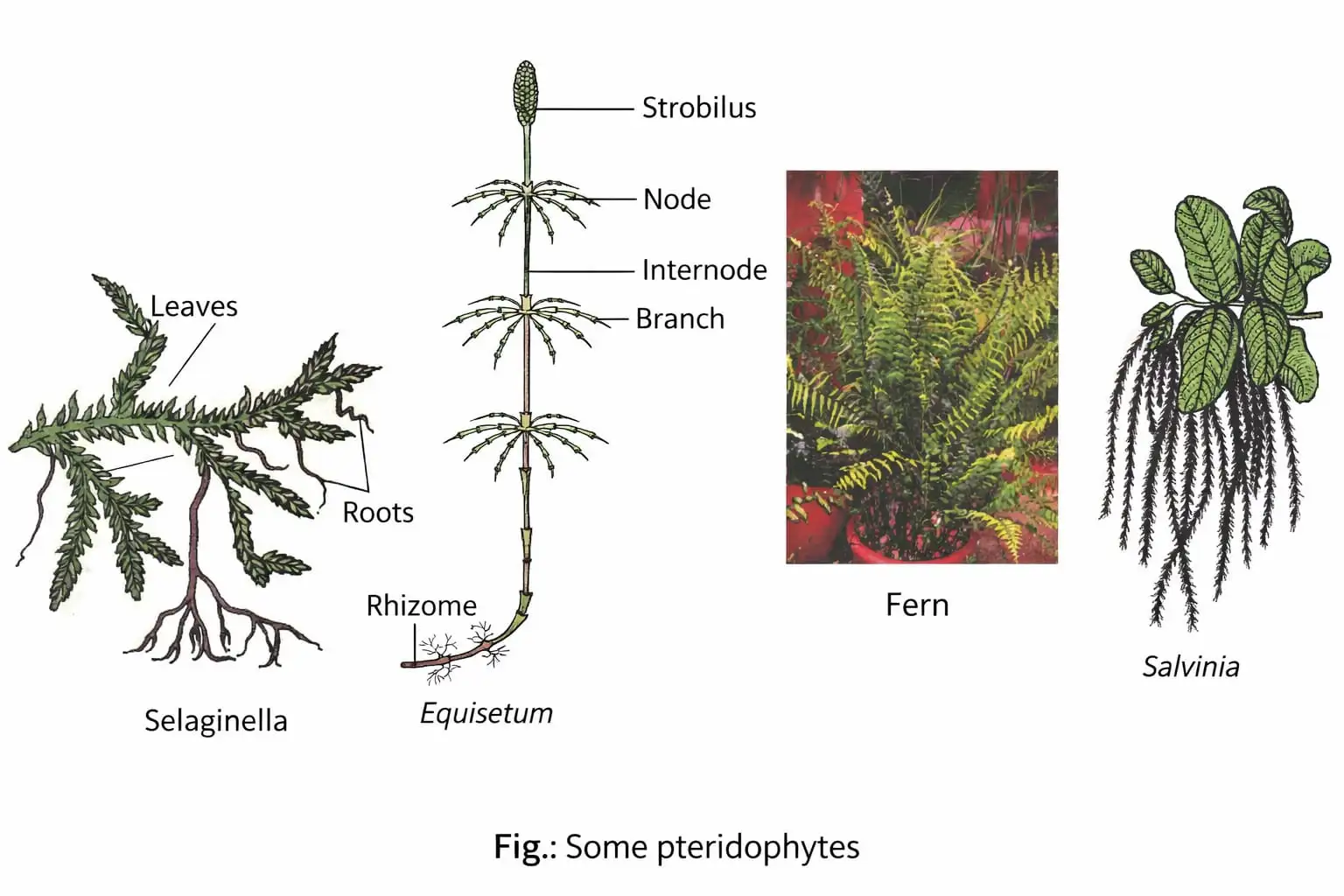
General Characteristics
Life Cycle and Fertilisation
- Sporophyte sporangia → meiosis → spores
- Spores → germination → free-living prothalli
- Prothalli form antheridia and archegonia → water enables antherozoid transfer
- Male gamete + egg → zygote → dominant sporophyte
Habitat and Reproduction
- Gametophyte conditions: Prothalli need cool, damp, shady places, and fertilisation also requires water.
- Distribution: These restricted requirements limit pteridophyte spread to narrow geographical regions.
- Antherozoids: Male gametes released from antheridia; water carries them to the archegonium.
- Dominant phase: The zygote develops into a well-differentiated sporophyte, which is the dominant phase.
| Type | Spores produced | Gametophyte development | Examples or significance |
|---|---|---|---|
| Homosporous | One kind of spore | Develop into bisexual gametophytes | Most pteridophytes |
| Heterosporous | Two kinds: large megaspores and small microspores | Megaspores form female gametophytes; microspores form male gametophytes. | Selaginella and Salvinia; an evolutionary step towards seed habit |
Heterospory and Seed Habit
- Retention: In heterosporous pteridophytes, female gametophytes remain on the parent sporophyte for a variable period.
- Embryo development: The zygote develops into a young embryo within the female gametophyte.
- Significance: This retention and embryo development are precursors to the seed habit, an important evolutionary step.
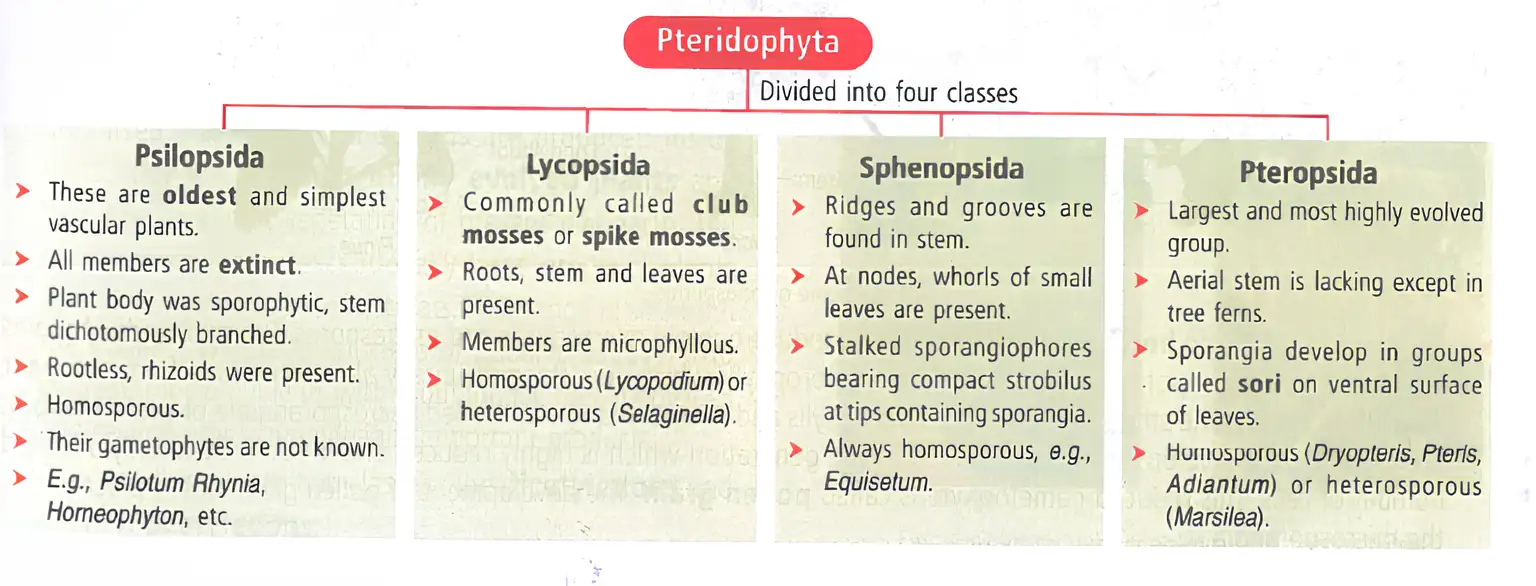
Classification of Pteridophytes
Economic Importance of Pteridophytes
| Use | Example or importance |
|---|---|
| Food | Pteridophytes provide food for animals; some tribals cook and eat Marsilea sporocarps. |
| Soil binding | They bind soil, including on hill slopes, and help prevent soil erosion. |
| Scouring and polishing | Equisetum stems are used to clean utensils and polish metals. |
| Biofertiliser | Azolla forms a symbiotic association with nitrogen-fixing cyanobacterium Anabaena azollae; it is used in paddy fields. |
| Medicines | Dryopteris rhizomes provide an antihelminthic drug. Equisetum is used to prepare diuretic, haemostatic and haemopoietic drugs. |
| Ornamental use | Ferns are grown for attractive foliage and used in bouquets and floral decorations. |
Term and Study
- 1866Haeckel proposed the term “Pteridophyta”.
- Pteridology
- The study of pteridophytes.
- Walking fern
- Adiantum; its leaf-tip can develop adventitious roots on touching soil and form a new plant.
- Rootless pteridophyte
- Salvinia, also called the “Sorrow of Kashmir”.
- Resurrection plants
- Some Selaginella species roll into brown balls in the dry season and turn green when water becomes available; examples include S. bryopteris (Sanjivani boot).
Other Notable Examples
- Size extremes: Alsophila is the tallest pteridophyte; Azolla, an aquatic fern, is the smallest.
- Selaginella: Also called club moss or spike moss; it may be trailing, hanging or erect and evergreen.
What is the evolutionary significance of heterospory in pteridophytes?
Why is the geographical spread of pteridophytes limited?
Quick recap
- Pteridophytes are seedless vascular plants with a dominant sporophyte and true roots, stems and leaves.
- Sporangia produce spores by meiosis; spores germinate into free-living prothalli.
- Water is needed for antherozoids to reach the archegonium and fertilise the egg.
- Most pteridophytes are homosporous; Selaginella and Salvinia are heterosporous.
- Retention of the female gametophyte and embryo development within it are precursors to seed habit.
- Pteridophytes have food, soil-binding, scouring, biofertiliser, medicinal and ornamental uses.
- Notable examples include Adiantum (walking fern), rootless Salvinia, and the size extremes Alsophila and Azolla.
Gymnosperms
General Characteristics
Gymnosperms — Seed plants whose ovules are not enclosed by an ovary wall; their seeds are therefore naked.
- Habit: Mostly medium-sized or tall trees and shrubs; Sequoia is among the tallest tree species.
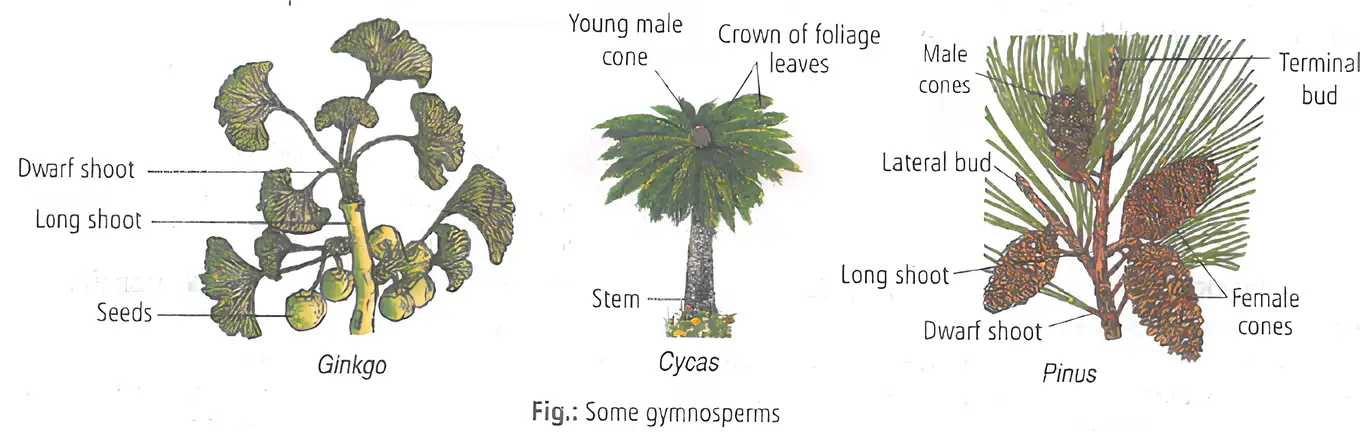
- Roots: Usually tap roots; Pinus has mycorrhizal roots, while Cycas has coralloid roots associated with nitrogen-fixing cyanobacteria.
- Stems: May be unbranched, as in Cycas, or branched, as in Pinus and Cedrus.
- Leaves: Simple or compound; Cycas has pinnate leaves that persist for several years.
- Adaptation: Leaves tolerate extremes of temperature, humidity and wind. Conifers have needle-like leaves, thick cuticles and sunken stomata that reduce water loss.
Reproduction and Life Cycle
Heterospory — The production of two kinds of haploid spores: microspores and megaspores.
- Spore-bearing structures: Spores form inside sporangia borne on sporophylls; spirally arranged sporophylls form compact cones, or strobili.
- Male strobili: Microsporophylls bear microsporangia; these cones are called microsporangiate strobili. Microspores develop inside the microsporangia into pollen grains, the highly reduced male gametophyte.
- Female strobili: Cones bearing megasporophylls with ovules (megasporangia) are called macrosporangiate strobili. Megasporophylls may cluster to form female cones.
- Ovule structure: The nucellus is protected by envelopes; together they form an ovule.
- Megaspore formation: A megaspore mother cell in the nucellus undergoes meiosis to form four megaspores; one develops into the multicellular female gametophyte.
- Female gametophyte: Retained within the megasporangium and bears two or more archegonia, the female sex organs.
- Cone arrangement: Male and female cones may occur on the same tree, as in Pinus. In Cycas, male cones and megasporophylls occur on different trees.
- Gametophyte dependence: Neither gametophyte is independently free-living; both remain within sporangia retained on the sporophyte.
Pollination to Seed Formation
- Pollen grains are released from microsporangia and carried by air to the opening of an ovule.
- A pollen tube grows towards an archegonium and releases the male gametes near its opening.
- Fertilisation forms a zygote, which develops into an embryo; the ovule develops into a seed.
| Group |
|---|
| Cycadopsida |
| Ginkgopsida |
| Coniferopsida |
| Gnetopsida |
Economic Importance
| Product or use | Source or application |
|---|---|
| Edible seeds | Seeds of Pinus gerardiana are eaten after roasting. |
| Timber | Used for light furniture, plywood and railway sleepers. |
| Paper | Wood of Picea, Pinus, Larix and Abies is used to manufacture paper. |
| Linoleum and plastics | Saw dust is used in their manufacture. |
| Ephedrine | Obtained from Ephedra and used to treat respiratory ailments. |
| Resin products | Resin is distilled to obtain turpentine and rosin. Rosin is used in waterproofing and writing paper; turpentine is a solvent in paints, polishes and wax. |
Other Exam-Relevant Features
- Habitat and adaptation: Gymnosperms commonly grow on cold mountain slopes and show xerophytic adaptations.
- Vascular tissues: All gymnosperms have xylem and phloem. Usually, xylem lacks vessels and phloem lacks companion cells.
- Xylem exceptions: Gnetum, Ephedra and Welwitschia have true vessels.
- Wood: Secondary growth makes stems woody. Gymnosperm wood is called softwood because vessels are generally absent.
- Endosperm: It forms before fertilisation and is therefore haploid.
- Common names: Ginkgo biloba is the maidenhair tree; Sequoia is the redwood tree.
- Cycas: The largest egg, sperm and ovule are found in Cycas.
Why are gymnosperm seeds called naked?
State the usual differences between gymnosperm xylem and phloem, and name the exceptions for xylem.
Quick recap
- Gymnosperm ovules are exposed, not enclosed by an ovary wall, so their seeds are naked.
- They are heterosporous; microspores form pollen, while one megaspore develops into the female gametophyte.
- Male cones are microsporangiate strobili; female cones are macrosporangiate strobili.
- Gametophytes remain dependent within sporangia on the sporophyte; air carries pollen to ovules for fertilisation.
- Living gymnosperms are grouped into Cycadopsida, Ginkgopsida, Coniferopsida and Gnetopsida.
- Gymnosperms provide timber, paper, resin products, edible seeds and ephedrine; their endosperm is haploid.
Angiosperms
Angiosperms — Seed plants whose sporophylls are organised into flowers and whose seeds develop inside fruits.
- Dominance and diversity: Angiosperms are the most highly evolved plants, dominate present-day vegetation and occur in a wide range of habitats.
- Size range: They include the tiny *Wolffia* and *Eucalyptus* trees over 100 metres tall.
- Uses: They provide food, fodder, fuel, medicines and many commercially important products.
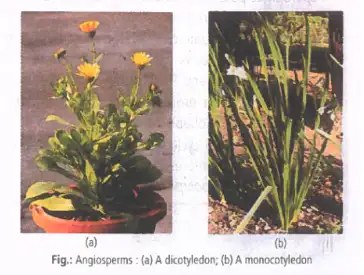
- Classes: Angiosperms are divided into dicotyledons and monocotyledons.
Plant Life Cycles and Alternation of Generations
Alternation of generations — The regular, sequential recurrence of phases through which a plant life cycle is completed.
- Types: Plant life cycles are haplontic, diplontic or haplodiplontic.
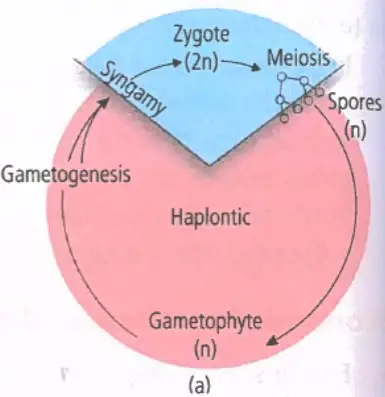
Haplontic Life Cycle
- Main plant: A single haploid somatic individual, usually the gametophyte, produces haploid gametes.
- Fertilisation: Gamete fusion forms a diploid zygote, which remains single-celled and does not develop into a multicellular diploid plant.
- Meiosis: It occurs when the zygote germinates, producing four haploid nuclei.
- Possible outcome 1: In some cases, three nuclei degenerate and the haploid protoplast of the zygote directly gives rise to a new plant.
- Possible outcome 2: In other cases, the zygote protoplast divides into four meiospores, which may divide further to form 8–16 spores.
- Generation pattern: There are no two cytologically distinct somatic phases; the sporophytic generation is represented only by the one-celled zygote.
- Examples: *Volvox*, *Spirogyra* and *Chlamydomonas*.
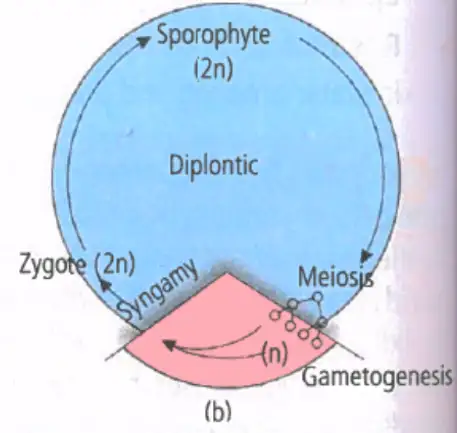
Diplontic Life Cycle
- Main plant: A single diploid somatic individual, the sporophyte, develops from the diploid zygote; it may also multiply vegetatively or produce accessory spores.
- Meiosis: It occurs in the plant body or sex organs during gamete formation.
- Haploid phase: Gametes are the only haploid structures in the typical cycle; seed plants follow this pattern with a few- to multicellular gametophytic phase.
- Fertilisation: Haploid gametes fuse to form a diploid zygote, which develops into the next diploid individual.
- Examples: *Fucus* and *Cladophora*; all seed plants—gymnosperms and angiosperms—follow this pattern with the noted variation.
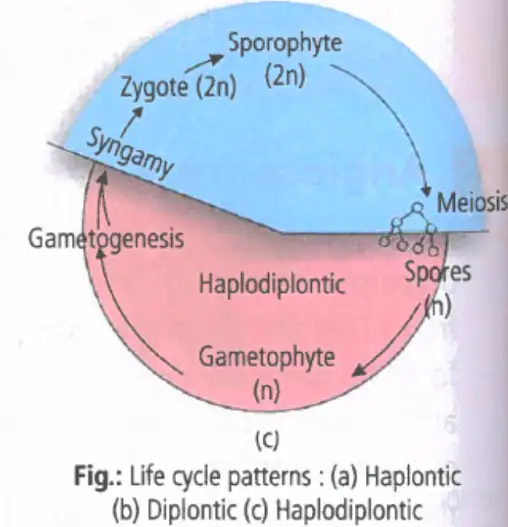
Haplodiplontic Life Cycle
- Two somatic phases: This cycle has two well-developed generations: a haploid gametophyte and a diploid sporophyte ().
- Sporophyte: Meiosis produces haploid meiospores, which germinate into haploid gametophytes.
- Gametophyte: It produces gametes; their fusion forms a diploid zygote that develops into the next sporophyte.
- Examples: Bryophytes, pteridophytes and the alga *Dictyota*; among algae, *Ectocarpus*, *Polysiphonia* and kelps are also haplodiplontic.
Quick recap
- Angiosperms are flowering seed plants with seeds enclosed inside fruits; they are divided into dicotyledons and monocotyledons.
- Alternation of generations is the regular sequence of phases in a plant life cycle.
- In haplontic cycles, the haploid gametophyte dominates and meiosis occurs as the zygote germinates.
- After haplontic zygote meiosis, three nuclei may degenerate and the protoplast may form a new plant; alternatively, it may produce meiospores.
- In diplontic cycles, the diploid sporophyte dominates and meiosis occurs during gamete formation; seed plants have a small gametophytic phase.
- In haplodiplontic cycles, meiosis in the diploid sporophyte produces spores that grow into a multicellular haploid gametophyte.
NEET Botany — ALL CHAPTERS
1
The Living World
2
Plant Kingdom
3
Morphology of Flowering Plants
4
Anatomy of Flowering Plants
5
The Unit of Life
6
Photosynthesis in Higher Plants
7
Respiration in Plants
8
Plant Growth and Development
9
Sexual Reproduction in Flowering Plants
10
Principles of Inheritance and Variation
11
Molecular Basis of Inheritance
12
Biotechnology :Principles and Processes
13
Biotechnology and its Applications