NEET UG . NEET Botany . Botany . Respiration in Plants
Chapter 7: Respiration in Plants
Ch 7
NEET Botany
NEET UG
Do Plants Breathe?
Why Living Organisms Need Respiration
Gas Exchange in Plants
- Gas exchange: Plants use oxygen for respiration and release carbon dioxide; stomata and lenticels allow gas exchange.
- No specialised organs: Unlike animals, plants have no specialised respiratory organs because each part largely meets its own gas-exchange needs.
- Low demand: Roots, stems and leaves respire at much lower rates than animals, so their gas-exchange requirements are modest.
- Photosynthesis: Large volumes of gases are exchanged during photosynthesis, and each leaf is adapted to meet its own needs. Oxygen released within photosynthesising cells is available there for respiration.
- Short diffusion distance: Living cells lie close to the plant surface. Loosely packed parenchyma forms interconnected air spaces that aid gas diffusion.
- Limited internal transport: There is little movement of gases from one plant part to another; each part exchanges gases locally.
Oxygen Availability and Energy Release
Aerobic respiration — The complete oxidation of glucose using oxygen produces carbon dioxide and water, with much of the released energy given out as heat.
- Oxygen requirement: Complete combustion of glucose requires oxygen and produces carbon dioxide and water; much of its energy is released as heat.
- Anaerobic respiration: When oxygen is unavailable, some organisms respire anaerobically.
- Facultative anaerobes: These organisms can respire anaerobically when oxygen is unavailable.
- Obligate anaerobes: These organisms depend on anaerobic conditions.
- Stepwise oxidation: Plant cells break down glucose through several small steps rather than one rapid reaction; some steps release energy that can be coupled to ATP synthesis.
- Respiration products: In the process described, oxygen is used and carbon dioxide, water and energy are released.
Why do plants not need specialised respiratory organs?
How is energy released during cellular respiration made available to cells?
Quick recap
- Cellular respiration is the enzyme-controlled, stepwise oxidation of food in living cells; it provides energy for life processes.
- Plants are autotrophic; animals are heterotrophic, obtaining food directly or indirectly from plants.
- Carbohydrates are usual respiratory substrates; proteins, fats and organic acids may also be used.
- Respiration releases energy stepwise, with some of it trapped as ATP.
- Plants exchange gases through stomata and lenticels, without specialised respiratory organs.
- Local gas exchange, low respiratory demand, short diffusion distances and air spaces help plants meet gas needs.
- Complete glucose oxidation uses oxygen and produces carbon dioxide and water; some organisms respire anaerobically when oxygen is unavailable.
Glycolysis
Overview and Starting Material
- Glycolysis: A universal pathway in the cytoplasm in which one glucose molecule is partially oxidised to form two pyruvate molecules.
- Starting material: In plants, glucose comes from sucrose or stored carbohydrates; invertase splits sucrose into glucose and fructose, which enter glycolysis.
Energy Yield and Key Control Step
- Energy yield: Glycolysis uses 2 ATP and produces 4 ATP, giving a net gain of 2 ATP and 2 NADH per glucose; the notes count the NADH yield as an additional 6 ATP.
- Rate-limiting step: Phosphofructokinase catalyses the irreversible phosphorylation of fructose-6-phosphate to fructose-1,6-bisphosphate.
Fate of Pyruvate and Use of Intermediates
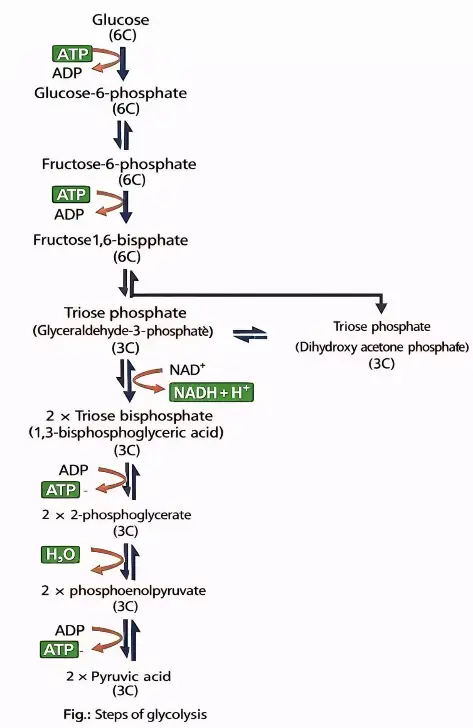
Do not confuse the four ATP produced with the net ATP gain: two ATP are first used, so direct net gain is two ATP; the lecture’s total of eight also includes the ATP equivalent of NADH.
Quick recap
- Glycolysis is the cytoplasmic EMP pathway: one glucose produces two pyruvate.
- Plant glucose can come from sucrose, which invertase splits into glucose and fructose, or from stored carbohydrates.
- Phosphofructokinase catalyses the irreversible, rate-limiting step; ATP and fructose-6-phosphate control it.
- Per glucose, glycolysis uses two ATP, produces four ATP and forms two NADH.
- The lecture’s total ATP yield is eight when each NADH is counted as three ATP.
- Pyruvate can enter fermentation or aerobic respiration; pathway intermediates also support biosynthesis.
Fermentation
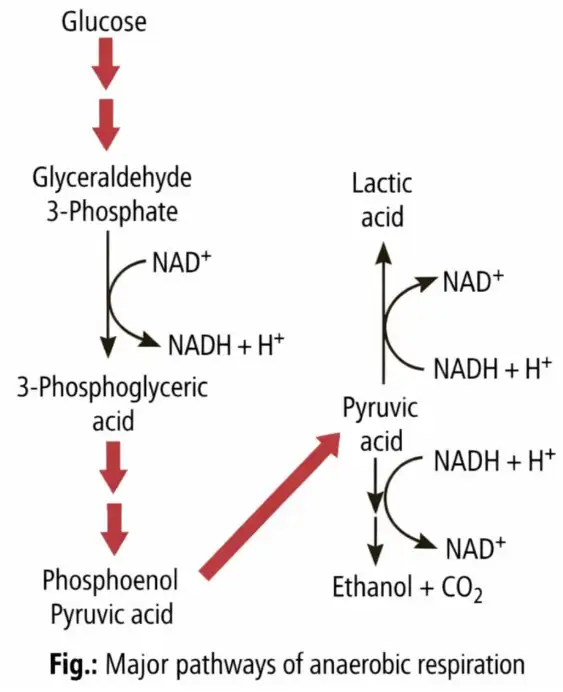
Meaning and Pathways of Fermentation
| Point | Alcoholic fermentation | Lactic acid fermentation |
|---|---|---|
| Main products | Ethanol and CO₂ | Lactic acid |
| Where it occurs | Yeast | Some bacteria and animal muscle cells when oxygen is inadequate |
| Key enzyme(s) | Pyruvic acid decarboxylase and alcohol dehydrogenase | Lactate dehydrogenase |
| NADH | Used in the conversion to ethanol and reoxidised to NAD⁺ | Used to reduce pyruvic acid and reoxidised to NAD⁺ |
Energy Yield and Limitations
- Energy release: Fermentation releases less than 7% of the energy in glucose, and only part of that energy is trapped in ATP.
- Limitations: Fermentation produces potentially harmful acid or alcohol; yeast dies when alcohol concentration reaches about 13%.
Uses and Occurrence
What are the products and key enzymes of alcoholic fermentation in yeast?
What happens to pyruvic acid in animal muscle cells when oxygen is inadequate?
State two limitations of fermentation.
Quick recap
- Fermentation incompletely oxidises glucose without oxygen.
- Yeast produces ethanol and CO₂; some bacteria and oxygen-starved muscles produce lactic acid.
- NADH + H⁺ acts as the reducing agent and is reoxidised to NAD⁺.
- Less than 7% of glucose energy is released, and not all is captured in ATP.
- Yeast can poison itself when alcohol reaches about 13%.
- Saccharomyces cerevisiae is used in brewing; fermentation can also occur in germinating barley.
Aerobic Respiration
Overview and Pyruvate Oxidation
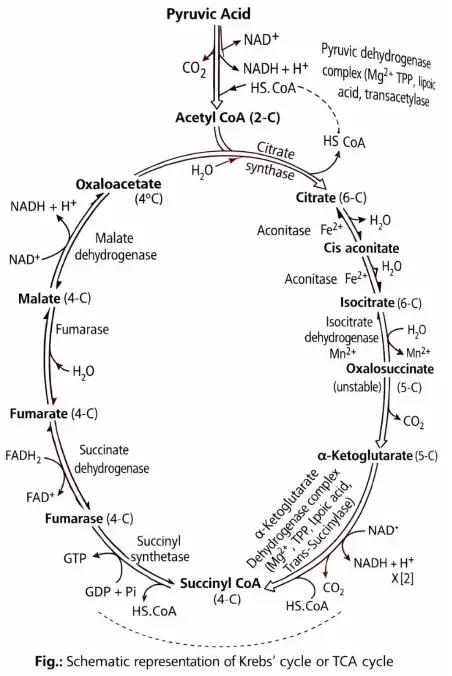
Pyruvate oxidation (link reaction) — In the mitochondrial matrix, pyruvate is oxidatively decarboxylated and joined to coenzyme A to form acetyl-CoA.
Krebs’ Cycle
| Conversion | Enzyme / cofactor | Key outcome |
|---|---|---|
| Acetyl-CoA + oxaloacetate → citrate | Citrate synthase | Condensation; citrate is the first product |
| Citrate ⇌ cis-aconitate ⇌ isocitrate | Aconitase | Dehydration followed by hydration |
| Isocitrate → oxalosuccinate | Isocitrate dehydrogenase; | produced |
| Oxalosuccinate → α-ketoglutarate | Decarboxylase | One released |
| α-Ketoglutarate → succinyl-CoA | α-Ketoglutarate dehydrogenase complex; and CoA | Oxidation and decarboxylation; and produced |
| Succinyl-CoA → succinate | Succinyl synthetase; GDP and inorganic phosphate | GTP formed; ATP can then be made from ADP |
| Succinate → fumarate | Succinate dehydrogenase | Dehydrogenation; produced |
| Fumarate → malate | Fumarase | Water is added |
| Malate → oxaloacetate | Malate dehydrogenase; | produced; oxaloacetate is regenerated |
Yield, role and location
- Per pyruvate, including the link reaction: The phase summary gives , , and .
- Per glucose: Two pyruvate molecules yield , , and in this phase.
- Amphibolic role: The cycle supports both catabolism and anabolism; intermediates can be used to synthesise compounds such as glutamic acid and aspartic acid.
- Enzyme location: TCA-cycle enzymes are in the matrix except succinate dehydrogenase, which is located in the inner mitochondrial membrane.
- Name and date: Hans Adolf Krebs proposed the cycle in 1937.
Electron Transport Chain
Electron flow and proton gradient
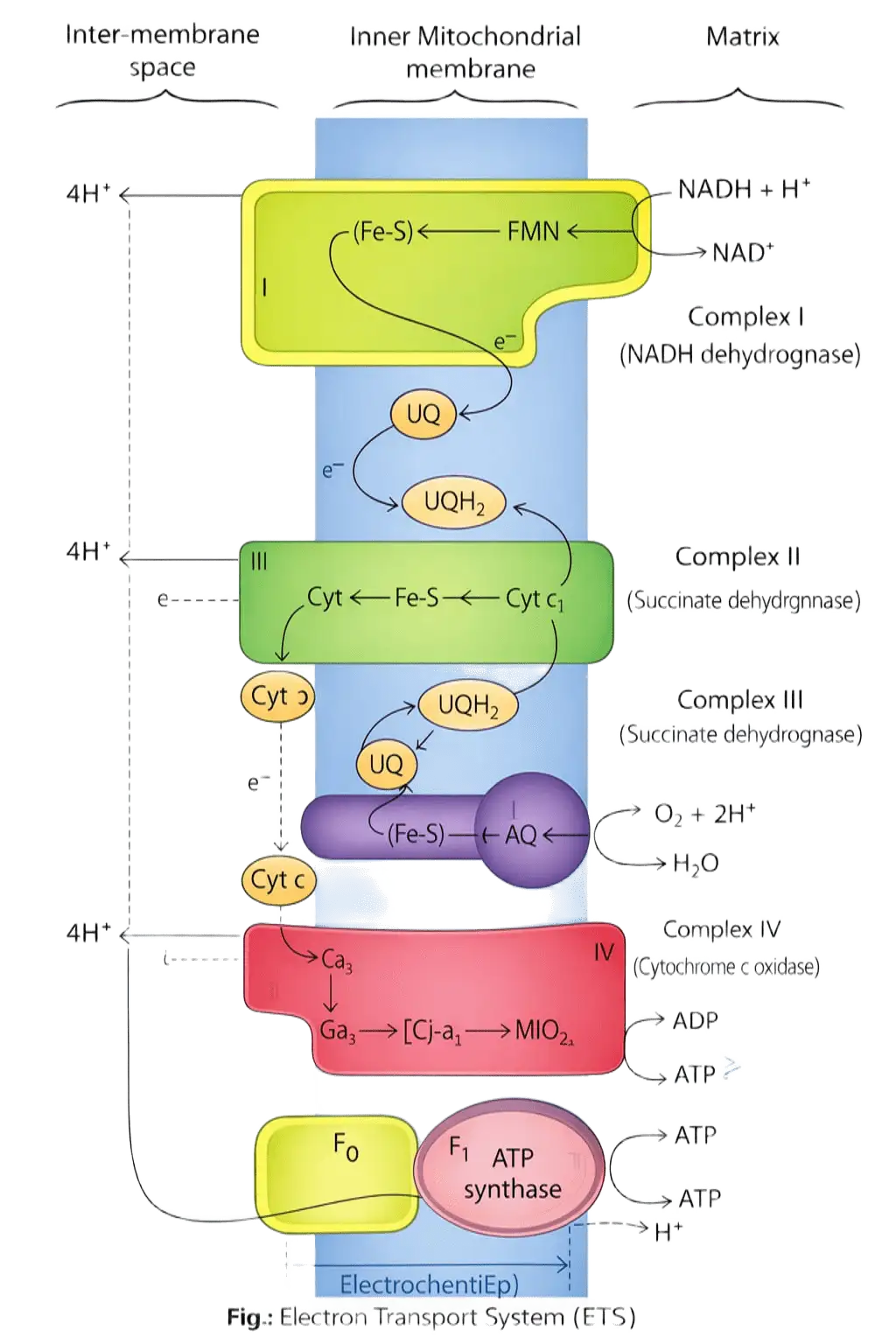
- enters at complex I; enters at complex II.
- Electrons pass to ubiquinone → complex III → cytochrome → complex IV.
- Oxygen accepts electrons at the terminal stage and combines with hydrogen to form water.
- Energy released during electron transfer drives proton pumping from the matrix to the intermembrane space.
- The difference in concentration and charge across the inner membrane forms the proton motive force.
Oxygen, ATP yield and inhibitors
- Oxygen’s role: Oxygen is vital as the final electron and hydrogen acceptor; it removes hydrogen from the system and forms water, enabling electron transport to proceed.
- ATP yield stated in this lecture: Oxidation of one gives 3 ATP; oxidation of one gives 2 ATP.
- Cyanide: Blocks electron transfer from cytochrome to oxygen.
- Antimycin: Blocks electron transport between cytochrome and cytochrome .
- 2,4-Dinitrophenol: Allows electron transport but prevents ATP synthesis.
Oxidative Phosphorylation
| Point | Oxidative phosphorylation | Photophosphorylation |
|---|---|---|
| Energy source | Energy released by oxidation of and | Light energy |
| Proton gradient | Generated through electron transport in mitochondria | Generated using light-driven processes |
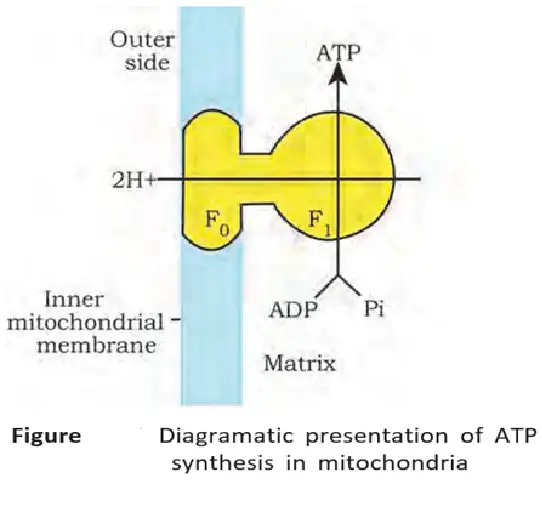
Why is the Krebs cycle called amphibolic?
What is the role of oxygen in aerobic respiration?
How does ATP synthase use the proton gradient to form ATP?
Quick recap
- Aerobic respiration completely oxidises organic substrates using oxygen and releases , water and energy.
- Pyruvate oxidation links glycolysis to the Krebs cycle by producing acetyl-CoA, and .
- The Krebs cycle regenerates oxaloacetate and produces reduced coenzymes, ATP/GTP and .
- The ETS transfers electrons from and to oxygen and builds a proton gradient across the inner mitochondrial membrane.
- ATP synthase uses proton flow through to power ATP formation at .
- Oxygen is the terminal acceptor; cyanide, antimycin and 2,4-dinitrophenol disrupt different parts of respiration.
The Respiratory Balance Sheet
Theoretical ATP Accounting
Respiratory balance sheet — An accounting of the theoretical net ATP yield from the aerobic oxidation of one glucose molecule.
Assumptions behind the estimate
- Orderly sequence: Glycolysis, the TCA cycle and the ETS operate one after another, with each product becoming the next pathway’s substrate.
- Glycolytic NADH: NADH formed during glycolysis enters mitochondria and undergoes oxidative phosphorylation.
- No diversion: Pathway intermediates are not used to make other compounds.
- Glucose only: No alternative respiratory substrates enter the pathway.
Why the estimate is theoretical
- Living cells: Pathways operate simultaneously rather than as isolated, strictly sequential steps.
- Flexible flow: Substrates enter pathways and intermediates are withdrawn when needed.
- Regulation: ATP use and enzyme rates change according to cellular requirements.
| Respiration stage | ATP source | ATP produced |
|---|---|---|
| Glycolysis | Direct synthesis | 2 |
| Glycolysis | 2 NADH; 1 NADH = 3 ATP | 6 |
| Pyruvic acid → Acetyl-CoA | 2 NADH | 6 |
| Citric acid cycle (Krebs cycle) | 6 NADH | 18 |
| Citric acid cycle (Krebs cycle) | 2 FADH₂; 1 FADH₂ = 2 ATP | 4 |
| Citric acid cycle (Krebs cycle) | Direct synthesis | 2 |
| Total | 38 ATP |
The estimated net gain from aerobic respiration of one glucose molecule.
Fermentation vs Aerobic Respiration
| Point | Fermentation | Aerobic respiration |
|---|---|---|
| Glucose breakdown | Partial; glucose is degraded to pyruvic acid. | Complete; glucose is ultimately degraded to CO₂ and H₂O. |
| Net ATP per glucose | 2 ATP | Theoretical estimate: 38 ATP. |
| NADH reoxidation | NADH is oxidised to NAD⁺ relatively slowly. | NADH reoxidation is vigorous. |
State the theoretical ATP yield from one glucose molecule during aerobic respiration.
Why is the respiratory balance sheet only a theoretical estimate?
Quick recap
- The respiratory balance sheet estimates ATP yield from one glucose molecule.
- Its calculation assumes orderly pathway sequence, mitochondrial use of glycolytic NADH, no intermediate diversion and glucose as the only substrate.
- These assumptions are not fully valid in living cells because pathways and metabolic demands are dynamic.
- The theoretical aerobic yield is 38 ATP per glucose.
- Fermentation yields 2 ATP and partially breaks down glucose; aerobic respiration completely degrades it to CO₂ and H₂O.
- NADH reoxidation is relatively slow in fermentation but vigorous in aerobic respiration.
Amphibolic Pathway
Entry of Respiratory Substrates
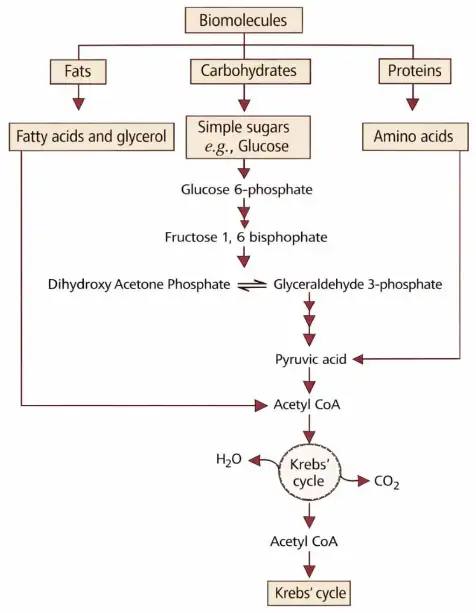
Why Respiration Is Amphibolic
Why is the respiratory pathway called amphibolic?
Quick recap
- Glucose is the favoured respiratory substrate; other carbohydrates usually become glucose first.
- Fatty acids enter as acetyl-CoA, while glycerol enters after conversion to PGAL.
- Deaminated amino acids enter at different points, including as Krebs-cycle intermediates, pyruvate or acetyl-CoA.
- Respiratory intermediates can be used for biosynthesis as well as breakdown.
- The respiratory pathway is amphibolic because it functions in both catabolism and anabolism.
Respiratory Quotient
Respiratory quotient (R.Q.) — The ratio of the volume of carbon dioxide released to the volume of oxygen consumed during respiration by a unit of tissue, organ or organism over a specific period.
Use the volumes of gases exchanged over the same period.
R.Q. for Different Respiratory Substrates
| R.Q. | Substrate or process | Example / significance |
|---|---|---|
| 1 | Carbohydrate; aerobic respiration | Equal volumes of CO₂ are released and O₂ consumed. |
| Less than 1 (about 0.7–0.9) | Fats or proteins; aerobic respiration | Typical during germination of seeds. |
| 0 | Carbohydrates converted to organic acids | O₂ is used without net CO₂ release; in succulents, produced CO₂ may be used in carbon fixation. |
| Greater than 1 | Organic acids used in aerobic respiration | More CO₂ is released than O₂ consumed. |
| Infinity | Carbohydrate; anaerobic respiration | CO₂ is released while no O₂ is consumed, as in alcoholic fermentation. |
The CO₂-to-O₂ ratio is 1.
The fat example gives an R.Q. of about 0.7.
The protein example gives an R.Q. of about 0.9.
The numerator is zero although oxygen is consumed.
The example gives an R.Q. of 4.
A positive CO₂ release divided by zero O₂ consumption gives an infinite R.Q.
Measurement of R.Q.
- Respirometer: An instrument used to measure the rate of respiration and R.Q.
- Mixed diet: Respiration using a mixture of carbohydrates, fats and proteins has an R.Q. of about 0.85.
Why is the R.Q. of fats less than 1?
When is R.Q. zero or infinite?
Quick recap
- R.Q. = volume of CO₂ liberated ÷ volume of O₂ consumed.
- Carbohydrate aerobic respiration has R.Q. = 1.
- Fat and protein aerobic respiration have R.Q. values below 1.
- R.Q. is zero when O₂ is used but CO₂ is not released.
- Organic acid respiration can have R.Q. greater than 1; oxalic acid gives 4.
- Anaerobic alcoholic fermentation has infinite R.Q.
- A mixed diet has an R.Q. of about 0.85; a respirometer measures R.Q. and respiration rate.
NEET Botany — ALL CHAPTERS
1
The Living World
2
Plant Kingdom
3
Morphology of Flowering Plants
4
Anatomy of Flowering Plants
5
The Unit of Life
6
Photosynthesis in Higher Plants
7
Respiration in Plants
8
Plant Growth and Development
9
Sexual Reproduction in Flowering Plants
10
Principles of Inheritance and Variation
11
Molecular Basis of Inheritance
12
Biotechnology :Principles and Processes
13
Biotechnology and its Applications